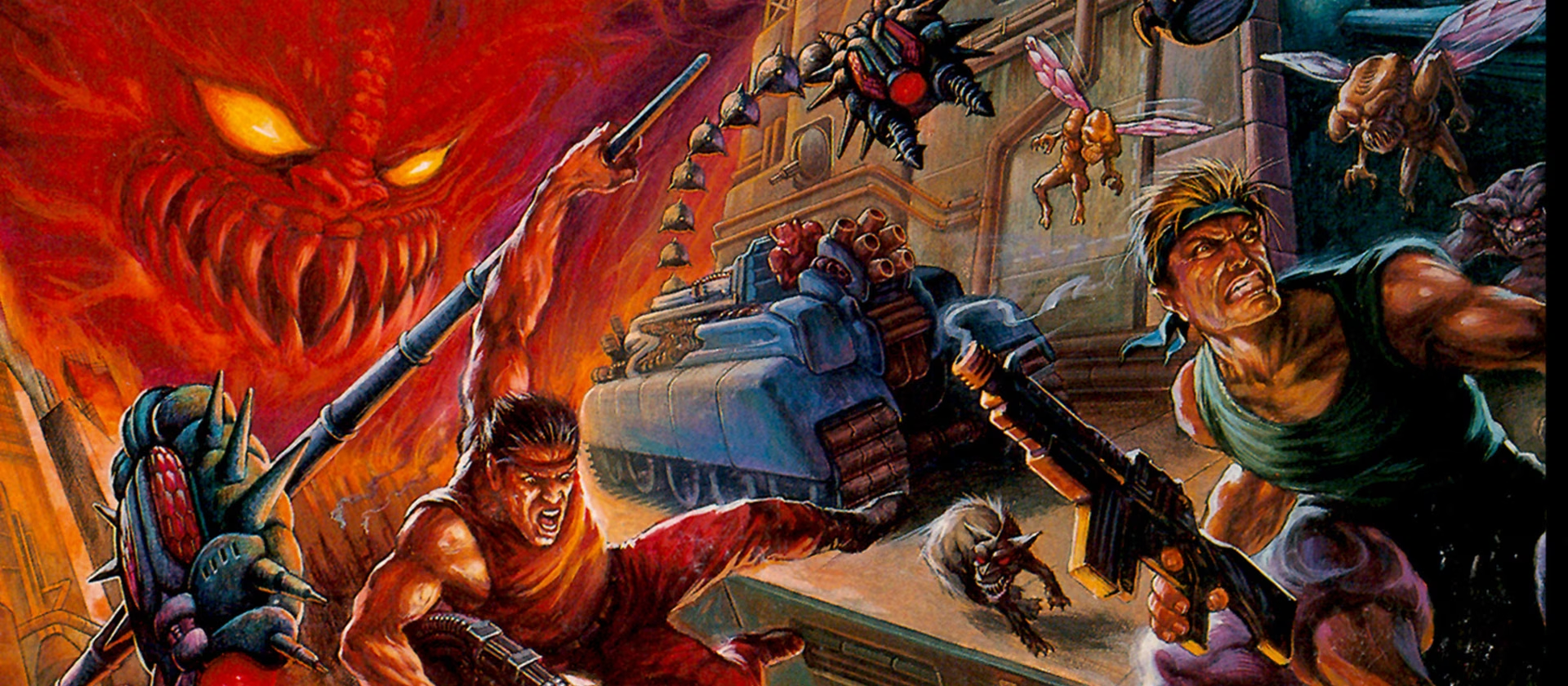
Two studios begin inside this cartridge, and only one of them is the one on the label. The credited director is Nobuya Nakazato, three years into Konami, making his debut at the wheel of an action game; the design rules he sets here — situation-rush pacing, comic-violence tone, multi-jointed boss spectacle — run through Hard Corps, Rocket Knight Adventures, Shattered Soldier, and 2024’s Operation Galuga. The other studio is Treasure. Two of Contra III’s programmers, Mitsuru Yaida and Hideyuki Suganami, were holding planning sessions in coffee shops while shipping this cart, and walked out of Konami before the year ended. The cartridge is the fork point.
What the period press saw was the showpiece. The Mode 7 overhead stages with their shoulder-button rotation, the rooftop opening with its swarming tank, the giant alien rising out of the floor — all of it called “arcade quality” by reviewers reaching for the highest compliment available. What they were responding to but couldn’t yet name was a first director’s design language being printed onto the franchise. The SNES boast was the salesman’s pitch. The interesting object was always inside.
Something Interesting Every Three Screens
Konami’s own History of Contra — the digital book bundled with the Anniversary Collection — credits Nakazato with a stopwatch design rule on his debut: a new threat every three screens of progress. Stage 1 is the rule made audible. Bill drops onto a rooftop, jogs four steps, a tank crests the horizon firing missiles; a clutch jump becomes a grapple along a hanging chain; a tower mid-boss erupts from the next block; an alien the size of the screen tears itself out of the asphalt. The opening minutes are choreography pretending to be combat.
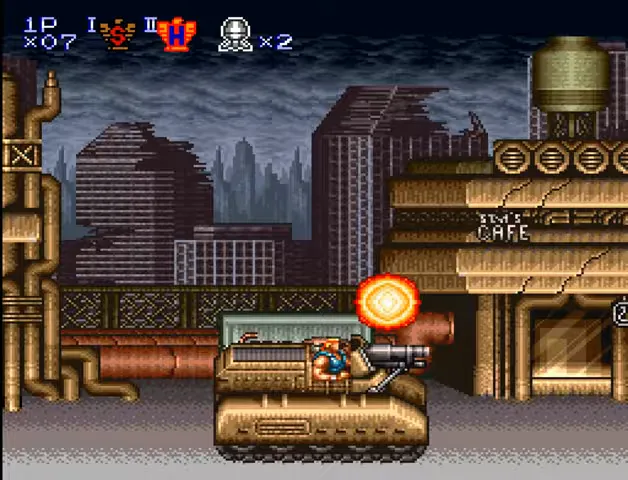
Four screens into the game, Bill is already on top of a tank firing at something else. The three-screen rule is a stopwatch, not a metaphor. Contra III: The Alien Wars · Konami, 1992.
The rule explains why the difficulty does not feel padded. Contra’s NES progenitor solved length through repetition: long corridors of identical infantry, a difficulty curve maintained by stripping continues. Contra III refuses that solution. Each stage is shorter than the last comparable arcade run-and-gun, and each is denser. There is no traversal between events. The “every three screens” promise becomes a contract the player can feel — pattern memorisation never catches up to surprise, because the next surprise is already setting up behind the current one. Nakazato, asked about Contra difficulty more than a decade later, framed it as a transaction:
“Regular action games can be beaten just by guts and stamina; you can just keep on playing through to the end. That’s normal these days. But with Contra, you have to really think about what you’re doing, and challenge it over and over in order to master your skills. The more that you try, the more reward you get for your efforts.”
Nobuya Nakazato, Game Developer, 2004
The two-weapon toggle is the system that lets the rule breathe. The cart is the first Contra to let the player carry two power-ups at once and switch between them with the shoulder, so a level’s grammar can be answered with a sentence, not a single verb. A flamethrower for the rooftop infantry; a spread shot saved for the screen-filler at the end of the block. The player rotates vocabularies as the camera rotates angles — and the dread of losing the right tool to a stray hit becomes the game’s secondary tension.
The Turtle That Became Seven Force
Inside the same cartridge, Yaida and Suganami were programming bosses that Konami’s middleware had not been built to host. The Stage 4 enemy is the visible proof: a vast turtle called Taka with four independently tracking limbs and a head that swings on its own clock. Each limb runs its own animation routine, anchored to a moving body that itself scrolls relative to the player — a tree of nested objects, each parented to the next, all updating at sixty frames a second on a console without hardware sprites for the job.
Four parallel missiles, a hull whose plates open and close around an exposed core, and a player hanging from one of the missiles to fire back. Multi-jointed boss programming written inside a Konami project — and out the door inside a year. Contra III: The Alien Wars · Konami, 1992.
Within months of the cart shipping, Suganami and Yaida had left Konami and were at a new studio called Treasure, programming a Mega Drive boss called Seven Force — a multi-segment shapeshifter that morphs through seven jointed configurations, each held together by the same nested-object discipline that built Taka. Treasure founder Masato Maegawa, asked later about Gunstar Heroes, put the lineage on the record without flinching:
“Many people see Gunstar Heroes as our defining work, and since the programmers on Contra III and Gunstar Heroes were the same and both games share a lot of similarities, Contra III can be considered one of the origin points of Treasure.”
Masato Maegawa, Time Extension
This is what makes Contra III a stranger object than its reception admits. It is the SNES Contra; it is also the design vocabulary that Treasure would carry across the divide and use to compete with Konami for the rest of the decade. The cartridge births a director and seeds the studio that will become his most consequential rival. The Mode 7 boasting is the only part the magazines knew how to talk about.
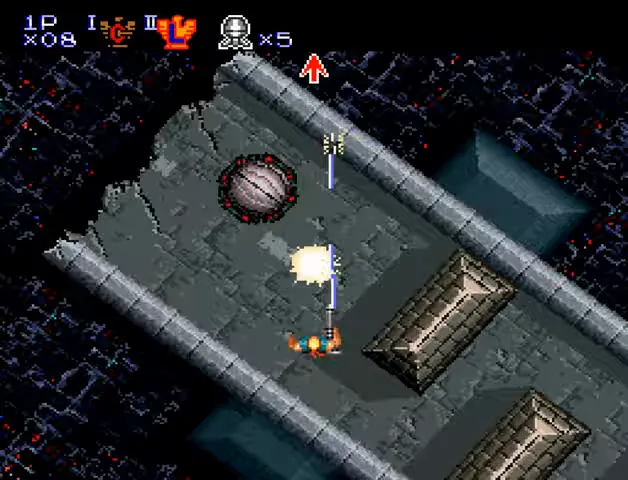
The overhead stages were the salesman’s pitch — Mode 7 rotation and scaling on the cart’s marquee. Time has divided modern players on the controls; the design intent was always to break the player’s posture between stages, not to wow them. Contra III: The Alien Wars · Konami, 1992.
Robots In Place Of Soldiers
The same cart shipped in Europe as Super Probotector: Alien Rebels, with Bill and Lance redrawn as humanoid robots — RD-008 and RC-011 — to clear German content rules. Every human enemy in the game was reanimated as a machine. The robots are a thoughtful piece of art direction, not a slapped-on hack: they move with the same animation budget, sell the same hits, fit the metal-and-rubble palette of the alien-war fiction. A generation of European players’ Contra is a robot Contra, and the version is preserved as a region toggle inside the Anniversary Collection, not buried.
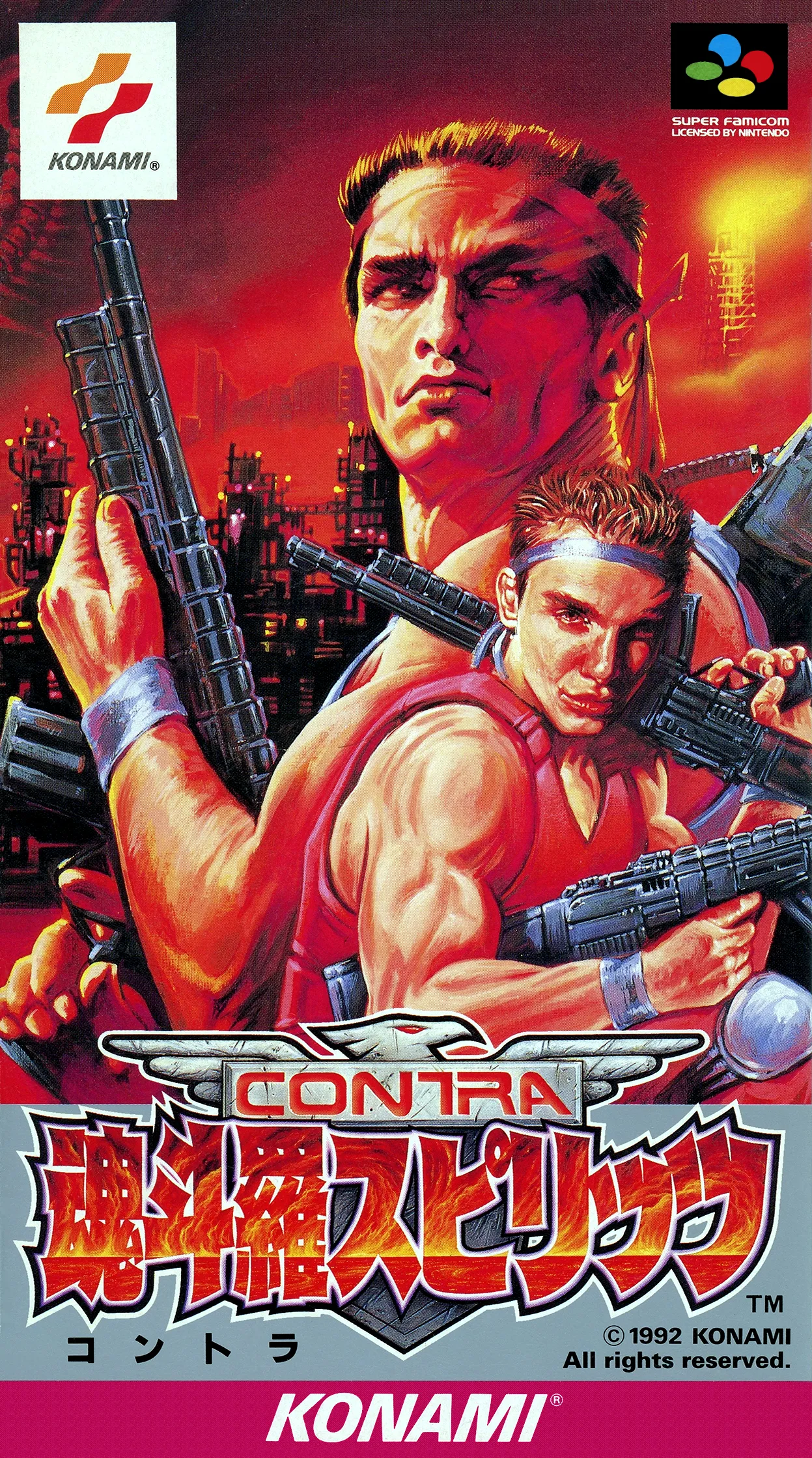
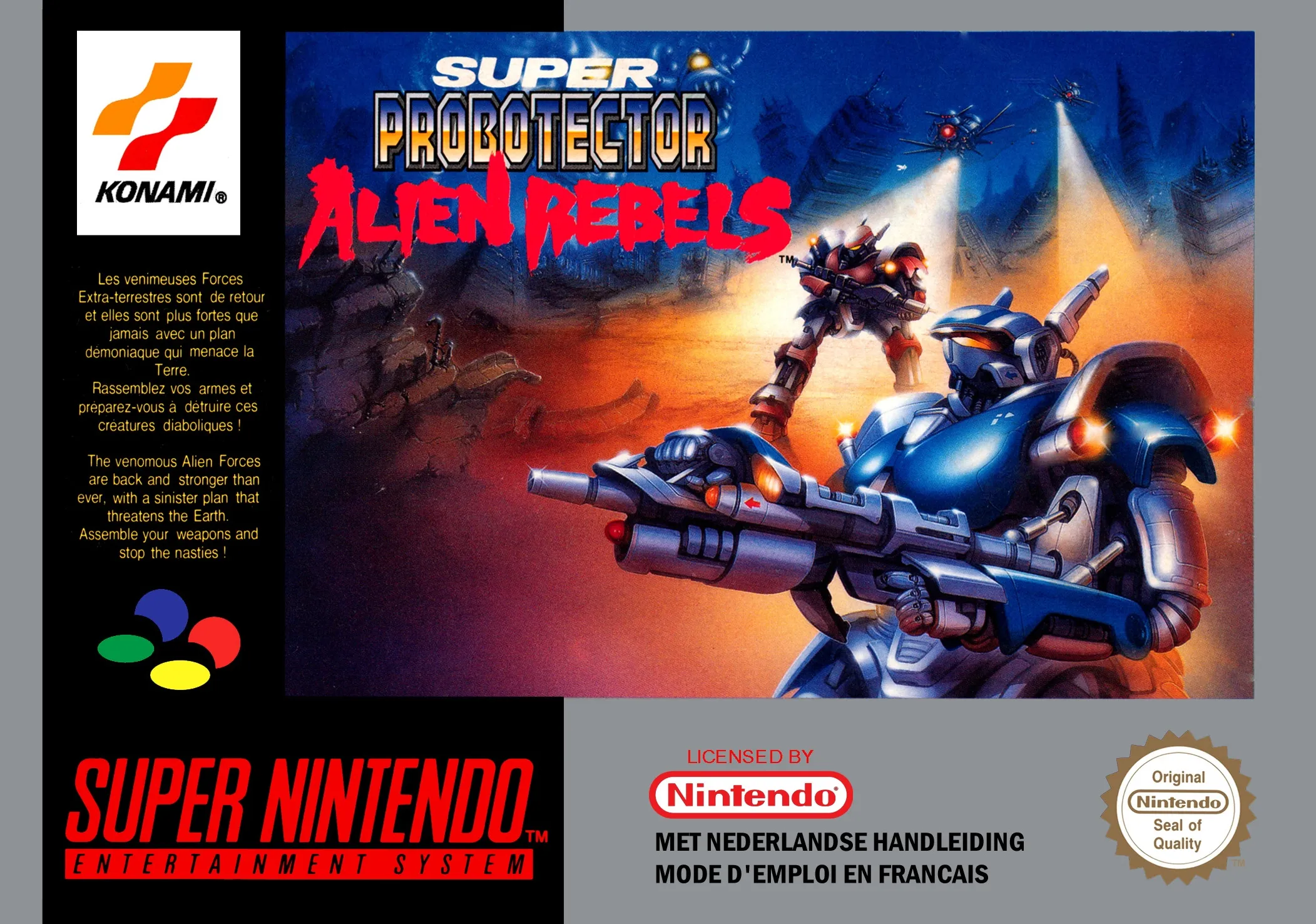
Japan’s 魂斗羅スピリッツ keeps the painted soldier; the PAL Super Probotector repaints him as a machine to clear German content rules. Inside both boxes, the same cartridge — and inside the Anniversary Collection, the Probotector version is preserved as a region toggle rather than buried. Contra III · Konami, 1992.
The defacement, when it came, was American. Time Extension’s reporting on the regional editing of the SNES release makes the bookkeeping plain: Konami of America stripped the cheat-code menu, removed infinite continues, and locked the secret boss off the Normal difficulty. The Japanese 「魂斗羅スピリッツ」 cart is the game Nakazato shipped; the North American SNES cart is the same code with the design’s safety net cut away. If your Contra III was the grey Konami of America cart, you were playing a harder game than the one the team made — and not seeing all of it.
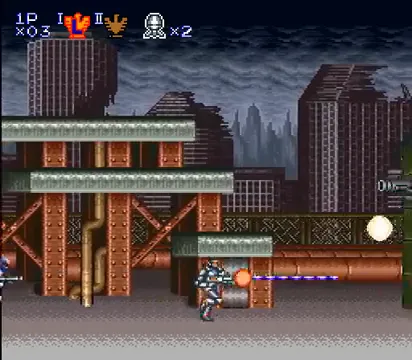
Bill, redrawn as RD-008. The robot is named after Konami’s internal product code for the original NES Contra — the European censorship sleeve carries a Konami in-joke inside it. Super Probotector: Alien Rebels · Konami, 1992 (PAL).
The Score That Stops Being Background
Miki Higashino’s name is on this soundtrack four years before Suikoden. So is Masanori Adachi, who would score Rocket Knight Adventures the next year, and Tappi Iwase, whose later Konami work would include the Policenauts and Metal Gear Solid sound teams. Three composers, one short cartridge, almost no track over two minutes long — and yet the score reads as a single argument about how percussion holds a player to a pulse.
The rooftop theme is the clearest case. It opens with a snare hit on the downbeat and stays there, four-on-the-floor, while the bassline runs underneath at double time. The melody enters late and stays sparse. The result is a track that does not push; it locks. When Stage 1’s three-screen rule starts firing — tank, jump, chain, mid-boss — the percussion is already counting the beat the rule rides on. The music is the choreography in audible form.
What the score refuses to do is the more interesting story. There is no swelling string motif. No power-ballad guitar emulation. No vocal pad faking heroism. Konami’s Kukeiha Club was capable of all three, and proved it elsewhere; on Contra III they treat the genre as machinery and write for it like industrial composers — repetition, locked tempos, bass and drums first. The texture matches the game’s surface: metal, smoke, urgency, no slack.
The boss cues break that rule deliberately. When the screen-fillers arrive, the percussion drops back and a synth lead takes the line, looping a short harmonic figure rather than a melody. The score is telling the player the scale has changed before the boss has finished entering. The rooftop runs on locked tempo; the bosses run on sequence. Recovery becomes possible because the music carries on without underlining failure — when a weapon is lost and a pattern misses, the cue does not punish, it just keeps moving, and the hand follows back into the choreography.
What Operation Galuga Was Reaching For
In an interview ahead of Operation Galuga in 2024, WayForward producer Tomm Hulett and Konami producer Akiyoshi Chosokabe described the remake’s brief as a return to the SNES and Genesis-era games specifically — the cartridge era Nakazato directed. The Flame Weapon, the multi-jointed bosses, the stage pacing where one threat hands off to the next inside a few seconds of screen-time, all trace back. Nakazato himself, five years earlier, pointed at a Contra Spirits moment — Bill hanging from a missile to fire backward — as the motif he kept reaching for across the franchise.
So the cartridge is also a template the publisher is still using three decades later. The 1992 reviewers were not wrong that Contra III looked the part. They were wrong about what made it durable. The Mode 7 stages, the showpiece bit reviewers reached for, are the part time has been hardest on — the rotation feels sluggish to a modern hand; one Twentieth Century Gamer retrospective called the controls “positively abominable” without anyone rushing to argue back. The three-screen pacing, the boss programming, and the two-weapon system feel like they were written yesterday. The friction is the salesman’s pitch the longplay is glad to skip past. The design grammar is the part that runs the franchise.
Contra III is not the longest 16-bit action game, or the deepest, or the most generous. It clears in an hour. It punishes the unprepared, especially on the Konami-of-America cart. But as a piece of playable design it is dense with ideas the rest of the era spent a decade catching up to — and the cartridge contains, in the same plastic shell, both the director those ideas would shape and the studio they would walk out the door to build.