// // import swarmDivePoster from ”../../assets/images/galaxian-1979-swarm-dive-poster.jpg”; // deleted // deleted
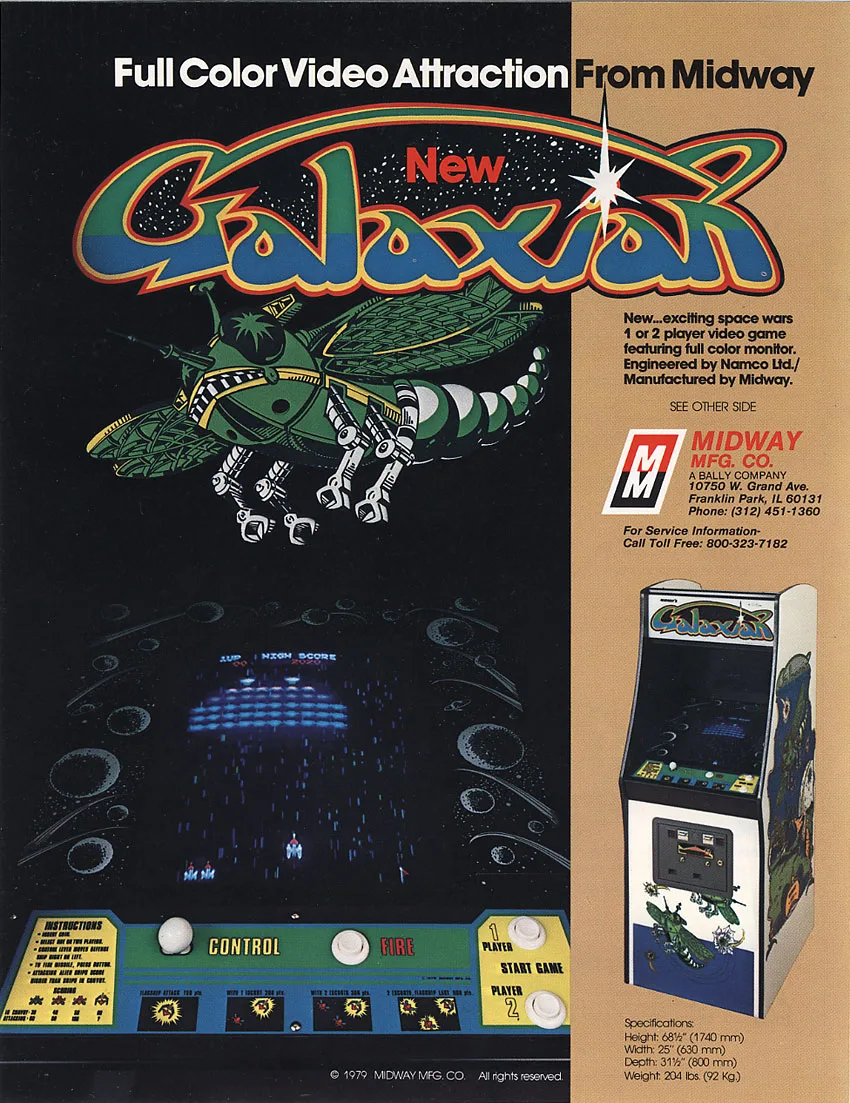
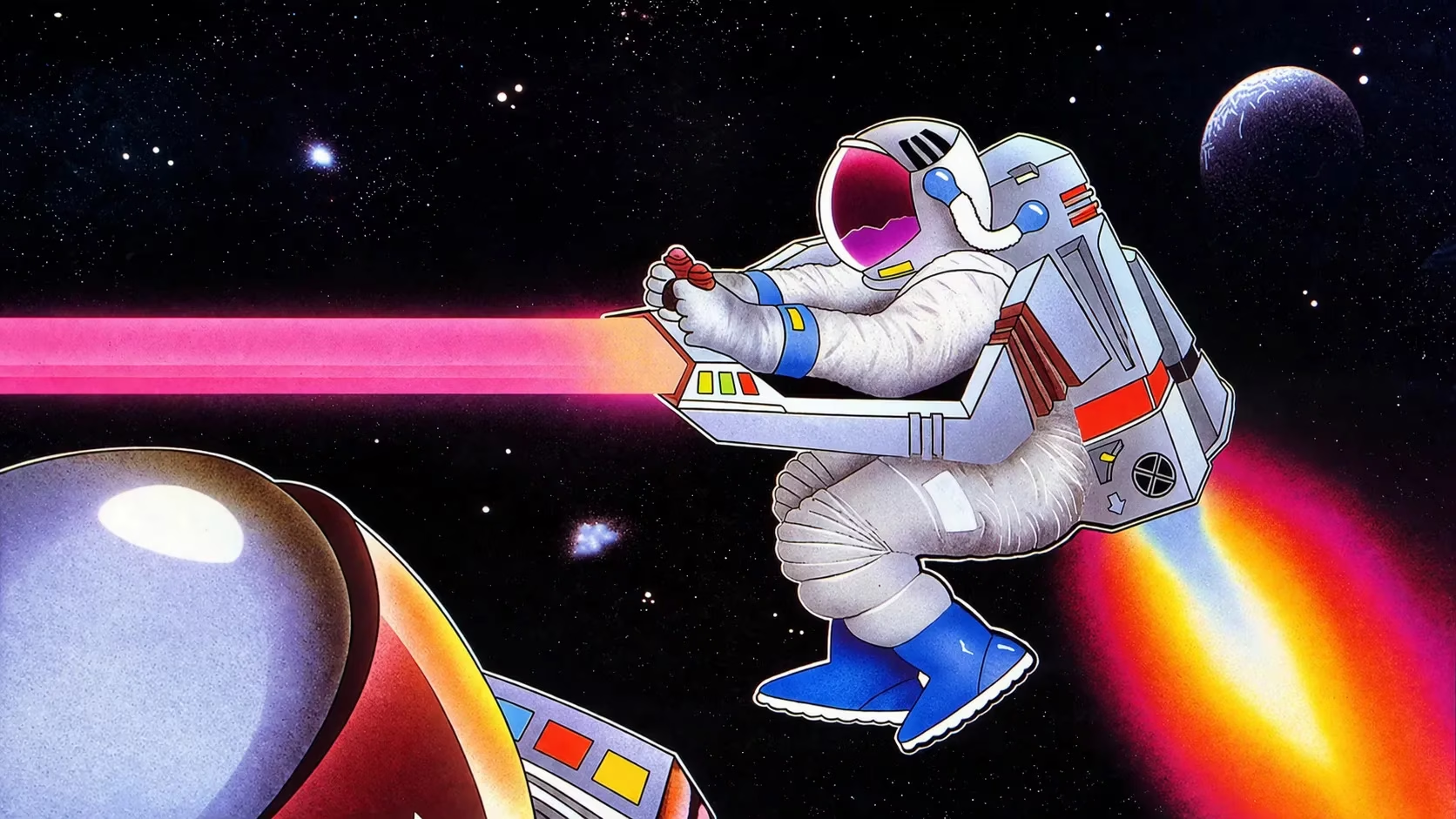
The 1979 Midway operator flyer. Note the headline: Full Color Video Attraction — RGB sprites were a selling point an operator could put on a shop poster. · Midway Mfg. Co., 1979
Space Invaders’ aliens did not attack. They advanced — left, right, drop a row, left, right — and the player advanced into them. Eleven months later, in September 1979, Namco shipped Galaxian, and the aliens at the top of the screen began to leave the grid. One peeled off, slanted down trailing fire, then another, then a flagship and its escorts in a tight diagonal sweep. The wall was still there. The wall now had behaviour.
That behaviour is what Galaxian introduced to arcade games. Choreographed enemy attacks — individual flight paths, sprites that acted instead of marched — became the design grammar every later shoot-‘em-up worked inside. The cabinet also introduced the hardware that made the choreography legible: the first true RGB-colour arcade board, the first to render multi-coloured sprites over a scrolling tilemap. Both shipped together. Both got copied — the design idea quickly, the hardware slowly, until eventually Nintendo built a console on top of it.
Post-Invaders, By Order of the President
The brief came from above. Space Invaders had reached Japan in summer 1978 and produced, by spring 1979, the arcade-industry phenomenon that the country’s coin-op trade still measures other phenomena against. Namco’s president Masaya Nakamura, watching Taito take the market Namco’s electromechanical division had been chasing for a decade, told his engineers, in the words of the planner who eventually carried the project, that the next game out of the company had to be the post-Invaders game. The pressure was not subtle. Kazunori Sawano, who had spent the back half of the 1970s designing Namco’s shooting-gallery arcade pieces — Shoot Away, Periscope — was given the role and a small team.
”The post-Invaders arcade scene belongs to Namco! — that was the goal we set, and the pressure riding on us with the development of Galaxian.”
— Kazunori Sawano, Galaxian developer interview, 1985 (trans. Shmuplations)
Sawano had carried the concept for six months before development started. The inspiration he names is Star Wars: not the dogfights specifically but the feeling of a war in space, ships acting against ships, a battlefield with depth and movement. Space Invaders was a wall. Galaxian would be a battle. The two propositions look similar on a marketing flyer and different inside the code. Where Space Invaders had a single state machine moving the entire row of aliens together, Galaxian needed every alien on screen to be addressable as a small program of its own — a path to follow, a moment to launch, a curve to fly.
The team was small. Sawano planned; Kōichi Tashiro programmed; Shigeichi Ishimura handled hardware. Space Invaders came out partway through their development, and the pressure landed. They had until late summer to deliver something that would be measured directly against Taito’s machine. They delivered on 15 September 1979.
The Gorgs Learn to Dive
What the cabinet does, mechanically, is simple to describe. A formation of forty-two enemies — Gorgs, in Namco’s manuals — fills the upper half of the playfield in four colour-coded ranks. Yellow flagships at the top, escorted by red commanders. Below them, purple emissaries; below those, blue scouts. The player ship sits at the bottom on a single axis of movement and fires one bullet at a time. So far, Space Invaders. Then the dive begins.
A Gorg peels off the grid and curves down toward the player on an individual flight path. The path is not the same path the alien beside it would have flown — each enemy carries its own trajectory data — and the speed escalates with the wave. The flagships, the yellow ones at the top, dive escorted: two red commanders flying tight beside them. Hit the flagship while its escorts are still alive and the score multiplier ladders up sharply. Hit it cleanly with a full escort and the cabinet pays out a fanfare that rises across two octaves. The game is teaching, with payouts, that the choreography it has invented is the entire point.
This is what the individual personality claim, repeated about the game for forty years, meant inside the code. Each Gorg is a small actor. It is in formation when the wave begins; it has a moment at which it leaves; it has a curve to fly down and a curve to fly back up; it has a behaviour at the bottom of its arc, which is to fire and pull. Nothing was acting in arcade games before this. Things were moving — bouncing, sliding, advancing in lockstep — but the difference between a ball that bounces and an alien that chooses a moment to dive is the difference between a physics simulation and a piece of theatre. Galaxian found the second register first.
The friction in the cabinet, today as in 1979, is bullet capacity. You fire one shot at a time, and the shot has to clear the top of the screen before you can fire again. A Gorg in mid-dive often does not present a clean target window long enough for one bullet to land cleanly. The temptation, learning the game, is to spray. The cabinet punishes that immediately. What it asks is for the player to choose which curve, in the choreography unfolding above, will pass through the muzzle. The cabinet is, in 1979 terms, a game about reading attack patterns — a phrase that did not yet exist as an idiom and would not for another decade.
The Hardware That Built Nintendo
The reason a flagship and two escorts can dive on a tight diagonal trail, all three rendered cleanly, all three in different colours, is hardware Ishimura built specifically to make sprites cheaper than Space Invaders had made them. The Namco Galaxian board was the first arcade hardware to use a true RGB-colour video path and the first to combine a tile-based scrolling background with multi-coloured hardware sprites. Space Invaders drew every alien into a framebuffer the CPU rewrote every frame. The Galaxian board kept the background in tile memory and the moving objects as sprite primitives, each addressable by position and animated independently. The economy of the trick is large — sprite-and-tile rendering needs a fraction of the memory bandwidth a framebuffer of the same resolution would — and it is also why the screen could afford to be black and full of colour-coded actors instead of a single off-white field of identical sprites.
The downstream is the part of this story that hides in plain sight. Masayuki Uemura, the lead engineer for Nintendo’s R&D2 group, has named Galaxian’s hardware specifically as the basis for what his team built next. The board influenced the architecture of Radar Scope, the Nintendo cabinet that arrived in 1980; the same architecture became the chassis for Donkey Kong in 1981; the same lineage of sprite-and-tile thinking ran through Nintendo’s arcade hardware into the Famicom in 1983. The Famicom is the Galaxian board’s design philosophy taken into the home, four years later. Without the demonstration in Galaxian that you could render a screenful of independently-moving coloured sprites on commodity hardware, the console that followed would have been a different machine, and the half-decade of arcade ports that defined the early home market would have been a different conversation.
This is the reception gap. Galaxian is remembered as the game Galaga improved on — a stepping stone toward the genre’s second cabinet two years later. What it was, looked at squarely, was the cabinet that proved the architecture every subsequent Nintendo and Namco arcade machine built on. Galaga is Galaxian on the same board, refined. The decade and a half of Nintendo-published console hardware that followed are Galaxian on different boards, refined further.
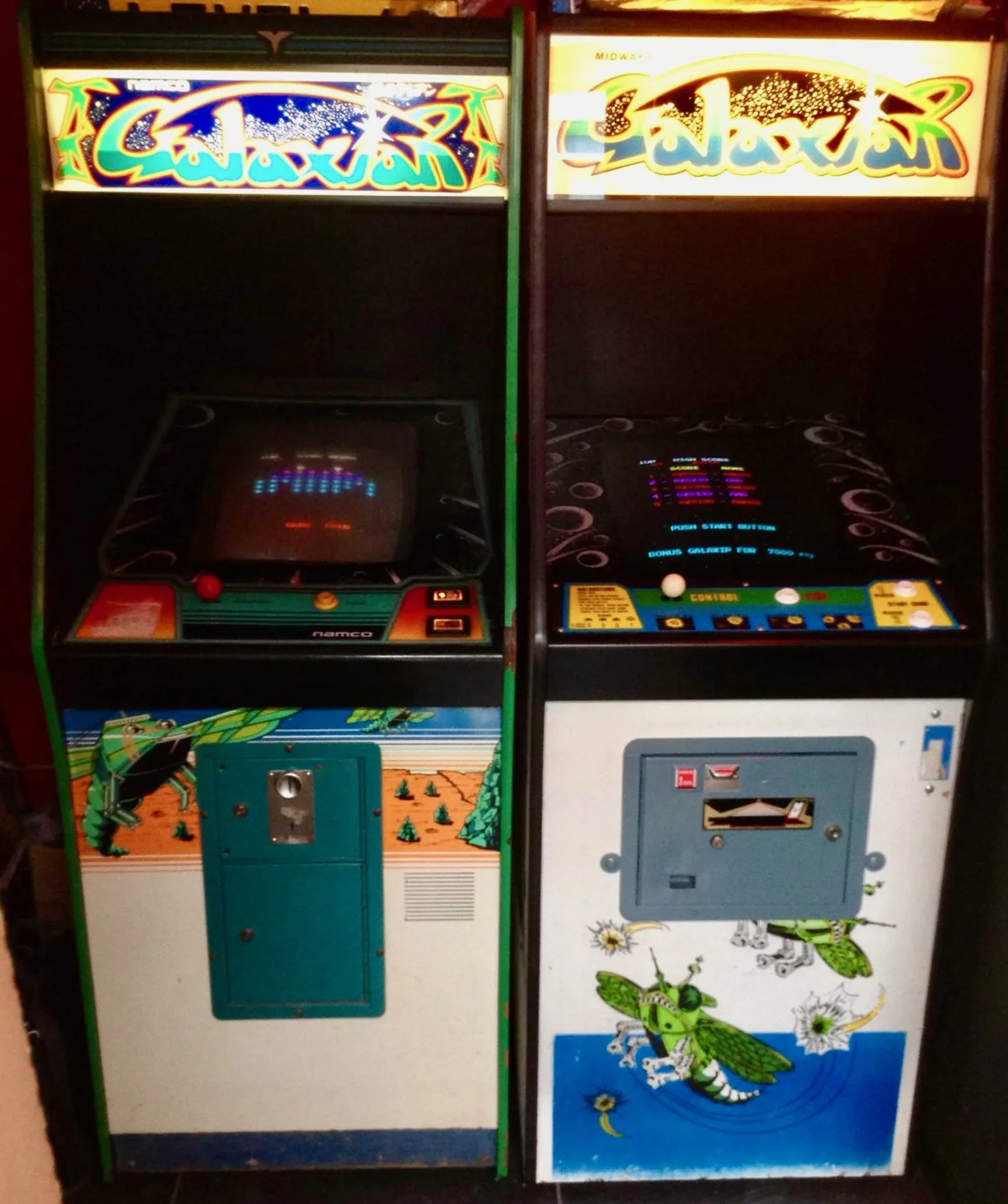
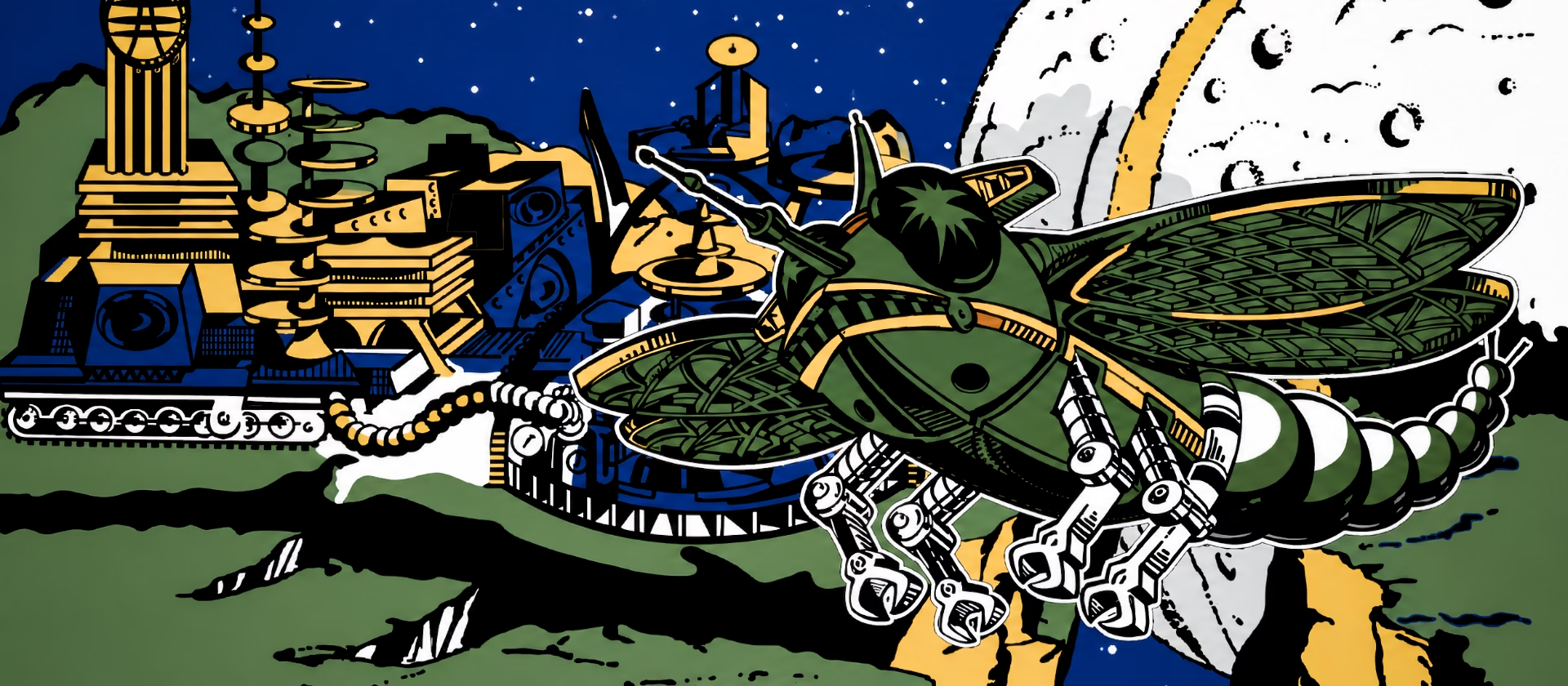
The original Namco upright (left) beside the early Midway US machine (right). Same board, same game, different sales argument: Namco painted the alien as an insect threat in a wraparound mural; Midway abstracted it into a marquee illustration over a plain white cabinet. · Namco, 1979 / Midway Mfg. Co., 1980
Sound Engineered by Argument
Sawano remembered the audio specifically as the part of the cabinet he spent the most time on. The Namco hardware did not generate music — there is no soundtrack to Galaxian in the way later arcade machines have soundtracks. What it generates is a small library of cues: the rising whine of a Gorg leaving formation, the chirped tone of a bullet, the explosion cluster of a hit flagship, the rising scale of a perfect escort kill, the constant low pulse of the formation’s collective movement. Each cue carries information the player needs: which kind of enemy is diving, how many escorts are alive, whether the multiplier ladder is still climbing.
Sawano’s account of how the cues were arrived at is the texture under everything else.
”The sound effects, in particular, were something I really laboured over. I would explain my ideas to the sound effects guy, and he would create something and bring it back to me. I’d say, ‘this is a little off,’ and then try to find other words to explain the image I had — this back-and-forth process went on for a while.”
— Kazunori Sawano, 1985 (trans. Shmuplations)
This is how you make a cabinet that reads as choreography. The visual side of the dive — the path, the colour, the formation breaking — needs a corresponding signal in the audio that the player processes before they have time to read the image. The escort fanfare especially does this. Hit a flagship clean with its two reds still flying and the cabinet rewards you with a rising arpeggio that anyone within twenty feet of the machine hears as that player just did the thing. The audio is teaching the room as well as the player. In a 1980 arcade — loud, crowded, competing — the cues had to carry through everything else. They were tuned, by argument between Sawano and his audio engineer, until they did.
Why the Grid Still Holds
Forty-six years on, the cabinet still rewards what it was built to reward. Wave one introduces the dive vocabulary in slow time. Wave two raises the frequency. By wave four the screen is in constant motion, two or three Gorgs in flight at any moment, and the player is reading the field as a continuous attack-pattern problem rather than a wave-clear problem. The loop is short and tight. Two minutes will tell a modern player whether the cabinet is for them. Six minutes will tell them whether they have begun to read the choreography it asks for.
What the game gives now, that almost nothing else does in this clean a form, is the visible birth of an idea every later shoot-‘em-up takes for granted. The dive-bomb is the design unit. The escort multiplier is the first real reward loop for learning a pattern rather than clearing a screen. The colour-coded ranks are the first sprite-level use of palette as information. Nothing in the cabinet is decorative; everything is the demonstration. Galaga, 1942, Raiden, Ikaruga, Resogun — every game in the line is variations on the curve a Gorg flew down the right side of a Namco cabinet in September 1979. The original is still the place you can see the curve for what it was when it was new.
![The Midway Galaxian arcade marquee. The rainbow-outlined GALAXIAN logotype curves across a black starfield, a small star spark at the right; 'MIDWAY'S' at top left, 'a [Bally] co.' at top right.](/_astro/galaxian-1979-marquee.D-RqFuKK.webp)
The Midway cabinet marquee. The rainbow-outlined logotype against the starfield was the cabinet’s pitch in one image: full-colour space, in 1979. · Midway Mfg. Co., 1980