Gimmick! looks like a bedtime toy until the star refuses to behave. It appears over Yumetaro’s head as a cheerful weapon, round and bright and obedient in the way mascot platformers teach you to expect; then it leaves your hand, hits a slope, skips off a wall, rolls away with enough speed to make you chase it, and suddenly the cute game has become a physics lesson you are taking in public.
That is the real trick. Sunsoft’s late Famicom platformer is often introduced through rarity, difficulty, or audio hardware: released in Japan, barely released in Scandinavia as Mr. Gimmick, cancelled for the United States, scored with the Sunsoft 5B expansion chip, now expensive enough to turn a cartridge into a museum piece. All true. All secondary. The reason to play it is that Gimmick! makes one object carry the whole game. The star is weapon, platform, projectile, clock, bridge, rhythm instrument, and rebuke. If you treat it as a shot, the game feels cruel. If you treat it as a body with weight, the level opens.
One Star Does Everything
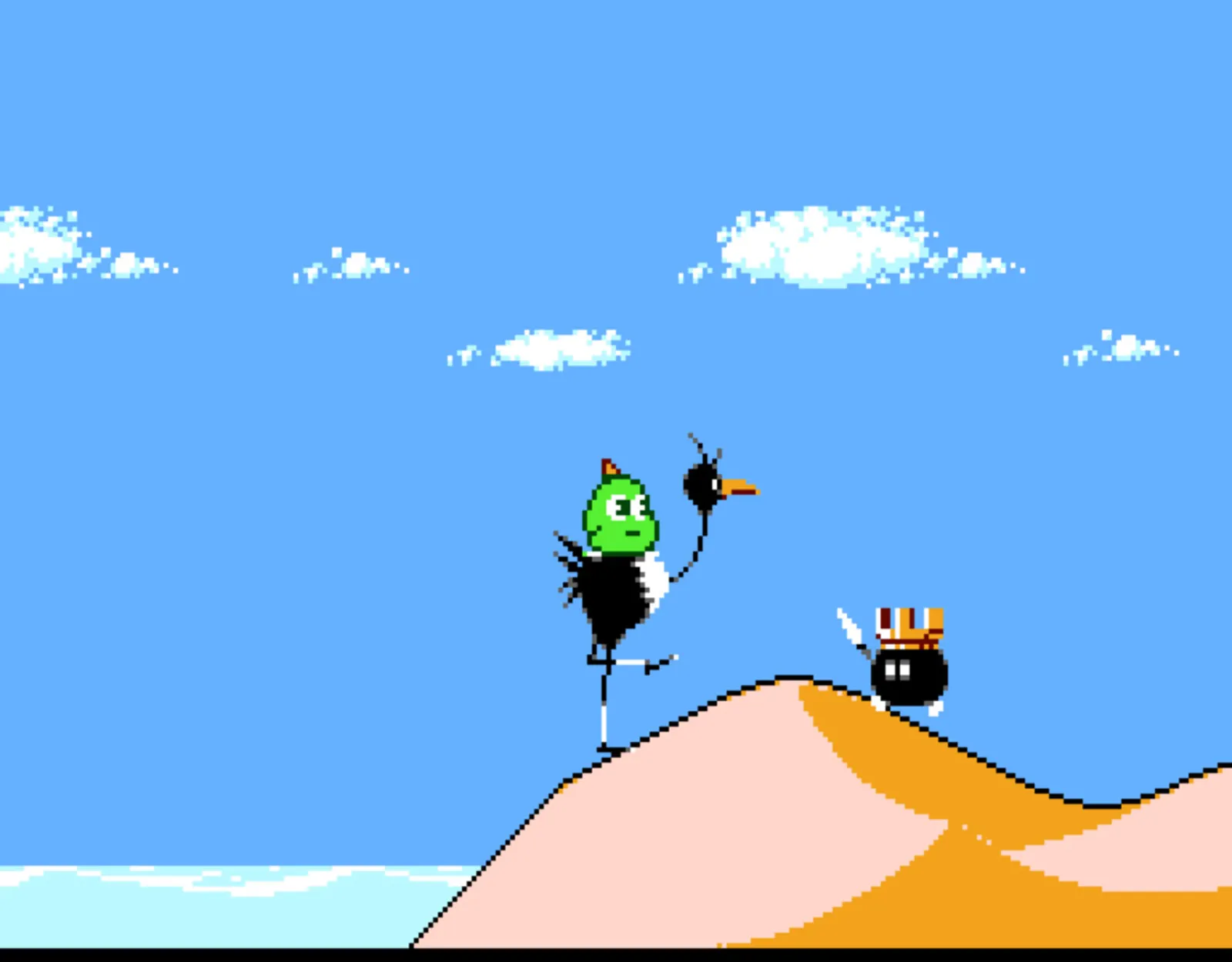
The world is built around rides, ricochets, and temporary footholds. Gimmick! Special Edition · Sunsoft / City Connection.
Most platformer weapons erase problems. A fireball leaves Mario and the enemy disappears. A lemon pellet leaves Mega Man and the enemy blinks out. Yumetaro’s star makes problems more complicated. You hold the button to charge it, release, and it travels according to its own logic: bouncing, rolling, losing and gaining angle, carrying momentum across surfaces. It can defeat enemies, but that is its least interesting job. Throw it under yourself and it becomes a moving platform. Throw it against a wall and it comes back at an angle you can learn. Throw it too early and the room keeps the evidence of your bad idea alive for a few seconds, bright and useless and out of reach.
The act of riding it explains the reputation. You are not jumping to a platform alone; you are creating the platform, moving toward it, matching its speed, and committing before it has fully proved trustworthy. A good star jump feels like a handshake between intention and accident. A bad one feels like stepping onto a skateboard you forgot you were holding.
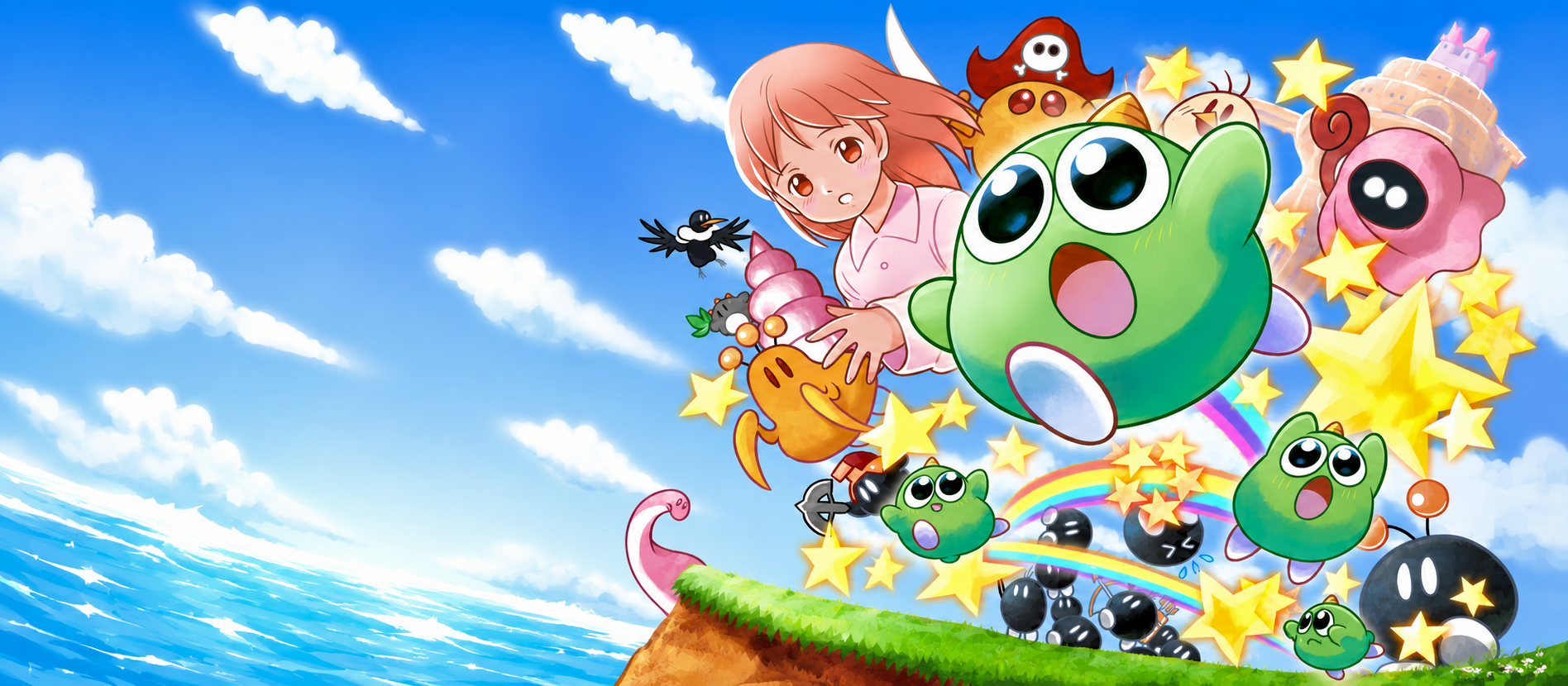
This is where the cute fiction matters. Yumetaro is not a soldier, knight, robot, or acrobat. He is a small green youkai mistaken for a toy, trying to rescue the girl whose jealous toys have taken her away. The star should feel like play, and it does. It also carries the density of a billiard ball. Gimmick! lets the player discover that toy logic can be harsher than military logic because toys answer to touch, not justice.
The Movement Was the Difficulty
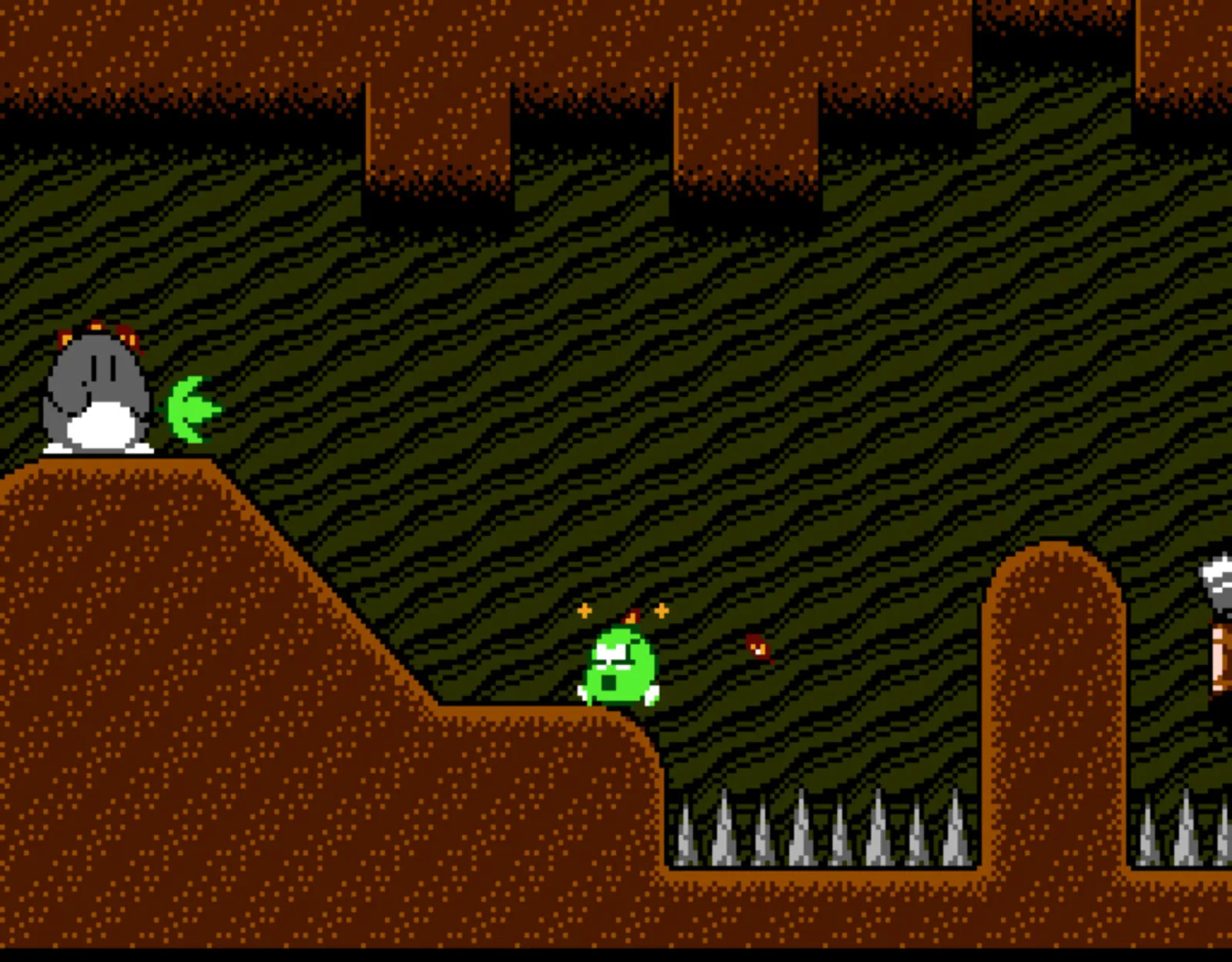
Slopes do not decorate the screen. They change acceleration for Yumetaro, enemies, and the star. Gimmick! Special Edition · Sunsoft / City Connection.
Tomomi Sakai, who designed, programmed, and directed Gimmick!, offered the cleanest explanation decades later. When Sunsoft showed it publicly, some players could not adjust. The problem, he said, was not only enemy placement or limited lives. They “couldn’t keep up with Yumetaro’s movement.” Gravity affected acceleration on slopes, and that physical behaviour was unfamiliar on the Famicom.
”couldn’t keep up with Yumetaro’s movement”
- Tomomi Sakai, Time Extension, 2024
That line changes the whole reading. Gimmick! is not hard because it is mean. It is hard because it asks for a literacy most players had not been taught. The first shock is not the damage but the body: Yumetaro is light without being loose, quick without being snappy, a creature who changes speed because the ground says so. Enemies participate in the same world. The star does too. Everything obeys shared physics with enough consistency that the levels feel less like arrangements of tiles and more like small machines.
That machinery makes the secrets feel earned. The true ending asks for hidden items and no continues, a demand that turns an already exacting game into a technical recital. But the hidden routes are not arbitrary keyholes. They usually require a player who understands how to place a star, how to catch it, how a slope might feed speed back into the throw. The punishment is severe, but the test is honest: have you learned what this world does when touched?
Modern precision platformers have made that kind of literacy familiar. Celeste teaches wavedashes and wall-bounces through ritualised repetition. Super Meat Boy turns failure into a visible trail of bodies. Gimmick! does something more tactile and less explicit. It hands you a toy and lets the toy embarrass you until you respect it.
Three Years Inside One Object
Sakai has said development took about three years, an extravagant span for a late Famicom platformer built by a small Sunsoft team. He also described the frustration that sent him toward that kind of control: he had worked on earlier projects where his influence felt limited, then decided, in effect, that he could make a better game if he had full control. Gimmick! feels like a young designer taking that promise as instruction.
Every screen is full of tiny refusals to fake things. Backgrounds animate. Enemy behaviours are oddly particular. Objects interact in ways that seem excessive until the room suddenly depends on them. Sakai later credited artist Hiroshi Kagoya for the graphics, pushing back on the idea that a special chip made the visuals impressive by itself; the hardware helped with switching animated backgrounds, but the artistry was Kagoya’s. The same distinction matters for the design. Gimmick! is often discussed as a technical showpiece, which it is, but the showpiece quality comes from a team using technical force to make the world feel physical.
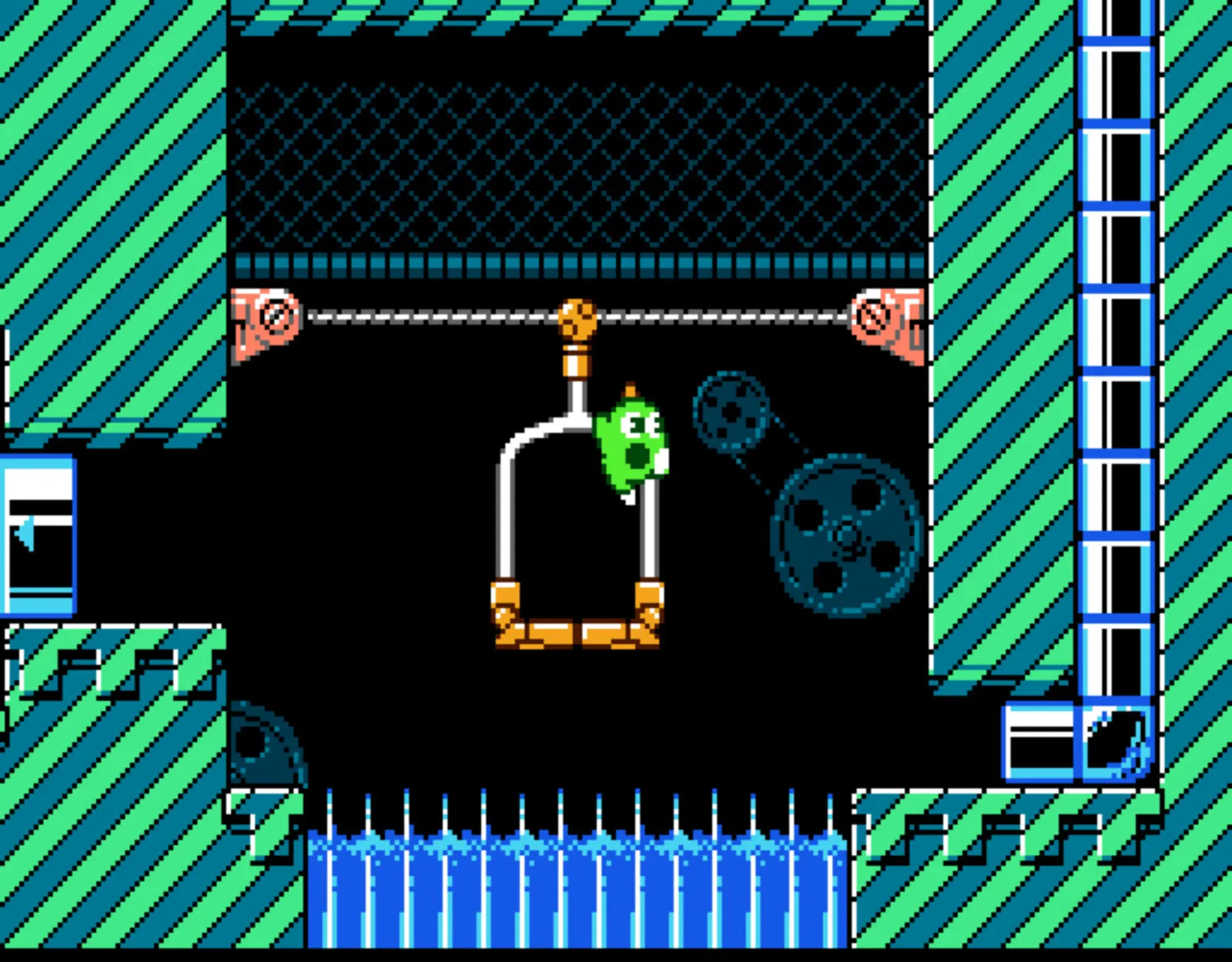
The later stages turn the star into route-making under pressure. Gimmick! Special Edition · Sunsoft / City Connection.
That physicality also explains why the Special Edition’s rewind and save features do not trivialise the design so much as expose it. Rewind can turn failure into rehearsal. You try the throw, miss the ride, rewind, adjust by a few pixels, and notice the angle you had not seen. Serious Mode can take the support away later. The modern release works because Gimmick! was already a game about practice, not endurance. The old cartridge made you pay in time for every misunderstanding. The new one lets you inspect the misunderstanding before it hardens into resentment.
The Music Bounces Too
Masashi Kageyama’s score is not decoration around the physics. It is another way of feeling them. The Famicom cartridge used Sunsoft’s 5B expansion audio, adding voices that give the soundtrack a shine the Scandinavian NES cartridge could not reproduce. That fact can turn into chip trivia fast, but the important thing is not that Gimmick! has more channels. It is what Kageyama does with the air those channels create.
In a shmuplations-translated interview, Kageyama said he was careful about “writing music that just felt good”, then connected that directly to Sakai’s pursuit of floaty controls. He wanted the music to match the sensation, to feel more like live performance than fixed composition. Listen to the soundtrack with the game running and the logic is obvious. The basslines have bounce. Melodies hop, delay, and land. The music rarely clamps down on a stage with menace; it gives the room elasticity.
That is why the score survives outside the game better than many showy 8-bit soundtracks. It is not only memorable melody, though it has plenty of that. It is kinaesthetic. “Good Weather” feels like forward motion with room under the feet. “Aporia” has the strangeness of a toy cupboard after the light goes off. “Sophia” can make a simple rescue plot feel suddenly enormous. Kageyama was not scoring a cute platformer with difficult bits. He was scoring a body learning how to move.
The Wrong Countries, The Right Game
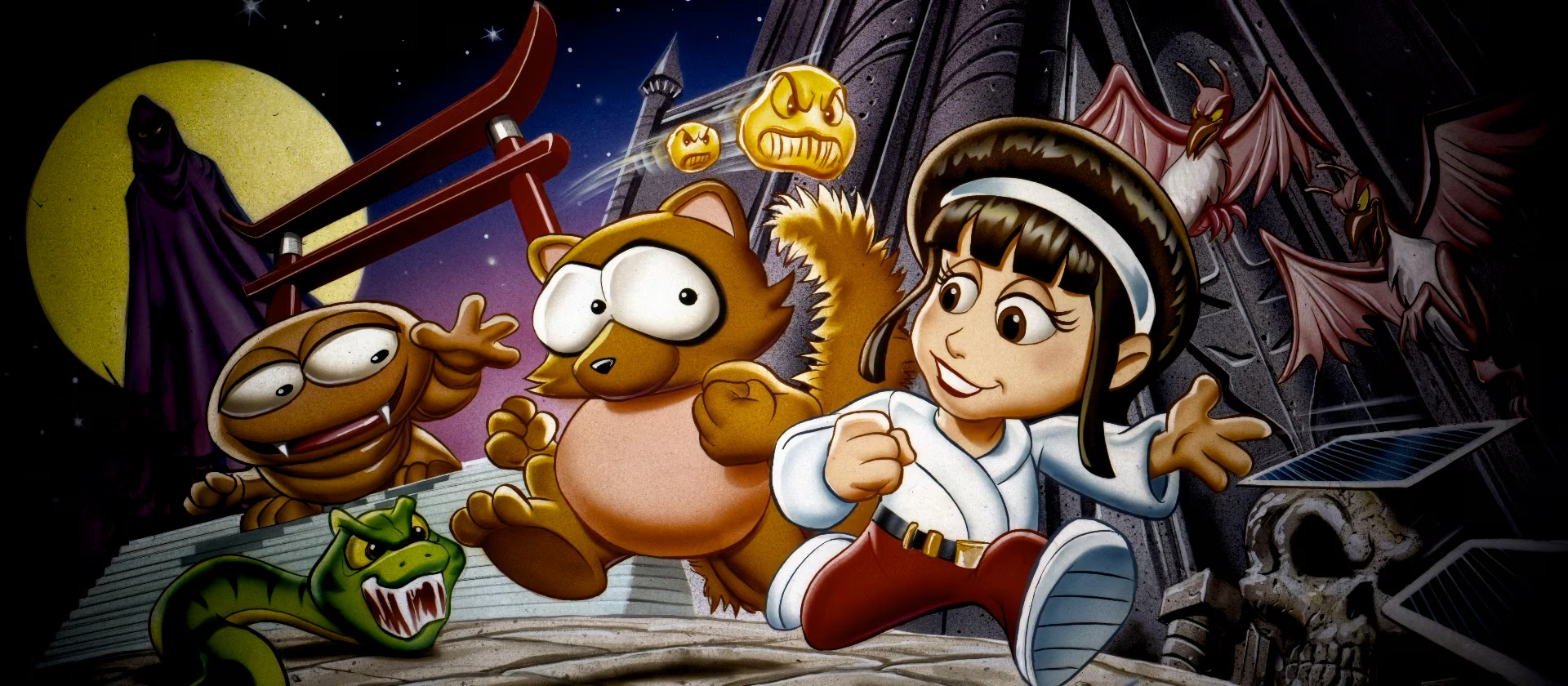
The release history reads like the usual cult-game obituary. Gimmick! arrived in Japan in January 1992, when the Super Famicom was already pulling attention upward. Sunsoft prepared a Western release, and Electronic Gaming Monthly even reviewed Mr. Gimmick in July, but the United States version vanished before shelves could receive it. Sakai later said he heard management thought the character was too strange and would not sell. Scandinavia got the NES version. North America got rumour. The packaging split tells the story in miniature: Japan sold a handmade-looking creature among gears, while Europe hurled Yumetaro into a black-and-yellow spiral and renamed him for the market that nearly had him.
The funny thing is that the old review confusion almost proves the point. One EGM reviewer correctly noticed a game that “requires a great deal of technique”; another complained the score would have been higher “if it wasn’t so easy.” Both reactions can coexist only if Gimmick! is not being read on its own terms. It can look simple to someone watching a first stage and feel impossible to someone trying to make the star do exactly one advanced thing.
That ambiguity is why Gimmick! belongs in a modern library instead of behind collector glass. It is short enough to learn, dense enough to keep arguing with, and strange enough that the platformer vocabulary around it still feels slightly inadequate for what your hands are doing. The Special Edition gives it context, leaderboards, rewind, save states, a gallery, and the soundtrack release restores the Famicom audio as more than a footnote. None of that softens the central object. The star still leaves your hand and becomes itself.
The best games with cult reputations eventually outgrow the romance of scarcity. They stop being interesting because few people had them and start being interesting because anyone can test the claim. Gimmick! passes that test the moment you stop asking whether it is hard and start asking what the star knows that you do not.