// // import iRobotDoodleCityPoster from ”../../assets/images/i-robot-1984-doodle-city-poster.jpg”; // deleted // deleted
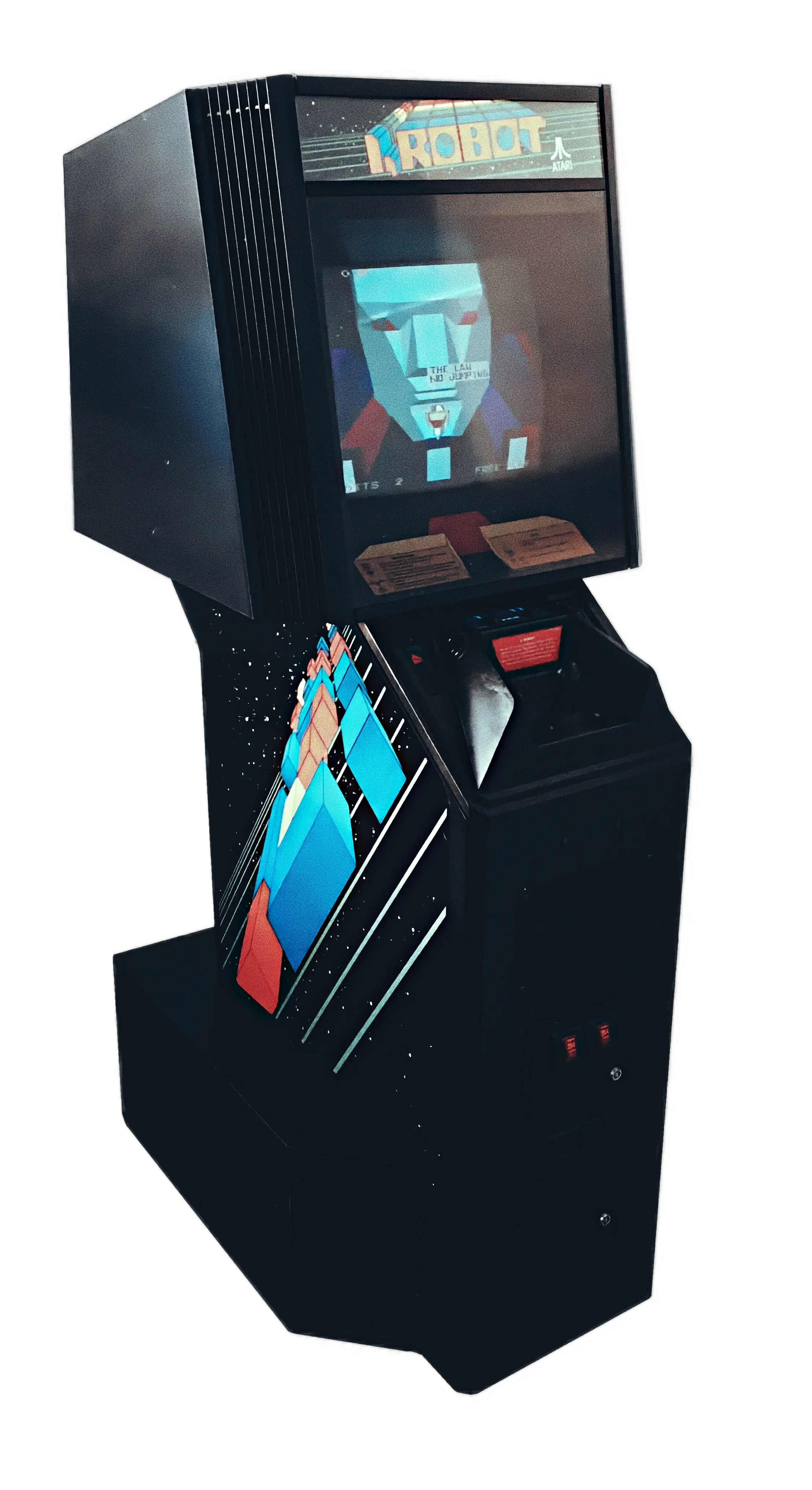
The upright cabinet. The side-art extends the marquee’s cubist grid onto the machine itself — the only arcade hardware Atari ever shipped that looked like the game it housed. · Atari, Inc., 1984
Atari shipped I, Robot in the summer of 1984 and never measured what it had actually built. Seven hundred and fifty cabinets went out; roughly five hundred found homes in American arcades; the rest went, reportedly, to Japan. Dave Sherman, the hardware engineer who had soldered RAM chips in ten-high stacks to fit his 3D co-processor onto a commercial coin-op board, put the moment plainly in a later interview: the game was released into the maelstrom of Atari dying horribly in 1983 and 1984, and the idea of polishing it any further got dropped.
What shipped was the first arcade game ever rendered in real-time, flat-shaded 3D polygons. It was also the first arcade game to hand the player control of the camera, the first to hide a pure visual-toy sandbox inside a commercial coin-op cabinet, and, within six months, a commercial failure. The reading that has stuck — too weird for 1984 — is true and thin. Score the game by what an arcade operator needed it to do in 1984, and it fails the test. Score it by what it actually contained, and the test was wrong.
Ice World, Then Revolution
The project began in June 1981 as a flying game. Sherman and Dave Theurer — already the designer of Missile Command and Tempest — filed a hardware proposal aiming to push the mathbox architecture behind Battlezone several orders harder. Six months later the flying game had become a driving game. “It started out as a 3D driving game,” Theurer wrote in a 1989 retrospective message preserved in LordFrito’s archive. “You drove down the road, stopped at shops alongside the road, and went in” — into smaller games hosted inside the larger one. The hardware could not support it. Collision against the hilly terrain was unreliable and the storage budget kept overrunning.
The project pivoted a second time, under the name Heart of Ice: a Central European folktale staged in polygons, with prince, princess, palace, monster. The problem was that flat-shaded polygons render beautifully as cubes and pyramids and badly as anything resembling a human face. The hardware Sherman was building didn’t cooperate with fairytale iconography. The solution, eventually, came from accepting the constraint. If polygons could not be princesses, they would be cubes; if a face made the hardware look clumsy, the face would have to be a faceted skull, the landscape an abstracted grid, the protagonist a small angular figure whose articulation would never aspire to anatomy.
Heart of Ice became Ice World, which in August 1983 became I, Robot. The two-year development ran straight through the crash of 1983 and Atari’s slide into insolvency. By the time field testing happened — February 1984, at an arcade called Merlin’s Castle in San Jose — the company that would ship the finished cabinet was already in the process of ceasing to exist. Sherman’s own hardware story is its own kind of portrait. His 3D co-processor, the one that gave the cabinet its roughly 2,000-polygon-per-second throughput, outgrew its memory budget during development.
”I originally targeted that the microcode would be 256 words deep. Well it wouldn’t fit, and we added more and more features. So what I did is I soldered RAMs on top of the RAMs. It got up to like 1,000 words. I was embarrassed by it, so I would cover it up with a little cardboard thing.”
— Dave Sherman, The Ted Dabney Experience, 2023
The development team called it the Mondo Condo. No other 1984 arcade cabinet carried anything half as improvisational.
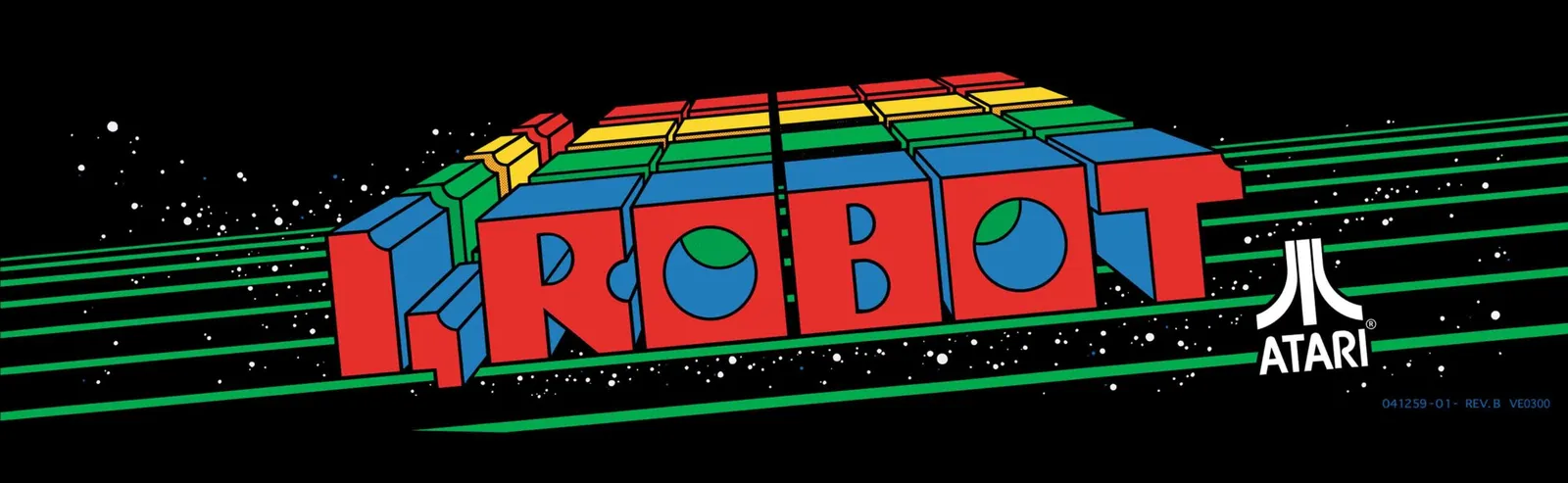
The cabinet marquee. The cubist grammar Atari arrived at — faceted skull, green eye, gridded landscape — became the visual signature distributors saw before they ever turned the machine on. · Atari, Inc., 1984
Twenty-Two Playfields and an Eye
I, Robot opens with a brief of almost Orwellian flatness. You are Unhappy Interface Robot #1984. You serve Big Brother. Big Brother watches you through a floating green eye that enforces a simple law: do not step on red unless the eye is closed. Your job is to step on every red tile on the playfield anyway.
The puzzle sounds childish. In play it is a study in conditional movement. Each of the game’s twenty-two unique playfields — cycled across 126 total levels — lays down a grid of red and blue squares. Blue is safe. Red, under Big Brother’s open gaze, kills. The eye blinks, rolls, closes, opens again; the player moves in the negative space of its attention, a rhythm that reads as nothing so much as a stealth game a decade and a half before the genre existed. The robot is tiny. The landscape is enormous. The geometry itself is the threat.
Two innovations kept the play surface from thinning across that many levels. The first is the camera. A button on the cabinet switches between an overhead view — which reveals the full layout — and a low ground-level view, which scores higher points for enemies destroyed and trades spatial awareness for commitment. No arcade game before I, Robot had offered its player a choice between vantage points. The second is the Mondo Condo’s ability to hold genuine pseudo-randomness in its state. The floating hazards — beach balls, space sharks, birds — do not follow fixed patterns the way ghosts followed patterns in Pac-Man. They seed from the frame counter, which means memorising a level transfers no advantage to the next attempt. In 1984 this was frustrating. Today it is the feature every modern roguelike builds around.
The audio treats the polygons with the same abstraction. Four POKEY chips — the quad-POKEY arrangement Rusty Dawe later named as one of three things the cabinet held a patent on — synthesise a clipped digital voice that enforces the rules at you. TOUCH RED. TRANSPORTER. The voice is wooden by design: the machine you are inside, not a composer writing music for it. There is no hummable theme to carry the cabinet across a noisy arcade floor. The game expects you are already standing there.
The Sandbox in the Coin Slot
Tucked into the attract loop is a mode that does not belong in an arcade cabinet. It is called Doodle City. At the title screen, the player holds a button and three minutes open up — three minutes of no enemies, no timer, no score, no robot: a free-drawing canvas in 3D polygons. Cubes, pyramids, and spirals tumble outward in colours the player chooses. Nothing in the mode earns quarters. Nothing is scored.
Theurer’s own later comment on the mode, preserved in the same 1989 message archived by LordFrito, is apologetic: he added it, he says, to entice video-game haters to put in their money, and doubts many players ever even knew it was there. What Doodle City actually is, looked at now, is the ancestor of everything the arcade had no commercial room for. It is a screensaver. It is a generative-art toy. It is a visualiser. It is the pure-pleasure visual mode that Rez would rediscover in 2001 and that Jeff Minter has spent four decades trying to put back into games where the industry keeps losing it.
Minter, who owned a cabinet through a friend in the 1980s, released a licensed I, Robot remake in April 2025 with Atari’s blessing. He centred his entire reimagining on exactly this mode, renamed The Ungame. “One thing I loved about it,” he told Nintendo Life that spring, “was that because the graphics technology was so new, they built a special mode into the game where you just played with the 3D graphics.” He is identifying the thing that made the original hard to sell as a cabinet. An arcade machine’s job, by 1984, was to hold a player tightly enough to convert five minutes into a quarter; a machine with a three-minute no-score drawing mode is already arguing with its venue. Theurer and Sherman had built the first arcade game that was also something other than an arcade game, and the part that was something else was the most forward-looking part of it.
What Play Meter Couldn’t Score
In its December 1984 issue, the trade magazine Play Meter ran its operator-facing review of I, Robot. Gene Lewin gave the dedicated cabinet a 2 out of 10, bumping it to 7 if it came as a conversion kit installed in a cabinet an operator already owned. Roger C. Sharpe, scoring in the same issue, marked it three hashes and wrote that the game lacked the excitement necessary to make it a top-earning machine.
There is nothing wrong with those reviews. They were doing exactly what a trade-paper review was for: telling an operator, in front of whom a $1,995 cabinet was being proposed, whether the machine would pay for itself. I, Robot, on that metric, would not. Its audio was too clipped to pull players across a noisy floor. Its reward loop was abstract in a way the 1984 arcade had no grammar for. Its Hall-effect joystick — an innovation the hardware group chose for precision — was delicate and broke often; in one Seattle arcade beside a scrapyard, Dawe recalled, it registered phantom inputs from the yard’s crane magnet until the machine was grounded half to death.
Sherman’s own later verdict was sharper than the reviews.
”It’s like people had trouble just getting it. They were used to a certain style of game. It’s genuinely a weird game. I mean, you know, some robot and a big eye.”
— Dave Sherman, The Ted Dabney Experience, 2023
What Play Meter could not measure — what Play Meter was not paid to measure — was whether the thing an operator could not sell was, on its own terms, good. Clare Edgeley, writing about the game six months later for Computer and Video Games in April 1985, in a review aimed at players rather than operators, led with the sentence that the graphics were perhaps the most unusual of any arcade game around. That review was not treating the cabinet as a revenue stream. It was asking the question the trade press had no reason to ask.
Forty years on you can ask that question cleanly. The cabinet is scarce; the ROM emulates faithfully in MAME; Minter’s I, Robot for modern platforms is out and centres the right thing. Play it once for the aesthetic — a cubist robot inside a grid built by a man who soldered RAM chips ten high to make it render. Play it a second time for the systems — conditional movement, camera toggle, pseudo-random hazards that quietly invented a decade of design thinking. Then open Doodle City and stay for the full three minutes. That is the part the 1984 arcade could not score. It is also the part you are here for.