You lift off and, almost immediately, realise that stopping is not really an option. Thrust carries you upward, and when you release it you don’t drop so much as drift, still committed to whatever direction you chose a moment ago. Every adjustment becomes a correction, every mistake a slow-motion promise that the game is about to collect on. Enemies don’t trap you so much as arrive where you were already heading.
In 1988, Tim Stamper finally broke five years of near-total press silence to describe seeing the ZX Spectrum for the first time:
“What a piece of garbage! Compare to arcade hardware it was, but it was so cheap.” That ambivalence is exactly the right frame for Jetpac. It is not a game that celebrates its platform. It is a game that refuses to be limited by it.
The Loop
You are Jetman, chief test pilot of the Acme Interstellar Transport Company. Your rocket has arrived in pieces on an alien world. You assemble it, fuel it, and escape, then repeat the process on the next planet, and the next. The premise is almost throwaway, but the loop is surgical: collect the three rocket parts, carry fuel canisters back to the assembled ship, launch before the screen’s traffic finally catches your mistakes.
Between you and each departure are the aliens: floaters, darting ships, homing menaces, each moving to its own logic and accelerating as the game progresses. Every few stages the structure resets just enough to give you a breath, an extra life, a momentary easing, before the pressure resumes its climb.
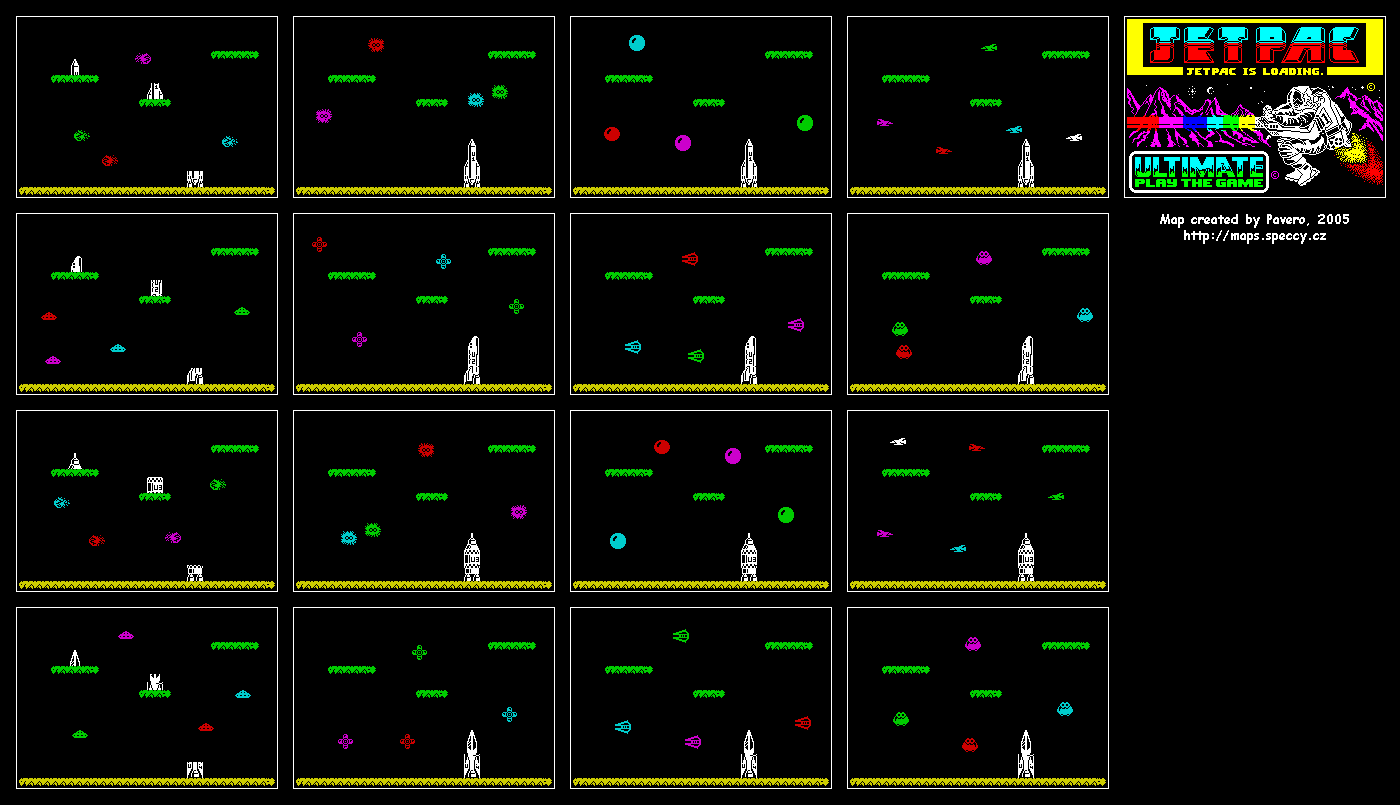
Sixteen planets. The same single screen every time. The loop is identical — collect, refuel, launch — but the enemy roster changes and the pressure climbs. The map makes the design argument visible: it is not variety the game offers, it is escalation. Map: Spectrum Computing / Pavero. Gameplay GIF: retrogames!now.
What matters is not the description, but the rhythm. Retrieving rocket parts requires controlled movement, careful approach, and a constant awareness of exposure. Refuelling turns that into repetition under pressure, as you make multiple trips while the screen grows more crowded and less forgiving. Launch offers a brief release before the escalation begins again. Three distinct beats, all drawn from the same tiny ruleset.
The controls are where the loop truly takes hold. Jetpac gives you inertia. Thrust moves you, but releasing it does not stop you. Momentum carries forward, and you have to work against it, shaping your path rather than snapping to it. The result is a game that feels less like steering and more like flying. Failure arrives quickly, but so does the restart. There is no long recovery, no extended lead-in. You are back in motion within seconds, re-entering the same space, the same pressures, the same possibility that this time you will handle it better.
What The Screen Edges Are For
Most early home-computer shooters offer a kind of comfort at the edges. You can skim the boundary, buy yourself a moment, treat the perimeter as a place of relative safety. Jetpac removes that idea entirely.
The screen wraps. Leave one side and you reappear on the other. Your laser does the same. So do the enemies. There is no corner to retreat to, no wall to lean against. The space folds back on itself, and with it, the danger. The map is small, a single screen with a handful of platforms, yet it never feels contained. Threat circulates. Movement loops. The game is intimate and unbounded at once.
Even the Spectrum’s limitations are turned to advantage. The background is pure black. Sprites are bright and distinct. Jetman reads instantly against the void, as do the enemies and the scattered rocket parts. What might have been a technical compromise becomes visual clarity. The machine’s constraints are not hidden; they are absorbed into the design.
That clarity is what keeps the pressure fair. Jetpac is hard, but it is rarely muddy. When an enemy clips you, the game has usually shown the collision forming long before it happens. You saw the angle. You knew where your drift was carrying you. You trusted the screen edge too late, or fired instead of correcting your fall, or grabbed the canister before checking the lane above you. The punishment is immediate, but it reads as consequence rather than noise.
This is where the arcade thinking matters. The game is not just difficult; it is legible at speed. Every run teaches spatial judgement in the same small room, and the room changes because you change inside it.
Built From Constraint
The game fits into 16 kilobytes, and that limitation defines everything about it. This is not minimalism as a style, but compression as a necessity. Nothing can exist unless it justifies itself immediately. There is no room for excess systems, no tolerance for mechanics that do not directly serve the loop.
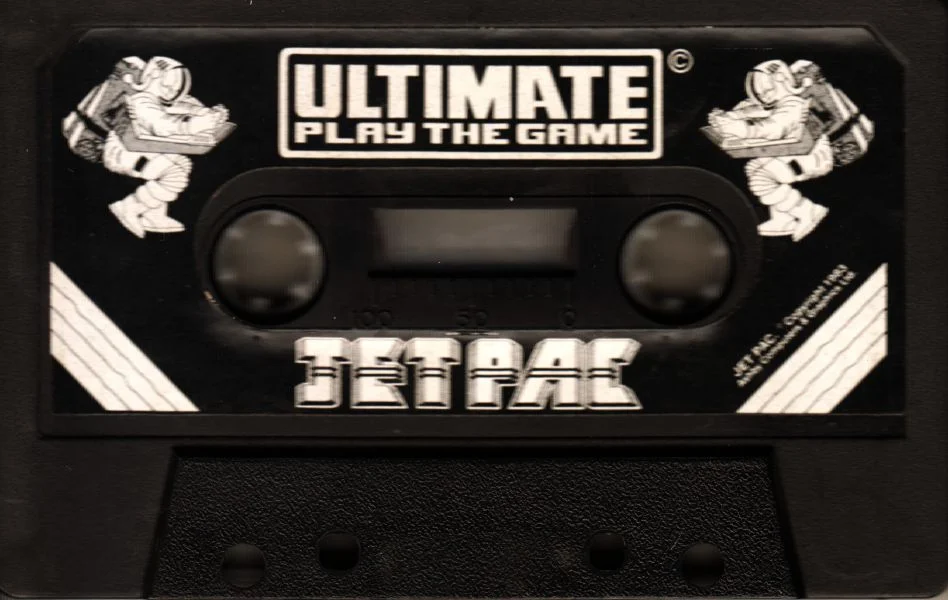
The physical object: 16 kilobytes on a cassette, sold as a premium arcade product. The label design is as confident as the box — chrome logo, twin Jetman figures, no apology for what the medium is. Cassette scan: Spectrum Computing.
That compression mattered commercially as well as aesthetically. Ultimate Play the Game was working from a house in Ashby-de-la-Zouch, and Jetpac was the studio’s first release. The Stampers had experience with arcade hardware and a clear sense of how a game should communicate its state. On the Spectrum, they targeted the 16K machines partly because the audience was larger and the development cycles could stay short. But in Jetpac, that practical choice becomes a discipline. The limited memory does not make the game feel thin. It makes every element answer to the same question: does this sharpen the loop?
The answer is visible in the absence of padding. No map screen. No narrative interstitials. No inventory beyond what Jetman is carrying in the moment. No decorative complexity competing with the hazards. Even the pickup logic is exact: rocket parts must be collected in sequence, while fuel canisters become a recurring demand, a little labour ritual performed under fire. The game keeps asking for the same action and keeps changing the cost of doing it.
The result is not a smaller game, but a denser one. Every element carries weight. Every action feeds back into the same core rhythm. What remains is pure structure.
Gold On The First Attempt
Jetpac won Game of the Year at the inaugural Golden Joystick Awards in 1983 and sold in remarkable numbers for the time, quickly establishing Ultimate Play the Game as the dominant developer on the Spectrum. For a debut, it is absurdly assured: not a sketch of future promise, but a finished argument about what home-computer arcade design could be.
More telling, though, is how people responded to it. Contemporary reviews kept reaching for the word “addictive,” not as a vague compliment, but as a way of describing something new on home computers: a game built around immediate readability, rapid restart, and steadily rising pressure. It did not ask for patience. It asked for repetition.
That experience was reinforced by how quickly you could access it. Released on ROM for the ZX Interface 2, Jetpac could be running in seconds, at a time when most Spectrum games required minutes of loading from tape. The gap between failure and the next attempt all but disappeared. The cartridge version did not change the rules, but it changed the ritual around them. No waiting room. No tape squeal. Just the loop, available immediately, which is exactly how an arcade idea wants to be treated.
What players were responding to was not just quality, but structure — a game built around the loop, not around progress.
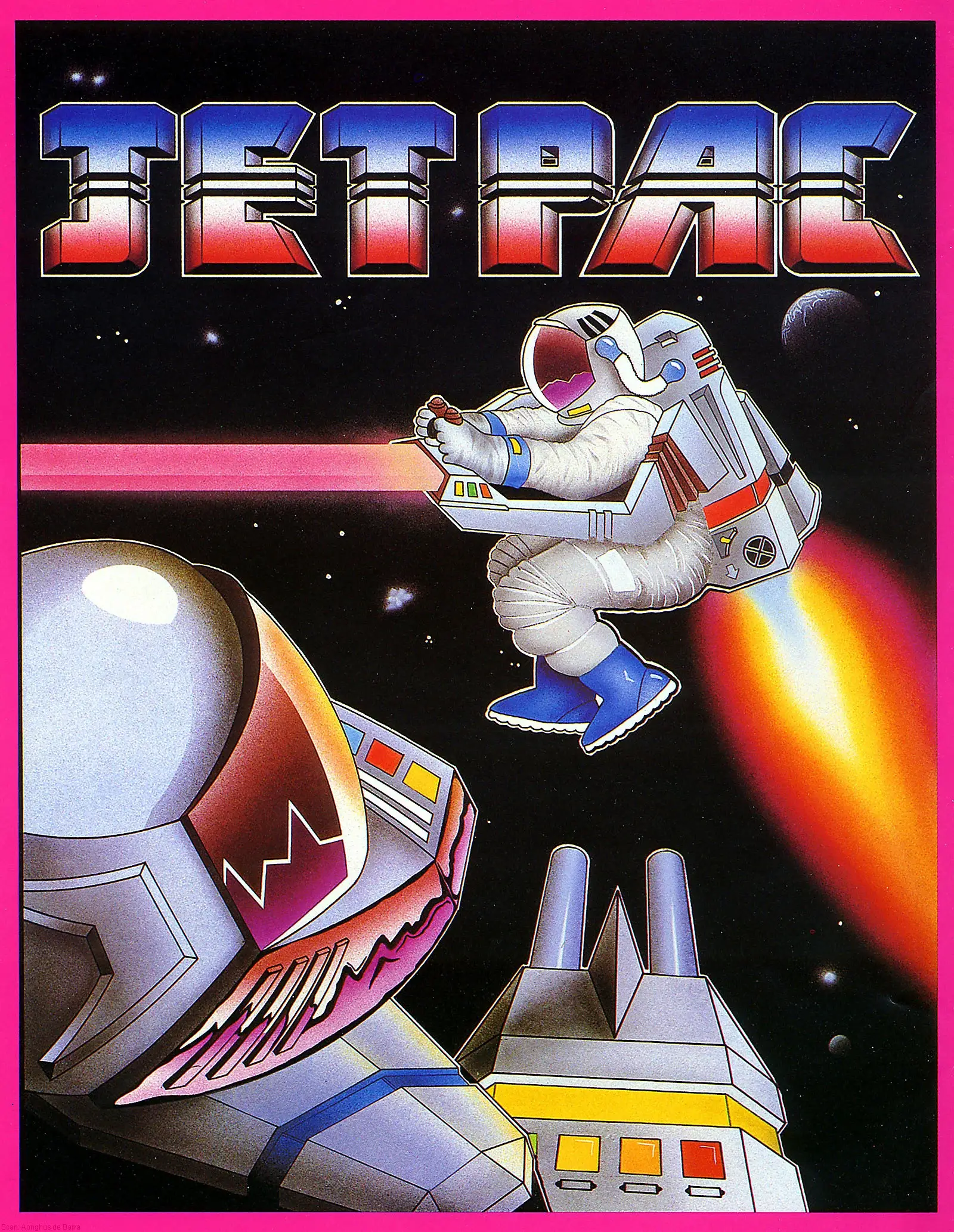
The poster pitches Jetman as a genuine science-fiction hero, the world beneath him worth escaping. Poster: Ultimate Play the Game / Spectrum Computing.
The packaging and adverts lean hard into that confidence. They sell Jetpac as space adventure, all lasers, rocket exhaust, and clean heroic silhouette. The game itself is harsher and more abstract than the art, but the gap works in its favour. The cover gives you the fantasy; the screen gives you the machine. One says Jetman is a pulp hero. The other reveals he is a small, fragile point of control inside a system that never stops moving.
It also shows how quickly Ultimate understood presentation. The box art does not apologise for the Spectrum or frame the game as a budget curiosity. It treats a 16K cassette release like a premium object, with a logo, a figure, a world, and a promise of arcade discipline in the home. That mattered in 1983, when the British micro scene could still feel improvised, brilliant, and uneven all at once. Jetpac looked like someone had arrived with standards.
What Survives
While making Jetpac, the Stampers were already looking beyond the Spectrum, studying the Japanese market and laying the groundwork for what would become Rare. The through-line is already visible: clarity, responsiveness, and a refusal to waste the player’s attention.
The game’s afterlife makes the point more clearly than any retrospective could. Jetpac appears inside Donkey Kong 64 as a required challenge for full completion, still demanding enough to gate progress in a much larger, more modern game. Rare later returned to it directly with Jetpac Refuelled, a remake that understands the shape of the original even as it adds modern gloss, widescreen movement, and a proper soundtrack. The fact that Refuelled works at all is evidence of how sturdy the 1983 design already was. You can expand the presentation and still recognise the skeleton immediately.
There is something funny, and slightly brutal, about that persistence. Lots of early home-computer games survive as artefacts: charming, important, best approached with historical sympathy. Jetpac asks for less charity than that. Its age is visible in the small sprite set and the beeper austerity, but not in the contract it makes with the player. It still knows exactly what it wants from your hands.
That is the honest argument for it now. Not that it was first. Not that it was influential. But that its loop still runs cleanly. The physics remain legible. The escalation remains fair. The pressure still circulates across the screen, never settling, never offering a safe edge. Five minutes is enough to produce the same feeling it did in 1983: that the next run will be the one where everything finally aligns.
That feeling is not nostalgia.
It is cadence.