The most commercially successful arcade machine ever made in America was a bootleg. Not a sequel — a speedup kit, built by three engineers who had sued Atari two years earlier to establish that rewriting somebody else’s ROMs was legal. Midway bought the kit, drew a bow on the yellow circle, and shipped it without asking Namco. By the time Masaya Nakamura was shown the finished cabinet and offered the only note he had — get rid of the hair — more than a hundred thousand machines were already earning quarters in American bars.
What Midway’s marketing called a sequel was an engineering fix for a problem the original had caused. By late 1981, competent players had memorised every pattern in Pac-Man, and a machine that used to swallow quarters had begun to hold them. The fix was random ghost behaviour, four mazes instead of one, and moving fruit. The bow was cover.
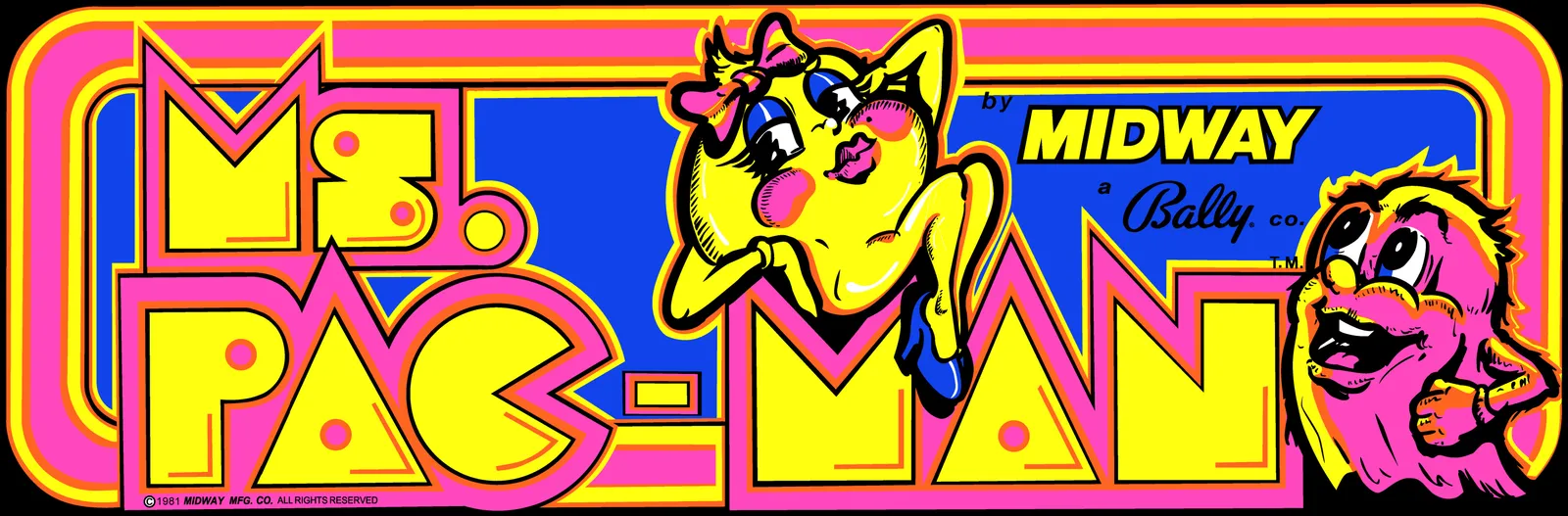
The Midway marquee. The typography and the palette are the game’s real signature — bolder, hotter, and more aggressive than anything Namco shipped under its own name. · Midway Mfg., 1982
The Enhancement Kit Industry
In 1981, Doug Macrae and Kevin Curran ran the arcade at MIT’s Tech Square. Their best-earning machine was a Missile Command cabinet that had stopped earning; the novelty had worn off, and the regulars had beaten it. Rather than replace the board, Macrae modified the ROMs to add extra levels and harder enemies. He called the result Super Missile Attack. It doubled the cabinet’s weekly take. The pair founded General Computer Corporation to sell the kit commercially, hired a recent MIT graduate named Steve Golson, and were promptly sued by Atari for copyright infringement.
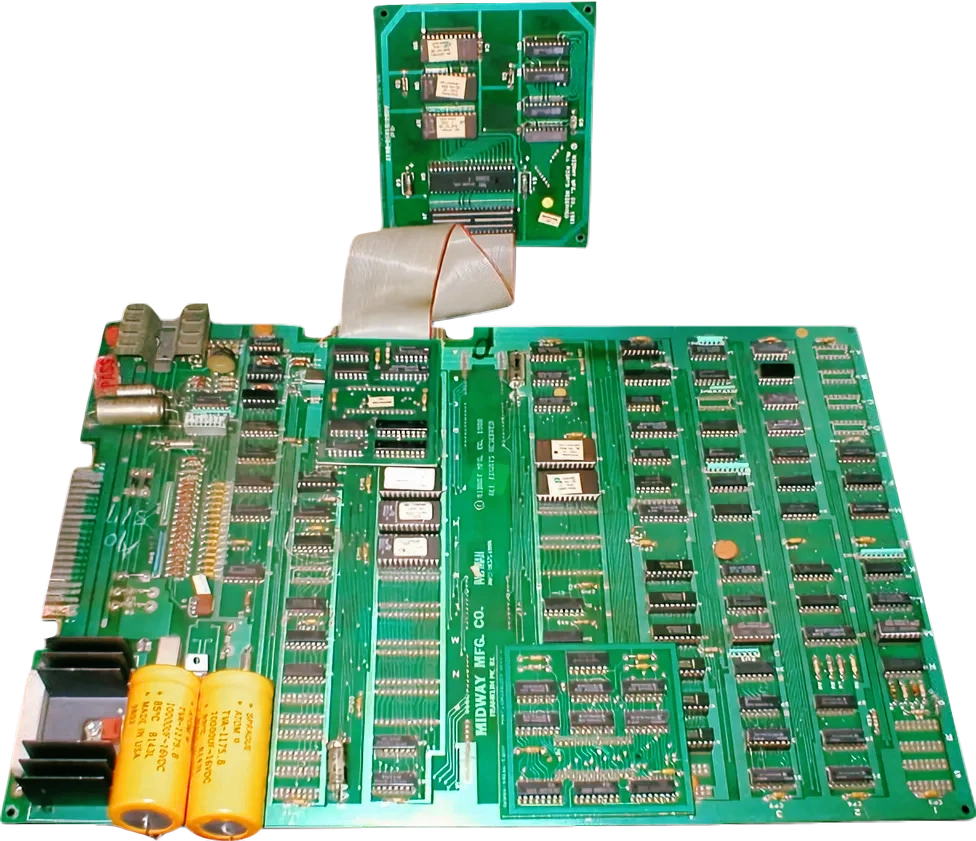
The physical evidence. The green GCC daughter-board riding the Midway Pac-Man PCB is the game. Install the ribbon cable, power up, and Ms. Pac-Man boots. · Midway / GCC, 1982
The case settled in 1982. GCC paid Atari fifty thousand dollars and agreed not to produce further unauthorised Atari conversions. In return, Atari retained them to build future kits under licence. The ruling was commercially consequential in a way that mattered far beyond one machine: ROM enhancement kits, as a practice, had been legitimised. A small team with an oscilloscope and a disassembler could now take a tired cabinet, rewrite its brain, and sell the result back to the operators. An industry arrived inside a year.
GCC’s next kit was for Midway’s Pac-Man. The project was codenamed Crazy Otto. It replaced the single maze with four new ones, gave the ghosts unpredictable behaviour in their first seconds out of the pen, added fruit that wandered the maze instead of sitting in one spot, and sped up the entire chase. The star was a small-footed blob named Otto, because without Midway’s cooperation the kit could not ship as a Pac-Man product.
Midway’s cooperation was exactly what the kit needed.
Pattern Players and an Exhausted Machine
By late 1981, Pac-Man was hurting on the floor. The game had been out for eighteen months, and American players had learned to beat it. Craig Kubey’s How to Win at Video Games, published in early 1982, laid out the exact ghost-navigation routes with the calm authority of a chess primer. A competent player could ride a single quarter for forty minutes. Competent players were no longer unusual.
Arcade machines earn money by turning players over. A cabinet that holds a skilled player for half an hour earns nothing from the line waiting behind them. Pac-Man had been printing cash in 1980; by 1981 it had become, in the operators’ trade language, a pattern-solved machine. The industry wanted something that restored the game’s hostility to expertise without requiring a whole new cabinet — a problem GCC had now built a business around.
They walked into Midway’s Franklin Park headquarters with a finished hack that fixed the pattern problem in four different ways at once. Midway bought it on the spot. The acquisition terms were not public, but the essential deal was that GCC would receive a royalty on every cabinet sold and Midway would handle manufacturing, marketing, and — a detail that would matter later — the delicate question of permission from Namco.
What the ROM Actually Did
The four new mazes are the change most players notice. They rotate as the game progresses: cyan on pink, orange on white, cyan on blue, bare on white, then back to the start. The topology of each is different enough that routes learned on one do not transfer to the next. That alone would have forced players back to improvisation. The other changes made improvisation the permanent mode.
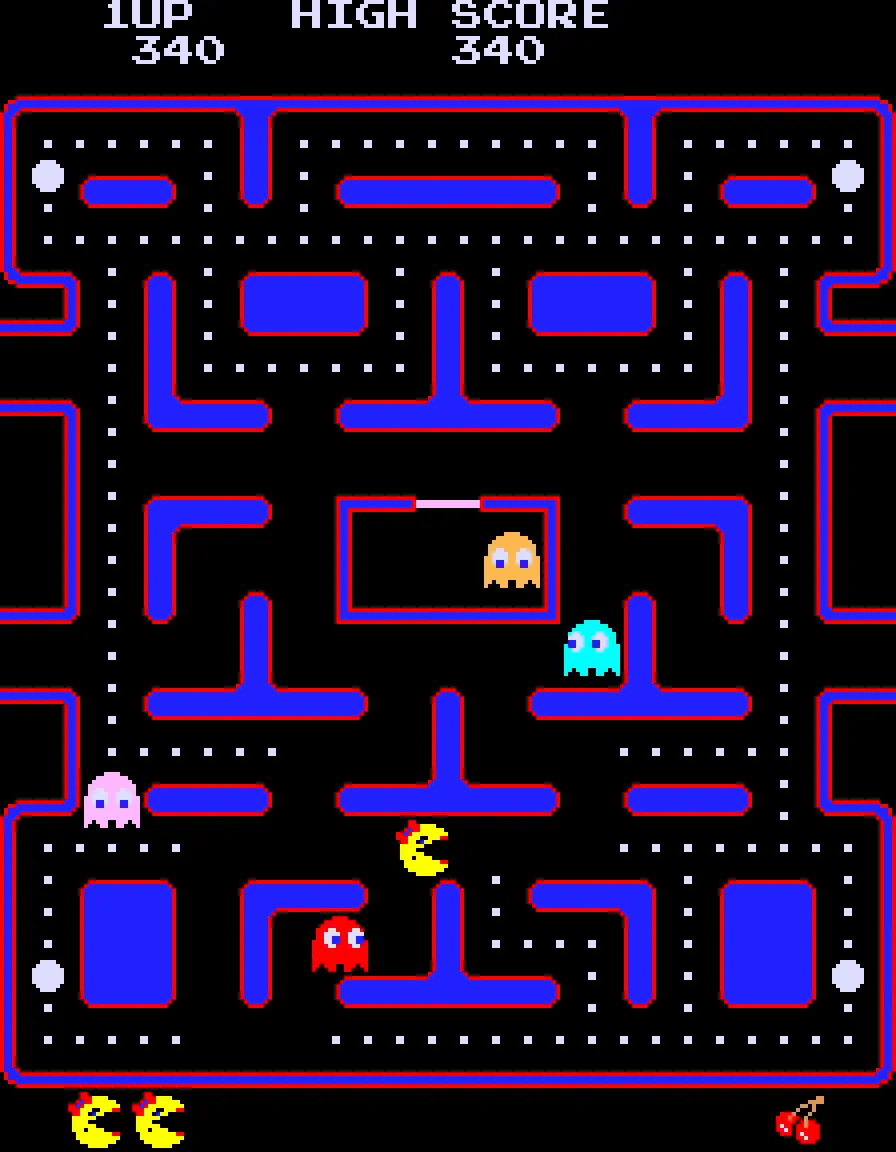
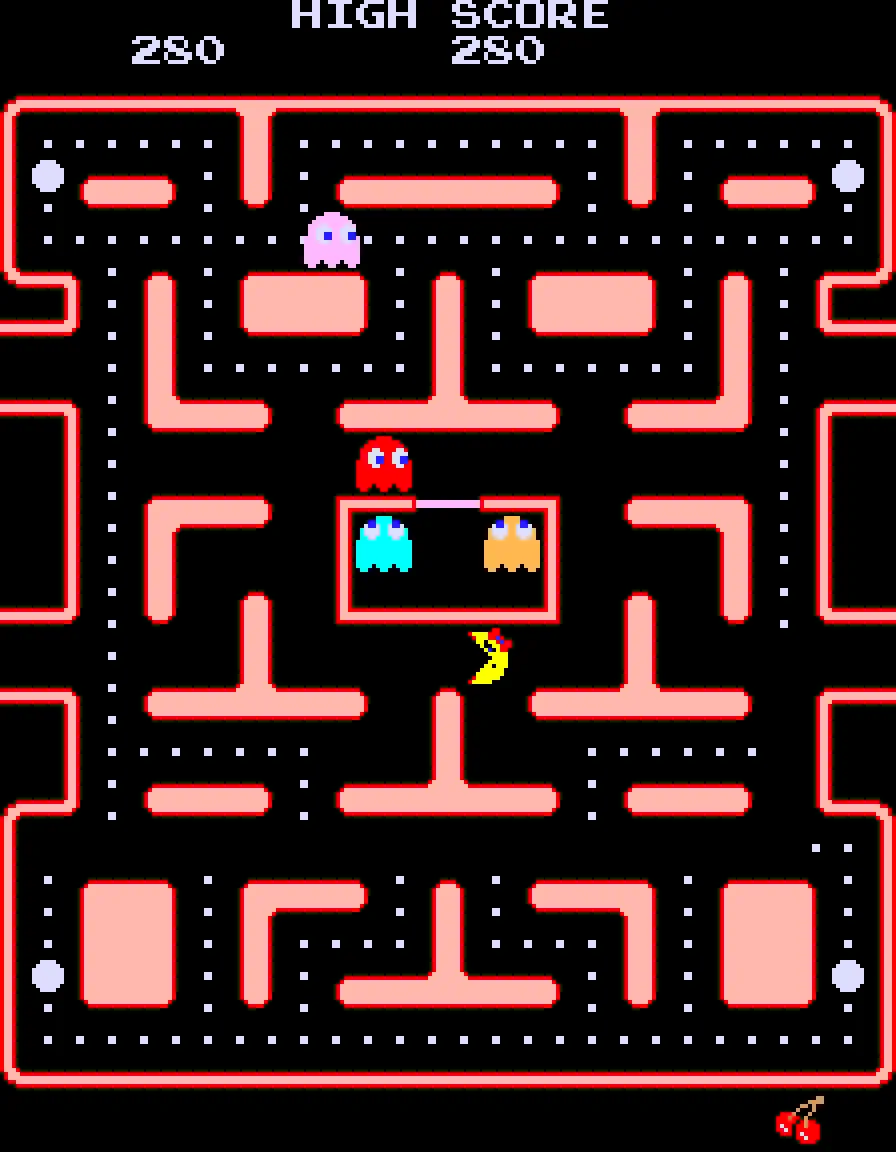
Two of the four mazes. The first and second ship in different palettes and different topologies — the same machine, running what amounts to four games. · GCC / Midway, 1982
The ghosts in the original Pac-Man are deterministic. Given an identical input, they produce an identical output. That determinism is what allowed pattern play to work: once a route through a given level was discovered, it could be repeated perfectly. Ms. Pac-Man introduces a pseudo-random element during the ghosts’ first few seconds out of the pen. The seeding is tied to the frame counter, meaning the ghosts behave differently depending on when the player moves. The effect is subtle per-frame and devastating across a session. Pattern play does not become harder. It becomes impossible.
The moving fruit reinforces the change. In Pac-Man, the bonus item sits in a fixed position and rewards the player who arrives at a known spot on a known schedule. In Ms. Pac-Man, the fruit enters from the tunnels and wanders the maze. Chasing it costs time and exposes the player to ghosts. Ignoring it forfeits points. The decision has to be made in motion and it has to be made freshly each time. None of these changes are cosmetic. They are the game.
The Cabinet Painted Over the Engineer
Midway’s marketing solved a different problem. Pac-Man’s success in 1980 had already made the character company property in the American imagination; Ms. Pac-Man needed a reason to exist that a ten-year-old and a bar owner would both accept. Midway gave it two, simultaneously and incompatibly.
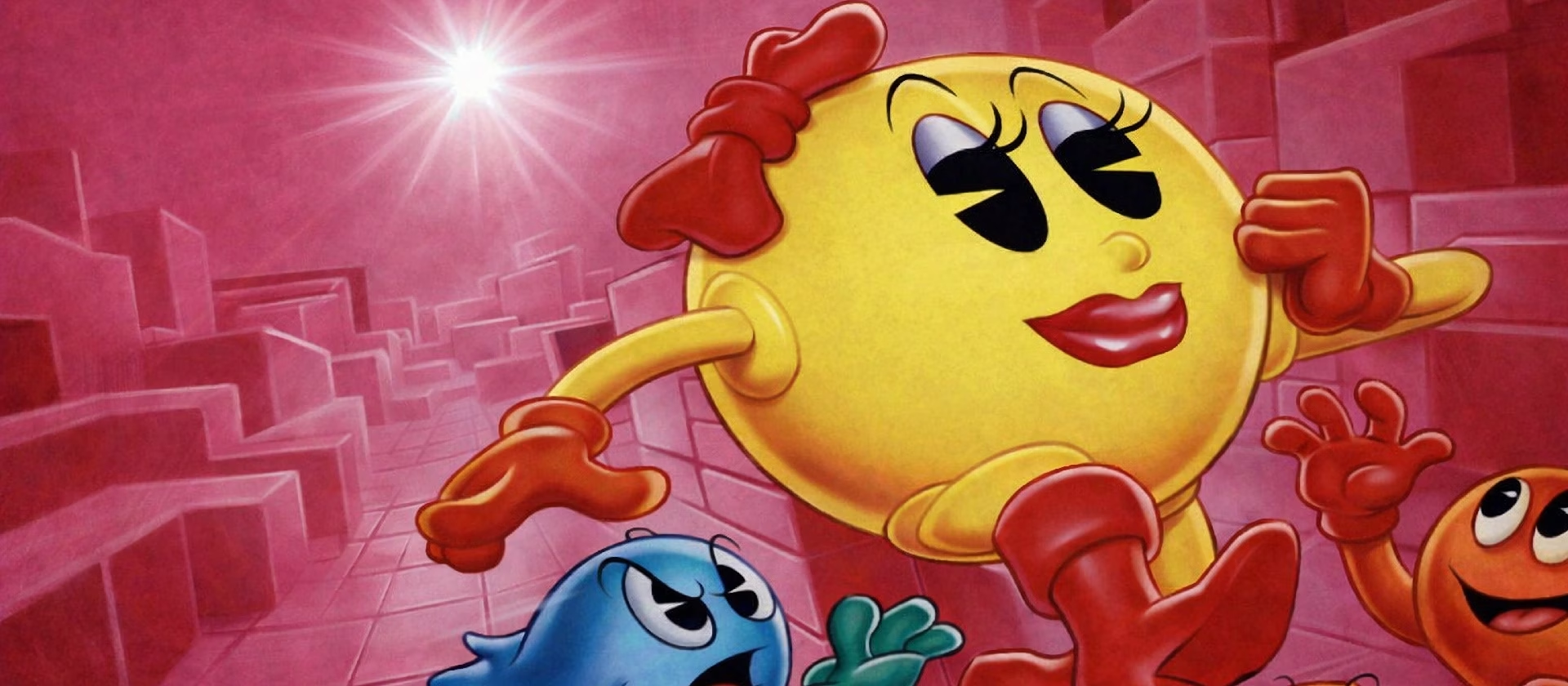
The press release, quoted in Electronic Games in May 1982, had Midway marketing manager Stan Jarocki calling the game “a thank you to all the lady arcaders who have stood by us.” The promotional flyer sent to operators that same month carried the headline Introducing the new femme fatale of the game world, above an illustration of the character in high heels and a fur stole, posed beside a shadowy man in a trench coat and a waiting black car. The two documents say different things. Both are authentic; neither is the whole story.
Maria Lewis, writing for the Australian Centre for the Moving Image’s collection notes, is crisp on the contradiction. The cabinet art belongs to the lineage of mid-century advertising that used women to sell appliances to men; the marketing copy belongs to a different lineage, the slightly nervous accommodation the arcade industry had begun to make with the fact that its audience was not the one it had imagined. That accommodation was not hypothetical. Kubey’s 1982 book and Joyce Worley’s columns in Electronic Games both reported, flatly and without editorialising, that women already made up a clear majority of Pac-Man players. Midway’s thank-you note was being delivered to the customers it had spent two years pretending it did not have.
The cabinet is loud about the confusion. The wood-grain surround is standard Midway hardware; everything above it is the hottest pink available and yellow, with the character above the monitor in heels and eyelashes and the blue ghost beside her drawn with a raised, cartoonish scowl. It is a machine that is trying very hard to be read as feminine by people who have never had to think about what that means.
Permission, Retroactively
Masaya Nakamura, president of Namco, first saw Ms. Pac-Man as a finished product. In Doug Macrae’s telling, given to Retro Gamer in 2015, Nakamura was shown the cabinet in Chicago after more than a hundred thousand units had already shipped. He approved the character on a single condition — that the long-lashed hair Midway had drawn on the original promotional art be removed from the in-game sprite. The hair went. The bow and eyelashes stayed. Namco received a royalty arrangement that had been negotiated entirely after the fact.
GCC’s engineers left a small acknowledgement of the unauthorised origin inside the ROM. A string buried in the program memory reads HELLO, NAKAMURA!, placed where the original Pac-Man code had Toru Iwatani’s name. The ROM is still in the cabinets today. So is the game that grew out of a patent-and-permission argument and outsold the machine it was built on top of. Guinness lists roughly 115,000 Ms. Pac-Man cabinets sold in North America. The original Pac-Man’s American total was around 100,000. The sequel Namco never commissioned — built by a team whose previous legal defence had been that rewriting other people’s games was not theft — remains the best-selling arcade machine ever made in America.
The game survived all of this because the engineering was load-bearing. The marketing is a period piece now, interesting mainly as evidence of how unsure the industry was of the audience it already had. The cabinet art is an artefact of a different time, and a short walk through the ACMI’s notes is enough to see why it reads the way it does. What endures is the thing GCC actually built: four mazes, ghosts that do not repeat, fruit that moves. An exhausted machine brought back to life by somebody willing to rewrite its brain. The most commercially successful unauthorised hack ever shipped, and a better game than the one it hacked.
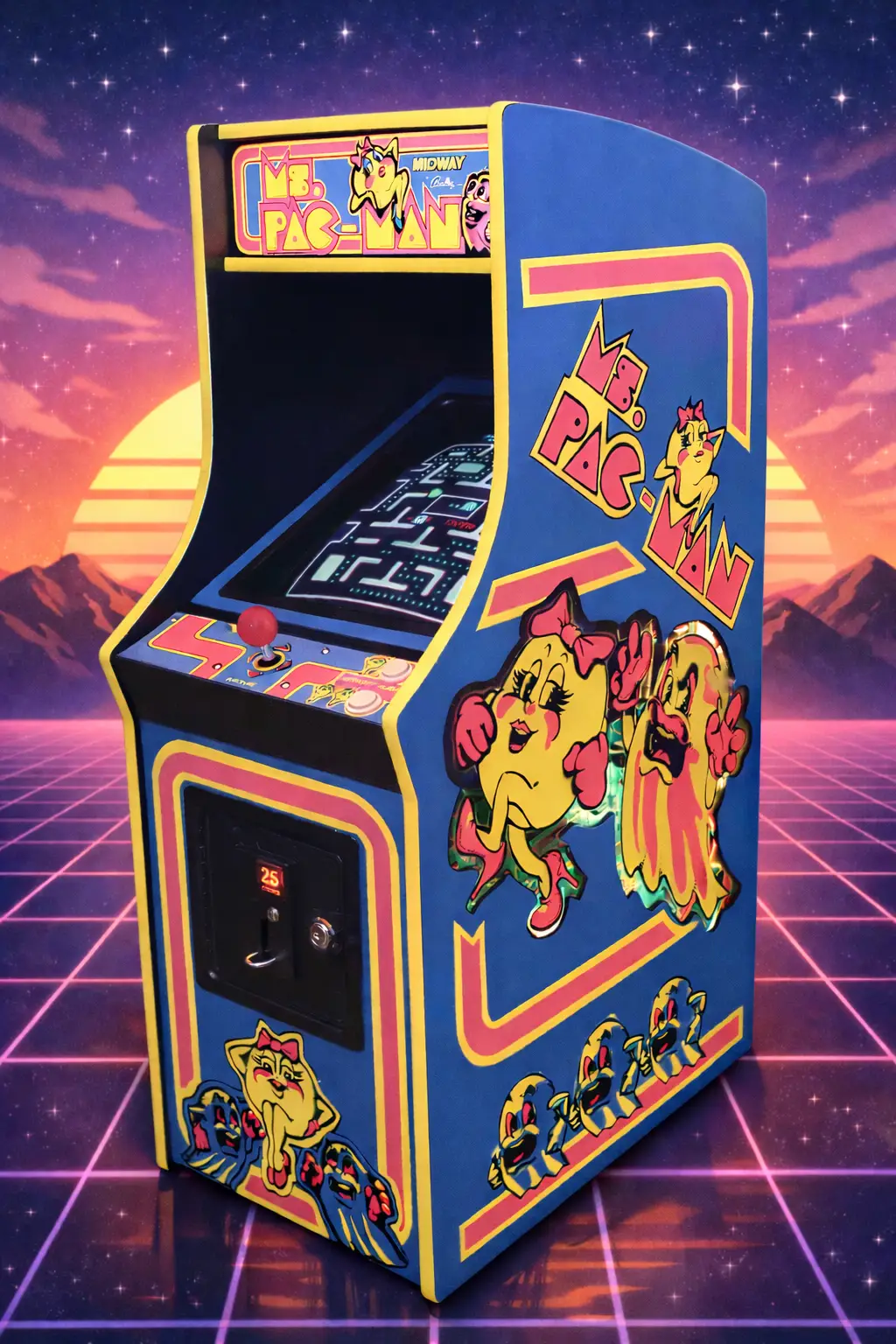
The upright cabinet. Standard Midway hardware below, entirely new above. · Midway Mfg., 1982
Most sequels add content to a working design. Ms. Pac-Man did the opposite. It took a design whose commercial life had ended and wrote a new one underneath the same character, then sold the result as a gesture of thanks to an audience it had only just noticed. Three engineers fixed an exhausted machine. Midway sold the fix in heels.