// // import shmupPoster from ”../../assets/images/astro-boy-omega-factor-2003-shmup-poster.jpg”; // deleted // deleted
// // import bossPoster from ”../../assets/images/astro-boy-omega-factor-2003-boss-poster.jpg”; // deleted // deleted
Osamu Tezuka spent sixty years running the same theatre troupe. The cast was his own — Rock the unreliable charmer, Duke Red the patriarchal villain, Ham Egg the schemer, Skunk Kusai the thief, the Phoenix who kept turning up to watch — and he moved them between manga the way Chekhov moved a company between plays. A character would die in Metropolis and headline Black Jack twenty years later. A child in Kimba would grow up into a senator in Phoenix. He called it the Star System, and it was the most useful theory of adaptation Japanese comics ever produced.
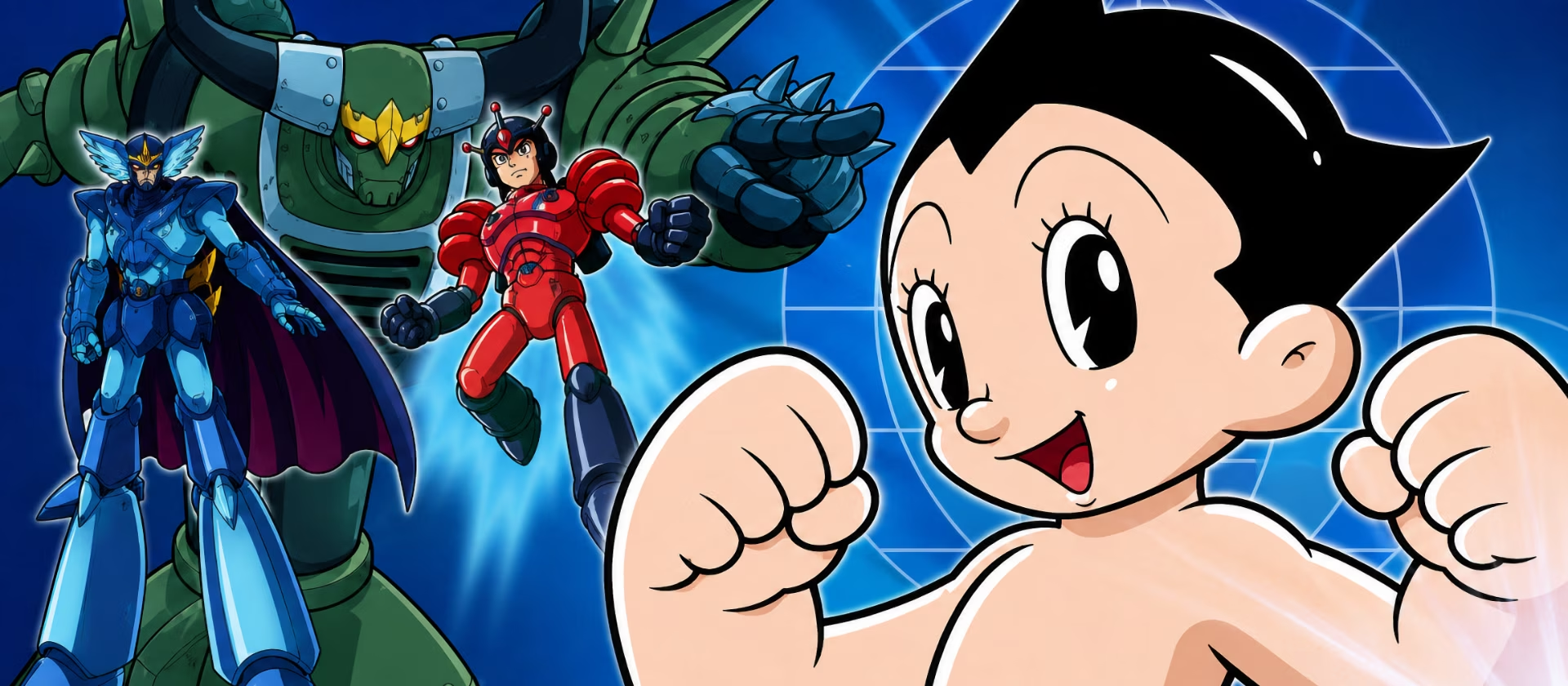
In 2003 Sega compiled the Star System onto a Game Boy Advance cartridge. Astro Boy: Omega Factor is a 2D action game about a flying robot with a jet-boot rocket and a finger gun, but its actual subject is the 120-odd Tezuka characters that make up its cast, and its actual engine is the Omega Factor power-up — a meter assembled by meeting them. As a beat-em-up it is very good. As a compression of Tezuka’s authorial system into sprites, it is one of the quiet miracles of the handheld era.
The moment was not an accident. Tezuka had died in 1989, and by the early 2000s his estate was beginning to stage-manage the inheritance: a new Tetsuwan Atom television anime arrived in April 2003, co-produced by Sony and Tezuka Productions, and the licensing gates opened wider than they had in a decade. A Sonic Team PlayStation 2 game was already in production. Omega Factor is what happened when the Game Boy Advance version was handed not to a cartoon-tie-in studio but to the developer of Gunstar Heroes and a producer who cared enough to read the whole bibliography.
Who actually made this game
Treasure are the studio usually credited, and Treasure did make it — Mitsuru Yaida, the programmer who’d written Gunstar Heroes a decade earlier, led the design, and the sprite animation carries the house fingerprint in every dash cancel. But the pitch, the producer, the 2D mandate, and the Tezuka licence all came from somewhere else. Sega’s internal studio Hitmaker — then run by Mie Kumagai, the first woman to lead a major Japanese game studio — had signed a seven-year deal with Tezuka Productions around the 2003 anime reboot. Kumagai made herself producer, hired the Segagaga director Tez Okano as creative lead, and decreed that their version would be 2D specifically because the concurrent Sonic Team PlayStation 2 Astro Boy was 3D. The whole game is an argument against that other game. Okano, asked about it twenty-two years later, was disarmingly direct:
“Sega had a contract that gave them full rights over Tezuka Productions for seven years, to use as they saw fit. I did my best to make something that would stand up even in the eyes of die-hard fans.”
— Tez Okano, Time Extension, 2025
“Die-hard fans” is the giveaway. Omega Factor was built for people who already own the thousand-page paperbacks, and the half of the authorship that decided that — Kumagai’s half, Hitmaker’s half — is the half the English-language retrospective record has almost entirely forgotten. Hitmaker is usually remembered, when remembered at all, as the Sega AM3 spin-off that made Crazy Taxi and Virtua Tennis. Omega Factor was their last major Tezuka-era project; the studio was folded back into Sega’s reshuffled internal structure the following year, and Okano went on to shorter-form work. Treasure get the heritage-brand premium on Omega Factor because Treasure survived. Hitmaker’s name stayed on the Japanese box art and fell off everywhere else.
What the hands are doing
Open the cart and it plays like a dense, readable 2D action game that keeps inventing new reasons to retune your thumbs. Mostly it is a side-scrolling beat-em-up: Astro dashes left and right along a single plane, cancels animations into air dashes, fires machine-gun finger shots, and punches combos that chain into a super meter. Because Astro is the only playable character, Yaida leaned on movement variety — a six-way aerial dash, a ground slam, a charged finger laser, a contextual ranged target-lock — so no fight reduces to one tool for long. Then, every other stage, the game changes shape: it becomes a vertical shmup with Astro flying through missile waves, a dialogue tree with branching endings, a chase through a collapsing building, a boss duel against a robot the size of a small building.
Nothing is held long enough to grow stale, and nothing arrives before the previous verse is earned. This is Treasure doing what Treasure did — working the GBA sprite pipeline hard enough to keep a city skyline parallaxing in four layers while a boss the size of a marquee sprays pink starburst particles across the foreground — but under a structural plan that isn’t Treasure’s usual. Each chapter lands on a Tezuka character. You defeat Pluto in a mountain amphitheatre and the Omega Factor meter fills a square. You meet Black Jack in a hospital corridor to cure Prime Rose’s Dolmehka syndrome, and another square fills. You talk your way past Skunk Kusai in a museum and the meter edges another notch. The Phoenix is the last to arrive, and when she does the game’s entire first half unlocks a second, stranger reading, and you travel backwards in time to replay it carrying everyone you met the first time through.
Every cameo is load-bearing. The Star System has become a progression system. Each character you meet is both a plot beat and a dataset entry, and the game is keeping score — which is why the best way to appreciate what Yaida and Okano built is to replay a stage immediately after the unlock, when you can see the character you just recruited actually turning up in the margins, as a sparring partner or a dialogue tree, and recognise them as something more than set dressing. A reader who knows the Tezuka canon plays a subtly different game from a reader who doesn’t. Both games are good. Only one has the floor under it.
The score that holds all of it
Norio Hanzawa — the Treasure house composer who wrote the overclocked orchestra of Gunstar Heroes and Mischief Makers — split the music with Tsuyoshi Kaneko, and the score does the load-bearing work the screen can’t. It is relentlessly major-key, brass-forward, and faster than its tempo suggests. Boss fights run on off-beat snare rolls that sit exactly between Hanzawa’s usual action-game propulsion and a Saturday-morning cartoon horn section. The GBA’s audio hardware is not kind to composers — four PSG channels and two direct-sound channels, and most GBA scores thin the mix to fit — but Hanzawa and Kaneko write through the constraint by keeping melodic lines short and harmonic motion fast. The result is the single most convincingly anime-feeling score the platform produced, and the only one I can think of that doesn’t sound like it’s trying to hide the hardware.
Why it still pays back
The received reading of Omega Factor is that it is an underrated Treasure gem that got lost on a GBA the audience was leaving. The second half of that sentence is true — the game launched in North America in August 2004, three months before the DS, and in Europe in February 2005, by which point the platform’s readers had moved on. The first half is the misread. Famitsu gave it 9/9/8/8 Gold on Japanese release. GameSpot named it their GBA Game of the Year for 2004. GMR’s contemporary review called it:
“A surprisingly challenging, exceptionally beautiful time capsule of Tezuka’s greatest hits.”
— GMR Magazine, September 2004
Omega Factor was not ignored by critics. It was born onto a platform losing its readers faster than it could find them — and because the Western marketing sold it as a solo Astro Boy platformer rather than a Tezuka tribute, even the readers who stayed didn’t know what they were looking at. That is a different argument from “underrated,” and it’s the one that matters now, because every reason the game was adored in 2003 is still sitting inside the cart.
Played today, on an Analogue Pocket or mGBA or a Game Boy Advance SP held close enough to see the pixels, it does the thing a good Treasure action game always did — gives your hands something new to learn every fifteen minutes — and it does the thing almost no licensed game has ever done, which is to actually know its source material, and to make that knowledge into mechanics. You do not have to have read Black Jack to enjoy meeting Black Jack. But if you have, the game becomes briefly the thing only this game is: Tezuka’s compressed collected works, running at sixty frames a second in your palm.