// import bunnySushiCastlePoster from ”../../assets/images/ganbare-goemon-2-1993-bunny-sushi-castle-poster.jpg”; // deleted
// // import impactCockpitPoster from ”../../assets/images/ganbare-goemon-2-1993-impact-cockpit-poster.jpg”; // deleted // deleted
// // import twinbeeTvPoster from ”../../assets/images/ganbare-goemon-2-1993-twinbee-tv-poster.jpg”; // deleted // deleted
Ganbare Goemon 2: Kiteretsu Shōgun McGuinness opens like a game trying to see how much nonsense it can smuggle past you before you notice that it is, underneath, absurdly well made. The villain is a Western general called McGuinness, complete with an army of anthropomorphic rabbits and a plan to improve feudal Japan by force. One town will sell you a cruise liner as casually as another game might offer a bicycle. Another hides a fully playable slice of an obscure Konami shooter. The climax involves piloting Goemon’s giant robot lookalike in a first-person brawl against a flying saucer while the mech struggles through what appears to be a fairly unpleasant cold. None of this is accidental. None of it is throwaway. The miracle of Goemon 2 is that all this lunacy is under excellent management.
That is what makes the game special. Plenty of old action games are odd. Plenty are energetic. Plenty have one or two ideas you remember years later. Goemon 2 feels different because its strangeness is not a garnish. It is the delivery system for one of the most generous, tightly paced, and cheerfully overstuffed action games on the Super Famicom. It keeps changing masks, costumes, and comic registers, but the hand guiding it never slips. Beneath the rabbits, robots, festivals, and roadside idiocy is a game that knows exactly where it is taking you.
A Package Holiday Through Absolute Nonsense
Part of the pleasure is how easily readable it all is. Goemon 2 is structured as a journey across Japan, with each region broken into towns, diversions, platforming stages, castles, and an Impact sequence at the end. The overworld map gives the whole thing the clarity of a grand day out. You are not being thrown through disconnected levels so much as sent on a very silly national tour. Village follows village, castle follows castle, and the route always feels legible even when the details become gloriously deranged.
That sense of travel matters. It gives the game a holiday mood: not restful, exactly, but festive. You are always arriving somewhere new, and the new place usually has some fresh bit of business to show off. A strange local attraction. A weird shop. A detour that feels half like a joke and half like a reward. The result is a game that rarely feels like it is repeating itself. It keeps the road moving beneath your feet.
What makes that impressive is how little confusion it creates. This is a busy game. A greedy game, in the best sense. It keeps stuffing extra bits into its own pockets. But it never loses sight of the basic rule that variety only feels good if the player can still read the journey. Goemon 2 understands that instinctively. It gives you direction, then fills the road with comic trouble.
Too Japanese? Rubbish
For years, the usual line was that the Goemon games were too specifically Japanese to travel. There is some truth in the premise. This is a series drenched in Edo-period iconography, folklore, broad local caricature, and a comic sensibility that is unmistakably domestic. But the old conclusion never really survives contact with the controller. So much of what makes Goemon 2 delightful is not trapped in text. It is in the pacing, the staging, the visual gags, and the sheer confidence with which the game throws one idea after another across the screen.
You do not need a cultural briefing to understand the joke of a giant mechanical fish turning up as a level, or a sunset road gradually dimming into evening, or a castle that looks as though it was designed by someone with access to too much food and too little restraint. The game gets its point across the old-fashioned way: by making everything immediately funny, legible, and satisfying to play. Its Japanese identity gives it flavour, but the pleasure is mechanical. The comedy is in the timing. The surprise is in the construction.
That is why the game never feels like a curio. It is not something to admire from behind glass while someone explains the context. It is a game that makes itself understood at speed. What once looked like an export problem turns out to be one of its strengths. The setting is specific. The joy is not.
Choose Your Chaos Gremlin
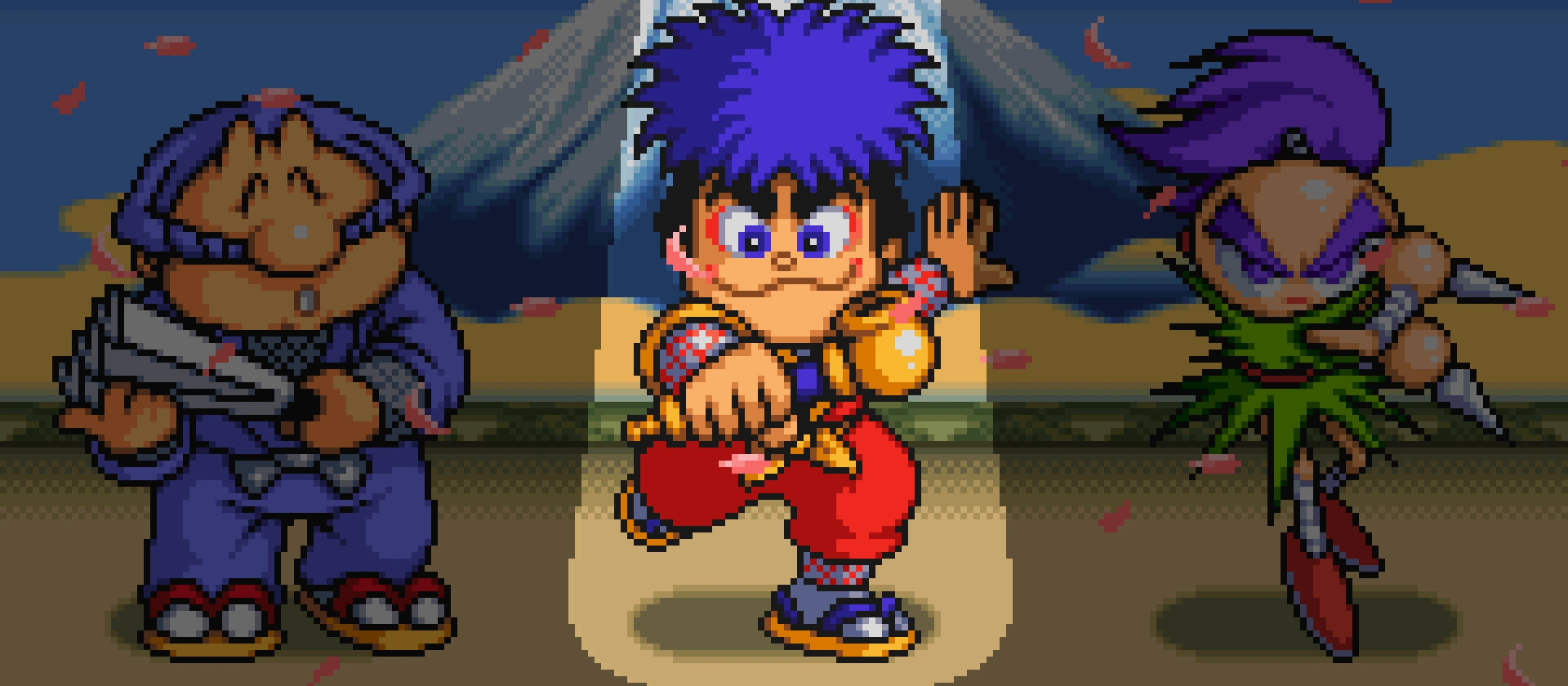
The playable cast helps. Goemon is the balanced option, the one most players will settle into first: quick enough, sturdy enough, and reliably good at whatever the game asks next. Ebisumaru, by contrast, moves like a man who has mistaken lunch for a combat style. He is broader, clumsier-looking, and faintly ridiculous, but the joke hides a proper bruiser. Then there is Sasuke, the clockwork ninja, who is all speed and precision and gives the whole game a sharper edge.
The clever part is that these choices are not just there to pad the back of the box. A run with Sasuke does not feel like the same experience wearing a different hat. The flow changes. The tempo changes. Certain stretches feel cleaner, quicker, more evasive. Ebisumaru turns other moments into a sort of waddling assault. The game bends just enough around each character to make the choice matter without ever making one of them feel like the joke option.
Even the animation gets in on the act. Characters idle with little bits of personality. Enemies do not merely disappear when you hit them; they react, flop, or fly off with a comic flourish. It gives ordinary movement and combat an extra layer of showmanship. Goemon 2 does not just want to play well. It wants to put on a performance while it does it.
This Game Refuses to Sit Down
Then there are the stages. One level gives you a giant snowball to steer down a mountain. Another threads you through laser grids. Another straps you to the back of a mechanical fish. Elsewhere the game changes scale, inverts gravity, or swaps its mood so abruptly the only sensible response is to laugh and keep going.
The key is that it never hangs around too long. Goemon 2 has the instincts of a good variety show: it sends an idea on, lets it do its turn, gets the applause, and ushers it smartly off before anyone starts glancing at the clock. The novelty is rationed. Every stage has a hook, but very few outstay their welcome.
The background art pulls its weight too. Roads darken measurably as evening draws in. Villages fill with lanterns, stall vendors, and dancing silhouettes. Castles become visual punchlines — less fortresses than themed attractions built by eccentrics. The kitsch is staged, not sprayed.
The soundtrack keeps pace. One stretch skips along on bright woodwind and temple bell; another leans into theatrical brass; the final stretch turns unexpectedly heroic as Impact approaches. Each new stop on the map sounds like a new stop. The music gives the travelogue its momentum rather than underlining gags that are already landing on their own.
Meanwhile, a Giant Robot Sneezes
And then, just as the platforming settles into a groove, along comes Impact. A giant Goemon-faced mech barrels across the landscape on its own world map; the view swings into the cockpit and the boss fight plays out in first-person melee, with scaling sprites, shoulder-charges, and ranged sneeze attacks when the robot catches cold. In a lesser game these would be a novelty chapter. Here they are the evening entertainment.
They also arrive at exactly the right moments. Each region closes on a different scale of spectacle, which stops the platforming from ever becoming too comfortable. The Mode 7 scaling and cockpit gags make each battle feel like an event rather than a reskinned boss fight. Even the sneezing works because the game plays the absurdity straight.
That confidence extends to the towns. Shops sell the aforementioned cruise liner. Side attractions contain fully playable slices of other Konami games. Hidden routes reward a second run. Goemon 2 overdelivers as a matter of principle — the game is not parsimonious for a second, and nothing in it feels like filler.
What remains impressive, three decades on, is how effortlessly the game travels. Clarity travels. Momentum travels. Comic surprise travels. Ganbare Goemon 2 is not great because it is strange — strange is easy. It is great because it knows exactly what to do with its strangeness. Every rabbit soldier, every absurd machine, every theatrical castle, every giant-robot interruption serves a game that is carefully shaped, joyfully excessive, and almost aggressively unwilling to become dull. It is one of the most exuberantly controlled action games on the Super Famicom, and it still feels like opening a toy box that keeps producing another toy.