The most influential Game Boy RPG of 1992 was written as a joke about Game Boy RPGs. Kaeru no Tame ni Kane wa Naru — For the Frog the Bell Tolls — never left Japan, never received an English translation from Nintendo, and still hasn’t. Two years ago Nintendo finally added it to Switch Online; the catch was that you needed a Japanese account, and even then it remained in Japanese. Most players who have heard of this game have heard of it as the ghost inside Link’s Awakening — the place Richard the duck-prince came from, the engine that ran Koholint, the font that spelled the words on every signpost. That ghost story is true, and it is also undersold. Kaeru is not a footnote to Link’s Awakening. It is the joke Nintendo told first, and Link’s Awakening is the version of that joke they let the rest of the world hear.
Sakamoto Versus the Serious Hero
Yoshio Sakamoto had spent the second half of the eighties on Nintendo’s most stoic projects. He wrote Famicom Detective Club, an unblinking text adventure about a teenage murder investigation. He wrote Metroid, in which a bounty hunter walks into a cave alone and meets a god. By 1991 he was watching the JRPG market crystallise into something he didn’t want to write.
”At the time, RPGs were becoming popular, but that whole vision of a serious hero bravely setting forth into the world… I wasn’t into that (laughs). I thought I’d try to subvert it a little, or make something akin to a parody.”
— Yoshio Sakamoto, 2000
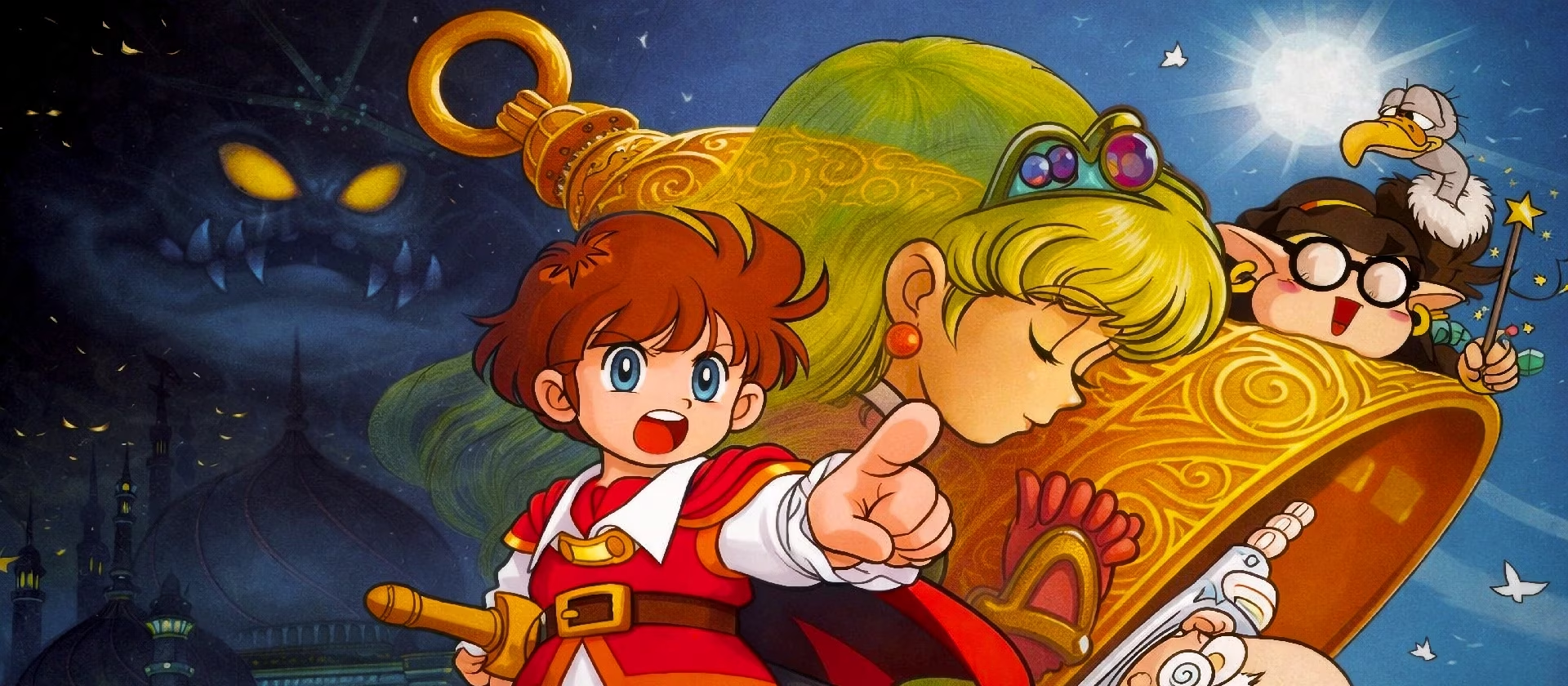
The result is a fairy-tale comedy about two princes named after pastries — Sablé and Richard, after the biscuit and the cake — competing to rescue a princess named Tiramisu from a king named Delarin. Sablé is a moron. Richard is a worse moron. The princess can fight better than either of them. Every NPC has been dropped into the kingdom from a different cartoon, the villain spends most of the game complaining, and the title — For the Frog the Bell Tolls — is a Hemingway pun nobody asked for. Fold this onto the Game Boy’s four-shade screen, render every speech bubble in a chatty Japanese kanji font Yasuhiko Fujii had to handwrite his own converter to fit, and the joke begins to read like an experiment in how much personality you can squeeze into 256 kilobytes.
A Battle System Built Three Times
Fujii — later famous as a programmer on Super Metroid — was a third-year college student when Intelligent Systems handed him the Game Boy technical manual and told him to study it for a week. He spent his summer holiday writing the map-scrolling routines. By the time he was hired full-time and given the combat layer, he made the mistake of building it as a Zelda-like action RPG.
”I originally made Kaeru to be more of an RPG like The Legend of Zelda, but I realized that copying it wouldn’t be very interesting, so midway through I simplified the battle system. I actually remade the whole system three times, partly because Super Mario Club gave the first version a bad review.”
— Yasuhiko Fujii, 2007
Mario Club was Nintendo’s in-house playtesting team — the people you didn’t want telling Yamauchi your game wasn’t fun. What survived the rewrites is the joke that runs the rest of the game: there is no battle system. You walk into an enemy. A dust cloud puffs up around the collision. Both health bars drain at speeds set by your level and equipment. Whoever bottoms out first dies. That is the entire combat loop.
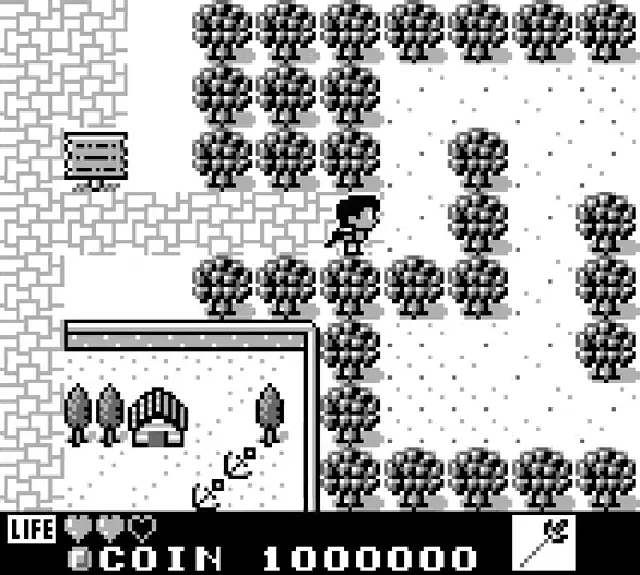
Sablé in the overworld, fan-translation patch installed. Screenshot: Kaeru no Tame ni Kane wa Naru · Nintendo R&D1, 1992.
In a 1992 RPG market still escalating into more menus, more elemental triangles, more job classes, this is genuinely radical and almost certainly funnier than Sakamoto needed it to be. The system rewards you for being a stronger character without ever rewarding you for performing that strength. Combat becomes architecture. You move through enemies the way you move through doorways. The piece of the genre most other developers were lavishing their cleverness on, Kaeru deletes — and the absence is the point. Sakamoto told the same shmuplations interviewer he thought the era’s battle systems “were getting to be a drag,” then asked, on the record, “what’s so wrong with rock-paper-scissors?”
Why It Doesn’t Feel Like 1992
The game is short — eight to ten hours if you read every line of dialogue, half that if you don’t — and it spends almost none of those hours making you wait. Talk to villagers; they say something funny; they hand you the next thing to do. Walk into the next area; the perspective tilts ninety degrees and you are in a side-scrolling platformer for ten minutes; then it tilts back. Find the apple, you can become a frog and swim through water that would otherwise drown the prince. Find the egg, you can become a snake and slither through gaps no human passes. The transformations are dialogue gates as often as movement gates — the frog can talk to other frogs, who tell it things humans are not told, and the snake terrifies the wrong NPCs into giving up information they would never have surrendered to a man holding a sword.
This is the design that aged. The auto-battle removes the era’s chief friction point. The transformations turn traversal into joke setup. The script is genuinely funny in a way that survived the fan translation in 2011 and is, even allowing for the lossy transit of decades-old comedy, the best-written thing on the Game Boy that year. The whole package runs about half the length of Link’s Awakening and never loses its grip on its own tone. There is no padding. There is no grind. There is, mercifully, no Owl.
Totaka’s Bells
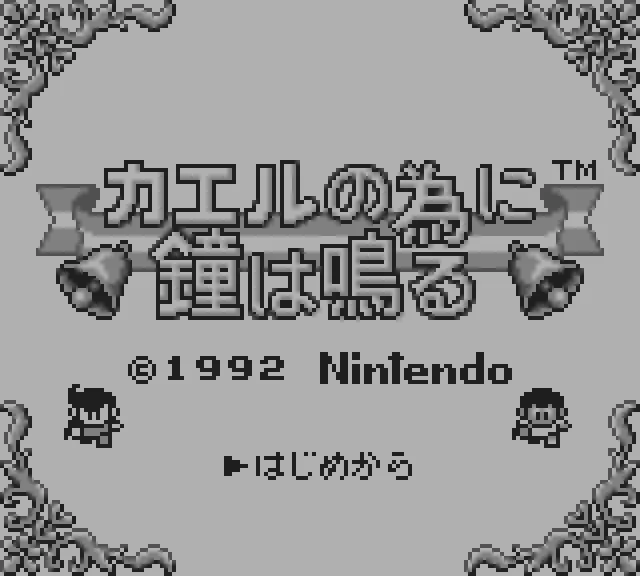
The title card, bells already ringing. Screenshot: Kaeru no Tame ni Kane wa Naru · Nintendo R&D1, 1992.
Kazumi Totaka scored it. He had joined Nintendo three years earlier and would later become inseparable from the music of Animal Crossing, Yoshi’s Story, Wii Sports, and Luigi’s Mansion — the composer whose hidden eighteen-note melody is buried in nearly everything he touches. Kaeru is the album where the Totaka voice is already fully formed: harmonic-minor verses that resolve into mischievous major-key choruses, fanfares with one wrong note, the bell motif that gives the game its title rendered as a four-bar earworm you can hum after a single playthrough. The score is comic in the same way the script is comic — never undermining the player’s investment, always letting them in on the joke a half-bar before the gag lands.
The Game Boy’s three-tone synth chip leaves nowhere to hide bad writing. Totaka writes for the chip the way Hirokazu Tanaka wrote for it on Super Mario Land: as if the constraint were the brief. Listen for the way the overworld cue walks up to a note and then declines to play it; the way the boss fanfare lands a triumphant major chord a bar earlier than the ear expects and then stops. Every cue knows exactly how long a Game Boy player’s patience runs and gets off the stage before the melody outstays it. The opening theme is a rare 1992 cue you can put on a phone speaker today and still want to hear out. None of which is what makes the soundtrack important to the rest of this story.
What Koholint Inherited
Takashi Tezuka and the Zelda team began work on what became Link’s Awakening shortly after Kaeru shipped. They needed a Game Boy engine that handled top-down exploration with seamless pivots into side-view interiors. R&D1 had just built one. The Zelda team took the skeleton — the scrolling routines, the sprite handling, the perspective-switch logic, the dialogue font — and built their dream-island Hyrule on top of it.
The borrowing went further than the engine. Richard, the duck-prince who lives in the villa in Mabe Village, is Prince Sablé in a different costume. The music that plays inside his villa is the Kaeru main theme rearranged. The frogs hopping around his garden are the frogs Sablé becomes. Every player who has wandered into Richard’s house and felt something faintly off-key about the scene — a guest from a different game, smiling at the wrong joke — was registering an inheritance the West was never told about. Link’s Awakening is full of weird non-Zelda cameos, but Richard is the only one who is, structurally, the protagonist of the engine the game was built on.
This is why the article you are reading has Link’s Awakening in its title and not Kaeru. Most readers will only have an entry point through the Zelda. But once you are inside the joke — once you have spent eight hours with Sablé being an idiot, Totaka writing comic fanfares, the auto-battle puffing dust clouds at every villain — Link’s Awakening starts to read differently. The dreamlike strangeness people credit to Tezuka and Twin Peaks was already half-built. It came in via Sakamoto’s parody. Koholint’s surrealism is inherited, not invented.
There is still no official English release. Nintendo has had thirty-four years to translate eight hours of dialogue and has chosen not to. The fan translation patch released in 2011 — the work of a small team — remains the only way to play this game in any language other than Japanese. On Switch Online you can play it in Japanese if you have a Japanese account. Emulator plus patch is faster, lighter, and runs everywhere. The English-speaking world has been allowed to love the descendant for thirty-three years and to ignore the source. Eight hours and a fan patch closes the gap. Once it closes, you cannot un-see Richard.