The story everyone tells about 1990 is the one that ends on the 21st of November, when the Super Famicom arrived in Tokyo shops at ¥25,000 with Super Mario World and F-Zero at the till. It is the correct story. It is also less than half of it. In the same twelve months that Nintendo launched the successor to the Famicom — and in the same twelve months that the Famicom itself produced the densest masterworks of its seven-year run — a different machine, in a different room, was quietly teaching itself to do things the console had no way to attempt. The year the 16-bit console wars opened in Japan was also the year the PC learned to write in full sentences.
1990 is the year the console and the PC forked. The console consolidated. Super Mario Bros. 3 finally reached America in February. Square and Enix and Intelligent Systems wrung every last instruction out of the Famicom in the spring. The Super Famicom arrived in November with a Mode 7 demo standing in for a new generation. The PC, meanwhile, was inventing: a living planet, a living economy, a comic novel that refused to kill you, a puzzle system sung rather than clicked, and a cockpit that could hold a war. Six things the console could not compute. The medium had found a second voice.
The Last Famicom Year
February the 12th, 1990. Nintendo of America finally shipped Super Mario Bros. 3 domestically, seventeen months after its Japanese release and two months after Fred Savage had promised it to millions of children in The Wizard — a ninety-minute Nintendo commercial dressed as a feature film. The game went on to sell nine million American copies and become the best-selling standalone cartridge of the NES era. It was also, by that point, an old game. The team that had finished it in 1988 had long since moved on. What the US launch of SMB3 signalled was not the start of anything. It was the arrival of the NES’s peak as a commercial phenomenon at the exact moment its developers were packing up the Famicom.
The Japanese side of the Pacific had spent the preceding months — and would spend the following spring — doing the heaviest lifting of the 8-bit generation. Dragon Quest IV shipped on the 11th of February, one day before SMB3 reached America. Its headline innovation was a party AI that learned during battle; allies adjusted their tactics turn by turn in real time. “An AI that’s too smart is also problematic,” programmer Koichi Nakamura told Famicom Tsuushin with characteristic dryness in November 1989. Nine weeks later, on the 20th of April, Intelligent Systems shipped Fire Emblem: Shadow Dragon and the Blade of Light and invented the console tactical RPG wholesale — permadeath, grid movement, a class triangle — in a game so Japan-local that the West was not allowed to play it, officially, for another thirty years. A week after that, Square released Final Fantasy III with a 23-class job system the series would not equal again until Final Fantasy V. In July, on the MSX2, Hideo Kojima finally shipped the Metal Gear sequel whose cutscenes he had been forced to cut from the first game for ROM reasons. The extra megabit that Metal Gear 2: Solid Snake secured late in development was the extra megabit that turned a stealth game into a spy novel.
”I had my doubts about action games where all you do was shoot enemies, so I was thinking about coming up with ways you could express the thrill and suspense you would experience from spy films or adventure novels.”
— Hideo Kojima, MSX Magazine, August 1990
The texture of 1990’s Japanese console year is in that sentence. Teams that had learned the hardware cold were using their final cartridges to ask questions the hardware had not been designed to answer.
A Grammar, Re-Crowned
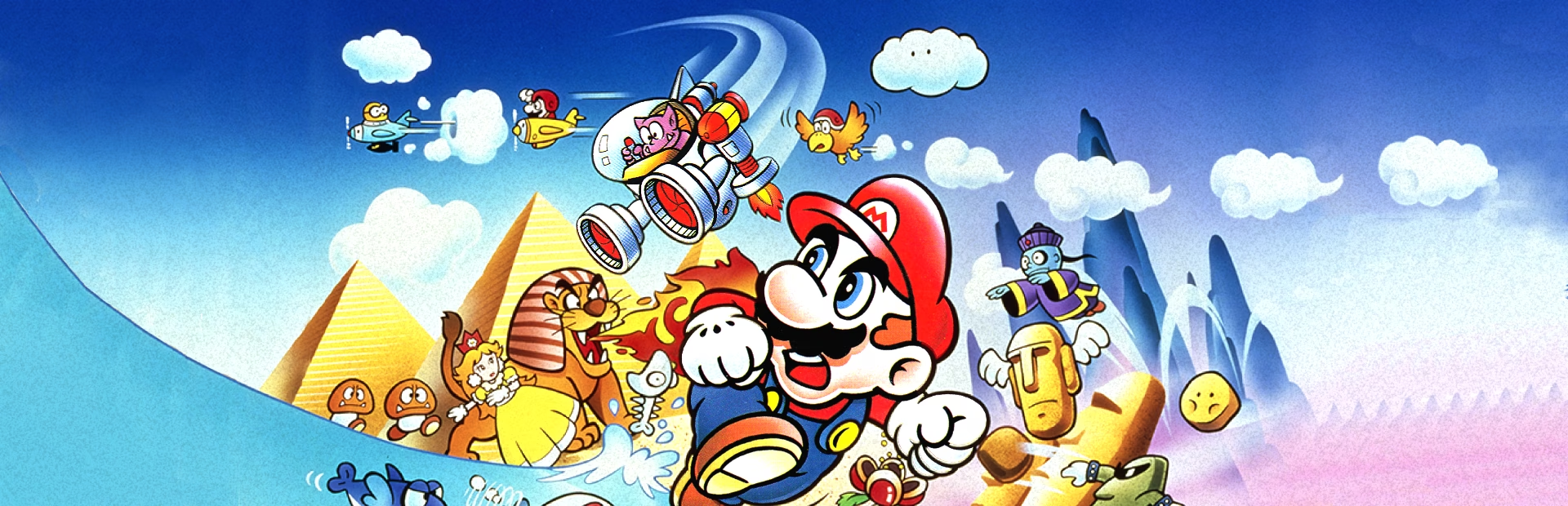
And then, on the 21st of November 1990, Nintendo shipped a new machine. The Super Famicom launched at ¥25,000 with two games at the till: Super Mario World and F-Zero. Pilotwings followed a month later. What the SFC offered in those first thirty days was not a new grammar. It was the Famicom’s grammar given a better hardware to whisper it through. Parallax. Mode 7. More colours. Yoshi.
The Yoshi sketch, Shigeru Miyamoto confessed in the 1990 Super Mario World guidebook, had been taped to his desk for five years. Famicom silicon could not render a rideable dinosaur. Super Famicom silicon could. SMW was, in that sense, a list of things the previous generation had held in escrow — and, Miyamoto said, it was deliberately aimed at newer players, a reversal from SMB3’s bias toward veterans.
”We no longer had the restrictions on scrolling and the number of colors that the Famicom had… but it was still the same game. It made me realise we couldn’t just make the same game again: we had to create something new.”
— Shigeru Miyamoto, Super Mario World guidebook, 1990
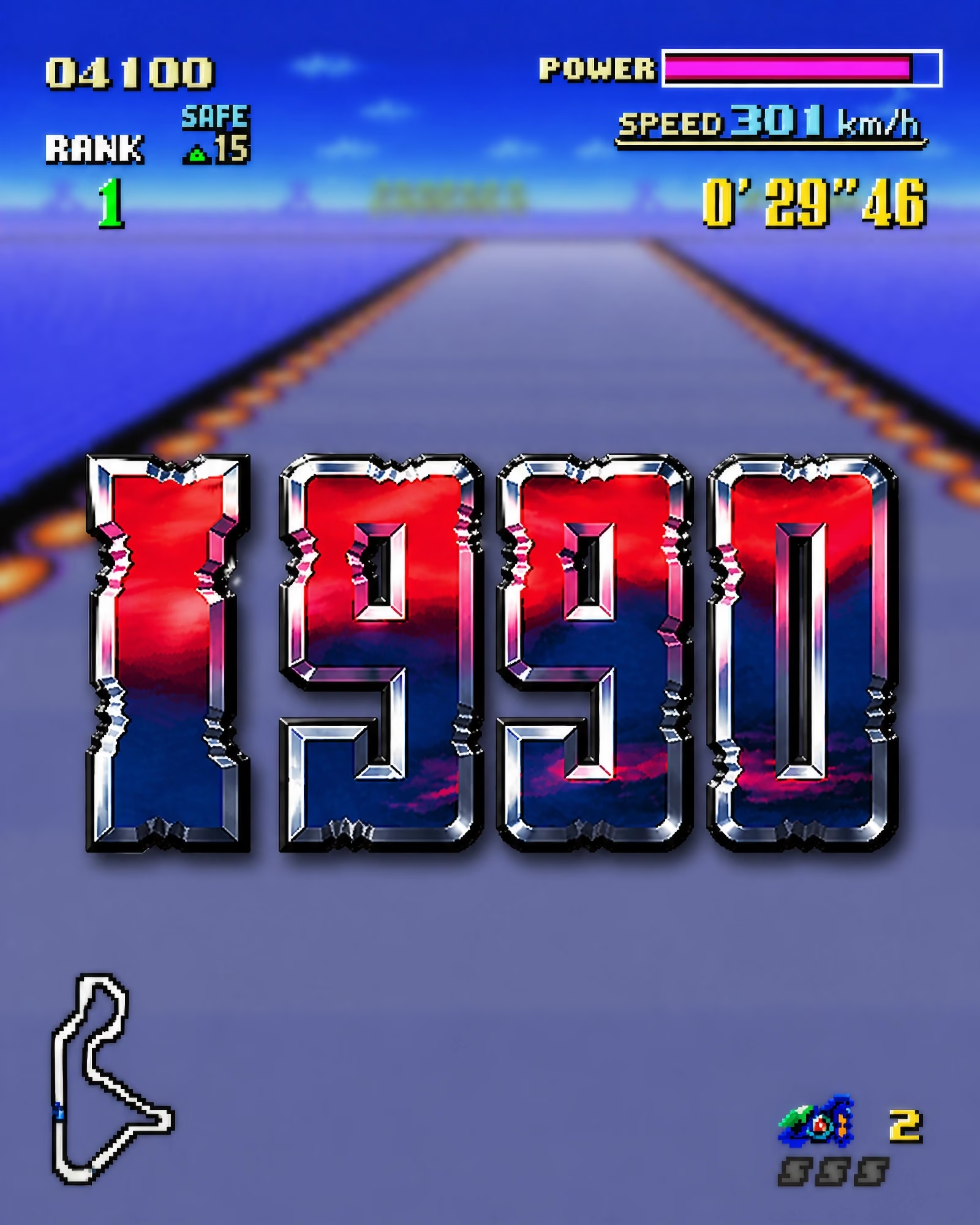
F-Zero was the argument in hardware. Director Kazunobu Shimizu, shown an in-house Mode 7 racing demo by programmer Yasunari Nishida, has since said his reaction was immediate: a racing game. This will shock everyone. At the game’s first public showing, a rival developer from an unnamed studio pressed his face to the cabinet glass and asked, apparently in earnest, whether those were polygons. They were not. A plane rotated and scaled in hardware to give the illusion of three-dimensional motion — the same trick Origin’s Wing Commander would pull that September on the PC, via different maths, toward the same end. The Super Famicom’s debut was not a new vocabulary. It was an older vocabulary, recrowned, with the polish and permission its authors had been waiting half a decade for.
Essays in Boxes
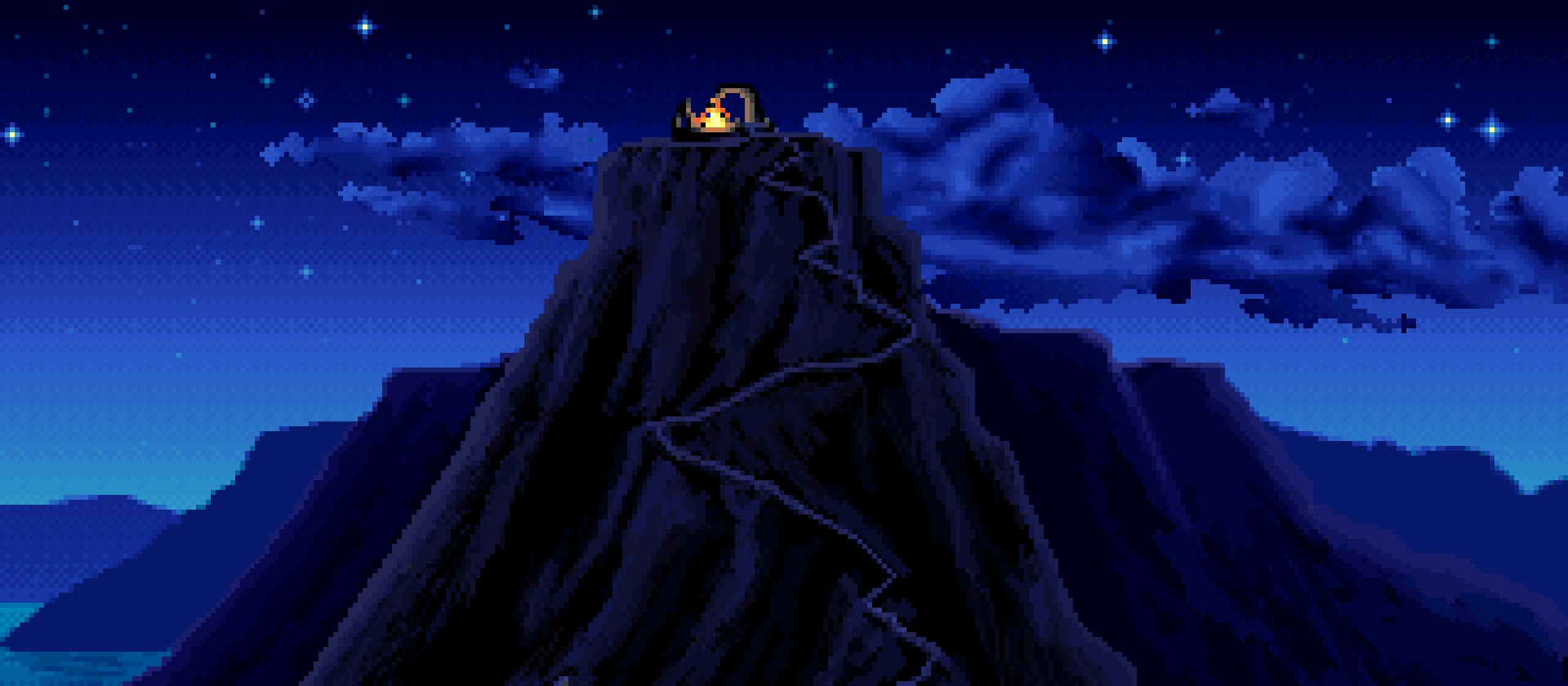
In December 1989, ten months before The Secret of Monkey Island shipped on the PC, Ron Gilbert published an essay in the Journal of Computer Game Design titled “Why Adventure Games Suck.” The thesis was a one-sentence indictment of the genre’s prevailing orthodoxy: adventure games, Gilbert wrote, “should be able to be played from beginning to end without ‘dying’ or saving the game if the player is very careful and very observant.” Frustration was not entertainment. I never would have gotten that was the worst reaction a puzzle could produce.
Monkey Island is that essay made playable. Guybrush Threepwood cannot be killed except in one short, telegraphed window underwater — a joke, not a mechanic. The SCUMM interface that Gilbert and Aric Wilmunder had built for Maniac Mansion had been refined into something that refused the player the possibility of a soft-lock. The inspiration came, Gilbert has always said, from Disneyland’s Pirates of the Caribbean ride — specifically from the ride’s first minute, the scenery-setting shuffle before the drop. What Gilbert wanted was the permission to linger.
Brian Moriarty shipped Loom on the PC in May 1990, from the same Lucasfilm Games offices, with an opposite kind of permission. He had learned at Infocom, his previous employer, that most adventure-game buyers never reached the end. Loom was designed so that they would. There was no inventory. There were only three verbs. The puzzles were solved by playing four-note “drafts” on a staff — MIDI fragments George “Fat Man” Sanger had adapted from Tchaikovsky’s Swan Lake. The game was short and, its many contemporaneous reviewers complained, too easy. The criticism was a category error. Moriarty had designed a game you were supposed to finish. Finishing it was success, not a flaw.
Six months later, up the road in Orinda, California, Will Wright shipped SimEarth: The Living Planet. The consultant on the geophysical models was James Lovelock himself — Wright had reached him through Stewart Brand, his neighbour and the former editor of CoEvolution Quarterly. Lovelock wrote the manual’s introduction. His Daisyworld toy model was ported in as a tutorial. The manual ran to 228 pages, half of it an Earth-science primer written for players willing to treat the box as a course. No console in 1990 could have run SimEarth. No console in 1990 would have shipped that manual.
”Working on SimEarth was very fun. [It was] a sophisticated representation of the planet on par with global climate models.”
— James Lovelock, Slate, 2015
Three games, one platform, three decisions to treat the PC as a venue for the kind of idea that needed an evening, a manual, and a reader.
A Cockpit and an Economy
Sid Meier had the railroad game shelved until Bruce Shelley refused to let him shelve it. Shelley had arrived at MicroProse from Avalon Hill, where his day job had been shepherding Francis Tresham’s 1830: Railways and Robber Barons through production. When Meier showed him an early railroad toy in the spring of 1989, Shelley’s response was blunt: if you’re asking me, there’s no contest. We’re doing the railroad game. Railroad Tycoon shipped in April 1990. Six months of development, a 180-page manual Shelley wrote himself, Computer Gaming World’s Game of the Year. The one more turn rhythm — the compressed timetable that makes a four-hour session feel like forty minutes — is already in it. The full version of that discovery would become Civilization eighteen months later. But the rhythm was Shelley’s, and it was in the board-game DNA he had carried into a software office. Time, in Railroad Tycoon, was something the player controlled. No cabinet could have priced that against a quarter.
Five months later, Chris Roberts shipped Wing Commander at Origin in Austin. The design bet was a specific fantasy: the cockpit, the hand on the joystick, the legs under the instruments. Roberts wanted the player inside the aircraft, not hovering outside it. Sprite-scaled ships, swung and rotated by code derived in spirit from Larry Holland’s Battlehawks 1942, produced the illusion of three-dimensional dogfights. Pilots got personalities. Pilots could die. The campaign branched depending on who lived. The Star Wars framing every reviewer reached for was the skin. The bones were something older and more specific.
”WC was directly based on WW2, or more specifically the war in the Pacific. The fantasy I always wanted was to be a bad ass top-gun star fighter — having the cockpit around me, seeing my legs and hand on a joystick put me in that world.”
— Chris Roberts, Wing Commander CIC Q&A, 2012
Wing Commander and Railroad Tycoon are the PC’s 1990 two-punch. One asks for spectacle and one asks for time, and both ask for more than thirty seconds of a player’s attention — the one thing the arcade had never given the developer, and the one thing the console was still only beginning to.
Coda: Two Vocabularies
The Super Famicom’s November debut was the headline. The PC was the sentence the headline sat on top of. Super Mario World and F-Zero are two of the finest games of the decade, but they are games the Famicom’s team had been waiting to make for five years; the new hardware was a permission slip, not a new language. Monkey Island, Loom, SimEarth, Railroad Tycoon, Wing Commander — and, on the MSX2 side of the console line, Metal Gear 2 — are arguments. They are the first year in which individual authors, named on the boxes, built software whose ambitions the console’s business model would not yet have sanctioned. A 228-page manual. A four-note music puzzle. A three-branch campaign of dying pilots. An AI-allied economy the player could sit with, wordlessly, for an afternoon.
1989 feels older than 1991 by more than two years. 1990 is the pivot. It is the year the console and the PC stopped sharing a vocabulary and started competing in two different rooms, for two different kinds of time, with two different kinds of reader. The war between the Mega Drive and the Super Famicom got the magazine covers. The quieter war — over which platform would host the medium’s first essays — was decided on a floppy disk.