You begin by clicking on things. Verbs, mostly. Open. Push. Pick up. Talk to. The screen fills with possibilities, most of them wrong, and none get you killed. Progress arrives not as revelation but as a slow accumulation of small, reasonable steps.
This is The Secret of Monkey Island: a pirate comedy built on one quiet, radical idea. Curiosity should be safe.
In 1989, while Monkey Island was in development, Ron Gilbert published “Why Adventure Games Suck.” It reads less like criticism than a set of refusals: no arbitrary deaths, no dead ends, no punishing curiosity.
”Adventure games should be able to be played from beginning to end without ‘dying’ or saving the game if the player is very careful and very observant.”
— Ron Gilbert, “Why Adventure Games Suck,” 1989
Monkey Island is that essay made playable. Famous for insult sword fighting, rubber chickens, and Guybrush Threepwood’s impossible name, its deeper achievement is structural: it makes absurdity feel trustworthy.
The Ride, the Novel, and the Refusal
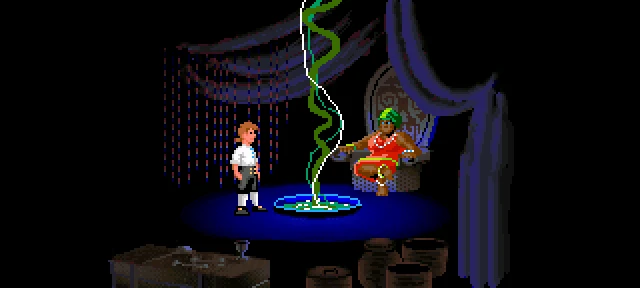
Gilbert conceived the game in 1988 after finishing Zak McKracken. The atmosphere came partly from Disneyland’s Pirates of the Caribbean — a ride he wanted to step off and wander through. The substance came from Tim Powers’ novel On Stranger Tides: the Voodoo Lady on Melee Island, the ghost-pirate framework that becomes LeChuck, a supernatural that need not footnote itself. Writing in LucasArts’ in-house magazine the season the game shipped, Gilbert was explicit:
“The pirates on Monkey Island aren’t like real pirates, who were slimy and vicious, the terrorists of the 17th century. These are swashbuckling, fun-loving pirates, like the ones in the adventure stories everyone grows up with.”
— Ron Gilbert, The Adventurer №1, Fall 1990
Between those influences sits the real contribution: restraint. A place, a verb interface, problems approached without hurry. Progress depends on noticing what the world has already told you.
That sounds obvious only because Monkey Island made it obvious. Earlier adventure games confused friction with challenge — killing the player for curiosity, allowing unwinnable states, hiding solutions behind what could only be called spite. Gilbert’s refusal was not ease. It was legibility.
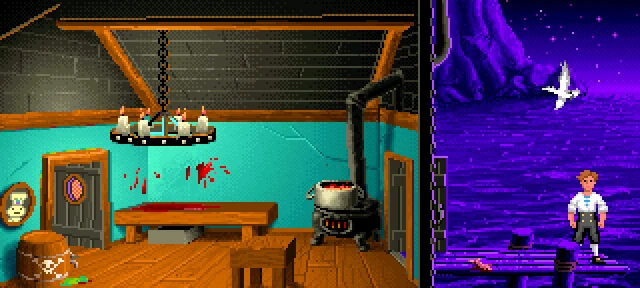
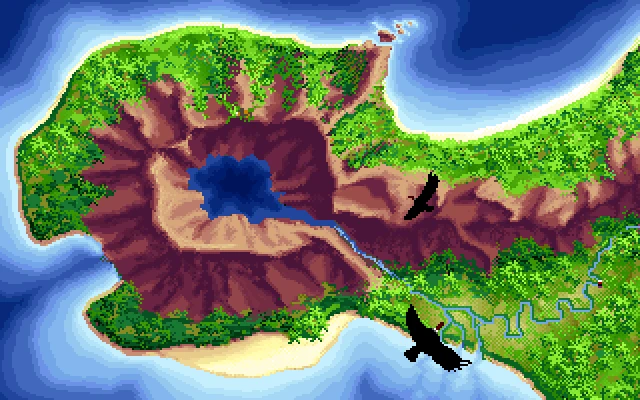
Melee Island is designed around that same legibility. Not large, but dense with purpose: SCUMM Bar, jail, church, Stan’s used-ship lot, forest paths, the Sword Master’s house, circus, Governor’s mansion.
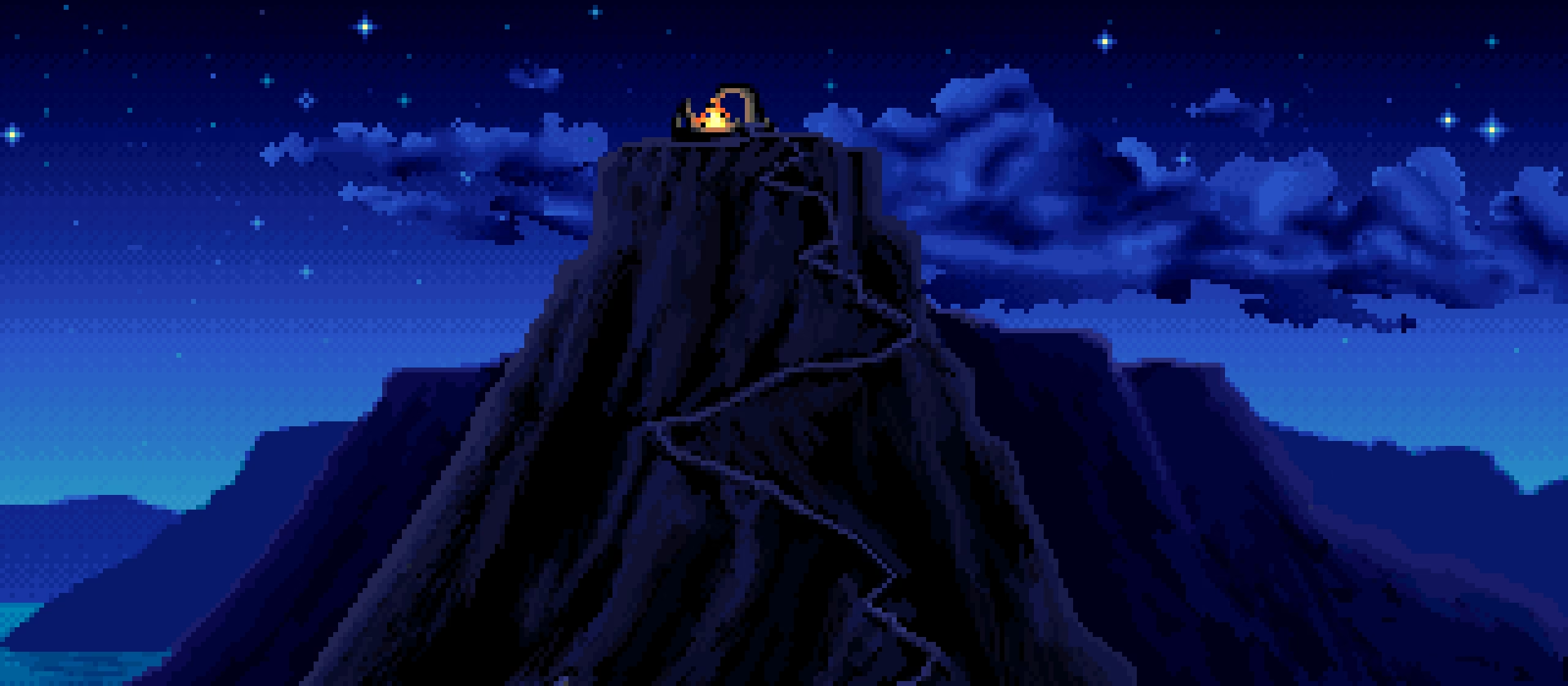
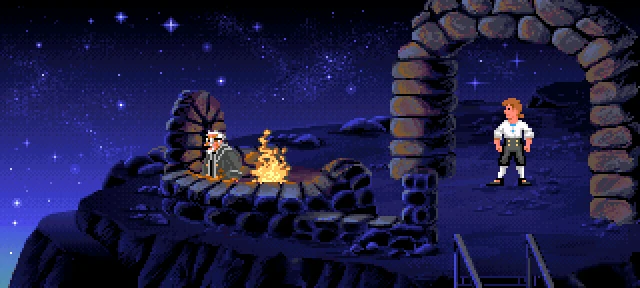
The art does too. Steve Purcell and Mark Ferrari make Melee readable before it becomes useful: crooked rooftops, warm tavern windows, graveyard blue, forest black. On the original 16-colour EGA release, Ferrari’s dithering and colour-cycling turn hard limits into atmosphere — the lookout fire flickers, the sky changes with the island’s evening. The world already behaves like a puzzle: every surface invites noticing.
You are not walking down a corridor of jokes — you carry small unfinished problems in your head and let them cross-pollinate. A pamphlet, a breath-holding brag, a line from a pirate filling time: all of it can be useful later. Monkey Island trusts you to remember, but rarely demands the right thing at the right moment.
Not every discovery is a puzzle. Somewhere in Melee Island’s forest sits a stump. Walk up, look, and a message orders you to insert Disk 22 — a disk that never existed. The joke is the ritual itself: disk-swapping, the patience assumed of anyone who bought a game shipped on eight floppies. Lucasfilm trusted its world enough to break it for a punchline.
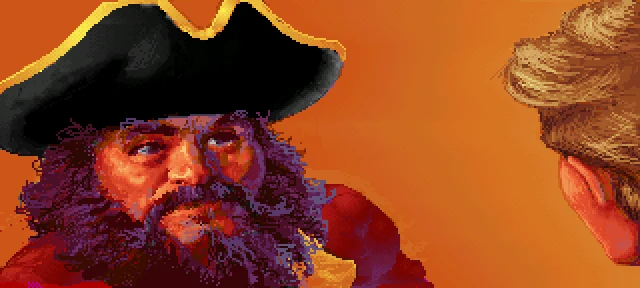
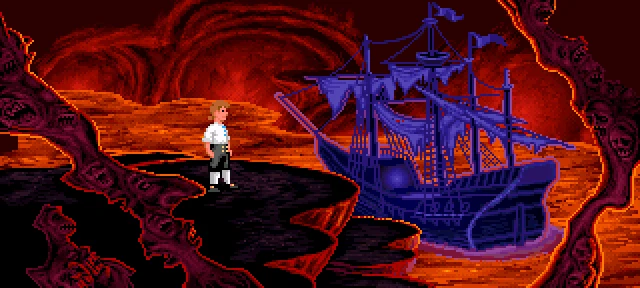
Behind the comedy sits a genuine threat. LeChuck is not a punchline waiting to be revealed — his menace is signalled early, through pirates who flinch at his name, through the way Governor Marley matters to him: history, not convenience. That economy of threat is what keeps the comedy stable. The jokes work because something is at stake.
The Fight That Is Language
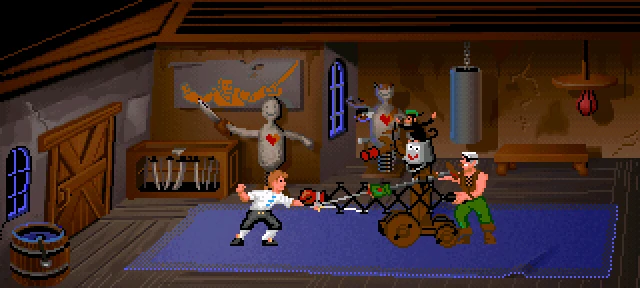
The insult sword-fighting sequence makes the argument cleanly. A pirate game needs duels, but reflex combat would violate the rest of the design. Gilbert’s solution came from old Errol Flynn pirate films: combat as theatre, the barbs as load-bearing as the swordplay. Lucasfilm’s afternoon brainstorming room had a rule — do not leave until you have two puzzles — and this one turned an action scene into language. With insults credited to Orson Scott Card, you wander Melee Island challenging pirates, collecting barbs and matching replies, building a linguistic inventory before facing the Sword Master.
A pirate sneers, “You fight like a dairy farmer!” The parry is the punchline: “How appropriate. You fight like a cow.” The comedy is the system.
It looks like combat. It plays like a puzzle. The Sword Master changes the insults, not the logic — new lines, old replies, proof you learned relationships rather than memorised a script. Like every other puzzle here, it cannot punish failure. You learn, adjust, try again.
That is the trick Monkey Island repeats. It takes situations from other genres — duels, treasure hunts, ghost-pirate showdowns — and bends them back into adventure-game grammar. You are allowed to be silly because Gilbert is doing the serious work of staying fair.
A Comedy That Respects Your Time
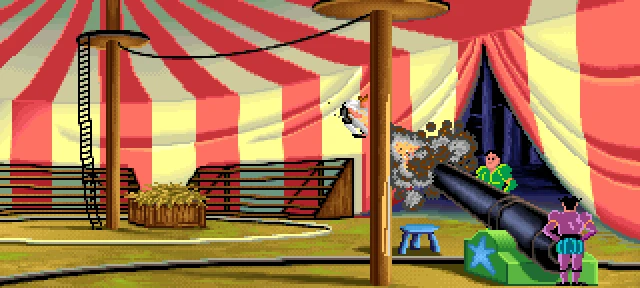
Over six to eight hours, you move through the Three Trials: sword fighting, treasure hunting, thievery. The order is flexible enough that a stalled thread rarely becomes a hard stop. If the forest maze has not clicked, the circus may. If the Sword Master is still beyond you, the town has other doors. Progress is distributed, not bottlenecked. Gilbert named the principle directly:
“If you have a lot of bottlenecks, you’re going to increase the chance that players will become frustrated with your game. Because they’re sitting in one room trying to get through one door, and there’s nothing else to do in the game until they get through that door.”
— Ron Gilbert, The Adventurer №1, Fall 1990
Gilbert mapped puzzles on dependency charts so solutions opened possibilities without silently closing others. The craft is invisible when it works. Monkey Island feels breezy because someone did the labour of making breeziness reliable.
The Video Game History Foundation’s source-code excavation makes the discipline visible. Recovered material shows design paths abandoned because the final shape needed to hold: a lost trail into the cannibal village, an unused drunk swordfighter, an abandoned kitchen arrangement for the tavern. Earlier drafts pushed further toward systems — ship-to-ship combat, cargo raids, silver cannonballs — closer to Sid Meier’s Pirates! than the game Gilbert shipped. He later said cutting the voyage combat was right. The Governor’s mansion idol theft is the cleanest case: early drafts had Guybrush routing ants with jam; Dave Grossman suggested an offscreen comedy beat instead. Gilbert kept the joke. A puzzle became timing.
The constraints were real — disk space, tools, time — but the cuts reveal taste. A funny room that damages pacing is still damage. A lovely animation that weakens a joke can still lose.
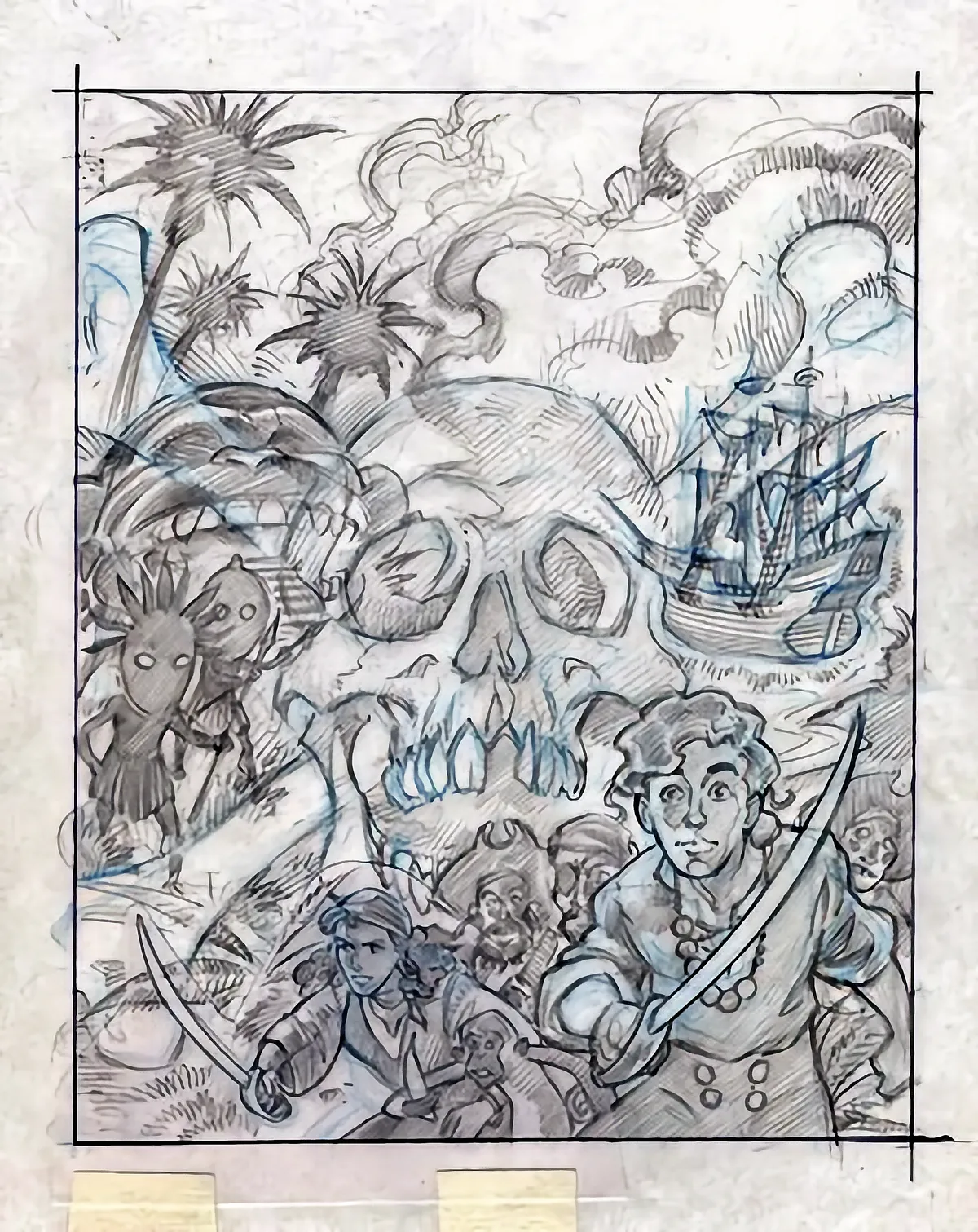
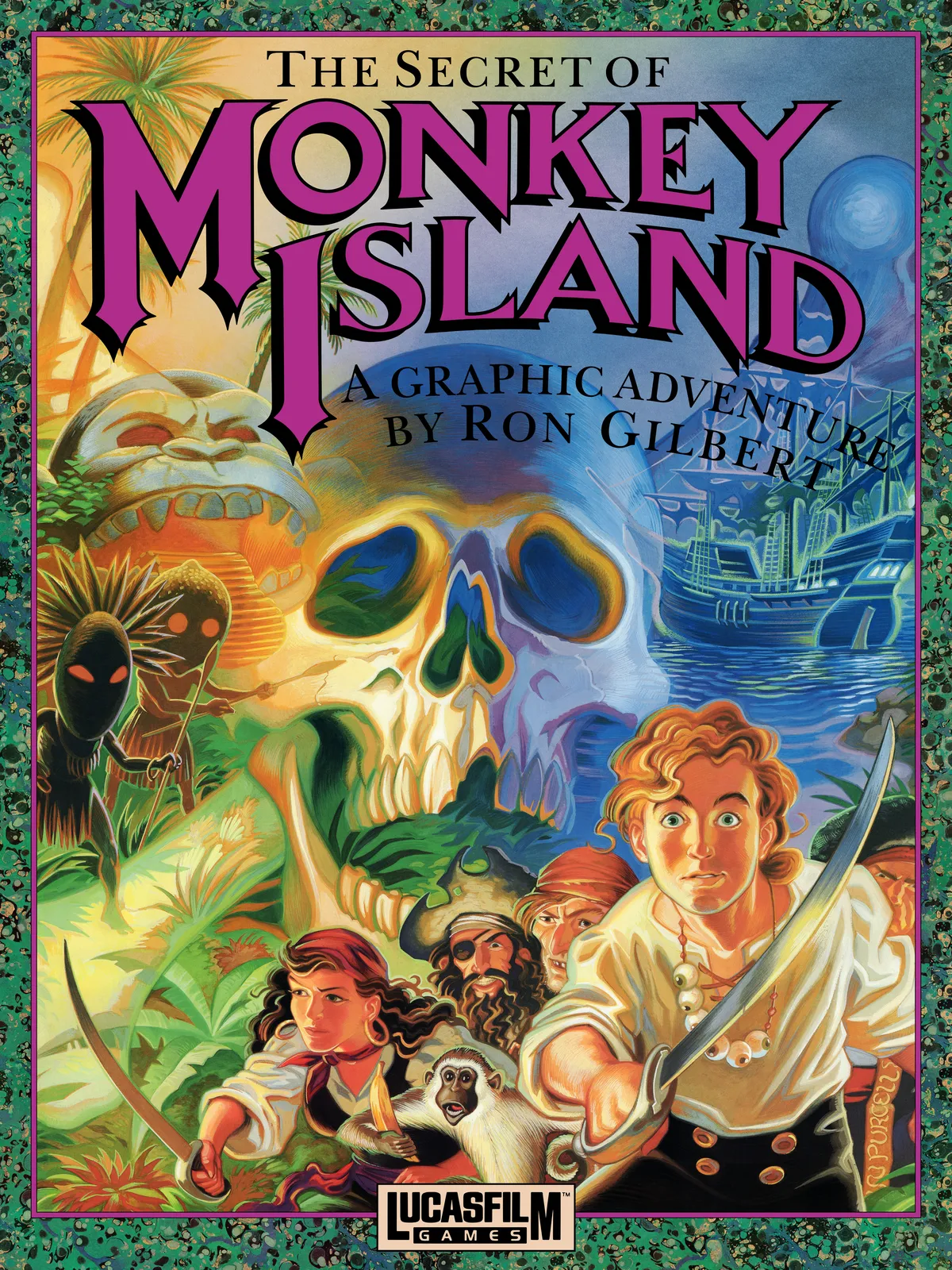
Steve Purcell’s pencil comp and the final 1990 box art. The cover was edited into existence the same way the game was: ideas drawn, narrowed, set against the shape they had to fit. Sketch: Steve Purcell, via The Legend of Monkey Island.
The writing carries the same discipline. The humour comes from character: Guybrush’s unearned confidence, LeChuck’s melodramatic menace, Stan’s flailing salesmanship, a world that treats its own nonsense as municipal business. The jokes land because the logic holds.
Tim Schafer assumed placeholder lines like “Look behind you, a three-headed monkey!” would be replaced before shipping. Gilbert kept them. The placeholder was the real thing.
Consider the rubber chicken with a pulley in the middle. You buy it from the Used Stuff shop because it is, plainly, the funniest item the screen offers. It sits in your inventory for hours, tried against doors, pirates, dogs, ledges, always failing. Then you reach the cable strung across the canyon — and the rubber chicken, with its rigid pulley spine, is suddenly the only thing that fits. The joke and the solution arrive in the same moment. You laugh, and the laughter is the click of the puzzle resolving.
Elaine Marley applies the principle to the story. She is the nominal prize and refuses to behave like one — when LeChuck takes her, she escapes herself. The comedy that follows her rescue is funnier because she needed no rescuing. Grossman has called the broader story serious beneath the silliness: Guybrush arrives chasing a career dream and discovers Elaine matters more. Lucasfilm had already made her the more capable person in the room.
The Sound of a Joke Landing
Michael Land and Patrick Mundy score a world that has to be playful without dissolving into parody. The main theme does the obvious pirate thing — bright melody, sea-air bounce — but with a looseness that fits Guybrush better than a heroic fanfare would. Stan’s music turns salesmanship into rhythm; LeChuck reaches for melodrama and stays cartoon enough to be funny.
The score is audibly constrained — short loops, abrupt transitions, 1990 on a budget. Land was unhappy with the limits, and the next year he and Peter McConnell built iMUSE, the adaptive-music system that follows the action room by room. Monkey Island 2 was its debut. Here the limitation matches the rest of the game: short cues waiting for the player to move.
The 2009 Special Edition adds Dominic Armato’s voicing of Guybrush: eager, baffled, somehow unbreakably sincere. A keypress swaps between the redrawn remake and a classic version closer to the CD-ROM lineage than the original EGA release. The toggle quietly proves the central point: the remake is not carrying the experience. The old logic is.
Most adventure games from 1990 ask for forgiveness. Monkey Island asks for less. It still has rough edges — some puzzles need the old patience of rubbing nouns against verbs, some Special Edition art choices remain divisive — but the basic contract holds: experiment, learn, continue.
That contract changed the texture of the genre. It made adventure games feel less like negotiations with a hostile author and more like conversations with a comic world. Monkey Island remains the clearest entry point into LucasArts adventures because it knows how to treat the player. It did not remove challenge. It removed spite.
You begin by clicking on things. The game, quietly, never punishes you for it.