// import robotronSwarmPoster from ”../../assets/images/robotron-2084-1982-opening-swarm-poster.jpg”; // deleted
Eugene Jarvis broke his right hand in a car accident in early 1982. He could not press an arcade fire button. Six months later he and Larry DeMar shipped Robotron: 2084, a game whose two-joystick control scheme — one for movement, one for fire — became permanent grammar. The twin-stick shooter, the genre we still play forty years on, was engineered around a hand that could not push a button. The whole twelve months that produced Robotron worked on that principle. 1982 is not remembered for that. It is remembered for the dollar amount.
The dollar amount is large. Time magazine put a video-game cabinet on its January cover under the words Gronk! Flash! Zap! Thirteen thousand US arcades took $4.3 billion in coin slots that year, more than baseball, basketball, and American football combined. Atari was the largest entertainment company on the planet. The standard retrospective tells the next part as a tragedy of timing — peak in 1982, crash in 1983 — and ends the conversation. The more interesting story is what those twelve months produced and why they could only have produced it then.
A Genre From a Six-Week Convalescence
Jarvis returned to Williams Electronics in Chicago at the tail of 1981 with a right hand he could barely use. He was already a star — Defender (1980) and Stargate (1981) were his — but he was no longer technically a Williams employee. He and Larry DeMar had formed Vid Kidz earlier that year, an independent design house contracting back to Williams precisely to keep design latitude and ownership. Most arcade designers of the period were salaried and anonymous, credited only in marquee text few players read. Vid Kidz was the structural exception. The freedom that produced Robotron: 2084 depended on that contract.
The injury changed the design problem. Jarvis loved Berzerk but its move-and-shoot controls demanded a button he could not press.
”Some guy jumped a red light and the shock of the impact through the steering wheel completely shattered my right hand. I was out for about six weeks. At the time, I loved Berzerk, but it was frustrating because my broken hand meant I couldn’t press the fire button any more.”
— Eugene Jarvis, on the origin of Robotron’s twin-stick controls
The fix was to put a second joystick on the cabinet for fire. He screwed one onto a wood panel at home to test it. It was like magic. The Robotron cabinet — two joysticks, no fire button — shipped in March 1982. Smash TV, Geometry Wars, Hotline Miami, every twin-stick shooter that has been made in the four decades since runs on the grammar of that one decision.
What is remarkable is the conditions: a medical accident became a permanent control scheme in six months, on a team of two, under an IP arrangement that let the designers ship the unconventional version. Jarvis’s own articulation of the design philosophy is the line the rest of 1982 reads under:
“Designing videogames is all ABOUT limitation. It’s not about doing everything that’s possible, just because you can. It’s about finding some small subset of something that’s FUN and building on that.”
— Eugene Jarvis
Limitation, in the 1982 arcade, was not romantic. It was real. Robotron had under 16 KB of program ROM. Its sprites animated in two-frame loops. Four of the six development months Jarvis and DeMar spent on the project were spent playing it. The single-screen room you cannot leave, and the constant feeling of being cornered in it — fight or flight, in Jarvis’s later phrase — are not aesthetic choices. They are what fits in 16 KB once you have used the rest on robots and humans. The conditions for that argument lasted exactly twelve months.
Twelve Months of Rooms No One Built
Robotron was one game on a slate that, in the same calendar year, also gave the arcade isometric perspective, pseudo-three-dimensional racing, flap physics, axonometric projection, character-led platforming, and pyramid hopping. None of those forms existed as conventions before 1982. Most became conventions during it.
Sega’s Zaxxon shipped in January, the first arcade game to render in true axonometric projection — a flying perspective that read as three-dimensional even on strictly raster hardware. Williams’s Joust followed Robotron in July, replacing fire-button shooting with a flapping wing whose acceleration the player had to read against gravity. The fights are jousts in the medieval sense; they are also small problems in physics. Namco’s Pole Position arrived in September on the first 16-bit arcade system board ever built — Namco-designed silicon, custom-fabricated to do what no commodity board could yet — and used it to draw a horizon that scrolled and rotated with the steering wheel. Mount Fuji and the Goodyear blimp were the spectacle the new chip existed to host.
Gottlieb’s Q*bert shipped in October. Warren Davis had answered a Sunday newspaper advertisement at Christmas 1981; he started programming in April 1982 and shipped seven months later. The pyramid grid was sourced from a hexagon pattern Davis had seen in Mad Planets, a colleague’s prior game. The four-way joystick was rotated forty-five degrees against the explicit advice of Gottlieb staff. He shipped it that way anyway. Q*bert’s distinctive bouncing diagonal — the way the character reads as obeying a different geometry than the player’s joystick — is one designer’s call against management, retained because management had not yet learned to overrule it.
The home side of the slate is the one most retrospectives undersell. Pitfall! shipped on the Atari 2600 in April. David Crane gave it a moving human protagonist who could run, jump, climb, and swing across tar pits — the move set we now read as the platformer. The 2600 was a 128-byte machine. Pitfall Harry exists at all because Crane chose to spend bytes a more cautious designer would have spent on level data, and then borrowed the level data back from a procedural seed that generated 255 screens from the cartridge’s tiny ROM. The cartridge held the Billboard video-game number-one slot for sixty-four consecutive weeks; it did not change hands until spring 1983.
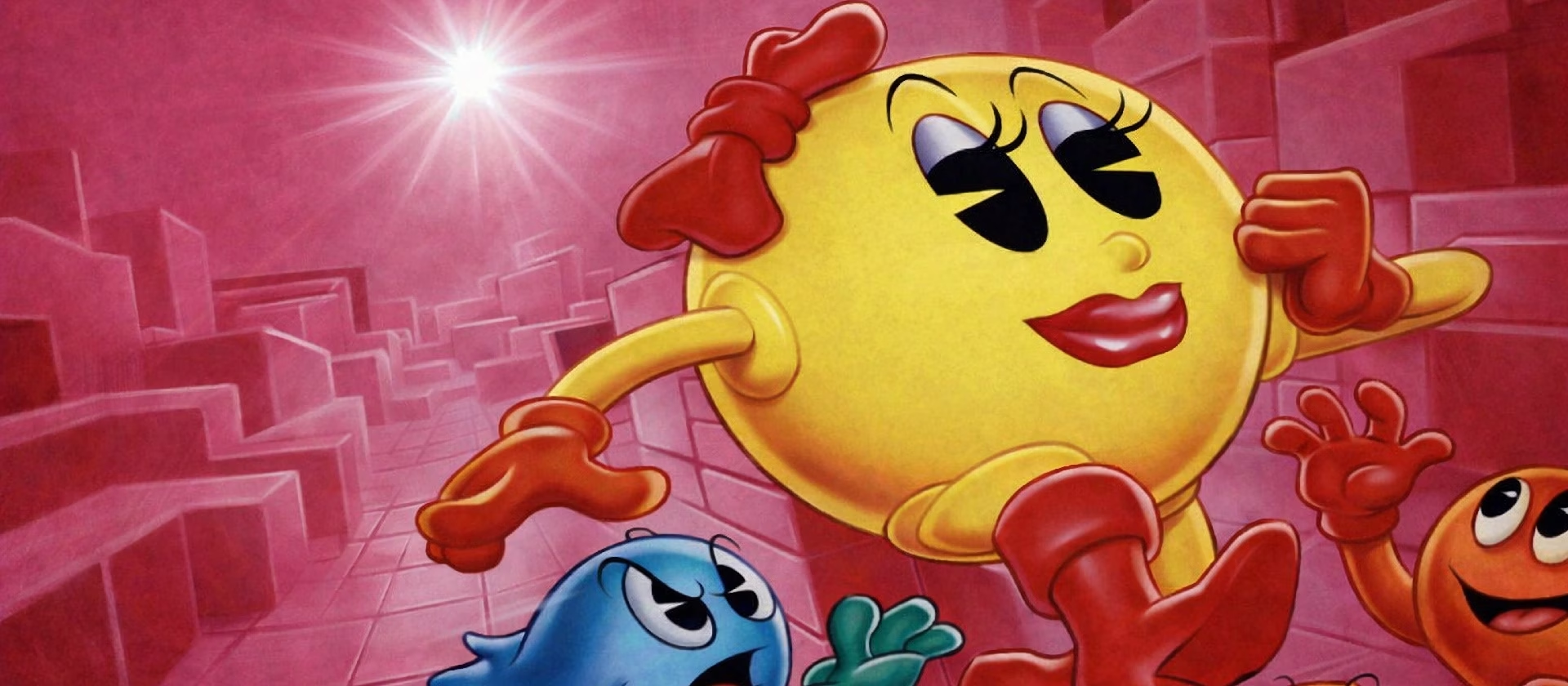
Ms. Pac-Man, the year’s highest-earning arcade cabinet, started life as an unauthorised Pac-Man enhancement kit built by three MIT engineers; Midway shipped it as a sequel without Namco’s knowledge and outsold the original. Tron, Time Pilot, BurgerTime, Dig Dug, Moon Patrol, Donkey Kong Jr., Mr. Do!: every one of these is a different formal experiment, executed inside the same twelve months, by teams of two to five.
The arcade as formal laboratory
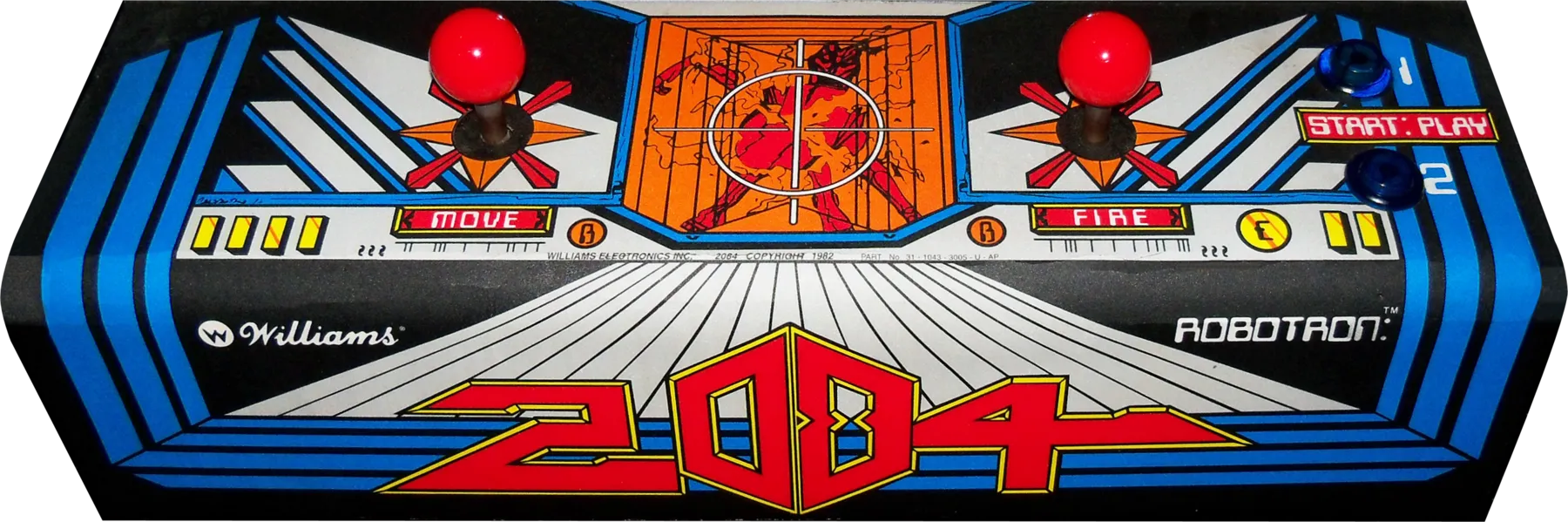
Two joysticks, no button. A genre engineered around a hand that could not press a button.
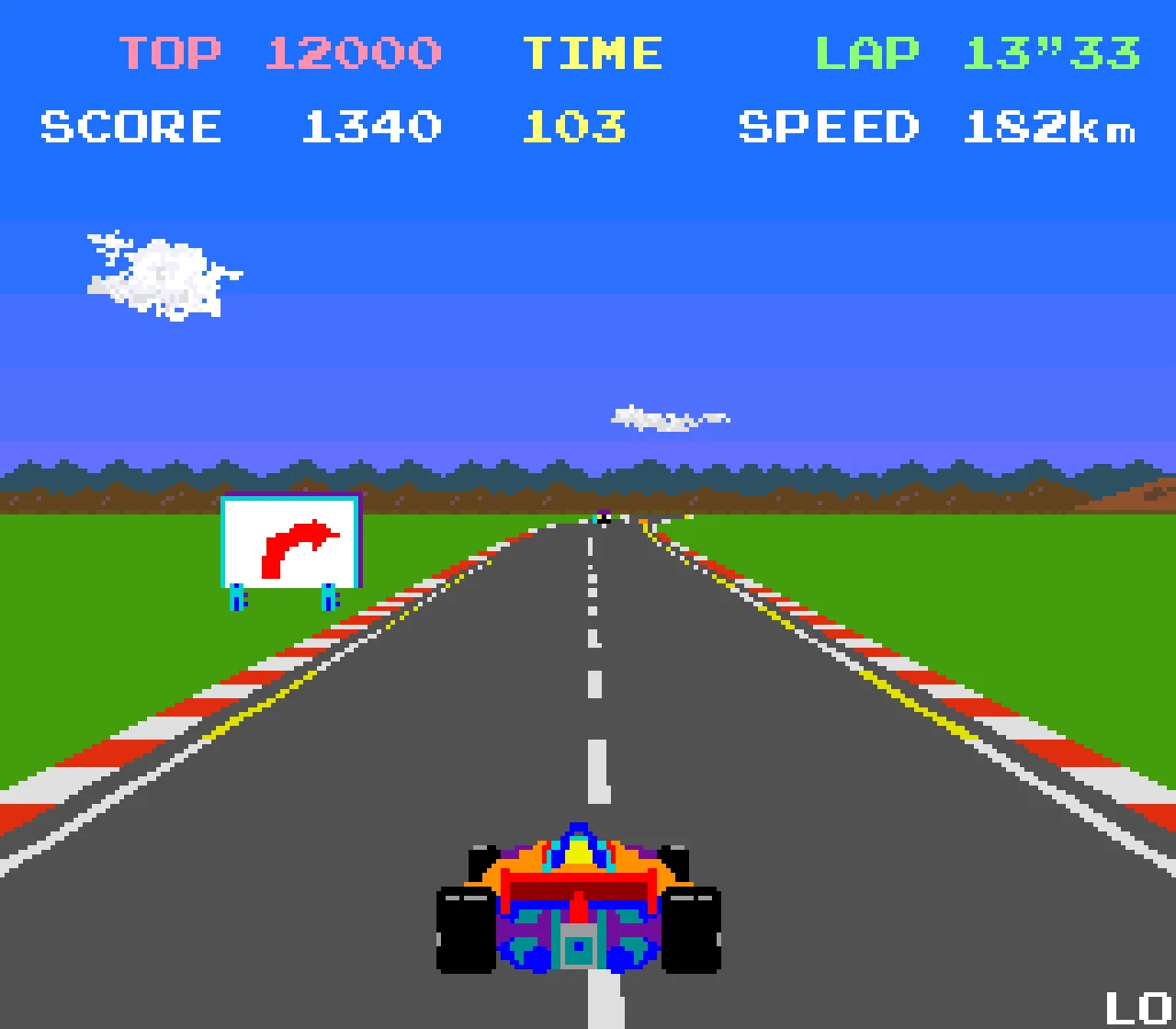
Custom 16-bit silicon built to draw a horizon. Mount Fuji and the blimp were the spectacle the chip was for.
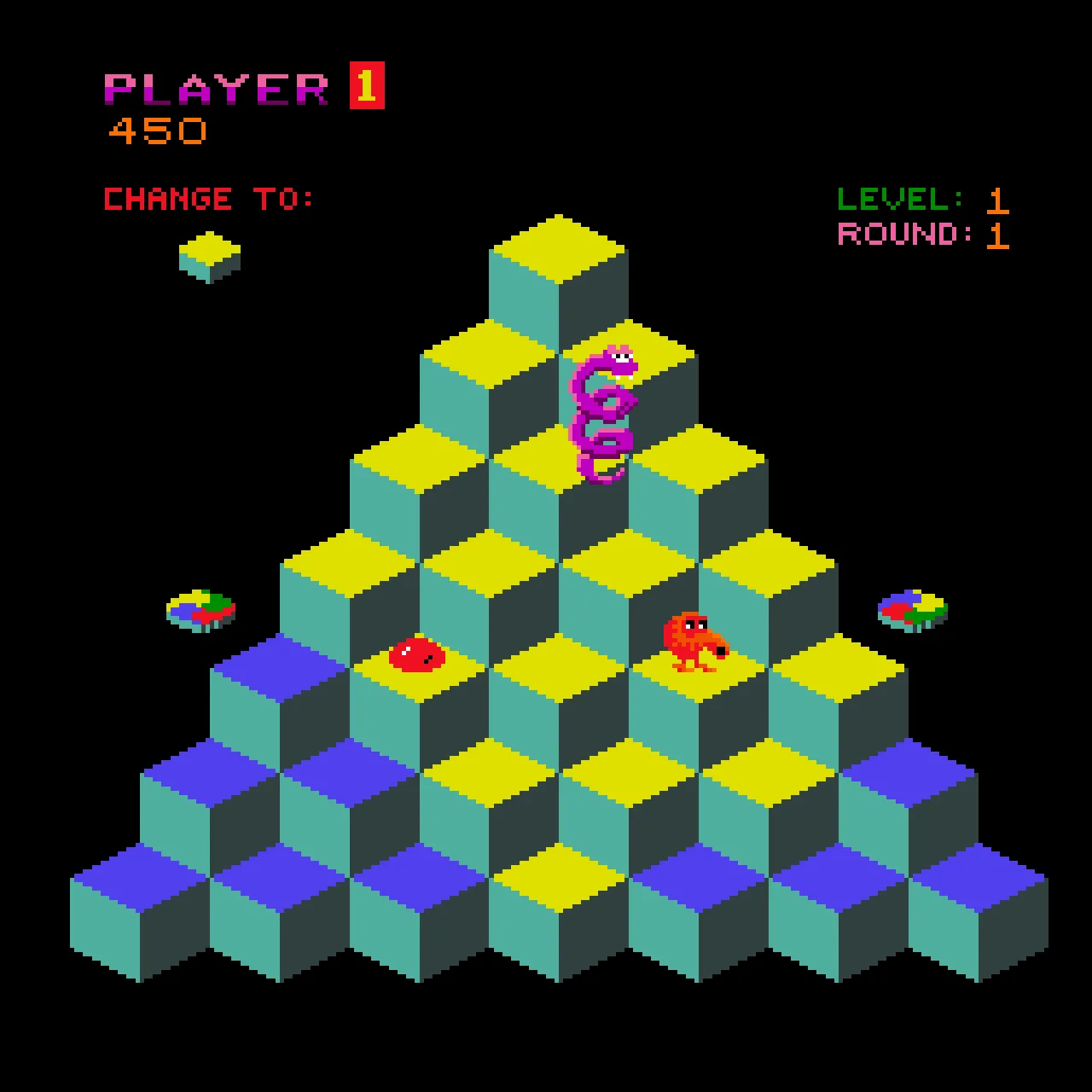
A hexagon pattern from a colleague's other game, made into a grid. The diagonal joystick was one designer's call against management.
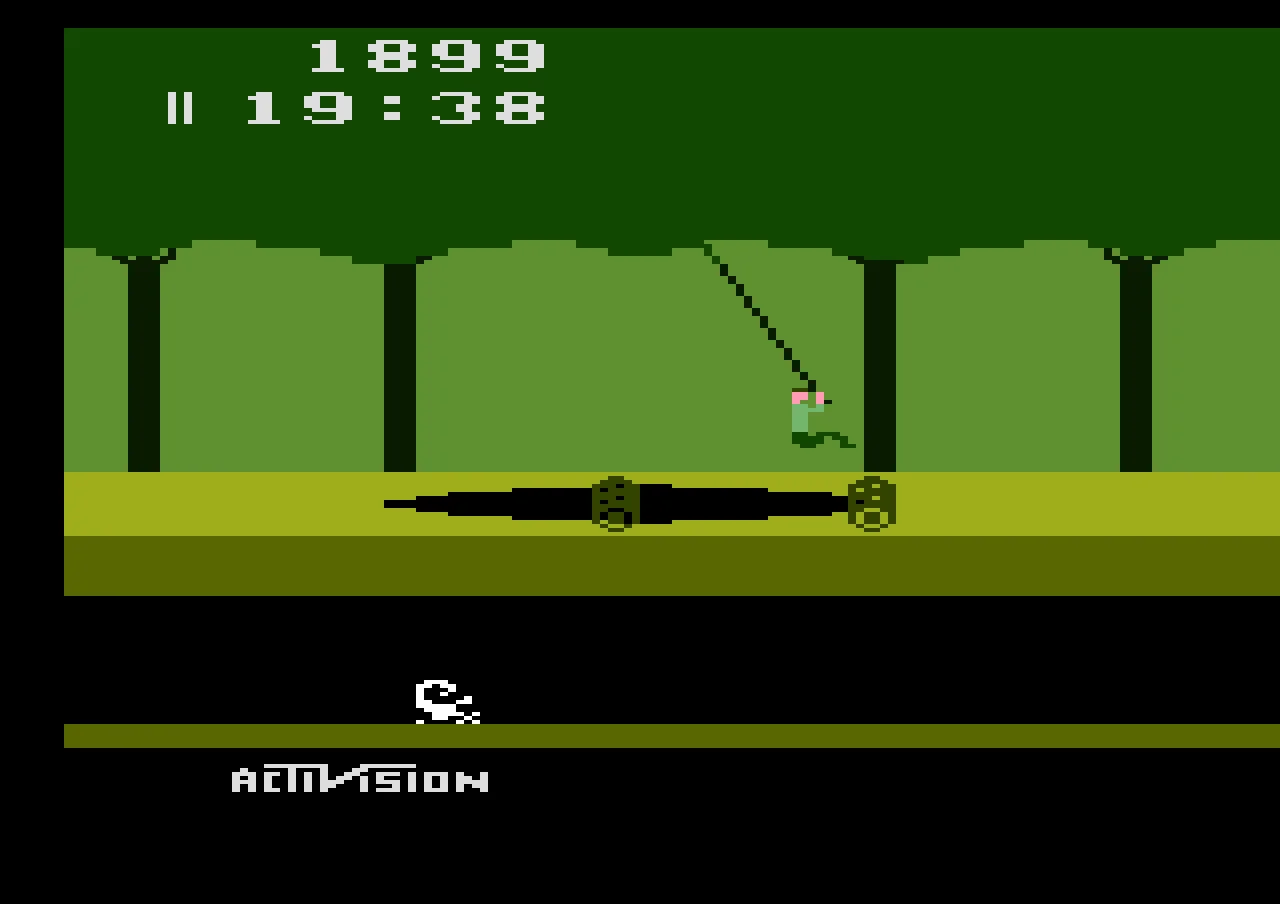
On 128 bytes of RAM. The move set we now read as the platformer — run, jump, climb, swing — authored deliberately as such in 1982.
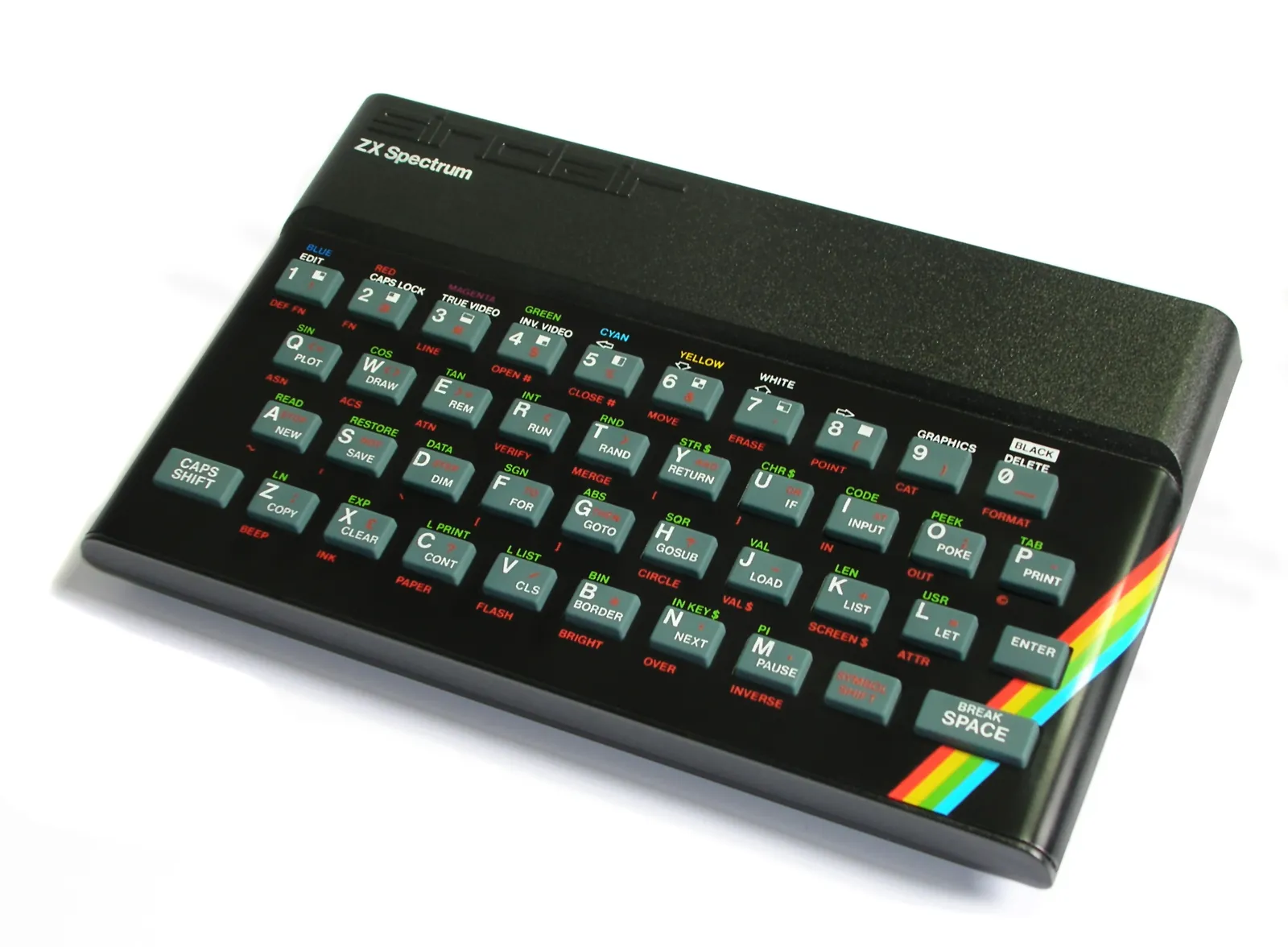
£175 in April. Rubber keys. The bedroom computer that taught a generation to type LOAD "".
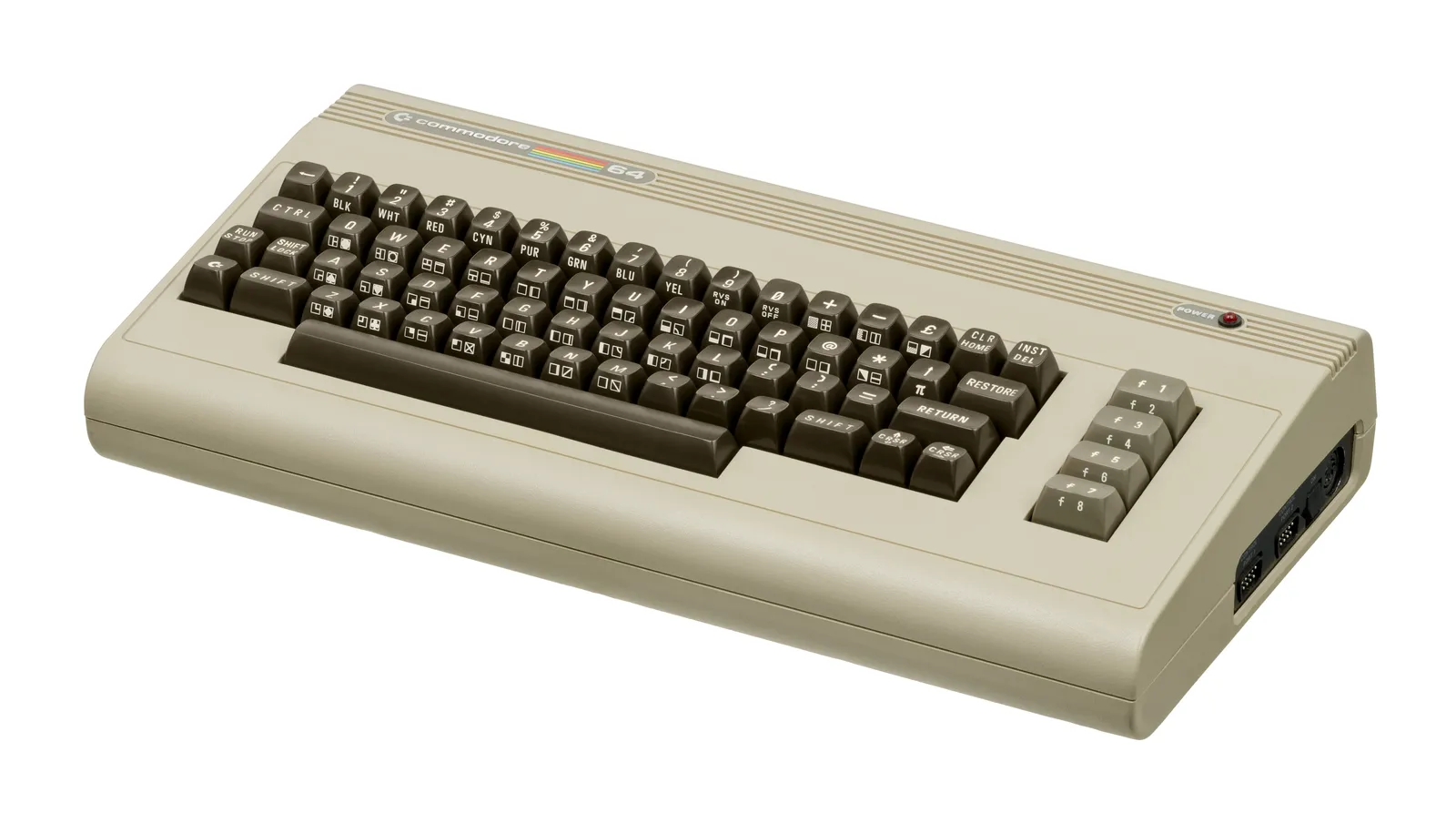
Volume shipments in August. The SID chip arrived with the machine; a decade of bedroom composers arrived with the SID chip.
The Bedroom Got a Computer
The arcade story is the one 1982 retrospectives tell. The other story is the parallel twelve months in which the British and American home-computer markets each shipped a machine that became a games platform almost despite its makers’ intentions.
The Sinclair ZX Spectrum launched on the 23rd of April 1982, designed in Cambridge and manufactured in Dundee by Timex. The 16K model cost £125; the 48K, £175. The keys were rubber. Two pixels next to each other could not hold different colours unless they belonged to the same eight-by-eight character cell — the attribute clash that became the visual signature of an entire computing culture. The Spectrum was not a games machine. Sinclair built it for hobbyist programmers, and the games that filled its commercial life were largely the work of teenagers in bedrooms, posting cassettes to small publishers, learning Z80 assembly from magazines.
The Spectrum’s audience was its own developer base. Manic Miner was Matthew Smith aged seventeen; Knight Lore was the Stamper brothers in their parents’ house in Ashby-de-la-Zouch; Elite was two undergraduates at Cambridge writing on a borrowed BBC Micro and porting back. The British games industry that would matter through the rest of the eighties — Ultimate Play the Game, Ocean, Imagine, Codemasters — is, to a first approximation, the diffusion of one machine launched in April 1982 into the kitchens and bedrooms of children who became programmers because they had a Spectrum to programme.
The American machine arrived four months later. The Commodore 64 began volume shipments in August 1982 at $595 — a price that would fall to a tenth of itself within five years and thereby make the C64 the best-selling computer of all time. It had 64 KB of RAM, three sprite-capable graphics modes, and the SID chip — a three-voice synthesiser by Bob Yannes with envelope shaping, ring modulation, and a programmable filter. No other home computer of the era had the SID. Rob Hubbard, Martin Galway, Tim Follin, and a generation of teenagers who would later be hired into AAA studios learned to write music on a chip Yannes drafted in six months.
What the Spectrum and the C64 shared was structural rather than technical. Both were built to be programmed by their users in a way the Atari 2600 and ColecoVision were not. Both shipped with BASIC in ROM. Both incubated a culture of self-taught teenage developers who would, within four years, be the primary suppliers of their own platforms. A teenager could not, in any practical sense, build a Robotron in their bedroom. They could build Manic Miner. The home-computer launch year of 1982 is the structural enabling of the cottage-industry decade that followed.
What Activision Set in Motion
The other 1982 game whose number-one status mattered structurally was Pitfall! — and the reason was not the game itself.
Activision had been founded in 1979 by four Atari programmers — David Crane, Alan Miller, Bob Whitehead, Larry Kaplan — who walked out of a meeting with Atari president Ray Kassar after he told them they were no more important than the guy on the assembly line who puts them together. They had been responsible internally for sixty per cent of Atari’s cartridge sales while earning thirty thousand dollars a year. They formed Activision in a vacuum: there was no third-party-publisher industry to join. They invented the model, and Pitfall! — sixty-four weeks at Billboard’s number one, four million cartridges sold — was the model’s vindication.
It was also the model’s curse. Crane has been blunt about what happened next:
“The crash was largely caused by a glut of poor product. In fact, Activision was the main cause — although indirectly. In one six-month period, 30 new companies sprang up trying to duplicate our success. These companies had to make do with amateur game talent, and the products were mostly awful.”
— David Crane, on the third-party-publisher rush of 1982
Atari’s response was a memo, internal to the company, that has since become infamous. These type of games are selling the best. Do more like these. Issued to a designer pool already chafing at low pay and no credit, it accelerated the homogenisation the third-party rush had already begun. By autumn 1982 the 2600 cartridge market was being described in trade-press internal circulation as flooded.
The flood’s most legible product was E.T. the Extra-Terrestrial. Negotiations between Atari and MCA Universal closed on the 27th of July 1982. Howard Scott Warshaw — who had previously made Yars’ Revenge, the year’s most-praised 2600 cartridge — accepted a development brief that would later become a textbook chapter in production management: can you do anything in five weeks? Warshaw built the game in thirty-five working days, including the design.
”I just worked my ass off for five weeks and made a game. For a five-week effort, which is what it was — about 35 days that I had to work on it, including the design — it’s a hell of a game.”
— Howard Scott Warshaw, designer of E.T.
What 1982 contained were the two opposite poles of the period in their purest forms. Pitfall! — six months of one designer’s attention, vindicating the small-craft model. E.T. — five weeks of one designer’s despair, on the same kind of small craft team but contracted by industrial logic to deliver against a Christmas window no quality of work could meet. Both shipped from the same conditions. Both were authored by individuals. The difference was the structure that surrounded them. Activision had been able, in its first three years, to make its conditions itself. By autumn 1982 the conditions were making the games.
Coda: A Window That Did Not Reopen
The arcade revenue figures for 1983 fell roughly forty per cent year over year. By 1984 the US home-cartridge market had collapsed by ninety-seven per cent. The conventional history calls this the crash and attributes it variously to E.T., to the third-party glut, to the Famicom not yet having reached the West, to the rise of the home computer as a games machine. All are true and most were already in motion by autumn 1982.
What did not survive the crash, and never returned in the same form, was the structural condition that made Robotron and Q*bert and Pitfall! possible. Two-person teams, contracting to a hardware vendor under a name they themselves had chosen, with six months and a few kilobytes and total latitude to ship the unconventional version. By 1986, the Famicom-led restoration of the home market had also restored a publishing apparatus in which licensing, market research, focus-tested mascots, and platform-holder approval were the floors a game cleared before it shipped. Some of the work that came after that restoration was fine. None of it was made in twelve months by two designers who decided, between them, that a broken hand could be a control scheme.
This is why the games of 1982 are still worth playing now, and why the case for them is not nostalgia. Robotron’s room is a five-square-metre design problem you can grasp inside thirty seconds and not solve inside a lifetime. Pitfall!‘s swing has the readability of a single beautifully-drawn animation cycle on hardware that should not have been able to draw it. Pole Position’s horizon is the first time anyone made one move at speed. The games are short, brutal, abstract, and built to take quarters; they are also the work of individuals making something new with no template to copy and very little to lose. The room they were made in did not stay open. The games are what is left of it.