// import bridgeZonePoster from ”../../assets/images/sonic-the-hedgehog-1991-bridge-zone-poster.jpg”; // deleted
// import jungleZonePoster from ”../../assets/images/sonic-the-hedgehog-1991-jungle-zone-poster.jpg”; // deleted
// import jungleBossPoster from ”../../assets/images/sonic-the-hedgehog-1991-jungle-boss-poster.jpg”; // deleted
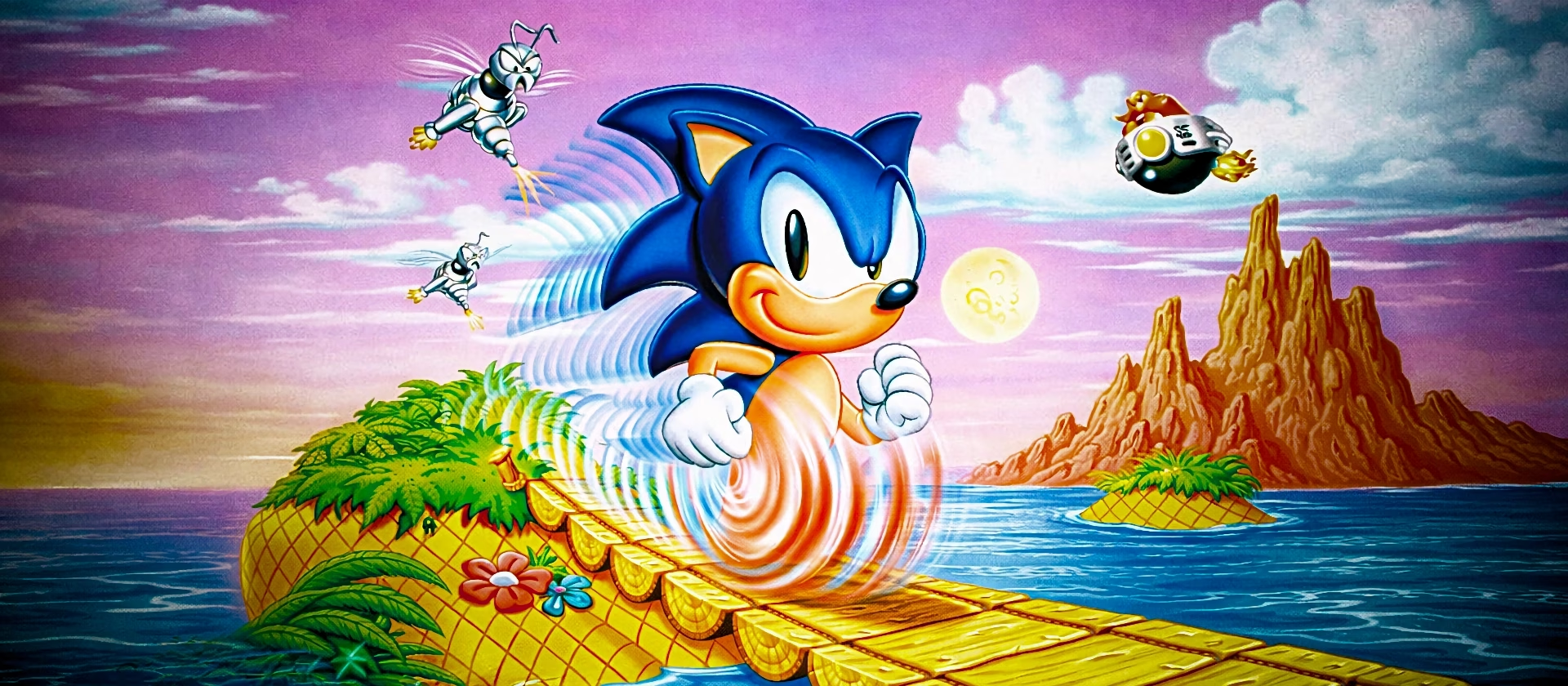
Speed is the lie the Mega Drive version tells you is the truth about Sonic. The famous Sonic — the one bundled with the Genesis, the one that put Sega on a competitive footing with Nintendo — is built around one argument: velocity as spectacle, a platformer as kinetic poetry if you let the physics carry you. It is brilliant. It is not what most European children played first.
The Master System II launched across Europe in 1991 with Sonic the Hedgehog built into the hardware — no cartridge required, no separate purchase. The console started and Sonic was there. What those children experienced bore the same name, shared the same blue hedgehog, the same rings, the same Robotnik. But almost everything underneath was different. The speed was gone. The loops were gone. In their place was something that moved at a careful walk: a platformer that asked you to look, to explore, to find six Chaos Emeralds hidden inside the levels themselves rather than in dedicated bonus stages. A game that had made a different bargain with its hardware entirely.
A Composer Builds the Wrong Game First
The development of the 8-bit Sonic carries a fact that most accounts bury: the Game Gear version came first. Sega wanted to promote its handheld and contracted the work there; only after completion did they ask for a Master System port. That ordering matters. What Ancient built was designed around a small screen, then expanded, rethought, and improved. The Master System version is not a downgrade of its handheld sibling. It is, by most measures, the superior of the two.
That hardware was six years old in 1991. The Master System ran on a Z80-derived processor that the Mega Drive had been designed to make obsolete. When Sonic Team was building their 16-bit game around a physics engine that let a sprite roll on curves, the Master System had no plausible way to replicate it. Something else would have to be designed — not a downgrade, but a reinvention — and the person Sega asked to do it was not a game developer at all.
Yuzo Koshiro was twenty-two years old and had composed the soundtracks for The Revenge of Shinobi and Streets of Rage. His name appeared on those title screens — unusual enough for a composer working for hire that players noticed it — and when he told a Sega section chief that he thought he could develop games himself, the response was not scepticism. It was an offer.
”At the time, I was working for Sega and went out drinking with a section chief, and I told him, ‘I think I can develop games as well.’ Then later, the section chief came to my house and asked me, ‘Will you make Sonic the Hedgehog?’”
— Yuzo Koshiro
Here was Sonic, the company’s most important new character. Here was the hardware. Could Koshiro figure out what the 8-bit version should be?
The reason Sega gave Sonic to a twenty-two-year-old composer with no development experience is documented in Koshiro’s own interviews: the internal teams were overwhelmed. Sonic Team was so deeply committed to the Genesis game that they stayed out of the 8-bit version. This is not the story of a second-tier team filling a gap while the real work happened elsewhere. It is the story of a family, working alone, with the franchise’s most important character and unusually little supervision.
Koshiro founded Ancient specifically to accept the contract — Sega could not make agreements with individuals. His sister Ayano served as director and handled the graphic design. His mother Tomo worked in a supporting role. The first external hire was programmer Shinobu Hayashi. Seven people in total. That was the team.
Three Stages to Something New
Koshiro later described development as moving in phases, each further from the source material than the last. Green Hill Zone is recognisable — rolling hills, blue sky, checkered landscape — because it came early, while Ancient still thought of themselves as adapting something. Everything that follows is phase two and three. It is Ancient’s game.
What they produced in approximately one year on the 8-bit hardware is not a compromised version of something greater. It has a different set of priorities, executed with precision. The level architecture replaces momentum-based play with attention-based play. The zones that follow Green Hill have no equivalent on the Mega Drive at all. Bridge Zone — wooden platforms over a bottomless river, with seesaw mechanisms and horizontal springs — is a design problem solved entirely on 8-bit logic: how do you create hazard and tension without speed, on hardware that cannot process much at once? The answer is architecture. Enemies fire projectiles at angles. Gaps require reading the screen before committing. A boss encounter requires understanding the platform geometry to survive. Later zones push the logic further: Jungle Zone layers vine-swinging vertically through dense canopy, and Sky Base Zone drops Sonic onto a moving airship platform in a sequence that owes nothing to the 16-bit Scrap Brain and everything to the constraints Ancient worked within. It is hard in the way designed games are hard: the information is there, and the solution follows from attention.
None of this is free. Sprite animation runs on fewer frames than the 16-bit version, enemy variety is thinner, and a single hit still strips every ring with no save system between zones — the push through Scrap Brain and Sky Base punishes a first playthrough in ways a modern player will feel. The trade justifies itself only because the architecture is worth reading.
The PSG Chip’s Secret Legacy
Koshiro’s music is where the reinvention becomes most audible. He began by converting Masato Nakamura’s 16-bit Sonic score to the Master System’s PSG chip, the programmable sound generator at the core of the 8-bit hardware — using a PC-88 computer as his compositional tool, the same machine he would later use for the entire Streets of Rage series. Of all those conversions, he kept three. The remainder of the soundtrack — everything that plays over Bridge Zone, Jungle Zone, Scrap Brain Zone, Sky Base Zone — is Koshiro’s original composition, written specifically for a chip with severe constraints on simultaneous tones.
Musicians and critics have covered, remixed, and analysed the Bridge Zone theme for thirty years — not because it approximates something better, but because it is fully itself, a piece of music that achieves what it intends without strain. The opening of Tails’ character theme in Sonic Adventure — written in 1998, by a completely different composer — is clearly descended from it. A melody composed on a PC-88 for the Master System PSG chip became, without formal acknowledgement, the emotional signature of a character who would not appear for another year. This is the measure of what Ancient made: a build so complete in itself that its music entered the series’ DNA as though it had always been there.
Emeralds Inside the Walls
The Chaos Emeralds are where the exploration argument becomes clearest. On the Mega Drive, they live in special stages — isolated challenges accessed by jumping into large rings. They are optional, self-contained, and the main path is complete without them. On the Master System, they are scattered inside the zones themselves: hidden in the level architecture, requiring detours, rewarding the player who treats each stage as a space to inhabit rather than a track to complete. This is not a limitation imposed by the hardware. It is a decision. Ancient built a different kind of Sonic game, and then made the mechanical rules match what that difference required.
The manual treated it as a separate adventure occurring on the same island under its own internal logic. Koshiro and his team never tried to make the same thing on inferior hardware. They made a companion piece — and the companion piece, freed from the burden of comparison, turned out to be excellent.
The Console That Came First
Across Europe, the Master System II sold throughout the early 1990s. When Sega relaunched the hardware, they built Sonic into the console’s ROM. This was not the Game Gear port, not the 16-bit release, not an emulation. The 8-bit Master System Sonic was the pack-in for what became the first games console hundreds of thousands of European children ever owned. When those children eventually encountered the 16-bit Sonic — faster, louder, technically astonishing — their reaction was often not that the real Sonic had arrived at last, but that this was a different thing from the Sonic they knew. Both reactions were correct.
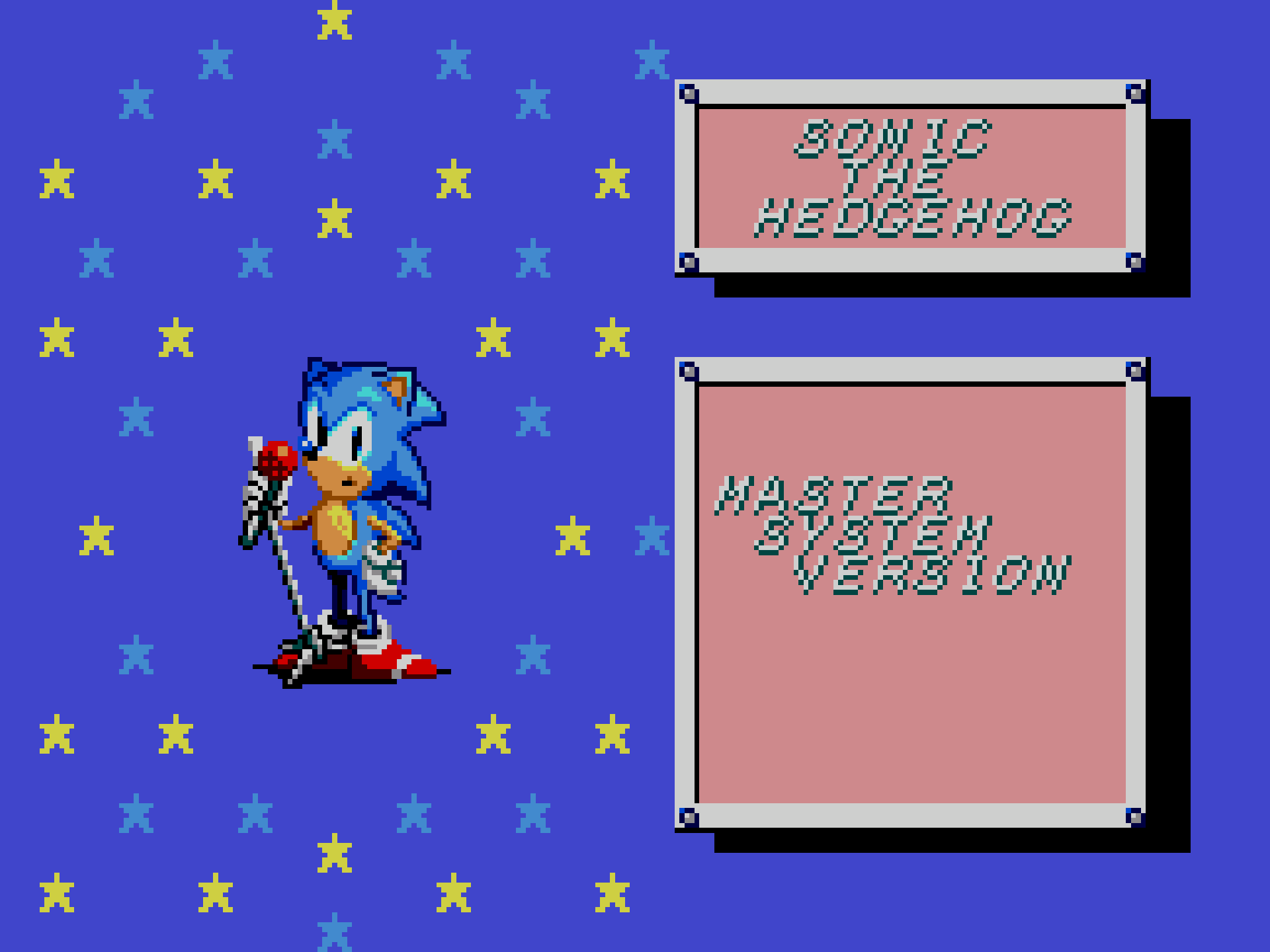
For many players, this screen was not an alternate Sonic. It was Sonic: no cartridge, no comparison, just the blue hedgehog waiting inside the console. Screenshot: GameTripper.
Ancient made exactly one Sonic game. The sequels that followed on the Master System and Game Gear were developed by Aspect Co., a different studio with a different sensibility. This makes the 8-bit Sonic the Hedgehog a closed statement rather than the opening of a series. The success of the 8-bit Sonic — strong enough that Sega returned to Ancient and commissioned Streets of Rage 2, trusting them to develop the whole game rather than just score it — is the moment Ancient became a studio rather than a contract arrangement. Sega had hired a composer to make their most important new game on hardware nobody wanted to develop for, and he had delivered something that sold well enough to change what his company was allowed to do next.
The version worth playing is the Master System rather than the Game Gear. The handheld’s lower resolution squashes the field of view, and while Sega added warning signs to compensate for the reduced screen, the architecture reads more cleanly on a television. Both versions are the same build; the Master System renders it as it was meant to be seen. The Sonic Origins Plus compilation (2023) includes the Game Gear version, which is the most accessible modern route in. Emulation of the Master System release is straightforward on any modern platform and remains the cleaner experience.
What the Master System Sonic asks of you is modest: about two hours for a first playthrough, three and a half if you hunt all the Chaos Emeralds. Within that time it makes a complete argument for a way of playing Sonic that the franchise immediately abandoned in favour of something louder. The Mega Drive original is canonical. The Master System version is correct about what a Sonic game could be.