// import outrunCoastDrivePoster from ”../../assets/images/outrun-1986-coast-drive-poster.jpg”; // deleted
// import outrunCannonballAutumnPoster from ”../../assets/images/outrun-1986-cannonball-autumn-poster.jpg”; // deleted
// import outrunCannonballCanyonPoster from ”../../assets/images/outrun-1986-cannonball-canyon-poster.jpg”; // deleted
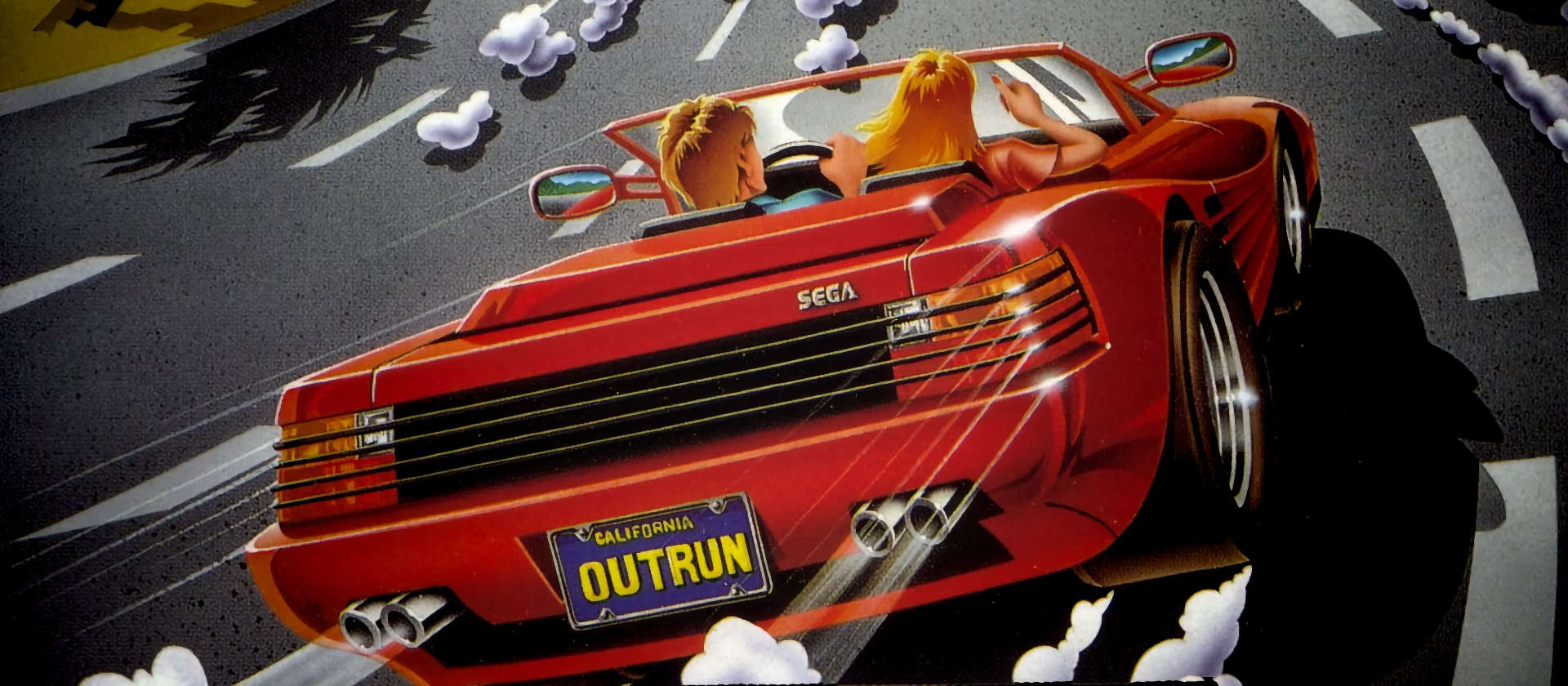
Most driving games are about proof. Be faster than the field. Hit the perfect line. Treat every mistake as a small personal failure. OutRun is about something else. It gives you a Ferrari Testarossa, a passenger in the seat beside you, three songs on the radio, and a road that keeps dividing toward places you will not fully see in a single run. There is traffic to avoid and a timer to beat, but the sensation is not rivalry. It is momentum.
Modern racing games offer more cars, more systems, more realism, more things to tune, customise, and optimise. OutRun offers a sharper answer to a simpler question: why did anyone want to drive in games in the first place? Not to manage a garage. Not to complete a season. Not to shave tenths from a qualifying lap. To move. To feel speed as liberation. To have the horizon keep arriving.
That is the real reason to play OutRun now. Not because it is historically important, though it is. Not because it influenced half the genre, though it plainly did. Play it because very few games understand pleasure this clearly. Within seconds, it establishes a complete fantasy: speed without heaviness, danger without cruelty, music that changes the colour of the journey.
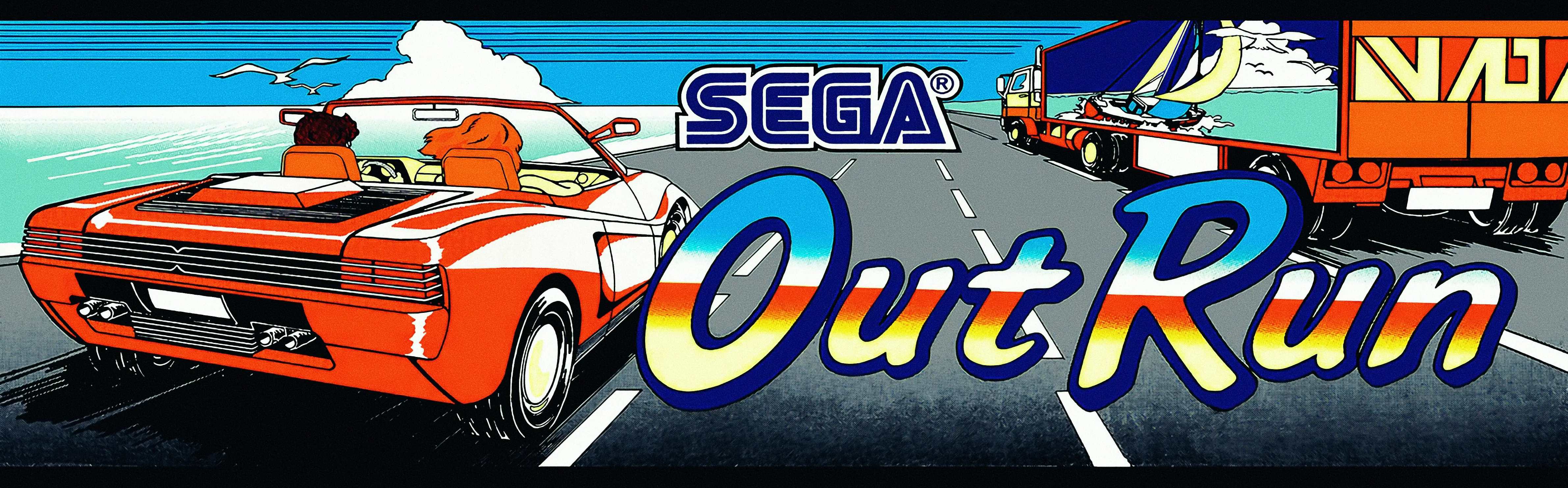
The arcade marquee — Ferrari, open road, truck, sea. The whole fantasy in one image. · Sega, 1986
The Key Design Decision Was Mercy
Yu Suzuki has been blunt about the philosophy underneath the design.
”In the racing games before OutRun, when you crashed your car would explode. I didn’t want that. I wanted the player to feel the joy of driving.”
— Yu Suzuki, Phantom River Stone interview
That instinct shapes everything. In OutRun, a mistake hurts, but it does not usually end the run. You lose speed, rhythm, and precious seconds. Then the car settles. You gather yourself. You accelerate again.
That distinction matters more than it first appears. Most arcade games of the mid-eighties are brittle. They punish curiosity. They are designed to eject you before you have properly entered their world. OutRun does the opposite. It applies pressure, but it wants you to stay inside the fantasy. The question is not whether you can play perfectly. It is whether you can recover quickly enough to keep the feeling intact.
That is a different philosophy of skill. Not control, but recovery. Not perfection, but flow regained under pressure.
It is also why the game still feels so good in the hands. The controls are responsive without being twitchy. The car drifts just enough to feel glamorous rather than technical. Traffic creates hazard, but also texture. You are not threading through a sterile course. You are negotiating a road in motion. OutRun does not chase realism, yet it understands something many later simulations forgot: exhilaration depends as much on forgiveness as precision.
Five Minutes, Five Routes, A Whole Journey
The structure is simple enough to explain in a sentence. Each stage ends in a fork. Left or right. Choose quickly, and the scenery changes. Over five stages, those choices carry you toward one of five endings.
But the brilliance of OutRun lies in how much that small structure implies. There is no campaign map, no branching dialogue, no grand statement of consequence. The choice happens in motion. You commit, the road bends, and suddenly the run has a different tone.
Take the early split. One route leans toward wide coastal roads — open skies, forgiving curves, a sense of ease. The other begins to tighten almost immediately — denser traffic, sharper turns, less room to recover. Neither is strictly harder in a systemic sense, but they feel different. One invites you to relax into the drive. The other demands attention. Over time, those small differences accumulate into something larger: not a different level, but a different kind of journey.
A short arcade game begins to feel like travel. Not travel as geography, exactly, but travel as mood: coastal ease, desert glare, alpine danger, the sense that a turn taken at speed can alter the shape of the day.
This is one of the game’s great tricks, and one of the main reasons it remains worth returning to. The routes are not deep in a modern systemic sense. They do not need to be. They create variation without friction. Repetition feels like return, not labour. A strong run lasts only minutes, but the branching ensures that the game always suggests more road than it can show in one sitting. That suggestion is part of the fantasy. OutRun is small, but it feels open.
Not a Racer. A Holiday Dream
The usual way of writing about OutRun is to call it a racing game and move on. But that misses the thing that makes it distinct. There is no proper pack battle, no jockeying for position, no circuit logic, no obsession with first place. It is a driving game in the purer and stranger sense: a game about sustained movement through attractive space.
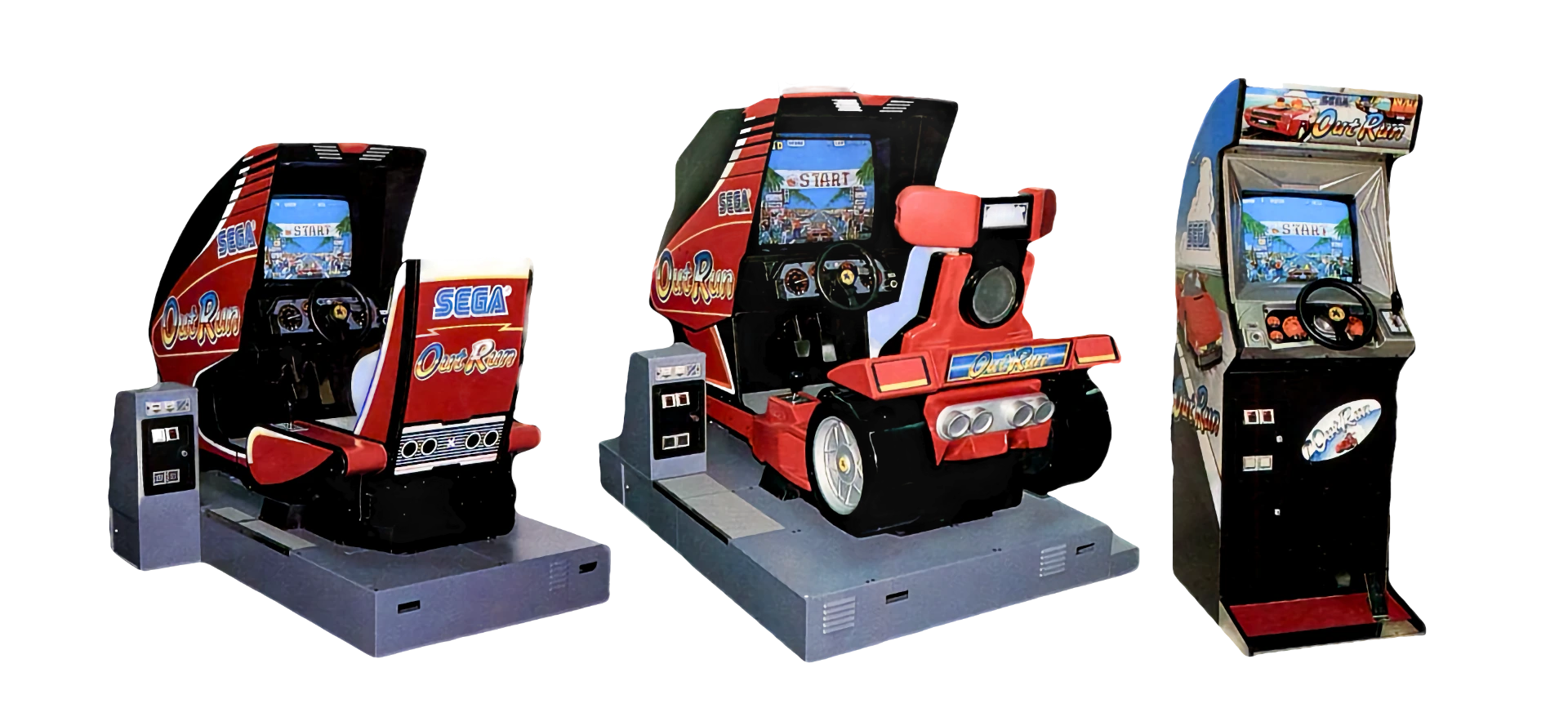
The three OutRun cabinet formats. The deluxe sit-down enclosed the player in a fibreglass car body — the fantasy made physical before the screen loaded. · Sega, 1986
Everything supports that idea. The road rises and falls dramatically. The backgrounds are broad, bright, and simplified, less interested in realism than in atmosphere. Palm trees, open skies, glowing coastlines, sudden shifts in terrain: the world is a postcard rack in motion. Even the car is less a vehicle than a symbol — and here the production history becomes revealing. The red sports car in the original OutRun is not, strictly speaking, a licensed Ferrari Testarossa. It was designed to look precisely like one, but Sega never secured the official rights. That apparently incidental detail has a practical consequence: it is the main reason OutRun has been ported so freely across forty years of hardware, while the officially Ferrari-licensed OutRun 2 remains largely inaccessible today, trapped in expired contracts. The original is available not despite its compromises but in part because of them.
The visual world of OutRun draws on sources that most players never knew. The game’s aesthetic owes a significant debt to Hiroshi Nagai, the Japanese illustrator whose work defined the visual language of city pop — sunlit roads adjacent to blue sea, palm trees, a particular kind of luminous, uninhabited leisure. The connection runs deeper into the soundtrack. Composer Hiroshi Kawaguchi has cited the jazz fusion musician Naoya Matsuoka as a direct inspiration for the score, saying that without Matsuoka’s work, OutRun would not have been born. Matsuoka’s 1982 album September Wind even features the sound of waves between tracks — the same mood that saturates OutRun’s music selection screen. What looked and sounded like a pure arcade fantasy was, quietly, Japanese city pop translated into motion.
This is where the game’s age almost helps it. Because the hardware could not chase realism, Suzuki and his team had to chase sensation instead. The result is cleaner than many later driving games with far greater technical means. OutRun understands that movement can be seductive before it is competitive. That speed can feel romantic. That a road can be exciting simply because it keeps unfolding.
The Music Changes the Road
Few games have ever done more with music selection at the start than OutRun. “Magical Sound Shower,” “Passing Breeze,” and “Splash Wave” are not just excellent tracks. They are mood selectors. They tell you what kind of drive this is going to be.
Choose one, and the road feels bright and playful. Choose another, and it turns softer, smoother, more wistful. The route itself has not changed, but the emotional charge has. That is a remarkable achievement for such a small system. In most games of the period, music decorates action. In OutRun, it defines the emotional frame around it. The songs do not sit behind the experience. They author it.
It is difficult to think of many driving games since that have understood this quite so cleanly. Modern racers license dozens of songs and build radio stations and playlists and streamer modes. OutRun asks you to pick one track before the engine even settles into your hands, and somehow makes that choice feel more personal.
Its influence also escaped the series. You can see traces of OutRun anywhere a driving game values mood as much as mastery: in arcade racers that care about drift and spectacle over realism, in games that treat music as part of the vehicle fantasy, in the long afterimage of sunlit coasts, neon skies, and immaculate cars moving through a world designed less as a simulation than as an invitation. Even the modern use of “outrun” as a retro-futurist aesthetic — the visual genre of synthwave album covers and vaporwave imagery — says something revealing. Very few games lend their name not just to sequels or imitators, but to a whole visual mood. That happened because the original found something durable underneath the spectacle: driving as longing, sensation as philosophy.
The development story clarifies why the game feels so specific. Suzuki and his team had only ten months to build the game, a constraint that forced him to do much of the programming himself. The result is not European geography but something more interesting — luxury travel reduced to image and desire: Mediterranean light, impossible leisure, a red sports car moving from one idealised horizon to another. The fantasy is obviously of its time. The glamorous passenger is less a character than an accessory, part of the game’s soft-focus eighties image-making. You can see the limits of that immediately. But what has lasted is not the pose. It is the clarity of the wish underneath it. OutRun understands something very basic and very durable: that driving, in games, is often less about competition than about escape.
The sprites are small. The environments are abstract. The collision model is not interested in plausibility. But those are not the things the game was built around, and they are not the things that have kept it alive. What has aged well is the design underneath the presentation. The route structure still works. The timer still generates pressure without panic. The handling still encourages commitment rather than caution.
Plenty of canonical arcade works are now more interesting as history than as play. OutRun is not one of them. It does not simulate driving. It remembers why driving ever mattered, then strips everything else away.