// // import threedPoster from ”../../assets/images/earthbound-1994-threed-poster.jpg”; // deleted // deleted
// // import battlePoster from ”../../assets/images/earthbound-1994-battle-poster.jpg”; // deleted // deleted
The most unsettling world you can put in a video game is the one the player already lives in. That is the bet EarthBound makes, and thirty years later it is still the clearest explanation for why the game outlived the campaign that was supposed to sell it. Kids with baseball caps. Psychic powers. Shopping malls and ATMs and fathers who only ever call on the telephone. A world that looks exactly like the one outside the window — and that is, for that reason, far stranger than any dragon or castle could be. The familiar, made uncanny. Everything else in the game’s strange history flows from that instinct.
The Game That Nearly Died
Shigesato Itoi was not a game designer. He was Japan’s most celebrated advertising copywriter — a television personality, an essayist, the voice of the father in My Neighbour Totoro. In 1987 a colleague showed him Dragon Quest on a Famicom, and he walked away with the idea that would become Mother 2. He pitched it to Shigeru Miyamoto, who rejected it on the grounds that celebrity-produced games had tended to fail. Nintendo’s president Hiroshi Yamauchi overruled him. Development began at Ape Inc. with HAL Laboratory brought in as technical partner, and then it stalled. By its fourth year the project had expanded from an 8-megabit cartridge to 24, survived repeated threats of cancellation, and arrived at a point where the codebase was so tangled progress had effectively stopped. The assets were complete. The scenario was written. Everything was there — except a game.
“If we use what we have and repair it, two years. If we can rebuild from the data, six months.”
— Satoru Iwata, reconstructed from Iwata Asks
Iwata, then president of HAL Laboratory, took the assets back to Yamanashi, worked for a month in isolation, and returned with a scrollable overworld running cleanly for the first time. Six months after he joined, the game was playable from start to finish. They spent another six polishing. He would later become Nintendo’s president — but no official account has acknowledged the degree to which he personally salvaged one of the company’s most distinctive games.
Suburban America as Surrealist Canvas
What Iwata saved is worth understanding on its own terms. There is no overworld map — Itoi refused one, not wanting an artificial barrier between towns and the roads that connected them. You walk from place to place continuously, the world seamless and unbroken in a way that no contemporaneous RPG attempted. Enemies are visible on screen rather than random, which means you choose your fights — and if you’re sufficiently overlevelled, weaker enemies recognise this and flee, sparing you a battle you’ve already won. And your health doesn’t drop instantly when you take a hit: it ticks down on a rolling counter, like an odometer unwinding, giving you a window after even a fatal blow to act — to heal, to run, to land one last strike. It makes combat feel like a sustained near-miss rather than a clean binary, and gives the whole game an undertow of controlled anxiety that its cheerful surface keeps partially concealed.
Your enemies are called things like “New Age Retro Hippie” and “Annoying Old Party Man.” The soundtrack borrows from salsa, reggae, dub, and psychedelic rock — Hiroshi Kanazu, Keiichi Suzuki, and Itoi himself contributed, producing something that sounds like nothing else Nintendo released before or since. The Mr. Saturn characters speak in a font drawn from the handwriting of Itoi’s daughter. Shops sell food instead of potions; you call your dad instead of saving at a church; one character’s signature weapon is a yo-yo. For most of its length EarthBound is funny and warm and entirely charming in a way that reads as effortless but is in fact the result of years of very specific craft: the craft of someone trained in advertising, who understood that tone is not decoration but argument.
The game’s design philosophy — if you can call the intuitions of a copywriter a philosophy — is that every element should feel native to the world it inhabits. Most RPGs of the era asked players to accept a fantasy frame and navigate within it. Itoi’s frame was the world the player already lived in, distorted just enough to make it strange. The Onett police who block your progress because they think a boy with a bat constitutes a public nuisance. The department store haunted by a ghost with department-store problems. The town of Threed, where a zombie invasion plays out with all the low-grade civic inconvenience of a burst pipe. None of it is played for parody. The game takes its own absurdity entirely seriously, which is what makes it land.
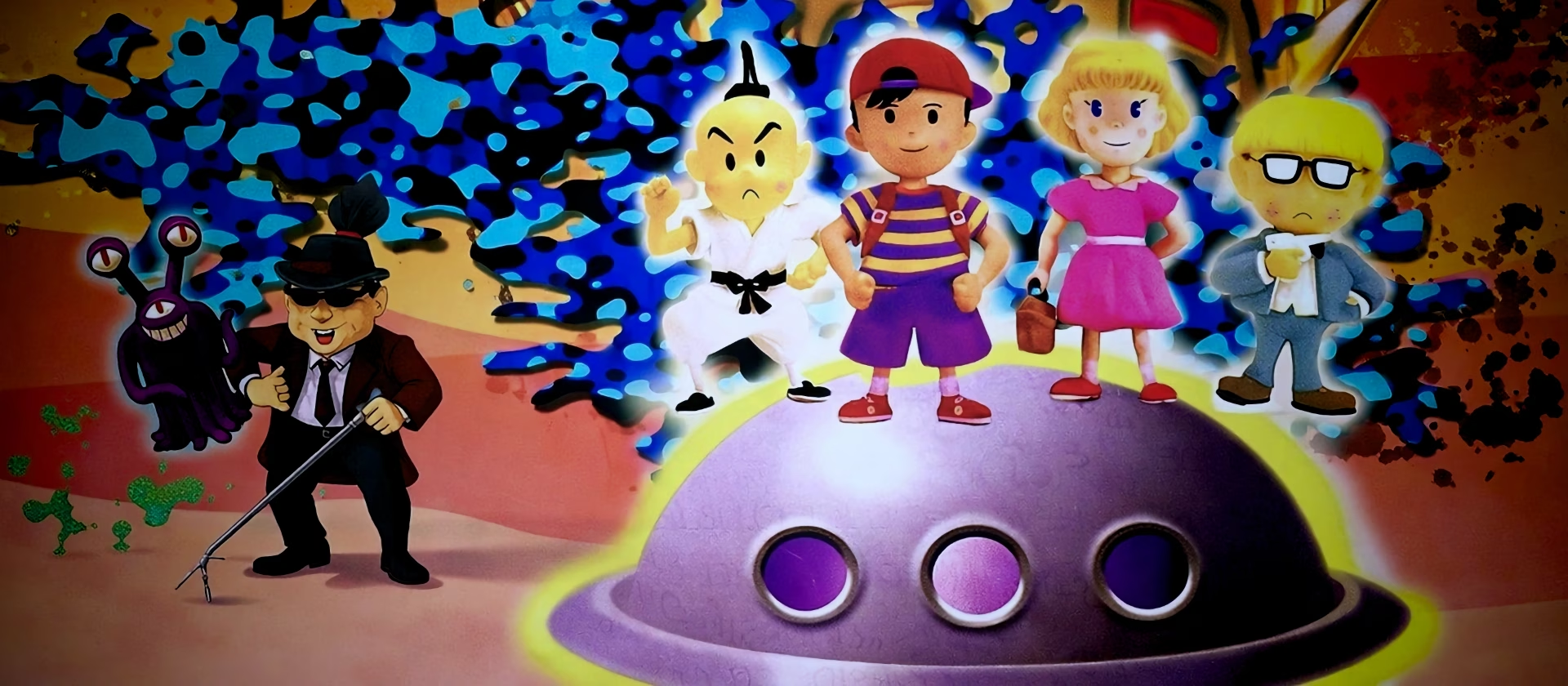
There is also a party system that quietly does something no other SNES RPG attempted. Your four characters are not a band of adventurers or a guild of specialists — they are children. A boy, a girl with psychic powers, a boy obsessed with gadgets, and a boy from a foreign country who speaks in broken grammar and calls everything “neat.” Their friendship accumulates across the game in the texture of small exchanges: the way Paula’s telepathy reaches Ness even when she’s separated from him, the way Poo’s status as a prince from a distant land makes him a tourist in his own adventure. The game never announces that it cares about these characters. It just gradually makes you care too, so quietly that the moment when it matters is already past before you’ve noticed it arriving.
What Giygas Actually Is
Then, in the final hour, the familiar turns on you. The final boss, Giygas, is a cosmic horror without form — a swirling mass of red and black that the game explicitly tells you cannot be comprehended, whose attacks cannot be grasped, whose dialogue consists of fragments of pain repeated in loops. The encounter is unlike anything Nintendo had published. The music warps. The background writhes. Nothing in the preceding thirty hours prepares you for it.
Itoi has said the confrontation was drawn from a traumatic childhood experience: walking into the wrong cinema as a young child and witnessing a scene of violence he misunderstood — a murder in the Shintoho film The Military Policeman and the Dismembered Beauty, which he believed, without understanding what he was seeing, to be something sexual. He described what he was trying to evoke as atrocity and eroticism side by side, indistinguishable, the confusion of a child encountering something he cannot process. The development team reportedly wept while typing Giygas’s lines from Itoi’s dictation. The way to defeat this incomprehensible entity, in the end, is to pray — an instruction the game delivers earnestly, without irony. The characters’ prayer propagates out into the world and reaches the player. The game asks, directly, that you take part.
Few Nintendo games have ended anywhere near here, before or since. It works precisely because the preceding thirty hours have made you unprepared for it — because Itoi spent that entire time establishing a world so recognisably mundane that breaking it feels like something is being broken in you. The tonal collapse from comedy to horror is not a gear-change but a revelation: the strangeness was there all along, held just below the surface, and the game was patient enough to wait until you’d stopped looking for it.
The Campaign That Broke the Wrong Way
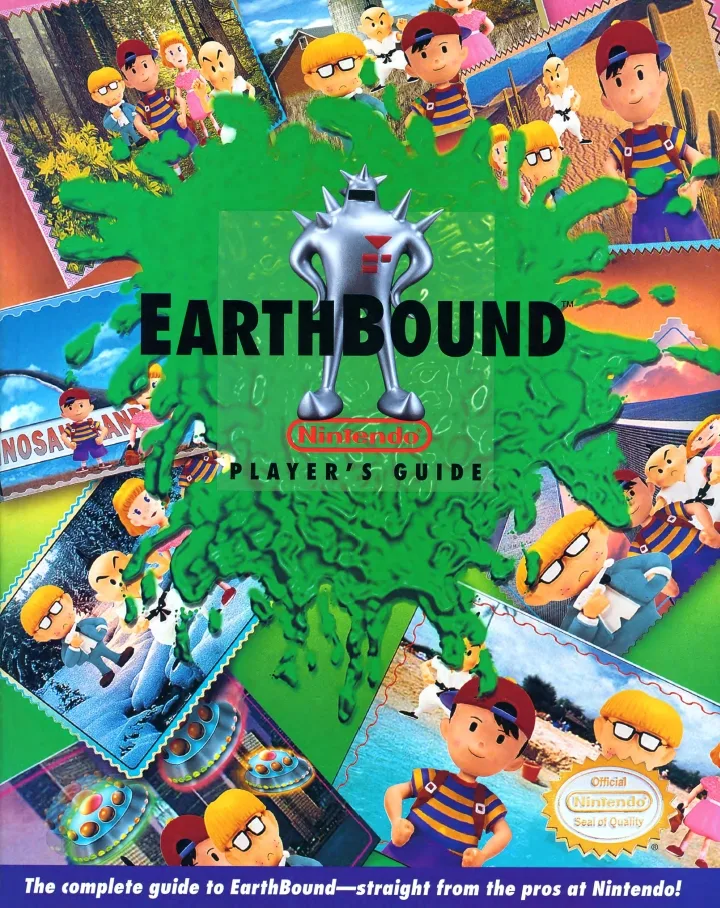
Bundled in every NA copy: the 150-page Player’s Guide. Nintendo of America’s defence against a game its sales team did not know how to describe.
The American release in 1995 was a study in mismatch. Nintendo of America spent $2 million on a campaign built around the tagline “This Game Stinks” — full-page magazine ads with scratch-and-sniff inserts smelling of flatulence and stale pizza. The scratch tabs didn’t stay sealed in postal transit. Nintendo Power readers reported their mailboxes had been infected for weeks. The game sold 140,000 copies in North America — which Nintendo called a commercial failure — and never received an official European release.
The mismatch between the campaign and the game is almost too complete to be accidental — as though nobody at Nintendo of America had played more than twenty minutes of it. The game is quiet, strange, and emotionally ambitious. The campaign was juvenile in the most literal sense, aimed squarely at a demographic that the game itself has no particular interest in flattering. EarthBound is a game about childhood that is not for children in the way that a McDonald’s Happy Meal is for children. The marketing reached its audience. The audience wasn’t the right one.
What followed was one of gaming’s great slow reversals. A community at Starmen.net kept the game alive through the late 1990s and 2000s — petitions, advocacy, a fifteen-year organised campaign for an official re-release. When Ness appeared in Super Smash Bros. in 1999, millions of players encountered the character without knowing his game. When EarthBound finally reached the Wii U Virtual Console in 2013, Iwata credited the fan community on Miiverse as the direct cause of the release. It arrived on Nintendo Switch Online in 2022, legally available in Europe for the first time. Undertale, Omori, Yume Nikki, and a dozen games after them learned from what Itoi built: the world you know, refracted just slightly, is the most unsettling world of all.