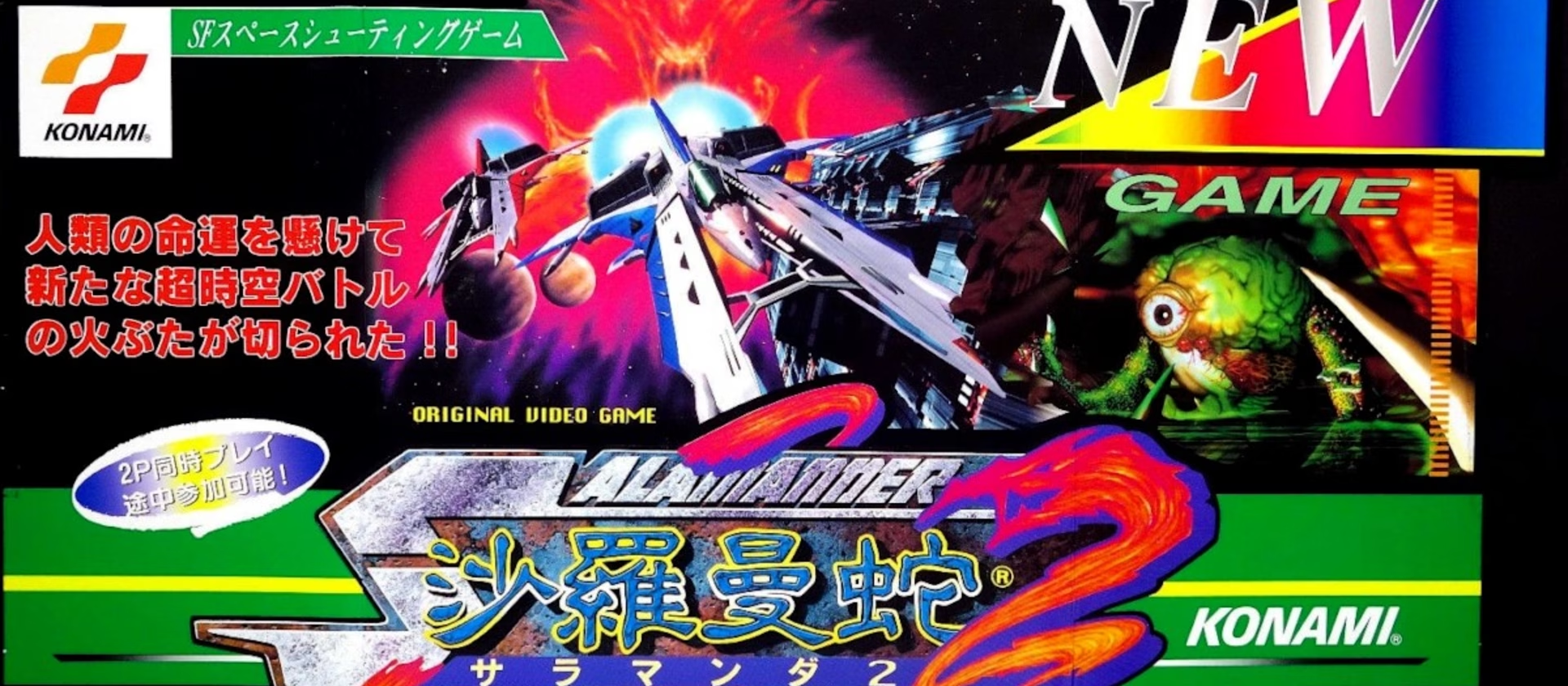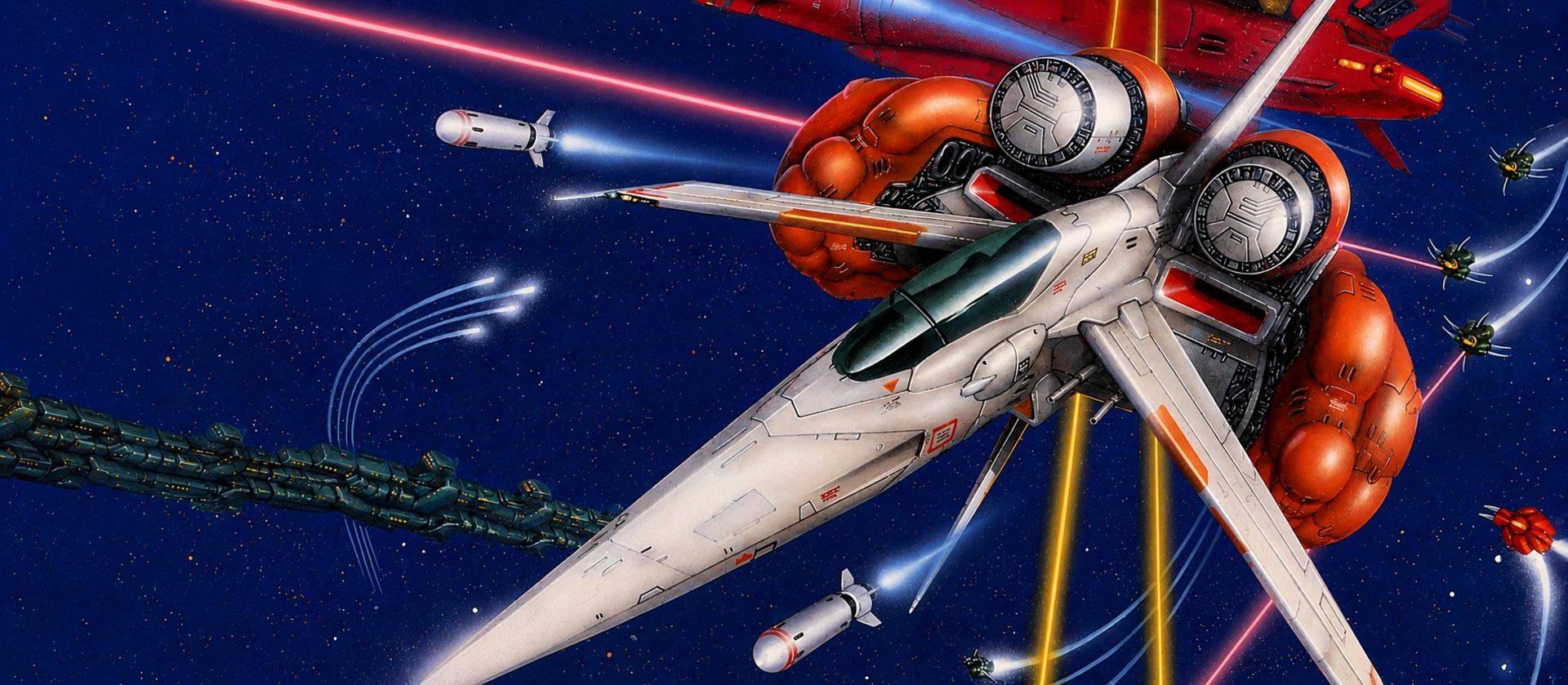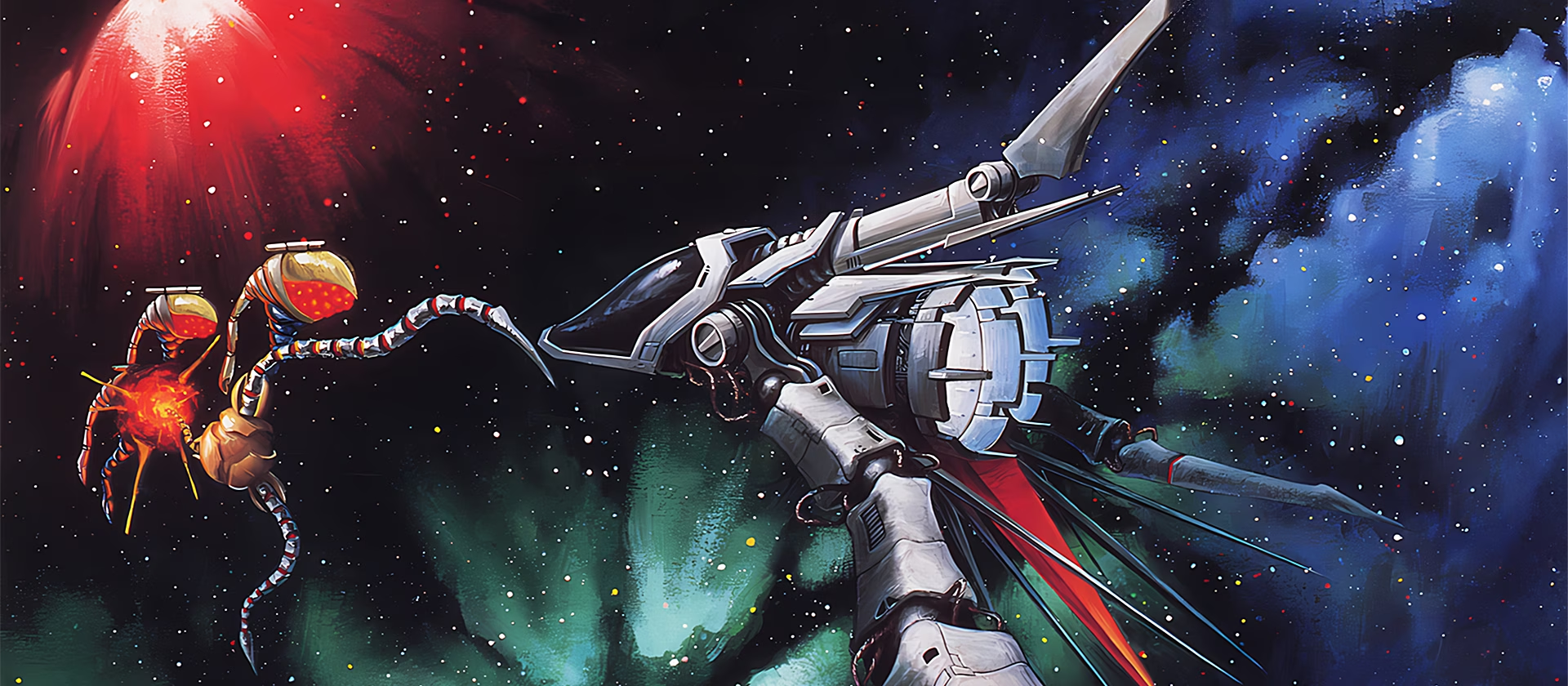
Xexex won Best Graphics and Best VGM at the 1992 Gamest Awards and placed third overall. It beat Virtua Racing for the graphics crown and Metal Black for the music. It came ninth in Player Popularity. The trade press loved it more than the players did, the trade press was right, and within twelve months Konami had quietly accepted that the game could not be moved off the cabinet that made it. The board was a one-off — Konami’s GX067, custom-built and never used again. No SNES port was attempted. No Mega Drive version. A PlayStation 2 release was started and cancelled. The Princess on the flyer at the top of this article called out into a Japanese arcade for sixteen years before any version reached a home machine, and into the world for thirty years before any version reached one outside Japan. Today the most-decorated Konami arcade shooter of its year is still missing from Konami’s own Gradius Origins compilation.
A Princess and a Custom Board
The team’s stated goal was an accessibility move. “Our goal for Xexex was to change the image people had of Konami STGs as being ‘hardcore,’” Konami planning told Gamest in February 1993. “That’s why we added a cute girl.” Her name in the cabinet is Princess Irene La Tias, of planet E-Square, and she calls out for the Flintlock fighter between every stage in the voice of Sumi Shimamoto — the actress who had voiced Nausicaä in 1984 and Clarisse in The Castle of Cagliostro five years before that. The casting was not a flourish. Konami had cast the most recognisable young-woman voice in mainstream anime to soften a horizontal shooter.
Stage 1 in motion — the Flint detached, tracking the next enemy across the screen on its own. Konami’s answer to the Force pod of R-Type, fused with the tentacle weapon of X Multiply, on a board its own maker would use exactly once. Xexex · Konami, 1991.
The board they wrapped this around was a custom Konami PCB, the GX067, sitting in the family below the Konami GX flagship that would arrive three years later. It carried a 16-megahertz 68000 CPU and a Z80 sound chip driving a YM2151 with PCM samples — mid-tier for late 1991, by Konami’s own standards. What made it remarkable was that Konami never used it again. The cabinet on the workbench in front of the team was theirs alone, the chips were not going to be reused for Sunset Riders or Lethal Enforcers, and the porting question — what comes home, what stays in the cabinet — had been answered before the team finished the cabinet. Nothing about this would come home. The custom board was the bargain that paid for the seven-stage spectacle on screen.
What the Flint Actually Does
The Flint is the mechanism. It is the single most expressive piece of arcade-shooter design Konami shipped in 1991, and it is two competing Irem ideas combined into one organism. R-Type in 1987 had given the genre the Force pod — a detachable forward unit that could be launched and recalled, that absorbed bullets while attached and dealt contact damage while loose. X Multiply in 1989 had given the genre tentacles — flexible, invulnerable, articulated limbs flanking the player ship that lashed at enemies on either side. Konami’s Flint is what happens when those two ideas are placed in the same chassis.
Launched from the Flintlock, the orb homes in on the nearest enemy at slow speed and clamps on, dealing contact damage as long as it stays attached. Charge it up with pickups and it grows tentacles — first one, then two, then a full set of articulated limbs that lash automatically at anything nearby and physically block enemy bullets. Press fire while the Flint is locked to the ship and the tentacles fan out into a charge-shot lattice across the screen. The orb is alive, and it gets more alive the more you feed it. There is nothing else in 1991 doing this. Gradius had the Option satellites, which were obedient duplicates. R-Type had the Force, which was a tool. The Flint is a creature on a leash, and what the leash does shifts as the run progresses.
The Japanese build offers five mutually exclusive primary lasers to fire alongside it. Photon, the standard beam. Ground Laser, which hugs the surface terrain. Spiral, a rotating wide pattern. Homing, splitting into three tracked beams. Shadow, which leaves a damaging trail wherever the ship has flown. Switching between them is its own ongoing decision layer — the Spiral changes how levels read, not just how they play; the Shadow turns the ship’s path into a weapon — and an arcade run is partly the choice of which laser to lock to which board. The Orius build, as we are about to see, threw all four alternates away.
The Spiral Laser engaged on Stage 2’s orb fields — the rotating wide pattern doing crowd control across a screen Konami had no business pushing in 1991. The five-laser ladder is the Japanese build’s strategy layer; the Orius export kept only one of these. Xexex · Konami, 1991.
Two Builds, Two Konamis
The Western export of Xexex — branded Orius in North America, kept under the Xexex name in Europe — is functionally a different game with the same artwork. Single forward weapon plus homing missiles, no five-laser ladder. Energy bar instead of single-hit death. Respawn in place, no checkpoint regression. Rapid fire removed. Five difficulty cycles to clear. Two-player simultaneous co-op, where the Japanese cabinet was solo. Hardcore Gaming 101 is direct: without the rapid-fire option, the Orius bosses become “a total chore.”
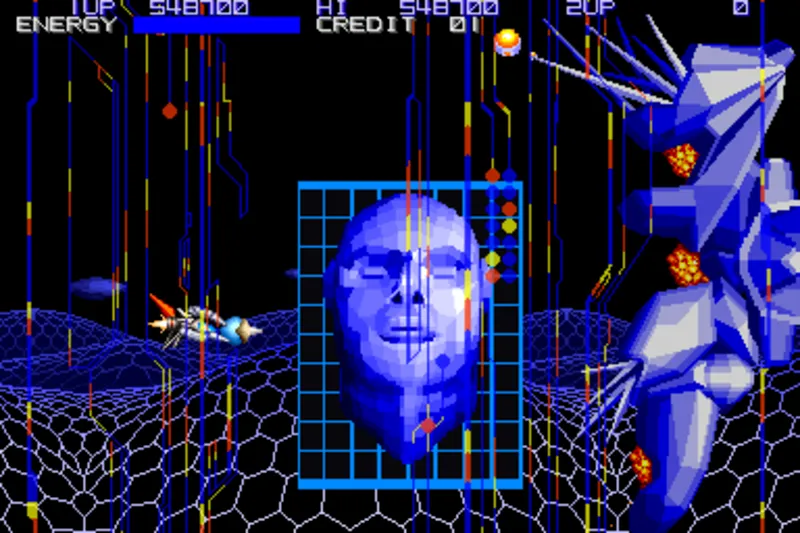
Stage 5’s trompe-l’œil monitor — a screen-within-the-screen built out of wireframe geometry and a sampled face. Half of the 1992 Gamest Best Graphics crown is built out of this stage alone. Xexex · Konami, 1991.
That regional split is itself part of the angle. The Japanese cabinet is uncompromising in the 1991 way — single hit, checkpoint regression, five-laser strategy — sitting under a story scaffold that is deliberately soft. The Orius build inverts the proportion: a forgiving health bar under a story scaffold stripped of most of its anime. Konami’s “soften the image” decision did not have one shape. It had two, region-specific, addressed to two different rooms. The reader who comes to Hamster’s 2021 Arcade Archives release with the region menu in front of them is, for the first time on a home console, holding both versions of that decision at once. The recommendation is to start in the Japanese build with save states, and come back to Orius for the two-player co-op. The argument the cabinet was making in 1991 is only legible when both builds are seen against each other.
The Year the Cabinet Won
The 1992 Gamest crown for Best VGM went to the Konami Kukeiha Club team that scored Xexex — Hidenori Maezawa, Motoaki Furukawa, Satoko Miyawaki and Ayako Hashimoto, credited on the cabinet under the era’s standard Konami-Kukeiha alias play (Furukawa as “CAROL QUEEN,” Maezawa as “MICHAEL OLDRIER,” the rest in kind). The score they cut to that board is a sustained piece of late-bubble Japanese arcade composition — bright, lacquered, fast on the bass, leaning into the YM2151’s pitched percussion in the way Gradius II had, but with more PCM in the mix and a willingness to let single tracks carry an entire stage without a transition cue. The opening Breeze sets the floor; The Polygontal Energy on the monitor stage runs grid-pattern arpeggios against the wireframe; Crystal Clear on Stage 1 is the cleanest Kukeiha Club chord work of the year. Furukawa’s hand is the most legible. He had been writing for the Konami arcade catalogue since Gradius in 1985, and Xexex is the loudest thing he ever shipped for the cabinet.
”Our goal for Xexex was to change the image people had of Konami STGs as being ‘hardcore.’ That’s why we added a cute girl.”
— Konami planning team, Gamest #87, 28 February 1993; translated by Shmuplations
The Stage 4 biomechanical interior in motion — green serpents articulating across an organic membrane while the parallax behind them shifts. The X Multiply / Giger inheritance, routed through Konami’s 1991 palette discipline and a board its own maker built for this game alone. Xexex · Konami, 1991.
The graphics award is harder to pull apart in prose because it is half built out of effects the screen had to be doing in motion. Sprite scaling. Multi-plane parallax. Animated palette cycles for the organic stages. Line-scroll on the monitor stage. Pre-rendered tile work behind sprite work, on a board with no transcoding budget at all. The four-year gap before Saturn and PlayStation made an arcade-perfect port unnecessary in commercial terms; the reason Konami did not try a Super Famicom version was the same reason they would have to invent the Axelay Mode 7 vocabulary the following year on the SNES. Xexex is what the arcade workbench could do when the cartridge translation was nobody’s problem.
Thirty Years, Still Outside
For sixteen years after the cabinet shipped, the only home presence Xexex had was a mini-game cameo. A scaled-down version of Stage 2 appears inside Ganbare Goemon 2 on the Super Famicom in 1993 — sub-window, Hardcore Gaming 101 notes, with “tons of slowdown.” That was it. Konami’s planned PlayStation 2 release inside Hamster’s Oretachi Geesen Zoku compilation was cancelled during development. The first proper home port arrived in 2007, on PSP, inside the Japan-only Salamander Portable UMD bundle alongside Salamander, Salamander 2, Gradius II and Life Force. International readers waited another fourteen years.
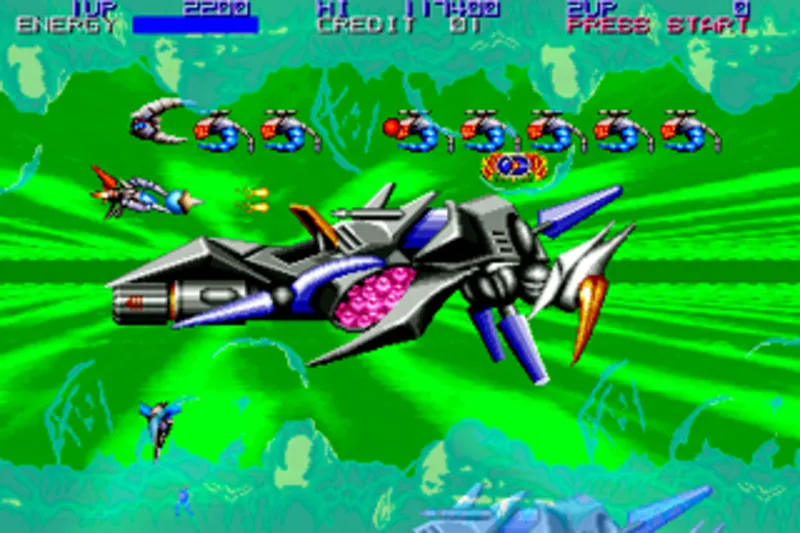
Late-stage biomech architecture — chrome plate over pink organic interior, the X Multiply / Giger inheritance routed through Konami’s 1991 colour discipline. Each stage carries one of these set-pieces; the board does the work. Xexex · Konami, 1991.
Hamster’s Arcade Archives Xexex shipped on Switch and PlayStation 4/5 on 23 December 2021, the first international release of any kind, with the full region toggle the cabinet never offered: Japanese build, European Xexex, US Orius, switchable from a menu. Save states. Online rankings. The standard Arcade Archives feature set. It is the cleanest route on current hardware, at the cost of being a third-party release in a Konami canon — Hamster’s name on the front. Eight months later, in August 2025, Konami’s own Gradius Origins shipped on every current platform with M2’s restoration of Gradius I, II, III, Salamander, Life Force, Salamander 2 and the new Salamander III. Xexex is not in it. The most-decorated Konami arcade shooter of its year — sitting squarely inside the Gradius / Salamander cosmology, sharing engineers, sharing the Vic Viper silhouette, sharing the cabinet vocabulary — is still excluded from the franchise’s canonising compilation.
That omission is real friction for the reader. To play Xexex today you go through Hamster’s Arcade Archives, not through Konami’s own franchise box. The Japanese build’s checkpoint regression and single-hit death are 1991-arcade-strict, and a casual modern player will lean on the save-state option; the Orius build is the gentler entry point but mechanically thinner, missing four of the five lasers and the rapid fire that lets boss fights land. Runtime is forty-five to fifty-five minutes for a one-credit attempt at the Japanese build, longer for a serious Orius five-loop. What you get for the work is the Hardcore Gaming 101 assessment, plain enough to lift: “XEXEX’s graphical intensity prevented straightforward 16-bit console ports without drastically downgrading it. The four-year gap before Saturn/PlayStation availability rendered arcade-perfect porting obsolete from a commercial perspective.” In 1991 the answer to that intensity was to leave the cabinet in Japanese arcades. Today the answer is Hamster’s region menu, six pounds twenty-nine, and the cleanest version of Konami’s most spectacular arcade workbench that the home market has ever held.