
You jump for the lift slightly too late, the way you have already learned not to, and the lift catches you anyway. A hen — released from its cage three platforms up — is closing the gap behind you. There are still four eggs to collect on this layout and the timer is dropping a beat at a time. You climb. You drop a level. You jump again, this time onto a platform; the bird collides with the ladder you just left and reverses direction. You exhale.
This is Chuckie Egg on the ZX Spectrum: eight platforms wide, eight screens long, written across one summer holiday in 1983 by a sixteen-year-old in his bedroom. Britain bought it in such numbers that it became one of the defining home-computer platformers of the decade — and remembered it, almost universally, as the country’s answer to Donkey Kong. Its author thought he was making something else. He thought he was making Space Panic 2.
A Schoolboy with a Loathing
Nigel Alderton was sixteen or seventeen when he wrote it — “definitely still at school, because I remember finishing the game during a summer holiday” — and the work took four or five months. Beyond two screen layouts contributed by a friend, Phil Berry (numbers six and seven, since you asked), he did the lot: design, code, graphics, sound, the high-score table, the redefineable keys. His first Spectrum game, Blaster, supplied the keyboard routines he reworked for the new project.
What is striking about the way he describes those months is not the precocity — that is a familiar 1980s bedroom-coder story — but the specificity of what he was reacting against. Manic Miner had come out a few months earlier and become an instant hit. Alderton hated it. “I had a loathing — & still do — of games where the collision detection of the sprites is unforgiving pixel-to-pixel checking.” He wanted a game built around dexterity and reactions, not the puzzle solving of Matthew Smith’s caverns. He wanted the agreement between player and platform that Manic Miner refused to make.
That single design choice — that the controls should never punish the player for being slightly off — explains more about why Chuckie Egg still works than any of its more famous features. Watch the lifts. In the Spectrum and C64 versions only, if you jump for a moving lift slightly late, Harry catches the edge anyway and is carried up. On every other port, that same jump drops you through. The lifts are the part of the game that feels alive: the part where the design philosophy reaches out and meets you.
The Lineage Nobody Noticed
Every contemporaneous review compared Chuckie Egg to Donkey Kong. Some compared it to Manic Miner — the comparisons that, Alderton said, “really annoyed me.” Nobody compared it to Space Panic, the obscure 1980 Universal arcade game that he had played to death at a newsagent on his way to school and that the game is, by his own admission, much closer to.
“The inspiration for the game came from two arcade games of the time — Donkey Kong which is well known and Space Panic by Universal which is a bit more obscure. Some reviews of Chuckie Egg compared it to Donkey Kong and also Manic Miner which came out a few months earlier… I don’t think anyone noticed how similar the game was to Space Panic.” — Nigel Alderton, 80sNostalgia
The lineage matters because it changes how you read the design. Donkey Kong is built around a vertical climb under threat — angled girders, jumping over barrels, a goal at the top of each board. Space Panic is a grid of horizontal platforms connected by ladders, with monsters that climb after you and an objective that requires moving through every level of the screen.
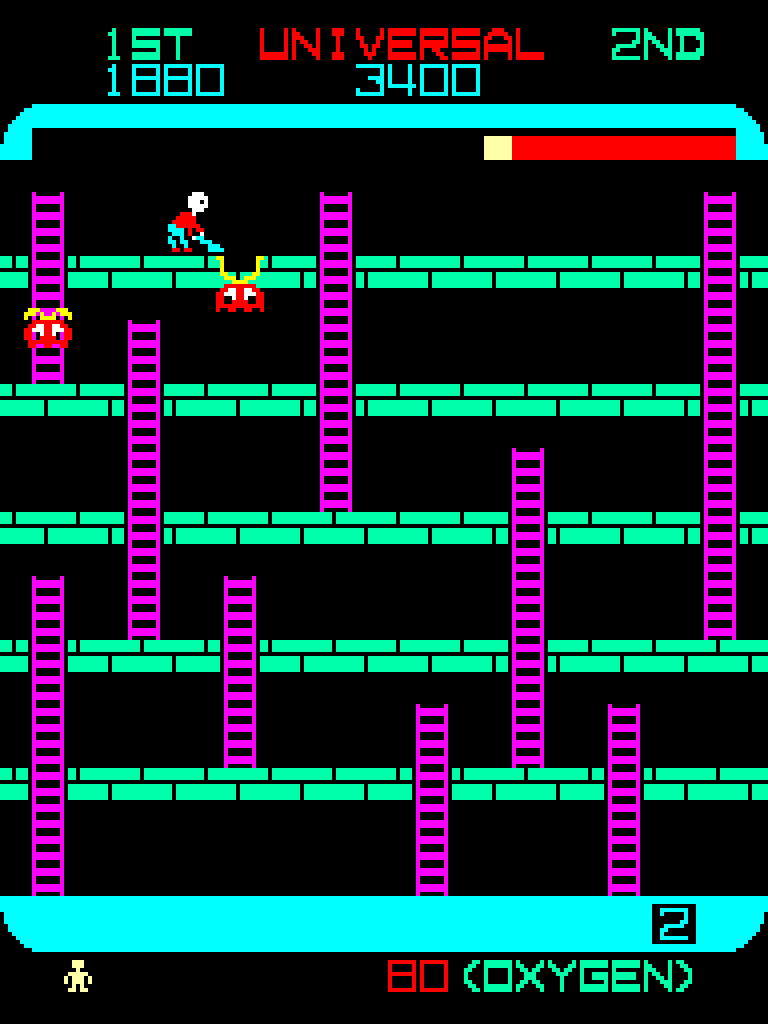
The skeleton Alderton borrowed: eight-platform grid, ladders, climbing pursuers, the requirement to traverse the whole screen. Space Panic · Universal, 1980.
Chuckie Egg keeps the Space Panic skeleton — the eight-platform grid, the climbing pursuers, the requirement to traverse the whole screen to clear it — and replaces the trap-digging with egg collection. Once you see it, you cannot unsee it.
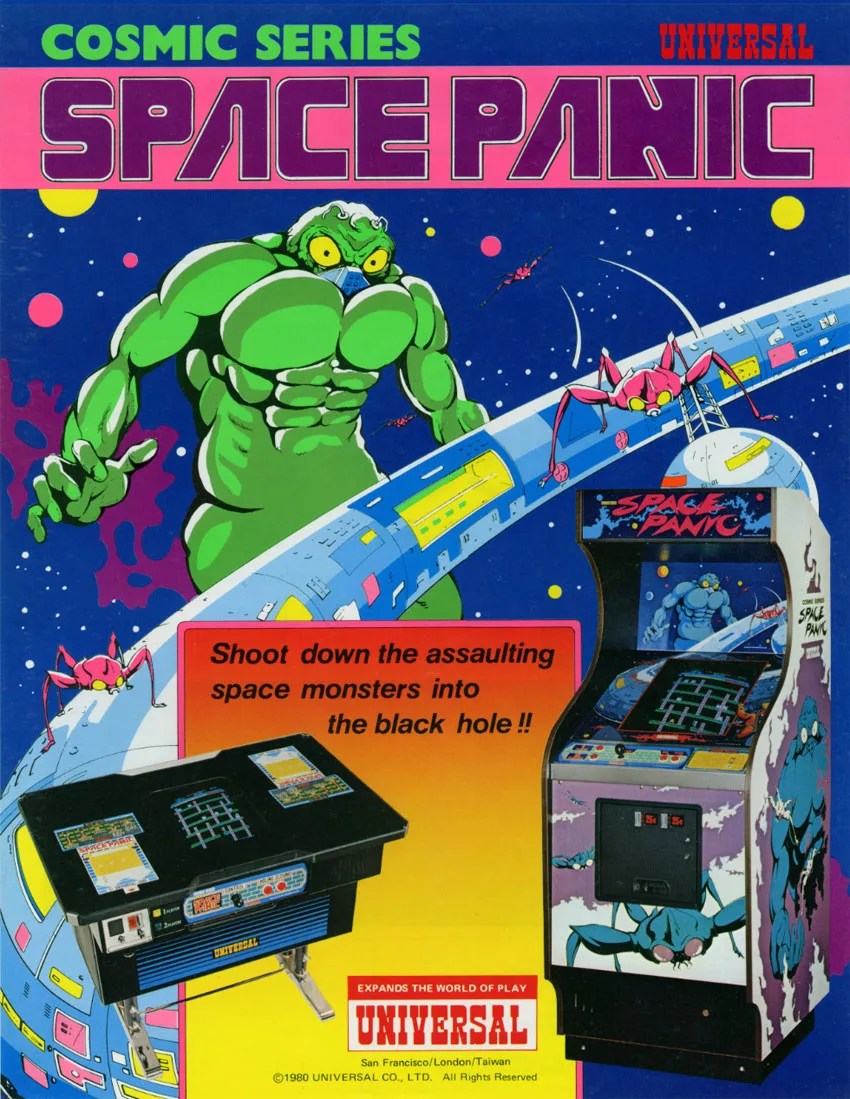
The obscure Universal arcade that Alderton played obsessively at the newsagent. Space Panic · Universal, 1980.
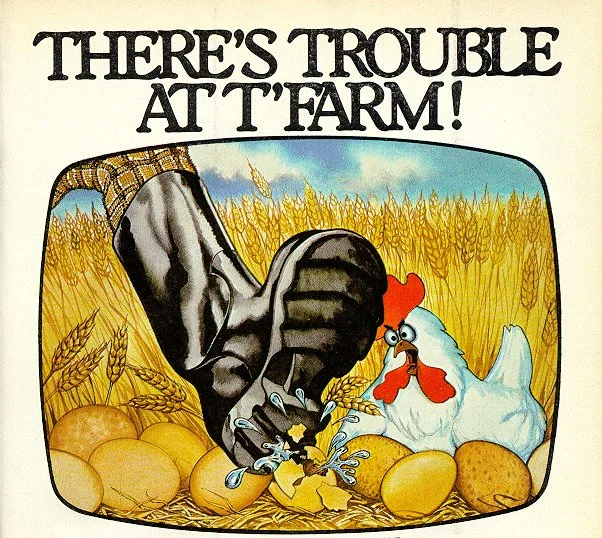
A&F’s marketing leaned on the comic farmyard veneer. The design underneath was something else. Promotional art · A&F Software, 1983.
But nobody saw it in 1984. The British Spectrum press had a vocabulary that ran Donkey Kong → Manic Miner → “platform game” and stopped there. Chuckie Egg was sorted into that taxonomy on arrival and has been remembered there ever since. The strangest fact about one of the most-played British platformers of the eighties is that it isn’t really, in the lineage that produced it, a British platformer at all. It is a teenager’s love letter to a forgotten Universal arcade that almost nobody else in the country remembered.
Smooth Pixel Movement Was Clever
The other thing the British press got wrong, or never thought to mention, was how Harry actually moved. In 1983, almost every platformer on the Spectrum used character-based movement: sprites jumped from one 8×8 cell to the next, snapped to the grid, never occupied the spaces between. Manic Miner did. Jet Set Willy would. It was the norm because it was easy.
Alderton refused. “I wanted to do smooth pixel movement not the character movement which unbelievably was the norm at the time. Pixel movement was perceived to be ‘very clever’.” Harry walks one pixel at a time. He climbs ladders one pixel at a time. He falls one pixel at a time. The hens that chase him do too. Multiply the difference across an eight-screen game cycled five times and the result is a level of moment-to-moment precision that other Spectrum platformers of 1983 simply did not offer.
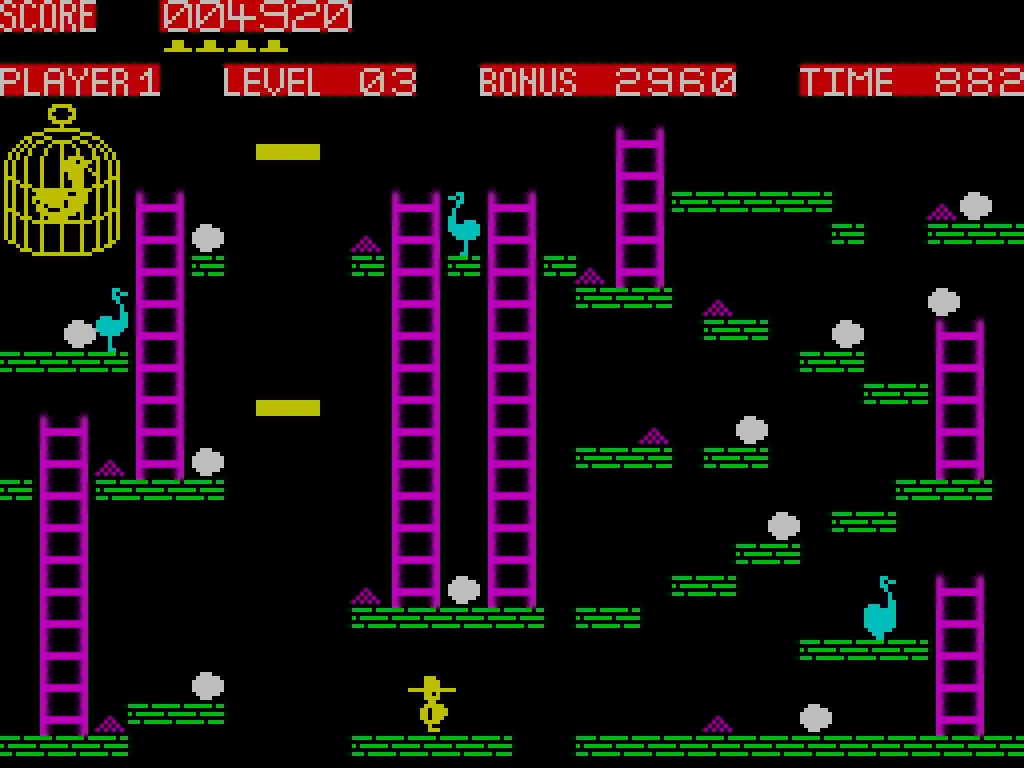
The design philosophy rendered: pixel-perfect movement, forgiving lifts, hens that punish indecision. By level three, the timer is the real threat. Screenshot: Chuckie Egg · A&F Software, 1983.
This is craft, in the sense the word is supposed to mean — a technical decision made because it produces a better feel, taken on by a programmer who could have shipped something easier and didn’t. The forgiving lift-grab is the same instinct expressed in the other direction. The control scheme is, all the way down, an argument with Manic Miner.
Forty Levels, Then He Caved
You play through eight platform layouts; the cycle repeats five times with escalating speed and added enemies; on the sixth pass the game gives up and loops the last eight forever. Forty levels of designed difficulty, then the curve flattens. Alderton has been clear about what was supposed to be there instead. A cycle with two birds whose top speeds and accelerations were deliberately mismatched, so that they wouldn’t lock together. Then a cycle that didn’t change at all, to lull the player into thinking they had seen everything. Then, finally, the move:
“On the next cycle, I would have put breaks in one or two ladders and removed one or two ladders from each layout. It doesn’t sound like much but I’d noticed that I’d developed a favourite route for completing each layout and assumed others would too. Removing ladders would probably disrupt the players favourite route which if it was done late enough in the game when the player had already put hundreds of hours into the game (on the same eight unchanging layouts) would have had a big impact for a small amount of coding.” — Nigel Alderton, 80sNostalgia
That is the design talking, and it is good design — the kind of long-arc thinking that recognises that mastery itself becomes the obstacle a hard game has to overcome. None of it shipped. A&F Software, the Rochdale outfit Alderton showed an early version to, had its own factory unit and banks of cassette decks, and was urgently chasing review-copy deadlines and buying meetings. “They couldn’t understand,” he said, “(or didn’t want to understand) that I wasn’t ‘adding bits’, I was trying to finish coding a game that was already designed in my head. In the end I caved in.”
So the canonical version of one of the most-played British games of its decade is, by the author’s account, the one he was pushed to ship before he was done. The forty-level curve was supposed to be the warm-up. The real game began on level forty-one.
Why the Friction Reads as Designed
What is surprising about playing it now — past the looped final cycles, in the eight layouts everyone knows — is how little is wrong. The friction is in the right places. The timer is tight enough to demand a route. The hens, once released, force the route to flex. The lifts move at exactly the wrong speed for a casual jump. None of this is a function of the game’s age; all of it is a function of the design philosophy that its author articulated and then enforced one pixel at a time.
That distinction matters because the standard British retrospective on Chuckie Egg tends to settle for “it still holds up.” It does, but not for the reasons that phrase usually means. Old games hold up by accident, or because nostalgia smooths over the rough edges. Chuckie Egg holds up because a sixteen-year-old who hated Manic Miner spent four months making sure the controls did the work the level design asked of them, then was forced to ship before he could prove how far he could push it.
Open Fuse, load the .tap, and clear the first eight screens at your own pace. The agreement between player and platform is right there in the first lift-jump. You will recognise it, and you will probably finish the eight without dying, and you will be tempted to call it nostalgic. It isn’t. It is the work of someone who understood that craft is the difference between a game that asks you to forgive it and a game that simply is what it is.