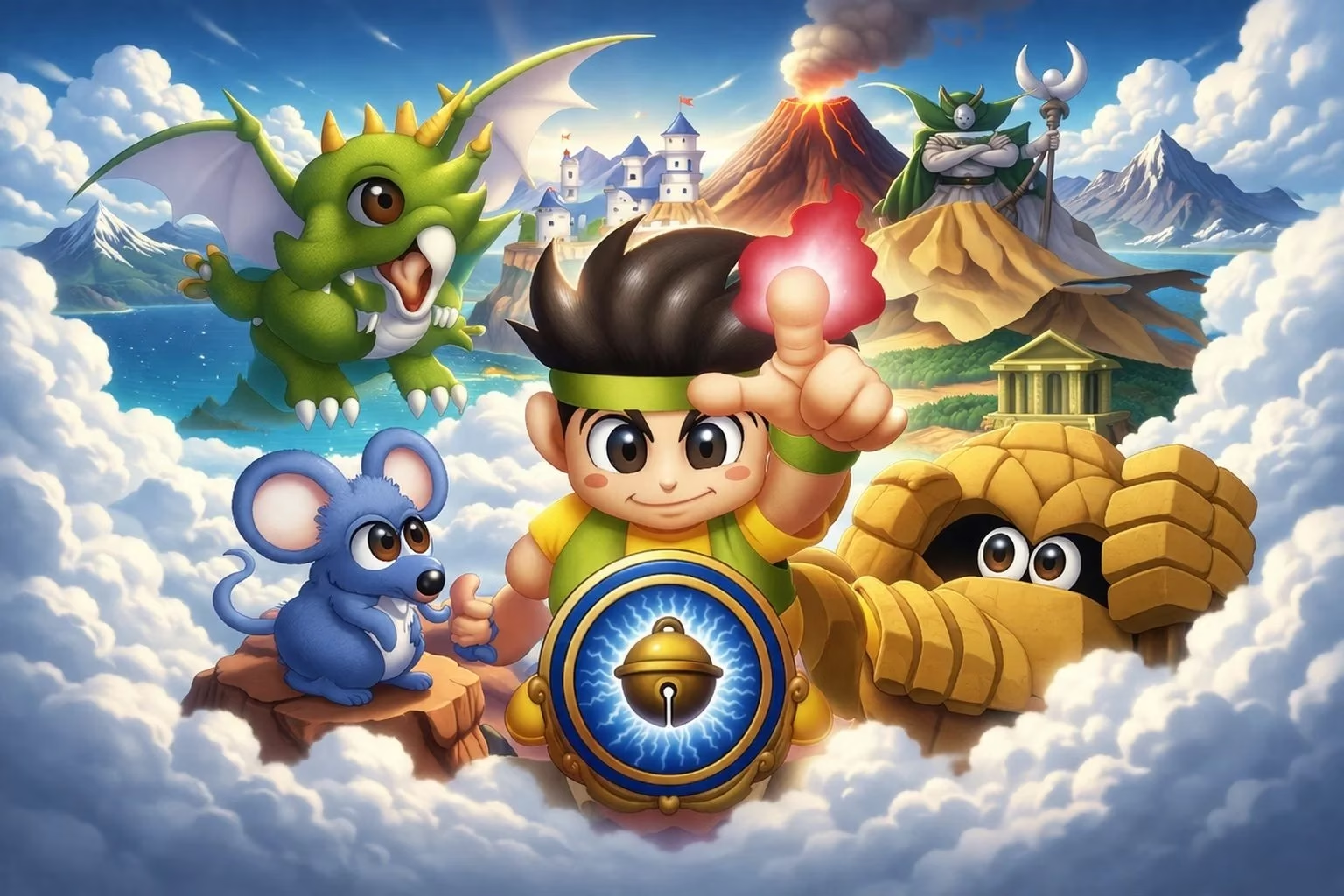
You are a small grey mouse, alone in a corridor your other three heroes cannot enter. The ceiling is too low for the boy with the bells. The walls are too narrow for the dragon. The golem could not even reach the entrance. So you — K.O., with a single pixel-sized health bar and a satchel of explosives — crawl in, place a bomb against a wall the larger heroes could not have seen, and open a path none of them could have opened. Then you pause, choose another body, and you are not a mouse anymore. You are the dragon, drifting above where you just walked, and the level is suddenly readable in a way it was not a minute ago.
That act — changing bodies after changing the room — is rare even in a late-NES library full of experiments. Mega Man changes the weapon, Bucky O’Hare builds a rescue-gated crew, but Little Samson makes the whole platformer feel like one shared level being read through four bodies.
Four Bells, One Design Philosophy
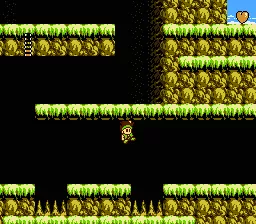
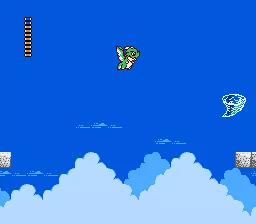
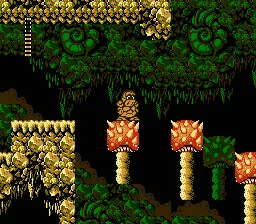
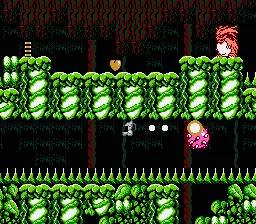
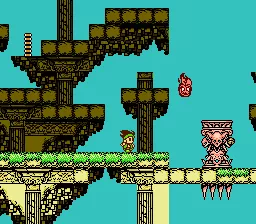
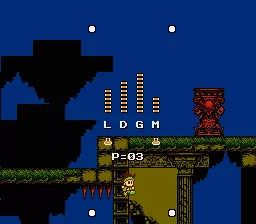
Little Samson reveals its structure from inside the level, not from the menu. Four heroes — Samson the bell-wielder, Kikira the dragon, Gamm the golem, K.O. the mouse — are each introduced across their own opening stage before becoming freely interchangeable. The four levels can be played in any order, and each functions as both character tutorial and level-design showcase. Samson is the all-rounder: moderate health, wall-climbing, bells that fly straight and true. Kikira can breathe fire in an upward arc, charge it to three levels of power, and briefly hover — which turns entire platforming sections from tests of precision into questions of positioning; her claws even keep her steady on ice where the others skid. Gamm is slow and can barely jump, but his fists extend in all four cardinal directions and he can walk across spike fields that would kill the others instantly. K.O. has almost no health — the fragility of tissue paper, as one contemporary reviewer memorably put it — but can fit through passages no one else can navigate, climbs every surface Samson can, and his bombs, placed correctly, deal damage the other characters cannot match.
You can feel director Shinichi Yoshimoto’s arcade pedigree — Strider, Ghouls ‘n Ghosts — in the hit reactions and enemy spacing, translated to a platformer that never demands arcade reflexes. Much of the game can be forced through with Samson alone, but playing it that way is like solving a crossword with only one letter. The real pleasure is in reading each encounter: the aerial section where Kikira turns a death trap into a flight path, the spike corridor that Gamm simply walks through while the others would die trying to jump it, the narrow passage that only K.O. can access to reach the true path. Every character has their own health bar, and the game treats those bodies as resources. If someone other than Samson dies mid-stage, they stay gone until the stage is cleared, or until you spend one of the rare revival potions each character can carry. Swapping out a wounded hero before they die is not convenience. It is triage. The design never shows off. It never makes character-switching feel like a gimmick. But the level and enemy design consistently synergise with it in ways that accumulate rather than announce themselves.
Kikira’s hover turns a lava corridor into a flight path. The other heroes would be reading this room as a precision platforming test. Little Samson · Takeru / Taito, 1992
What the game does not tell you — what the manual provides and the game itself leaves silent — is that three of these four heroes are there under coercion. Kikira began as a human woman whose arrogance turned her into a dragon. Gamm started as a thief who drank a stolen potion. K.O. began as a wizard who accidentally transformed himself into a mouse. Only Samson chose this. None of it appears in the game’s cutscenes, which are wordless throughout, but it reframes every swap as something more complex than tactical resource management. The mouse planting bombs in narrow passages is not a hero by nature. He is making do.
A Squad, Not a Loadout
Switchable heroes were not new in 1992. Mega Man 2 had eight robot masters’ weapons; Castlevania III had Sypha, Grant, and Alucard joining Trevor; Teenage Mutant Ninja Turtles had already made a four-character life pool out of the license’s central quartet; Kirby’s Adventure arrived the following year with a copy-ability system that turned Kirby into twenty different specialists. What Little Samson does differently is grant each hero an entire moveset and an entire health bar, freely interchangeable mid-level rather than recruited at narrative junctions, and then design every screen as if all four could plausibly walk into it.
Mega Man’s weapons are tactical loadouts on the same body — the silhouette, the jump, the damage taken are all his. Trevor’s companions in Castlevania III split the campaign between Grant’s path and Sypha’s, but you commit to one for each route. The Turtles share a city but mostly differ as reach, damage, and survivability. Kirby’s powers come and go with whatever he last inhaled. Little Samson is the one where you carry a permanent four-body squad whose differences matter to the geometry, not just the damage table — and where dying as the mouse and switching to the dragon is a decision, not a punishment.
The case against the game is honest, and worth saying. It is short — a confident player will see the credits in around two hours, and a skilled one can cut that down sharply. The difficulty curve sits on the gentler side of the NES action-platformer spectrum; Ninja Gaiden fans expecting a precision grinder will find this less wiry. A few of the boss patterns reward trial-and-error on the first encounter more than reading. The late game also repeats a few stage ideas after the system has already made its point, stretching a design that is at its best when it feels concentrated. But because the four characters arrive in quick succession across the opening hour, the game’s full vocabulary is on the table early — the rest of the runtime is the level designers writing increasingly dense sentences in it. On Normal, the final castle reprises boss fights, keeps fallen partners dead across its internal gauntlet, and ends with an escape that asks for all four bodies one last time. Whether that is “too short” or “exactly long enough” depends on what you came in expecting. Little Samson never overstays. It also does not ask for a second visit the way a Mega Man does.
The skull castle finale keeps fallen partners dead across its internal gauntlet — the squad’s resource economy at maximum pressure. Little Samson · Takeru / Taito, 1992
From Parts to Bodies
To understand what Little Samson is and why it plays the way it does, you have to understand the studio that made it. Akira Kitamura founded Takeru after leaving Capcom, where he had directed the first two Mega Man games and helped define the body-and-weapon grammar the NES would keep returning to. Takeru’s work reads like a private continuation of that question. Cocoron, its first Famicom game, lets players assemble a hero from interchangeable parts; Little Samson fixes the parts into four complete bodies and lets you carry them all at once. Shinichi Yoshimoto, who directed Little Samson, had been a designer on Ghouls ‘n Ghosts and the arcade Strider at Capcom — two games that knew exactly how much information an action sprite could carry.
Takeru’s catalogue is small enough to read as one argument. Cocoron asks what happens if a platform hero can be built from parts. Nostalgia 1907, an expensive adventure game, pushed the young studio into riskier commercial territory. Little Samson, its final game, answers the same question with cleaner discipline: stop rebuilding the hero, keep four of them in play, and make the level design do the talking.
The Platform That Wasn’t Ready
Little Samson arrived at the worst possible moment in hardware history. Nintendo had been selling the SNES in North America since 1991, and by November 1992 the marketing energy in games retail had fully shifted to 16-bit. The NES was not dead — games continued to be made for it until 1994 — but it was invisible. A new NES game in 1992 had no natural marketing context. Retail gave no dedicated columns or shelf space to the old platform, and magazines had no reason to put it on the cover. Famitsu’s reviewers praised the audiovisual quality and the distinct character design but found the action somewhat lacking in intensity. Nintendo Power gave it a feature in issue 40, which remains close to the only major Western coverage the game received in its commercial life. Print runs are thought to have been small. The cartridges sat. The studio dissolved.
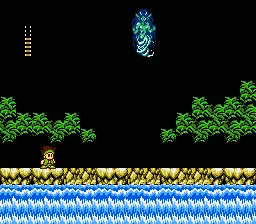
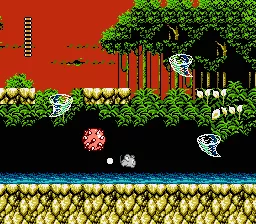
The graphics do not look like a game the market ignored. The sprite animation — particularly Samson’s extravagant full-body twirl on every jump, however small — is some of the most expressive work on the system. The bosses dwarf the player in ways the hardware had no business producing in 1992: enormous creatures that take up the full screen and move with a fluidity the NES was not supposed to permit. The best of them look as if they wandered in from Castlevania after losing their way through a brighter, stranger game: skeleton riders, skull-spitting horrors, dragons that turn the arena into a memory of Mega Man 2. The music system gives each character their own leitmotif, the soundtrack shifting every time you switch — Samson’s bright march giving way to Kikira’s breezy flight theme, Gamm’s slow bass trudge, K.O.’s tight jazz. It is a technical achievement by a studio that disappeared before the game could find its audience.
A boss that dwarfs the player and moves with a fluidity the NES was not supposed to permit — a memory of Mega Man 2 drifting into a brighter, stranger game. Little Samson · Takeru / Taito, 1992
The Box That Couldn’t Explain It
A folk explanation has grown up around the commercial failure. In Japan, the game was released as Seirei Densetsu Lickle — Holy Bell Legend Lickle. For Western release, Taito renamed it Little Samson. By 1992, the story goes, North American NES players had developed a reliable internal taxonomy: games with biblical names were almost invariably edutainment products, Sunday-school software in cartridge form, reliably among the worst games ever made. Collectors who were browsing NES shelves that Christmas have described seeing the box, seeing the name, and putting it back. One commenter on the Nintendo Life re-release announcement remembered seeing it at KB Toys on clearance, assuming it was a Bible game, and passing.
That story is partly post-hoc — the kind of folk diagnosis that gets attached to commercial failures after the fact — and impossible to prove against the simpler explanation that a new NES game in an SNES Christmas was always going to sit. But it is plausible at the shelf level, and it points toward the larger problem. Little Samson did not have a cover, a title, or a market position capable of explaining what it actually was. The game has no religious content; its story is a demon king, a supernatural mountain prison, an emperor, and four magical bells. The part worth selling was not mythic strength. It was the pleasure of changing shape.
Rescued by Japanese Law
When Limited Run Games began pursuing a proper re-release, the trail did not lead neatly from Taito to a contract drawer. According to Josh Fairhurst, Limited Run’s Japanese business development lead Alexander Aniel, its Japanese agent, and partners at Tatsujin helped chase the rights through original publishers, former Takeru staff, and even children of former Takeru executives. No one could definitively claim enough ownership to license the game. The solution was Article 67-2 of the Japan Copyright Act, which permits the Agency of Cultural Affairs to issue a licence for works whose owners cannot be definitively identified, holding royalties in escrow against the possibility that someone eventually surfaces to claim them. Limited Run registered the licence in September 2025. The re-release, announced for Nintendo Switch, PlayStation 5, and PC in 2026, will arrive thirty-three years after the game quietly appeared and disappeared.
”Daunting.”
— Josh Fairhurst, Limited Run Games, on the three-year rights hunt
The legal mechanism, according to Fairhurst, is not unprecedented; other publishers have used the same route to rescue games that would otherwise remain locked. But it is rare, and the fact that it was needed at all underscores a story shaped by institutional indifference. Limited Run also registered trademarks for both Little Samson and Lickle, not as an ownership claim, Fairhurst said, but to secure the right to use the names and avoid the kind of trademark squatting that has become its own preservation hazard. People who had left their jobs made the game. A company that did not know how to sell it published it. Taito named it in a way that made it invisible. Its rights chain went cold. And it is returning to players now because of an escrow clause in Japanese intellectual property law.
None of that history is the game’s fault. What you get for two hours with Little Samson is the specific pleasure of carrying four bodies through one set of levels, and watching the level designers stay one step ahead of you the entire way. Mega Man gives you weapons. Castlevania III gives you company. Kirby gives you costumes. Little Samson gives you a squad — a permanent, switchable, four-silhouette squad in a genre that almost never trusts the player with one. That is the thing the rest of the canon does not have, and it is the reason a 1992 cartridge that sold almost nothing is worth an evening now.