// import zombiesHedgemazePoster from ”../../assets/images/zombies-ate-my-neighbors-1993-hedgemaze-poster.jpg”; // deleted
// import zombiesDrTonguePoster from ”../../assets/images/zombies-ate-my-neighbors-1993-dr-tongue-poster.jpg”; // deleted
Zombies Ate My Neighbors looks like a shooter. It isn’t. It’s a system about preventing irreversible loss.
LucasArts built a game full of monsters, projectiles, and comic-book chaos, but the manual makes the real priority plain: save the victims before the monsters destroy them, because once they are gone, they stay gone. That one rule changes the meaning of everything around it. What looks like a run-and-gun quickly reveals itself as a panic machine about triage, routing, and the cost of arriving a few seconds too late. The horror is set dressing. The game underneath is about subtraction.
Horror Becomes Rules
Horror becomes rules the moment the game begins.
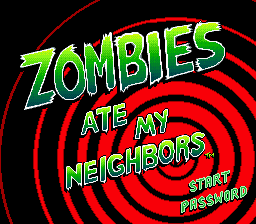
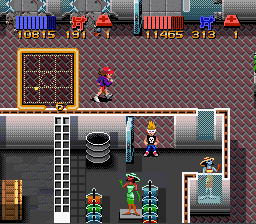
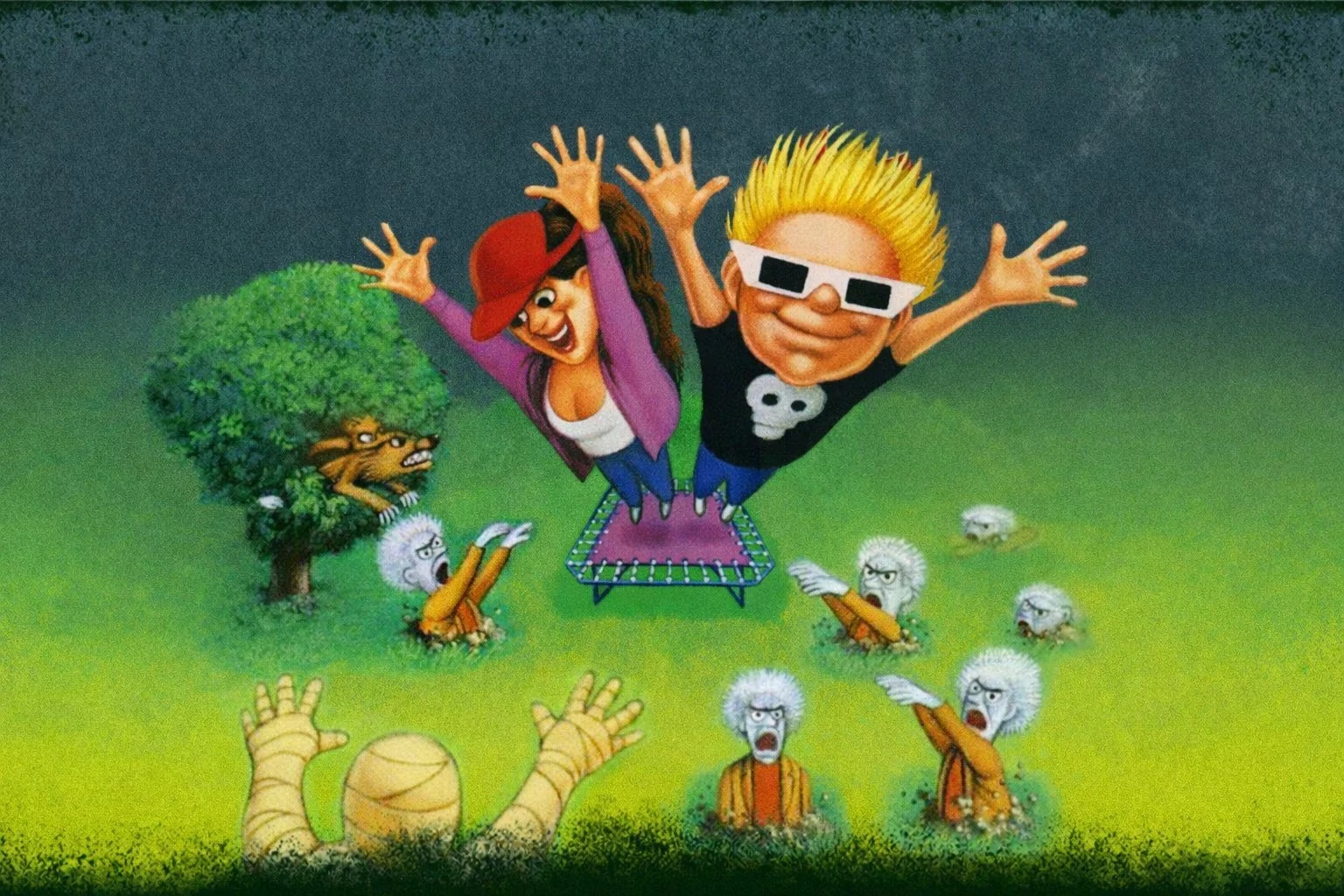
The joke is readable before the first shot: Saturday-matinee horror up top, then a compact map where monsters, doors, civilians, and ammunition compete for your attention. Images: Zombies Ate My Neighbors · LucasArts / Konami.
Zombies shamble in straight lines — slow enough to dodge, numerous enough to corner you. Werewolves require silverware specifically; anything else buys a step back, not a kill. Vampires recoil from crosses but keep advancing otherwise. Chainsaw maniacs move at a sprint and demand space that the level geometry rarely provides. Giant babies make slapstick out of menace: chunky, absurd, and somehow more dangerous in groups than most enemies that are trying harder to look threatening. The game does not simply quote horror cinema. It translates pulp monsters into mechanical problems, each one encoding a specific response from the player.
That translation came from a team whose instincts leaned as much toward arcade action as LucasArts comedy. Designer Mike Ebert pointed to Robotron: 2084 and Smash TV as key influences — a lineage that explains why the game feels so immediate beneath the parody. Robotron had already discovered the emotional brutality of watching saves fail in real time, of knowing exactly where the human was and still not reaching it. What Zombies Ate My Neighbors adds is genre specificity: the monsters arrive pre-loaded with decades of B-movie grammar. A chainsaw maniac means Texas, 1974. A tiny grey alien means Invasion of the Body Snatchers, 1978. A werewolf means a specific silver-bullet rule you already knew from cinema before you opened the box. The game never explains these references because it doesn’t need to. The icons carry their weight before the first shot is fired.
The humour sits on top of all this without resolving into parody. Zach Meston, who co-created the game with Ebert, built a world where the laughs and the dread occupy the same space without cancelling each other out. A level set in an Ancient Egyptian pyramid uses the same spatial logic as a suburban back garden, but the tone shifts slightly, and that shift is half the joke. The comedy is structural as much as visual — the absurdity of a cheerleader being savaged by a mummy while you fumble with a squirt gun is precisely the kind of joke that only works as a game mechanic, not as a line of dialogue or a cutscene.
Space Turns Against You
Space turns against you long before the monsters do.
Suburban back gardens become hostile through layout rather than atmosphere alone. Malls, pyramids, hedge mazes, and supermarket aisles all work the same ugly trick: they cut sightlines, narrow choices, and turn movement into risk. The environments shift every few levels — Antarctic ice fields, haunted houses, cornfields at dusk — but the logic stays constant. You are not exploring for pleasure. You are solving a map against a clock measured in screams.
The multi-level architecture of the later stages sharpens this pressure. As the 55-level run progresses, corridors fold back. Open squares compress. What seemed like space to manoeuvre turns out to be the path a monster was already taking. The top-down view offers the impression of control — you can see the level, or most of it — but comprehension and reach are different things. Seeing where a victim is does not mean you can cross the gap before something else arrives.
You hear the chainsaw before you see it.
The radar marks the cheerleader ten steps away.
You take three.
The scream tells you you’re too late.
That gap between intention and consequence is the game’s real emotional unit. The feeling is not quite failure — the level continues — but the loss registers with precision. You made a calculation, you ran it, and the result reduced your future options. That ratchet moves only one direction.
Every Life Counts Down
Every life counts down whether you reach it or not.
The monsters are the noise. The neighbours are the system. You begin with ten victims on the counter — cheerleaders, tourists, colonists in pilgrim hats, babies in prams. Rescue them and the level opens further. Lose them and the counter ticks down. Lose them all and the game does not offer a conventional game-over screen so much as a slow structural collapse: the final playable levels with zero victims become a kind of purgatory, where the mechanic has already stripped you of everything it cares about. You can still complete levels with no survivors. The game does not stop. It just becomes meaningless.
The radar deepens the cruelty. It points only to people, never to danger. It tells you where help is needed while refusing to tell you what stands between you and it. You move toward the signal with incomplete information, gambling that speed will matter more than caution.
Two-player mode restructures everything. Split the radar coverage between two players and the problem becomes a negotiation: who takes the far path, who clears the near corridor, whose job it is to absorb a hit so the other reaches the victim in time. Co-op does not make the game easier as much as it distributes the panic differently. You can cover more ground simultaneously, but you can also fail simultaneously — two players sprinting in opposite directions toward separate screams, both arriving a second late. The guilt of a missed rescue becomes shared, which somehow makes it heavier. A missed route is not a setback. It is subtraction. In co-op, someone has to own it.
Panic Is the Interface
Panic is the interface, not a by-product of it.
The weapon roster runs to absurd lengths: water pistols, squirt flowers, ice cream cones, bazookas, tomatoes, fire extinguishers, a weed whacker, a silverware fork that handles what bullets cannot. Each item has specific use cases. Ice cream freezes enemies briefly. The bazooka clears a room and also kills you if you fire it in a tight corridor. The fire extinguisher stalls flaming skeletons and not much else. Understanding the weapons in theory is straightforward. Using the correct one under pressure, while cycling through in real time, is a separate skill.
That cycling is where the game actually lives. You cannot pause to browse. You select in sequence while the map contracts around you. The comedy of the items evaporates when you need the fire extinguisher and your thumb overshoots to the tomato. The game’s humour and its difficulty share the same mechanism: the absurdity of the items is exactly what makes fumbling them feel catastrophic.
Joe McDermott’s score understands this balance at the structural level. In a 2016 Q&A, McDermott described walking a deliberate line between menace and absurdity — the music designed to reinforce the game’s tone rather than collapse it into pure comedy or straight horror. The tracks shift register without warning, moving from rubbery carnival menace into Saturday-matinee uplift in the space of a few bars, then pulling back before it tips into parody. Like the weapon roster, the soundtrack asks the player to hold two emotional registers at once. The game is funny. The game is also trying to kill you. Neither fact cancels the other out, and the music holds both in suspension.
You reach for the flamethrower. You overshoot. The werewolf does not wait.
The Game LucasArts Didn’t Repeat
This is the game LucasArts never quite made again.
The SNES version is the stronger presentation: richer visual effects, better colour saturation, cleaner readability. The Mega Drive release moved the HUD to a sidebar that shrank the play area, and in a game where incomplete spatial information is the core mechanism, every pixel of visible map matters. The version differences are not catastrophic, but they favour the SNES — and the SNES version’s richer palette makes the B-movie references read slightly louder. Konami retitled the Mega Drive release Zombies for European markets, stripping the title of everything that made it funny.
What remains striking is how strangely the game sits inside LucasArts’ broader identity. The studio’s reputation was built on Monkey Island, Day of the Tentacle, Sam & Max — the craft of narrative adventure design, the architecture of the SCUMM engine. Zombies Ate My Neighbors is something else entirely: a top-down action game about attrition, routing, and B-movie systems, developed in parallel with Day of the Tentacle and released in the same year. The same studio made both. It is genuinely difficult to think of another developer whose 1993 catalogue showed that kind of range in a single release window.
The follow-up, Ghoul Patrol, arrived in 1994 and kept the premise alive: same victims, same monsters, same structural logic. But it never found the same pressure. The mechanics are present but the calibration is different — looser where Zombies is taut, more forgiving at exactly the points where Zombies builds its argument on unforgiving loss. When the 2022 rerelease finally brought both games to modern platforms, players encountering Zombies fresh reported the same experience that 1993 players reported: the first level misleads you, the second corrects you, and the third tells you exactly what kind of game you are playing. That correction is built in. The game assumes you will underestimate it, and it waits.
The code can be repeated more easily than the thinking behind it. Thirty years on, most retro games survive as nostalgia. Zombies Ate My Neighbors survives as a system you can still fail.