You do something in one century and only later discover what it means in another. That is the basic pleasure of Day of the Tentacle, and thirty years on it still feels like a magic trick the rest of the genre never quite learned how to steal. Leave a bottle of wine in colonial America and it turns up in 1993 as vinegar. Send a hamster through a cryogenic freezer and collect it two hundred years later, alive, furious, and still a hamster. Convince the Founding Fathers to add a clause to the Constitution allowing non-humans to own property, and a tentacle can check into a motel in the distant future. The punchlines are ridiculous. The logic holding them together is steel.
That is why Day of the Tentacle still works. Not because it is merely funny, though it is very funny, and not because it is merely handsome, though its cartoon world still looks terrific. It works because it is built like a machine disguised as a farce. Most adventure games are strings of puzzles. This is one large contraption, spread across three centuries, humming away behind the scenery. Every room, object and gag slots into the same mechanism. You are not so much clearing problems as learning how the whole mad apparatus thinks.
Tim Schafer and Dave Grossman arrived at that structure by not really treating the game like a conventional sequel at all.
”We stopped thinking of it as a sequel almost immediately and just did our own thing.”
— Dave Grossman
That turns out to be the right way to understand Day of the Tentacle. It keeps the Edison mansion, the comic anarchy, and the broad inheritance of Maniac Mansion, but it rebuilds the whole thing around a much tighter idea. Instead of widening the possibilities, it narrows them into something cleaner, funnier, and far more exact.
One House, One Machine, Three Centuries
The premise remains ludicrous in exactly the right way. Hoagie is dumped into the 1770s, where the Founding Fathers are drafting the Constitution. Laverne lands two hundred years ahead, in a purple-tentacle dictatorship where the Edison mansion has become a glossy prison-motel. Bernard stays in the present, which in this game is simply the least deranged version of reality. All three occupy the same space at different points in time, and almost every meaningful puzzle depends on passing influence between them. The move away from Maniac Mansion’s broader cast to this fixed trio was not a loss. It was the breakthrough. It gives the game a stable frame and lets every puzzle tighten around the same central trick.
That sounds elegant in retrospect. In practice it is a viciously difficult design problem. Every puzzle has to create consequences in another era that are visible, funny, and fair. The game has to teach you that objects can be planted in the past and harvested in the future, that information can move one way while inventory moves another, and that a joke can also be a rule. It does all this without fanfare. The first time you alter history and return to find the present quietly changed, the game does not ring a bell or flash a sign saying Clever Bit Incoming. It just lets the new reality sit there and trusts you to notice.
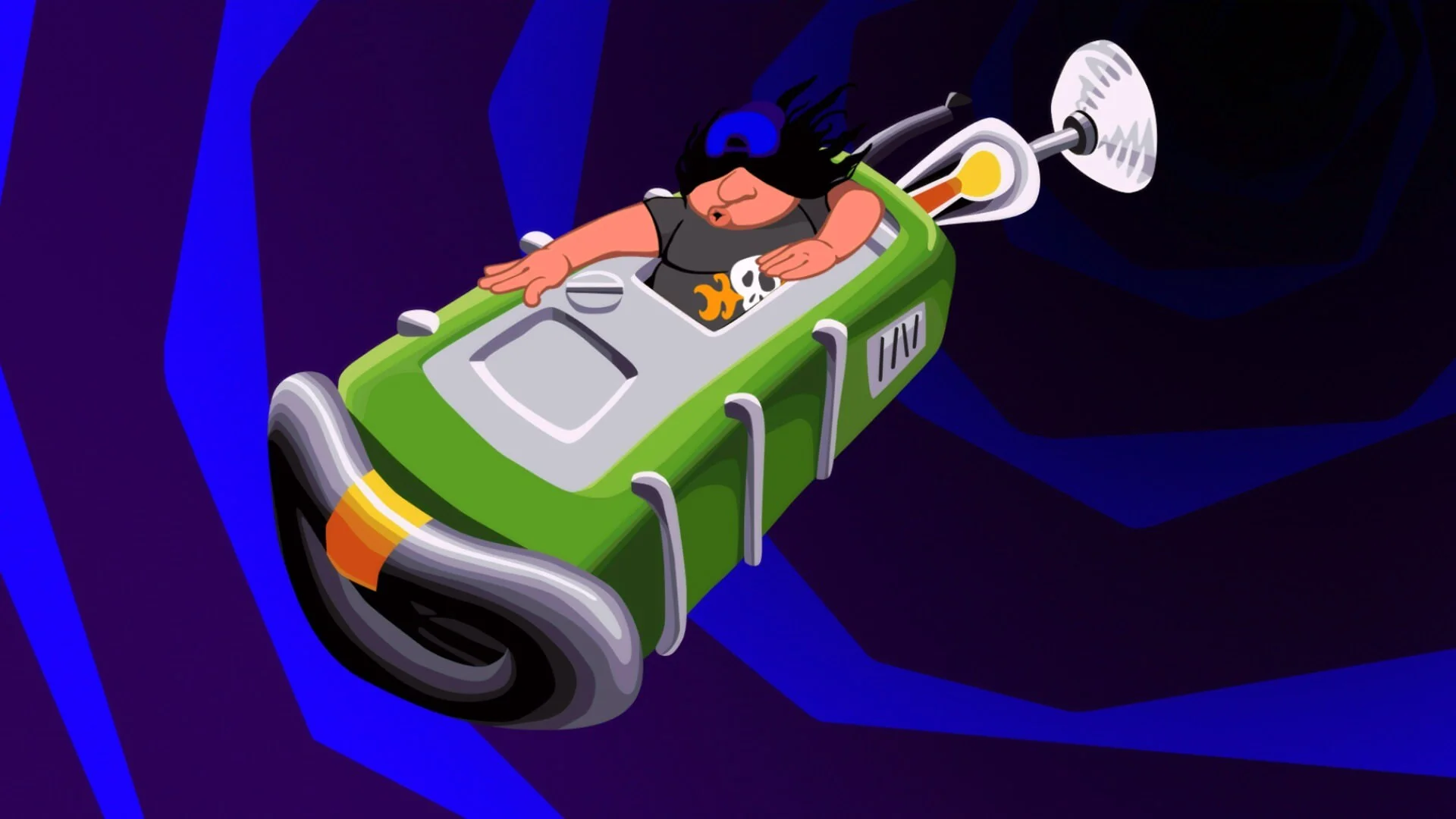
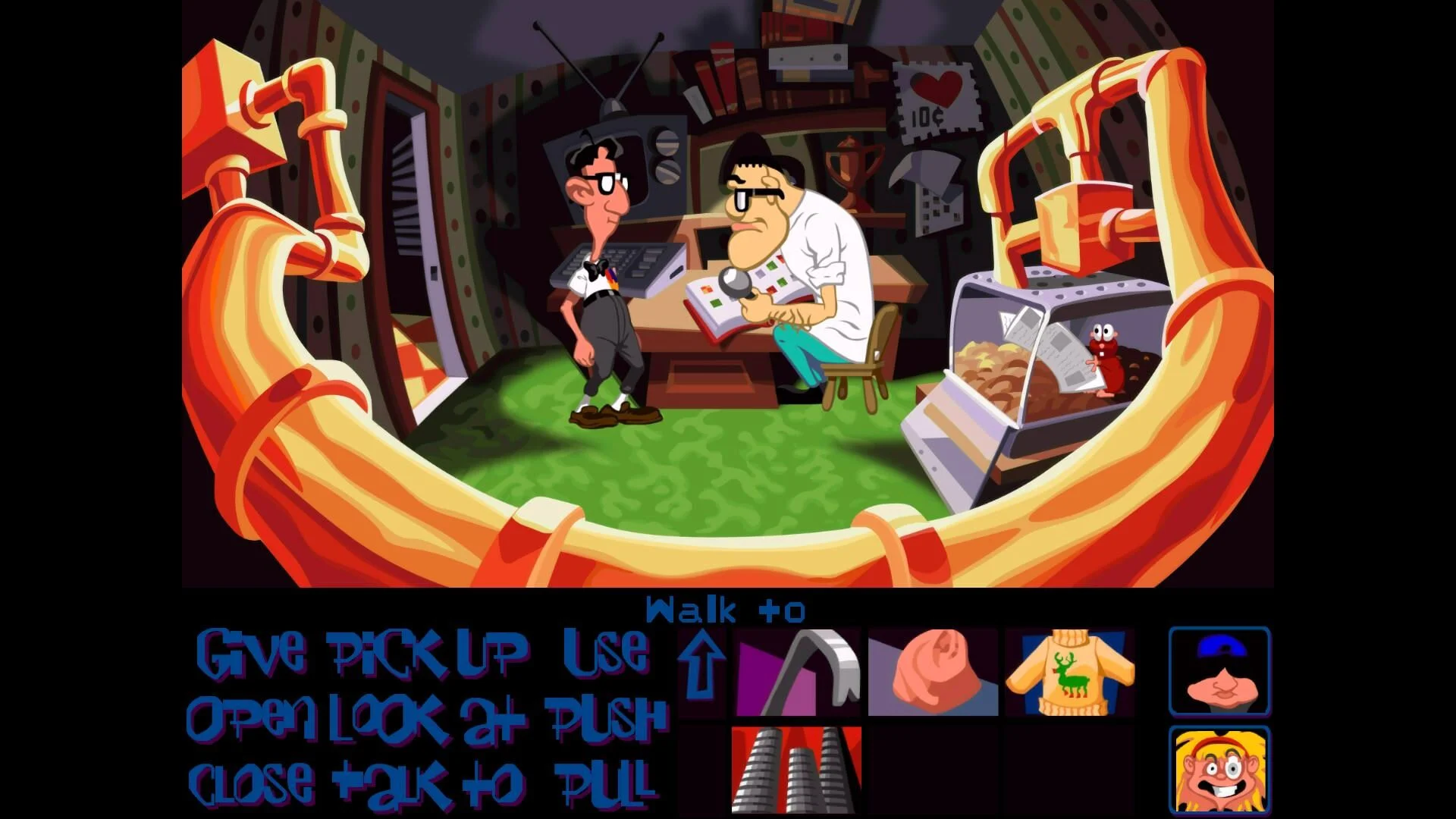
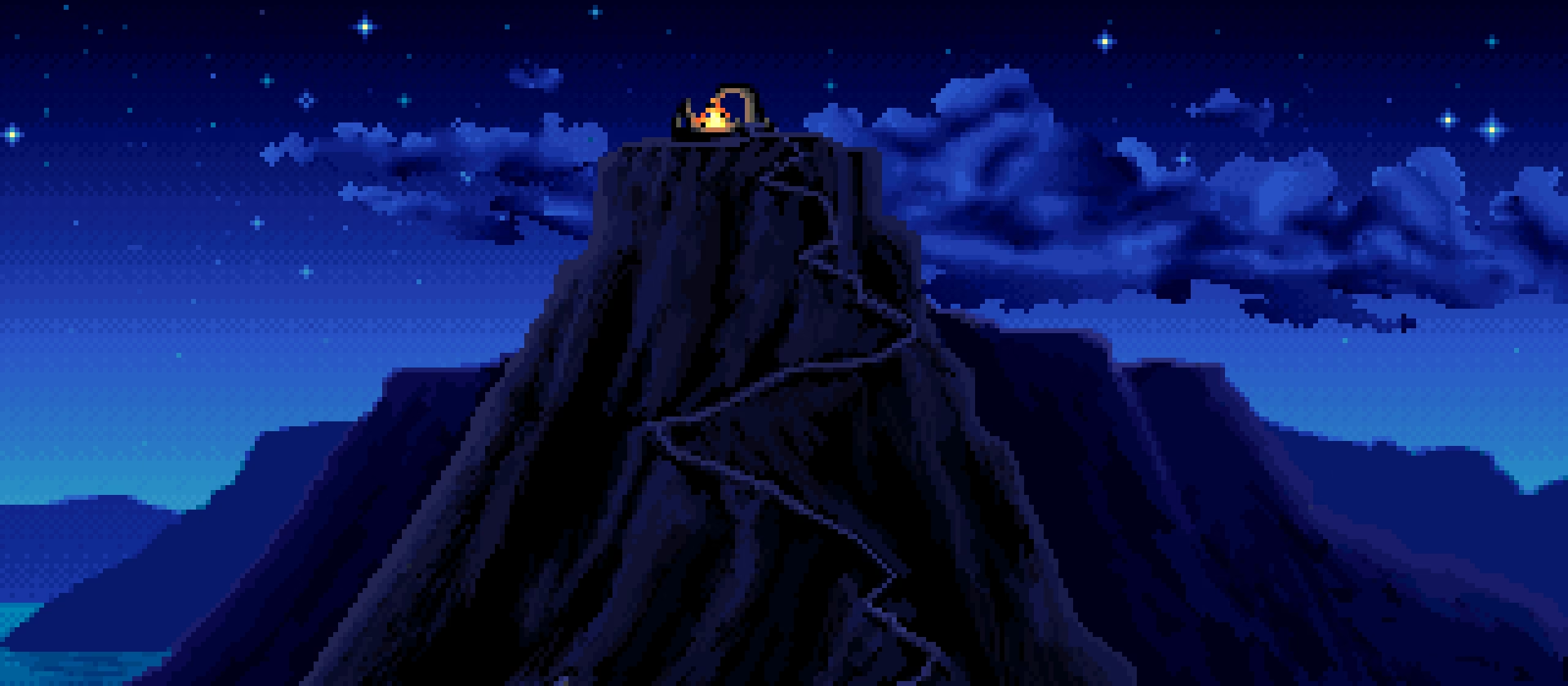
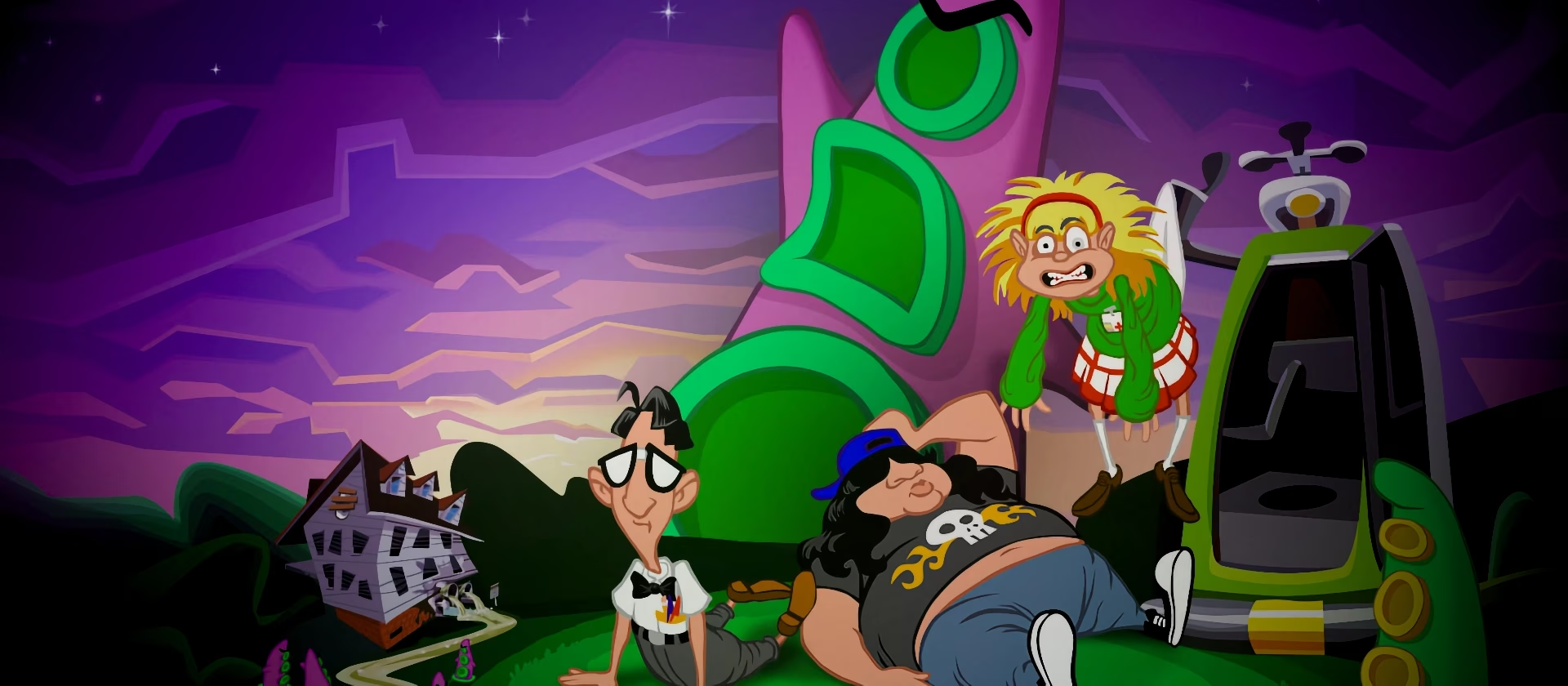
Two sides of the same machine: cartoon staging up front, puzzle grammar underneath. Images: Day of the Tentacle Remastered · LucasArts / Double Fine Productions.
That trust is a huge part of why it still feels so fresh. One of LucasArts’ great strengths in this period was fairness: no dead ends, no arbitrary deaths, no requirement that you read the designer’s mind. Day of the Tentacle turns that philosophy into structure. It is not merely that the game is kind to the player. It is that the whole temporal design depends on the player believing that every absurd action belongs to a coherent system. Remove that trust and the whole thing collapses into nonsense. Keep it, and nonsense becomes design.
There is a late gag about keeping a dryer running for two hundred years by feeding it $876,600 in quarters. That number is not random. It works. Leap years included. It is the sort of detail that tells you exactly what kind of game you are in. Even the throwaway joke has been balanced with a slide rule. The comedy is elastic, but the design is buttoned up tight.
Cartoon Exaggeration as Interface Design
The visual style deserves more credit than it usually gets, because it is doing more than looking good. Schafer later described the game as having a “silly, cartoony Chuck Jones vibe,” and that is more than a mood-board phrase. Lead animator Larry Ahern said the team were “pushing things in more of a Looney Toons direction,” while Peter Chan was “really exaggerating the angles and warping things” in the environments so the whole world felt like a classic cartoon. Ahern also said they wanted it “to look different than the typical computer game at the time.” That difference is not just aesthetic. It is functional.
When three timelines are interlocked, the player needs to read rooms at a glance, remember their layout across centuries, and spot what has changed without friction. Day of the Tentacle’s cartoon style is not decorative frosting on top of the puzzles. It is part of how the puzzles stay legible. The house is drawn like a joke, but also like a diagram. That is why the game can be so visually playful without ever becoming muddy. It is visual comedy doing hard mechanical labour.
That is true of the writing as well. The script is packed with jokes, but the jokes are not there to distract from the puzzle design. They are often the delivery system for it. The game’s great trick is that it makes rigorous cause-and-effect feel light. You are laughing at a tentacle trying to found a new social order, but you are also tracking chains of causation across centuries like a very harassed temporal accountant.
The Moment the Trick Reveals Itself
The moment Day of the Tentacle fully declares itself is the moment you realise it is not three adventures running side by side. It is one structure viewed from three angles. An item left behind in one era appears transformed in another. A problem in the future turns out to require a nudge in the past. A piece of information in one century becomes an object lesson in another. The game stops being a set of puzzles and becomes a model you carry around in your head.
The Chron-O-John, a time-travelling portable toilet that can send only small objects between eras, is the perfect emblem of the whole thing: stupid, memorable, and mechanically strict. Because it only accepts some items, other solutions have to be arranged indirectly. You cannot simply mail your way out of trouble. You have to plant causes and wait for effects. That limitation is what gives the game its shape. It forces the design away from convenience and toward causation.
This is the real reason the game still plays so well now. Its pleasures are not mainly nostalgic. They are systemic. You are building a model of the world in your head and testing it against a game that has actually done the work to deserve that attention. There are no dead ends. No unwinnable states. No cruel adventure-game stings waiting to punish you for not guessing the one correct absurdity from a pile of incorrect absurdities. Day of the Tentacle is generous without being soft. It wants you to experiment. It wants you to poke at things. It wants you to feel the machinery catch.
Why So Few Games Dared This Again
One reason so few adventure games have matched it is that this kind of design is expensive in exactly the least glamorous way. It is not enough to invent funny scenarios. Someone has to test the entire web of consequences, check that one puzzle does not break another, and make sure the whole lunatic engine never jams. A game like this has to be funny, yes, but it also has to be provable. The player only experiences the lightness. The developers have to build the clock inside the toy.
That helps explain why Day of the Tentacle still feels rare: not just a very good comedy adventure, but a solved problem that most of the genre decided not to solve again because the labour is brutal and mostly invisible. The game sold respectably rather than spectacularly, but what has lasted is not size or scale. It is density: the sense that everything in it has been checked and made to pull its weight.
The Machine Still Runs
The 2016 remaster understood that the thing worth preserving was not the art but the engineering beneath it. The instant swap between old and new graphics feels like the right kind of confidence — the game has nothing to hide. The mechanism still works.
A new player finds the same thing players found in 1993: every absurdity accounted for, every joke bolted to the design beneath it. By the time the credits roll, the American flag has been quietly altered by the chain of events you set in motion hours earlier — simply different, because something changed at the source and the effect carried all the way to the end. That is Day of the Tentacle in miniature: history as a toybox, causation as a punchline, a ridiculous machine that runs perfectly anyway.