// import lizardManPoster from ”../../assets/images/wonder-boy-iii-the-dragons-trap-1989-lizard-man-poster.jpg”; // deleted
// import mouseManCanyonPoster from ”../../assets/images/wonder-boy-iii-the-dragons-trap-1989-mouse-man-canyon-poster.jpg”; // deleted
// import remakeDungeonPoster from ”../../assets/images/wonder-boy-iii-the-dragons-trap-2017-dungeon-poster.jpg”; // deleted
// import remakePirateLairPoster from ”../../assets/images/wonder-boy-iii-the-dragons-trap-2017-pirate-lair-poster.jpg”; // deleted
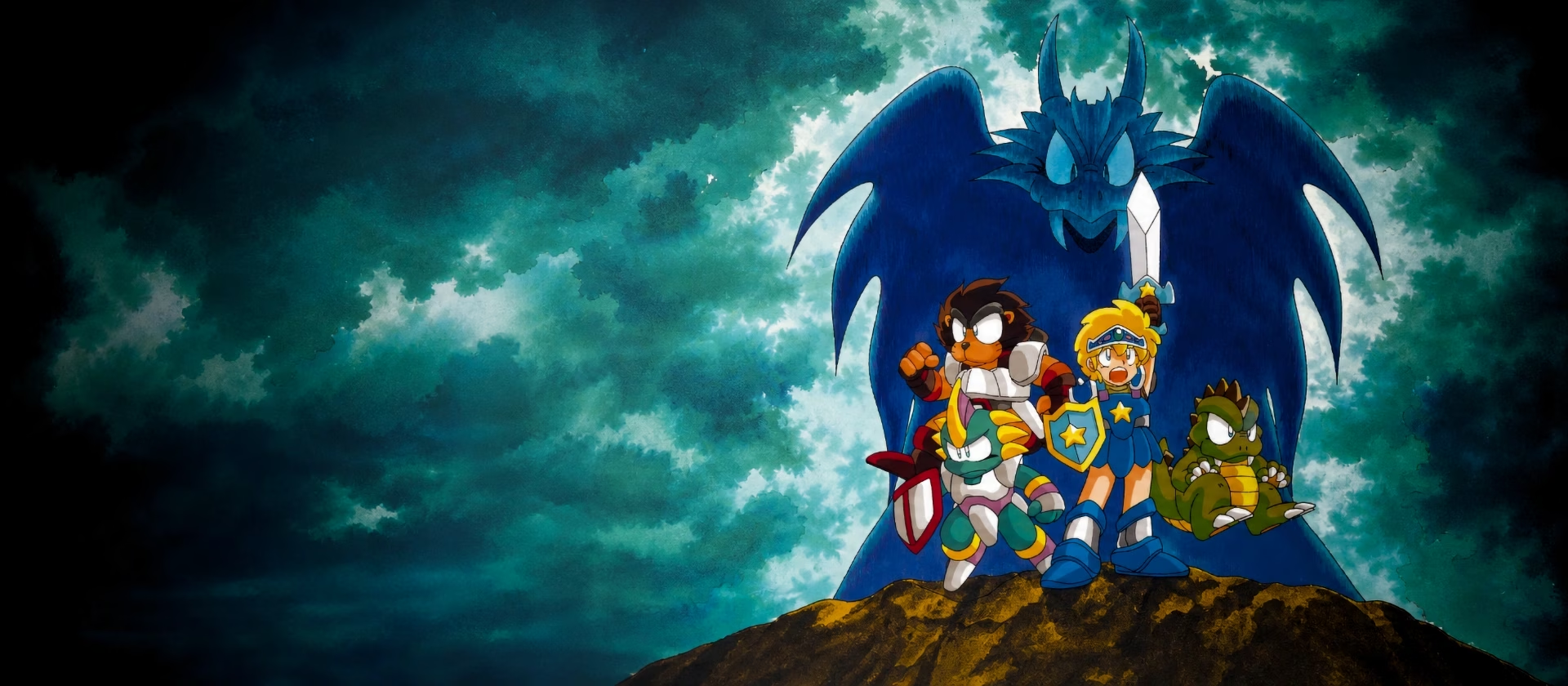
A Lizard-Man, a Mouse-Man, a Piranha-Man, a Lion-Man, a Hawk-Man — five different bodies, each with its own physics model, all of them the same protagonist. Wonder Boy III hands you these forms one at a time across thirty hours and asks you to navigate one Monster Land using all of them. The puzzle isn’t “how do I get past this.” It’s “who am I right now.” That question, asked plainly enough that no metroidvania since has matched the clarity, is what Westone shipped on a Master System cartridge in 1989.
The frame for the question is set in the first sixty seconds. The cartridge boots you straight into the climax of Wonder Boy in Monster Land — Hu-Man, fully equipped, sword in hand, against the Mecha Dragon. You win. You watch the dragon shatter. The curse hits in the moment of triumph and you walk out of the cutscene as a knee-high green Lizard-Man whose only weapon is a fireball cough. The game’s first move is to hand you an apex hero and rip him apart. Everything that follows is reconstruction by addition: each dragon you fight gives you another body to inhabit, each body re-reads the geography, and the same Monster Land becomes five Monster Lands depending on whose feet are on the ground.
The Curse Came With the Victory
Most sequels start at zero. Wonder Boy III starts at the apex of Wonder Boy in Monster Land — Westone’s 1987 arcade hit — and refuses you the trophy. The opening cinematic isn’t a recap; it’s the boss fight, playable, with all the Legendary equipment and full health. You enter the Mecha Dragon’s chamber as the most powerful version of yourself the series has ever offered. You leave it stripped. The cursive title screen — Sakamoto’s woodwind theme winding behind it — shows up only after the curse has taken everything you came in with.
It is, in 1989, an unusually literary move for an 8-bit action game. Most of the Master System library opened on a hub town or a stage one. Wonder Boy III opens with what most games would call an ending. The score isn’t dragged down to zero by the curse; it’s dragged up to maximum, displayed for one second, and then the world becomes a different game.
That one second between victory and curse is structural. The game doesn’t ask “can you beat the dragon” — it asks “what are you now that you’ve beaten it.” The transformation, in other words, is the question.
Five Bodies, Five Verbs
The transformation system reads, on paper, like Metroid power-ups. It isn’t. Lizard-Man, Mouse-Man, Piranha-Man, Lion-Man, Hawk-Man — five forms, each unlocked by defeating a dragon — are five different physics models stitched together, each with its own movement vocabulary. Lizard-Man is short and squat and breathes fireballs in a low arc. Mouse-Man clings to wooden walls and squeezes through gaps Hu-Man cannot. Piranha-Man is helpless on land and sovereign underwater. Lion-Man swings a longer sword and shatters stone blocks. Hawk-Man flies. Forms can be swapped at will once unlocked. The game’s puzzle isn’t ability gating in the Metroid sense; it’s choosing which body to inhabit for a stretch of architecture.
This is closer to a fighting game’s character roster than to Samus Aran’s progression. Each form has personality. Mouse-Man’s miserable face in tight passages. Lion-Man’s sluggish, weight-pleased gait. Hawk-Man’s flicker of altitude before the wing-flap settles into rhythm. The game treats them as distinct creatures whose surfaces happen to belong to one continuous protagonist. The metroidvania reading flattens this — turns the bodies into keys for locks. What Wonder Boy III is actually doing, fifteen years before the genre had a name and a deflationary frame, is asking the player to inhabit five movement contracts inside one geography. The reason the architecture feels generous, when so much of the period’s level design feels narrow, is that the architecture has to host five contracts and accommodate any of them at any moment.
The puzzle, which becomes apparent around the fourth or fifth dragon, is that each form sees the same map slightly differently. A passage Mouse-Man squeezes through is invisible to Hu-Man at his height. A platform Hawk-Man brushes from above is unreachable from below. Once the world has rooms only certain bodies can read, the question stops being “how do I get past this” and becomes “who am I right now.” This is the kind of question games still ask in 2026. Wonder Boy III asked it on a system whose hardware limits should have prevented the conversation.
Sakamoto Wrote the Sound Engine Himself
The credits give Shinichi Sakamoto a single line: composer. The technical reality is denser. Sakamoto didn’t write notes for someone else’s sound driver; he programmed the driver, then wrote the music in hex-notation assembly macros, then handed the game team a set of fixed entry points and said: call these. The composer wrote the chip’s voicing as well as the chord progressions. He had done it before for NMK’s Famicom titles in 6502; here he did it in Z80 for the Master System. The result, on the Japanese Mark III with its built-in YM2413 FM chip, is a soundtrack that uses the hardware as if the hardware had been built around the score.
The rest of the world heard a thinner version. The Western Master System shipped without the YM2413; the same ROM, played outside Japan, fell back to the SN76489 PSG and sounded a fraction of what Sakamoto had written. The conventional retrospective gloss — “the Japanese version sounds better” — is more specific than that. The Japanese version is the version the composer designed. Everyone else was hearing the rough mix that survived the absence of his chip.
The themes themselves are economical and recursive. The town theme — Sakamoto’s signature voice, melancholy in a way Master System scores rarely permitted themselves — circles its opening figure for the duration of the loop, never resolving the question it asks in the first bar. Boss themes tighten the harmony into something almost percussive. The hospital chime that signals a heart-up purchase is three notes that register in muscle memory after twenty minutes. The score’s argument is the game’s argument: the same shape revisited from different angles.
”Monster World II. I loved it so much I made it twice.”
— Ryuichi Nishizawa, Hardcore Gaming 101
The remake Nishizawa refers to is the 1992 Game Gear version he directed himself. He didn’t port the Master System code; he rebuilt the level layouts so the smaller LCD wouldn’t compress the spatial reading. The composer he kept; the rest he rewrote. A designer protective of his own work to that degree is rare. A designer who admits as much in print is rarer.
Outlived, Not Ignored
The reception reads like vindication and then like erasure. Mean Machines in their inaugural 1990 issue: “ranks as one of the greatest Master System games ever,” 95% overall, with a specific call-out for the password system. Sega Pro: 97%. ACE: 91.5. Computer and Video Games: 86. Electronic Gaming Monthly’s 1989 awards issue gave it Best Master System Game of the Year. IGN, looking back, called it “perhaps one of the best games of the 8-bit era.” None of this is whispered. The game was on the cover.
What erased it was hardware. The Master System lost the West to the NES so completely that even a 95% review couldn’t get the cartridge onto most American shelves. The Japanese Mark III release reached the audience that already had a Mark III. The 1991 PC Engine port — retitled Dragon’s Curse — lost the West to Nintendo and Sega both. The 1992 Game Gear remake arrived after the Sonic generation had moved past Wonder Boy. Each port reached a smaller audience than the one before. By the time Westone’s actual canonical sequel — Wonder Boy in Monster World, 1991 — landed, the player who’d liked Dragon’s Trap had moved to a different shelf altogether.
The Brazilian port is the cleanest evidence of what happened. Tec Toy released the same Westone code in 1993 as Turma da Mônica em o Resgate, with Wonder Boy and his transformations swapped out for characters from Mauricio de Sousa’s Monica’s Gang comics. Sega Brazil understood that the Wonder Boy brand alone wasn’t going to move enough cartridges, so they shipped the same game with a different cast. The Westone level design worked. The Westone label, by 1993, didn’t.
What Lizardcube Preserved
In 2017, two French studios — Lizardcube developing, DotEmu publishing — released Wonder Boy: The Dragon’s Trap, a remake whose architecture is the original code. Omar Cornut started it as a fan disassembly project; the team traced every Westone routine, rebuilt the engine to run at 60fps with smoother physics, then layered hand-drawn animation over the top. The signature feature is one button: press it and the game switches to its 1989 graphics and audio, instantly, no pause. The same code paths run underneath either way. The 2017 remake is the 1989 game with optional new clothing.
The most editorially generous touch is in the password screen. WE5T 0NE 0000 0000 — Westone’s own studio name, encoded as a debug cheat into the 1989 ROM — still works. Type it into the 2017 remake and the game hands you Hu-Man with all items, the way it did when the password was first published in Mean Machines. A player who memorised it from a magazine in 1990 and types it into a 2026 Switch will get the same result. That isn’t preservation rhetoric; that’s preservation. Cornut’s team didn’t re-implement the password generator — they kept the 1989 one and let it keep working.
The recommendation, then, is exact: play the remake on whichever hardware suits you, and toggle to original-graphics mode for the cold open. The first sixty seconds are not improved by hand-drawn animation. The Mecha Dragon, when reduced to its 1989 sprite, hits harder.