The licensed cartoon platformer is the safest brief a publisher can hand a team in 1992: take the show, take the characters, take a year, ship something cheerful for the holiday window. The cart Konami shipped under that brief at the end of 1992 spends six stages refusing every part of it.
The Super Famicom Tiny Toon Adventures, packaged for the West as Buster Busts Loose!, has been filed for thirty years as a competent licensed B-tier — a one-line “varied platformer” verdict in the back half of every SNES top-100 list. That filing has nothing to do with the game. Underneath the lime-green box, Konami’s flagship SNES platformer pipeline is rehearsing a dash-and-vertical-wall-run traversal idea two years before Sparkster (1994) takes the same impulse, straps a rocket pack to it, and gets the credit.
Two Tiny Toons, on Purpose
The clearest evidence that Konami knew what it was doing on the SNES is what Konami simultaneously shipped on the Mega Drive. Buster’s Hidden Treasure, on Genesis the same year, is a Sonic-adjacent jump-on-heads platformer with conventional stage counts and conventional level grammar — the safe answer to the brief. The SNES cart is the deliberate other one: six elaborated episodes, a dash gauge, vertical wall-running, an auto-scrolling football stage, an auto-scrolling runaway train, a Star Wars parody finale, and a true ending gated behind one-heart Challenge mode.
Two licensed platformers, same publisher, same year, opposite design solutions. The SNES game is not a port and not a B-team commission; it is a different design conversation Konami chose to have on the Nintendo platform. Capcom had already shipped The Magical Quest Starring Mickey Mouse twenty-eight days earlier, building its identity around a costume-power-up system — fireman, magician, climber. The SNES shelf that month had two cartoon platformers. Capcom chose costumes. Konami chose traversal.
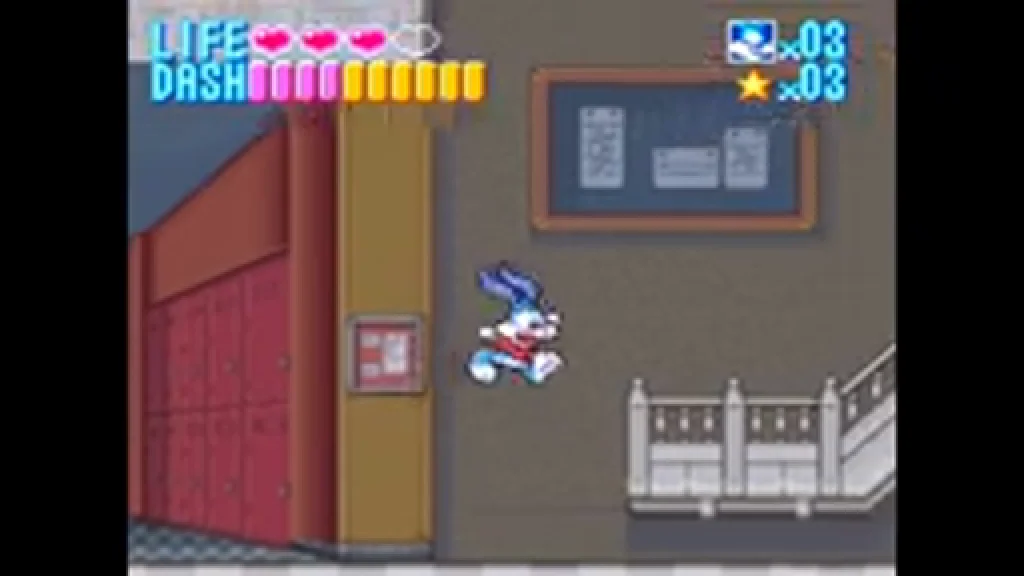
The dash gauge is the first thing the HUD teaches you. Not life, not score — momentum, with a meter. Buster Busts Loose! · Konami / SNES, 1993.
The Dash Is the Pivot
Every review of Buster Busts Loose eventually arrives at the dash. The manual’s own developer language is plainer than the breathless retrospectives: “Buster can dash across the screen really quick. He can also run up walls when he is dashing.” That second sentence is the design.
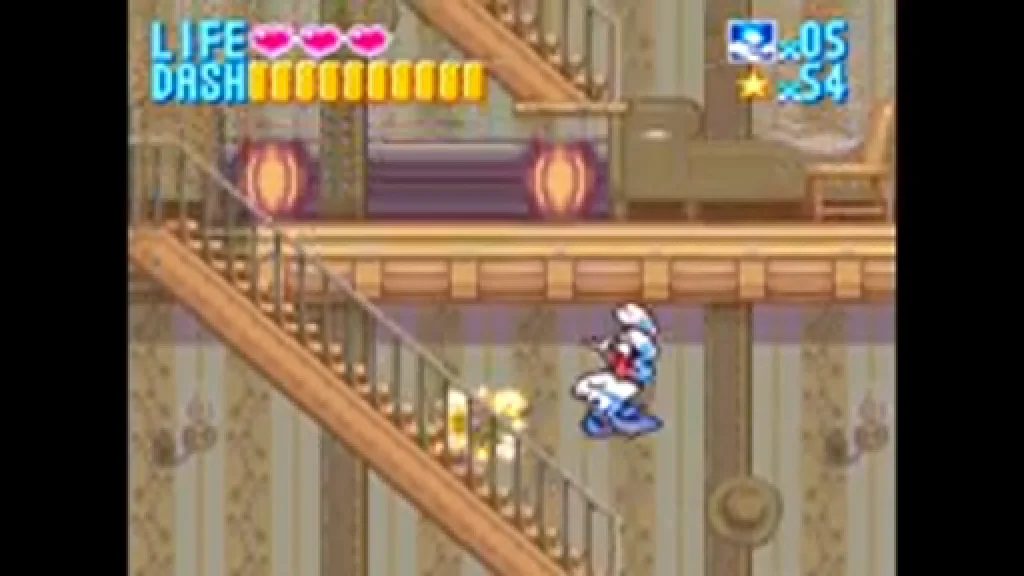
A dash that converts to a vertical wall-run on contact means the level geometry is not a sequence of jump arcs with intervening enemies. It is a momentum problem with recharge stations. Classic-Games.net clocked the design layer best: “Buster’s dash doesn’t last long enough to get you the whole way to the top. You’ll have to run over the dodo buttons set on the wall to refill your power along the way.” The shaft levels are platform geometry standing on its end, and the verb that solves them is the same verb that crosses the horizontal courtyards. Konami built one traversal grammar and pushed it through every plane.
The first room of the game labels the verbs on the wall. The second room asks you to send one of them up a wall. Buster Busts Loose! · Konami / SNES, 1993.
This is what gets undersold by the “good for a licensed game” framing. Capcom’s wall-mounted moves predate it; Sonic’s held-jump-into-roll predates it; nobody owns the dash. What Konami owns here is the combination — a dash gauge, a vertical wall-run as continuation of the horizontal dash, and a cartoon licence wrapped around it tightly enough that the experiment was sold as kids’ merchandise. Two years later the same SNES platformer pipeline ships Sparkster, where the verb is a rocket boost and the design analysis falls into place immediately. The earlier game has been waiting that whole time to be recognised as the rehearsal.
Episode Is the Level Unit
The six stages are framed, in the manual and in the prose between them, as Tiny Toon TV episodes. The framing is not decoration. It changes what a level is allowed to be.
A conventional platformer commits to a level type and varies the obstacles inside it: a forest level, a snow level, a fire level. Buster Busts Loose commits to a level format. Stage 1 is a 2D action-platformer corridor through ACME Looniversity. Stage 2 is an auto-scrolling football play — Buster catches the opening kickoff and runs the ball, dodging linesmen, against a time limit and end-zone goal. Stage 5 is a runaway train. The finale is a princess-rescue Star Wars parody set against Duck Vader and the Milky Way Imperial Army.
The Western saloon: chandeliers, balconies, a cowboy hat on the floor. Each episode commits to set dressing the way a TV production does. Buster Busts Loose! · Konami / SNES, 1993.
The framing isn’t decorative either; RetroXP’s retrospective put it plainly:
“There are some stages where what you’re playing through is clearly a production of some kind put on by these students.”
— RetroXP
The cartoon is not a world to traverse. It is a series of bits the cast performs for you, and each bit gets to choose its own genre. That commitment is what makes the dash matter across formats. The football stage uses the same momentum verb to outpace tacklers that the school corridor uses to climb book stacks. The train sequence makes the dash the only way to stay ahead of the camera. The vocabulary stays constant; the situations rearrange around it. Most licensed-platformer reels of the era were a costume change between identical rooms. This one swaps the room every twenty minutes and trusts your hands.
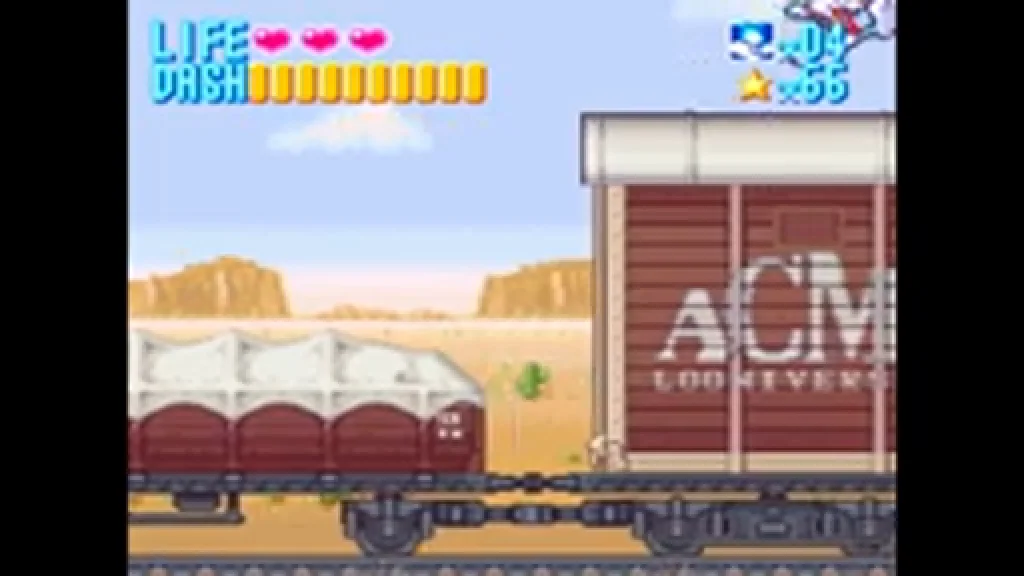
The runaway train: the dash stops being optional. Stage commits to format, format commits to the verb. Buster Busts Loose! · Konami / SNES, 1993.
Friction belongs in this paragraph, not buried in a Play It addendum. The train is the moment the difficulty turns — The Splintering called it “the most frustrating section of the whole game.” The standing flip-kick attack is fiddly until your thumb stops looking for a Mario stomp. And the cart is short by sixteen-bit standards: a confident first play runs sixty to ninety minutes, a speedrun under twenty-five. Anyone expecting Super Mario World’s seven-evening campaign will finish Buster Busts Loose in one. The cart’s answer to that — the trick that makes the runtime feel correct in retrospect — is that the true ending is locked behind Challenge mode: one heart container, no margin. Beat Normal once and you get a partial credit roll. Beat the harder version and the rest of the cartoon arrives. A 1993 platformer asking you to play it twice to see the end is a Konami arcade-instinct decision dressed in Warner Bros. fur.
The Bonus Wheel Knows What It Is
Between every episode the screen cuts to the Wheel-O’-Game: a roulette pointer, a ring of bonus minigames, and the chance to spin into a Tiny Toon bingo card, a basketball line, or a half-dozen other interstitials. Lose, you move on. Win, you collect lives.
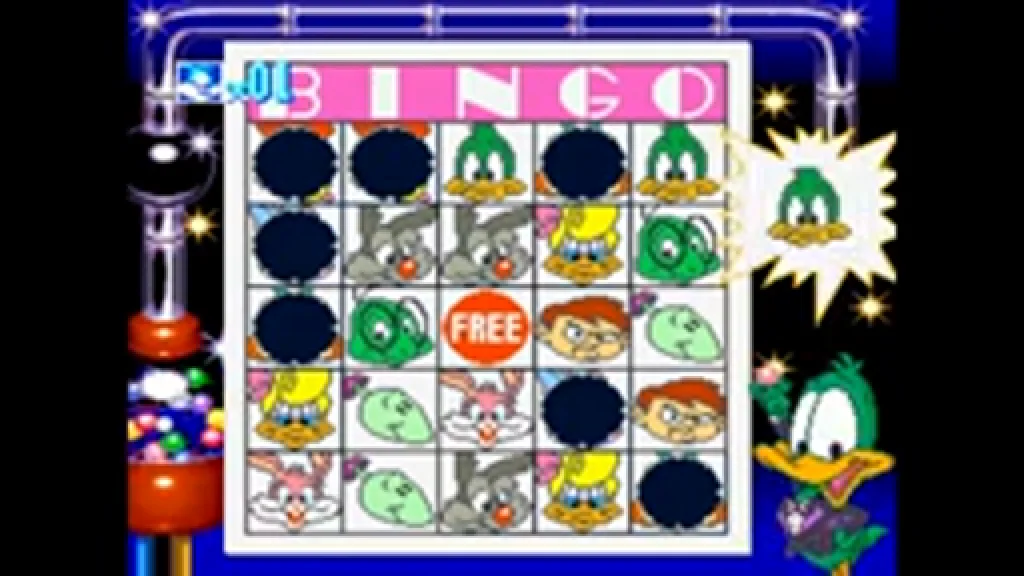
Between episodes: a roulette of minigames the prose of the game treats as commercial breaks. Cartoon-as-vaudeville is also cartoon-as-Saturday-morning-schedule. Buster Busts Loose! · Konami / SNES, 1993.
This is where the vaudeville structural reading earns itself. The minigames are not the level. They are commercial breaks between the episodes, with the cast hosting them. A normal platformer would not interrupt itself like this; the interruption is the whole pitch. The structure tells you that Konami’s design team understood the licence as a broadcast, not a world — five minutes of high-friction action, two minutes of comedy interstitial, repeat. It is also why the game ages better than its peer licensed platformers: the wrapper is correct about its source material, so the cart never has to apologise for being short on world.
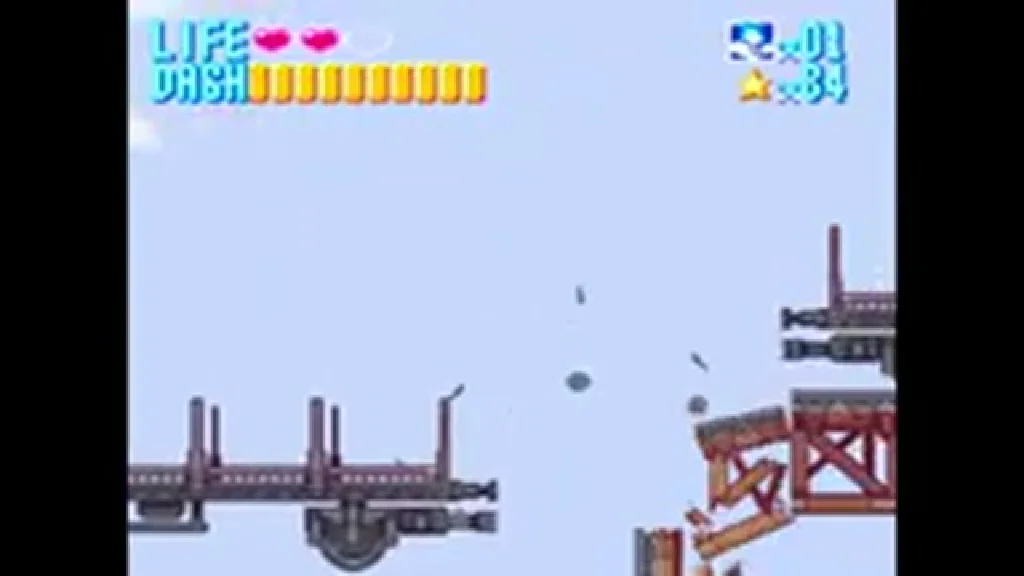
The sci-fi finale: a Pig Star, Duck Vader, and a Milky Way Imperial Army. The cartoon’s literacy reaches as far as the licence allows. Buster Busts Loose! · Konami / SNES, 1993.
The Konami house signature carries into the score. Kazuhiko Uehara and Yukie Morimoto, co-credited on Buster Busts Loose, are the same pair the publisher had on Gradius III, the Ganbare Goemon SNES run, TMNT IV: Turtles in Time, and the soon-to-arrive Sparkster. This is not a licensed-game B-team. The opening theme is a fanfare with the heroic bounce the brief demands; the boss music tightens into the arcade pressure the publisher could not stop writing if it tried; the train stage’s auto-scroll cue commits to motion the way a Castlevania corridor commits to dread. The licensed cartoon platformer is being scored by the people writing Konami’s flagship in-house material, and it sounds like it.
Filed Under Wrong
The contemporary press knew what it had. Computer and Video Games gave the cart a 94 in 1993. Super Play an 89. Official Nintendo Magazine a 93. GameFan cross-reviewed it in the low-to-mid 90s. Nintendo Power ranked it the tenth-best SNES game of 1993. The cart shipped to a confident upper-tier reception.
The reception gap is between then and the long tail. By the time the IGN and Complex top-100 SNES lists hardened in the 2010s, Buster Busts Loose had settled into the back half — “an impressively varied hop-and-bop platformer,” #99 or #92, depending on the list, depending on the year. The verdict that produced those rankings is not the same as the verdict in 1993; it is the verdict you reach by checking which games are currently available and which are not. Buster Busts Loose is not on Nintendo Switch Online. It is not in the Castlevania Anniversary Collection, the Arcade Classics Anniversary Collection, the TMNT Cowabunga Collection, or the Contra Anniversary Collection — Konami has skipped every Tiny Toon cart from its retro programme. There is no PC port. There has never been an HD remaster. The cart’s modern invisibility is what makes it look like a B+ also-ran. It is not one.
What you can do with that knowledge is play the game. The ROM has no enhancement chip — a clean dump runs on any accurate SNES core, FPGA or software, no rights complications and no transcoding to plan around. A first play takes an evening. The Challenge mode that gates the real ending takes a few. And what you are playing, when you settle into the corridors and the football play and the runaway train and the cartoon parody Death Star, is a Konami SNES platformer at full pipeline strength — the same hands that made the rest of the canon, working through a wrapper safe enough to disguise the experiment. The licence was a CV padding line at the time. In retrospect it was the only place Konami was allowed to try this.