// import streetNightPoster from ”../../assets/images/max-payne-2-2003-street-night-poster.jpg”; // deleted
// import corridorRushPoster from ”../../assets/images/max-payne-2-2003-corridor-rush-poster.jpg”; // deleted
Max Payne has already had his revenge. That is what makes Max Payne 2 hurt.
The first game could still run on forward motion: wife murdered, child murdered, cop framed, city turning rotten around him, the only available verb being shoot. The sequel begins after that motion has failed to redeem anything. Max is back in the NYPD, alive in the technical sense, but the grammar of his life has not changed. He still narrates himself as if he is watching someone else drown. He still moves through New York as if every room is a crime scene that has been waiting for him. The difference is that Max Payne 2 no longer pretends the gun at the end of the corridor is an answer.
It is a love story instead, and a crueler one because of that.
A Romance Built From Recurrence
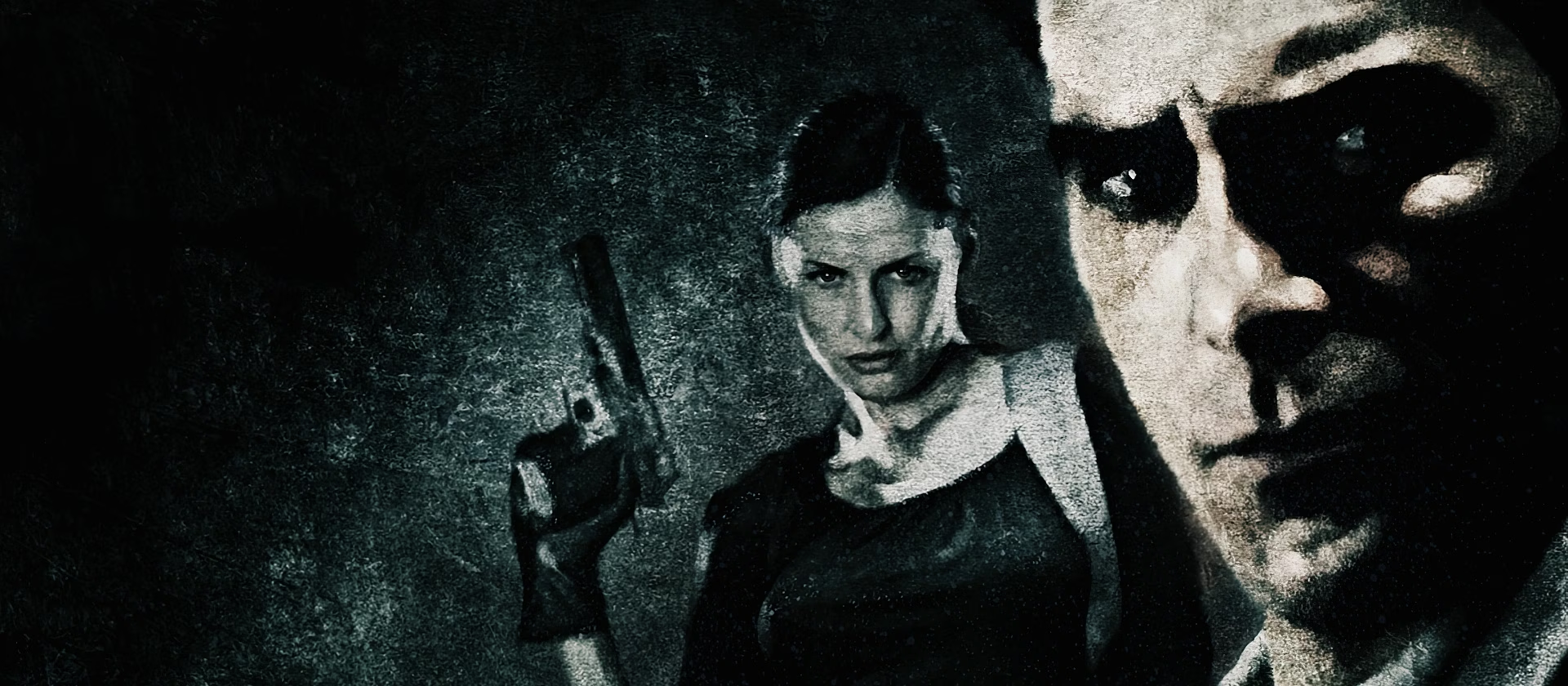
Mona Sax returns from the dead as a woman Max cannot trust and cannot stop following. The game treats that contradiction as its central engine. Mona is suspect, ally, fantasy, mirror, and warning. Every time Max reaches for certainty, she slips into another category. That slipperiness is not a weakness in the writing. It is the form of the tragedy: Max recognises the pattern and follows it anyway.
The subtitle says the quiet part aloud. This is not The Redemption of Max Payne. It is The Fall of Max Payne, and the fall is not a single event. It is repetition. The plot folds back through familiar rooms, recurring phrases, dream spaces, televisions, funhouse sets, and graphic-novel panels that make each scene feel remembered before it happens. Max is not solving the past. He is moving through an arrangement the past has already made for him.
That is where the noir matters. Plenty of games borrow noir lighting, trench coats, rain, and cynical narration. Remedy understood the deeper structure: noir is about belated knowledge. The hero learns too late what kind of story he is in. Max’s voiceover is full of aphorisms because aphorisms are what experience becomes after it can no longer help you. He can name the trap beautifully. He still walks in.
Sam Lake, who wrote the script, has been explicit about the pivot. Asked in 2003 what he meant by calling the sequel a “film noir love story,” he framed the choice as a deliberate twist of the knife:
“The idea was simply too delicious to pass over, and, as with the first game, our objective has been to evoke emotion with the game and to create strong characters. Basing the storyline around a cop and a murder suspect was such a great way to bring tension to the story that we couldn’t resist it.”
— Sam Lake, GameSpot Q&A, 2003
Mona changes the first game’s emotional geometry because she is not another memory to be avenged. She is present, armed, compromised, and making choices of her own. The player cannot reduce her to innocence without flattening the story, and Max cannot reduce her to danger without lying to himself. Their scenes work because they keep refusing the simpler version of the noir romance: the doomed woman as symbol, the damaged man as rescuer. Mona is not a prize at the end of Max’s grief. She is another person trying to survive inside the same machinery, and the intimacy between them is made sharper by the fact that neither of them has clean hands.
That is why the game’s tenderness has to be awkward. It arrives through pauses, half-confessions, cover fire, and the terrible convenience of finding someone whose damage rhymes with yours. The writing can sound florid on the page, but it earns that heightened register because the whole game is a pulp object taking itself emotionally seriously. Remedy is not embarrassed by melodrama. It understands that melodrama is only false when the work around it lacks conviction. Here, the conviction is total.
Panels, Dreams, and Broken Time
The graphic-novel panels remain one of the series’ smartest constraints — part budget solution, part rhythm engine. They make the plot feel already photographed, already fixed, like evidence pinned to a wall after the damage is done.
That fixedness matters because the playable scenes are so kinetic. In combat, the player bends time; in the panels, time has already hardened. The dream sequences are the same structure made explicit: Max walks through impossible spaces, hears voices recur, finds architecture arranged by guilt rather than real estate, and wakes with less certainty than he had before. Reality has learned how to speak in hallucination.
Bullet Time After the Trick
By 2003, Bullet Time was no longer a surprise. The original Max Payne had already translated Hong Kong action cinema and The Matrix into a playable grammar. The sequel’s problem was not how to introduce slow motion again, but how to make it expressive after the novelty had passed.
Remedy’s answer was physicality. Max Payne 2 uses Havok physics so that gunfights no longer feel like enemies reacting inside fixed animations. Bodies collapse badly. Cabinets tip. Boxes tumble. Barrels roll into paths you expected to use. A shootout becomes less like clearing a room and more like damaging one until it tells the truth about what happened there. Peter Hajba, Remedy’s animator and sound designer, later summed up the shift in a line: “Introduced ragdoll physics. No more hand-animated deaths.” That is both a technical note and a design thesis. Death, in this engine, is no longer a scripted performance. It is a consequence.
The revised Bullet Time system pushes that idea further. It rewards aggression. The meter returns through combat, and Max’s movement sharpens as the world slows around him. It feels empowering, but the power is strange: not invulnerability, not dominance, but the ability to live inside a catastrophic instant for longer than anyone should. The mechanic turns Max’s trauma into a skill. He survives because he is already slowed down inside.
That is the sequel’s great design insight. It makes style and psychology inseparable. The slow-motion dive looks cool because it is supposed to. It also looks like a man throwing his body into consequence because standing still would require him to think.
Rooms That Know Too Much
The environments are smaller and more purposeful than most shooters of the period. Apartment blocks, construction sites, police stations, warehouses, alleys, and luxury interiors are dense with the sad inventory of other people’s lives: takeout containers, televisions left on, stained wallpaper, beds nobody had time to make. The city does not feel open. It feels overheard.
The television material is crucial to that pressure. Address Unknown, Lords and Ladies, Captain Baseball Bat Boy, Dick Justice: these are jokes, but they are not detachable jokes. They are the game talking to itself in cheaper formats. Melodrama, revenge fantasy, soap opera, comic-book absurdity, noir pastiche; every channel is another distorted version of Max’s own situation. The world keeps parodying him, and because the parodies are funny, the sadness lands at an angle.
The funhouse sequence makes the method explicit. Sets slide into place. Painted walls pretend to be streets. The player moves through a fake city inside a fake attraction inside a game already obsessed with artifice. It should break the mood. Instead it clarifies it. Max has always been walking through constructed grief. The difference is that the plywood finally shows.
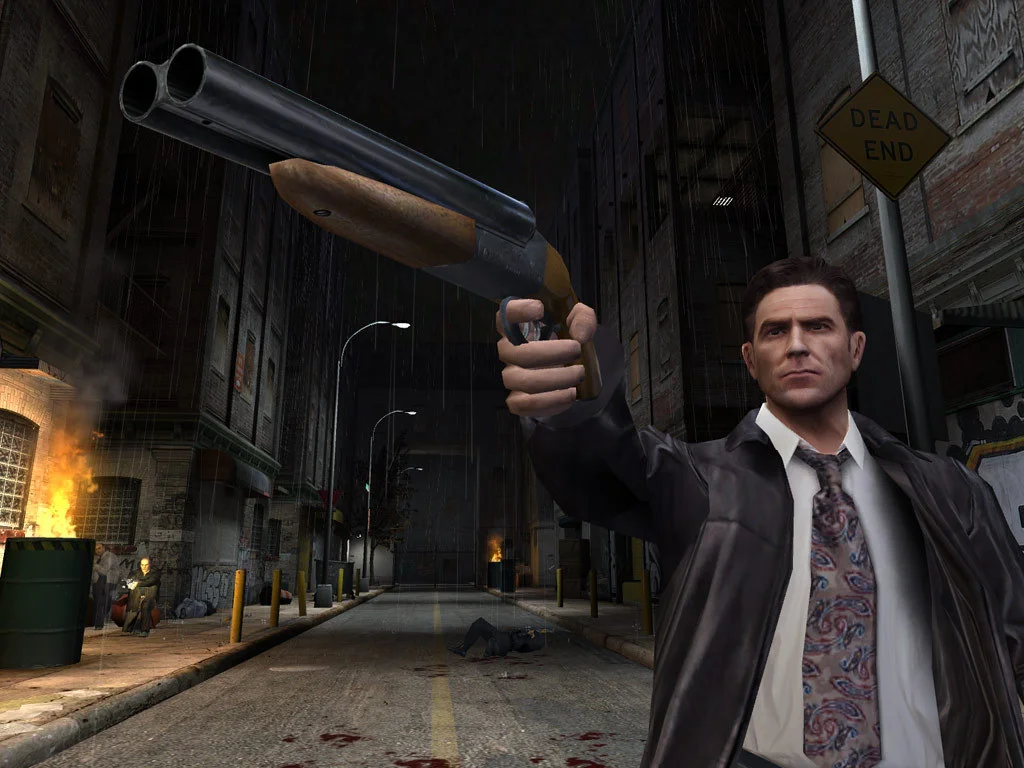
The signage is rarely subtle, but subtlety would be wrong here. Max Payne 2 is at its best when the city seems to have read the script before Max has. Image: Max Payne 2 · Remedy Entertainment / Rockstar Games.
The game is also funnier than its reputation suggests, and that is part of why the sadness holds. Captain Baseball Bat Boy is ridiculous. Dick Justice is ridiculous. Vlad’s taste for performance is ridiculous. The jokes are not exits. They are pressure valves in a city where everyone is performing a version of themselves. Max’s tragedy is that he knows he is performing too. He cannot stop narrating long enough to become unobserved.
The music understands this better than almost anything else in the game. Kärtsy Hatakka and Kimmo Kajasto’s cello-led theme is the emotional key — romantic, doomed, almost embarrassingly sincere. Then there is “Late Goodbye” by Poets of the Fall, built from a poem by Sam Lake. Characters hum it. Radios carry it. A piano catches a piece of it. By the time the full song arrives over the credits, it feels less like a licensed track than a memory the city has been trying to assemble. Noir does not require surprise. It requires inevitability with enough beauty attached that the hero mistakes it for choice.
Punished for the Pivot
Max Payne 2 is short, and that brevity is part of its discipline. It has no appetite for bloat. It does not need a crafting layer, a wider city, a faction board, or a longer road to the same conclusion. It needs pressure, rhythm, and return. Remedy built a shooter in which almost every system serves tone: the panels fracture time, the physics make violence messy, the dreams literalise guilt, the televisions mock the premise, the music turns recurrence into fate.
The market was not patient with it. Reviews were adoring — GameSpy five of five, IGN 9.4, GameSpot 9.0 — but on 2 February 2004 Take-Two publicly blamed “continued disappointing sales of Max Payne 2” for a reforecast that cut its 2004 guidance. It is a rare thing for a publisher to name a specific title in financial disclosures. The sentence stuck, and the received wisdom hardened around it: the sequel flopped, Rockstar shelved the series, Remedy was pushed aside. Lake has since explained that Remedy’s deal was always one sequel and no more: “that was all with the understanding that this will be the final Max Payne game for us. And you could kind of go through that emotional process while working on it, saying goodbye.” The commercial failure did not end Remedy’s run. It retroactively excused a door that was already closing, and framed Lake’s deliberate turn from pulp revenge to tragic romance as a market misjudgement rather than the creative step-up it was. When Max Payne 3 arrived nine years later, Rockstar Vancouver built a heavier, angrier, more straightforwardly violent game. That direction was not a correction of this one. It was a retreat from it.
That is why the thesis is complete rather than complicated. Revenge did not save Max. Love will not save Max. Style will not save Max. The only mercy the game can offer is form: a way to make the fall legible, elegant, and briefly controllable.
You dive. The room slows. The muzzle flash blooms. For a second, everything terrible becomes beautiful enough to survive. Then time comes back.