// import firstWavePoster from ”../../assets/images/space-invaders-1978-first-wave-poster.jpg”; // deleted
// import speedCurvePoster from ”../../assets/images/space-invaders-1978-speed-curve-poster.jpg”; // deleted
// import barrierEndgamePoster from ”../../assets/images/space-invaders-1978-barrier-endgame-poster.jpg”; // deleted
Wave four onwards, the cadence shifts. The four-note loop that opened the credit at a heartbeat starts to sprint, the last two columns close on the barriers faster than the first eight ever did, and the hands learn that the difficulty isn’t waiting for the next level — it’s already arriving, half a row at a time, getting closer. The canon doesn’t quite explain this, because the canon explains the wrong things.
What the canon explains is a national craze and a coin-shortage panic — the version of Space Invaders assembled in retrospect, mostly in English, mostly in the early eighties. The Japanese-side record describes something quieter and stranger. Taito hid the game behind its real summer bet. Arcade operators called it too hard. The famous mint crisis never quite happened. And the thing the back half of a credit does to a modern player’s hands turns out to be the actual reason any of this still matters.
What the Back Half Feels Like
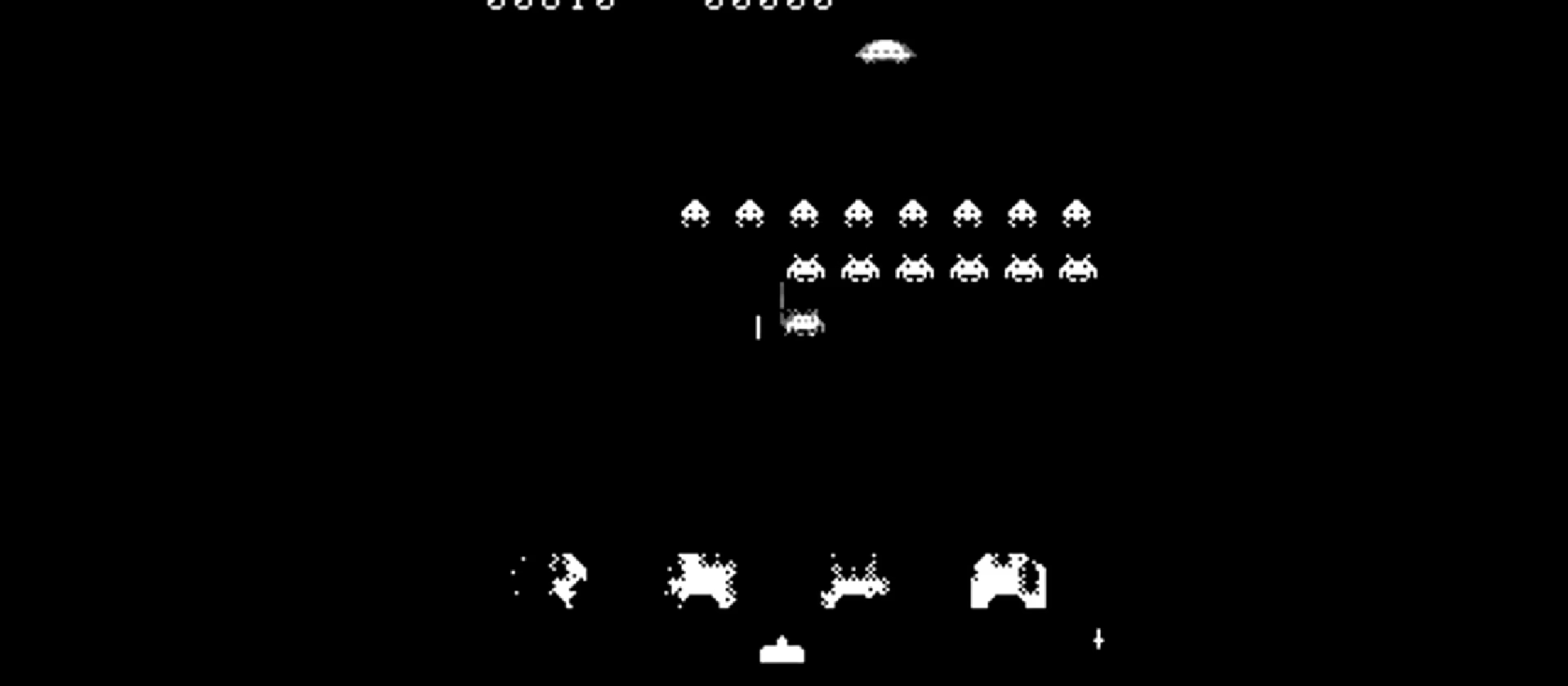
A wave starts as a pattern recognition exercise. Five rows of eleven, descending in lockstep, the bottom row a footstep ahead of the others. The barriers below sit in their starting silhouette — four mushroom shapes, intact. The four-note descending bass loop sets a cadence the speed of unhurried walking.
It is genuinely slow. Modern players who quit at this point conclude they’ve understood the game; they haven’t even met it. As the formation thins, the CPU has fewer sprites to render per frame, and the survivors update faster. The bass loop tightens accordingly — the same four notes, but compressed against shorter intervals. By the time twelve invaders remain, the cadence has stepped from a walk to a brisk jog. By six, it’s a sprint. By two, the surviving sprites cross the playfield at a pace that turns the player’s eight-pixel-per-frame ship into a problem of intercept geometry rather than aiming.
This is the design that buys Space Invaders its present tense. The barriers are destructible from both sides, and a credit-long session leaves them as period diagrams of where the player has been standing — a permanent stain of intent on the playfield. The descending bass is the first piece of game music that answered the game’s state, decades before anyone called that dynamic audio. And the speed curve is the first time difficulty in a video game was authored as a continuous accelerating function rather than as a sequence of discrete level boundaries. None of these were standard practice in 1978. None of them are absent from any current arcade-style shooter.
Blue Shark Was the Headline That Summer
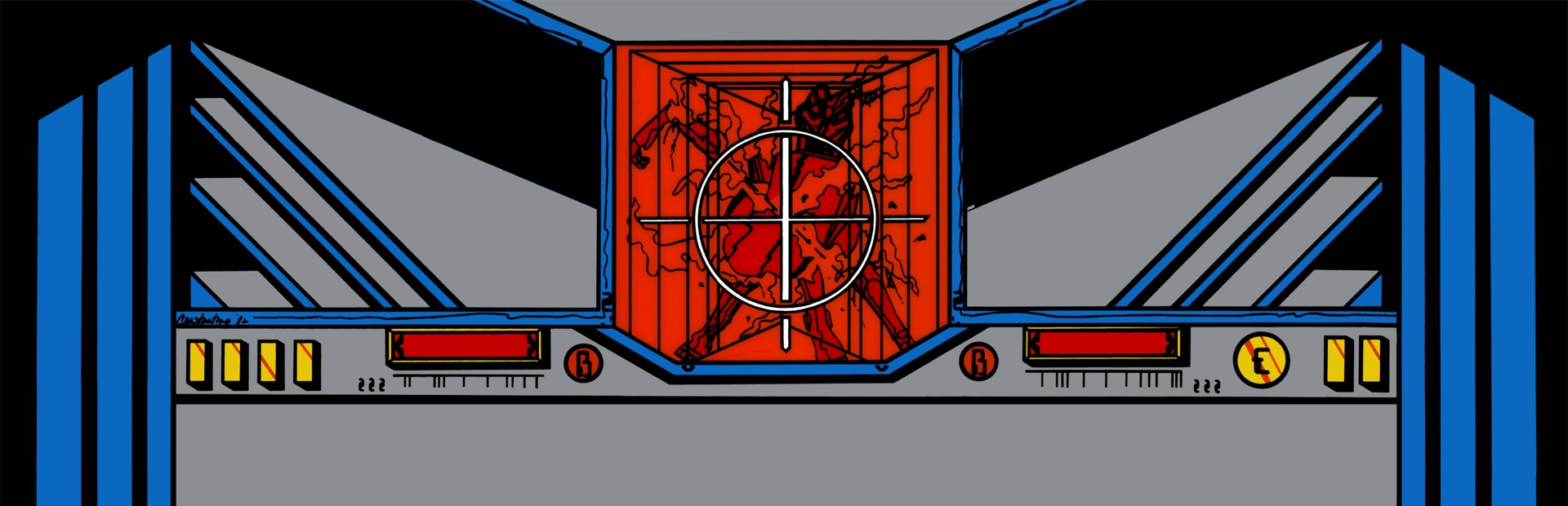
What Taito unveiled to the trade in June 1978 wasn’t this game. The event’s headline cabinet was Blue Shark, a periscope-style underwater shooter that management believed would carry the company through the second half of the year. Michiyuki Kamei, the sound designer, spent four to five months on Blue Shark’s audio circuitry and was hurried into producing the four-note descending bass for Space Invaders in the gaps — the latter ready, just barely, in time for the same demonstration.
The arcade operators who came to the demonstration backed Taito’s read on the room. Space Invaders drew shrugs. The complaint that has survived in Tomohiro Nishikado’s interviews from the Game Maestro book onward is that the game was simply too hard — that the operators couldn’t see who, exactly, was going to play long enough to reach a kill screen and accordingly couldn’t see how a cabinet of this thing would justify the floor space.
The trade reception got harder still after the unveiling. Nishikado has been steady, over forty-five years of interviews from the Game Maestro recollection in 2000 to the Time Extension piece in 2025, about what Taito’s own sales department thought of the format. They were, he said in 2025, “always saying that ‘these things will never sell.’” The prototype home console he built around the same period — a console Taito could have entered the consumer market with, ahead of the Famicom, ahead of every Japanese competitor — was killed by exactly that scepticism. It is one of those counterfactuals that historians prefer not to dwell on, because the alternative timeline it implies is unbearable.
”Their reception was also unfavorable. They said it was too difficult.”
— Tomohiro Nishikado, Game Maestro, c. 2000
What turned the operators around was the takings. By the autumn the cabinets that had been pushed in front of Blue Shark were the ones the route operators wanted, in numbers Taito’s production line could not initially meet. The pivot was driven by collection-day arithmetic, not by the marketing surrounding the unveiling, and by then nobody had to argue for the game in the room — the coin boxes did the arguing on its behalf.
The Six-Month Soldering Job
The cost of professional development tools in 1978 was, in Nishikado’s recollection, ten million yen — roughly a hundred thousand dollars at the period exchange rate, more than Taito was prepared to spend on a project whose commercial logic the sales team did not understand. So Nishikado bought LSI chips and soldered the development environment together on his bench. The work took six months. It was the work before the game.
He had wanted tanks for the enemies. “But the thing about tanks is, if their cannons aren’t facing forward, I don’t think they look cool” — and the 8080’s sprite system could not render sideways tracks smoothly enough to keep the rotation legible. He considered fighter planes next; planes had the same problem in the opposite direction, since the smooth horizontal sweep he wanted was beyond the hardware’s frame budget. Aliens were the third choice, and they survived because the hardware’s failure modes flattered them rather than betraying them. Vertical herky-jerky movement, sudden one-pixel descents, lockstep formation — none of these looked wrong on a creature whose locomotion the audience would invent for itself. The iconography of the most-copied arcade silhouette of all time is downstream of an 8080’s render budget.
The CRT inside the cabinet showed white pixels on black. The colour you have seen photographed on every original cabinet — the green ground stripe, the band where the UFO crossed in red — was supplied by strips of cellophane taped to the inside of the monitor glass, with a moonlit star-field painted onto a backing plate behind a half-silvered mirror to fill the upper third of the play area. The game ran in monochrome and was sold as colour. By the time the speed-up bug arrived, it had become part of the design: the CPU rendered the surviving formation faster as the wave thinned, and rather than spend cycles correcting for it, Nishikado decided the artefact was the rhythm the game wanted. The most consequential design decision in arcade history started life as the consequence of not enough silicon.
What the Mint Actually Minted
The version of the Space Invaders boom that ran in the British press in 1980 and survived into Martin Amis’s Invasion of the Space Invaders in 1982 turns on a single image — the Japanese Mint tripling its production of one-hundred-yen coins to feed the cabinets. It is one of those facts everybody knows. It is also wrong.
The actual production figures, audited by Daniel Paradis against Mint records and Bank of Japan statements, are uncooperative. In 1977, the year before the cabinets went out, the Mint struck 440 million hundred-yen coins. In 1978, the year of the unveiling, the figure was 292 million — a drop. In 1979 it rose to 382 million; in 1980, to 588 million. There is an increase across the period; there is nothing remotely resembling a tripling, and the gentler rise the numbers do show is well-documented Bank-of-Japan policy aimed at countering the hoarding of older coins, not arcade demand. When Paradis contacted both institutions directly, neither could produce any record of a Space Invaders-attributable coin shortage.
”The only defining word for this report is exactly that — unbelievable.”
— Daniel Paradis on the 1980 New Scientist coin-shortage article, Insert Coin to Play, 2013
The myth’s proximate source is a New Scientist piece from January 1980 that travelled fast and was never checked. By 1982 Amis had it as fact, and the English-language history of the game has carried it ever since. The boom was real — Invader Houses, dedicated single-cabinet arcades, opened across Japan in 1979 and 1980 and disappeared inside two years — but its proper subject is a market discovering that an interactive medium could sustain that kind of repeated transaction, not a national mint operating under crisis. The thing that’s most striking about the popular story is the size of the gap between the documentary record and the version of events the documentary record allegedly attests to.
The First Beat of a Decade
The reason any of this still matters is that the three design ideas the game introduced — destructible cover, dynamic music keyed to game state, difficulty as a continuous accelerating curve — became the structural floor of the genre that followed. Galaxian in 1979 added formation depth and divebombing attack patterns. Defender in 1981 gave the horizontal axis full scrolling and a minimap. Xevious in 1982 split air and ground into layered planes. Gradius in 1985 built a power-up economy on top. R-Type in 1987 generalised the speed-curve principle into entire stages designed as accelerating pressure tests. By the end of the decade the genre that Taito’s sales team had spent the summer of 1978 dismissing as “these things” was the medium’s most economically productive form, and every one of its later landmarks was built on a foundation Nishikado had laid alone, by hand, in monochrome, against advice.
It is tempting, looking back, to file Space Invaders as a museum piece — the proto-thing, the one before the ones that mattered. The cabinets in the Invader Houses are gone; the cellophane has yellowed in the few originals that survive; the New Scientist coin story has outlived its corrections by four decades. But the credit you can buy on a Switch in a 2026 sale for less than the price of a coffee still runs the same routine, and on the fourth wave the bass loop still tightens, and the hands still discover that the difficulty in front of them is not waiting at a level boundary but is already half a row away and arriving. That part hasn’t aged into history. That part is what the medium learned how to do here.