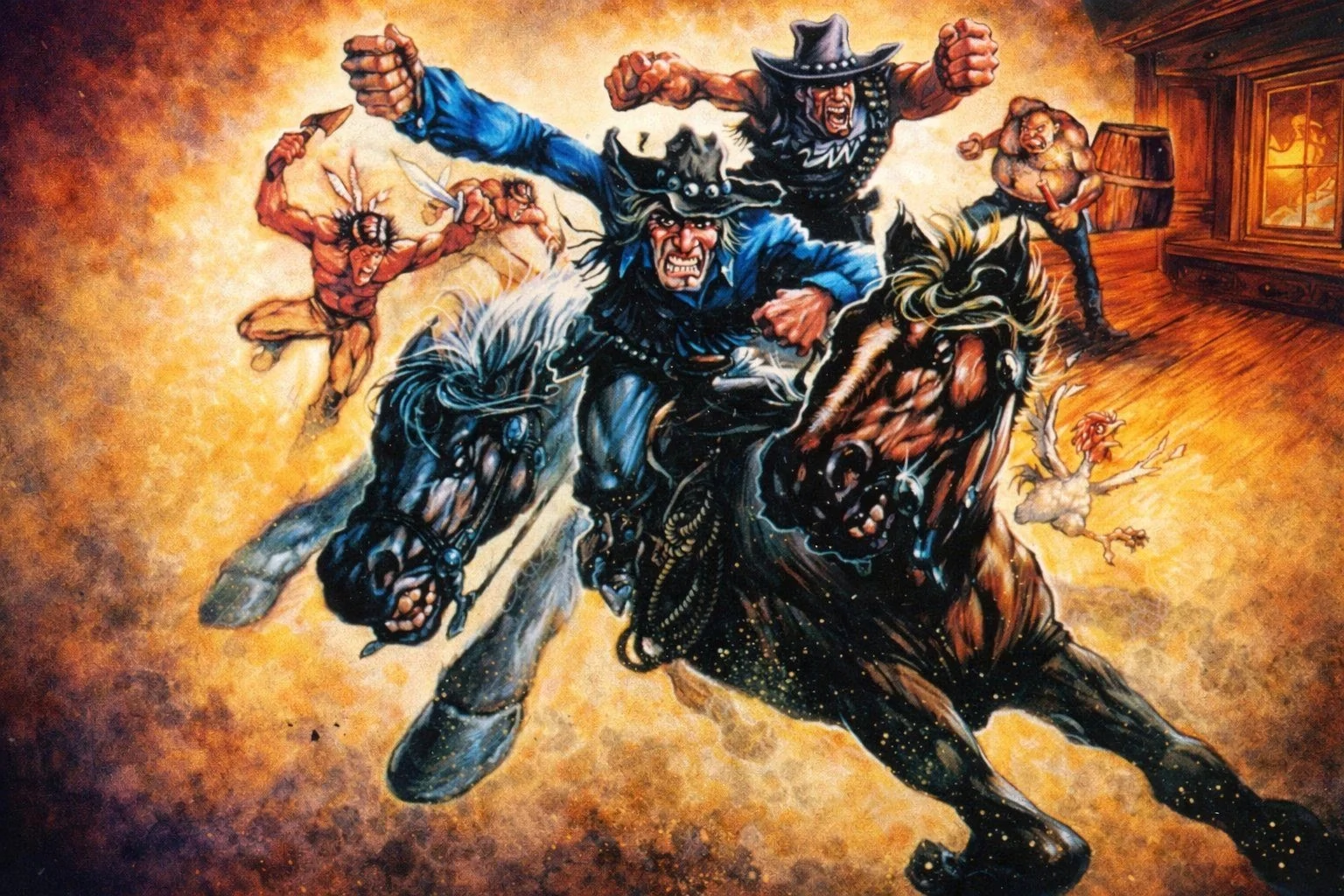
Konami’s G.I. Joe came seventh when RePlay magazine polled American arcade operators on their best-earning cabinets in July 1992. Two months earlier, Computer and Video Games had scored it 346 out of 400 — eighty-six and a half percent — and Electronic Gaming Monthly would file a positive review in October. Then, almost as quickly, the cabinet vanished from the canon. Teenage Mutant Ninja Turtles, The Simpsons, Sunset Riders, X-Men — Konami’s four-player run on the upright JAMMA family — became history; G.I. Joe did not. The reason has nothing to do with the game. Konami held only the arcade rights to the Hasbro license. The NES home rights belonged to Taxan, then to Capcom when Taxan went under, and the SNES era ended without anyone holding the keys to a 16-bit conversion. The cabinet stayed behind glass.
That accident of paperwork made the second mistake possible: the assumption that the game it preserved was the fifth Konami licensed brawler, slotted alongside TMNT IV and Sunset Riders in the same taxonomy. It isn’t. G.I. Joe is something else — a Cabal-style rail shooter pulled forward from the same studio’s 1988 cabinet Devastators, dressed in painted sprite-scaling backgrounds that Konami’s Sega-watching engineers had been quietly mastering for years. The brawler family it sat next to in the arcade is not the family it belongs to mechanically. Reading it as the run-and-gun cousin of Wild Guns, not the run-and-gun cousin of Turtles in Time, changes everything about how it plays.
Seventh, Then Vanished
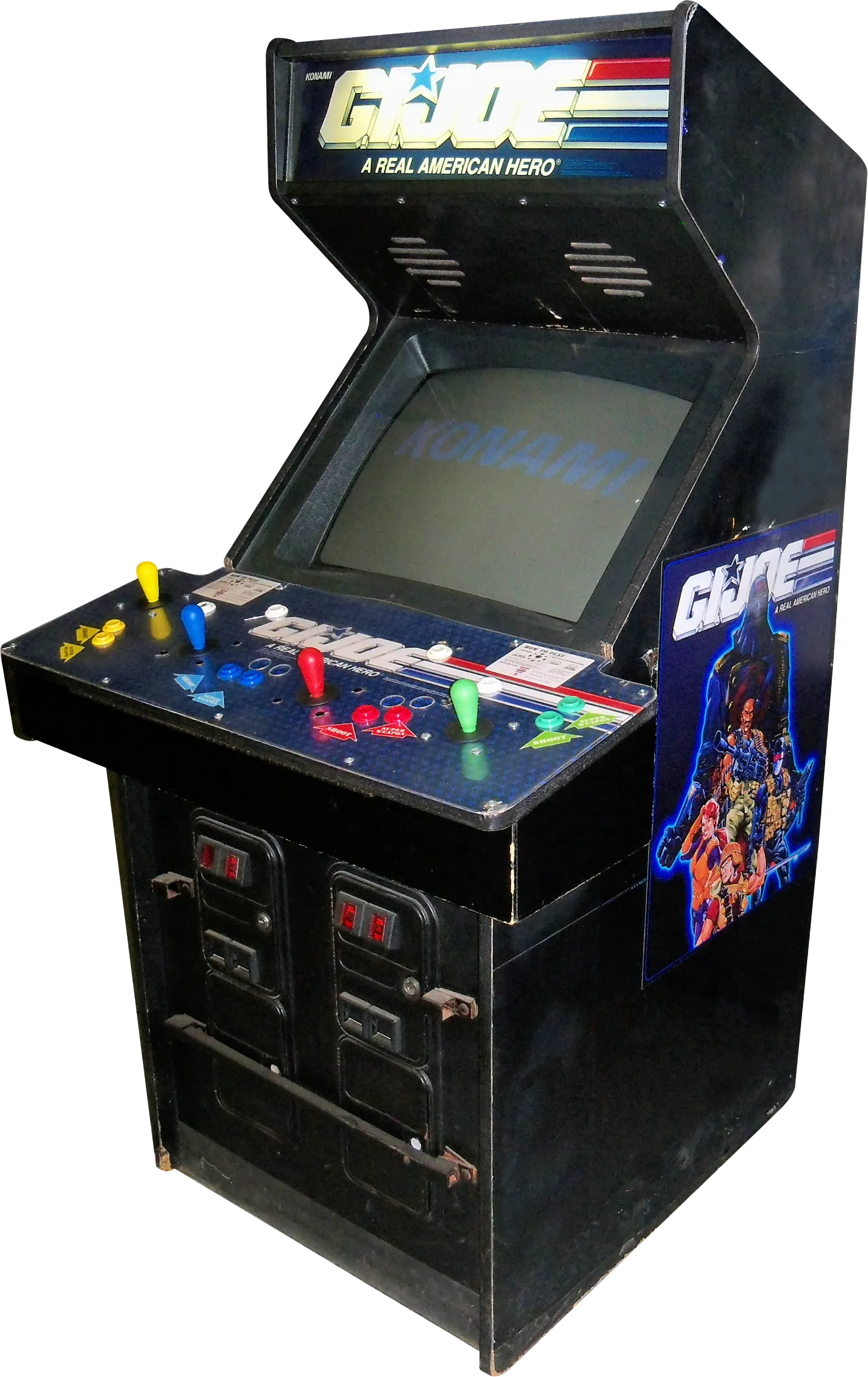
The four-player upright — same JAMMA form-factor Konami built Sunset Riders and TMNT IV into. G.I. Joe · Konami, 1992 · Arcade.
The licensing fluke is the entire reception-gap story. Taxan published a workmanlike NES G.I. Joe in 1991; The Atlantis Factor followed in 1992 under the Capcom imprint after Taxan dissolved. Both were on cartridges. The arcade rights, separately negotiated, sat with Konami. By 1992 the Japanese studio had four years of Western-IP cabinets behind it — Aliens, TMNT, The Simpsons, Bucky O’Hare — and a working arrangement with the Hasbro side: Steve Kaufman, a long-running Sunbow Productions producer, appears in the credit roll’s special thanks. The cabinet shipped through Konami of America in Buffalo Grove, Illinois, in April 1992, supporting one to four simultaneous players on the same upright JAMMA chassis the studio had built Sunset Riders into the previous year.
It was an immediate hit. RePlay’s “Player’s Choice — Top Games Now in Operation” had it seventh in the country; the Computer and Video Games review treated it as a marquee release; Famitsu covered the Japanese launch in issues 180 and 181 across late May and early June. And then the cycle finished. No port came. No Konami collection has ever included it — not the Arcade Classics Anniversary Collection, not Hamster’s Arcade Archives (where Devastators finally arrived as recently as March 2026, but its 1992 sibling did not). The Japanese retro commentator Hyasuhi recently noted, with some weariness, that this fate was structural: “TMNT, X-Men, G.I. Joe, Simpsons, Bucky O’Hare and so on — each was released in Japan and then disappeared almost immediately.” What Konami built, the home market never inherited.
Devastators, Four Years On
The closest relative is not on any Konami home cartridge. It is Devastators, the studio’s 1988 Cabal-format cabinet — a third-person shooter where the player’s character occupies the bottom of the screen and a cursor floats over the field, with enemies arriving behind a perspective horizon. The Cabal pattern was a small genre by 1992. Cabal itself, TAD’s 1988 original. SNK’s NAM-1975 in 1990. Seibu Kaihatsu’s Blood Brothers and the comparatively niche Wild Guns would come later. Inside that niche, G.I. Joe is the most expensively produced thing on the list. Kim Justice, in a 2024 retrospective of Konami’s 1990s arcade run, puts the case directly:
“This is a bit different from the normal side-scrolling formula. Essentially it’s a highly evolved Devastators from a few years ago, where your characters are running into the screen taking down the Cobra troops and blowing up absolutely everything in sight. Of the few games that can be found in this little niche — the likes of Cabal, Blood Brothers and the aforementioned Devastators — this might just be the absolute best of them. The only other one I can think of that could compete is Wild Guns.”
— Kim Justice, The A–Z of Konami’s Arcade Games 1990–1996, 2024
That family identification matters because it pulls the cabinet out of the wrong comparison. Read alongside Sunset Riders, G.I. Joe looks mechanically narrow — no jump, no slide, no melee, no platforms to traverse. Read alongside NAM-1975, the same constraints become genre vocabulary: the player is shooting up the screen, not across it, and the verbset is what the camera angle has to support. The director, credited as Formula Jun in the Konami pseudonymous house style of the period, did not set out to make another TMNT with army jeeps. He set out to make Devastators with a Hasbro budget.
Two Buttons, Both Halves of the Screen
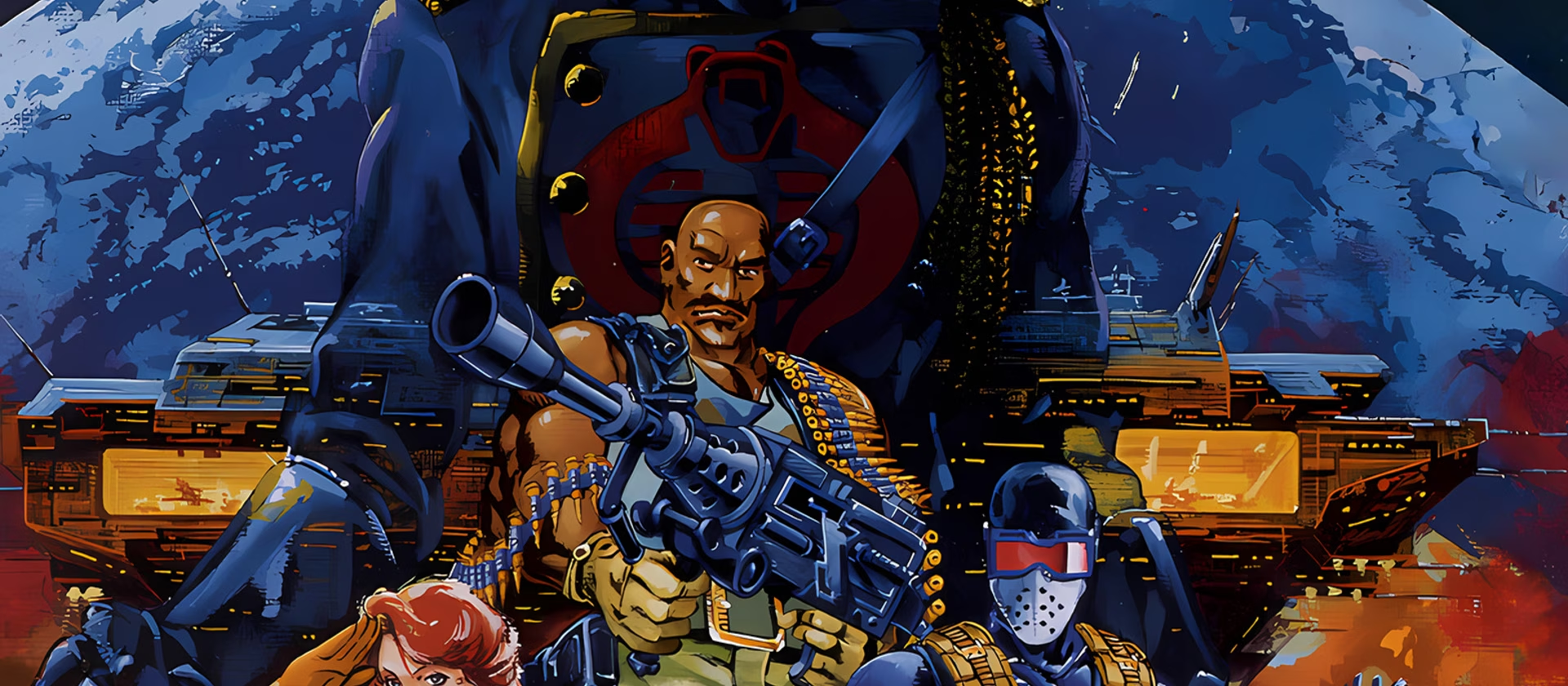
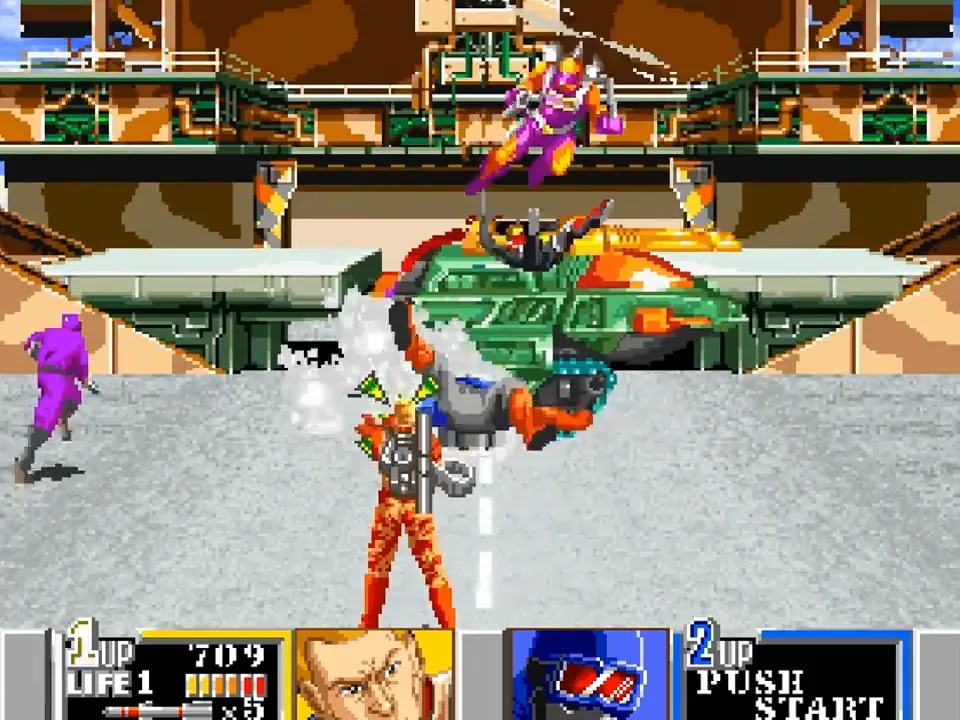
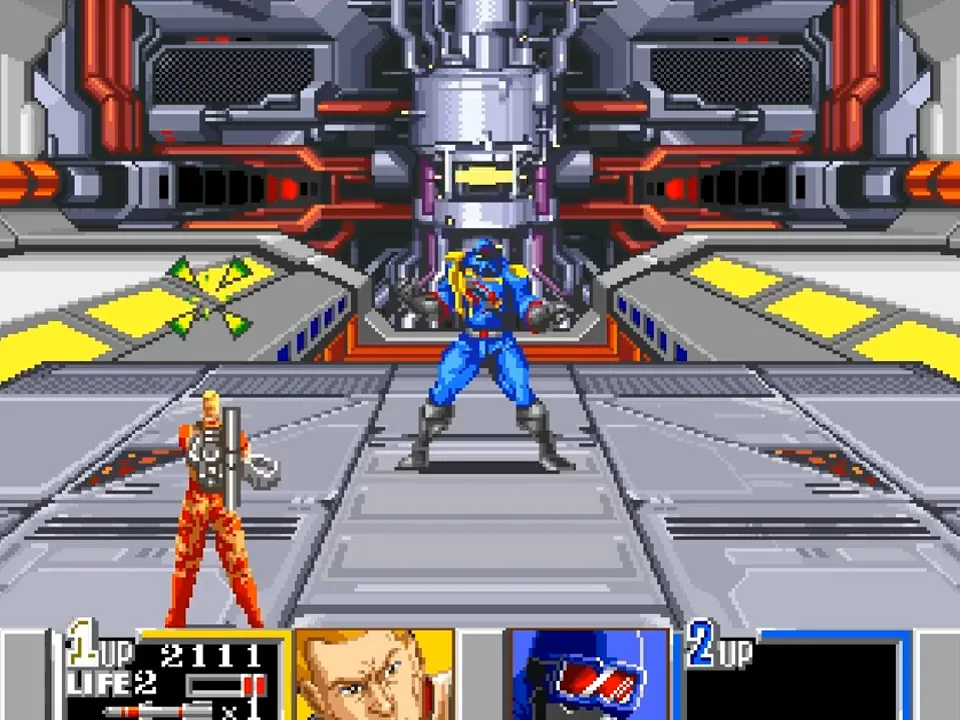
Stage 2’s Cobra installation grows continuously toward the camera as the player runs in — the sprite-scaling that carries the dramatic arc the gun cannot. G.I. Joe · Konami, 1992 · Arcade.
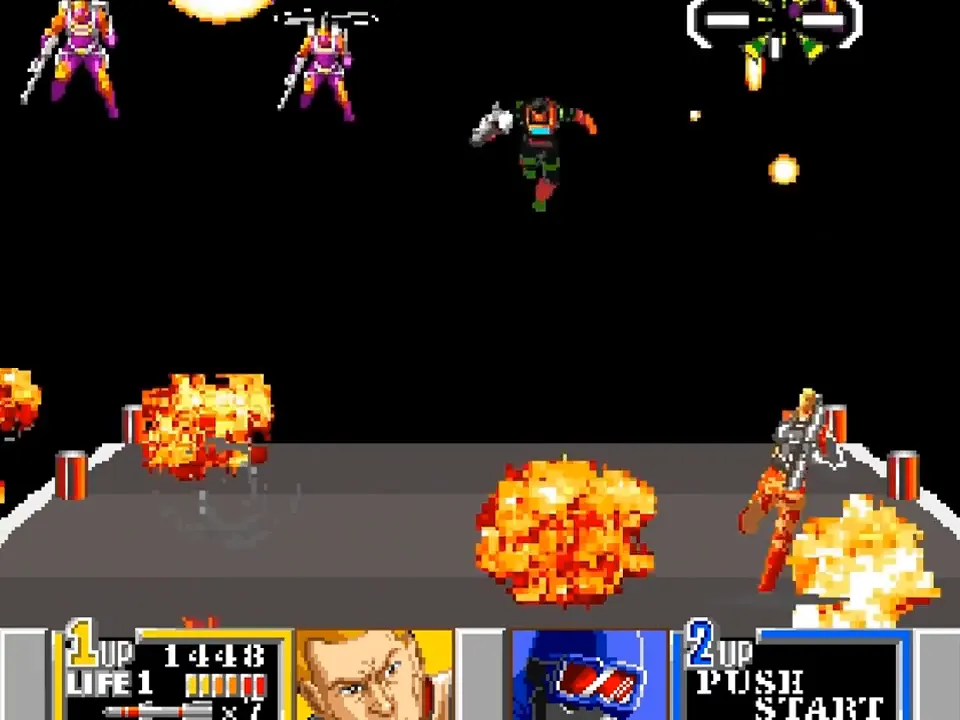
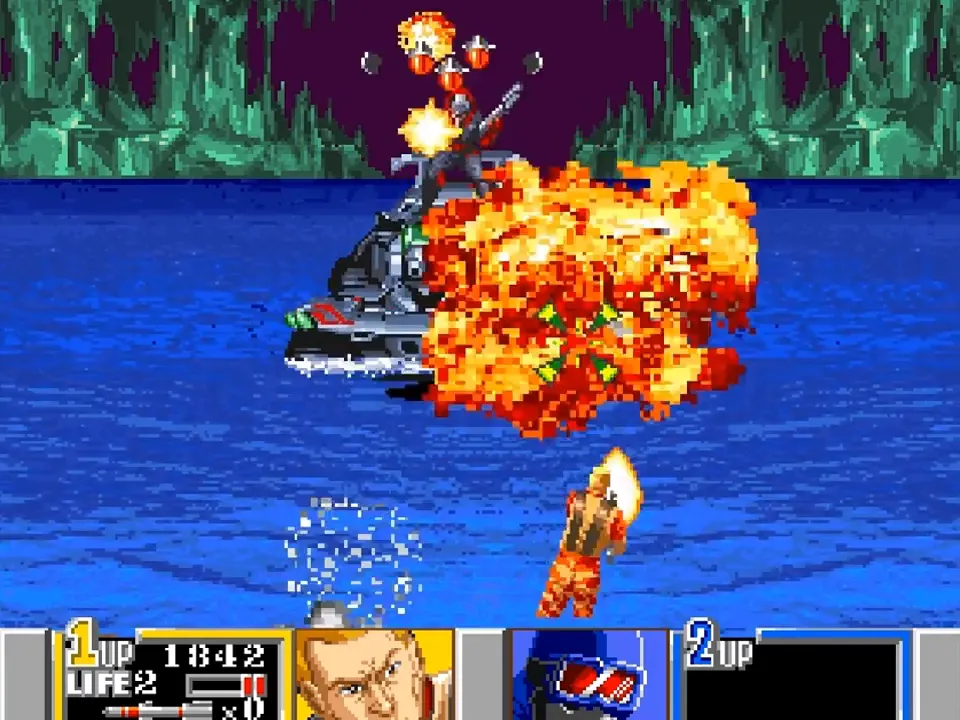
The cabinet runs a Motorola 68000 at sixteen megahertz with Konami’s 054539 PCM sound chip, on the studio’s Xexex-family board — the same chipset that powered the 1991 horizontal shooter currently sitting at the top of this volume’s reading order. The 8-way joystick moves a small reticle anywhere on the screen simultaneously with the character beneath it. One button is unlimited-ammo machine gun; the other launches missiles from a magazine of nine. Three missions, six stages, one loop to a Cobra Commander finale. A skilled player clears it in roughly thirty minutes.
What the camera angle costs in mechanical vocabulary it pays back in spectacle. Hardcore Gaming 101’s retrospective frames the visual identity exactly: “smooth 3D sprite scaling that almost makes it look like something Sega would’ve put out circa Thunder Blade or Galaxy Force II.” The stages do not so much scroll as advance. In Stage 2’s Air Base segment, a Cobra installation appears as a small structure on the horizon, grows continuously through the run, and resolves into a screen-filling fortress by the time the boss arrives. The scaling carries the dramatic arc the gun cannot — the player’s vocabulary is narrow, but the world inflates around the vocabulary until inflation itself becomes the drama. G.I. Joe is rarely thinking about the player; it is thinking about the structure approaching the player.
The friction the cabinet does not solve is feedback. As Cathy Vice noted in her Indie Gamer Chick read of the game, bosses “lack even that Contra-like chiming ping when you score a hit, so really, it just sort of feels like they’re absorbing your bullets until they start to blink and die.” The hit confirmation that Contra taught the player to depend on was never a Konami arcade default; G.I. Joe has it on troops and not on bosses, which means the final ten seconds of every confrontation feel quieter than they should. That is the cabinet’s most-cited failing, and it is real. Most modern players bounce off it briefly, then forget it. Almost nobody bounces off twice.
The Score Released, the Game Didn’t
The music was composed by Tsutomu Ogura, working at Konami since around 1987, and Kenichiro Fukui — both members of the studio’s in-house Kukeiha Club. Fukui would score Konami’s Lethal Enforcers later that year and contribute to Violent Storm in 1993 — the second cabinet in this volume’s reading order whose soundtrack is unmistakably his. The G.I. Joe score is direct, brass-heavy, and built around the cartoon’s “GOT TO GET TOUGH — YO JOE!” refrain, sampled and looped into the title screen. It is, in the strict sense, a licensed-property arcade soundtrack, and most of those go nowhere.
This one did not. On 24 December 1992, Konami’s house label released KONAMI ALL STARS 1993 — Music Station of Dreams, a three-CD year-end compilation catalogue-numbered KICA-9016. Disc three carries five G.I. Joe tracks, credited to “Funiki Fukui” — Kenichiro Fukui’s Kukeiha Club nickname. We Are G.I. JOES. Map Out A Plan Of Operations I. Go To The Airport!. Shooting Small Flies. Dash Toward The Final Battle!. Konami’s internal valuation of the score was such that the label gave it nearly twenty minutes of disc-three space at a moment when its arcade chart-runner was already on the way out of public memory. The compilation is still on VGMdb, Discogs and the Internet Archive. The cabinet that produced it is on none of those.
What Konami Did With the Same Board
The marquee Konami operators bolted onto the same upright chassis as Sunset Riders, TMNT IV, and X-Men — a matched cabinet family, one missing brother. G.I. Joe · Konami, 1992 · Arcade.
This volume of the Konami Anthology already covers the studio’s Xexex — the 1991 horizontal shooter whose chipset G.I. Joe shares. Read them side by side and the cabinet logic becomes legible: same board, two genres, the same studio’s hardware investment doing both jobs. Konami’s run between 1988 and 1992 was a hardware platform in search of as many cabinet pitches as the operator market could absorb — Cabal-style rail, side-scrolling shmup, four-player brawler, four-player run-and-gun, beat-‘em-up — and the platform was equal to all of them. G.I. Joe is not a brawler made in apology for not being TMNT IV. It is a thing Konami’s engineers and Konami’s artists could not have made on hardware they had not already mastered for Xexex.
The route to play it today is, accordingly, narrow. MAME’s gijoe romset runs cleanly enough to read what the cabinet did: two minor sprite-rendering glitches in Cobra’s Weapons Plant and one later stage, gameplay completely unaffected, the painted sprite-scaling backgrounds intact. No MiSTer FPGA core exists for this Konami board family — the GX400 core covers Nemesis-era hardware only, not this generation. No Hamster Arcade Archives release. No Konami collection. Original boards still circulate on the secondary market at around four hundred pounds — the LS74 logic chip around the DTACK signal is a known failure point, per Bryan McPhail’s working repair log; verify board health before buying, and don’t pretend the schematics exist.
What makes a thirty-minute one-credit clear worth the setup today is the specific pleasure the cabinet still gives that Wild Guns and NAM-1975 don’t. Wild Guns has the player’s verbset; NAM-1975 has the harder difficulty curve; G.I. Joe has the largest, most carefully painted scaling stages in the genre, with a four-player co-op layer no other Cabal-family cabinet ever ran. Two friends, an emulator, a Saturday afternoon. The cartoon you remember, the cabinet you didn’t get to play in 1992, the soundtrack Konami’s own label preserved on disc three of an album the game never lent its name to. The catalogue’s missing fifth chair, finally pulled up to the table.