// import spiderGladePoster from ”../../assets/images/shantae-2002-spider-glade-poster.jpg”; // deleted
// import pirateDeckPoster from ”../../assets/images/shantae-2002-pirate-deck-poster.jpg”; // deleted
The cartridge is thick in the hand. Most Game Boy Color paks sit flat against your palm; Shantae’s is noticeably heavier, the plastic swollen around a four-megabyte ROM and a battery-backed save chip that ran Capcom’s per-unit cost up into territory publishers had spent three years refusing to touch. In June 2002 the cart shipped anyway — into a store aisle that had moved on to a different handheld seven months before. Roughly twenty-five thousand copies made it out. None came back.
The received wisdom is that Shantae is a lost classic the 3DS eShop eventually rescued. That outcome is not the story. The story is how WayForward, a small studio of animators making work-for-hire licensed tie-ins to stay afloat, built the best-animated platformer of the Game Boy Color’s entire life on the wrong side of its funeral — and then had to wait a decade to find out they had made a franchise.
A Character Drawn at Summer Camp
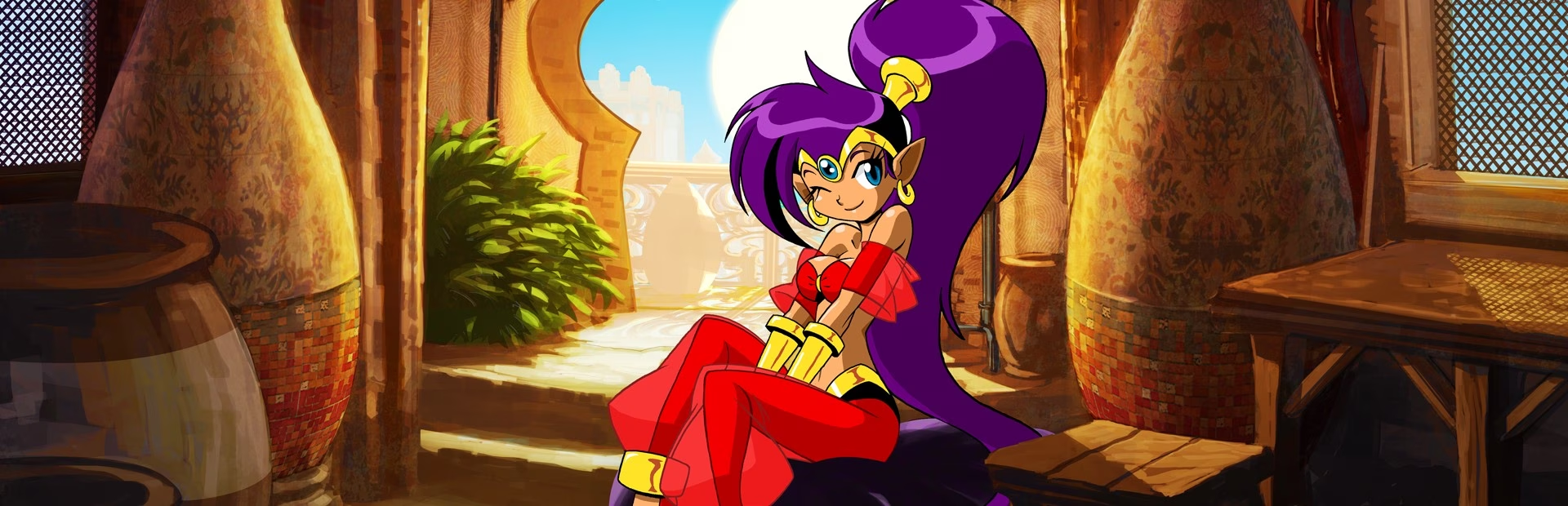
Shantae begins in 1994. Erin Bozon, an animation student at CalArts and a camp counsellor in the summers, sketched a character named after one of her campers — one hip cocked, a long lick of hair down the back, a shape that already needed mechanics for the pose to make sense. She and Matt Bozon, also a CalArts animator, had been dating; they married, and the character sat in a sketchbook while they both took industry jobs. Matt landed at WayForward Technologies, a small studio then making licensed Game Boy Color work for publishers who didn’t want to staff their own teams — Sabrina the Teenage Witch, Xtreme Sports, the kind of tie-ins nobody expects a studio to save itself with.
”Shantae’s story begins in 1994 with my wife Erin, who came up with the character and game concept following our time together as animation students at CalArts.”
— Matt Bozon, Nintendo World Report, April 2021
What started as a sketch became, slowly, a pitch. The Bozons owned the character outright; WayForward’s founder Voldi Way agreed that a Game Boy Color version could be built inside the studio’s existing cadence of licensed work. The studio had a programmer, Jimmy Huey, who had already pushed the GBC past its spec sheet on Xtreme Sports. The idea was to push it further.
The Cartridge Nobody Wanted to Make
The problem was the cart. A Shantae that looked the way Erin had drawn her — long frame animations, big sprites, parallel backgrounds — could not fit on a standard Game Boy Color ROM. The game needed four megabytes, the largest stock GBC cart, plus battery-backed SRAM to hold a save. That combination pushed per-unit manufacturing cost far past a licensed platformer’s comfort zone. Publishers kept passing. A new IP, female-led, on a shrinking handheld market, piled commercial red flags on top of expensive silicon.
Capcom eventually bit. Then Capcom held the finished game for roughly eight months. The Game Boy Advance launched in North America in June 2001. When Shantae finally shipped on June 2, 2002, it arrived next to the GBA launch window’s second holiday season — competing for shelf space with a platform that had already rendered its own hardware obsolete. The first print run was around twenty-five thousand cartridges. There was no second.
Engine Tricks on Dead Hardware
Inside the cart, Jimmy Huey had lied to the Game Boy Color. The system’s hardware does not support parallax scrolling or translucency — both were luxuries reserved for the Advance. Huey faked them anyway. Scenes in the desert town layer four visible planes: sand in the distance, middle-distance awnings, foreground market stalls, the sprite plane itself, each moving at a different rate as you walk. A waterfall arena shows translucent spray; a sunset washes Scuttle Town in what reads, to the eye, as alpha blending. None of it is. It’s all tile-trickery, colour swaps, and framebuffer discipline — a programmer treating a five-year-old chipset as a puzzle rather than a limitation.
”Jimmy found ways to get more tiles, extra colors, and even the illusion of parallax scrolling and translucency out of the GBC through a variety of programming tricks, somewhat blurring the lines between GBC and the Game Boy Advance.”
— Matt Bozon, Nintendo World Report, April 2021
Nintendo Power’s review argued the game’s graphics outclassed most of the GBA’s own launch year — which, given that Shantae was running on the GBA’s predecessor, was either a compliment to Huey or an indictment of the Advance.
The platforming that sits on top of the engine is disciplined. Shantae’s hair-whip has a short, readable arc that never clips into an enemy’s hitbox by surprise. Her jumps land with a recovery frame that tells you instantly whether you have room to whip again before the next threat. Labyrinths are laid out as small, knotted metroidvanias — dungeon maps are grids of screen-sized rooms rather than scrolling corridors, which makes return trips legible without modern fast-travel crutches. Dance transformations are fast. The monkey climbs, the elephant charges, the spider scales ceilings, and each form gatekeeps a different class of puzzle. The game asks you to think in layers and rewards the thinking with sharper tools.
The overworld economy is quiet but persistent. Shantae earns gems from enemies and sells pottery in town; the money funds health upgrades, warp dances that stitch the map together, and a Sky Lamp that exposes invisible platforms. Nothing is gated behind grind. The game respects the handheld-length play session a 2002 commuter might actually have — an hour on a bus, progress preserved at the next save pot, a warp dance that spares you from retreading a labyrinth you have already solved. A player coming to it cold today will recognise the shape; what they will not expect is how few of these systems feel vestigial. Every economy in the game still pulls its weight.
Dances That Turn the Screen
Jake Kaufman composed the soundtrack. This is worth saying plainly, because two decades on, Kaufman is the name the Shovel Knight credits carry and the name indie chiptune buys when it wants to sound like it was always there. In 2002 he was a young composer being trusted with his first major game-length score, and what came back is Shantae’s secret weapon. The dance themes pivot between Egyptian-pentatonic scales and Mediterranean harmonic minor, leaning into the Scheherazade-adjacent fantasy the art is already building. The main overworld theme loops on a four-note bassline that somehow never frays after an hour in town. Dungeon music shifts keys when you cross a labyrinth threshold. It is, sonically, a soundtrack that expects to be lived in, and it makes the GBC’s four-channel sound chip feel like it has eight.
The music is welded to the mechanics. Transformation dances each carry their own short musical cue — a four-bar call that plays as Shantae spins, and then the world bends into whatever the dance has asked it to become. The game’s insistence that magic is something performed, not something selected from a menu, runs through every system it has. You do not cast spells in Shantae. You dance them.
The Audience Capcom Missed
Capcom’s framing of the game in marketing was the other commercial problem. The box copy sold a dancing, whipping girl genie in terms that seemed to target no one particular — too cartoon for older Advance adopters, too girly for the male-coded platformer shelf, too weird for the licensed-cartoon aisle. Bozon has been diplomatic about this in interviews; he credits industry skittishness about female-led games more than any specific Capcom failure. What he does not say, because he does not have to, is that the game Capcom sold on the box is not the game in the cart. The cart is a carefully paced metroidvania with handcrafted backgrounds and a protagonist who owes more to Disney animation than to any early-2000s mascot trend. It did not need to find the broad GBC audience. It needed to find the GBA one.
Twenty-four years later, the game in the cart has survived every commercial reason it shouldn’t have. The 3DS Virtual Console port in 2013 introduced it to a second generation of players, who found the same thing the small 2002 cult had: a platformer whose controls are calibrated with the attention of animators, whose levels reward return trips, whose music is unashamed. Five sequels have followed. Limited Run produced a physical reprint. Original cartridges, when they surface, trade hands for more than five hundred dollars — a price tag that exists because twenty-five thousand people bought the game, and the four hundred million who didn’t turn out to have been wrong.
What separates Shantae from its commercial peers is the unembarrassed confidence of its making. A game built under duress often looks like one: rushed animations, borrowed assets, a plot apologising for itself. Shantae’s refusal to apologise — for the expensive cart, the dying platform, the newcomer IP, the dancing — is the most striking thing about it. It reads as a thesis on what a small studio can do when it decides the constraint is the material, not the obstacle. The GBC was dying. Capcom was hedging. WayForward built the best-looking, best-animated, best-written platformer on the console anyway, then sat back and waited for the audience to catch up.