The last first-party Game Boy Advance game Nintendo shipped was a pop album. It went on sale in Japan on 3 August 2006 with no fanfare, no English-language announcement, and a yellow cartridge the size of a matchbook. The GBA had been superseded for two years by the DS; the trade press had written the platform’s obituary; Nintendo never localised the project for any Western market. Rhythm Tengoku closed the book on a hardware generation by asking a question nobody at Nintendo was trained to answer — what does a rhythm game look like if the screen is a joke and the music is the test?
The pitch came from Tsunku, the J-pop producer who had spent the previous decade building Morning Musume, Country Musume, and the rest of Hello! Project into Japan’s dominant idol franchise. He had never designed a game. His terms were simple: the player should be able to close their eyes and still score. The Nintendo team, led by WarioWare veteran Kazuyoshi Osawa, took the brief. They didn’t understand it. So Tsunku proposed a solution so literal that the next thing the art director did was fly across the country to take dance lessons.
Twenty years later — and weeks before a sequel returns Tsunku to the same question on Switch — the manifesto still reads. Rhythm Tengoku is the only rhythm game of its era built on the thesis that the ear keeps better time than the eye, and it remains the most honest argument the medium has made for the primacy of sound.
Tsunku Teaches Nintendo to Listen
The Tsunku that Nintendo signed in the early 2000s was not a hobbyist with a demo. He had produced the bestselling J-pop act of the late nineties, written the hooks that ran the Hello! Project machine, and scored enough television theme work to be a household voice in Japan before he was a household name. What he did not have was a vocabulary for how a rhythm game should work. His first pitch to Nintendo was a drum demo. His second was a paragraph of instructions, built around the insistence that the player should be able to play the game with the screen off.
Osawa’s team came from WarioWare. Their instinct was visual: build a cue, animate the anticipation, reward the hit. That instinct — the reason WarioWare works — was the instinct Tsunku was asking them to switch off. Rhythm, to him, was an embodied thing. You didn’t see a downbeat; you felt it in the weight of your knees. If the screen told you when to press a button, you were reading a score, not playing music. The conversation stalled.
”While we were consulting with Tsunku-san, who supervised the game, about rhythm, he said the fastest way he could make us understand was to have us try dancing, so we all went to Tokyo.”
— Ko Takeuchi, Iwata Asks, 2008
The dance studio is the moment the game began. Takeuchi — the artist whose cartoon cast would later define the series’ face — learned choreography alongside Osawa’s team, sweat through repetitions, and came back to Kyoto with a different brief than the one they’d taken. The job wasn’t to build a rhythm game. It was to build a game that taught its own audience to stop watching and start moving. What you see on the screen became the punchline; what you hear became the instruction. Everything in the engine — the animation timing, the on-screen cue cards, the visual reward — was retrofitted around the music rather than the other way around. By the time development finished, the team had produced a first-party Nintendo title in which the player who looks up too often loses.
The Screen Is the Joke
Rhythm Tengoku ships with fifty-odd stages across six tempo grades and a handful of unlockable Rhythm Toys. The core loop is metronomically simple. A thirty-second to two-minute track plays. The game asks for one thing — one button, occasionally two — at precise moments in the bar. Miss enough and it tells you, politely, to study; nail enough and it tells you it’s a hit; clear a level with the hidden Superb threshold and it unlocks the perfection-grade epilogue. The second tutorial arrives in the form of a single sentence — 音に合わせて、Aボタンを押してください, press the A button in time with the music. That is, for the next six hours, the entire instruction set.
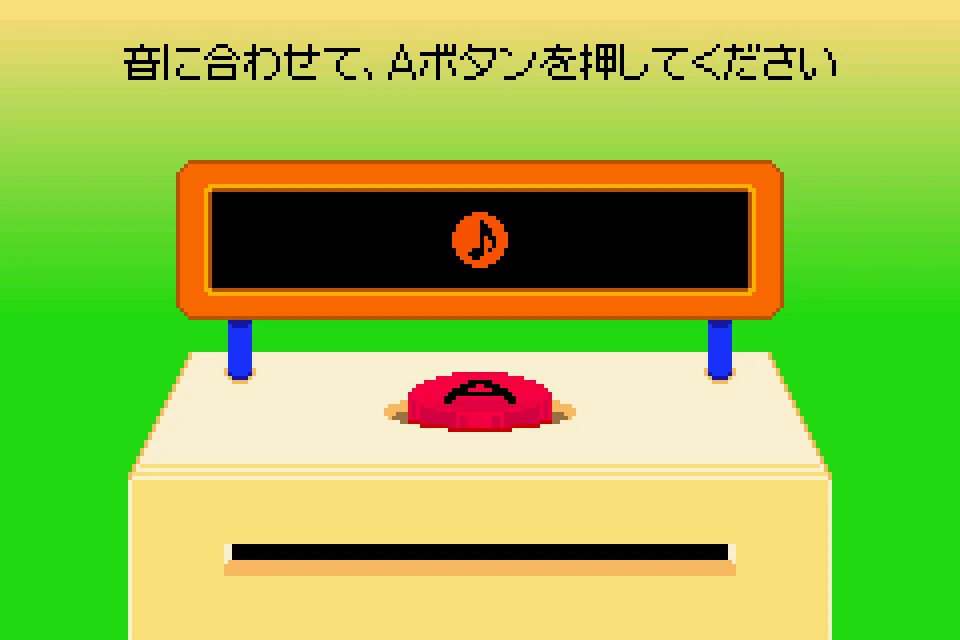
The entire game, stated once. Screenshot: Rhythm Tengoku · Nintendo SPD / Tsunku, 2006.
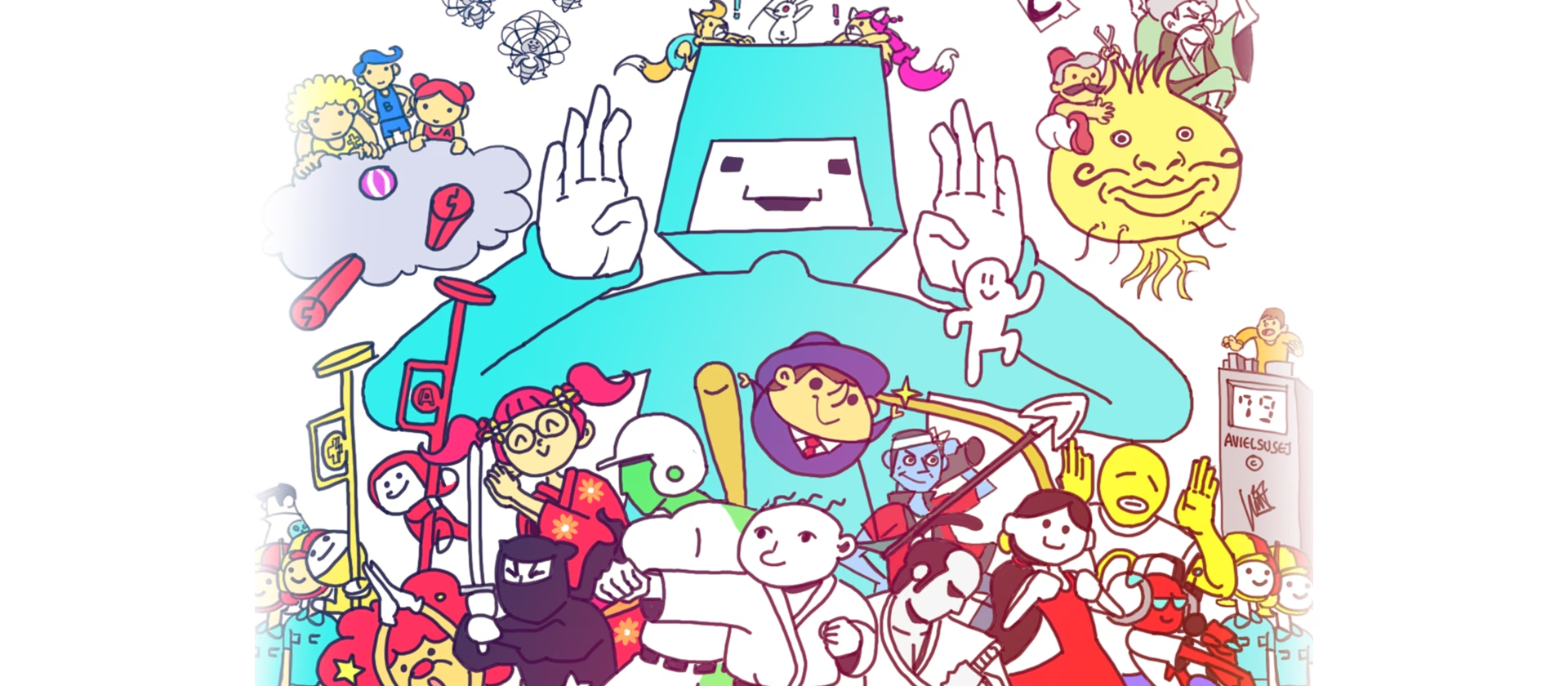
What the screen shows is the joke. Karate Man is a karate stance and a conveyor belt of pots, lightbulbs, and the occasional rock; the animation tells you nothing you don’t already hear in the claps of the backing track. Sneaky Spirits is two ghosts creeping out of a jar to the wrong downbeat, and the only way to tell which one is real is to listen to which phrase the music has lingered on. Marching Orders asks for a drill sergeant’s full left-right-face-about routine, and the visual cue arrives precisely one bar after the vocal instruction — which is how you know the vocal instruction is what you were supposed to be reading. Rap Men, Quiz Show, Power Calligraphy, Space Dance: every minigame is an argument for the ear over the eye, with a different accompaniment to prove the point.
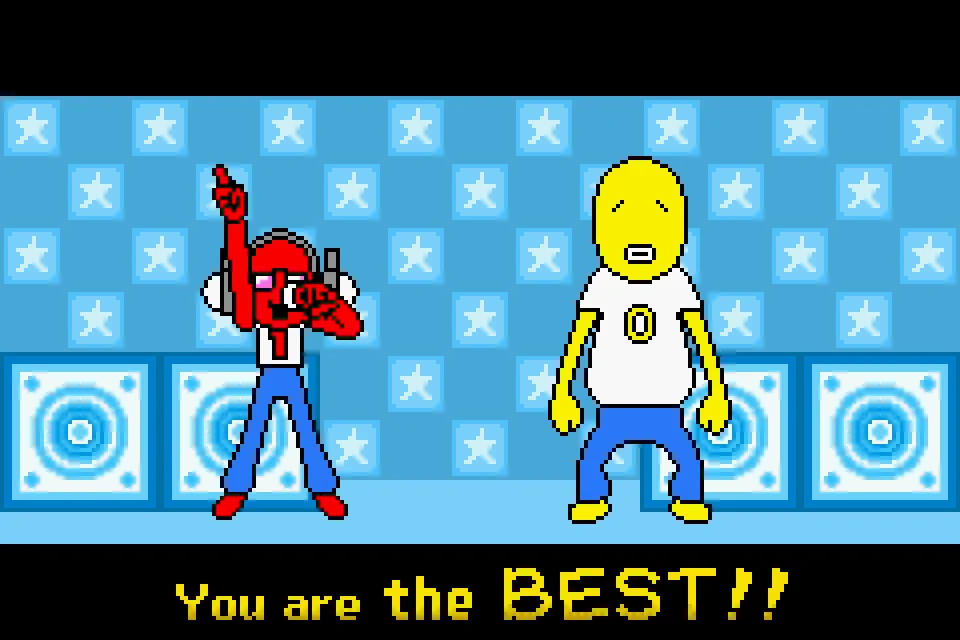
Rap Men, cleared. Screenshot: Rhythm Tengoku (Rhythm Heaven Advance fan patch) · Nintendo SPD / Tsunku, 2006.
The proof is in the grading. Rhythm Tengoku scores your timing to a tolerance tighter than the visual cues can resolve on the GBA’s screen, which means consistent Superb clears require you to trust the music ahead of the animation. The game is famously playable with the screen dark. Speedrunners do it; players with motor-accessibility needs do it; the fan-translation developers maintain that the patch is more readable if you don’t look at it. No other rhythm game of its era — not Beatmania, not Rhythm Heaven’s own DS sequel, certainly not Guitar Hero — inverts the display that far.
Thirty Tracks on Six Megabytes
The album underneath the minigames is Tsunku’s. He wrote or supervised every cue on the cart, and Masami Yone engineered them down to the GBA’s four pulse channels and a patchy sampled-audio pipeline that Nintendo had been stretching since Advance Wars. What you hear — the swaggering karate brass, the call-and-response rap workouts, the unexpected bossa on Space Dance, the children’s-choir refrains on the Rhythm Toys — is a pop producer’s songbook compressed to the kind of palette most composers would treat as a constraint to fight. Tsunku, typically, treated it as an arrangement problem. The loops stay short, the hooks stay syllabic, the backing parts carry the melodic weight; nothing fights the channel budget, and nothing apologises for it. Listen to Karate Man’s backing horns, cut to a two-bar loop and still swinging; to Spaceball’s satellite-dish vibraphone; to Tap Trial’s handclap-led shuffle; to the way Night Walk’s piano slips time against its own bass line for fourteen consecutive bars and pulls you with it. The hardware never rises above three voices at once. The arrangements never notice.
The songbook also does structural work. Each of the six grades closes with a Remix stage that medleys half the tracks you’ve cleared so far into a single continuous sequence, cross-fading the minigames at the bar line and asking you to hold the timing through every handover. The Remixes are the reason Rhythm Tengoku’s thesis holds up under pressure: the music is not providing colour to a game that already works, it is the only thing telling you what the game is asking for, stage to stage, beat to beat, with the visual vocabulary changing underneath the cue. A player who has been reading the screen loses the moment Karate Man cross-fades into Sneaky Spirits; a player who has been listening doesn’t notice the seam.
Listen back to the soundtrack album Nintendo pressed for Japan and the body of work reads like a Tsunku solo record. It is not a game score decorated with songs. It is songs, produced to game-score constraints, with the game built around whether you can keep time with them.
Why the Import Plays Now
Rhythm Heaven Groove arrives on Switch on 2 July 2026 — twenty years almost to the month after Tengoku shipped — with Tsunku back at the composer’s desk and Osawa’s successors handling the engine. The series has become, over the intervening decade, Nintendo’s quietest critical success: a DS sequel that sold into Megamix and a 3DS compilation that taught a generation of Western players to speak its visual shorthand without ever meeting the album that started it.
The title Nintendo never translated. Screenshot: Rhythm Tengoku · Nintendo SPD / Tsunku, 2006.
Which means the record that started it is, today, still only playable in English via a fan patch. An earlier Rhythm Heaven Silver patch ran in English for years before that project was discontinued in 2022. The Rhythm Heaven Advance fork took over in 2021 and ran for five years before the updates stopped; the Ex-Director Cut a maintainer spun off in July 2025 has since added new minigames to a ROM Nintendo shipped locked. The cleanest way to play the game today is to drop the Advance patch onto the Japanese ROM, load it in mGBA, and set the audio sample rate high enough that Tsunku’s bass lines survive the emulation. It is a stranger sentence to type than it is to do. A first-party Nintendo title nobody has ever been able to buy in English, kept breathing by hobbyists who have spent a decade patching it past Nintendo’s indifference — and playing better, for the effort, than anything you can hand Nintendo money for.
The reason to do it is not historical. Rhythm Heaven Groove will arrive on Switch with tutorials, accessibility modes, and twenty years of production polish between it and the cart it descends from. Tengoku will still be the version where the thesis is thinnest, loudest, and most defiant — the record where a pop producer made Nintendo agree that the eye was the wrong organ to read his cues with, and then bet a first-party release on whether a player, given no visual score, could still dance. That bet was placed once. Most rhythm games since have hedged. This one hasn’t.