// import bandLandPoster from ”../../assets/images/rayman-1995-band-land-poster.jpg”; // deleted
// import blueMountainsPoster from ”../../assets/images/rayman-1995-blue-mountains-poster.jpg”; // deleted
// import pictureCityPoster from ”../../assets/images/rayman-1995-picture-city-poster.jpg”; // deleted
Look at Rayman long enough and the character starts to come apart. The head floats a fist-width above the torso. The hands hang in empty air. The feet walk alongside, attached to nothing. For thirty years the received explanation has been that Ubi Soft’s 1995 platformer stripped its mascot of limbs to save sprite memory on struggling hardware — a charming technical accident, a kludge that happened to be cute. Michel Ancel, the game’s director, has finally said on the record what the design was actually for. It was not memory. It was economy: his mantra, his sketch discipline, his refusal to draw a skeleton he could do without.
The clarification matters because Rayman is otherwise the kind of classic whose real shape gets buried under received wisdom. It is a game that survived the death of three consoles before it shipped, arrived on a fourth whose manufacturer was actively telling its studio that 2D was a closed chapter, and is now playable for the first time in all five of its original forms side by side. Digital Eclipse’s 30th Anniversary Edition landed on 13 February with every version of Rayman, a restored SNES-CD prototype the world never saw, and an hour of new interviews with Ancel and co-lead Frédéric Houde. The collection makes the argument unavoidable. Rayman is not a sprite hack. It is a minimalist thesis about what a cartoon character needs to be, and it is still correct.
Three Consoles Deep Before It Shipped
Ancel started alone. The first version of Rayman was a solo Atari ST project on which he did, in his own words to Retro Gamer, “graphics, music, gameplay and programming” himself — one twenty-something in Montpellier, building a mascot platformer on a dying home computer. The ST was fading by 1992; Ubi Soft paired him with Houde and a three-person art team — Éric Pelatan, Alexandra Steible, Olivier Soleil — and bought the whole project a new target platform. That platform was Nintendo’s forthcoming SNES CD-ROM peripheral. They wrote an eighty-five-page design bible for it, drew up a fifty-eight-week work calendar, and started building it for hardware nobody outside the partnership had seen.
Then in early 1993, Nintendo killed the peripheral. Houde’s account, later, is blunt.
”Originally, Rayman was supposed to ship on SNES CD. Unfortunately this device was cancelled or at least reserved to Japan. We had to choose another support or die.”
— Frédéric Houde, Arcade Attack, 2018
The choice was the Atari Jaguar — not because anyone inside the team was convinced by Atari’s doomed 32-bit console, but because it was the only machine Ubi Soft could get hold of that could run Rayman at sixty frames per second with full-screen scrolling. That was the pledge underneath everything. “The very smooth 60Hz animation was something that was very impressive at that time when other games used full size sprites that animate at 5fps,” Houde said. The Jaguar’s sprite system happened to cooperate, and Rayman was rebuilt around it. Ancel, on the pivot: “sprite system was good, so it was perfect.”
The PlayStation arrived mid-development. Sony, looking at a Jaguar platformer being ported to its 3D-first launch hardware, told Ubi Soft the format was wrong. “When we did the original Rayman,” Ancel later said in Games™, “Sony was telling us that it wasn’t the right style for the current trend.” Ubi Soft shipped it anyway. The PS1 version went out in North America on 7 September 1995; the Jaguar version followed two weeks later. Saturn and DOS followed that autumn and into early 1996. Four platforms, one survivor: the PS1 version sold 400,000 copies in Europe in its first four months and would pass three million across its lifetime. The console Sony had thought would not want it became the console that made it.
Less Is More, Minus the Limbs
The limbless design has been folklore since the first previews. Critics decided early on that Rayman had no arms and legs because the team had no memory for them — a plausible story that survived by repetition and because nobody asked. When Ancel finally spoke to it in Retro Gamer, the answer rewrote the whole technical reading.
”No neck, arms or legs meant less work because I didn’t have to have all the combinations of animations. If you apply the mantra that less is more then Rayman had less, but the idea gave more because although it was simplistic it was enough to create a nice character.”
— Michel Ancel, Retro Gamer #282, 2026
The sentence does two things. It moves the design decision out of technical constraint and into authorial choice — Ancel wasn’t forced into minimalism; he preferred it. And it sets the character’s shape in direct service of the 60Hz pledge the Jaguar was chosen to honour. A mascot with no articulated limbs is a mascot whose every frame of animation can be drawn once and reused in every direction. Fewer combinations, more frames of the combinations you keep, smoother motion at sixty per second. The limblessness is not what the design could afford. It is what the design was for.
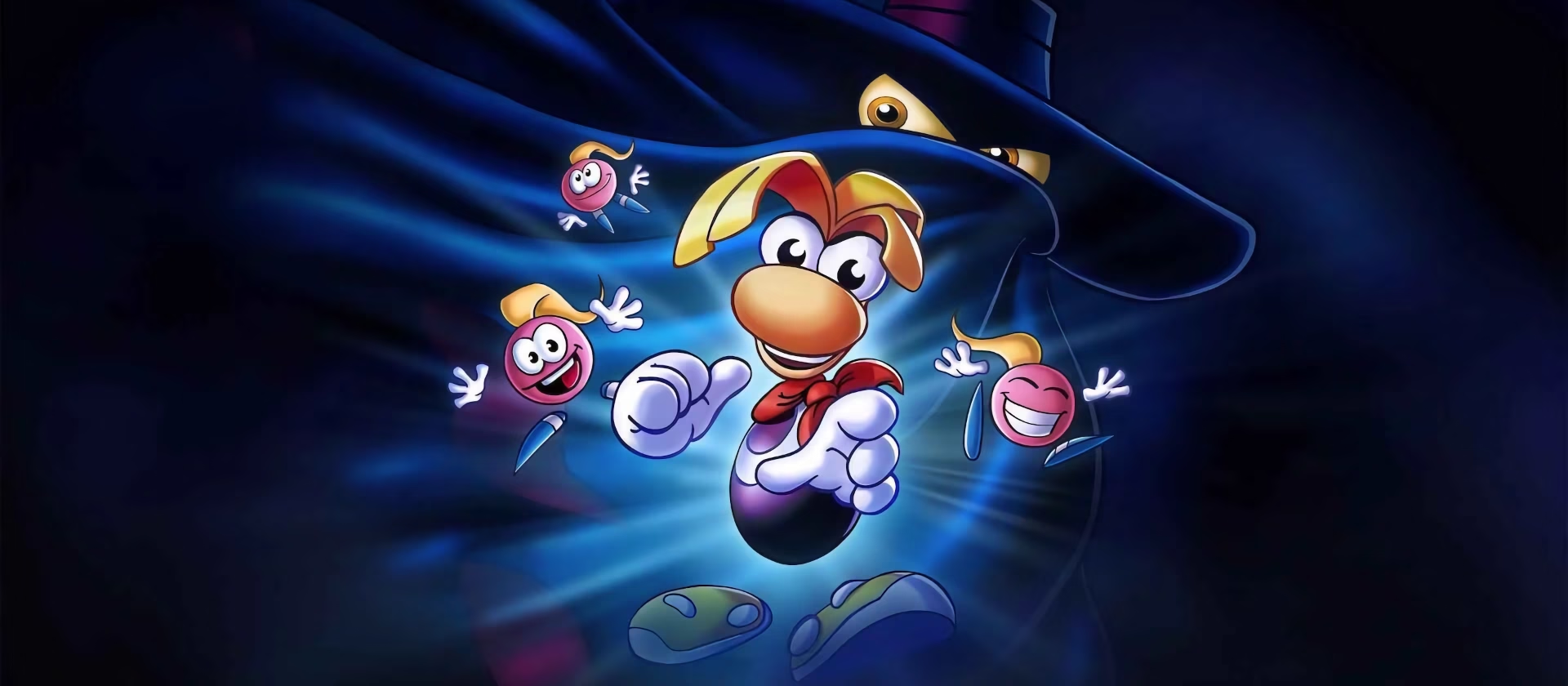
Everything else in the art department follows. The backgrounds are hand-painted — literally, on paper, by Steible and Pelatan — then scanned and composited behind layers of animated foreground. The colour palettes are saturated past any PlayStation norm of the era; the Japanese box, above, sells the world of painted creatures far more honestly than the stark North American portrait shipped to the United States. Rayman’s punch animation, his landing squash, his fall stretch — each one is a studied cartoon beat. Fleischer, Warner, Clampett: the vocabulary is older than games, and Ancel’s team clearly knew it. What the minimalism bought, at the shape-of-character level, was the headroom to draw the rest of the picture like animators rather than sprite artists.
A Playground Designed Against You
The other thing everyone remembers about Rayman is how difficult it is. This part of the folklore is not wrong — the game is genuinely punishing in a way that contemporary reviews flagged as a real problem. The Jaguar review at AtariHQ complained that “one slight mishap and you’re all the way back to the beginning.” EGM’s four-reviewer panel, giving the PS1 version scores of 9/7.5/9/9, singled out the Jaguar port specifically for slow controller responsiveness. Later retrospectives narrowed the complaints to specific levels — Pencil Pentathlon in Band Land, Mr Skops’s caves, the final Mr Dark’s Dare — but the shape of the criticism has not changed. This is a generous game with sparse checkpoints and a fondness for asking the player to do something twenty times.
What separates the friction from brokenness is that it is lawful. The jump arcs do not lie. The platforms do not shift mid-leap. Enemies telegraph. The one-hit spikes are the same one-hit spikes on every attempt, and the restart point is a fixed distance behind the failure. What the game asks is rote mastery — the same motion, clean, under pressure, at speed. Speedrunners finish the whole thing in under ninety minutes, which is the clearest argument available that the difficulty was always a design rather than a breakdown. A broken game does not reward that kind of study.
Rémi Gazel’s score is part of the same contract. Band Land’s stages are music: the platforms drawn as staves, enemies placed on the beat, a honky-tonk score rattling along the floor of the level like a score following a cartoon. Candy Château trades in carillon and celesta; the Caves of Skops drop to a minor-key dirge that announces the difficulty spike before the level does. Gazel composes each world as a complete musical idea, the way a Saturday morning cartoon composer would, and the levels are drawn to match. The game never tells you it is a musical. The music tells you.
Everything You Missed, In One Place
The score, the sprite work, the 60Hz pledge: each a version of the same argument, each only partially on record until now. Digital Eclipse’s Rayman 30th Anniversary Edition, released 13 February 2026, is the first place Rayman has ever been properly legible. All five original versions are on one disc — PS1, Jaguar, Saturn, MS-DOS, Mobile — and you can boot any of them and watch the claims of this article argue for themselves. The Jaguar build holds sixty frames per second at full-screen scroll. The PS1 version adds the CD-redbook score and the ice-slide mechanic that was never in the Jaguar original. The DOS port chugs in exactly the places the 60Hz pledge was written to avoid. The SNES-CD prototype, preserved for the first time, is a playable ghost of the hardware that never shipped.
Around the versions sits a museum: the eighty-five-page design bible, the fifty-eight-week work calendar, preproduction sketches, Gazel’s score sheets, and an hour-long documentary, No Arms, No Legs, No Problem: The Rayman Story, with new interviews from Ancel, Houde, Alexandra Ancel, and Yves Guillemot. It is not nostalgia packaging. It is evidence. The case for the limbless character as design choice rather than technical compromise, the case for the Jaguar as the architectural target rather than a footnote, the case for Ubi Pictures as a studio formed around a single twenty-something’s sketchbook — all of it is now sitting inside one disc, in the artists’ own voices.
What a modern player gets out of the game that has not been available at this clarity before is the alignment of every part. Character design, frame rate, level logic, soundtrack, painted backgrounds: each was chosen to serve one pledge, and each still delivers on it at sixty frames per second. The difficulty is not a relic; it is the contract the rest of the design was built to honour. Play Band Land and you can feel the economy — every obstacle, every note, every missed jump sitting inside the same tight rhythmic frame. Rayman is small, specific, and almost stubbornly well-made. Thirty years after Sony told Ubi Soft that nobody wanted this, we have finally been given the collection that shows exactly what they did.