
The boy on the screen will not go faster. Pressing right harder does nothing; mashing the jump button lifts him no extra pixel. Popils is a puzzle game wearing a platformer’s clothes, and its hero moves only at the speed the room was built to accommodate. Everything else — the columns that collapse when you punch their base, the ladders that appear where you place them, the warp doors that only matter in one particular sequence — is there to be thought about before it is done. Fukio Mitsuji designed the hundred rooms this boy will walk through. He also designed the editor, shipped inside the same cartridge, that lets you build thirty more.
That second design is the one people miss. Popils is routinely filed as a clever late-period Game Gear curio — a Bubble Bobble creator’s freelance detour, dimly remembered if remembered at all. But the editor reframes the whole thing. The hundred levels become a demonstration; the save-slot for your own stages becomes the prompt. Nine years after MTJ shipped this cartridge, he stopped designing games and founded a school. Popils reads, now, like the textbook he had already started writing.
The Designer Between Trees
MTJ — Fukio Mitsuji, born 1960, died 2008 — left Taito in late 1989. He was thirty. He had made Bubble Bobble in 1986 and Rainbow Islands in 1987, two of the most influential arcade platformers of the decade, and then he walked. The Taito Legends collection in 2005 caught him on video explaining himself: he would rather be someone who plants trees, he said, than someone who is a tree.
The freelance years that followed are fragmentary on purpose. MTJ worked under at least one pseudonym — “Jun Mizutani” — and his credits drift across publishers: UPL’s Omega Fighter, Namco’s Tinkle Pit, Kaneko’s Bonk’s Adventure port, Sega’s unreleased SegaSonic Bros. Some of these games shipped. Several did not. Tengen’s Popils, released in Japan on 12 July 1991, is the one with his real name on the title screen — MTJ/TENGEN, in pink, under an oval wizard logo a child might have drawn.

MTJ’s name, in the clear, under his final credited design. Screenshot: Popils · Tengen, 1991.
The North American box is more revealing than the front alone suggests. The Sega-frame slab on the front pitches Popils as a rack cart among forty others; flip the cardboard over and Tengen’s marketing copy pivots to the argument the front could not carry — a hundred block puzzles, a battery backup, a Map Editor, a Gear-to-Gear cable for trading rooms with a friend. The front sold the platform. The back sold the game.
The other thing to know about Popils is that it was not meant to be a Game Gear game alone. In 2016 the game’s programmer, Jun Amanai, quietly began uploading prototype footage of Famicom and PC Engine conversions Tengen had commissioned and shelved. Both were largely complete; both were cancelled for reasons the record does not record. Fans took Amanai’s footage, reverse-engineered the Famicom ROM, and eventually restored the missing audio by ear. The Game Gear version — the one version that ever reached a shop — was the bottom-tier platform for the design. It was also the only one that survived.
The Logic of a Falling Column
The mechanics are simple enough to explain in a paragraph. The boy walks. The boy punches, which destroys a single cell of block in front of him. If a column of blocks rests on destroyed cells, it collapses into the gap. Ladders exist where they have been drawn; there is no jumping. Spikes kill on contact. Enemies patrol. The princess stands somewhere in the room, waiting to be reached before a soft timer runs out.
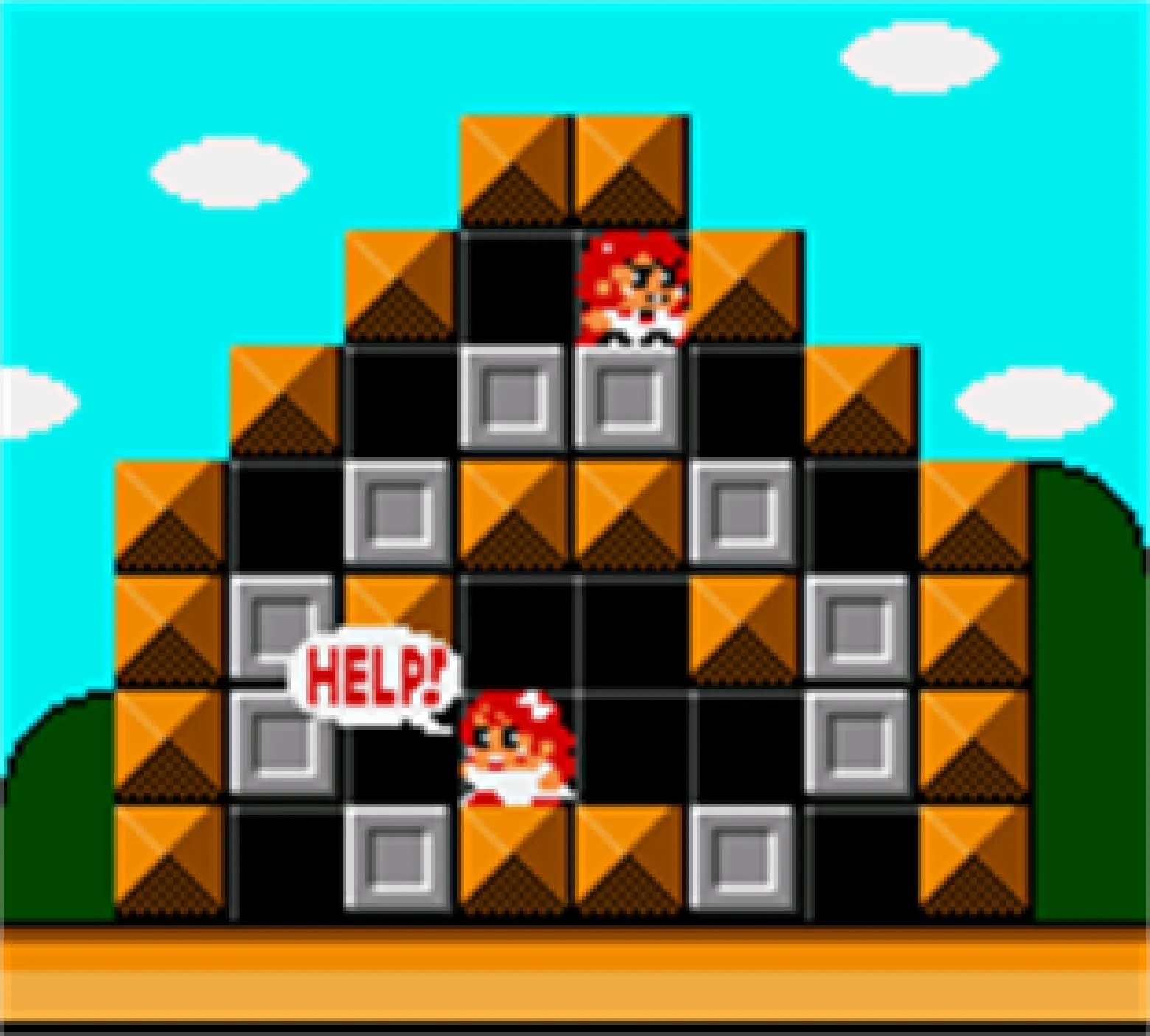
Stage seven. The princess is three punches and one ladder away from being reached — in the wrong order. Screenshot: Popils · Tengen, 1991.
What this description cannot convey is the quality of decision the system produces. Every punch is a commitment: the block, once destroyed, is gone; the column above it will fall, and what that column does to the room is not always recoverable. MTJ had written, two years before Popils, that a good game must let the player feel “always able to improve,” and must produce, even in defeat, the thought that was my fault. The steps counter at the top of every room quietly enforces both. It records the length of your solution. It does not demand optimality. But once you know a room can be finished in fourteen moves, seventeen is a question you have to decide how to answer.
The difficulty curve, across a hundred stages, is among the most carefully calibrated on the system. The first ten rooms teach single mechanics — collapse, ladder, warp door — one at a time. By stage forty the rooms are no longer about blocks at all. They are about sequence: the punch that opens a path closes another; the ladder placed too early traps you on the wrong side of the room. The stages unlock in banks of five or ten, with a battery-backed save that removes any reason to repeat solved material. You play forward, in the direction of the next puzzle you have not yet been asked.
”It’s only when the game fights back that the player is motivated to continue … it’s crucial to impart upon the player the feeling of always being able to improve.”
— MTJ, Developer Column, 1989
The critical reception was, depending on where you read it, either vindicating or indifferent. Zero gave the UK release 90 out of 100. France’s Consoles + went to 95 percent; Germany’s Video Games to 73. Japan’s own Beep! Mega Drive, reviewing the domestic release, gave it 6.0 out of 10. The European press encountered the game as an unexpected gift on a platform nobody was writing about. The Japanese press, reviewing it against the puzzle output of Compile and Taito and Namco in a crowded 1991, shrugged. Both readings can be true. Neither has much bearing on what the game actually is.
The Puzzles Inside the Puzzles
Where the cartridge earns its argument is the editor. Map Edit, on the title menu, is not a bonus. It is a working tile-placement tool with the full run of game objects — ladders, doors, enemies, spikes, blocks — and the space to build and save up to thirty of your own rooms. A second menu item, Edited Game, plays those rooms as if they were the designer’s. Finish all hundred official stages under the Steps threshold and a Round 0 unlocks — a single, unsolvable-looking room MTJ left for the reader who had done everything else.

The Japanese cartridge. Battery-backed save, Map Edit built in, English-language option toggled from the options screen. Photograph: LaunchBox Games Database.
Design-your-own modes were common enough in 1991 — Lode Runner had shipped with one in 1983, Excitebike in 1984 — but the editor in Popils is different in kind. It shares the full vocabulary of the hundred designed stages. Nothing is withheld from the user that the designer kept for himself. The sole asymmetry is that MTJ knows how to use the pieces, and you, on first contact, do not. The hundred stages are how you learn. By the time you reach the thirtieth, you are no longer thinking about whether a given object is useful; you are thinking about whether the same object, placed one cell earlier, changes the room’s character. That is not the vocabulary of a puzzle solver. It is the vocabulary of a puzzle maker.
The music, by an uncredited composer working the Game Gear’s twin-square chipset, sits under all of this without forcing a mood. A handful of chirpy themes loop and cycle; none of them insist. On a score that could have been bright and distracting, MTJ — or whoever he handed it to — chose restraint. The puzzle is the foreground. The music is the room the puzzle happens in.
What the School Knew
In 2000, MTJ founded the MTJ Game Designer’s School. He ran it until his death, at forty-eight, from a heart attack in December 2008. The school produced no famous graduates that the public record names; its reputation, such as it is, survives in scattered Japanese-language forum posts and the occasional acknowledgment from students who later found their own credits. It was a small institution, run by a famous designer who had decided that fame was the wrong tree to be.
What Popils clarifies, in hindsight, is that the pedagogy did not begin with the school. The cartridge you could buy in a Japanese toy shop in July 1991 was already teaching. The hundred rooms are a course in elimination, sequencing, and self-imposed constraint. The Steps counter is the rubric. The editor is the assignment. The Round 0 lock is the final exam — unreachable unless you have already internalised everything the designer put in front of you. A player who works through all of it, honestly, emerges fluent in a small but complete design language. A second player, handed the editor, could teach the first one something new.
This is why Popils rewards play today, and why the Game Gear’s marginal reputation is beside the point. The medium of a handheld puzzle game in 1991 was not the surface MTJ was designing for. He was designing for the act of designing. The screen is 160 by 144 pixels wide, and the cartridge is the size of a matchbox, and the game inside is one of the few pieces of commercial 1991 software that still, thirty-five years later, asks you to think like the person who made it.