// import rescuePoster from ”../../assets/images/ninja-five-o-2003-hostage-rescue-poster.jpg”; // deleted
// import plasmaPoster from ”../../assets/images/ninja-five-o-2003-plasma-burst-poster.jpg”; // deleted
The reviews were excellent and the shelves were empty. Craig Harris, writing for IGN in the spring of 2003, scored Ninja Five-O 8.5 out of ten: “a surprisingly great game that almost came out of nowhere,” he wrote, noting its “quiet” release “with relatively no previous hype.” GameSpy placed it third on its year-end list of the GBA’s finest titles. Game Informer praised the “accurate control and savvy level design.” The Metacritic aggregate landed at 82. IGN would later award the game the designation “Best Game No One Played.” In the case of Ninja Five-O, this was not consolation — it was a precise account of what had happened.
The reason sits on the box. “Ninja Five-O” is a reference to Hawaii Five-O, the CBS procedural that ran from 1968 to 1980. In the spring of 2003, that show had been off air for twenty-three years. The Game Boy Advance’s core demographic was eight to fourteen years old. The title communicated nothing — not genre, not tone, not invitation — to anyone standing in front of it at retail. Hudson Soft had built one of the finest action games on the hardware. Konami published it under a name nobody could decode, with no marketing support to compensate, and a print run too small to survive the gap between word-of-mouth and obscurity.
The Grapple That Beats Bionic Commando
The game is built around a single tool that it gets exactly right. Double-tap A to extend the grappling hook — it fires straight upward unless you’re holding a direction on the D-pad, in which case it fires at forty-five degrees. Latch to a ceiling or upper ledge and you are swinging. Hold R to reel in faster; tap R for a shorter retraction. Let the D-pad work the pendulum.
The distinction that matters: where Bionic Commando sends players zipping through a hook point — the rope a traversal tool that ends at a destination — Ninja Five-O lets you swing around it. The momentum is yours to build or bleed off. You can plant feet against a vertical surface, adjust your arc mid-swing, and launch from a wall rather than a floor. Missed grapples carry a cost — the long chain takes time to retract — which gives precision actual weight. The first mission teaches this vocabulary. By the second you are reading ceilings differently.
The objective across Joe Osugi’s five missions is not simply reaching an exit. Hostages are scattered through each stage, and the game is watching: on Hard mode, killing a hostage fails the level instantly; on Normal and Easy, it costs health the player may not have to spare. Enemy AI reinforces this pressure — opponents hide behind crates, use hostages as shields, and parry if approached carelessly. It asks for patience from a player dressed as a ninja.
Combat runs on its own internal logic. The sword fills the ninja magic metre faster and scores more points; the three-tier projectile system — shuriken, spread fireballs, a single plasma burst that kills almost anything it touches — offers range at the cost of both. A full magic metre clears the screen. A partial metre buys invincibility without the knockback that clears it. On Hard mode, which strips all in-level health pickups and scales enemy aggression accordingly, every fight is a calculation.
Aya Tanaka and Hiroyuki Tsuboguchi composed the soundtrack for the GBA’s constrained hardware — urgent, looping action cues built from the chip’s FM synthesis, precise in register and entirely committed to keeping the player moving. The music doesn’t demand attention it hasn’t earned. This is the correct relationship between soundtrack and mechanics in a game where the mechanics are the point.
A Japanese Game That Never Came Home
Hudson Soft’s history runs through the foundations of Japanese home gaming. They published the original Bomberman, developed the PC Engine library that gave Japan its first taste of CD-ROM gaming, and made the Hudson Adventure Island series across several console generations. By the early 2000s the company was in its autumn — an era of third-party reshuffling, institutional memory straining against a market reorganising around PlayStation 2 and a handheld landscape the Game Boy Advance was slowly consolidating.
What remained at Hudson in 2003 was craft. Ninja Five-O was announced in January that year at Konami’s annual Gamers’ Day event in San Francisco — hosted by the company that had acquired a significant stake in Hudson Soft two years earlier. Konami had purchased 5.6 million shares of Hudson in 2001 and was already on its way to becoming the controlling shareholder; the full acquisition would follow by 2005, with the formal merger into Konami Digital Entertainment completed in 2012. The publishing arrangement for the Western release in 2003 was a natural extension of that capital relationship.
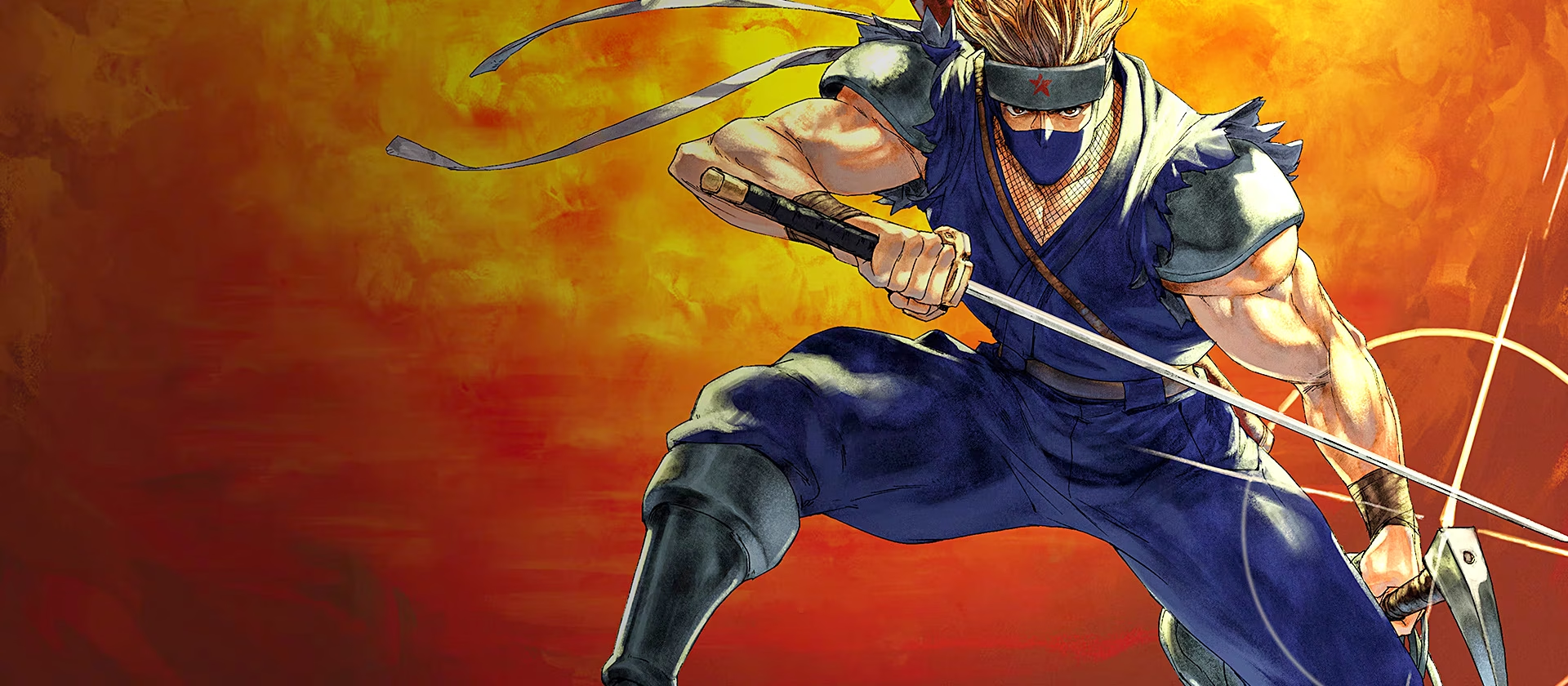
The game was directed by Gen Suzuki, with sound by Masato Aihara and composition by Aya Tanaka and Hiroyuki Tsuboguchi. The North American box art — a confident comic-style illustration of Joe Osugi mid-leap, sword drawn against a fire-orange ground — was produced by Julie Giles, who at the time was also designing packaging for Konami’s Castlevania and Metal Gear franchises. Giles drew the right image. The title undermined it.
Ninja Five-O was never released in Japan. The reasons remain undisclosed — no developer interview, no postmortem, no producer statement has explained why a Japanese studio built a game expressly for Western markets and then did not bring it home. For European release the title became Ninja Cop: a name that described the content without literary aspiration. The North American title was a legal-drama riff so specific to a decade that by 2003 it had become effectively invisible to everyone under thirty-five.
Four Words, $300, Twenty-Two Years
”Ninja Five-O was one of the biggest sleeper hits of 2003. Given lackluster sales it’s unlikely to spawn a sequel, but with everything it got right the first time one can only imagine what might have been.”
— GameFan, 2003
The review record for 2003 reads like a letter to a room nobody occupied. Harris’s 8.5 was part of a consistent pattern — GameSpy, Game Informer, and GameZone all found a polished, mechanically serious action title with a firm idea of what it was. GameSpy made Ninja Five-O runner-up for GBA Game of the Month in April (losing to Golden Sun: The Lost Age) and placed it third in its annual GBA rankings; the outlet also named it the best platform game on the hardware that year. GameFan’s notice reads like an obituary written inside a celebration. Ninja Five-O received the kind of critical reception that typically assembles at least a modest audience.
What it assembled instead was near-total retail invisibility. The game disappeared from shelves in its first weeks. Contemporary accounts describe copies sitting in bargain bins at five euros and going untouched — a title that communicated nothing about its contents to a browser who hadn’t already read a review.
What followed was collector’s market logic running to its conclusion: low print run plus eventually-discovered quality equals scarcity premium. By the 2010s, loose Ninja Five-O cartridges were trading at $100. By the early 2020s, the floor had risen to $200 or more, with complete-in-box examples clearing $500 and graded sealed copies reaching multiples of that. The game that nobody bought became the game nobody could afford to buy.
IGN’s designation “Best Game No One Played” was accurate at the time and remained accurate for two decades. The European release, as Ninja Cop, sold unremarkably. The Japanese release did not exist.
In February 2024, Konami announced a re-release — not a remake, not a remaster, but an emulated port via Limited Run Games’ Carbon Engine platform, for Switch, PlayStation 4, PlayStation 5, and Steam. It launched in February 2025. Konami published the game that disappeared in 2003. Konami brought it back in 2025. The twenty-two years between those two events are the distance between a wrong title and its eventual correction.
No Nostalgia Required
The difficulty of arguing for Ninja Five-O now is that there is no nostalgia to lean on. The people who played it in 2003 were too few to constitute a generation’s shared memory; the collectors who paid $300 for cartridges were engaging with the object rather than the game. What the 2025 re-release offers is a first encounter — for most players, genuinely the first time the game has been accessible at a rational price.
That first encounter delivers.
The grappling hook has not been improved by the years that followed it. The action vocabulary is honest and internally consistent: what the game promises with its controls, it delivers with its level design. The five-mission structure — fifteen stages total, each compact enough to complete in a single session, each dense enough to reward a second attempt on a higher difficulty — suits a modern player’s schedule without condescending to it. Hard mode, which removes all in-level health pickups and scales enemy aggression, is the version the design was working toward: one that asks for technique rather than resource accumulation. Hard mode’s zero-tolerance hostage rule is the genuine friction — one accidental kill resets the level — and players who prefer to absorb errors will find the policy uncharitable.
It does not ask you to remember anything. It asks you to read ceilings for grapple points, decide between a sword that builds the magic metre and a plasma burst that clears the room, and keep hostages alive under pressure from opponents that will use them as cover. Those demands exist in the present tense and function exactly as designed.
Precision action games have not disappeared — the sustained appetite for tight movement systems and consequential decision-making remains legible across modern releases and the retro archive alike. Ninja Five-O belongs in that conversation. It always did. The reason it was absent from it for twenty-two years is four words long, and references a television programme most of its intended audience had never heard of.