// import bunkerRecoveryPoster from ”../../assets/images/neo-turf-masters-1996-bunker-recovery-poster.jpg”; // deleted
// import southPacificFairwayPoster from ”../../assets/images/neo-turf-masters-1996-south-pacific-fairway-poster.jpg”; // deleted
Golf usually arrives in games wearing a cardigan. It asks for patience, silence, etiquette, and a willingness to treat small variations in grass as moral instruction. Neo Turf Masters has no patience for that performance. It gives you a joystick, three buttons, a visible wind arrow, a power bar that moves faster than your confidence, and a ball that will betray every lazy assumption you bring to the tee.
The joke is that it never stops looking serene. The sky is clean. The greens roll away into impossible colour. The crowd claps with the polite little bursts arcade hardware was made to compress. Underneath, Nazca turns golf into survival design: read the distance, pick the club, aim through wind, strike twice with your thumb, and live with the consequences before the shot clock starts judging you again. The reason to play it now is not that it makes golf accessible. It makes golf dangerous enough to feel awake.
Golf Under Coin Pressure
The arcade flyer sells Neo Turf Masters with a phrase too good to ignore: add some “schwing” to your life, your route, and most of all your cash box. It is ugly copy, perfect copy. SNK was not selling reverence for the sport. It was selling turnover: three holes for a credit, instant legibility for passers-by, enough drama in one swing to make a second coin feel reasonable.
That pressure changes the sport. A home golf simulation can ask the player to enjoy deliberation. Neo Turf Masters cannot. It has to make deliberation theatrical, then cut it short. The first screen of each hole gives you the whole problem as a diagram: dogleg, bunkers, trees, green, yardage, wind. It reads like a tactical map because the cabinet has no room for mystery. The next screen drops you behind the golfer and asks for commitment. Direction first. Power next. Hook or slice if your nerve holds. The ball leaves the club and cuts to the overhead lie as if delivering a verdict.
The strange thing is how fair that feels. You always know what you meant to do. You always know where you lost the shot. The punishment lands because the information was there.
That is the bargain the whole game keeps making. It will not hide the decisive variable from you, but it will make you act before comfort sets in. A good round becomes a chain of small, legible terrors: carry the bunker, stay left of the trees, accept the lay-up, resist the driver. The pleasure is not serenity. It is self-control made visible.
The three-hole credit format is brutal because it makes every correction expensive. A mistake on the first tee does not vanish into a long campaign of recovery; it follows you for the next two holes, shrinking the space between ambition and caution. That small frame gives the score meaning. You are not managing a season. You are trying to keep one bad decision from becoming the whole receipt.
The Fairway Is an Action Screen
Nazca would become famous for Metal Slug, a game where almost every moving thing tells you exactly what it is about to do. In a developer interview translated by shmuplations, the team described wanting “everything on screen to be immediately and easily understandable.” That line belongs to Metal Slug, but Neo Turf Masters already behaves like the proof.
”Everything on screen to be immediately and easily understandable.”
— Nazca, Neo Geo Freak interview, via shmuplations
Look at the shot interface. The wind arrow sits high and blunt. Club, stance, distance, lie, and shot power crowd the bottom edge without becoming noise. The course itself stretches into a fake 3D view that NeoGeoDev notes was built through hardware timing tricks, the field scaling and rotating as if the board had more golf-course geometry than it really did. It is not simulation in the modern sense. It is theatre with honest rules.
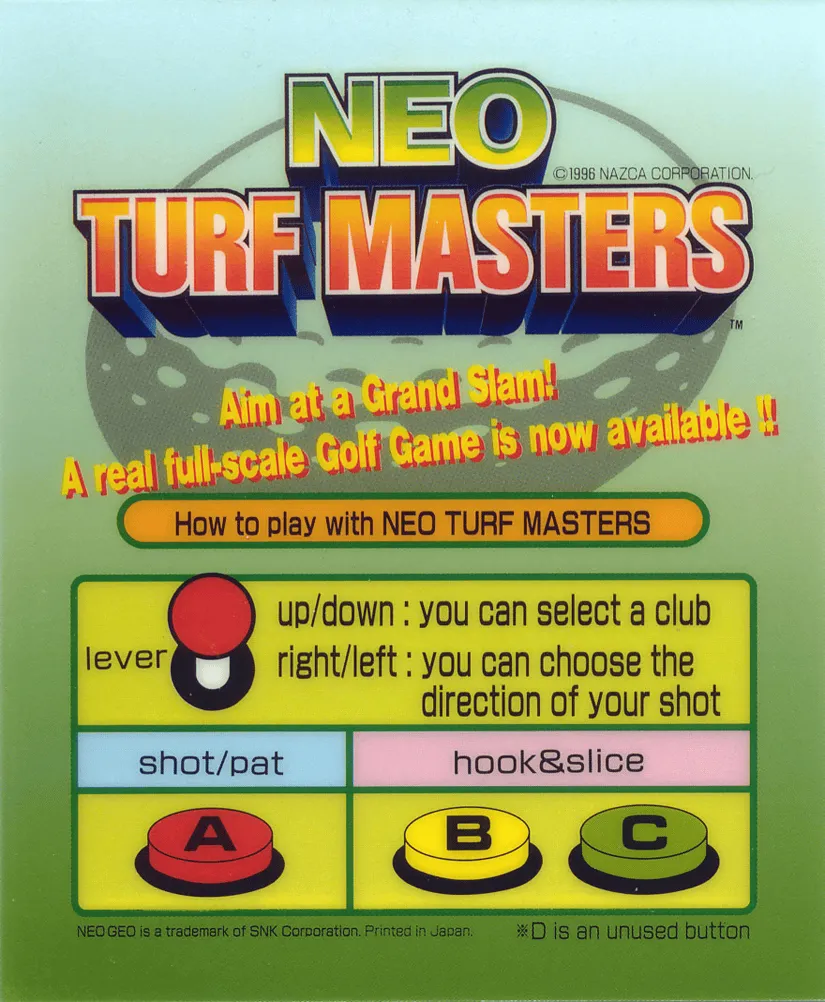
The whole control scheme fits on one instruction card. Neo Turf Masters · Nazca / SNK, 1996.
The A button starts the meter. Press it again and you choose force. Miss the sweet spot and the ball carries your impatience into public. The B and C buttons add hook and slice, which sounds like finesse until a tree line appears exactly where a safe shot should be. One more adjustment, one more risk, one more tiny wager. Good arcade design often lives in that last temptation before sense.
This is why Neo Turf Masters converts people who do not care about golf. You are not asked to admire a sport from the outside. You are given a clean verb. Strike. Watch. Recover. The rhythm is close to a shooter: assess the screen, decide quickly, accept that the safer line may only postpone a worse problem. The fairway is not a place. It is an attack pattern.
The six golfers make that attack pattern personal. The Power Golfer can bully a fairway until the moment distance stops being the problem. The Shot Maker looks elegant until a long par five exposes the cost. The Putt Master turns the green into a weapon but asks you to survive long enough to use it. None of them is neutral. You choose a kind of mistake before the first tee.
Calm Music, Cruel Grass
The soundtrack knows not to overplay the danger. Takushi Hiyamuta, credited as music director, keeps the surface light: bright fusion bass, small brass phrases, relaxed percussion, enough blue-sky melody to make the courses feel like postcards. A lesser arcade sports game would try to manufacture drama with constant fanfare. Neo Turf Masters lets the music smile while the terrain sharpens its teeth.
That contrast matters. The score gives the player emotional room to think. It makes a bad lie feel funny before it feels fatal. When the ball skips into a bunker, the music does not scold you. The crowd stings do that. The voice clips do that. The little pause before your next shot does that. The composition stays buoyant, which makes the failure easier to re-enter. You can hear why an arcade game needs that generosity. If the sound punished as hard as the grass, nobody would feed the cabinet twice.
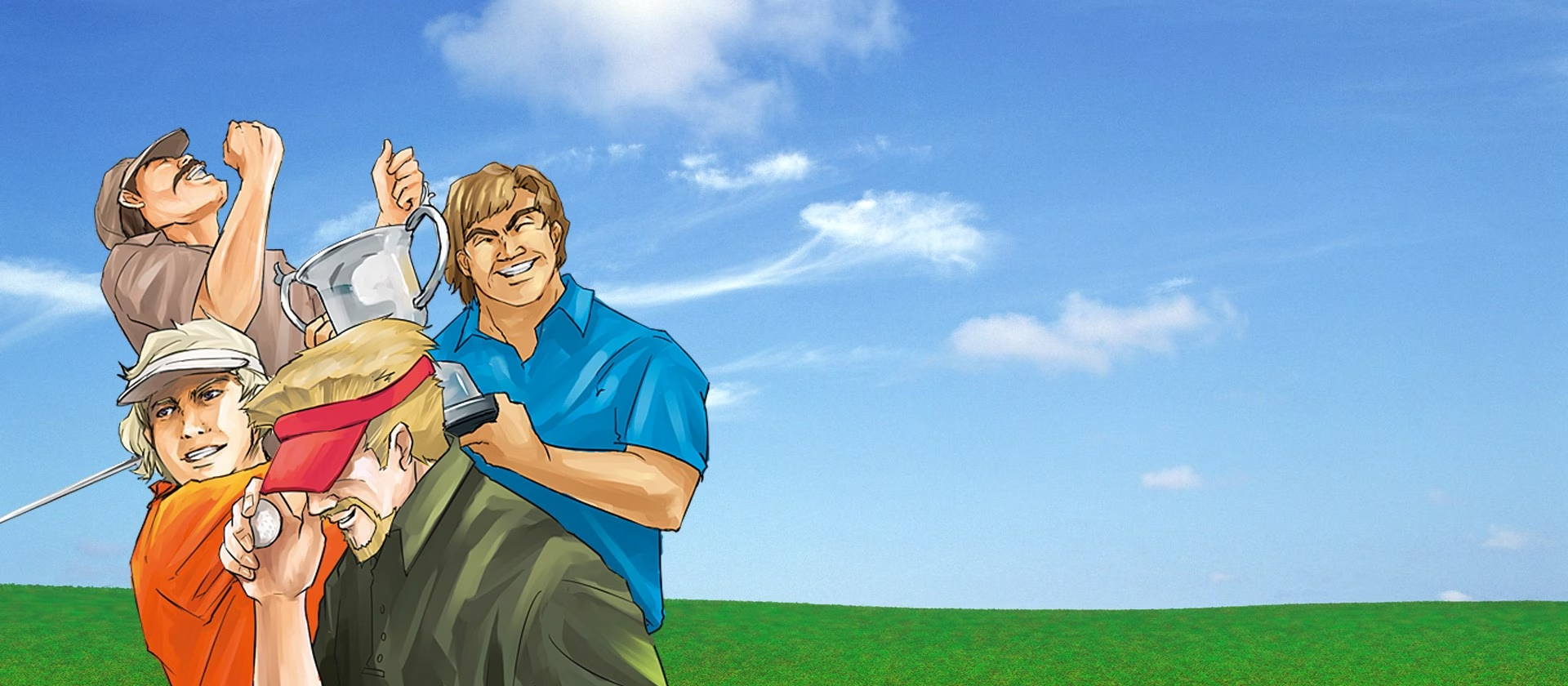
The golfers help, too. They are broad arcade archetypes, not licensed athletes: Power Golfer, Shot Maker, Young Hero, Putt Master. Their portraits grin with late-Neo-Geo confidence, all caps, gloves, collars, and improbable jawlines. Their stats matter, but the main pleasure is identification at speed. Pick the player whose flaw you can tolerate. Then discover that the flaw is you.
Listen closely and the cabinet keeps separating ceremony from consequence. The hole intro is crisp, almost television-like. The swing has that dry arcade snap, the ball leaving the club with a sound closer to punctuation than physics. Then the landing arrives with miniature social judgement: a cheer, a groan, a clipped voice, a pause just long enough for embarrassment. The music never needs to shout because the interface already knows exactly where to hurt you.
Every Shot Leaves Evidence
The courses earn their cruelty by changing the question. Arizona opens wide, a desert invitation with enough open fairway to make a player cocky. Japan tightens the routes and makes elevation feel like a second opponent. Australia pushes water close to the line until a confident drive looks reckless. Germany stops smiling and starts measuring how much you learned.
This is where the arcade compression pays off. A bad shot never becomes vague frustration. It leaves evidence: too much power, not enough wind allowance, a greedy club, a hook used as apology instead of plan. Because the holes are short and readable, correction feels immediate. You do not grind. You adjust. The game has the rare sports-game quality of making failure diagnostic without turning it into homework.
That quality also explains why the Neo Geo CD’s Scotland course has become such a preservation curiosity. More holes sound like a simple bonus, but the actual appeal is more exacting: another terrain grammar for a game built from terrain grammars. The MVS version does not feel incomplete without it. It feels concentrated. Scotland is a fascinating extra page. The arcade original is already a complete sentence.
The best holes understand when to give you a heroic line and when to make heroism look stupid. A narrow fairway beside water is not merely harder than a wide one. It changes your posture. The stick moves slower. The second button press becomes a negotiation. The game has taught you enough that you can see the sensible shot, then placed the spectacular shot close enough to ruin you.
One More Round Is the Trap
The best modern route is Hamster’s ACA NEOGEO release because it preserves the version that matters: the coin-op structure, the fast resets, the score-chasing, the slight absurdity of treating a peaceful sport like a survival exam. Portable play helps because Neo Turf Masters is exactly the right size for a spare half hour. Online rankings help because this kind of golf has always wanted witnesses.
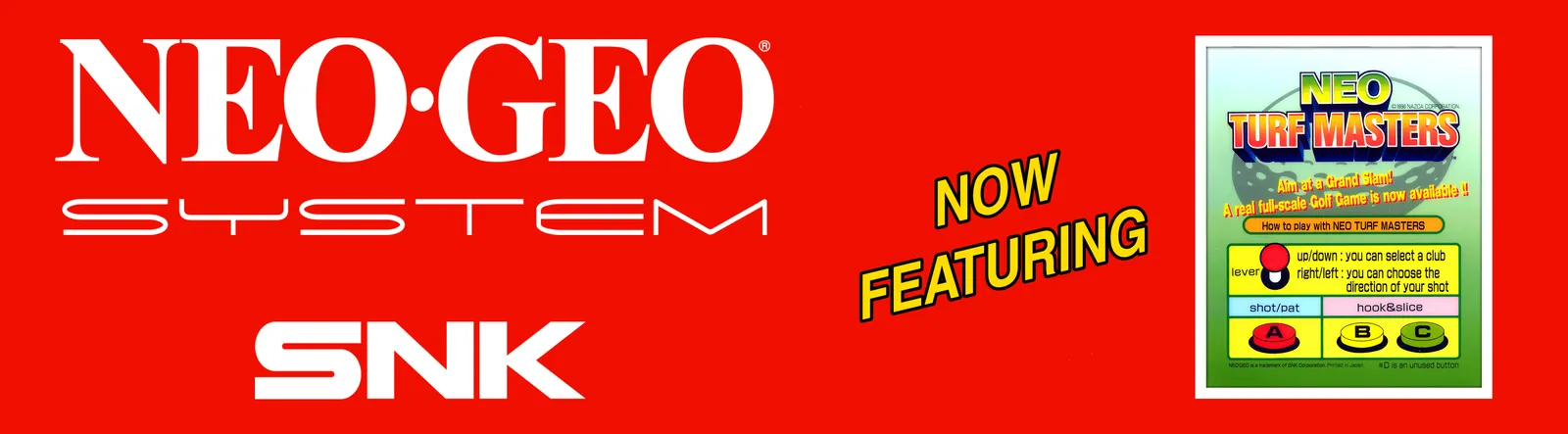
The marquee makes the cabinet promise explicit: Neo Geo spectacle, SNK branding, three-button clarity. Neo Turf Masters · Nazca / SNK, 1996.
What lingers is not sports authenticity. It is the feel of an elegant problem rebuilt under arcade rules. Golf gives Nazca a perfect contradiction: stillness at the moment of decision, motion after the button, consequence in the landing. The game understands all three. It does not need licensed clubs, photoreal grass, or commentary telling you how to feel. It needs one wind arrow, one dishonest-looking bunker, and your thumb arriving a fraction late.
That is a small miracle of design density. The cabinet takes a slow sport and refuses to make it shallow. It keeps the judgment, strips the ceremony, and leaves the player with the part that matters most in games: a decision made under pressure, visible enough to blame yourself for, quick enough to try again.