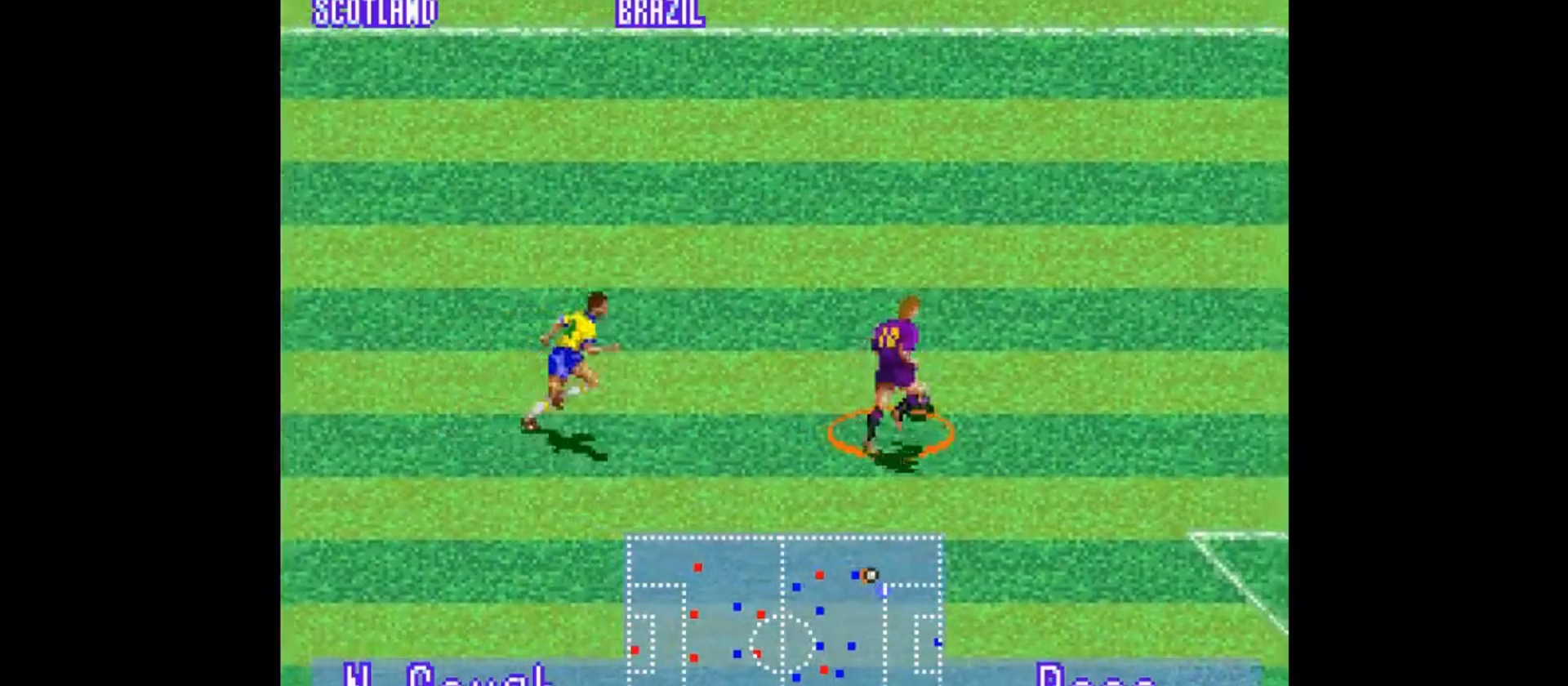
Holding Y burns a small reserve and your forward bursts past his marker — not gradually, not with a one-second wind-up animation, but immediately, with the sharpness of a 1990s arcade game in a hurry to entertain you. A one-touch pass arrives flat and exactly where you sent it. The lob you flicked from midfield is already most of the way to the box, having risen ludicrously high for the sheer fun of doing so, and is now descending in a way the keeper will not handle. He gets a glove to it. The rebound bounces back into the six-yard area, where two strikers are already running. The commentator shouts. Someone scores.
This is International Superstar Soccer Deluxe a minute into its first match. It is also, almost beat for beat, the rhythm of every Pro Evolution Soccer game that came after — sprint, pass, shoot, rebound, narration — minus a generation of presentation gloss and a licensing budget. The strange thing is that none of the people you might credit for Pro Evolution Soccer made it. The team in Tokyo who would, three years later, get their hands on the lineage that became Winning Eleven and then PES were working on a different football game on a different system. ISS Deluxe was built in Osaka, by a separate Konami studio, and it is the half of the eventual PES DNA that almost nobody traces back to its source.
Osaka, not Tokyo
Konami had two football teams running in parallel in 1995. The Tokyo office was on Goal Storm, a brand-new PlayStation entry — the line that the designer Shingo “Seabass” Takatsuka would inherit two years later and eventually steer through International Superstar Soccer Pro, Winning Eleven, and the Pro Evolution Soccer canon. The Osaka office, a separate internal studio known inside the company as Major A and later formalised as Konami Computer Entertainment Osaka, had been on football since 1994’s original International Superstar Soccer and was now shipping its sequel.
“Major A quickly became the ‘go-to’ team for soccer titles within the company.” — Time Extension, on Konami’s Osaka football studio.
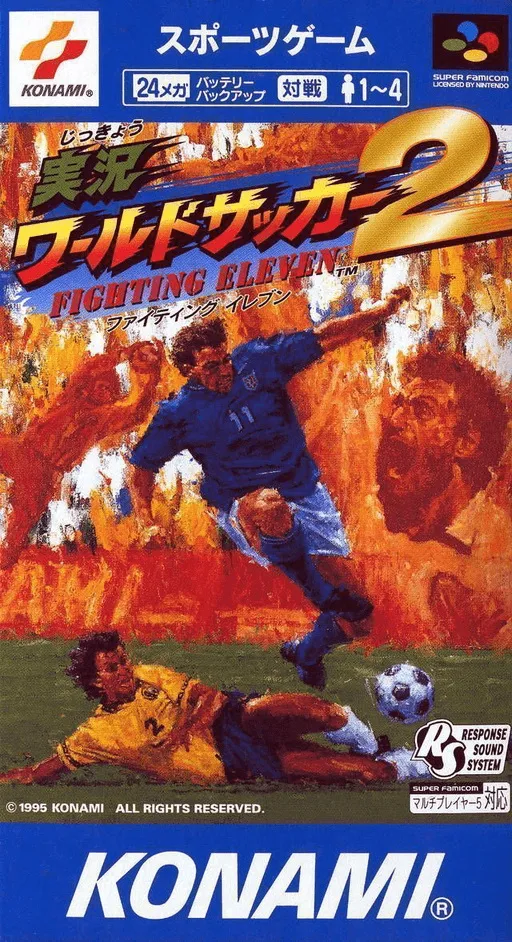
Super Famicom box · Jikkyō World Soccer 2: Fighting Eleven · Konami, 1995. Jikkyō (実況) — live commentary — leads the title.
They were different lines, with different design instincts. Tokyo’s PS1 work pulled toward simulation textures — broadcast cameras, deliberate movement, a softer feel of weight. Osaka pulled the other way. ISS Deluxe runs faster than any contemporary football game in its memory bracket; it treats matches the way Konami’s arcade games treated stages, as ten-to-fifteen-minute units of high-density input. Players sprint with a button. Passes are deterministic. The keeper spills more than he holds. The two lines didn’t merge into a single Winning Eleven pipeline until 1997, when Takatsuka took over and folded both teams’ design vocabulary into one engine. By then, the half of that vocabulary you can still feel inside modern PES — the sharpness, the one-touch passing, the commentary — had already been written. It had been written in Osaka, on a Super Famicom cartridge, in 1995.
Football as arcade game
The argument the game makes with its hands is that football is a sprint. Holding Y burns a stamina pip; the sprint resolves immediately into a forward burst, fast enough to get past a defender if you’ve timed it before he turns. FIFA Soccer 96, EA’s headline contemporary, had no analogue — its players accelerated through animation states. The contrast is the whole design.
Passing is the same: the pass button sends the ball flat and exactly where you sent it, with none of the modern simulation habit of nudging the ball toward the “right” target on the player’s behalf. The lob button, by contrast, is the arcade flourish — a flicked B goes ludicrously high, an exaggeration so committed it loops back into entertainment, before the ball returns to plausible physics on its descent. Iain Mew, in a long retrospective on the original ISS, characterised the keeper as “athletic reflexes but poor ball retention, creating entertaining ‘goalmouth pinball’.” That is precisely the texture: shots are saved into the danger zone, not out of it. Rebounds are a system, not a bug.
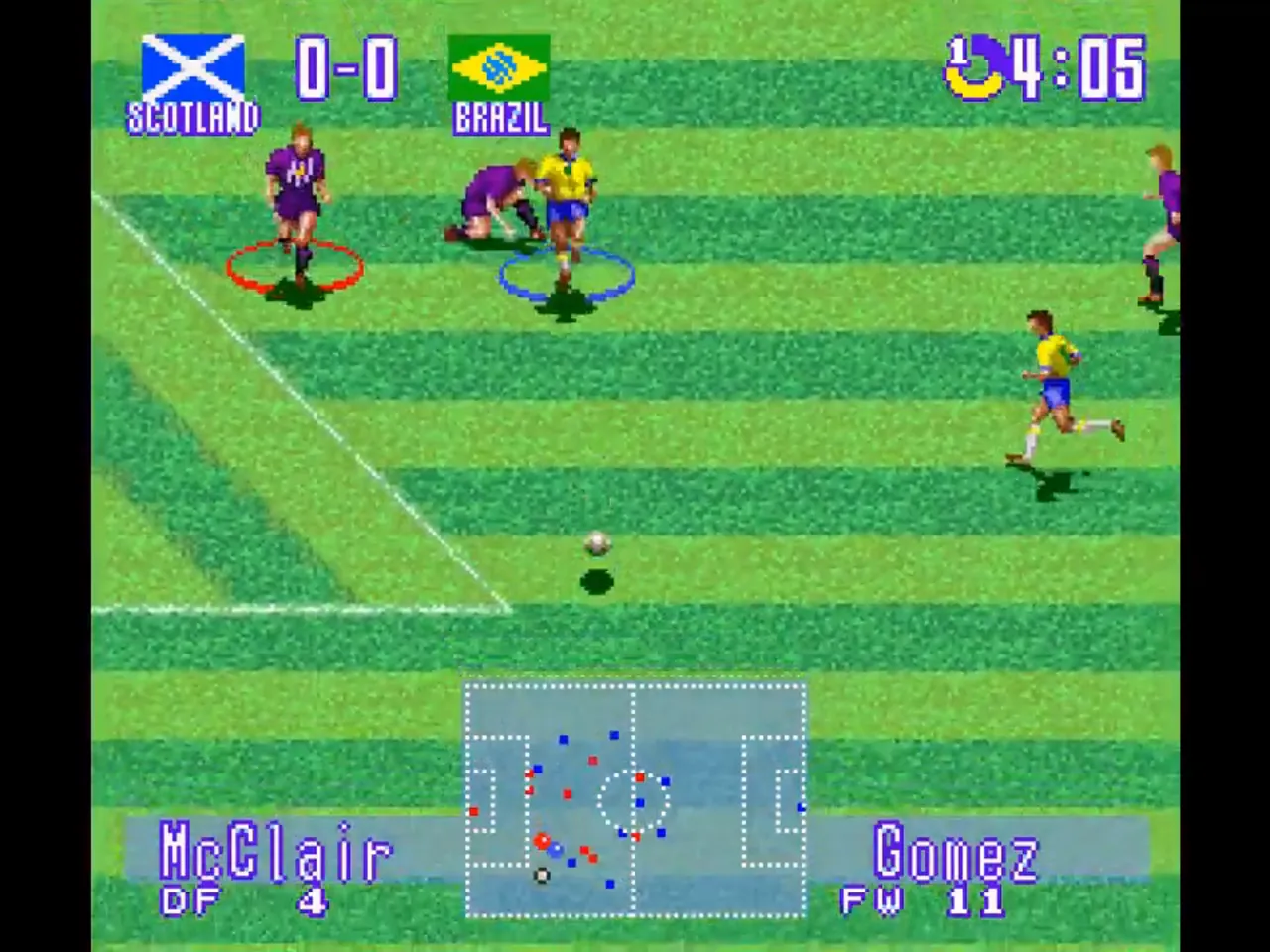
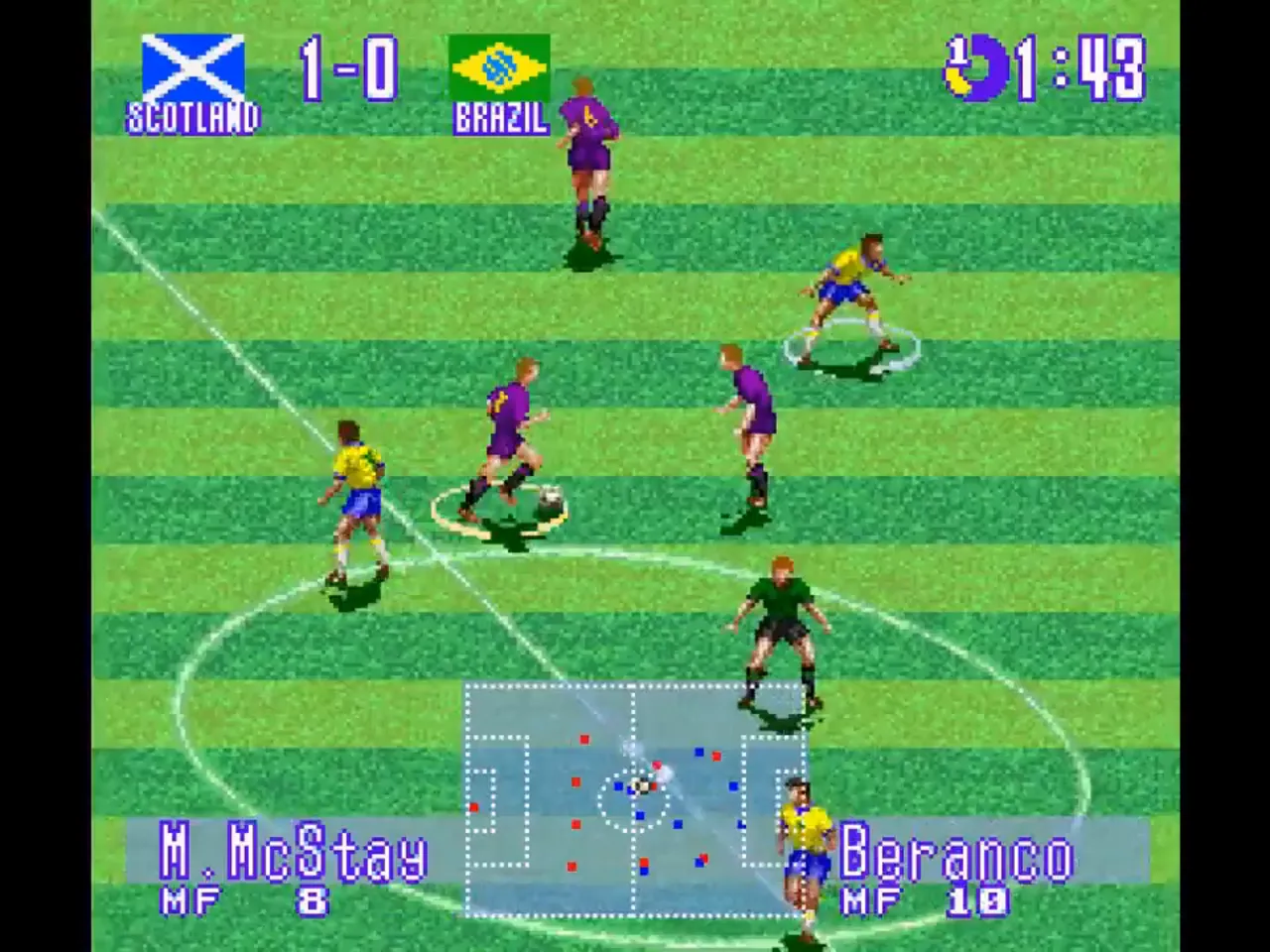
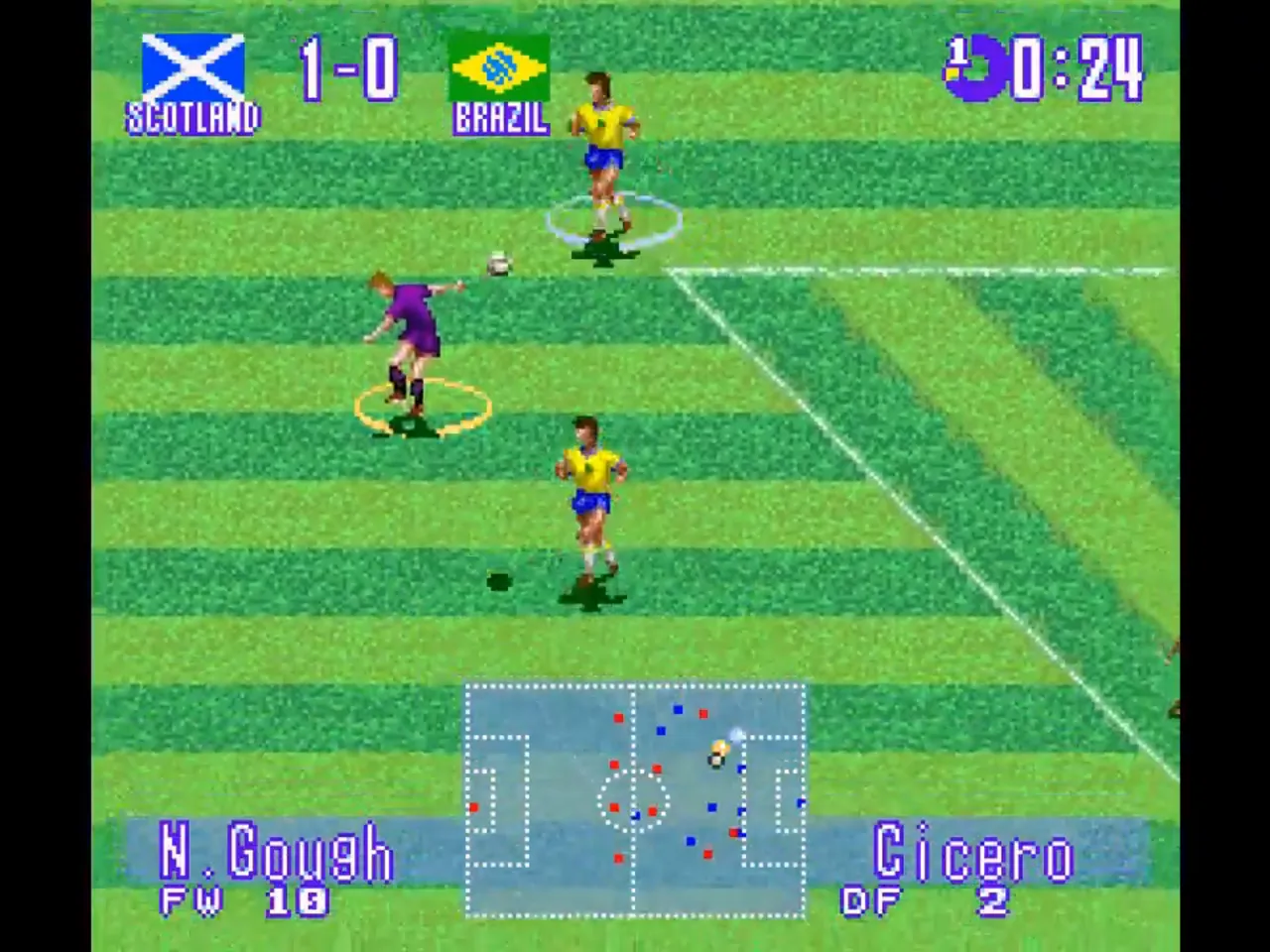
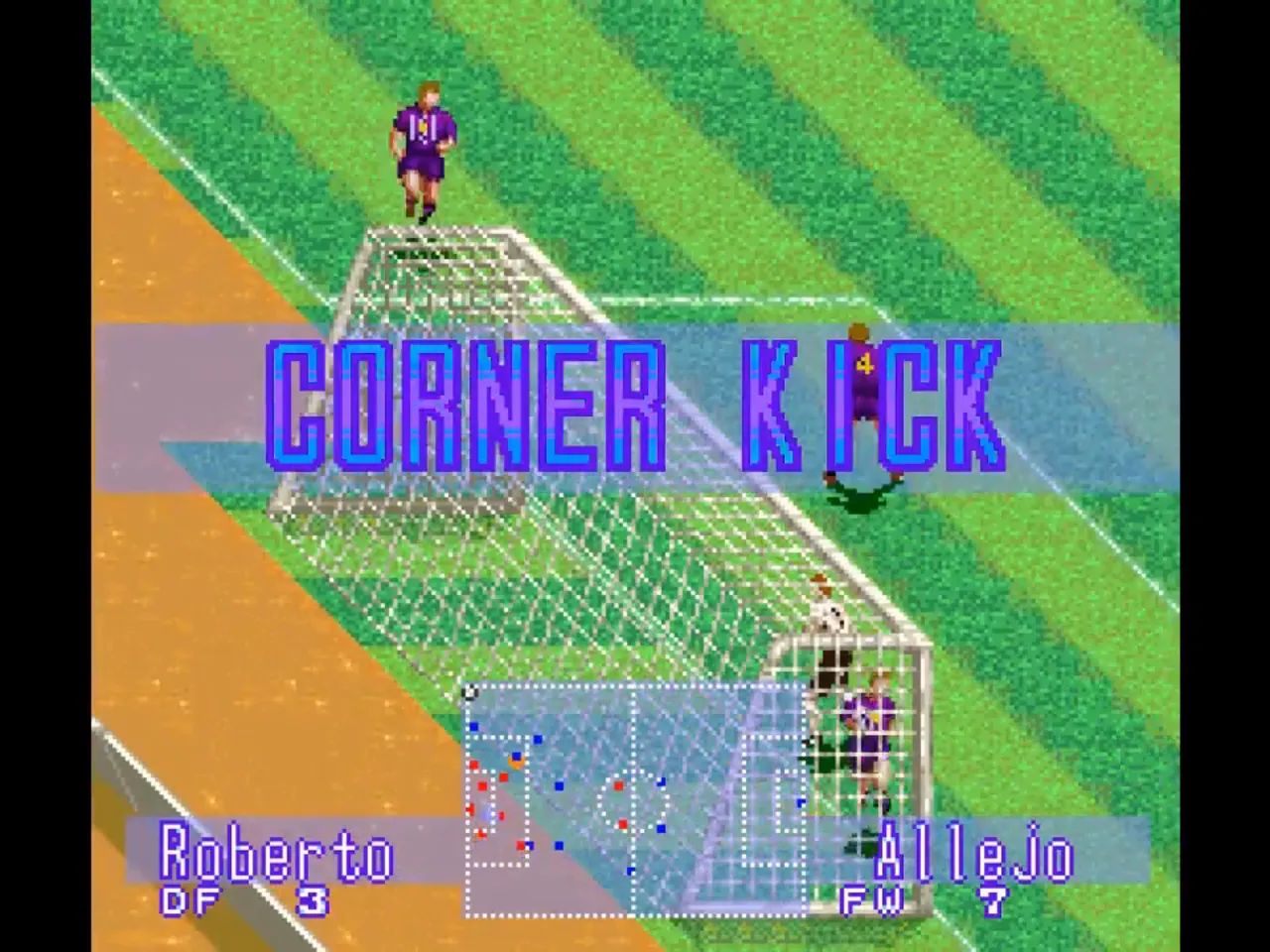
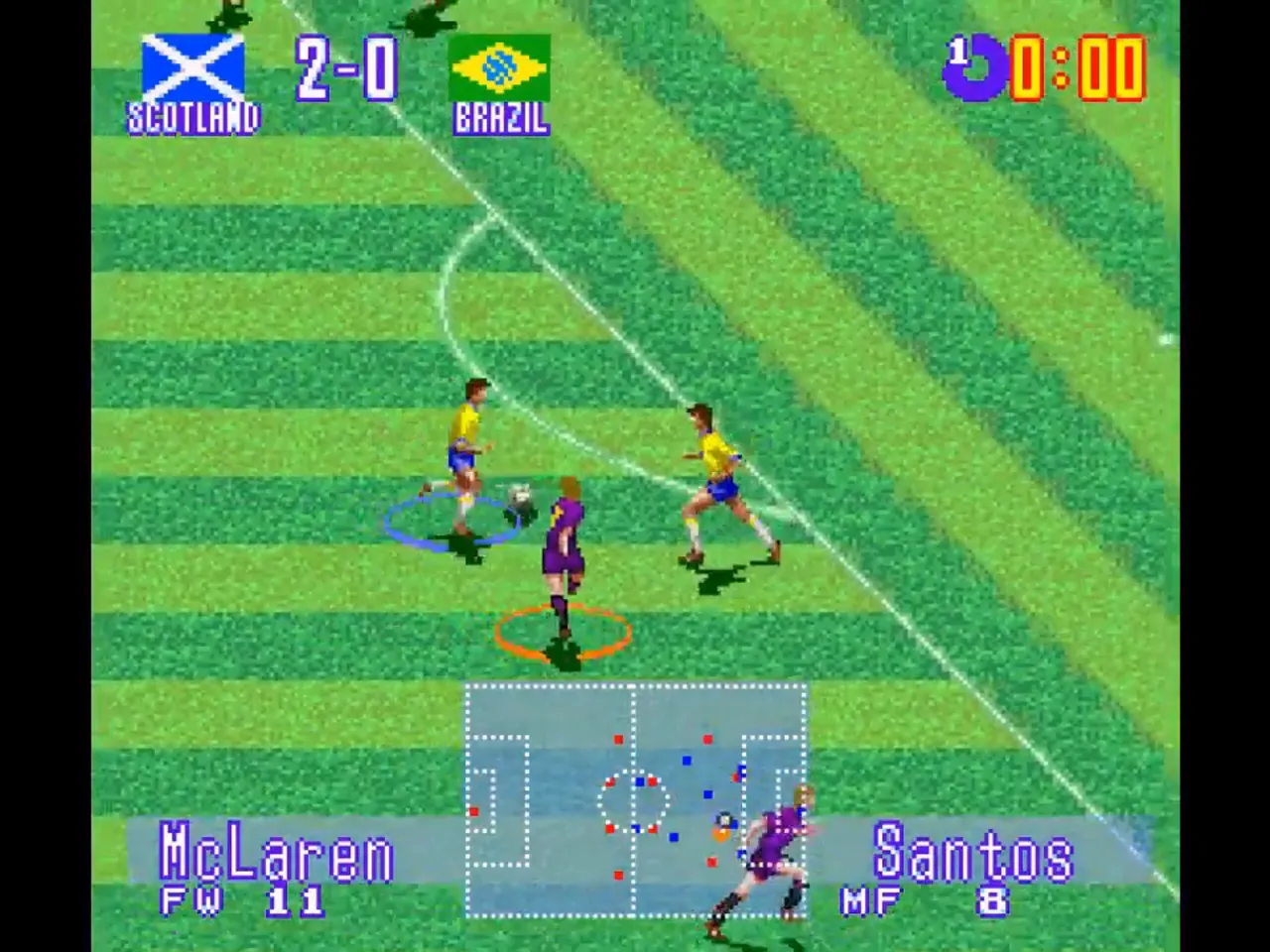
There are thirty-six teams on the select screen, none of them licensed, all of them recognisable from the unlicensed-but-suggestive surnames — a striker with a great hairstyle for Colombia, a holding midfielder named Beckenbauer-by-another-syllable for Germany. The team-balance is the sort of broad statistical sketch every football game ships now, but here it actually matters: a fast side plays differently from a technical one, because the sprint and pass primitives are precise enough to feel the difference. Friendlies, leagues, knockout cups, an international tournament — the modes are templates, but each match is paced like a 1990s Konami arcade level, with the same density of decisions per minute as Sunset Riders or Turtles in Time. Two SNES multitaps will get you eight controllers on the same console, eight humans on the same pitch, one ball.
The thing this all adds up to, played today, is that decisions happen at human speed. You see a gap, you sprint into it, the pass goes. There is no animation tax between intent and movement. Modern football games have spent twenty years adding plausibility to that pipeline — momentum, traction, contextual animation — and the side effect is that the moment of decision has gradually been moved from the player’s brain to the controller buffer. ISS Deluxe never made that trade. The cost is that it doesn’t look like football on television. The gift is that it feels like football in your hands.
A commentator who never shuts up
The Japanese title, Jikkyō World Soccer 2: Fighting Eleven, sells the commentary in the first word. Jikkyō (実況) means live play-by-play; Konami had built a recognisable engine for it the year before in Jikkyō Powerful Pro Baseball, and the Osaka football team applied the same template to a different sport. The result, in English, is a voice that calls every shot, every save, every offside, every long ball — chirpy, terse, occasionally inane, and atmospherically essential. The Mega Drive port that followed in 1996 was, by Mundo Retrogaming’s account, “probably the only soccer game on the Genesis that featured true voice-over commentary.” On the SNES, in 1995, it was a small miracle of cartridge engineering.
The compositions underneath, by Hideyuki Eto, Harumi Ueko, Tomoya Tomita and Kazuhiko Uehara, are written for a stadium — synth-brass anthems for menus and team-selects, crowd loops cross-faded under match audio. The Mega Drive port, conducted by the Turrican composer Chris Hülsbeck for the German developer Factor 5 (who handled the conversion entirely), exists as a fascinating parallel score. The notable thing about all of it is that it works in service of an idea: that a football game is an event, with a soundtrack and a narrator and a crowd, not a closed system. Konami Tokyo’s eventual PES line would inherit this conviction wholesale.
What the licence gap built
The reception, in English-language press, was as good as anything Konami released that year. Computer and Video Games gave it 91%, calling it “an essential buy for fans of fast, fun footy” and ranking it as the best soccer game on the system. GamesMaster placed it 34th in their 1996 Top 100 Games of All Time, ahead of most of its release-year peers. Nobody was treating it as the runner-up to FIFA.
The real difference was structural. EA had locked the FIFA Federation licence — real team names, real player names, the brand authority. Konami had to ship with unlicensed-but-recognisable rosters: a striker with curly hair who is obviously Carlos Valderrama, attached to a team that is obviously Colombia, with both standing in for what the licence would have called them. The whole ISS and PES line carried that workaround forward for two decades. The accidental effect is that the game’s energy goes into the model on the pitch — the sprint, the pass, the rebound — and not the model on the broadcast graphic. If you have ever wondered why PES fans, deep into the 2000s, kept loyal to a series that lost the licence war comprehensively, it is partly because Konami had been forced, by the licence gap, to put the design somewhere FIFA wasn’t competing.
The friction worth naming honestly is the camera. ISS Deluxe keeps the view zoomed in close to the play, with a radar minimap as the only way to see what the rest of the pitch is doing. Mew, in his retrospective on the original, called it a habit of “staring at little coloured dots.” Modern players accustomed to broadcast-cam football will notice. It is the one place the game shows its 1995 origin clearly, and there is no defending it as a design choice rather than a hardware constraint — the SNES could not show what a tactical-cam wanted shown. You play through it; you don’t play around it.
What it still gives you
There is no legitimate digital re-release. Konami has not put International Superstar Soccer Deluxe on a storefront, has not included it in any Konami Collector’s Series compilation, and has not added it to the Nintendo Switch Online SNES library at the time of writing. The MiSTer FPGA SNES core is the most-accurate route a paying customer can take; emulation is what the rest of the world will actually do. A Super Famicom cartridge of Jikkyō World Soccer 2 — the Japanese commentary build — costs less than a takeaway dinner on the import market.
The reason to play it now is not preservation. It is that modern football games have built a beautiful, broadcast-accurate, animation-locked decision pipeline that almost nothing immediate can survive, and ISS Deluxe is what football feels like before that pipeline existed. A sprint is a press, not a state machine. A pass is a line, not a probability cone. A save is a rebound. The Konami office in Osaka, working with a licence gap, a stamina reserve, and a commentator, found a tempo that nobody has since improved on. Tokyo got the eventual brand. This is where the football came from.