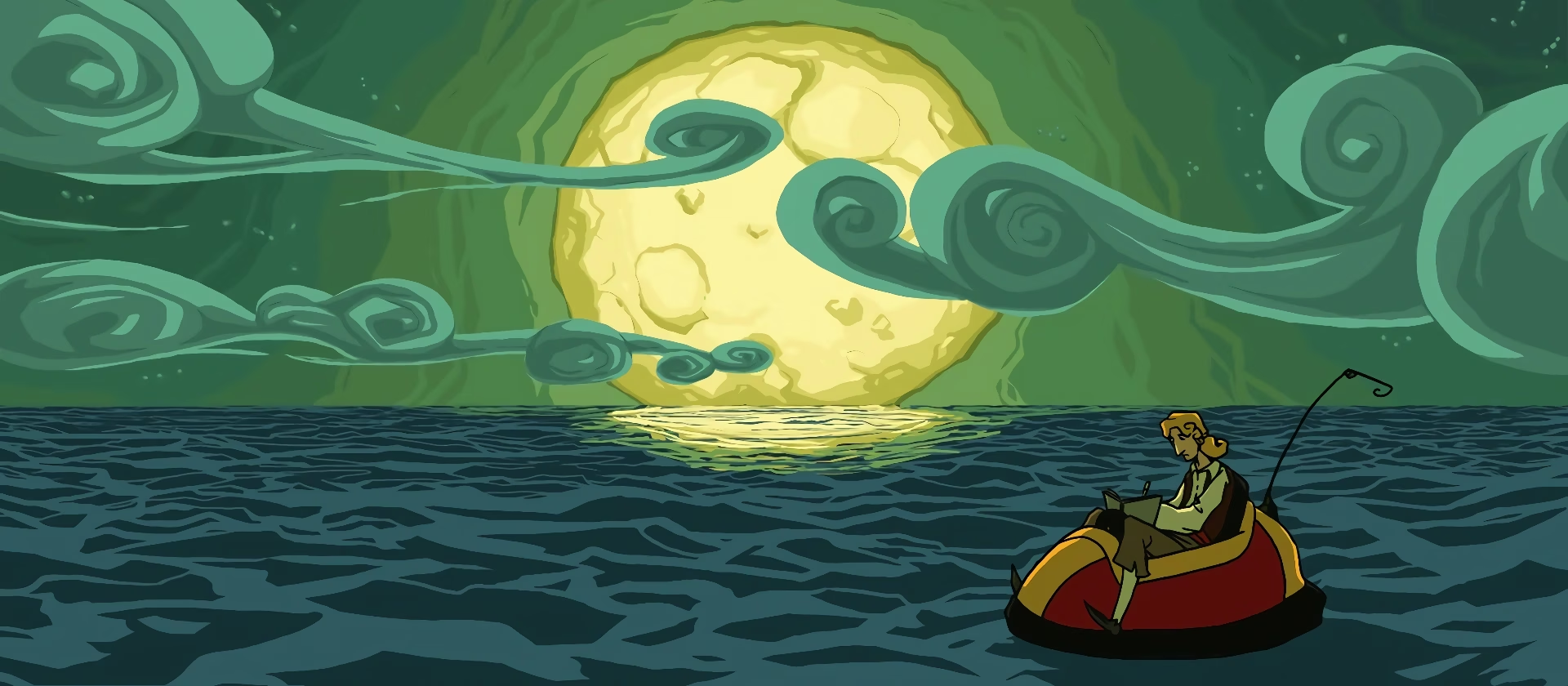
The joke about adventure games is that they died exactly once, cleanly and publicly, sometime in 1997 — and on their way out the door they stepped over their own best work. The Curse of Monkey Island arrived the year Half-Life shipped, when 3D accelerator cards became the only conversation in gaming. It sold 300,000 copies. Full Throttle, two years earlier, had moved over a million. The numbers told a clear story. LucasArts read them correctly and never made another 2D adventure game. The tragedy is that they had just made the finest one in the genre’s history.
This is not a position taken out of franchise loyalty or residual warmth for the Caribbean palette that greets you at the title screen. It is an argument about execution. The Curse of Monkey Island is better-looking, better-written, and better-composed than any adventure game that preceded it — including its own predecessors. Its status as the third entry in a beloved series has obscured this. When players rank the Monkey Island games, the original and its sequel crowd every top-ten list, and Curse gets credited for its visuals and little else.
A Blueprint for the Entire Thing
Jonathan Ackley and Larry Ahern arrived at The Curse of Monkey Island as first-time project leads. Ackley carried programming credits from Fate of Atlantis and Day of the Tentacle. Ahern had done art direction on Sam and Max Hit the Road and The Dig. Both were capable. Neither had run a project at this scale. Between their first meeting and the game shipping, the team grew from fewer than thirty people to over seventy, with the art department alone expanding from three staff to twenty-four.
The scale forced a decision unusual enough at LucasArts to be worth naming: they locked the design before production began. All five chapters. Every inventory item — over a hundred of them. Every puzzle solution. Every moment of Murray the skull’s increasingly implausible reappearances.
”There was a clear blueprint for the entire game with no holes.”
— Jonathan Ackley
The reasoning was economic as much as artistic: at the cost of producing hand-painted backgrounds at 640×480 — LucasArts’ first high-resolution title, nearly five times the pixel density of their earlier work — changes mid-production would have been catastrophic. The discipline that makes Curse feel composed rather than assembled is the direct consequence of a decision made before anyone picked up a stylus.
Their first creative conflict set the game’s character. Ackley wanted a text adventure. Ahern, whose previous job title had literally been “artist,” disagreed. Ahern won. The stated goal was to produce something that looked like an interactive animated film, built at a resolution high enough that it wouldn’t look dated in a couple of years. They achieved both. The irony is that critics called the game dated before the reviews were printed.
What Bill Tiller Saw in the Caribbean
Lead background artist Bill Tiller came to production with two major influences and the good sense not to choose between them. The first was the Disney Renaissance — Aladdin, The Lion King, Hercules — which had taught him, trained at a school whose faculty included Disney animators, to think about cel art as narrative architecture rather than decoration. The second was Howard Pyle, the nineteenth-century illustrator whose pirate scenes had defined the visual grammar of Caribbean adventure: dramatically lit, architecturally precise, morally nuanced. Ackley loved Pyle’s work. Ahern had more avant-garde tastes. Tiller occupied the fertile tension between them.
He spent part of his production bonus on a research trip to Disney World and the Bahamas, photographing light on water, the particular green of mangrove swamp, the way afternoon sun falls on old stone in the tropics. The backgrounds in Curse are the record of that trip translated into paint: a plaza in Puerto Pollo with a thermal quality to its shadows, a beach where phosphorescence in the shallows is implied rather than illustrated, a sugar-cane field with a humidity you can almost feel. Earlier Monkey Island games had art that was functional, charming, occasionally beautiful. Curse has backgrounds that are destinations.
The plaza at Puerto Pollo. Bill Tiller’s 640×480 painted backgrounds drew from Howard Pyle’s pirate illustrations and a production research trip to the Bahamas — readable signage, architectural depth, the thermal quality of tropical shadow. The Curse of Monkey Island · LucasArts, 1997.
The resolution was the enabling condition for all of this. At 640×480, Tiller could put readable detail into the middle distance — characters with actual facial expressions, environmental storytelling at the edge of frame, prop work that rewards the player looking closely before clicking. The game doesn’t ask you to imagine what a Caribbean pirate town feels like. It shows you, with enough specificity to make imagination redundant.
Murray and the Logic of Failure
There is a talking skull in The Curse of Monkey Island who believes himself to be terrifying, and cannot understand why no one is terrified. He introduces himself as Murray the Demonic Talking Skull and delivers a speech about striding through the gates of hell. Then he remembers he has no legs. So he revises: he’ll roll through the gates of hell, and he’d like it noted that this is still fairly menacing.
Murray was originally called Floating Skull and written as a purely insulting character — early lines had him telling Guybrush “You’re pathetic, you’ll never amount to anything.” The change came from testing. Players responded to him the moment he was rewritten as a genuine, earnest believer in his own menace who simply lacked the physical apparatus to deliver on it. That distinction — moving from “you’re pathetic” to “I’ll roll through the gates of hell, and that’s still fairly menacing” — is the difference between a villain you dislike and a villain you love. He became so popular with test players that the team went back through all five chapters and retrofitted him into scenes he’d never been intended for, replacing decorative skulls throughout the game with Murray’s face. If you look carefully at backgrounds in chapters he wasn’t originally designed to inhabit, you can find him watching from alcoves and cornices, still threatening, still unable to do anything about it.
This revision was possible because of the other discipline Ackley and Ahern brought to the production: the design was locked, but the writing inside it was alive. They had written specific jokes for every incorrect item combination, specific dialogue for every wrong approach. Ackley summarised the principle as “rewarding failure.” The game treats being wrong as an invitation rather than a verdict. Every dead end has a punchline. Some of the best lines in Curse are in the puzzle solutions you didn’t try. Not every chapter earns the discipline — Blood Island’s middle stretch slumps into scavenger-hunt busywork, and the third-act ship duels wear their joke thin — but the principle holds where the execution sags.
The interface simplification enforced the same principle in the engine. Where earlier LucasArts adventures had presented a grid of nine verb commands, Curse replaced them with three iconic symbols: a hand, a skull, and a talking parrot. The reasoning was pedagogical as much as aesthetic. The game contained over 100 inventory items and complex combination puzzles; there was no reduction in depth. The reduction was in the cognitive overhead between you and the next action — enough for the comedy to land, the characters to breathe, and the wrong choices to be explored freely.
The Voice That Already Knew the Character
Less than two weeks before auditioning for The Curse of Monkey Island, Dominic Armato told a friend that his dream voice-over job would be playing Guybrush Threepwood. He’d assumed the series was permanently dead — it had been six years since Monkey Island 2, long enough that a continuation felt implausible. Then he walked into his agent’s office and found a character sheet for Guybrush Threepwood on the desk. The audition was, by his own account, one of those moments where the outcome is not really in doubt.
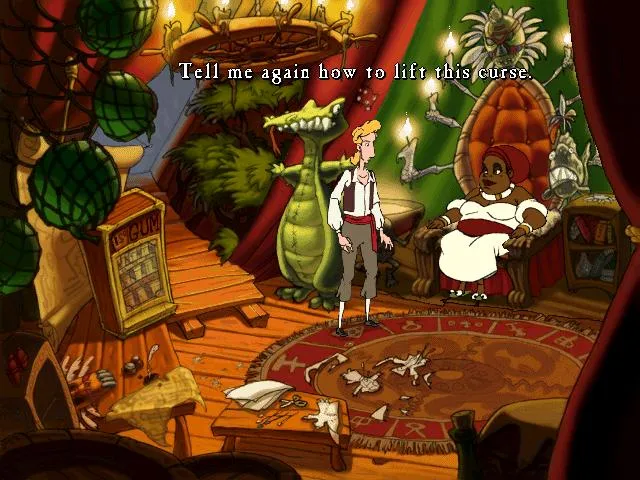
The Voodoo Lady’s cabin. 640×480 let the team put readable detail into every prop — and put 8,357 lines of spoken dialogue through characters who could finally be heard. The Curse of Monkey Island · LucasArts, 1997.
Armato’s Guybrush — earnest, slightly baffled, genuinely invested in his own competence despite considerable evidence against it — is the performance that made the comedy possible in a way the text-only predecessors couldn’t. Curse gave him a voice, and the character crystallised into something specific rather than projected. The cast, which included Alan Young of Scrooge McDuck fame, put 8,357 lines of spoken dialogue through a script that had previously only been read. The pirate shanty “A Pirate I Was Meant to Be” nearly didn’t survive production — the non-Armato actors were, diplomatically, not reliable singers — but the gag had been in the original pitch document two years earlier. Michael Land arranged around the actors’ performances until the result was intentionally, perfectly, comedically off-key.
Land’s score was its own coming-of-age. The iMUSE system had previously worked with MIDI arrangements; for Curse, Land recorded with live instruments — real brass, real strings, real Caribbean percussion. The music doesn’t loop and restart. It shifts, stretches, and resolves. Between one room and the next, the emotional key of the scene changes, and the transition is invisible.
The Year the Genre Became Archaeology
SCUMM — the Script Creation Utility for Maniac Mansion — had powered LucasArts adventures since 1987. For Curse, the engine was comprehensively overhauled, with Ackley pulling functions out of the engine itself and rebuilding them at the script level for greater control than the engine’s defaults allowed. SCUMM’s final game was, technically, its most sophisticated. The programmers buried a joke in the executable: a fake 3D acceleration toggle that, when players tried to activate it, displayed messages reading “We were only kidding.” The adventure game market had been awash with speculation about 3D transitions; the developers were fluent enough in the cultural moment to satirise it from inside the game they were shipping.
The 3D moment arrived not as speculation but as fact. Half-Life shipped the same autumn. Ackley watched his programmers absorbed in Valve’s game in the weeks after Curse released, and understood the era was ending. “We were lucky to be the last SCUMM game, and I think we went out on a good note,” he said later.
That understates it. Curse went out at the highest point the form had ever reached — better-looking and better-written than anything before it. The 300,000 copies it sold felt like a disappointment against Full Throttle’s million-plus; hand-drawn adventure economics had become impossible. LucasArts knew this and stopped. Contemporary critics, busy with their 3D benchmarks, processed Curse as retrograde. They were wrong about the departure order. What shipped that autumn was not the genre’s rearguard. It was the genre’s ceiling. The 640×480 resolution that earned dismissals now reads as precision: every object legible, every background a studied composition, every joke placed in the space it was designed to occupy. The game hasn’t aged. The form simply closed — here, at its highest point, on a joke about a skull who wanted to be feared and couldn’t work out why nobody was.