// // import saucerCleanupPoster from ”../../assets/images/asteroids-1979-saucer-cleanup-poster.jpg”; // deleted // deleted
Asteroids looks empty until your hands understand how crowded empty space can be. The ship begins in the centre, a white outline on black glass, and the whole control panel refuses the instinct most games have trained into you: there is no stick to lean on, only rotation, thrust, fire, and hyperspace.
That refusal is the reason to play it now. Atari could have made a cleaner post-Space Invaders product, a left-right shooter dressed in vector lines. Instead, Ed Logg, Lyle Rains, and Howard Delman kept the older, stranger pleasure of Spacewar alive inside a cabinet built for operators. Asteroids is not about shooting rocks. It is about accepting that every correction creates the next crisis.
Spacewar Survived the Arcade
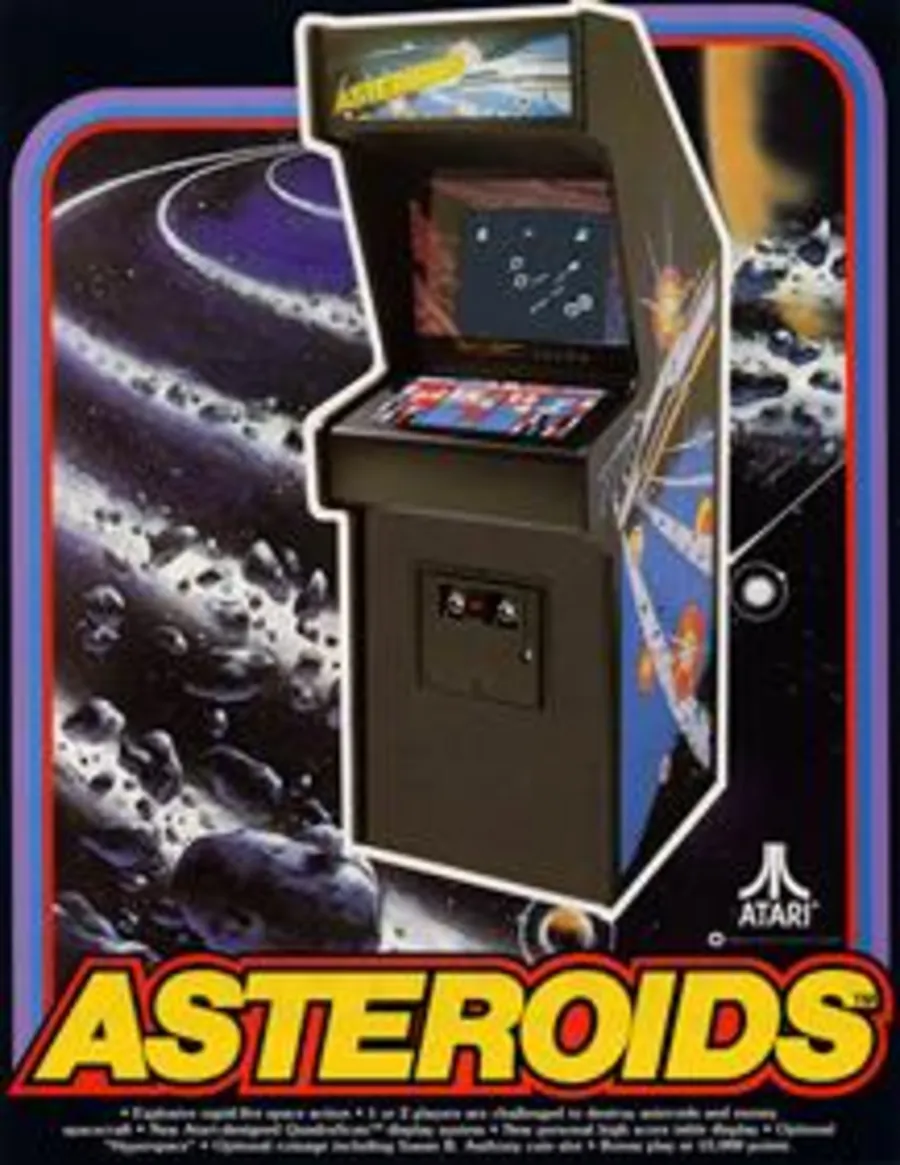
The operator flyer sold Asteroids as spectacle, but the cabinet it pictures is severe: black monitor, white vector line, five buttons. Atari, 1979.
The project began as an answer to a problem Atari had already failed to solve. Rains remembered an older space-combat prototype in which an asteroid got in the way of a duel and players kept trying to shoot it. Logg remembered playing Spacewar on Stanford machines, losing badly, and carrying the feel of thrust-and-rotate space combat with him. The new brief was simple enough to sound like a programmer’s sketch: a little ship, large rocks that split into smaller rocks, shoot until the screen clears.
That sketch could have become a joystick game. Rains initially leaned toward raster graphics, the conventional video path of the moment, but Logg pushed for vector hardware because the sharper X-Y line gave the player more precise aiming. In Retro Gamer’s making-of interview, Logg put the disagreement bluntly: “no, no, let’s do it on vector.” The sentence matters because it is not a polish choice. It is a control choice. Asteroids needs the shot to feel like a ruled line extending from the nose of the ship. If the aim blurs, the whole game becomes mush.
Howard Delman made that bet shippable. Atari’s Grass Valley research group had produced the groundwork for an X-Y display system, but Delman had to turn that concept into a platform an arcade game could survive on location. Lunar Lander proved Atari could ship vector. Asteroids made vector feel inevitable.
The difference matters at the eye before it matters as history. A raster display paints a screen in rows. A vector monitor draws the image as lines, the beam travelling point to point, leaving shapes that look less printed than incised. On an Asteroids cabinet the rocks do not sit on the glass like sprites. They glow in it. The ship looks small because everything else is so black, but the shot is exact: a white segment leaving the nose, crossing a field, cutting a polygon into two new obligations. That precision is not cosmetic. It is why the player accepts the blame when a shot misses by a few degrees.
Atari’s operator manual reads like a document from another mechanical culture: self-test tones, dip switches, X-Y monitor service, a fluorescent tube behind the marquee. The game was software, but the cabinet was also a machine with parts an operator could open, clean, and repair. Asteroids works best when that material fact stays in the reader’s head. The five buttons are not a control scheme abstracted onto a menu. They are the faceplate of a commercial object designed to take punishment from anxious hands.
Five Buttons, No Mercy
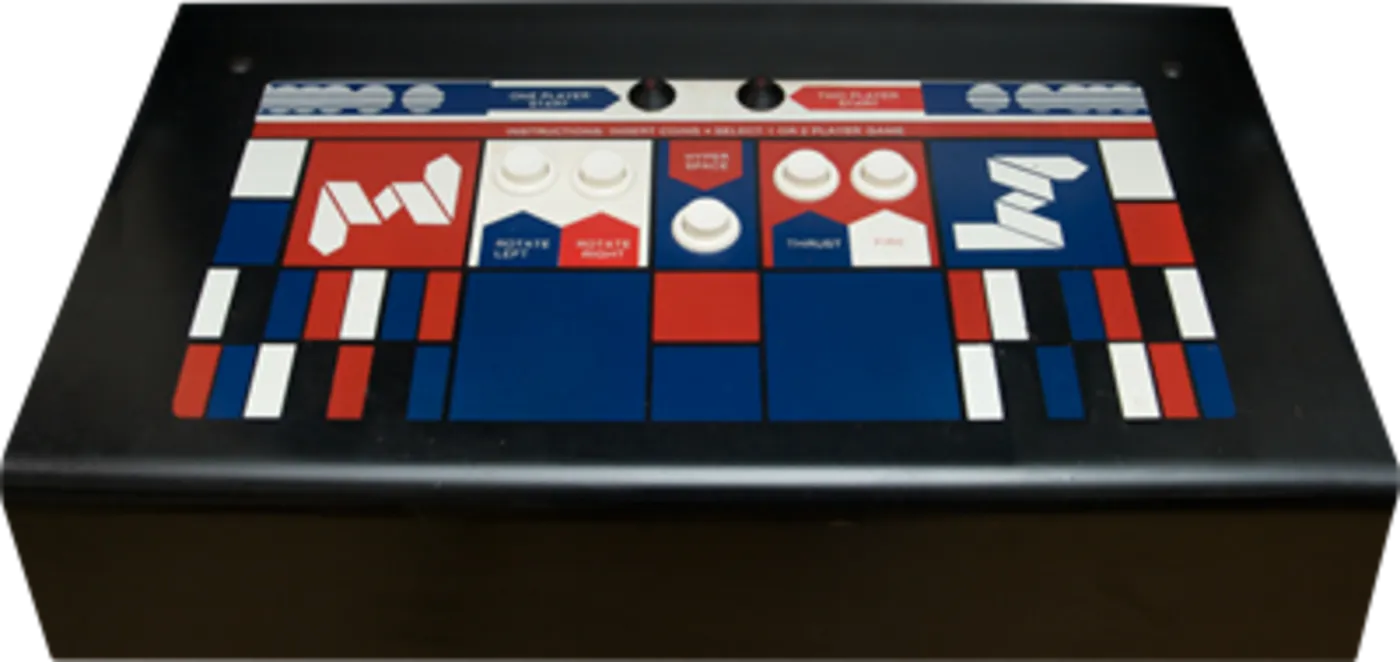
Five buttons replace the joystick: rotate left, rotate right, fire, thrust, hyperspace. The layout makes movement a sequence of decisions rather than an analogue lean. Atari, 1979.
The control panel is the game’s thesis in plastic. Left rotate. Right rotate. Fire. Thrust. Hyperspace. Each button is clean, but no single button is safe. Fire commits the ship to a line; thrust commits it to a future position; hyperspace cancels one disaster by gambling on a random new one. The player is never asked to push toward safety. The player has to build safety out of angular corrections and small burns.
This is why early players asked for a joystick. Atari ran focus groups in June 1979, one with older Spacewar veterans and another with teenage Space Invaders fans. The younger group, used to a base and a pause in the action, noticed that Asteroids never gave them cover. Some players wanted the controls softened into something more familiar. The game survived that feedback because Logg trusted what people did more than what they said. In Sacramento, he watched a test player die three times in about twenty seconds, then feed the machine another quarter. If a player died instantly and blamed the cabinet, the design had failed. If he blamed himself, the cabinet had him.
That is the small miracle of the panel. It feels awkward for the first credit because it is separating jobs a joystick combines: facing, moving, shooting, escaping. Then the separation becomes liberating. You can aim one way, drift another, and decide whether to spend thrust on speed or position. You can let a rock pass because slowing down would create more danger than waiting. You can rotate while the ship continues sliding, and in that sliding interval the game asks whether you have pictured where your body will be after the button press, not where it is now.
The fairness is brutal, but it is real. A large asteroid gives way to two medium ones. A medium rock becomes two small ones. The screen fills with smaller, faster obligations because the player created them. The mistake is legible. The recovery is legible. When Asteroids becomes hard, it does not hide the cause.
The Saucer Finds the Loophole
The famous problem with expert play is that a brilliant player can stop playing the rock field and start farming saucers. Leave one slow asteroid alive, drift safely, wait for the small saucer, kill it, repeat. Asteroids Deluxe exists partly because Atari needed to close that hole. Yet the exploit is also proof of how readable the original system is. Players found the economy inside it because every object obeyed a clear rule.
The saucers are not decoration. The large one bullies; the small one hunts. Their shots turn a game of clearing into a game of staying exposed for the shortest possible time. A timid player can circle at the edge and lose patience. An arrogant player can thrust into a screen full of fragments and discover that speed is only control when it has somewhere to land. The good line is usually a short burn, a rotation, one shot, and enough silence to see what the shot has done.
That silence is where the game keeps converting new players. Modern action games often solve movement by making acceleration generous and correction cheap. Asteroids makes correction expensive. It lets the ship keep drifting after the player’s intention has changed. The result is a score game where the score is secondary. The real reward is the moment your hands stop fighting the panel and start thinking in vectors.
The game also refuses the comforting hierarchy of later shooters. There is no boss, no last enemy that announces itself as the object of the room. A small rock can be more dangerous than a saucer because it arrives from the side while attention has narrowed elsewhere. A big rock can be safer left intact because splitting it would flood the screen. The cabinet’s deepest skill is not marksmanship but editing: choosing which threat should exist for another second, and which one must become fragments now.
The Cabinet Has a Heartbeat
Asteroids has no soundtrack in the album sense. It has a pulse. Delman built the sound hardware by hand, one circuit for each effect, and he described the thump as a heartbeat meant to sync with the player’s rising tension. The trick is not metaphorical. As the field becomes more dangerous, the pulse makes the cabinet feel as if it is sharing the room with you, counting down not time but nerve.
The audio also keeps the vector screen from feeling abstract. Fire cracks. Rocks pop into smaller rocks. The saucer arrives with a needling alarm that cuts through the empty black. These are not cinematic sounds; they are arcade-room signals, designed to tell anyone standing nearby that something is happening at this machine. Asteroids is austere on the eye and loud in the body.
That combination explains why the cabinet art feels almost excessive. The marquee promises pulp energy: a spaceship streaking past a planet, rays of red and yellow, a logo big enough to read across a room. The monitor answers with a diagram. The gap between those two surfaces is not a failure of resources. It is a productive mismatch. The outer cabinet tells the passer-by that this is space adventure. The screen tells the player that adventure has been reduced to bearing, velocity, collision, and nerve.

The marquee turns the cabinet’s white-line severity into pop art: planet, ship, rocks, and logo, all promising a space opera the monitor deliberately withholds. Atari, 1979.
That contrast between the marquee and the monitor is part of the cabinet’s power. The art gives operators colour, shape, and shelf appeal. The screen takes almost all of it away. What remains is brighter than colour: white geometry burned into black, a ship that rotates with tiny exactness, fragments that cross the field like thrown glass. The cabinet sells pulp space fantasy and then delivers a machine for reading motion.
Empty Space Still Crowds
Asteroids belongs beside Space Invaders and Galaxian because it answers the same room with a different body. Space Invaders compresses fear into a descending wall. Galaxian turns the wall into attack choreography. Asteroids removes the wall entirely and makes the player’s own momentum the threat that never leaves. The enemy is not above you or below you. It is in the course you chose half a second ago.
The friction is real. Marathon strategies can flatten the risk. Hyperspace can feel less like a tool than a shrug. A modern player coming from twin-stick shooters may spend the first minutes wishing the ship would go where the thumb points. That wish is exactly what the cabinet is built to resist. Asteroids is not the ancestor of dual-stick flow; it is the branch that says movement should be a debt.
Digital Eclipse’s Atari 50 release is the best modern route because it understands that the game needs context around it, not upgrades placed inside it. The arcade ROM sits among interviews, artifacts, and a timeline of Atari’s hardware imagination, so the player can approach Asteroids as an object with a room, a monitor, and a control panel. The temptation with a game this copied is to think the idea has been replaced by smoother descendants. The original argues the opposite. Smoothness would ruin it.
Play a few credits and the debt starts to feel clean. The screen clears because you learned not to overcorrect. The saucer dies because you waited for the nose to line up instead of firing through panic. The last small rock skims past the ship because seven seconds earlier you chose not to thrust. For a game made of outlines, Asteroids is unusually physical. It makes empty space press back.