Castlevania: Symphony of the Night opens with the end of a different game. Richter Belmont, climbing a clock tower, walks into Dracula’s throne room and fights him — under a banner reading “Final Stage: Bloodlines” — before the player has earned anything. Most Western players in March 1997 met the moment cold. They didn’t recognise Richter, hadn’t seen Annette being carried off in a stolen carriage four years earlier, didn’t know why Maria materialised from offscreen to make Richter invincible. Symphony won them anyway; the unknowing read as part of the charm. The game it was finishing had been on a Japanese console for four years, and would not be officially released in English for another ten.
Read forward, the gap looks like a translation problem. Read in the other direction — from the game Konami’s director shipped in 1993 — it looks like causation. Symphony of the Night is a sequel to Castlevania: Rondo of Blood, the Japan-only PC Engine CD release the West met in effigy through 1995’s SNES remake before it met it whole. Tōru Hagihara directed both. Koji Igarashi, the assistant director who finished Symphony after Hagihara was promoted away from it, is on record that the series’s actual departure from classic Castlevania happened on the earlier disc, not on the famous one. The Western canon disagrees. The Western canon also had not played the game in question.
The Hit Konami Didn’t Send West
Rondo of Blood shipped on 29 October 1993, on the PC Engine Super CD-ROM² System, on a console with a healthy Japanese market and almost no Western one. Famitsu’s first-week figure was 14,436 copies; PC Engine Fan’s readers’ poll handed it 26.0 out of 30; the January 1994 Micom BASIC Magazine placed it first in its popularity ranking. The audience that could play it loved it. That audience was small.
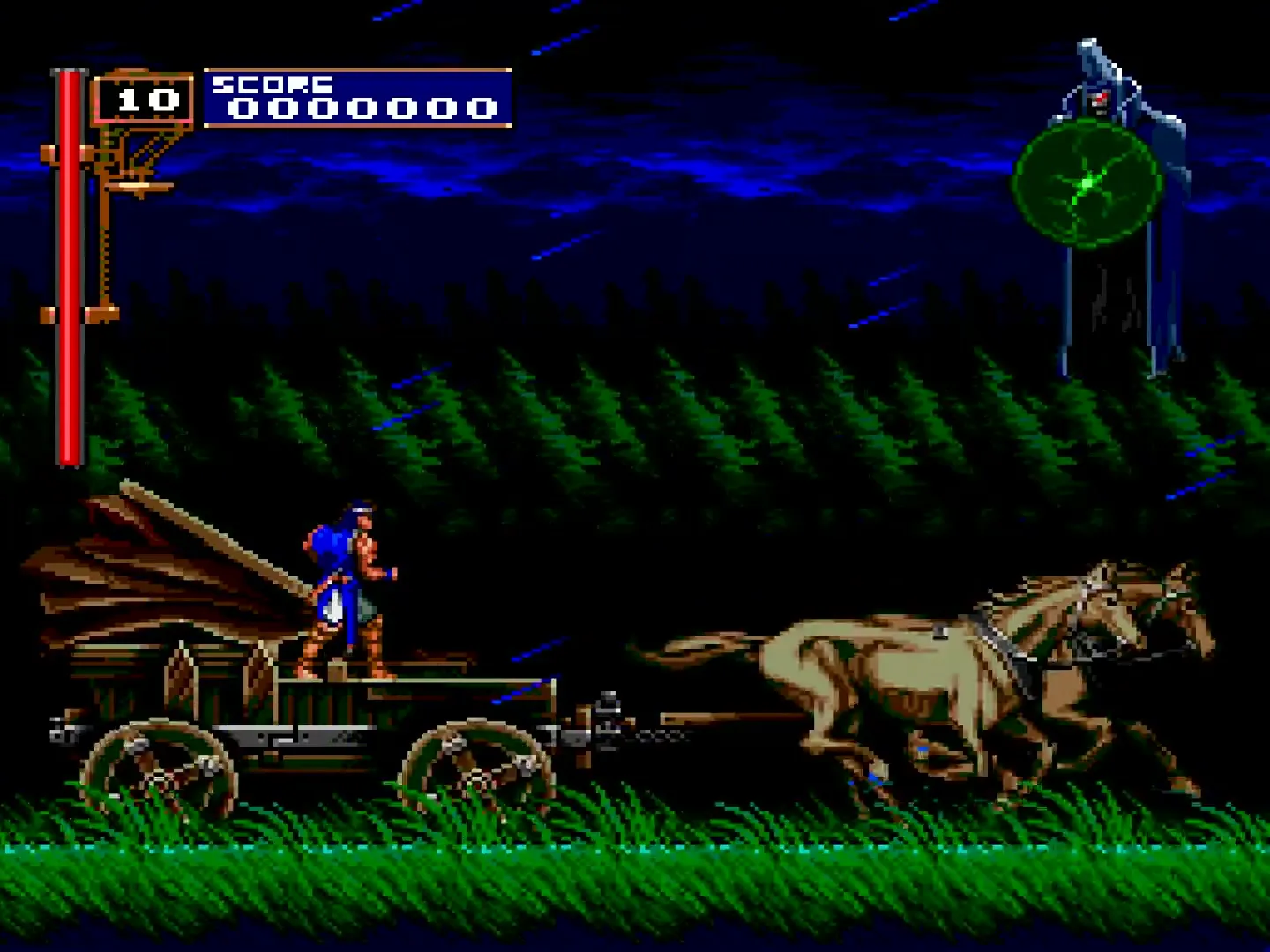
The franchise’s first cinematic action moment: Richter rides the carriage that just took Annette while Shaft summons Dracula in the wings. The CD-format budget that paid for it was also the format that stranded the game in Japan. Castlevania: Rondo of Blood · Konami, 1993.
A SNES port did not follow. Two years later Konami released Akumajō Dracula XX on the Super Famicom — Castlevania: Dracula X in North America, Vampire’s Kiss in PAL territories — and recycled Rondo’s sprites for a different game: different levels, fewer paths, no playable Maria, three endings tied to whether you rescued Annette in time. NEC’s exclusivity contract prevented anything closer to a port. Western buyers met Rondo through that misfit cartridge, then nothing, for twelve years.
The platform constraint was the design opportunity. Character designer Toshiharu Furukawa told the Akumajō Dracula X CD liner notes that previous Castlevania monsters had been restricted by what he called “American morals” — the half-human, half-monster forms he wanted to draw were not exportable to a Konami release that needed to clear Nintendo of America. Rondo being Japan-only, that brief came off. The same liner notes record sound designer Akira Souji recording Dracula’s cape by flapping a blanket in his living room — “an especially pathetic” domestic activity, in his own words. It is the first Castlevania with recorded Foley over chip synthesis, because it is the first Castlevania on a disc.
The Director Behind Both Castles
The line between Rondo and Symphony is not a metaphor. Hagihara directed and programmed Rondo, then directed and produced Symphony four years later, finishing the first half himself and handing the rest to Igarashi after a promotion. Between the two games sat a third Castlevania that the world did not see: a Sega 32X project announced in Game Players in December 1994 and cancelled, by Time Extension’s reconstruction, sometime before October 1995. Three character sprites are all that remain. The team disbanded. Several of them — Hagihara among them — reassembled around what would become Symphony of the Night.
Igarashi has been direct about this for nearly twenty years. In a GDC 2007 conversation with Christian Nutt, he put it plainly:
“Many of the gamers in the U.S., or outside Japan, tend to think that SOTN is one of the Castlevania titles that made a drastic change to the series. But personally speaking, I think Rondo of Blood was the title that actually started branching out from the past Castlevania series.” — Koji Igarashi, GDC 2007
The branching-out he is naming is not the RPG layer that made Symphony famous; it is the structural moves that made Symphony possible. A second playable character, unlocked through play and meaningfully different. Hidden rescuable side characters scattered through the stages. Branching paths discovered inside levels rather than picked from a menu. Anime cutscenes and voice acting placed on top of side-scrolling action. A direct, family-saga plot that pivots away from Simon Belmont’s solo myth. All of those moves are in Rondo. Symphony inherits them and adds the map.
What Rondo’s director also brought from his own production was a working memory of how much the new ambition cost. Hagihara, in the same 1993 liner notes, on the schedule: “Not a single thing went according to schedule… and Maria, that insufferable girl, gave us nothing but bugs!” Maria, the bug-ridden secret character of Rondo’s crunch, returns as the alternate protagonist of Symphony’s Saturn port in 1998 and the PSP remake in 2007. The character who broke the schedule became the franchise’s most-reused experimental moveset. That’s the kind of detail that gets lost when a game’s history starts at the sequel.
Branching Paths Before the Branch
Read on its own terms, without the Symphony lens, the playable thing the cartridge does is take classic Castlevania apart into eight numbered stages plus a brief prologue, then quietly slips four alternate-route stages inside the run: 2′, 3′, 4′, 5′. They are found, not chosen. Stage 2′ rewards a path through a destructible wall in Stage 2; the hardest level in the game sits behind one of these doors. A complete tour requires two or three playthroughs, which the 75-to-90-minute one-credit clear cheerfully accommodates. Scattered through the routes are rescuable maidens — Tera, Iris, Annette, and a violet-eyed twelve-year-old named Maria — who unlock cutscenes, items, and, in Maria’s case, an entirely different way to play the game.
Maria’s mobility — double-jump, slide, animal sub-weapons — translated to a stone bridge under a daylight sky. The verbset and palette that nothing in classic Castlevania ships, four years before Symphony will be praised for inventing them. Castlevania: Rondo of Blood · Konami, 1993.
Maria unlocks after the second stage’s hidden cell. Her moveset is the contradiction the dossier above keeps pointing at. Richter has the rigidity of NES Castlevania — fixed-direction whip, deliberate jump arcs, the same Castlevania-I knockback that can launch him into a pit on a clean hit. Maria has a double jump, a slide, a faster basic attack, and four animal sub-weapons whose effective damage roughly twice Richter’s. The GAME Watch retrospective is honest about what this does to the difficulty curve — her Guardian Knuckle technique, Hiroyuki Endo writes, makes the game “too easy” — and that frankness is the right read. Maria mode is not a parallel character. It is a difficulty toggle wearing a costume, and it’s also a sketch of Symphony’s entire alt-character economy: Saturn-Maria, Richter-Mode, the experimental playthroughs that became the series’s currency.
The friction the cartridge keeps is designed, not broken. Richter’s whip doesn’t aim in eight directions the way Simon’s does in Super Castlevania IV; that is sometimes read as a step back, but the level design is composed around the rigidity rather than against it. The choreographed bosses — a behemoth that crashes through the wall to start its fight, a dullahan knight, Death and Shaft on the same stage — are tuned to Richter’s exact attack arcs, and the 2007 PSP remake’s polygonal version of those encounters replaces the in-engine bursts with generic cutscenes precisely because the 1993 originals depended on what the sprite engine could do in the seventeen frames before the boss bar appears. That is the version that’s still on the disc. It is also the version that’s still on the PS4 store.
A Score That Wanted Real Guitars
Motoaki Furukawa, the in-house Konami guitarist and composer, is on record about what the CD-ROM format meant to him: “With Castlevania finally coming to CD-ROM, it could only mean one thing: we can record real guitar now!!!” The exclamation points are in the original liner notes. Six previous Castlevania soundtracks had been chip music. Rondo’s Stage 1 theme, Divine Bloodline — sometimes rendered into English as Bloodlines — is the first time the franchise’s music gets played by an instrumentalist rather than synthesised by the sound chip, and the Stage 1 burning village is built around it. Distorted guitar over orchestral arrangement, the village in flames, Richter walking forward into the brass.
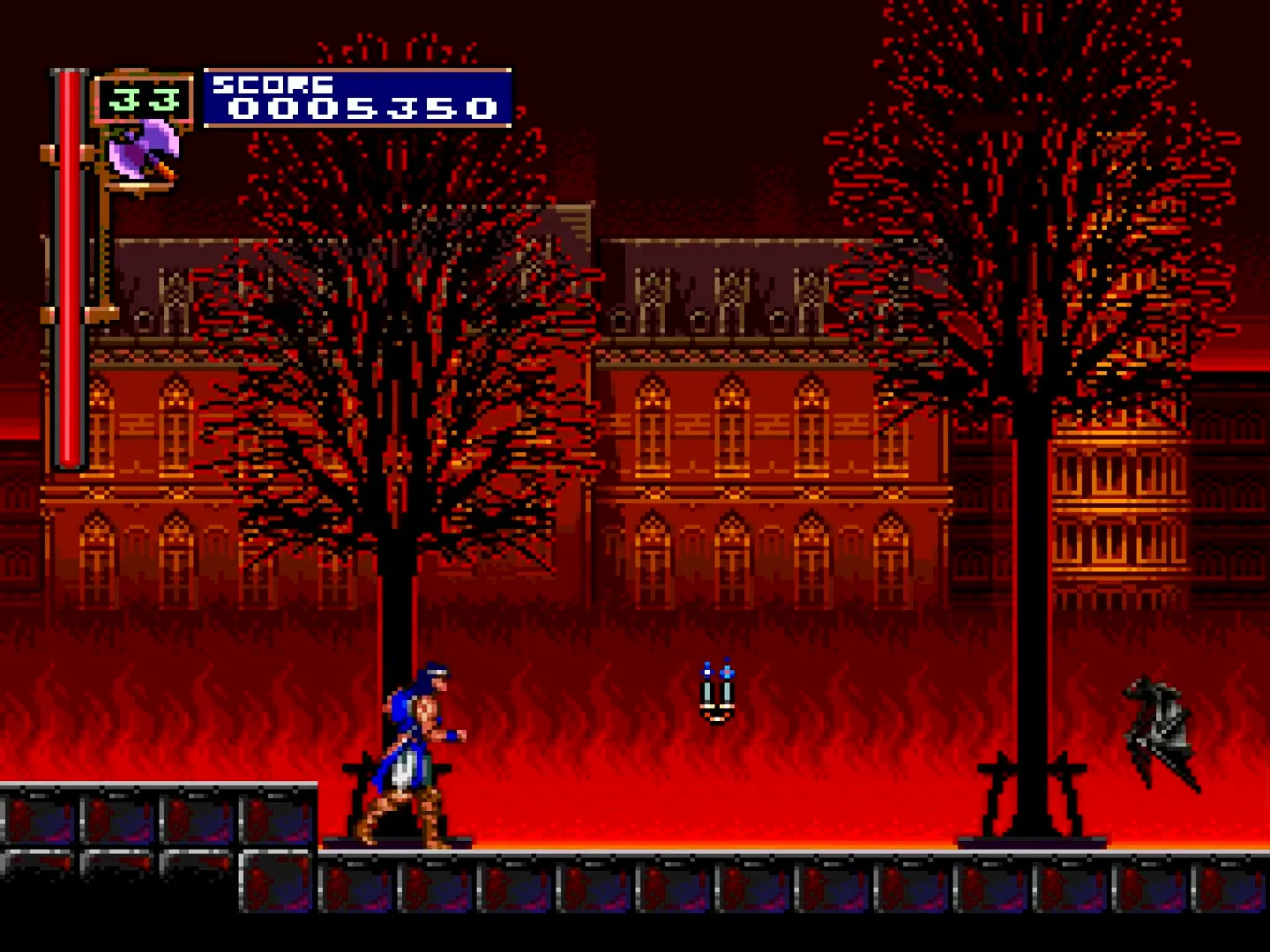
Stage 1’s burning village under live guitar — the first Castlevania level designed against a CD-Redbook soundtrack rather than around a chip score. The visual register is matched to instrumentation the cartridge format had never funded. Castlevania: Rondo of Blood · Konami, 1993.
The score’s emotional vocabulary changes accordingly. Akira Souji’s recorded effects pull the sound design into a register the chip generation could only suggest. Keizo Nakamura and Tomoko Sano’s arrangements weave franchise themes — Vampire Killer, Bloody Tears, Cross Your Heart — into new compositions written for the disc’s bandwidth rather than the cartridge’s. Endo’s GAME Watch retrospective names the Stage 1 theme specifically among Castlevania’s high-water marks; the audience the article addresses, two decades after release, places Rondo’s score in roughly the same shelf as Symphony’s, which is the highest praise a Castlevania soundtrack receives. It is a 1993 disc, played as a 1993 disc, with the period’s most ambitious production budget for what the genre still treated as background music.
Why Now, on a Console It Wasn’t Built For
The route to play this is narrower than it should be. The original PC Engine Super CD-ROM² disc is a collector item priced past honesty; the Wii Virtual Console import release closed when the Wii Shop Channel did; the 2007 PSP Dracula X Chronicles is physical-only and works on a PSP, a Vita via download, or a PlayStation TV with caveats. The currently-purchasable legitimate route, in 2026, is Castlevania Requiem on the PlayStation Store — a digital package that pairs Rondo with Symphony of the Night for nineteen US dollars, frequently under five in sale, and runs on every PS4 and PS5. My Life in Gaming’s careful technical breakdown identifies the underlying emulation as inherited from the PSP version and catalogues the resulting quirks — a persistent screen-tear in the Burning Town’s first screen, a misaligned scanline overlay, a vertical scroll that goes briefly out of sync on a parallax background — but their summary verdict is also the honest one: the games play correctly, the 4K output on PS4 Pro looks sharper than the original disc ever did on a CRT, and “the soul of these games has continued to shine through.” That is the package the article recommends.
What that package gets you, on a Saturday afternoon in 2026, is not a museum piece. It is a Castlevania short enough to finish in a sitting, hard enough to require a real one, with four hidden levels that reward the second run and a secret playable character that recasts the third. It is the apex of classic Castlevania and the first crack of the post-classic one, played in the same evening. The director told you. The producer told you. The Western canon, slowly, is catching up.