CARTRIDGE Collective VOLUME 01 A GENRE HISTORY The Shooting Game Ten Years That Built the Form, 1978–1988 1978 → 1988 CC · V01 £4.99

A Genre History

The Shooting Game

Ten Years That Built the Form, 1978–1988

A Genre History

The Shooting Game

Ten Years That Built the Form, 1978–1988

1978 → 1988

Cartridge
Collective

Volume 01

Contents

4 Pieces

  1. 01
    The Williams Panic Room With Two Joysticks Robotron: 2084
  2. 02
    The Cabinet Taito Sidelined for Blue Shark Space Invaders
  3. 03
    The Aliens That Learned to Break Formation Galaxian
  4. 04
    The Five Buttons That Refused a Joystick Asteroids

Chapter 01

Robotron: 2084

The Williams Panic Room With Two Joysticks

Eugene Jarvis and Larry DeMar turned a passive robot prototype into an arcade room where every instinct competes for the same second. Robotron: 2084 still teaches panic better than almost anything.

Arcade1982Twin-Stick ShooterVid Kidz
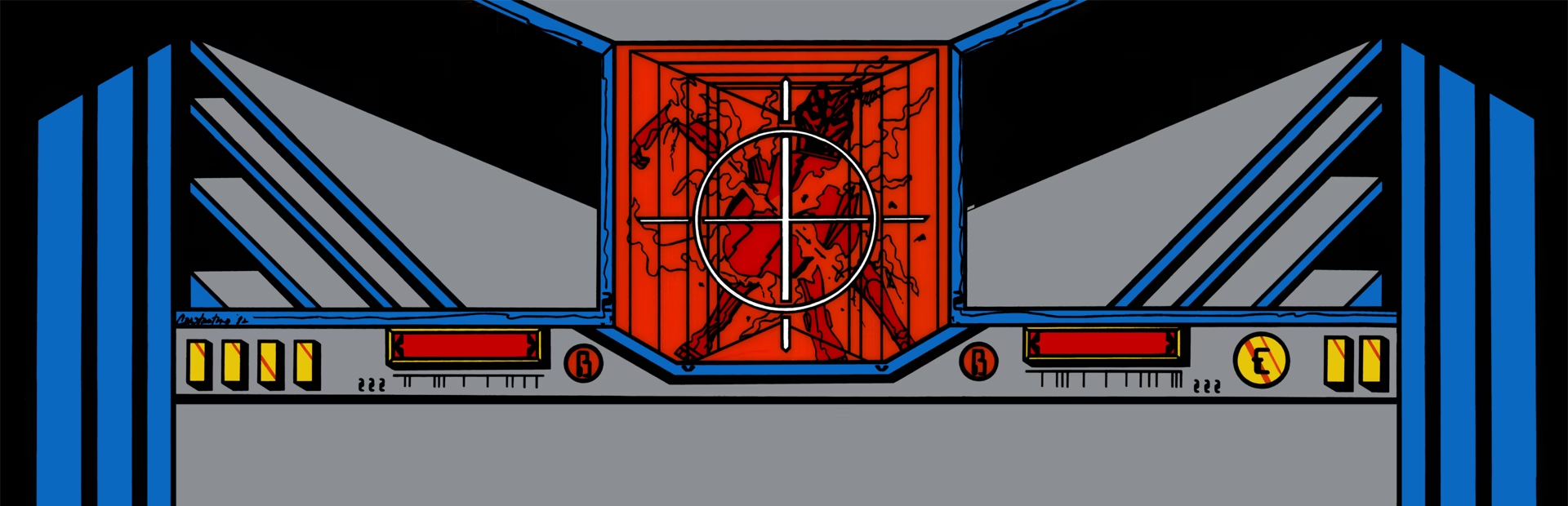
Robotron: 2084 · Vid Kidz / Williams, 1982 · Promotional artwork

The trick in Robotron: 2084 is that every correct move betrays another correct move. Step toward the family member drifting alone at the edge of the room and the Grunts close over the centre. Clear a corridor and an Enforcer turns the safe lane into ricocheting fire. Run from the Brain and the human you meant to save becomes a Prog, which is the game’s way of saying that hesitation is not neutral. Something gets worse while you are thinking.

This is why the twin-stick legacy, useful as it is, has always been too small a box for the game. Robotron is not only important because one joystick moves and the other shoots. It matters because that arrangement lets the cabinet ask two hands to hold incompatible desires at once. One hand wants flight. One hand wants violence. The score wants rescue. The room wants your body. The little black rectangle becomes an ethical disaster rendered in primary colours, and it does all of that before a modern action game would have finished teaching you how to open a door.
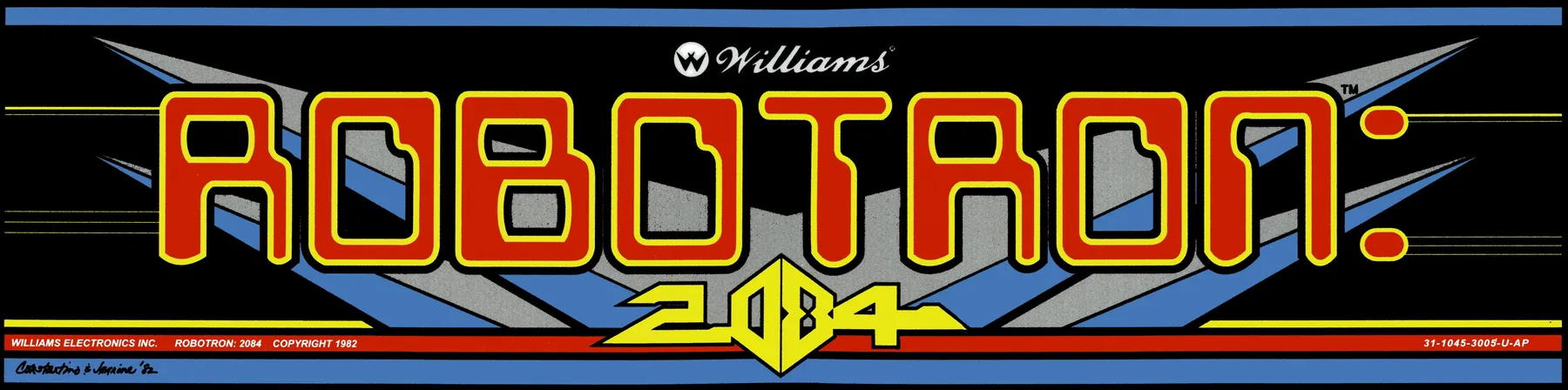
The Robotron: 2084 arcade marquee, with red block lettering over blue, grey, yellow, and black geometric lines.

The Williams marquee gives the game its hard-edged machine glamour before a single wave begins. The cabinet art promises an arcade object, not a home computer simulation. · Williams Electronics, 1982

The Room Closes In

Jarvis had just finished Defender and Stargate, games built around horizontal freedom and a little scanner that made the world larger than the screen. Robotron went the other way. It removed the horizon. It removed scrolling. It placed the player in a single room and let the enemies enter from every border, so the drama was not where to go next but how long one small body could keep multiple disasters apart.

”Robotron is a game about confinement.”
— Eugene Jarvis, Game Developer, 2014

That confinement did not arrive fully formed. The early idea was closer to a passive robot-avoidance game, a descendant of chase-and-lure designs where the player survived by steering danger into itself. It was missing the thing that would make panic expressive. Jarvis, recovering from a broken wrist and irritated by the physical act of repeatedly hammering a fire button, asked the crucial question: why not have two joysticks? Two Atari 2600 sticks were screwed to a board. Movement detached from fire. The room stopped being a trap the player merely endured and became a pressure vessel the player could fight inside.

The difference is not cosmetic. A single-stick shooter makes direction a compromise. To fire left, your body usually faces left; to flee right, you stop shooting left. Robotron breaks that marriage. It lets the player sprint away while firing backward, edge along a wall while cutting diagonals across the room, rescue in one vector and defend in another. The control scheme feels liberating for roughly half a second. Then the game spends the rest of its life proving that freedom creates more obligations.

Two Hands, Five Emergencies

The opening wave reads as an inventory of needs the moment it starts. Rescue, defend, sprint, shoot — the cabinet asks two hands to hold incompatible desires at once. Robotron: 2084 · Vid Kidz / Williams, 1982

Every wave begins as an inventory of needs. The player appears near the centre. Humans blink helplessly around the room. Grunts start walking the shortest route toward you, not smart enough to be elegant and therefore more frightening in a crowd. Hulks are worse because they cannot be killed. They turn rescue into geometry: a wall of moving inevitability that crushes humans, occupies lanes, and asks whether you can route around a thing your bullets cannot solve.

Then the game adds Brains. On paper they are another enemy type. In practice they change the moral temperature of the whole room. A Brain can capture a human and turn that body into a Prog, a fast, murderous version of the person you failed to reach. The conversion is a perfect arcade idea because it needs no cutscene, no dialogue, no sadness performed for you. The game simply changes a rescue target into a killer and lets you feel the cost in your hands.

Tanks and Enforcers make the room noisy with projectiles. Quarks and Spheroids create more trouble. Electrodes sit still and become accidental tombstones. The manual names these things as species and threats, but what matters in play is their job in the panic economy. One enemy makes space collapse. One enemy makes your greed dangerous. One enemy makes the innocent time-sensitive. One enemy makes the safe lane disappear.
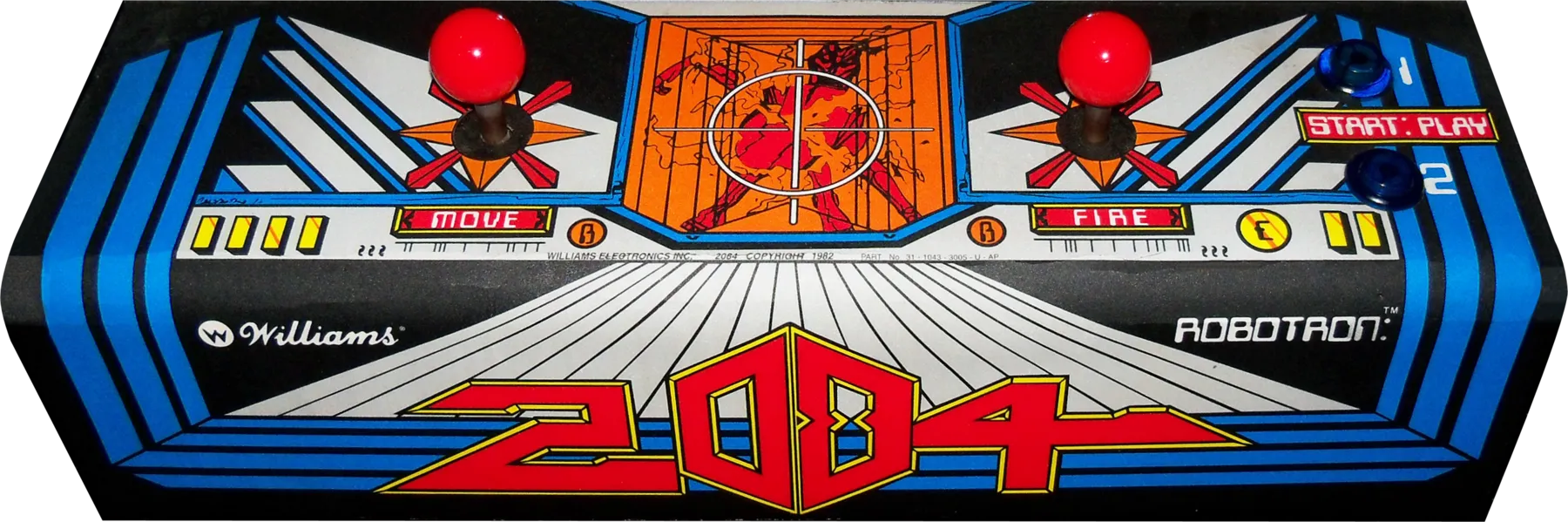
The Robotron: 2084 control panel with two red ball-top joysticks and geometric blue, black, white, yellow, and red cabinet artwork.

The whole thesis in hardware: two sticks, no fire button, no menu logic, no abstraction between intention and crisis. · Williams Electronics, 1982

Modern action games often talk about readable chaos. Robotron is one of the reasons that phrase has a standard to live up to. The graphics are tiny, crude, and ferociously legible. The black field does half the work. Humans, Grunts, Hulks, Brains, Progs, bullets, and obstacles each hold a distinct silhouette and colour role, so the eye can sort the room while the hand is already moving. It looks simple because it has to. The game is too fast to tolerate decoration that does not report a fact.

Panic Has a Soundtrack

There is not much music in Robotron, and that absence is part of its force. The cabinet does not score the scene from a respectful distance. It alarms the room. Player fire rattles like a malfunctioning signal. Human rescues chirp with tiny relief. Human deaths hurt because they are short, ugly, and interruptive. The start of a wave has the feel of machinery waking up badly.

This is not ambience. It is information with a pulse. In a crowded arcade, a loud cabinet had to claim attention from bodies, cigarettes, coins, and other machines. Robotron claims it by sounding as if it is already losing control. The audio tells you what the eyes might miss and then punishes you emotionally for missing it anyway. A human scream from the far side of the screen is the game reaching over your visual focus and pulling it by the collar.

The result is a strange kind of austerity. Robotron is frantic, but it is not maximalist in the modern sense. It does not layer systems to create the feeling of depth. It strips the room down until every noise is a consequence. Rescue has a sound. Failure has a sound. Survival has a sound, though usually it is just the brief lack of dying before the next wave starts.

The Score Is a Moral Trap

The humans are where Robotron becomes more than an exercise in dodging. If the game were only about clearing robots, the optimal desire would be obvious: stay alive, keep shooting, reduce the room. The family members complicate that clean loop. They are worth points. They are also bait. They make you cross unsafe lines and justify foolish diagonals. They are how the game turns score chasing into a story about obligation without ever stopping to tell one.

That matters because Robotron is often remembered as brutal, and it is, but the brutality is not just speed. It is the way the game makes the tempting move visible. There is always a human near danger. There is always a rescue that looks possible if you believe in the better version of yourself. The cabinet understands that players do not die only because they fail to see threats. They die because they see value.

The genius is that the score never sits outside the fiction. To play for points is to behave like the last human defender. To play for survival is to accept that people will be lost. The game gives you no clean division between heroic and sensible. It keeps creating rooms where the right answer changes while you are trying to execute it.

This is why the famous difficulty still feels earned. Robotron is not asking you to memorise a long track and repeat it cleanly. It is asking for continuous triage under uncertainty. Each wave has a texture, but the main skill is not rote route learning. It is threat reading, hand separation, and emotional discipline. The game wants to know whether you can abandon a rescue a fraction before your pride gets you killed.

The Modern Route Back

The easiest official route is not glamorous. Midway Arcade Origins is a broad Xbox compilation from the previous digital storefront era, but it remains available on Xbox One and Xbox Series X|S, and it includes the arcade original in a form that makes sense for a modern player. A controller is not a Williams control panel, but two analogue sticks at least preserve the central grammar: moving and firing as separate sentences spoken simultaneously.

MAME is the preservation fallback, and FPGA cores have made the hardware-simulation path more attractive for people who already live in that world. The cabinet is still the ideal if you can find one maintained properly. Two red ball-top sticks on a heavy panel change the posture of play. You lean into Robotron differently when the machine pushes back through your wrists.
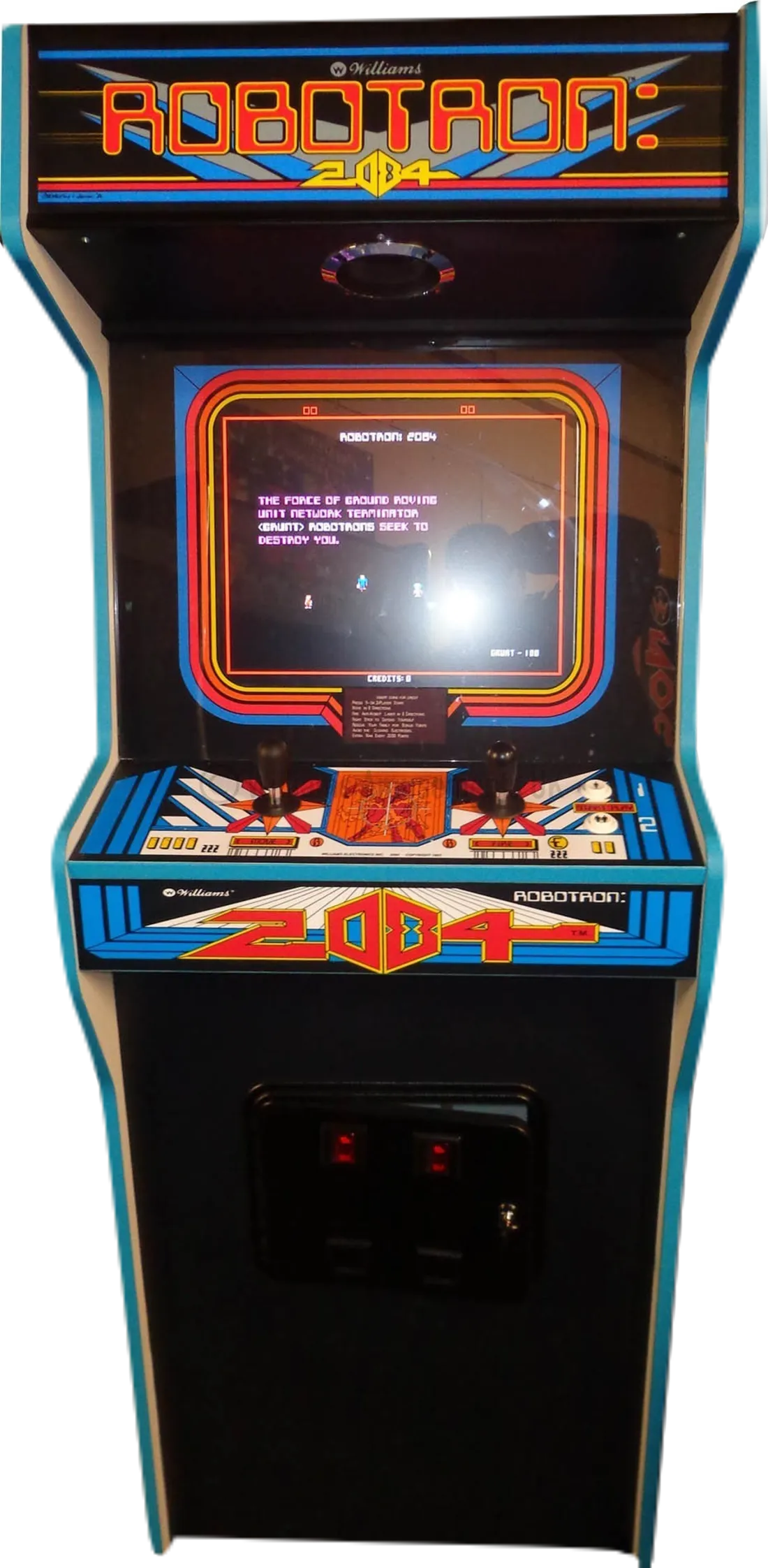
A Robotron: 2084 upright arcade cabinet with the marquee, screen, twin joysticks, and blue-and-black Williams cabinet artwork visible.

The upright cabinet turns the control idea into a stance. It is hard to overstate how much of the game lives in that panel. · Williams Electronics, 1982

What survives across all routes is the same: one room, two hands, too many correct priorities. The descendants are easy to name. Geometry Wars inherits the neon arena. Nex Machina inherits the rescue panic. Whole waves of survival games inherit the crowd-reading pleasure. But Robotron remains sharper than many of its heirs because it refuses to widen the frame. It has no upgrade build to soften a bad decision. No unlock tree to launder failure into progress. No story scene that forgives you for needing a break.

That sounds severe until the game starts moving. Then severity becomes rhythm. You learn to breathe through the first swarm, cut the room open, hear the rescue chirp, refuse the bad rescue, take the good one, and fire backward while your body runs forward. The pleasure is not nostalgia. It is the moment when panic stops being noise and becomes a playable instrument.

Cartridge Collective 1982 · Arcade

Where to play

Why Now

The twin-stick control is only the doorway — Robotron is a pure crisis of priorities, rescue and survive on one screen that never idles.

Best way to play now Midway Arcade Origins on Xbox

The cleanest current official route: the arcade original in a Williams-heavy compilation, playable on modern Xbox hardware with a controller already built for independent movement and fire.

Time
0.5h
Cost
$19.99

Alternatives

  1. 01
    simulation

    MiSTer / Analogue Pocket openFPGA

    The Williams 6809 arcade core route, if you want the feel of hardware-level recreation without owning a cabinet.

  2. 02
    emulation

    MAME

    The preservation fallback. Pair it with two tight digital sticks, or a modern pad if you are accepting the ergonomic trade.

  3. 03
    original

    Original Williams cabinet

    The definitive form: two red ball-top sticks, a 19-inch CRT, and Williams' alarm-call sound pouring out of a black-and-blue upright.

1982 · Vid Kidz

Listen

  • Robotron: 2084 - original arcade audioWilliams Electronics / YouTube No long score, no comfort loop: just sirens, pulses, screams, player fire, and the cabinet's constant insistence that something important is being lost.

Watch

  • Robotron: 2084 arcade gameplayOld Classic Retro Gaming / YouTube A useful full-credit view of the arcade game. Watch the first Brain wave and the whole design snaps into focus: rescue is not a bonus, it is another threat vector.

Read

  • The singularity beckons: a classic Robotron: 2084 postmortemGame Developer, Mike Rose, 2014 Eugene Jarvis on the GDC postmortem stage, describing the game's birth from confinement, pain, and the moment two joysticks made the prototype wake up.
  • This game industry pioneer never gave up on the video arcadeWired, Chris Kohler, 2013 Jarvis on the physical origin of the twin-stick control scheme, including the broken wrist story and the Atari 2600 joysticks screwed to wood.
  • A retired Microsoft engineer is training an AI to master Robotron: 2084PC Gamer, Rich Stanton, 2026 A contemporary reading of Robotron as a stress test for real-time decision-making, with Jarvis reflecting on why the game breaks finite human attention.
  • Robotron: 2084 instruction manualWilliams Electronics, 1982 Primary operator documentation: controls, enemy names, scoring, cabinet setup, and the official language around the Robotrons.
  • Robotron: 2084MobyGames Release data, credits, platform lineage, and the clean confirmation that Midway Arcade Origins contains the arcade original.
Chapter 02

Space Invaders

The Cabinet Taito Sidelined for Blue Shark

The canon remembers a national craze and a coin-shortage panic. The Japanese-side record describes a game Taito hid behind its real summer bet — and a back-half speed curve that still bites.

Arcade1978Fixed ShooterTaito

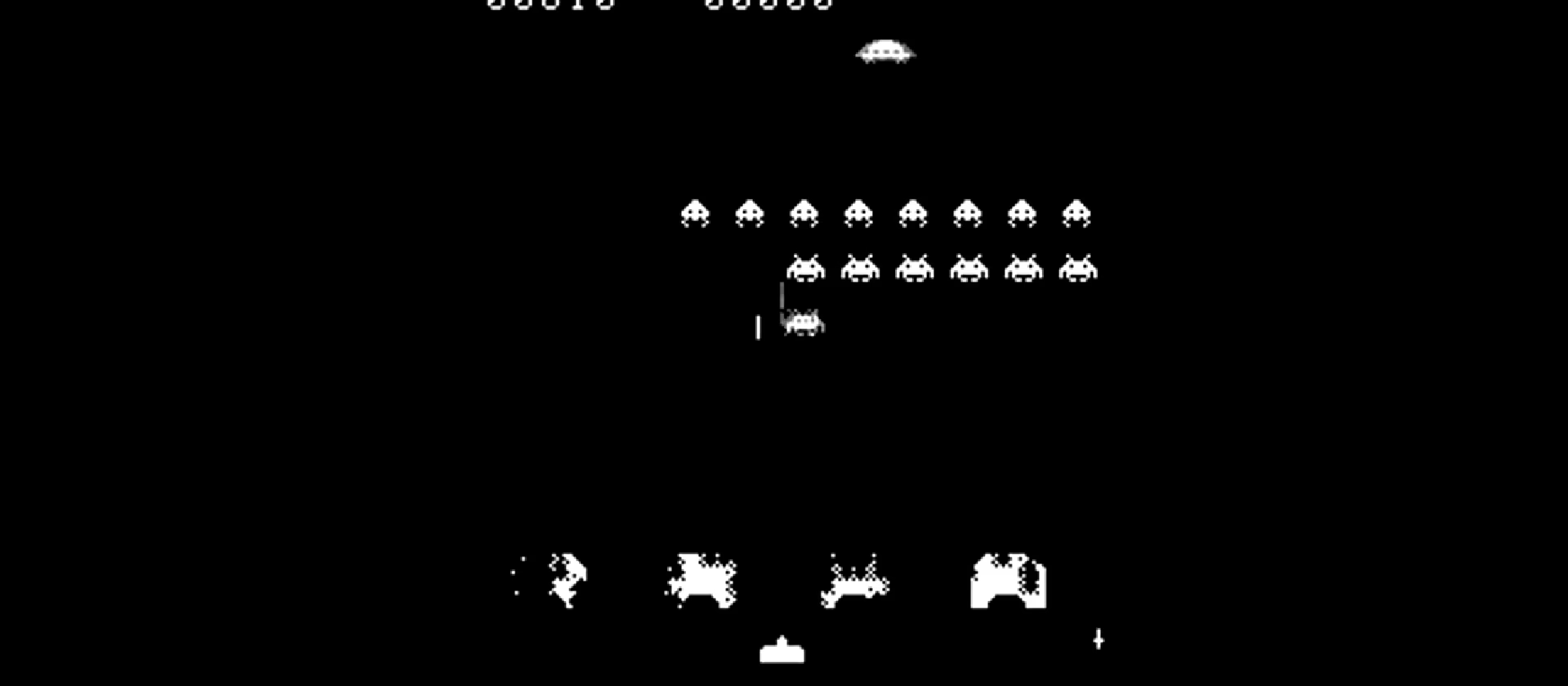
Space Invaders · Taito-8080 board, 1978 · monochrome CRT

// import firstWavePoster from ”../../assets/images/space-invaders-1978-first-wave-poster.jpg”; // deleted

// import speedCurvePoster from ”../../assets/images/space-invaders-1978-speed-curve-poster.jpg”; // deleted

// import barrierEndgamePoster from ”../../assets/images/space-invaders-1978-barrier-endgame-poster.jpg”; // deleted

Wave four onwards, the cadence shifts. The four-note loop that opened the credit at a heartbeat starts to sprint, the last two columns close on the barriers faster than the first eight ever did, and the hands learn that the difficulty isn’t waiting for the next level — it’s already arriving, half a row at a time, getting closer. The canon doesn’t quite explain this, because the canon explains the wrong things.

What the canon explains is a national craze and a coin-shortage panic — the version of Space Invaders assembled in retrospect, mostly in English, mostly in the early eighties. The Japanese-side record describes something quieter and stranger. Taito hid the game behind its real summer bet. Arcade operators called it too hard. The famous mint crisis never quite happened. And the thing the back half of a credit does to a modern player’s hands turns out to be the actual reason any of this still matters.

What the Back Half Feels Like

A wave starts as a pattern recognition exercise. Five rows of eleven, descending in lockstep, the bottom row a footstep ahead of the others. The barriers below sit in their starting silhouette — four mushroom shapes, intact. The four-note descending bass loop sets a cadence the speed of unhurried walking.

It is genuinely slow. Modern players who quit at this point conclude they’ve understood the game; they haven’t even met it. As the formation thins, the CPU has fewer sprites to render per frame, and the survivors update faster. The bass loop tightens accordingly — the same four notes, but compressed against shorter intervals. By the time twelve invaders remain, the cadence has stepped from a walk to a brisk jog. By six, it’s a sprint. By two, the surviving sprites cross the playfield at a pace that turns the player’s eight-pixel-per-frame ship into a problem of intercept geometry rather than aiming.

This is the design that buys Space Invaders its present tense. The barriers are destructible from both sides, and a credit-long session leaves them as period diagrams of where the player has been standing — a permanent stain of intent on the playfield. The descending bass is the first piece of game music that answered the game’s state, decades before anyone called that dynamic audio. And the speed curve is the first time difficulty in a video game was authored as a continuous accelerating function rather than as a sequence of discrete level boundaries. None of these were standard practice in 1978. None of them are absent from any current arcade-style shooter.

Blue Shark Was the Headline That Summer

What Taito unveiled to the trade in June 1978 wasn’t this game. The event’s headline cabinet was Blue Shark, a periscope-style underwater shooter that management believed would carry the company through the second half of the year. Michiyuki Kamei, the sound designer, spent four to five months on Blue Shark’s audio circuitry and was hurried into producing the four-note descending bass for Space Invaders in the gaps — the latter ready, just barely, in time for the same demonstration.

The arcade operators who came to the demonstration backed Taito’s read on the room. Space Invaders drew shrugs. The complaint that has survived in Tomohiro Nishikado’s interviews from the Game Maestro book onward is that the game was simply too hard — that the operators couldn’t see who, exactly, was going to play long enough to reach a kill screen and accordingly couldn’t see how a cabinet of this thing would justify the floor space.

The trade reception got harder still after the unveiling. Nishikado has been steady, over forty-five years of interviews from the Game Maestro recollection in 2000 to the Time Extension piece in 2025, about what Taito’s own sales department thought of the format. They were, he said in 2025, “always saying that ‘these things will never sell.’” The prototype home console he built around the same period — a console Taito could have entered the consumer market with, ahead of the Famicom, ahead of every Japanese competitor — was killed by exactly that scepticism. It is one of those counterfactuals that historians prefer not to dwell on, because the alternative timeline it implies is unbearable.

”Their reception was also unfavorable. They said it was too difficult.”
— Tomohiro Nishikado, Game Maestro, c. 2000

What turned the operators around was the takings. By the autumn the cabinets that had been pushed in front of Blue Shark were the ones the route operators wanted, in numbers Taito’s production line could not initially meet. The pivot was driven by collection-day arithmetic, not by the marketing surrounding the unveiling, and by then nobody had to argue for the game in the room — the coin boxes did the arguing on its behalf.

The Six-Month Soldering Job

The cost of professional development tools in 1978 was, in Nishikado’s recollection, ten million yen — roughly a hundred thousand dollars at the period exchange rate, more than Taito was prepared to spend on a project whose commercial logic the sales team did not understand. So Nishikado bought LSI chips and soldered the development environment together on his bench. The work took six months. It was the work before the game.

He had wanted tanks for the enemies. “But the thing about tanks is, if their cannons aren’t facing forward, I don’t think they look cool” — and the 8080’s sprite system could not render sideways tracks smoothly enough to keep the rotation legible. He considered fighter planes next; planes had the same problem in the opposite direction, since the smooth horizontal sweep he wanted was beyond the hardware’s frame budget. Aliens were the third choice, and they survived because the hardware’s failure modes flattered them rather than betraying them. Vertical herky-jerky movement, sudden one-pixel descents, lockstep formation — none of these looked wrong on a creature whose locomotion the audience would invent for itself. The iconography of the most-copied arcade silhouette of all time is downstream of an 8080’s render budget.

The CRT inside the cabinet showed white pixels on black. The colour you have seen photographed on every original cabinet — the green ground stripe, the band where the UFO crossed in red — was supplied by strips of cellophane taped to the inside of the monitor glass, with a moonlit star-field painted onto a backing plate behind a half-silvered mirror to fill the upper third of the play area. The game ran in monochrome and was sold as colour. By the time the speed-up bug arrived, it had become part of the design: the CPU rendered the surviving formation faster as the wave thinned, and rather than spend cycles correcting for it, Nishikado decided the artefact was the rhythm the game wanted. The most consequential design decision in arcade history started life as the consequence of not enough silicon.

What the Mint Actually Minted

The version of the Space Invaders boom that ran in the British press in 1980 and survived into Martin Amis’s Invasion of the Space Invaders in 1982 turns on a single image — the Japanese Mint tripling its production of one-hundred-yen coins to feed the cabinets. It is one of those facts everybody knows. It is also wrong.

The actual production figures, audited by Daniel Paradis against Mint records and Bank of Japan statements, are uncooperative. In 1977, the year before the cabinets went out, the Mint struck 440 million hundred-yen coins. In 1978, the year of the unveiling, the figure was 292 million — a drop. In 1979 it rose to 382 million; in 1980, to 588 million. There is an increase across the period; there is nothing remotely resembling a tripling, and the gentler rise the numbers do show is well-documented Bank-of-Japan policy aimed at countering the hoarding of older coins, not arcade demand. When Paradis contacted both institutions directly, neither could produce any record of a Space Invaders-attributable coin shortage.

”The only defining word for this report is exactly that — unbelievable.”
— Daniel Paradis on the 1980 New Scientist coin-shortage article, Insert Coin to Play, 2013

The myth’s proximate source is a New Scientist piece from January 1980 that travelled fast and was never checked. By 1982 Amis had it as fact, and the English-language history of the game has carried it ever since. The boom was real — Invader Houses, dedicated single-cabinet arcades, opened across Japan in 1979 and 1980 and disappeared inside two years — but its proper subject is a market discovering that an interactive medium could sustain that kind of repeated transaction, not a national mint operating under crisis. The thing that’s most striking about the popular story is the size of the gap between the documentary record and the version of events the documentary record allegedly attests to.

The First Beat of a Decade

The reason any of this still matters is that the three design ideas the game introduced — destructible cover, dynamic music keyed to game state, difficulty as a continuous accelerating curve — became the structural floor of the genre that followed. Galaxian in 1979 added formation depth and divebombing attack patterns. Defender in 1981 gave the horizontal axis full scrolling and a minimap. Xevious in 1982 split air and ground into layered planes. Gradius in 1985 built a power-up economy on top. R-Type in 1987 generalised the speed-curve principle into entire stages designed as accelerating pressure tests. By the end of the decade the genre that Taito’s sales team had spent the summer of 1978 dismissing as “these things” was the medium’s most economically productive form, and every one of its later landmarks was built on a foundation Nishikado had laid alone, by hand, in monochrome, against advice.

It is tempting, looking back, to file Space Invaders as a museum piece — the proto-thing, the one before the ones that mattered. The cabinets in the Invader Houses are gone; the cellophane has yellowed in the few originals that survive; the New Scientist coin story has outlived its corrections by four decades. But the credit you can buy on a Switch in a 2026 sale for less than the price of a coffee still runs the same routine, and on the fourth wave the bass loop still tightens, and the hands still discover that the difficulty in front of them is not waiting at a level boundary but is already half a row away and arriving. That part hasn’t aged into history. That part is what the medium learned how to do here.

Cartridge Collective 1978 · Arcade

Where to play

Why Now

Wave four onwards the four-note loop tightens to a sprint, the last two columns close on the barriers faster than the first eight, and difficulty stops being a sequence of levels and becomes a continuous accelerating function.

Best way to play now Arcade Archives Space Invaders

HAMSTER's reference TAITO-8080 ROM at the correct refresh, with the speed-up curve intact. The mirror-and-cellophane optics of the original cabinet cannot be reproduced any more honestly on a flat panel than this.

Time
0.5h
Cost
£6.29

Alternatives

  1. 01
    modern

    Space Invaders Invincible Collection (Switch)

    Bundles the 1978 ROM with descendants up through Extreme — useful as the arc of the genre's first decade in one package.

  2. 02
    simulation

    MiSTer (Arcade core, TAITO-8080)

    FPGA-accurate reference for the speed curve. The cleanest route if you care about cycle-accurate alien acceleration.

  3. 03
    emulation

    MAME (TAITO-8080 driver)

    Load the ROM without the overlay artwork to see the actual black-and-white screen the Taito sales team saw in June 1978.

1978 · Taito

Listen

  • Space Invaders — original arcade audioMichiyuki Kamei / Taito, 1978 Four descending diatonic bass notes plus shot, hit, and UFO effects. The looped bass accelerates with the invader count — gaming's first dynamically-paced soundtrack. No streaming-service release exists; the YouTube audio capture is the cleanest reference available.

Watch

  • Space Invaders (SV Version rev 4) arcade longplay
  • Tomohiro Nishikado on building Space Invaders

Read

  • Tomohiro Nishikado — Game Maestro developer interview
  • Nishikado · Wada — Space Invaders 30th Anniversary interview
  • Tomohiro Nishikado on Space Invaders, 2025
  • Daniel Paradis — Insert Coin to Play: Space Invaders and the 100 Yen Myth
  • Keith Smith — Video Game Myth Busters: The Space Invaders Yen Shortage
  • Karen Collins — From Pac-Man to Pop Music

Chapter 03

Galaxian

The Aliens That Learned to Break Formation

Namco's answer to Space Invaders let its enemies leave the grid — choreographed attack behaviour as a design principle, and the RGB sprite hardware to render it, both in one September 1979 cabinet.

Arcade1979Fixed ShooterNamco

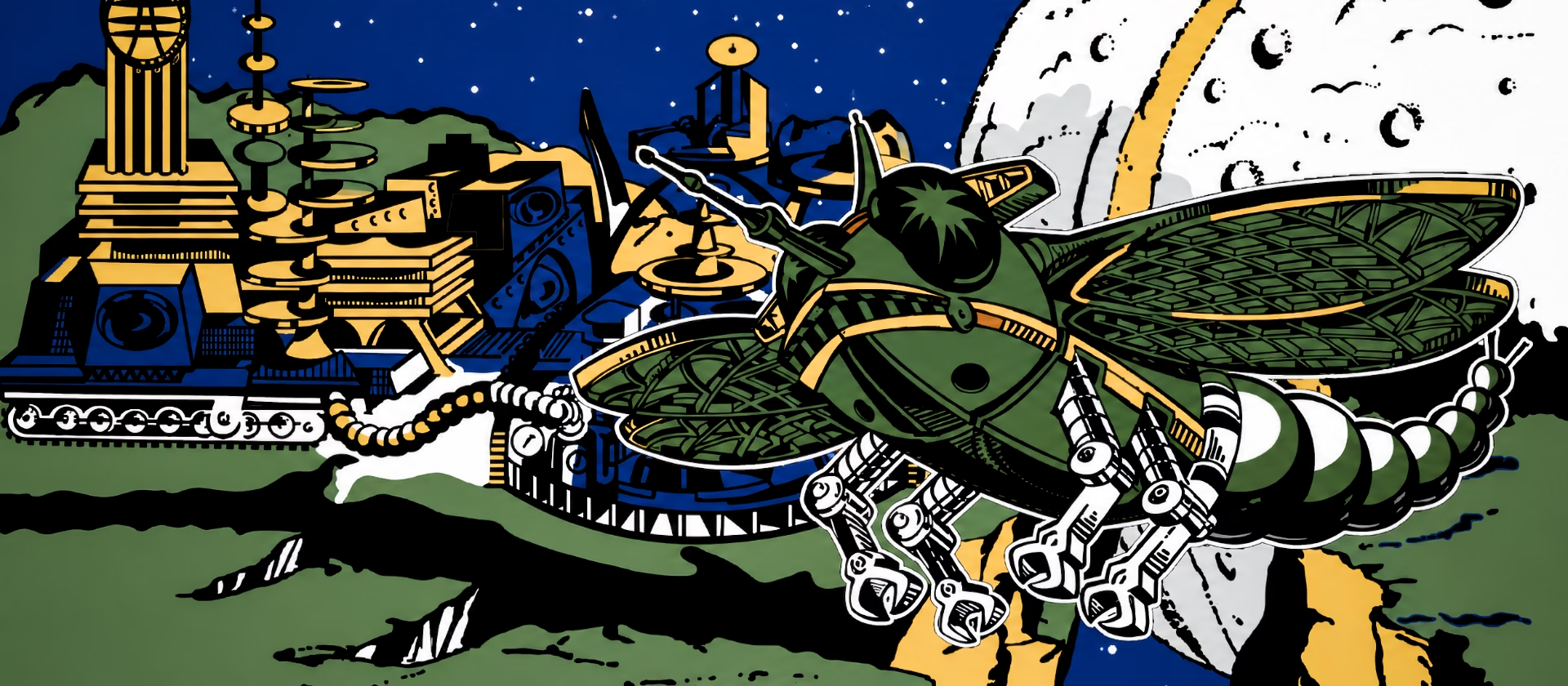
Galaxian cabinet side-art · Namco / Midway, 1979

// // import swarmDivePoster from ”../../assets/images/galaxian-1979-swarm-dive-poster.jpg”; // deleted // deleted

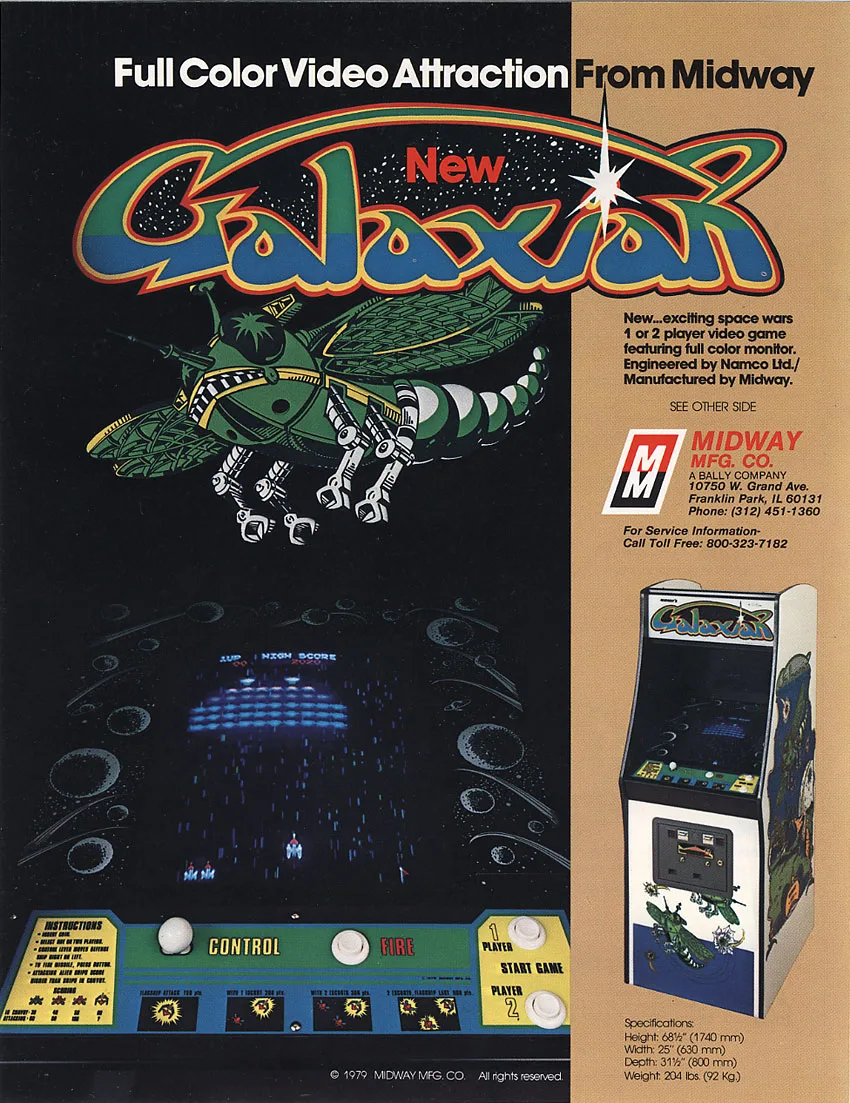
Midway's 1979 Galaxian sales flyer. A green dragonfly-like alien swoops in front of the Galaxian logo against a starfield. 'Full Color Video Attraction From Midway' across the top. The cabinet illustrated in the lower right.

The 1979 Midway operator flyer. Note the headline: Full Color Video Attraction — RGB sprites were a selling point an operator could put on a shop poster. · Midway Mfg. Co., 1979

Space Invaders’ aliens did not attack. They advanced — left, right, drop a row, left, right — and the player advanced into them. Eleven months later, in September 1979, Namco shipped Galaxian, and the aliens at the top of the screen began to leave the grid. One peeled off, slanted down trailing fire, then another, then a flagship and its escorts in a tight diagonal sweep. The wall was still there. The wall now had behaviour.

That behaviour is what Galaxian introduced to arcade games. Choreographed enemy attacks — individual flight paths, sprites that acted instead of marched — became the design grammar every later shoot-‘em-up worked inside. The cabinet also introduced the hardware that made the choreography legible: the first true RGB-colour arcade board, the first to render multi-coloured sprites over a scrolling tilemap. Both shipped together. Both got copied — the design idea quickly, the hardware slowly, until eventually Nintendo built a console on top of it.

Post-Invaders, By Order of the President

The brief came from above. Space Invaders had reached Japan in summer 1978 and produced, by spring 1979, the arcade-industry phenomenon that the country’s coin-op trade still measures other phenomena against. Namco’s president Masaya Nakamura, watching Taito take the market Namco’s electromechanical division had been chasing for a decade, told his engineers, in the words of the planner who eventually carried the project, that the next game out of the company had to be the post-Invaders game. The pressure was not subtle. Kazunori Sawano, who had spent the back half of the 1970s designing Namco’s shooting-gallery arcade pieces — Shoot Away, Periscope — was given the role and a small team.

”The post-Invaders arcade scene belongs to Namco! — that was the goal we set, and the pressure riding on us with the development of Galaxian.”
— Kazunori Sawano, Galaxian developer interview, 1985 (trans. Shmuplations)

Sawano had carried the concept for six months before development started. The inspiration he names is Star Wars: not the dogfights specifically but the feeling of a war in space, ships acting against ships, a battlefield with depth and movement. Space Invaders was a wall. Galaxian would be a battle. The two propositions look similar on a marketing flyer and different inside the code. Where Space Invaders had a single state machine moving the entire row of aliens together, Galaxian needed every alien on screen to be addressable as a small program of its own — a path to follow, a moment to launch, a curve to fly.

The team was small. Sawano planned; Kōichi Tashiro programmed; Shigeichi Ishimura handled hardware. Space Invaders came out partway through their development, and the pressure landed. They had until late summer to deliver something that would be measured directly against Taito’s machine. They delivered on 15 September 1979.

The Gorgs Learn to Dive

What the cabinet does, mechanically, is simple to describe. A formation of forty-two enemies — Gorgs, in Namco’s manuals — fills the upper half of the playfield in four colour-coded ranks. Yellow flagships at the top, escorted by red commanders. Below them, purple emissaries; below those, blue scouts. The player ship sits at the bottom on a single axis of movement and fires one bullet at a time. So far, Space Invaders. Then the dive begins.

A Gorg peels off the grid and curves down toward the player on an individual flight path. The path is not the same path the alien beside it would have flown — each enemy carries its own trajectory data — and the speed escalates with the wave. The flagships, the yellow ones at the top, dive escorted: two red commanders flying tight beside them. Hit the flagship while its escorts are still alive and the score multiplier ladders up sharply. Hit it cleanly with a full escort and the cabinet pays out a fanfare that rises across two octaves. The game is teaching, with payouts, that the choreography it has invented is the entire point.

This is what the individual personality claim, repeated about the game for forty years, meant inside the code. Each Gorg is a small actor. It is in formation when the wave begins; it has a moment at which it leaves; it has a curve to fly down and a curve to fly back up; it has a behaviour at the bottom of its arc, which is to fire and pull. Nothing was acting in arcade games before this. Things were moving — bouncing, sliding, advancing in lockstep — but the difference between a ball that bounces and an alien that chooses a moment to dive is the difference between a physics simulation and a piece of theatre. Galaxian found the second register first.

The friction in the cabinet, today as in 1979, is bullet capacity. You fire one shot at a time, and the shot has to clear the top of the screen before you can fire again. A Gorg in mid-dive often does not present a clean target window long enough for one bullet to land cleanly. The temptation, learning the game, is to spray. The cabinet punishes that immediately. What it asks is for the player to choose which curve, in the choreography unfolding above, will pass through the muzzle. The cabinet is, in 1979 terms, a game about reading attack patterns — a phrase that did not yet exist as an idiom and would not for another decade.

The Hardware That Built Nintendo

The reason a flagship and two escorts can dive on a tight diagonal trail, all three rendered cleanly, all three in different colours, is hardware Ishimura built specifically to make sprites cheaper than Space Invaders had made them. The Namco Galaxian board was the first arcade hardware to use a true RGB-colour video path and the first to combine a tile-based scrolling background with multi-coloured hardware sprites. Space Invaders drew every alien into a framebuffer the CPU rewrote every frame. The Galaxian board kept the background in tile memory and the moving objects as sprite primitives, each addressable by position and animated independently. The economy of the trick is large — sprite-and-tile rendering needs a fraction of the memory bandwidth a framebuffer of the same resolution would — and it is also why the screen could afford to be black and full of colour-coded actors instead of a single off-white field of identical sprites.

The downstream is the part of this story that hides in plain sight. Masayuki Uemura, the lead engineer for Nintendo’s R&D2 group, has named Galaxian’s hardware specifically as the basis for what his team built next. The board influenced the architecture of Radar Scope, the Nintendo cabinet that arrived in 1980; the same architecture became the chassis for Donkey Kong in 1981; the same lineage of sprite-and-tile thinking ran through Nintendo’s arcade hardware into the Famicom in 1983. The Famicom is the Galaxian board’s design philosophy taken into the home, four years later. Without the demonstration in Galaxian that you could render a screenful of independently-moving coloured sprites on commodity hardware, the console that followed would have been a different machine, and the half-decade of arcade ports that defined the early home market would have been a different conversation.

This is the reception gap. Galaxian is remembered as the game Galaga improved on — a stepping stone toward the genre’s second cabinet two years later. What it was, looked at squarely, was the cabinet that proved the architecture every subsequent Nintendo and Namco arcade machine built on. Galaga is Galaxian on the same board, refined. The decade and a half of Nintendo-published console hardware that followed are Galaxian on different boards, refined further.

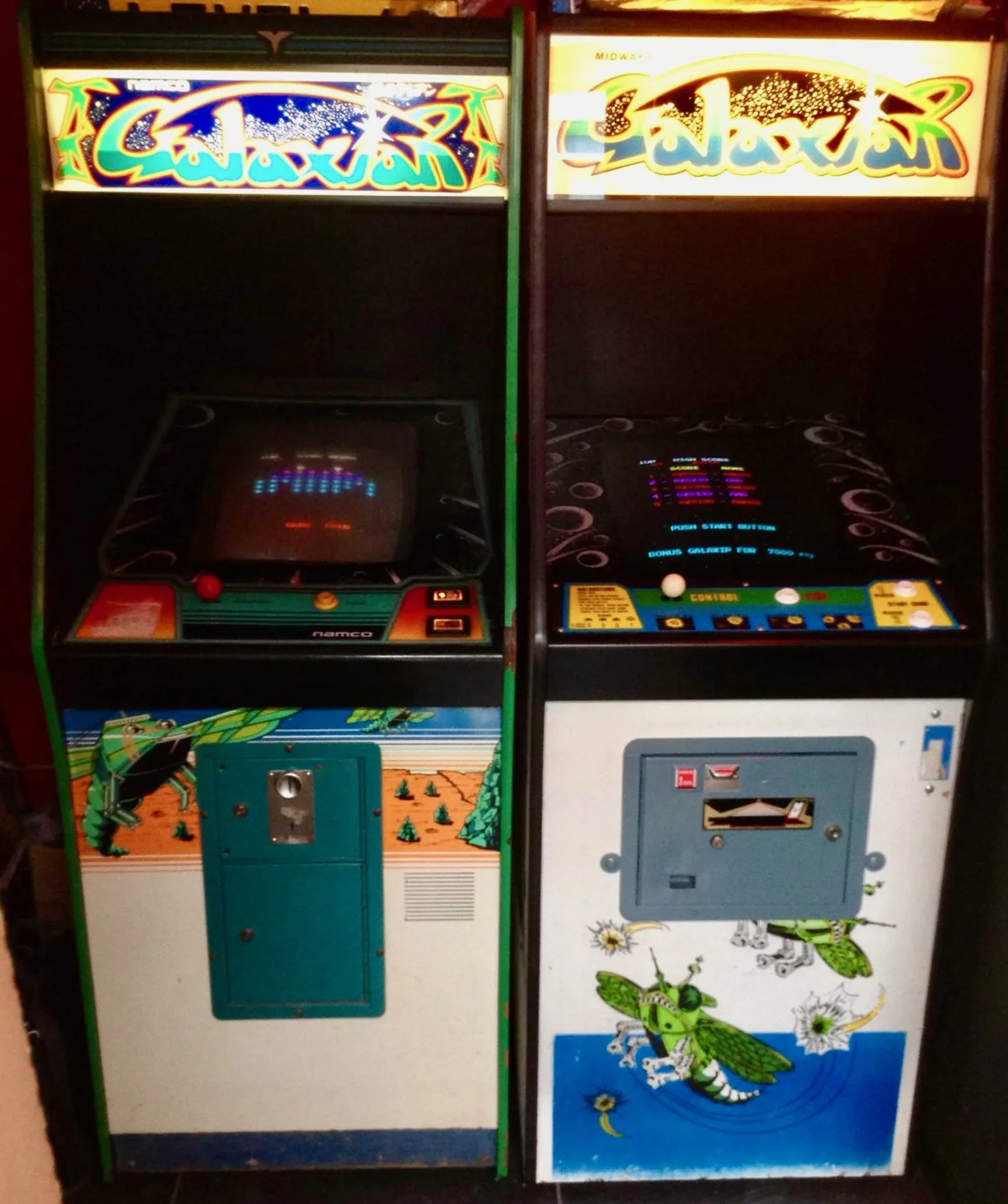
Two Galaxian arcade cabinets side by side. On the left, the original Namco upright from Japan: a black machine with a wraparound green-and-blue painted side panel showing a grasshopper-style alien and trees. On the right, the Midway USA upright: a white machine with a blue control panel and a smaller side-panel illustration of two green Gorg-like aliens above a tin.

The original Namco upright (left) beside the early Midway US machine (right). Same board, same game, different sales argument: Namco painted the alien as an insect threat in a wraparound mural; Midway abstracted it into a marquee illustration over a plain white cabinet. · Namco, 1979 / Midway Mfg. Co., 1980

Sound Engineered by Argument

Sawano remembered the audio specifically as the part of the cabinet he spent the most time on. The Namco hardware did not generate music — there is no soundtrack to Galaxian in the way later arcade machines have soundtracks. What it generates is a small library of cues: the rising whine of a Gorg leaving formation, the chirped tone of a bullet, the explosion cluster of a hit flagship, the rising scale of a perfect escort kill, the constant low pulse of the formation’s collective movement. Each cue carries information the player needs: which kind of enemy is diving, how many escorts are alive, whether the multiplier ladder is still climbing.

Sawano’s account of how the cues were arrived at is the texture under everything else.

”The sound effects, in particular, were something I really laboured over. I would explain my ideas to the sound effects guy, and he would create something and bring it back to me. I’d say, ‘this is a little off,’ and then try to find other words to explain the image I had — this back-and-forth process went on for a while.”
— Kazunori Sawano, 1985 (trans. Shmuplations)

This is how you make a cabinet that reads as choreography. The visual side of the dive — the path, the colour, the formation breaking — needs a corresponding signal in the audio that the player processes before they have time to read the image. The escort fanfare especially does this. Hit a flagship clean with its two reds still flying and the cabinet rewards you with a rising arpeggio that anyone within twenty feet of the machine hears as that player just did the thing. The audio is teaching the room as well as the player. In a 1980 arcade — loud, crowded, competing — the cues had to carry through everything else. They were tuned, by argument between Sawano and his audio engineer, until they did.

Why the Grid Still Holds

Forty-six years on, the cabinet still rewards what it was built to reward. Wave one introduces the dive vocabulary in slow time. Wave two raises the frequency. By wave four the screen is in constant motion, two or three Gorgs in flight at any moment, and the player is reading the field as a continuous attack-pattern problem rather than a wave-clear problem. The loop is short and tight. Two minutes will tell a modern player whether the cabinet is for them. Six minutes will tell them whether they have begun to read the choreography it asks for.

What the game gives now, that almost nothing else does in this clean a form, is the visible birth of an idea every later shoot-‘em-up takes for granted. The dive-bomb is the design unit. The escort multiplier is the first real reward loop for learning a pattern rather than clearing a screen. The colour-coded ranks are the first sprite-level use of palette as information. Nothing in the cabinet is decorative; everything is the demonstration. Galaga, 1942, Raiden, Ikaruga, Resogun — every game in the line is variations on the curve a Gorg flew down the right side of a Namco cabinet in September 1979. The original is still the place you can see the curve for what it was when it was new.

The Midway Galaxian arcade marquee. The rainbow-outlined GALAXIAN logotype curves across a black starfield, a small star spark at the right; 'MIDWAY'S' at top left, 'a [Bally] co.' at top right.

The Midway cabinet marquee. The rainbow-outlined logotype against the starfield was the cabinet’s pitch in one image: full-colour space, in 1979. · Midway Mfg. Co., 1980

Cartridge Collective 1979 · Arcade

Where to play

Why Now

A dive-bomber peels out of formation trailing fire — the first arcade game where enemies acted instead of marched, and the clearest demonstration of why.

Best way to play now Arcade Archives: Galaxian (Switch / PS4 / PS5)

Hamster's port of the original Namco PCB — accurate refresh, original soundtrack, the rotated portrait playfield preserved as the dominant aspect. The closest a modern player can get to the September 1979 cabinet without owning one.

Time
0.5h
Cost
£6.29

Alternatives

  1. 01
    simulation

    MiSTer FPGA — Galaxian core

    Gate-accurate Namco Galaxian board on FPGA. The CRT scanlines and arcade audio path are reproduced rather than emulated, which is where the dive-bombs read at their tightest.

  2. 02
    emulation

    MAME

    Set 1 of the original Namco ROM is fully supported and well-documented. Pair with a digital joystick for the tap-fire cadence the cabinet was built around.

  3. 03
    original

    Namco upright (1979) or Midway upright (1980)

    The Namco machines are uncommon outside Japan; Midway uprights surface regularly in US auction listings. Side art differs sharply between the two — see the photograph below.

1979 · Namco

Listen

  • Galaxian — Arcade Soundtrack (Namco, 1979)Namco / YouTube The full audio set from the original PCB — attract tones, the rising dive whine, the explosion clusters. There is no album release; the cabinet itself is the master.

Watch

  • Galaxian — Arcade Gameplay (Namco set 1)Recorded Amiga Games / YouTube A fourteen-minute run on the original Namco set. Useful for watching the dive frequency escalate wave by wave — the design ramp is steeper than memory of the game suggests.
  • Galaxian — Hardware That Changed Video GamesThe History of How We Play, 2021 Written rather than filmed, but the clearest single explanation of how the Namco Galaxian board's tile-and-sprite architecture changed what arcade hardware could afford to render.

Read

  • Galaxian / Galaga 30th Anniversary Developer InterviewShmuplations (trans. from 1985 Namco interview) The primary developer-voice source: Sawano on the pressure to make the post-Invaders game, the sound-effects argument loop, the design choices that became Galaga. Translated from a 1985 Japanese interview.
  • Galaxian — The Hardware That Changed Video GamesThe History of How We Play, 2021 Technical retrospective on the Namco Galaxian board: tile-based rendering, multi-colour sprites, the move away from Space Invaders' framebuffer. Includes Masayuki Uemura's account of why Nintendo built on top of it.
  • Galaxian — The Dot EatersThe Dot Eaters Sawano's own development account stitched together with contemporaneous Namco team material. The clearest English-language narrative of how the project was assembled and what the brief was.
  • Galaxian — Arcade Flyer ArchiveTAFA / The Arcade Flyer Archive Scans of the 1979 Midway sales flyer. Worth reading as a period sales document — *Full Color Video Attraction From Midway* was the line the operator literature led on.
  • Galaxian — Arcade ReviewRetro Gamer, 2023 A clean modern read aimed at players, not historians. Useful as a counterweight to the canonisation: argues the game still rewards attention on its own play merits, not as a footnote to Galaga.

Chapter 04

Asteroids

The Five Buttons That Refused a Joystick

Atari could have turned Spacewar into a softer joystick shooter. Asteroids kept the five-button argument intact: thrust as risk, vector light as precision, and a cabinet that made empty space physical.

Arcade1979Multidirectional ShooterAtari

Asteroids · Atari, 1979 · Arcade cabinet side-art detail

// // import saucerCleanupPoster from ”../../assets/images/asteroids-1979-saucer-cleanup-poster.jpg”; // deleted // deleted

Asteroids looks empty until your hands understand how crowded empty space can be. The ship begins in the centre, a white outline on black glass, and the whole control panel refuses the instinct most games have trained into you: there is no stick to lean on, only rotation, thrust, fire, and hyperspace.

That refusal is the reason to play it now. Atari could have made a cleaner post-Space Invaders product, a left-right shooter dressed in vector lines. Instead, Ed Logg, Lyle Rains, and Howard Delman kept the older, stranger pleasure of Spacewar alive inside a cabinet built for operators. Asteroids is not about shooting rocks. It is about accepting that every correction creates the next crisis.

Spacewar Survived the Arcade

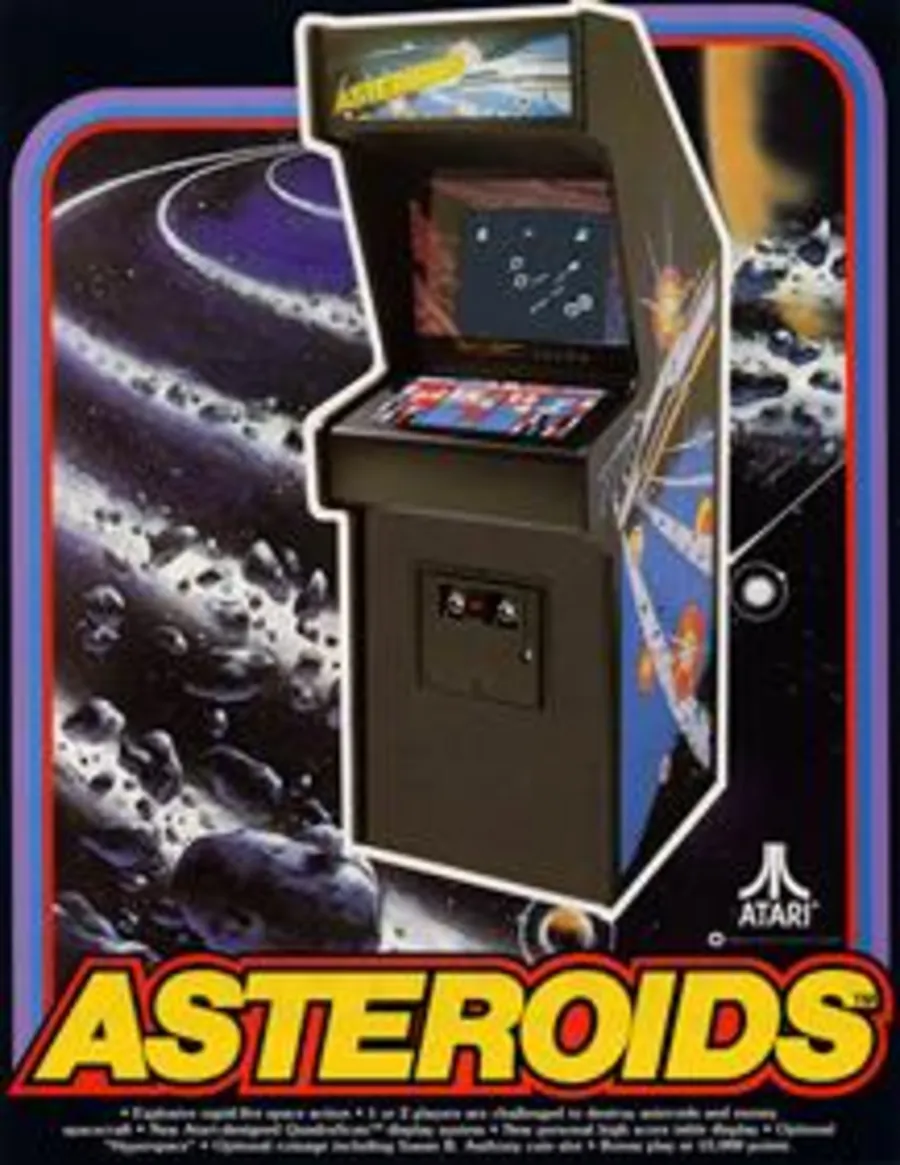
Atari Asteroids arcade flyer showing the upright cabinet floating over asteroid-field artwork, with the yellow Asteroids logo at the bottom.

The operator flyer sold Asteroids as spectacle, but the cabinet it pictures is severe: black monitor, white vector line, five buttons. Atari, 1979.

The project began as an answer to a problem Atari had already failed to solve. Rains remembered an older space-combat prototype in which an asteroid got in the way of a duel and players kept trying to shoot it. Logg remembered playing Spacewar on Stanford machines, losing badly, and carrying the feel of thrust-and-rotate space combat with him. The new brief was simple enough to sound like a programmer’s sketch: a little ship, large rocks that split into smaller rocks, shoot until the screen clears.

That sketch could have become a joystick game. Rains initially leaned toward raster graphics, the conventional video path of the moment, but Logg pushed for vector hardware because the sharper X-Y line gave the player more precise aiming. In Retro Gamer’s making-of interview, Logg put the disagreement bluntly: “no, no, let’s do it on vector.” The sentence matters because it is not a polish choice. It is a control choice. Asteroids needs the shot to feel like a ruled line extending from the nose of the ship. If the aim blurs, the whole game becomes mush.

Howard Delman made that bet shippable. Atari’s Grass Valley research group had produced the groundwork for an X-Y display system, but Delman had to turn that concept into a platform an arcade game could survive on location. Lunar Lander proved Atari could ship vector. Asteroids made vector feel inevitable.

The difference matters at the eye before it matters as history. A raster display paints a screen in rows. A vector monitor draws the image as lines, the beam travelling point to point, leaving shapes that look less printed than incised. On an Asteroids cabinet the rocks do not sit on the glass like sprites. They glow in it. The ship looks small because everything else is so black, but the shot is exact: a white segment leaving the nose, crossing a field, cutting a polygon into two new obligations. That precision is not cosmetic. It is why the player accepts the blame when a shot misses by a few degrees.

Atari’s operator manual reads like a document from another mechanical culture: self-test tones, dip switches, X-Y monitor service, a fluorescent tube behind the marquee. The game was software, but the cabinet was also a machine with parts an operator could open, clean, and repair. Asteroids works best when that material fact stays in the reader’s head. The five buttons are not a control scheme abstracted onto a menu. They are the faceplate of a commercial object designed to take punishment from anxious hands.

Five Buttons, No Mercy

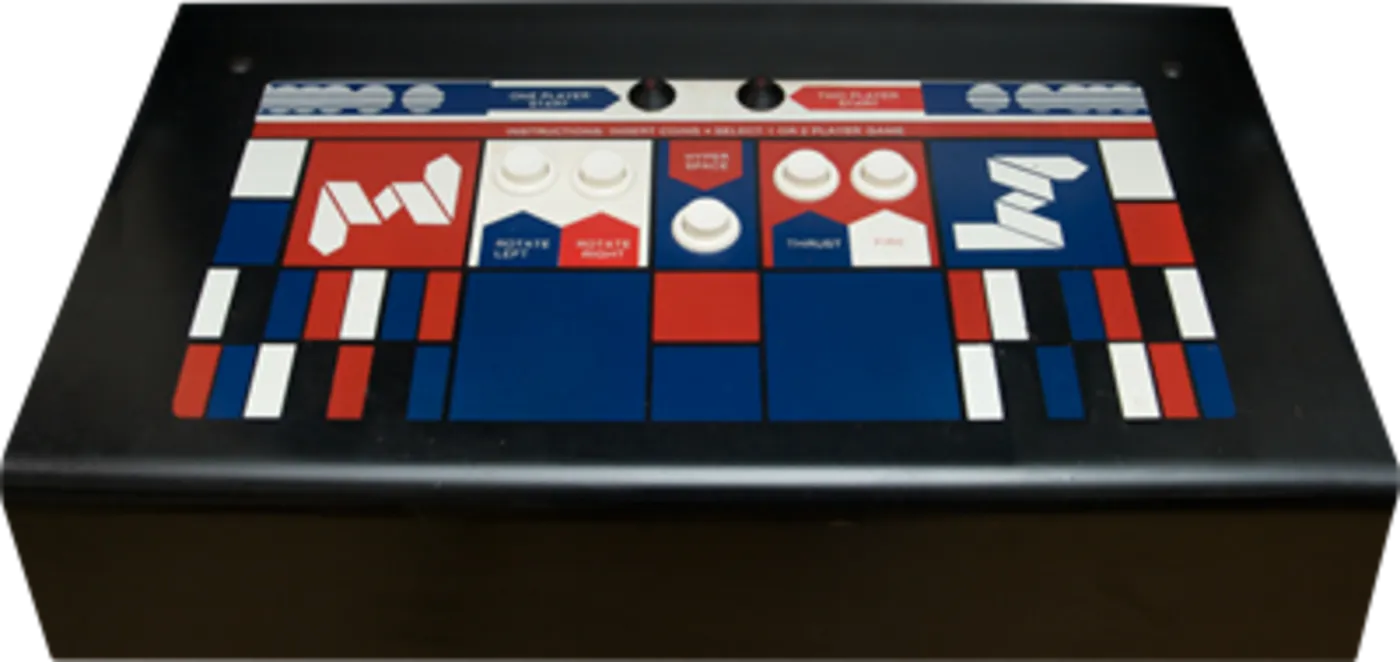
The Asteroids arcade control panel with five white buttons labelled left rotate, right rotate, fire, thrust, and hyperspace.

Five buttons replace the joystick: rotate left, rotate right, fire, thrust, hyperspace. The layout makes movement a sequence of decisions rather than an analogue lean. Atari, 1979.

The control panel is the game’s thesis in plastic. Left rotate. Right rotate. Fire. Thrust. Hyperspace. Each button is clean, but no single button is safe. Fire commits the ship to a line; thrust commits it to a future position; hyperspace cancels one disaster by gambling on a random new one. The player is never asked to push toward safety. The player has to build safety out of angular corrections and small burns.

This is why early players asked for a joystick. Atari ran focus groups in June 1979, one with older Spacewar veterans and another with teenage Space Invaders fans. The younger group, used to a base and a pause in the action, noticed that Asteroids never gave them cover. Some players wanted the controls softened into something more familiar. The game survived that feedback because Logg trusted what people did more than what they said. In Sacramento, he watched a test player die three times in about twenty seconds, then feed the machine another quarter. If a player died instantly and blamed the cabinet, the design had failed. If he blamed himself, the cabinet had him.

That is the small miracle of the panel. It feels awkward for the first credit because it is separating jobs a joystick combines: facing, moving, shooting, escaping. Then the separation becomes liberating. You can aim one way, drift another, and decide whether to spend thrust on speed or position. You can let a rock pass because slowing down would create more danger than waiting. You can rotate while the ship continues sliding, and in that sliding interval the game asks whether you have pictured where your body will be after the button press, not where it is now.

The fairness is brutal, but it is real. A large asteroid gives way to two medium ones. A medium rock becomes two small ones. The screen fills with smaller, faster obligations because the player created them. The mistake is legible. The recovery is legible. When Asteroids becomes hard, it does not hide the cause.

The Saucer Finds the Loophole

The famous problem with expert play is that a brilliant player can stop playing the rock field and start farming saucers. Leave one slow asteroid alive, drift safely, wait for the small saucer, kill it, repeat. Asteroids Deluxe exists partly because Atari needed to close that hole. Yet the exploit is also proof of how readable the original system is. Players found the economy inside it because every object obeyed a clear rule.

The saucers are not decoration. The large one bullies; the small one hunts. Their shots turn a game of clearing into a game of staying exposed for the shortest possible time. A timid player can circle at the edge and lose patience. An arrogant player can thrust into a screen full of fragments and discover that speed is only control when it has somewhere to land. The good line is usually a short burn, a rotation, one shot, and enough silence to see what the shot has done.

That silence is where the game keeps converting new players. Modern action games often solve movement by making acceleration generous and correction cheap. Asteroids makes correction expensive. It lets the ship keep drifting after the player’s intention has changed. The result is a score game where the score is secondary. The real reward is the moment your hands stop fighting the panel and start thinking in vectors.

The game also refuses the comforting hierarchy of later shooters. There is no boss, no last enemy that announces itself as the object of the room. A small rock can be more dangerous than a saucer because it arrives from the side while attention has narrowed elsewhere. A big rock can be safer left intact because splitting it would flood the screen. The cabinet’s deepest skill is not marksmanship but editing: choosing which threat should exist for another second, and which one must become fragments now.

The Cabinet Has a Heartbeat

Asteroids has no soundtrack in the album sense. It has a pulse. Delman built the sound hardware by hand, one circuit for each effect, and he described the thump as a heartbeat meant to sync with the player’s rising tension. The trick is not metaphorical. As the field becomes more dangerous, the pulse makes the cabinet feel as if it is sharing the room with you, counting down not time but nerve.

The audio also keeps the vector screen from feeling abstract. Fire cracks. Rocks pop into smaller rocks. The saucer arrives with a needling alarm that cuts through the empty black. These are not cinematic sounds; they are arcade-room signals, designed to tell anyone standing nearby that something is happening at this machine. Asteroids is austere on the eye and loud in the body.

That combination explains why the cabinet art feels almost excessive. The marquee promises pulp energy: a spaceship streaking past a planet, rays of red and yellow, a logo big enough to read across a room. The monitor answers with a diagram. The gap between those two surfaces is not a failure of resources. It is a productive mismatch. The outer cabinet tells the passer-by that this is space adventure. The screen tells the player that adventure has been reduced to bearing, velocity, collision, and nerve.

The Asteroids cabinet marquee, a wide banner with the yellow Asteroids logo, a white spaceship, a red-and-yellow planet, and asteroid-field artwork.

The marquee turns the cabinet’s white-line severity into pop art: planet, ship, rocks, and logo, all promising a space opera the monitor deliberately withholds. Atari, 1979.

That contrast between the marquee and the monitor is part of the cabinet’s power. The art gives operators colour, shape, and shelf appeal. The screen takes almost all of it away. What remains is brighter than colour: white geometry burned into black, a ship that rotates with tiny exactness, fragments that cross the field like thrown glass. The cabinet sells pulp space fantasy and then delivers a machine for reading motion.

Empty Space Still Crowds

Asteroids belongs beside Space Invaders and Galaxian because it answers the same room with a different body. Space Invaders compresses fear into a descending wall. Galaxian turns the wall into attack choreography. Asteroids removes the wall entirely and makes the player’s own momentum the threat that never leaves. The enemy is not above you or below you. It is in the course you chose half a second ago.

The friction is real. Marathon strategies can flatten the risk. Hyperspace can feel less like a tool than a shrug. A modern player coming from twin-stick shooters may spend the first minutes wishing the ship would go where the thumb points. That wish is exactly what the cabinet is built to resist. Asteroids is not the ancestor of dual-stick flow; it is the branch that says movement should be a debt.

Digital Eclipse’s Atari 50 release is the best modern route because it understands that the game needs context around it, not upgrades placed inside it. The arcade ROM sits among interviews, artifacts, and a timeline of Atari’s hardware imagination, so the player can approach Asteroids as an object with a room, a monitor, and a control panel. The temptation with a game this copied is to think the idea has been replaced by smoother descendants. The original argues the opposite. Smoothness would ruin it.

Play a few credits and the debt starts to feel clean. The screen clears because you learned not to overcorrect. The saucer dies because you waited for the nose to line up instead of firing through panic. The last small rock skims past the ship because seven seconds earlier you chose not to thrust. For a game made of outlines, Asteroids is unusually physical. It makes empty space press back.

Cartridge Collective 1979 · Arcade

Where to play

Why Now

Asteroids gives a modern player one perfect arcade grammar: five buttons, no joystick, bright vector lines, and a ship whose every burst of thrust is both escape plan and future problem.

Best way to play now Atari 50: The Anniversary Celebration on GOG

Digital Eclipse gives the arcade ROM historical context before you press start, and the GOG build keeps the collection DRM-free on PC.

Time
0.5h
Cost
£30-35

Alternatives

  1. 01
    modern

    Atari 50 on Switch / PlayStation / Xbox

    The same Digital Eclipse collection on console, useful if you want the museum framing from the sofa rather than a PC desk.

  2. 02
    simulation

    MiSTer FPGA

    The hardware-minded route for recreating Atari's vector arcade board without maintaining a forty-year-old monitor.

  3. 03
    emulation

    MAME

    The preservation fallback, especially if you can map the original five-button control panel instead of forcing the ship onto a stick.

  4. 04
    original

    Original Atari upright

    The definitive object: five white buttons, a black-and-white X-Y vector monitor, and cabinet art that turns blank space into a physical room.

1979 · Atari

Listen

  • Asteroids - original arcade audioAtari / YouTube No album exists; the cabinet is all discrete sound: thump, fire, explosion, saucer siren, and the heartbeat Howard Delman built by hand.

Watch

  • Asteroids arcade gameplay, 720p 60fpsYouTube Source for the two short 60fps loops in this article.
  • The Story of Asteroids - Ed Logg interviewAtari / ZKM-linked interview

Read

  • The Making of AsteroidsRetro Gamer 68, Paul Drury, 2009 Developer interviews with Ed Logg, Lyle Rains, and Howard Delman; the strongest source for the vector-vs-raster decision and field-test feedback.
  • Asteroids Operation, Maintenance and Service ManualAtari, 1979 The cabinet as Atari shipped it: installation, self-test, play modes, controls, parts lists, and X-Y game hardware.
  • Asteroids arcade flyer and cabinet mediaLaunchBox Games Database Source for the flyer, cabinet, marquee, control-panel, PCB, and hero material used here.
  • Asteroids arcade database entryArcade History / KLOV-derived record Release date, MSRP, revision notes, scoring table, and hardware summary.
  • Atari 50: The Anniversary CelebrationAtari / Digital Eclipse Current commercial route for playing the original arcade game inside a contextual collection.

Cartridge
Collective

Volume 01

The Shooting Game

Compiled from the Cartridge Collective archive — long-form editorial on games still worth playing now. Each piece argues, against modern standards rather than period nostalgia, why a curious reader in 2026 should give the game its hours.

The web archive lives at cartridgecollective.co, where every article in this volume can be read with its original links to soundtracks, longplays, and supporting writing.

June 2026

Typeset for A5 from the source archive.