CARTRIDGE Collective VOLUME 04 A KONAMI READER · VOLUME I Konami Anthology From Cabinet to Cartridge, 1990–1993 1990 → 1993 CC · V04

A Konami Reader · Volume I

Konami Anthology

From Cabinet to Cartridge, 1990–1993

A Konami Reader · Volume I

Konami Anthology

From Cabinet to Cartridge, 1990–1993

1990 → 1993

Eight studios, four years, one house style — the cabinet voice landing intact on the cartridge.

— Konami Anthology, Volume I

Cartridge
Collective

Volume 04

Contents

19 Pieces

  1. ·
    Konami's Cabinet Voice Set the 16-Bit Era Konami Anthology · Volume I Foreword
  2. Part I The Cabinet Voice
  3. 01
    The Konami Goodbye That Became SNES Gradius Gradius III: From Legend to Myth
  4. 02
    The Konami Parody That Out-Voted Gradius III Parodius Da! ~Shinwa kara Owarai e~
  5. 03
    The Konami Shooter Konami Couldn't Bring Home Xexex
  6. 04
    The Castlevania Where Simon Finally Aims Super Castlevania IV
  7. 05
    The Western Konami Priced by the Shot Sunset Riders
  8. 06
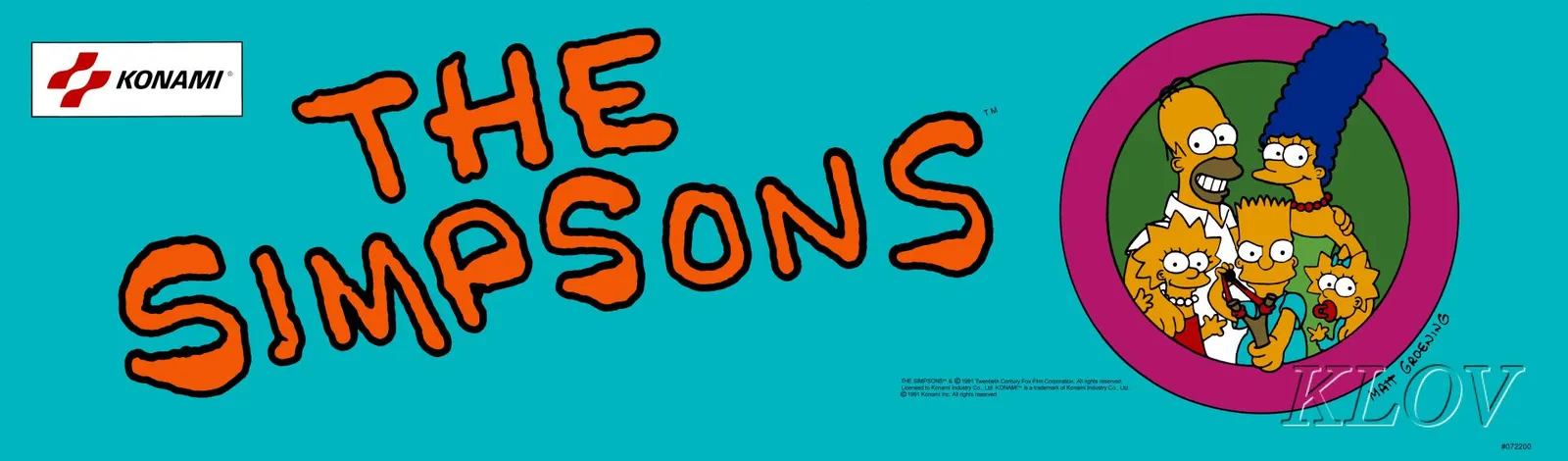
    The Konami Cabinet Without a Cartridge The Simpsons Arcade Game
  9. 07
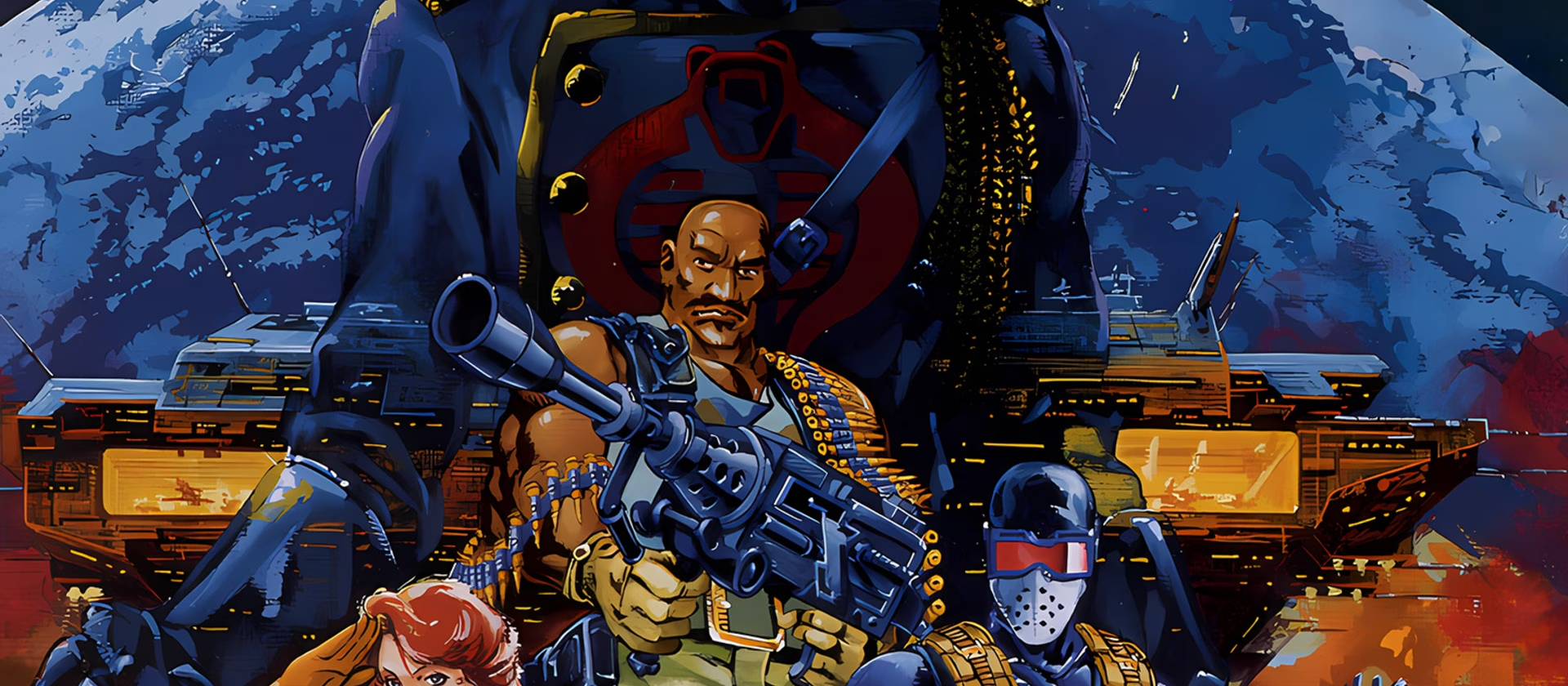
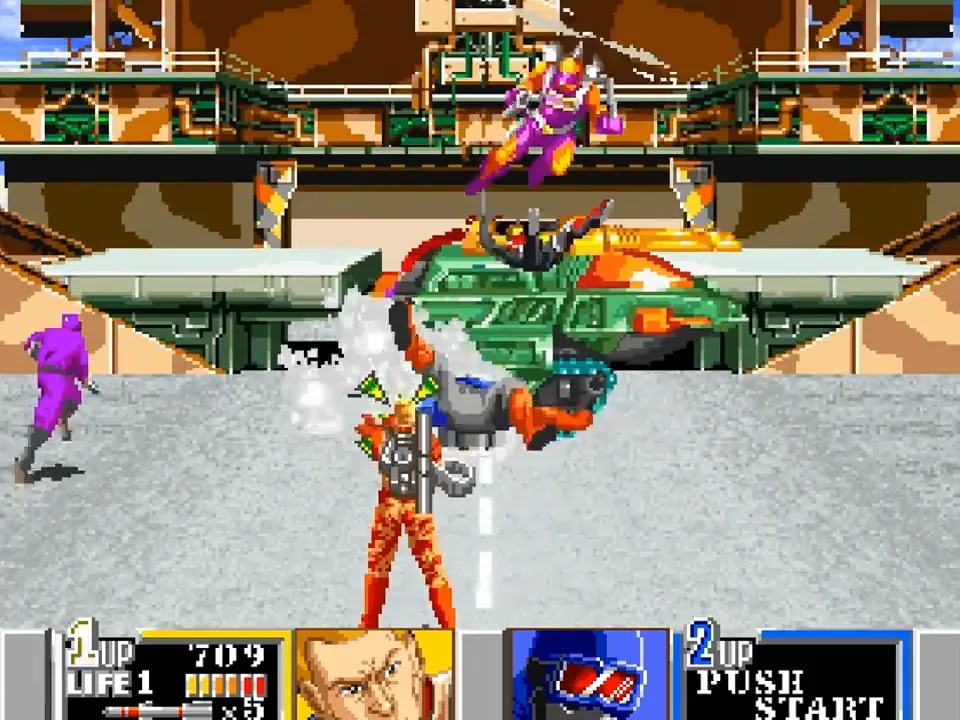
    The Cobra Cabinet That Never Left Arcades G.I. Joe
  10. Part II The Console Canon
  11. 08
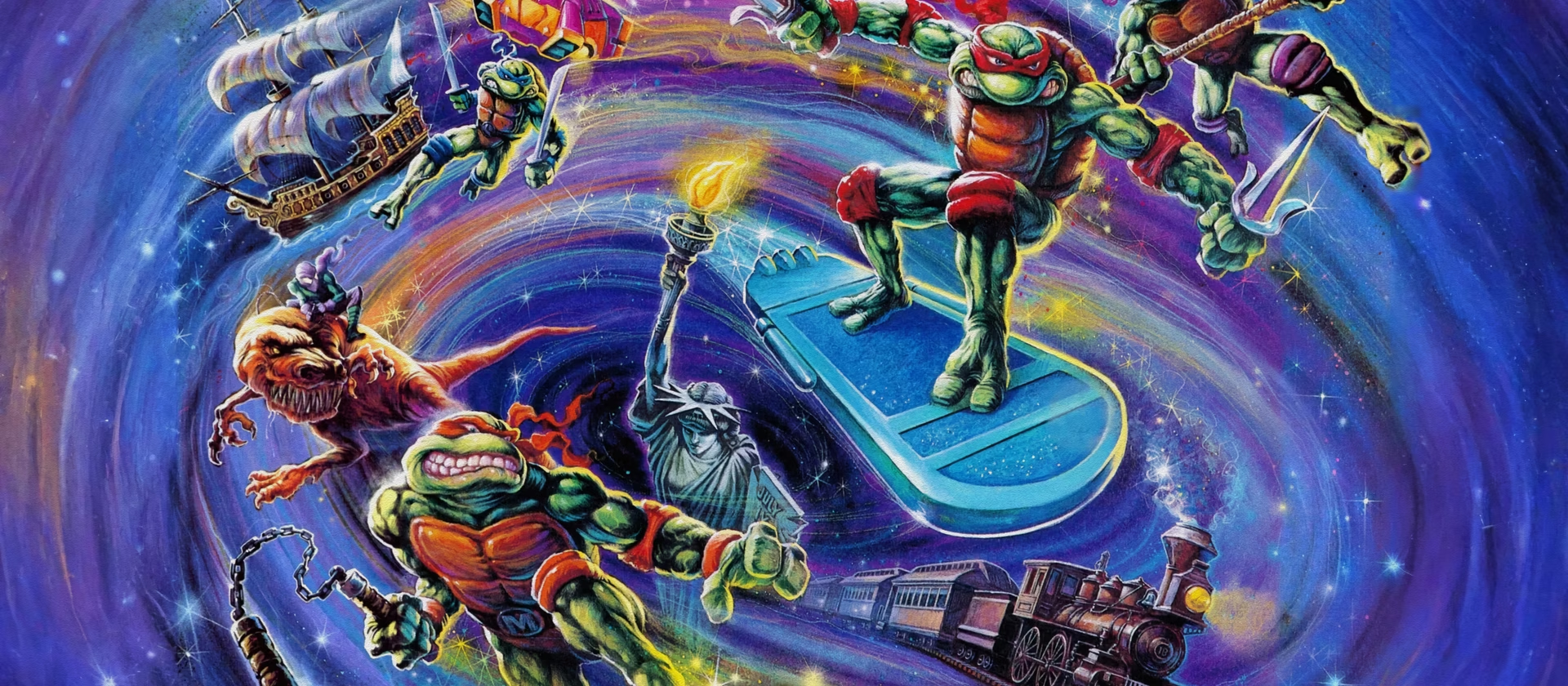
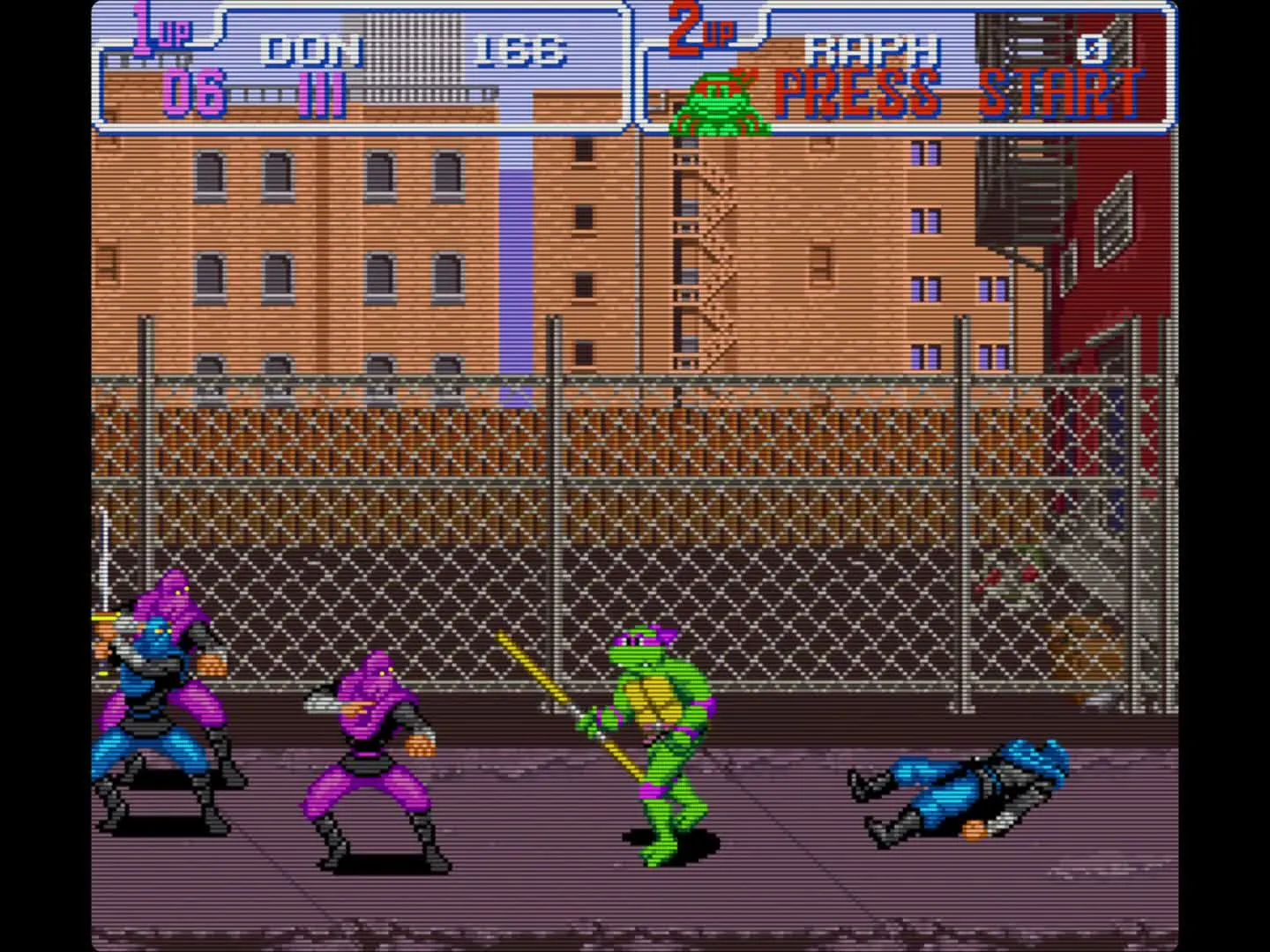
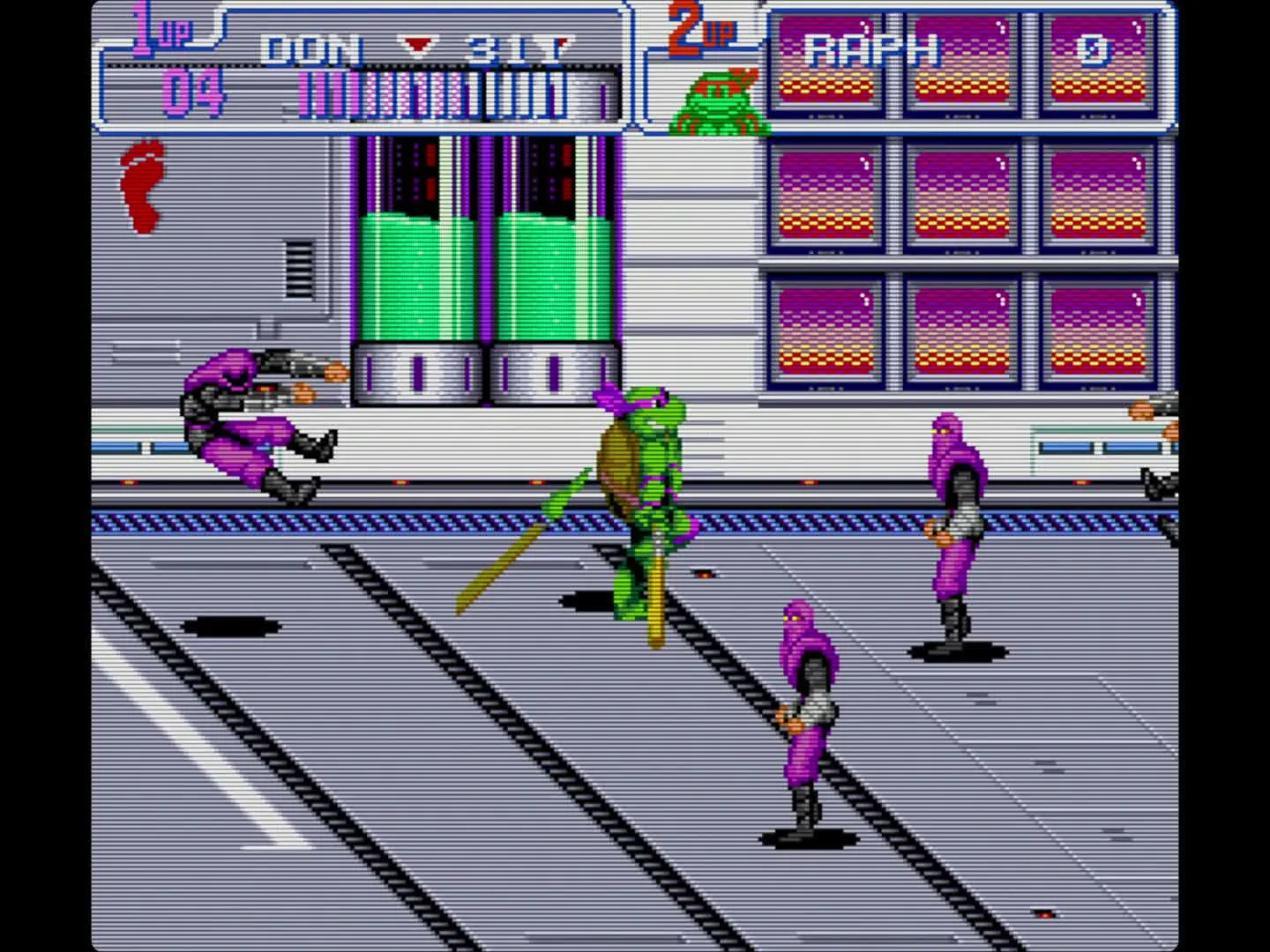
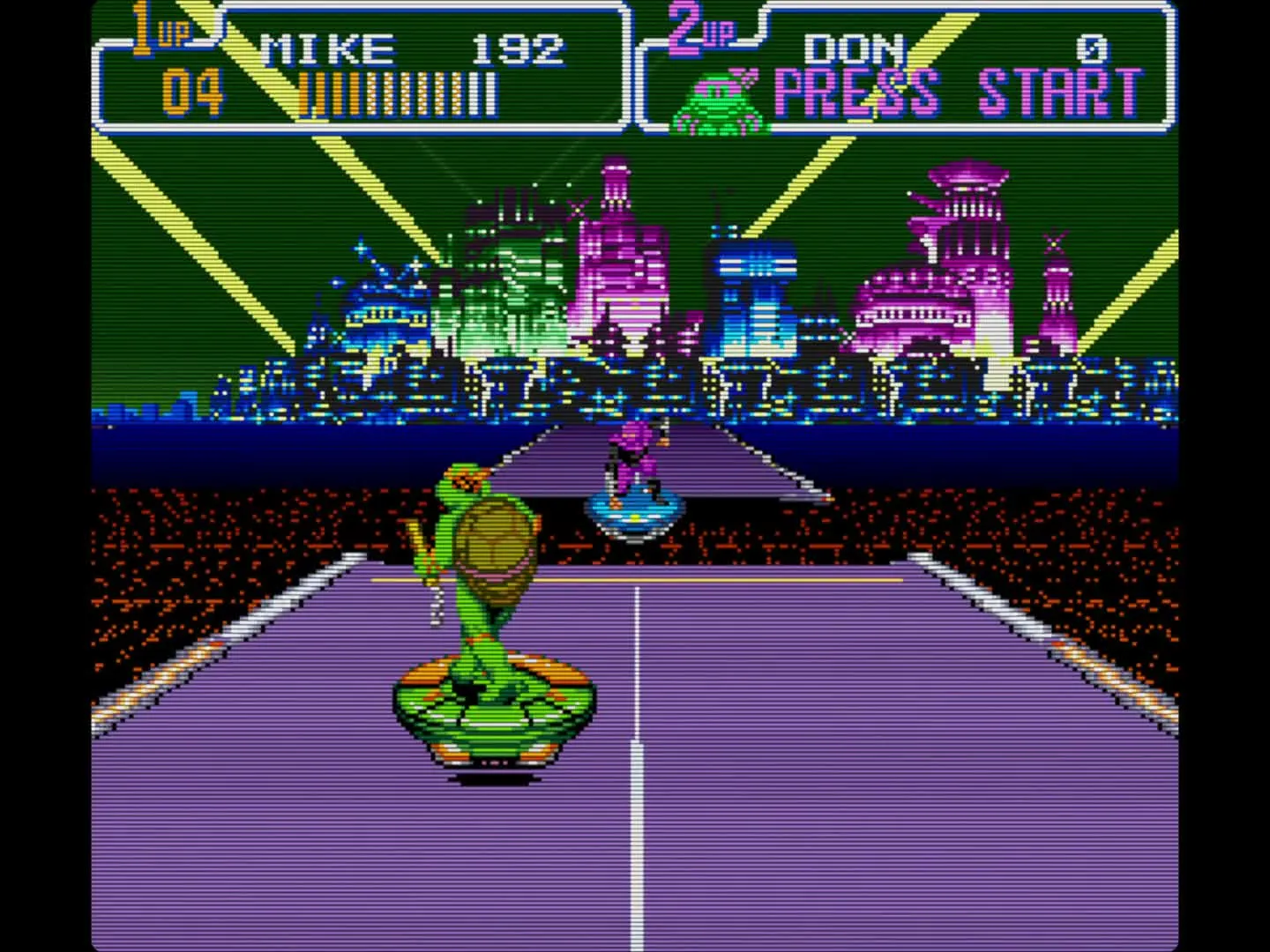
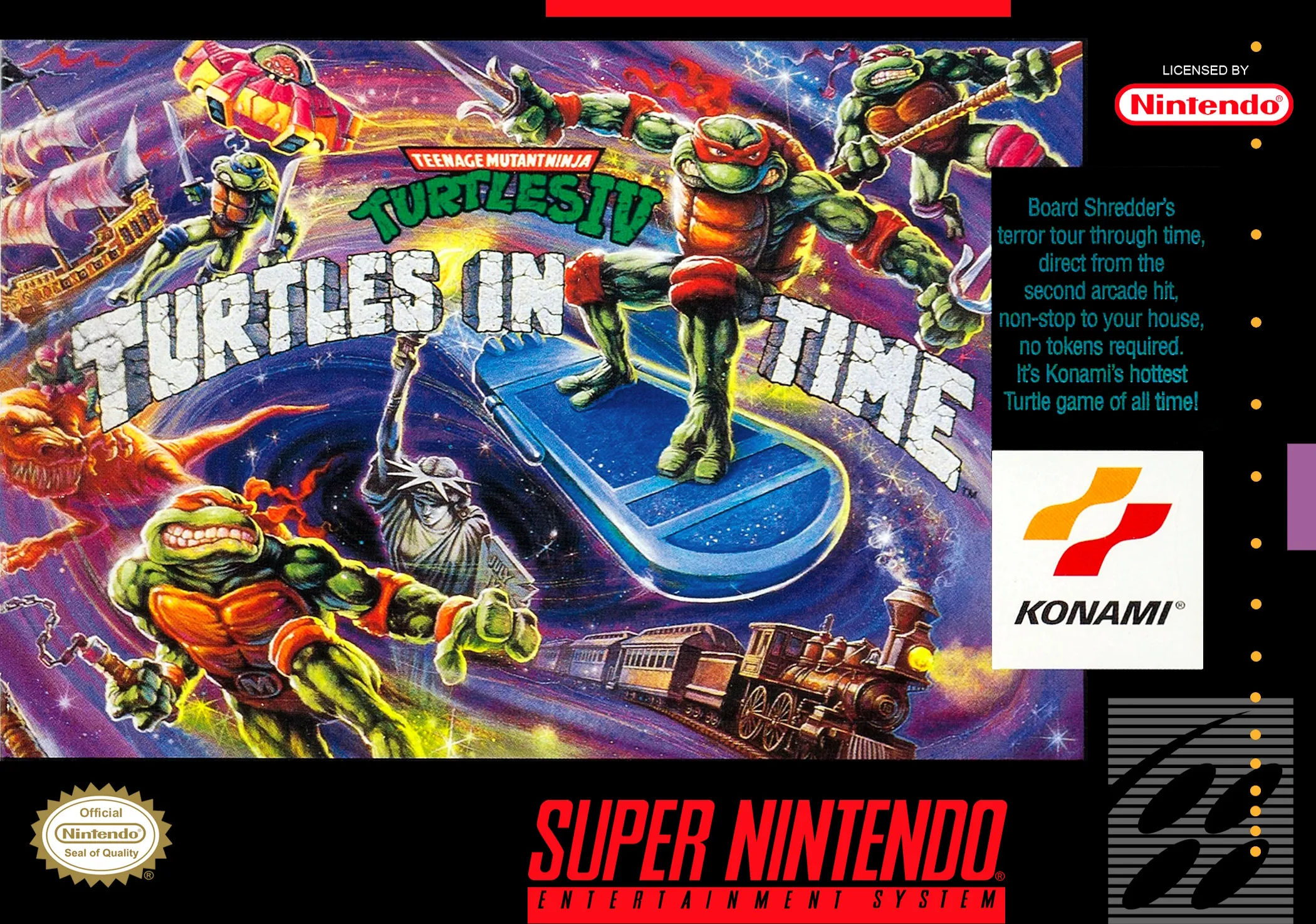
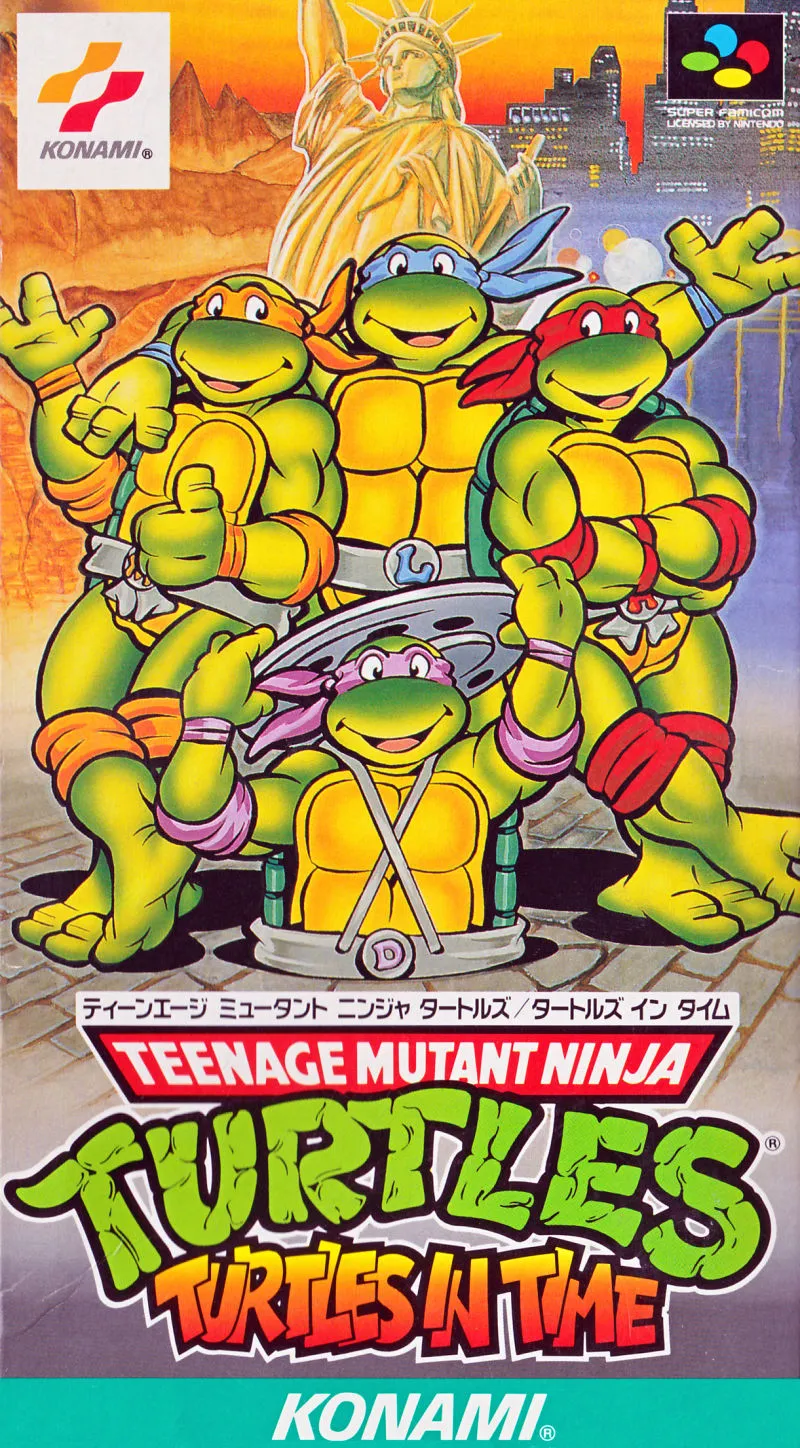
    The Konami Cartridge That Outdid Its Cabinet TMNT IV: Turtles in Time
  12. 09
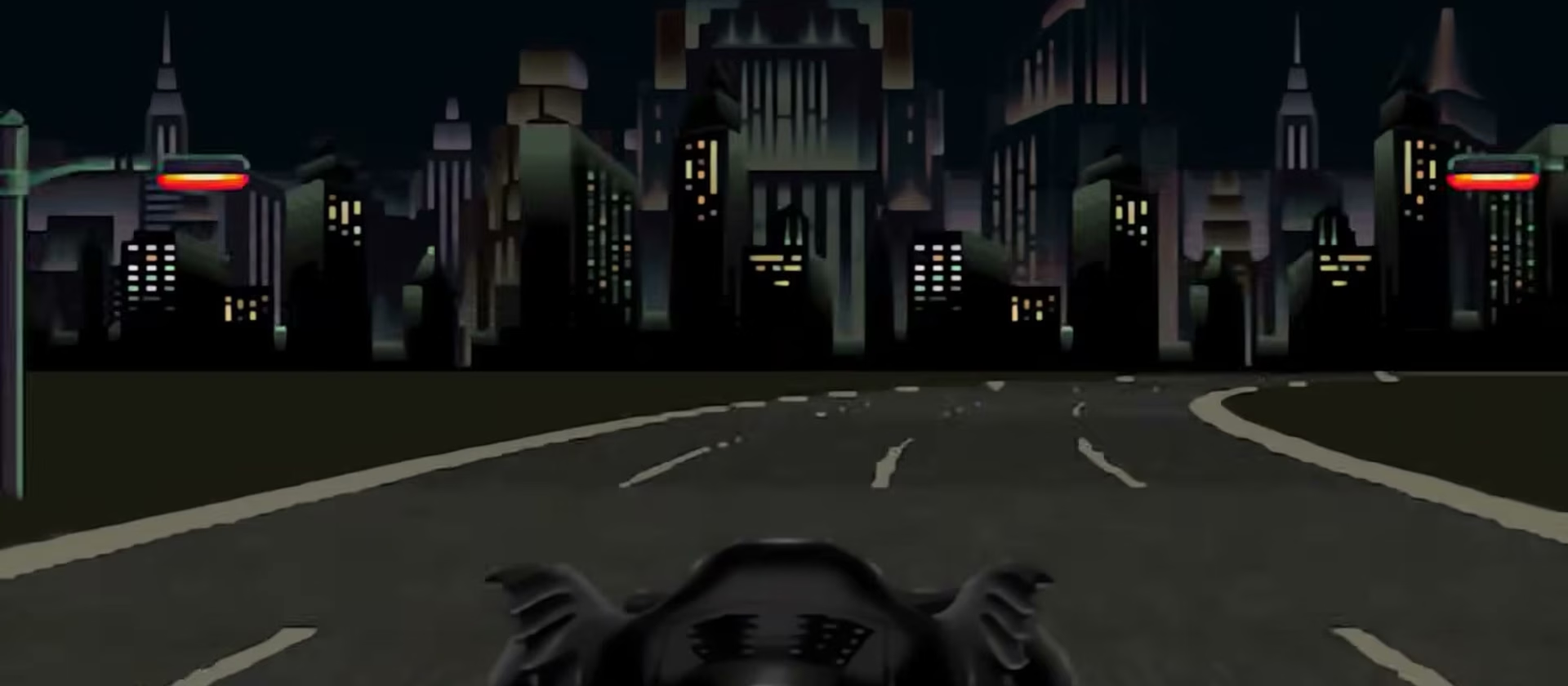
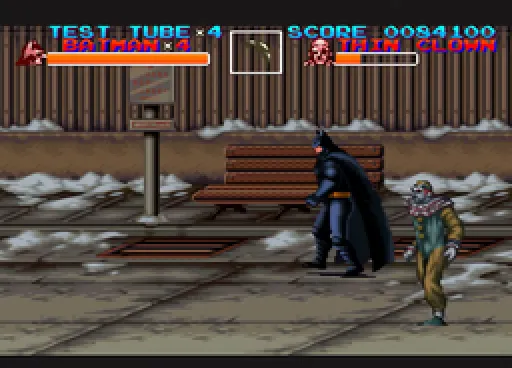
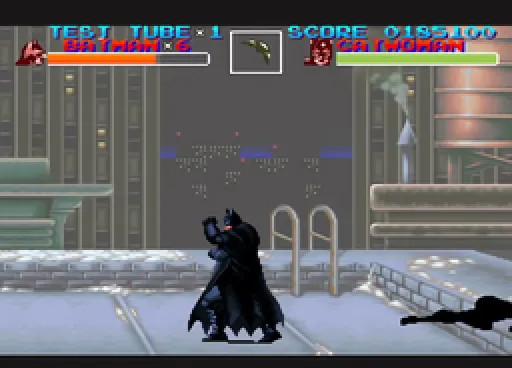
    The Konami Brawler Born on the Cartridge Batman Returns
  13. 10
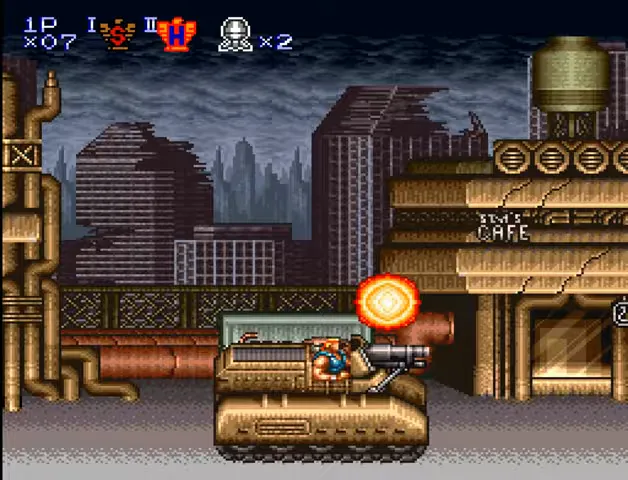
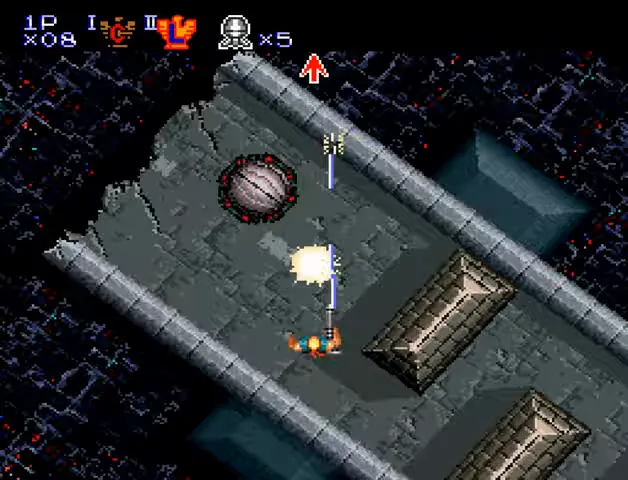
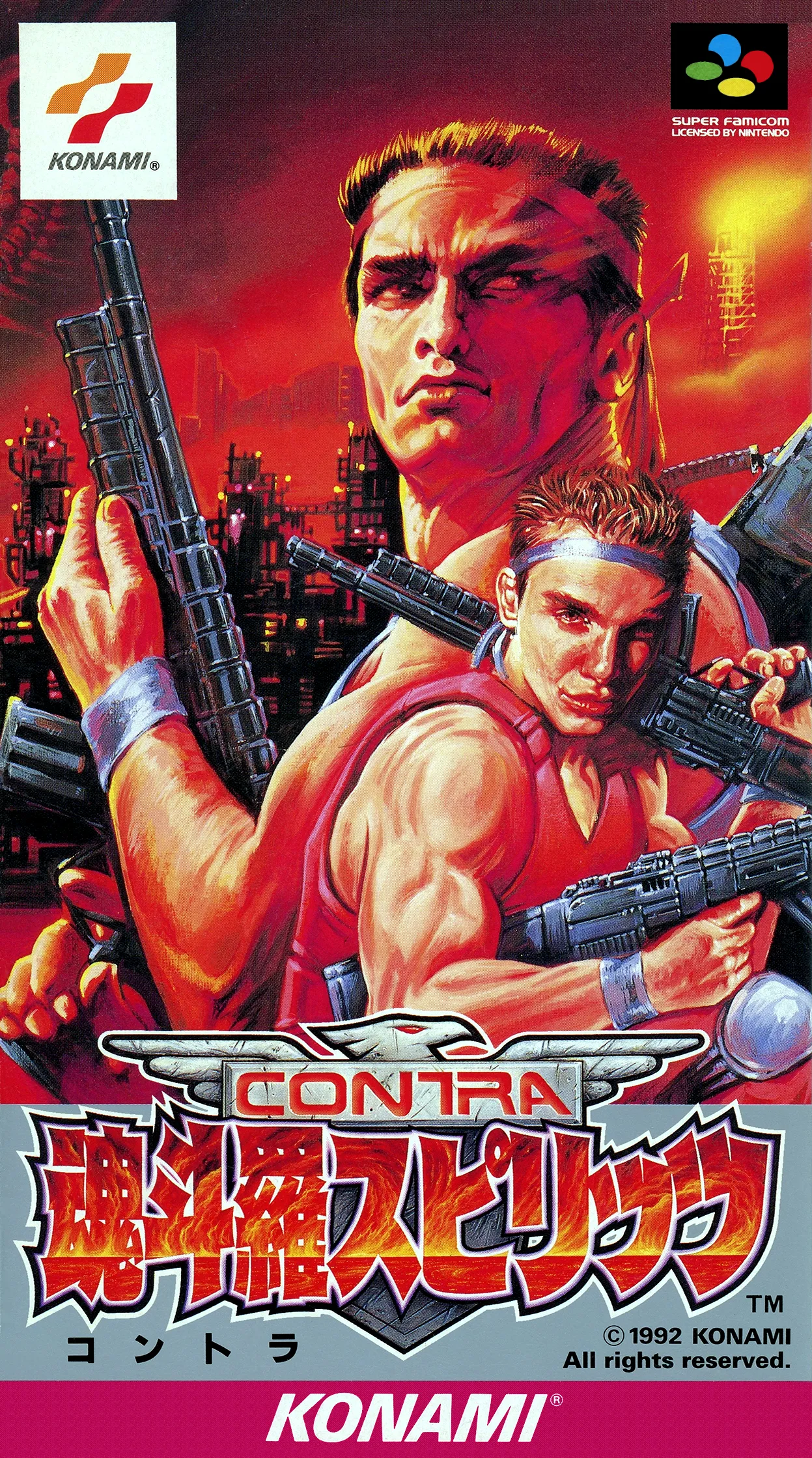
    The Konami Cartridge That Forked Treasure Contra III: The Alien Wars
  14. 11
    Konami's SNES Shooter That Weaponised Damage Axelay
  15. 12
    Konami's PC-Engine Snatcher Was the Real One Snatcher
  16. 13
    Konami's Mech Drama Reached the West Halved Assault Suits Valken
  17. Part III The Far Edge
  18. 14
    Where Symphony of the Night's Castle Began Castlevania: Rondo of Blood
  19. 15
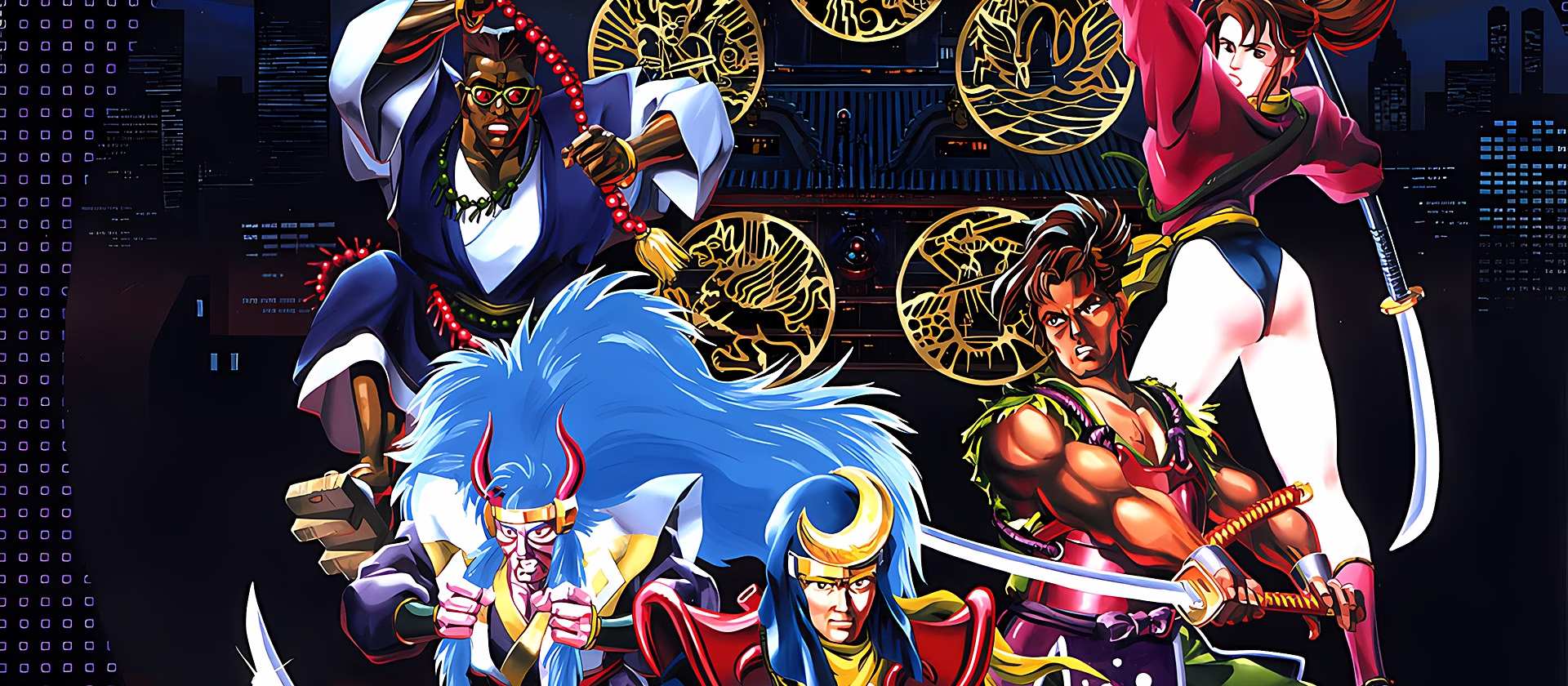
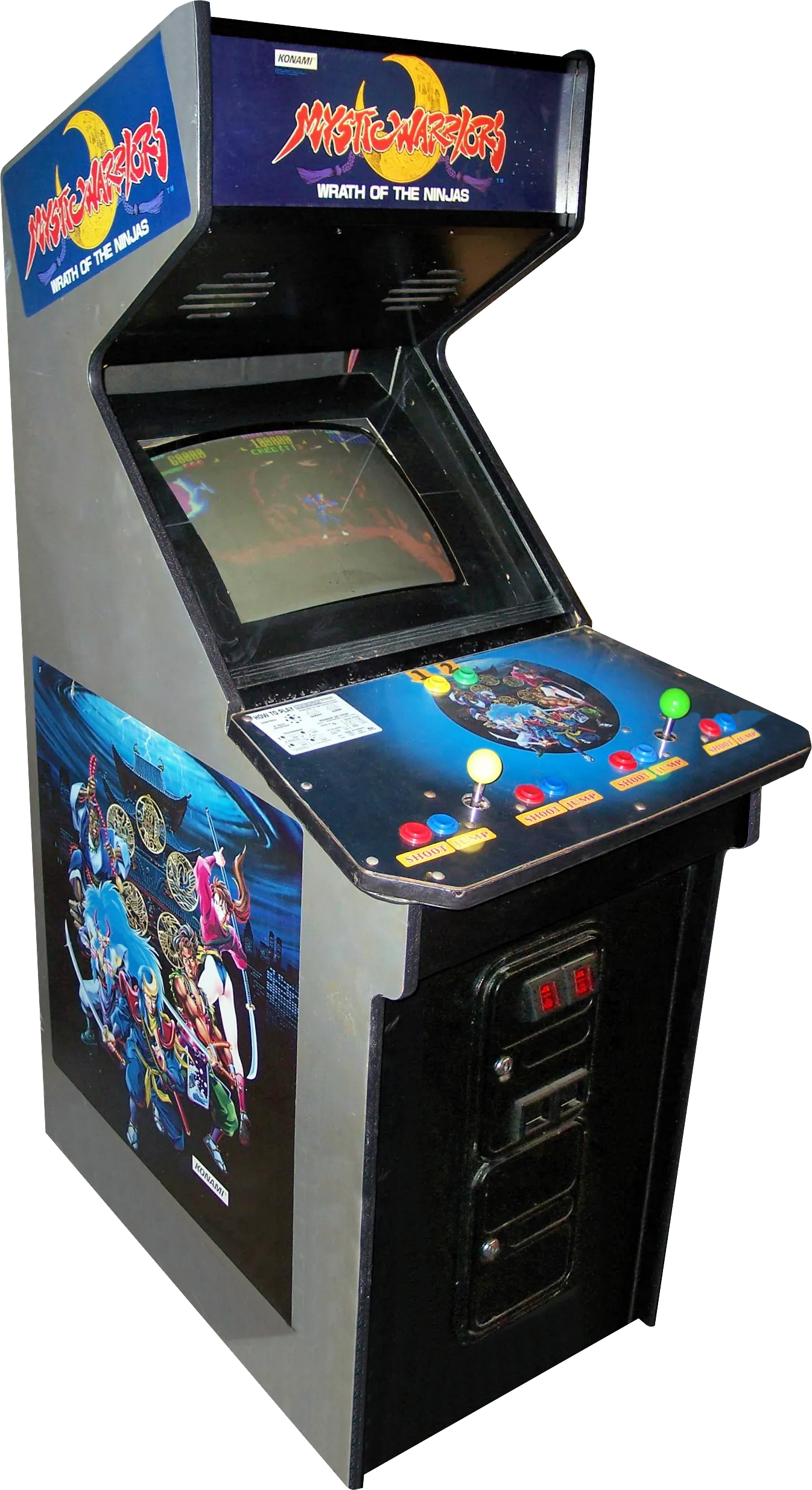
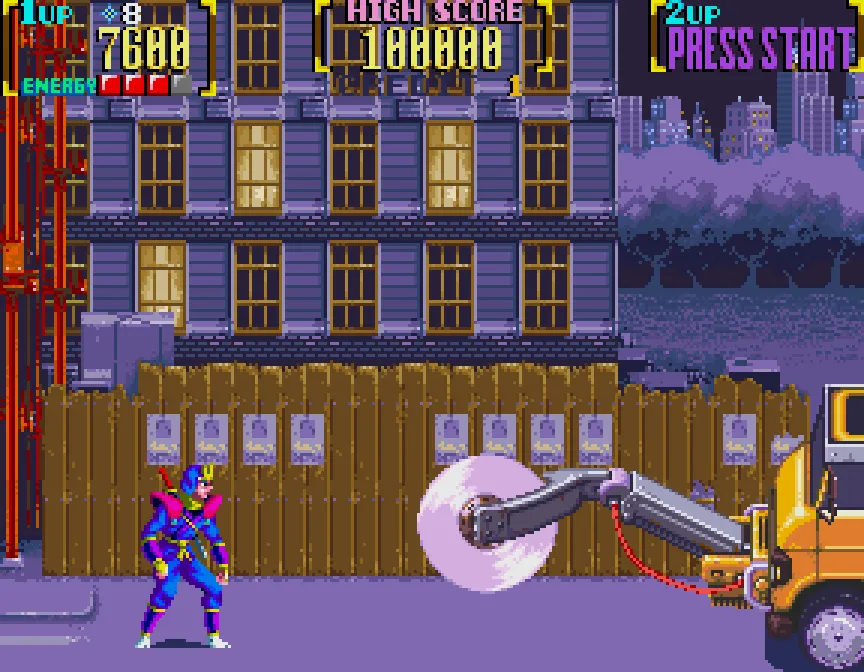
    Konami's Hollywood Ninja Movie in Cabinet Form Mystic Warriors: Wrath of the Ninjas
  20. 16
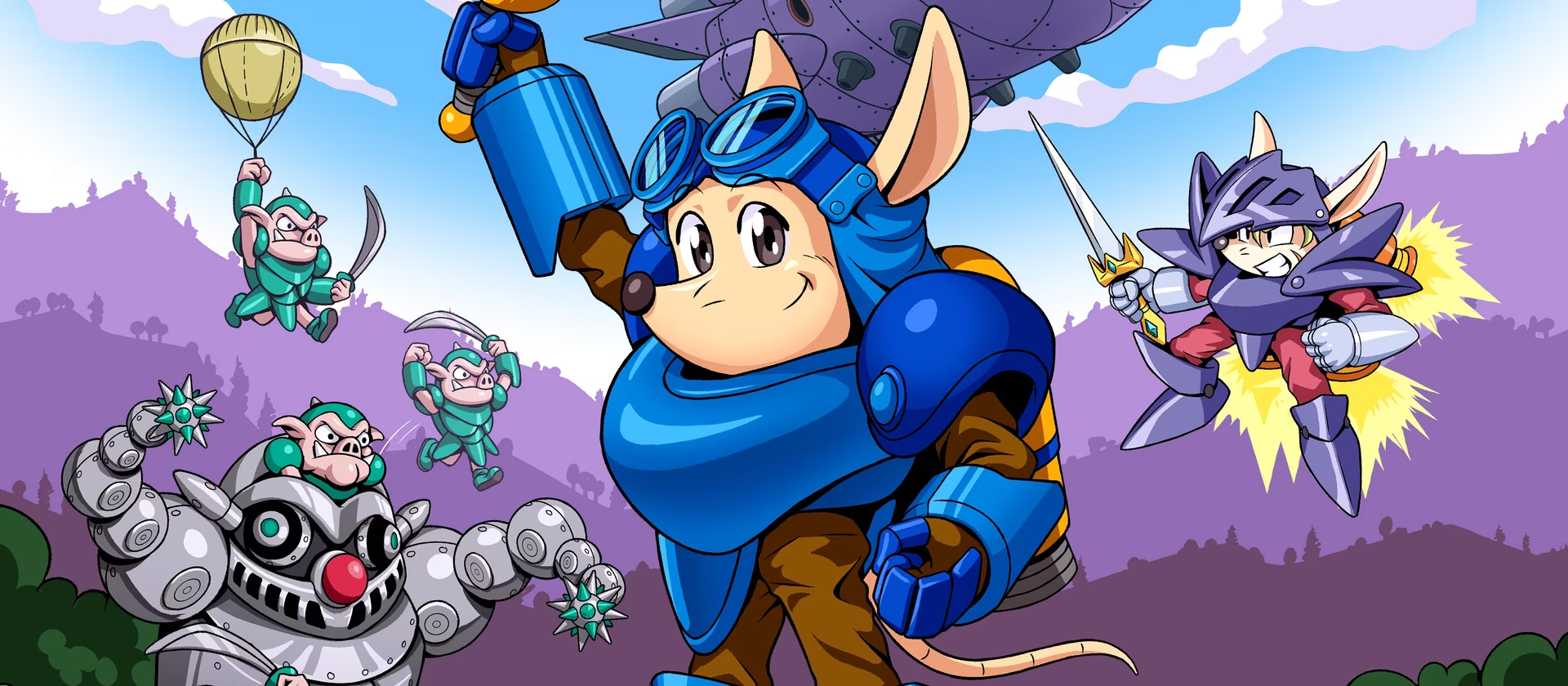
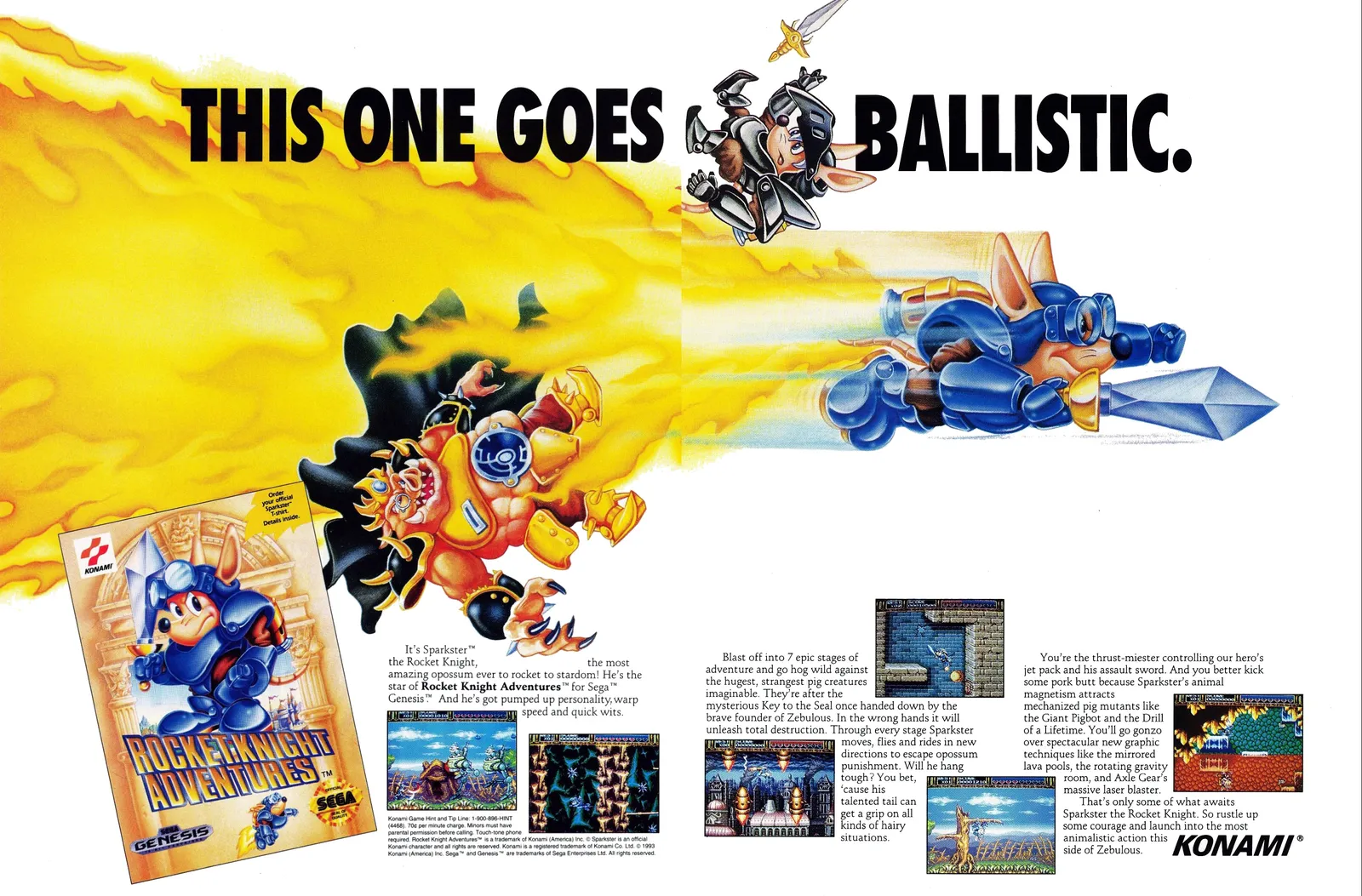
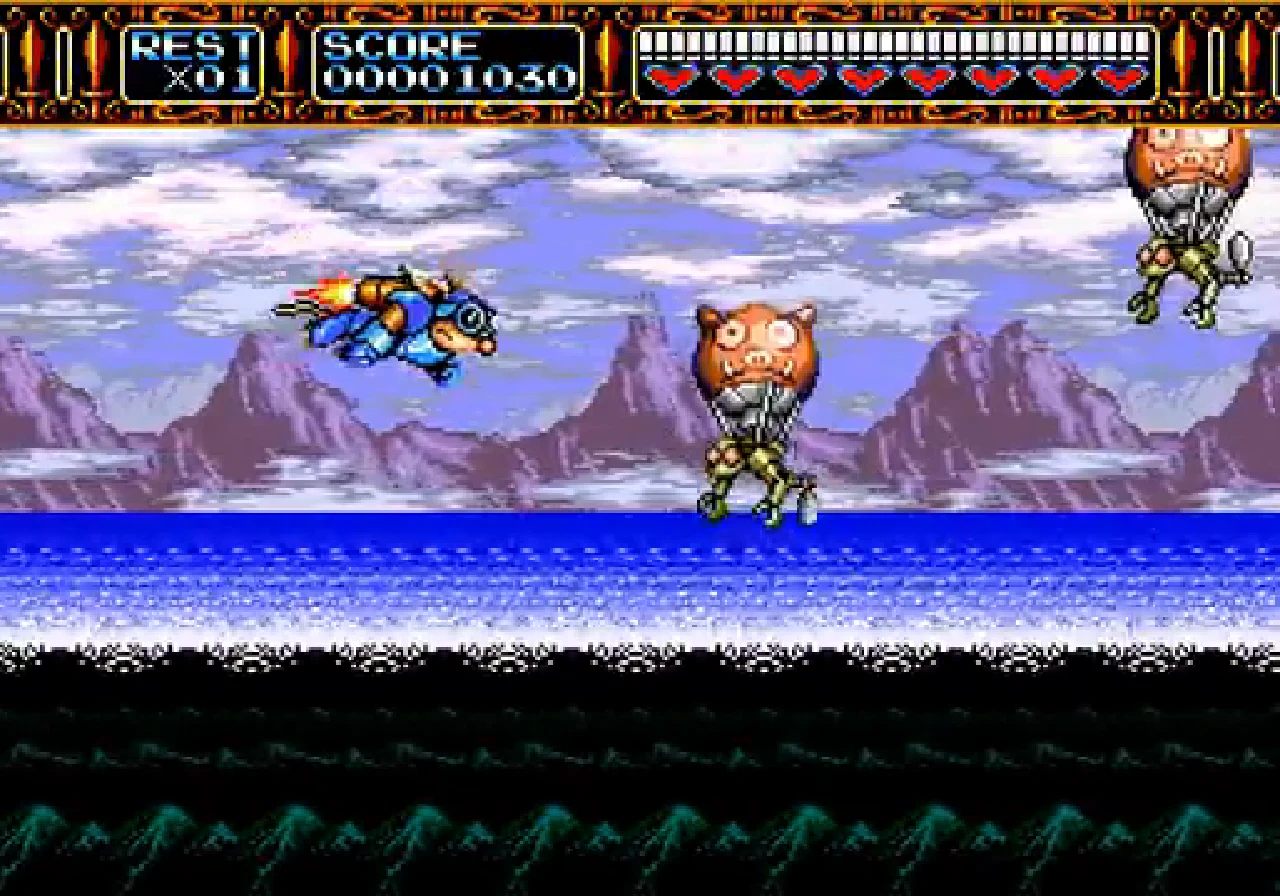
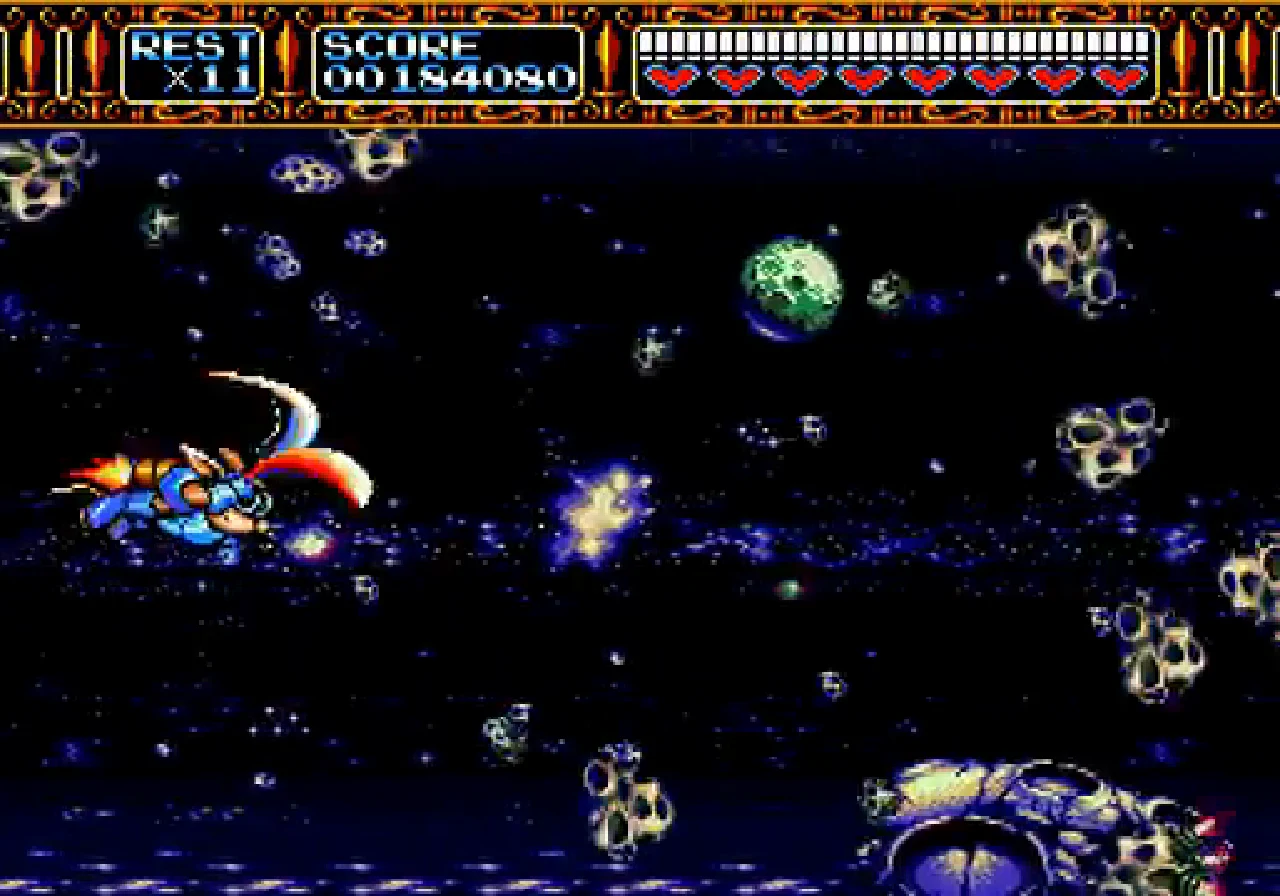
    Konami Hid Contra Inside a Marsupial Suit Rocket Knight Adventures
  21. 17
    The Masterpiece Konami Wouldn't Translate Ganbare Goemon 2
  22. 18
    Buster Bunny Was Konami's Sparkster Rehearsal Tiny Toon Adventures: Buster Busts Loose!
  23. 19
    Konami's Last Brawler, Locked to MAME Violent Storm
  24. ·
    Konami's Late 1993 Was Already Three Studios Konami Anthology · Volume I Afterword

Konami Anthology · Volume I Foreword

Konami's Cabinet Voice Set the 16-Bit Era

For four years, Konami's arcade voice was sixteen-bit. The four-player cabinet brawler peaked. The SNES cartridge became a cabinet object. In a back corridor, the studio was already on optical media.

Volume Foreword1990 → 1993
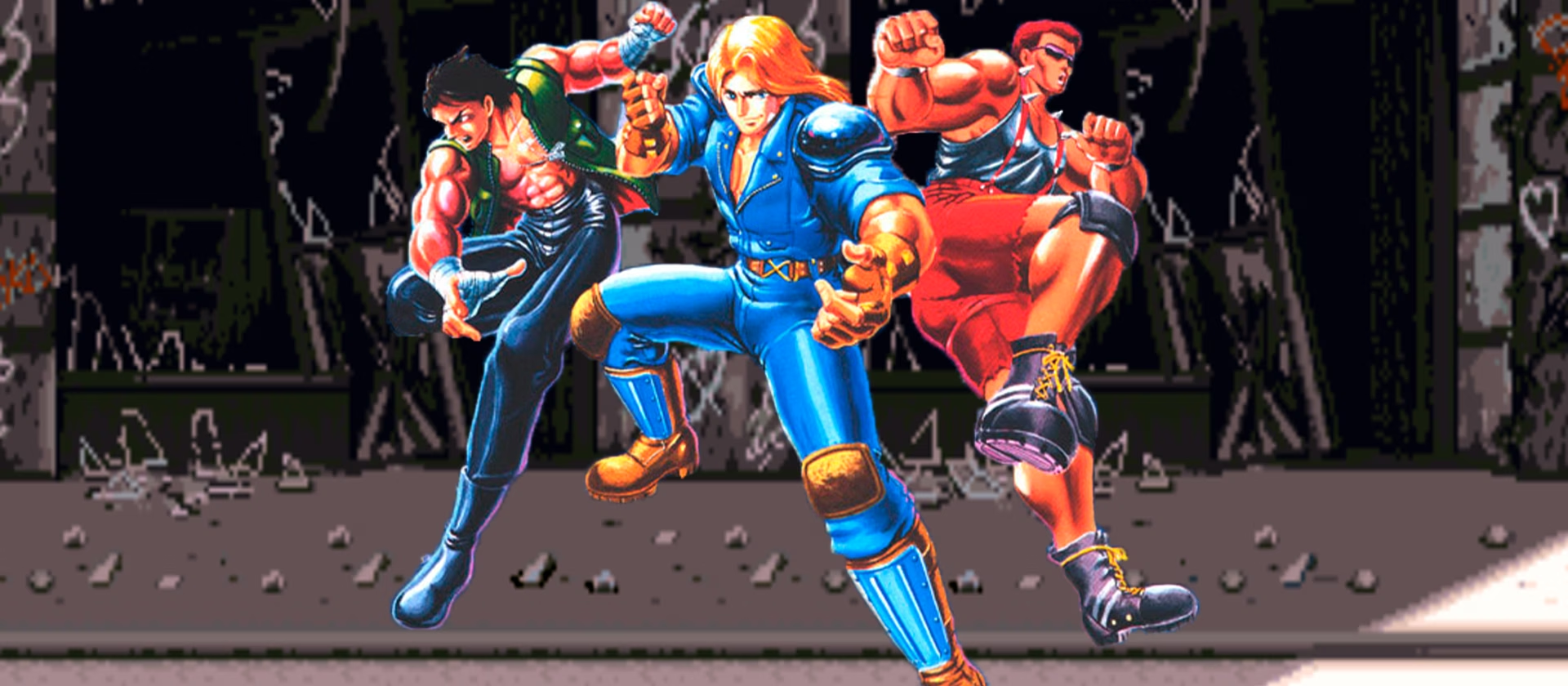
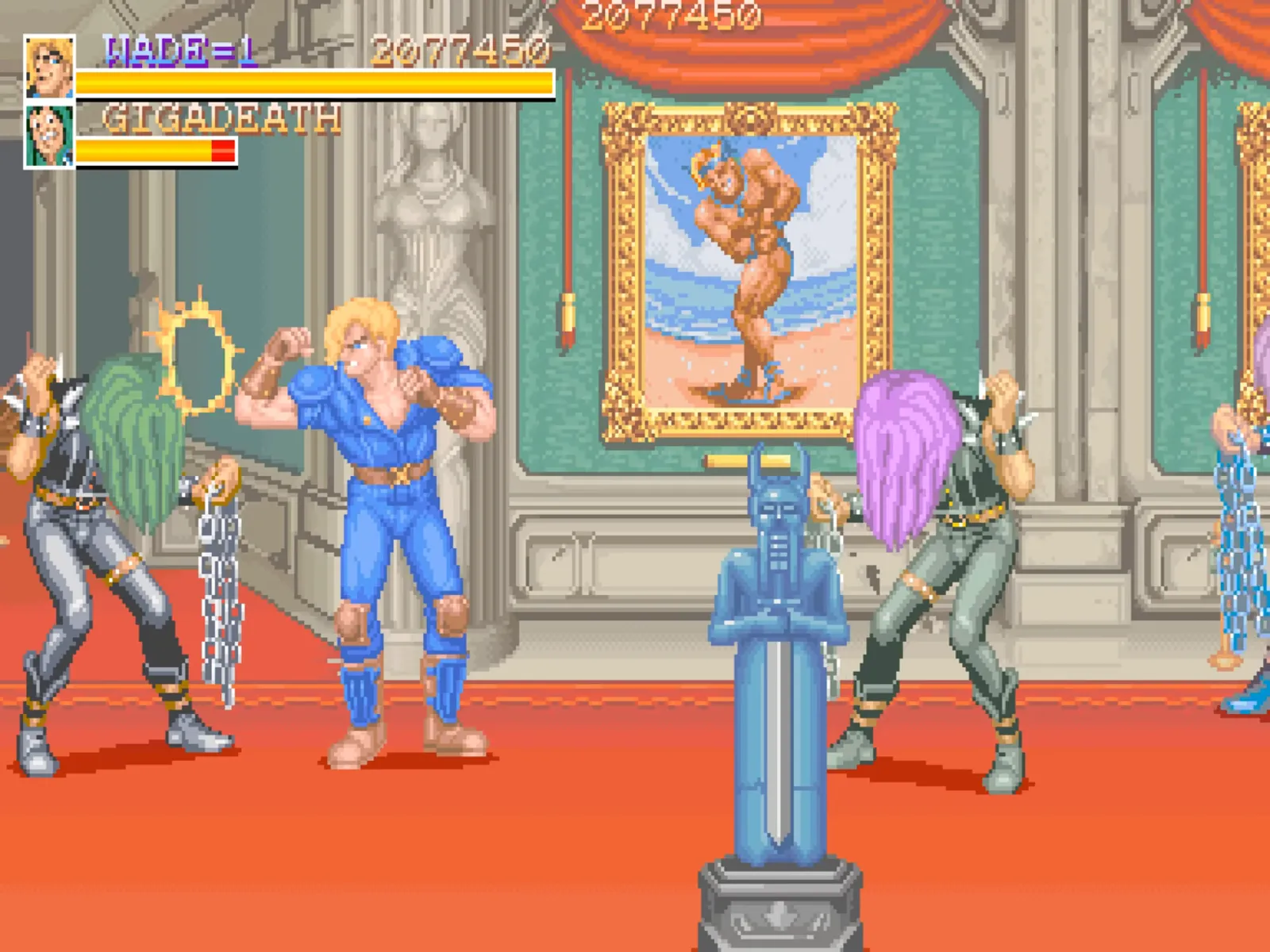
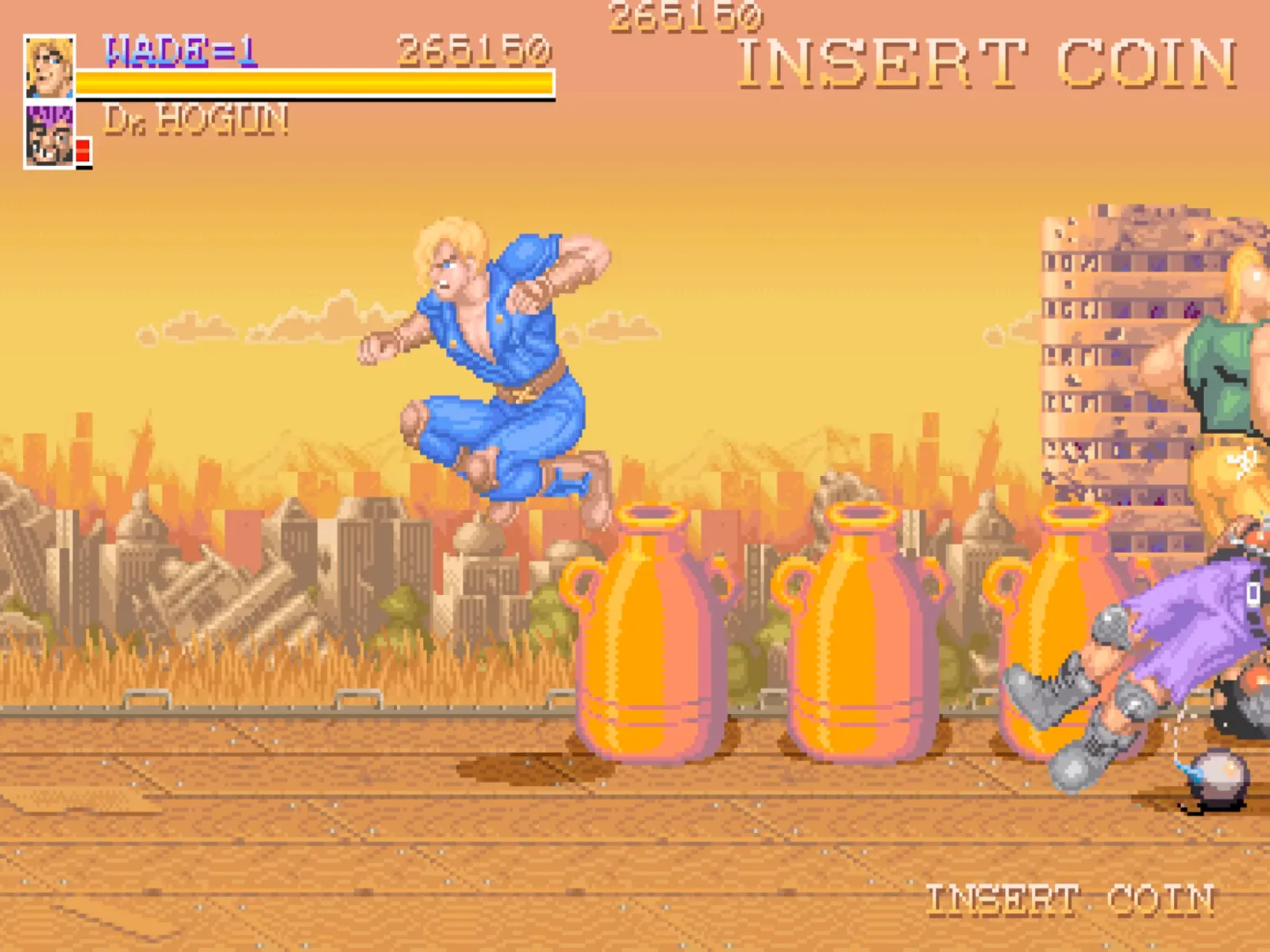
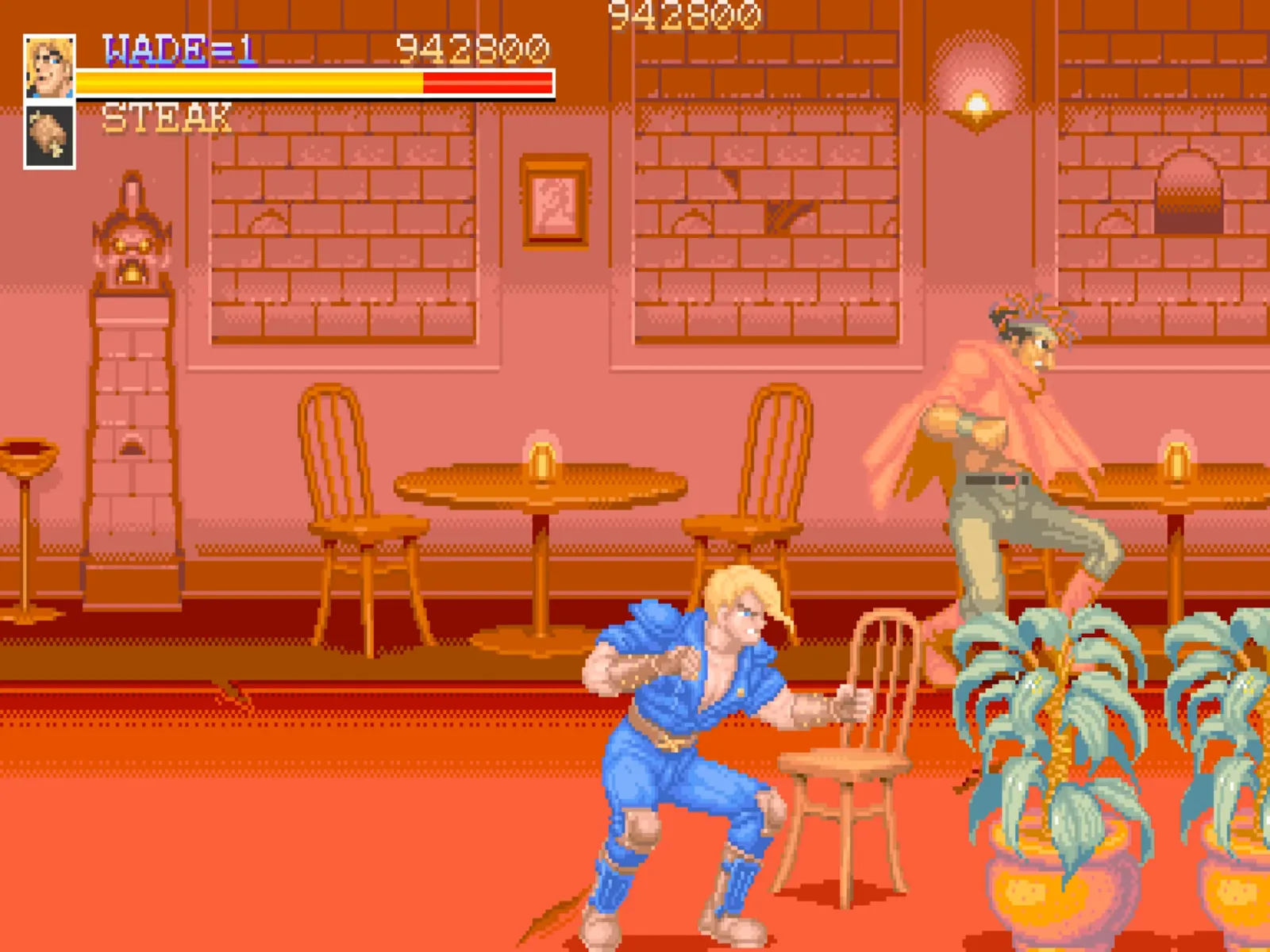
Violent Storm · Konami, 1993 (Arcade GX168) — the cabinet voice at its 1993 apex.

For four years, Konami did not miss.

Between 1990 and 1993, the studio shipped the best four-player licensed brawler the arcade cabinet ever produced — TMNT IV, Sunset Riders, The Simpsons, G.I. Joe, Mystic Warriors, the closing salvo of Violent Storm — while a parallel line on the back wall carried that same arcade voice, intact, into the Super Famicom cartridge. Super Castlevania IV, Contra III, Axelay, Rocket Knight, Ganbare Goemon are not arcade ports. They are cartridge-native translations of the same craft logic, made by the only third-party studio that had figured out the SNES before the SNES had quite figured out itself. The thing that goes missing when these games are read one at a time is that they are one body of work. This Volume reads them as that.

The Cabinet Line Still Wins

The cabinet thread runs the whole Volume. Konami’s coin-op division ended the 1980s with Gradius III on a board the team had built to retire the brand on, opened the new decade with Xexex in 1991 — a horizontal shooter that out-engineered most of Capcom’s CPS-1 catalogue on Konami’s own silicon — and spent the next thirty months running off the best painted-cabinet run in arcade history. The four-player licensed brawler — TMNT IV in 1991, Sunset Riders the same year, The Simpsons and G.I. Joe and Mystic Warriors across 1991 and 1992, Violent Storm as the late-1993 capstone — peaks in these four years and never quite comes back. The house style is visible from across the room: painted key art on the sideart, sprite work that out-detailed the SNES port it would later receive, choreography that lets eight enemies attack a four-player line without the screen losing its read. Violent Storm charted tenth in America in July 1994 and went home without a port. The cabinet was still drawing. The brand was being decided elsewhere.

The SNES Cartridge as a Cabinet Object

The translation thread is the harder argument. From the moment the Super Famicom shipped in November 1990 — Gradius III arriving as the system’s first showcase shmup eight weeks later, slowdown and all — Konami treated the cartridge as its own format. Super Castlevania IV in October 1991 reimagined a series whose home entries had been paced with coin-op rigour into a slower, longer, eight-axis whip-driven landmark. Contra III the following year built a third-person aerial set-piece on the same chip that ran the side-scroll. Axelay burned a Mode 7-and-back vertical scroller into the SPC700 that no other third-party had even attempted. Rocket Knight Adventures in 1993 closed the run with the cleanest single-cartridge platformer the studio would ever ship. None of these are ports. They are cartridge-native conversions of the same craft logic the cabinet floor was running — designed by people who had walked across the studio with the brief and built the SNES version on its own merits. The third-party SNES catalogue Konami filed between 1990 and 1993 is the deepest any third-party would build for any home console of the era. The cabinet voice translated. It did not transfer.

A Different Room on Optical Media

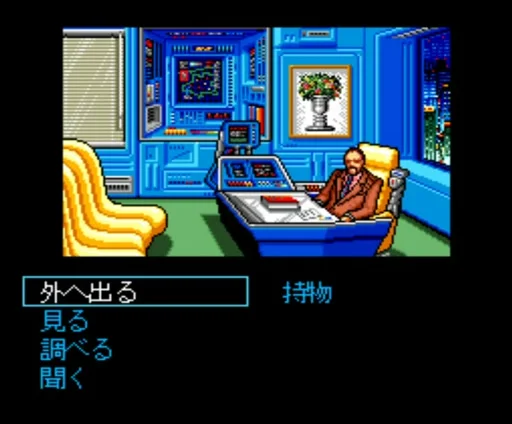
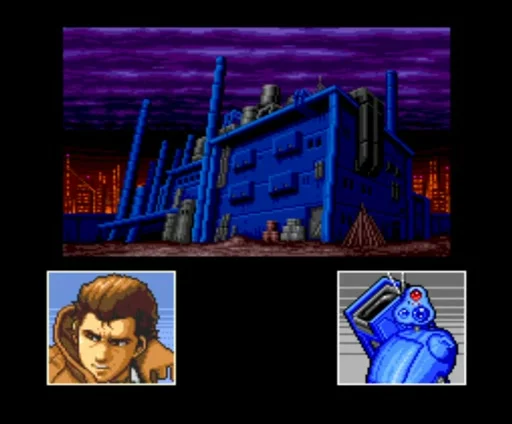
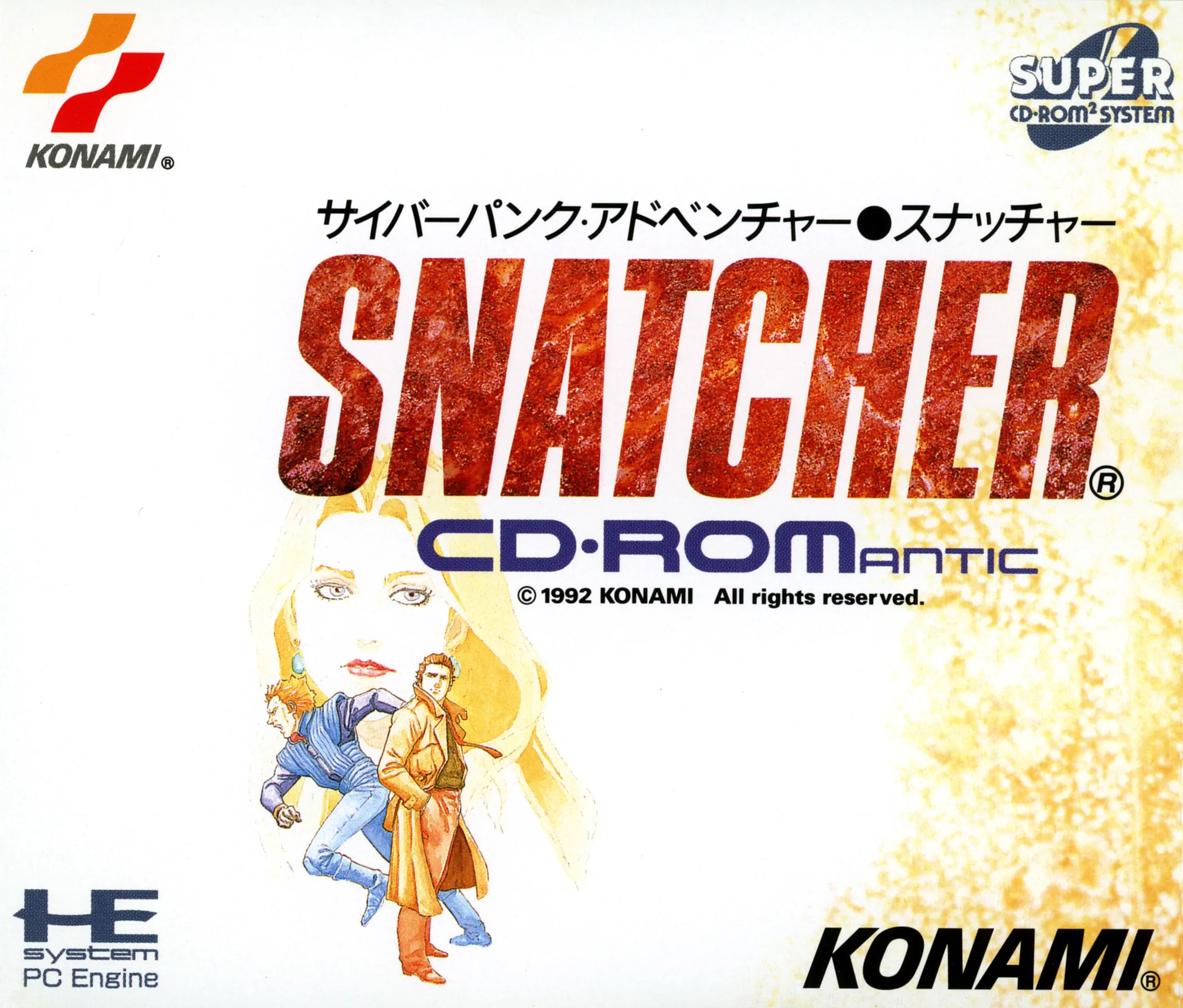
The auteur lab is the hidden inverse. While the cabinet was loudest and the SNES cartridge was selling, a back corridor of the same building was already on optical media. Snatcher CD-ROMantic — Hideo Kojima’s cyberpunk detective game, finally completed four years after the studio had forced him to cut it in half — shipped on the PC-Engine Super CD-ROM² in October 1992 as Konami’s first CD-ROM project. Rondo of Blood followed on the same format in October 1993 with the Castlevania the franchise still measures itself against: Red Book audio, anime cutscenes, two playable characters, the cabinet voice translated into the optical disc the cartridge division had no use for yet. Five years before Metal Gear Solid, the Konami capable of Metal Gear Solid was already operating. It just was not the visible Konami of the cabinet or the cart. The third thread of this Volume is the recognition that the studio’s coming decade was already being scored in 1992, on equipment most of the building had never touched.

How to Read This Volume

The nineteen pieces that follow read as one body of work because they were one. Three threads — the coin-op cabinet at its painted peak, the SNES cartridge at its third-party deepest, the optical disc at its auteur earliest — all run out of the same studio in the same months. The arcade Gradius III opens the Volume because it carries the seam: arcade-to-cartridge in eight weeks, the cabinet voice handed to the living room. Violent Storm closes the cabinet line. Rondo of Blood closes the disc one. Between them sits the run that, for four years, simply did not miss. The brawlers ask for quarters more than patience; the SNES cartridges are short by modern standards; Snatcher’s Act 3 collapses into what Kojima himself called a digital comic. None of that thins the body. It just names what the work is. Read the pieces in any order. The argument the Volume makes will land either way.

Listen

  • Super Castlevania IV — Original Sound VersionKonami / Mondo Records reissue Adachi and Kudo's full SPC-700 score — the Volume's clearest musical argument. The SNES translation thread in two minutes of cellar theme.

Watch

  • Violent Storm (Arcade) Playthrough — NintendoCompleteNintendoComplete / YouTube The cabinet line at its 1993 apex, played start to finish. Where the Volume's arcade thread lands.
  • The A–Z of Konami's 1980s Arcade GamesKim Justice / Retrounlim The only long-form video that places the studio's coin-op decade in one frame. The setup the Volume picks up from.

Read

  • Sunset Riders — Hardcore Gaming 101Hardcore Gaming 101 A platform-by-platform overview of the four-player cabinet line at its sharpest — the cabinet thread's clearest reference.
  • Masanori Adachi & Hirofumi Taniguchi — VGMO InterviewVideo Game Music Online The Super Castlevania IV composers on the SPC-700 score that defined the SNES translation thread's sound.
  • Snatcher — 1992 Developer InterviewHideo Kojima / Shmuplations translation The auteur lab thread, in Kojima's own words — the studio's first CD-ROM project explained by the director.
Part I

The Cabinet Voice

Konami's arcade house style at full volume — readable, choreographed, top-tier art — and its first leap onto the Super Famicom.

Chapter 01

Gradius III: From Legend to Myth

The Konami Goodbye That Became SNES Gradius

Hiroyasu Machiguchi's team meant Gradius III as their swan song; what arrived on the Super Famicom eight weeks after launch became Gradius for everyone west of Japan, slowdown and all.

Arcade · Super Famicom · SNES1989Horizontal ShooterKonami

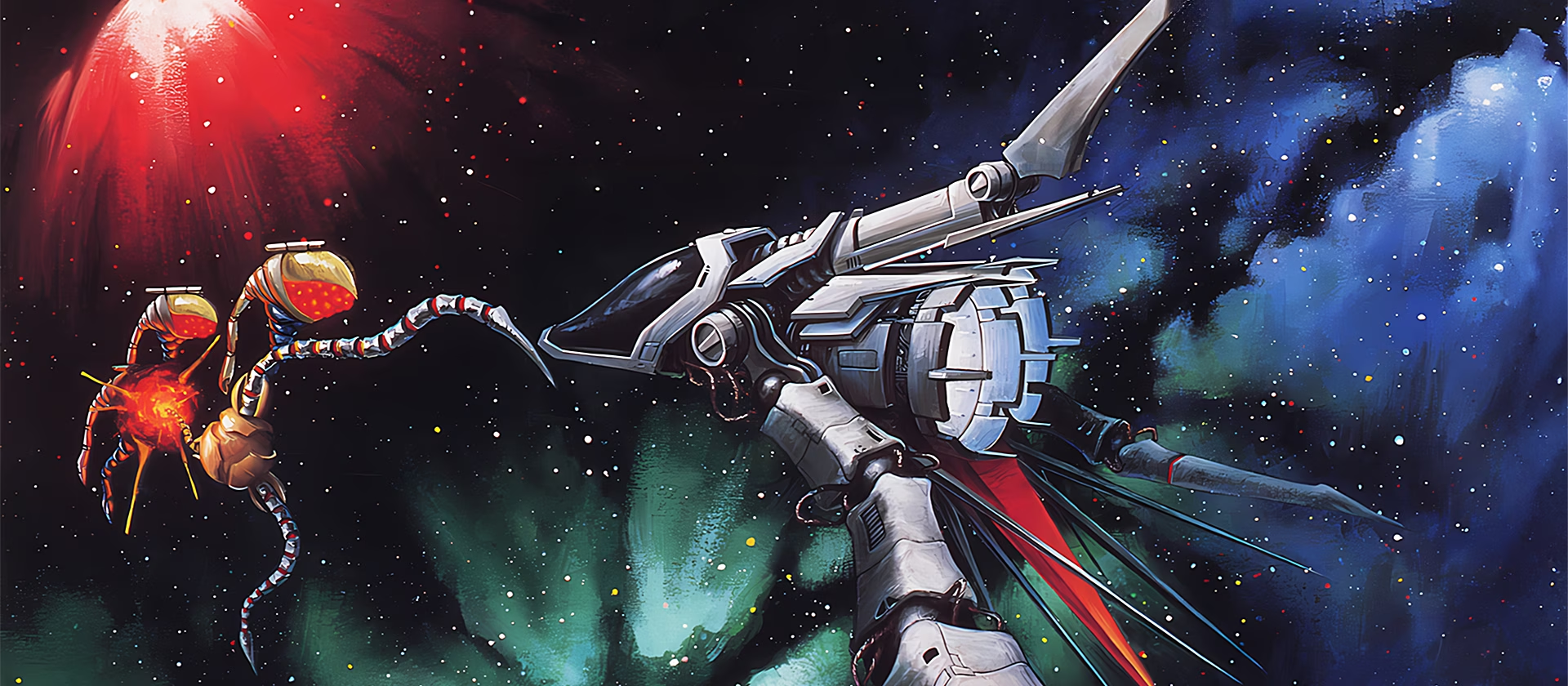
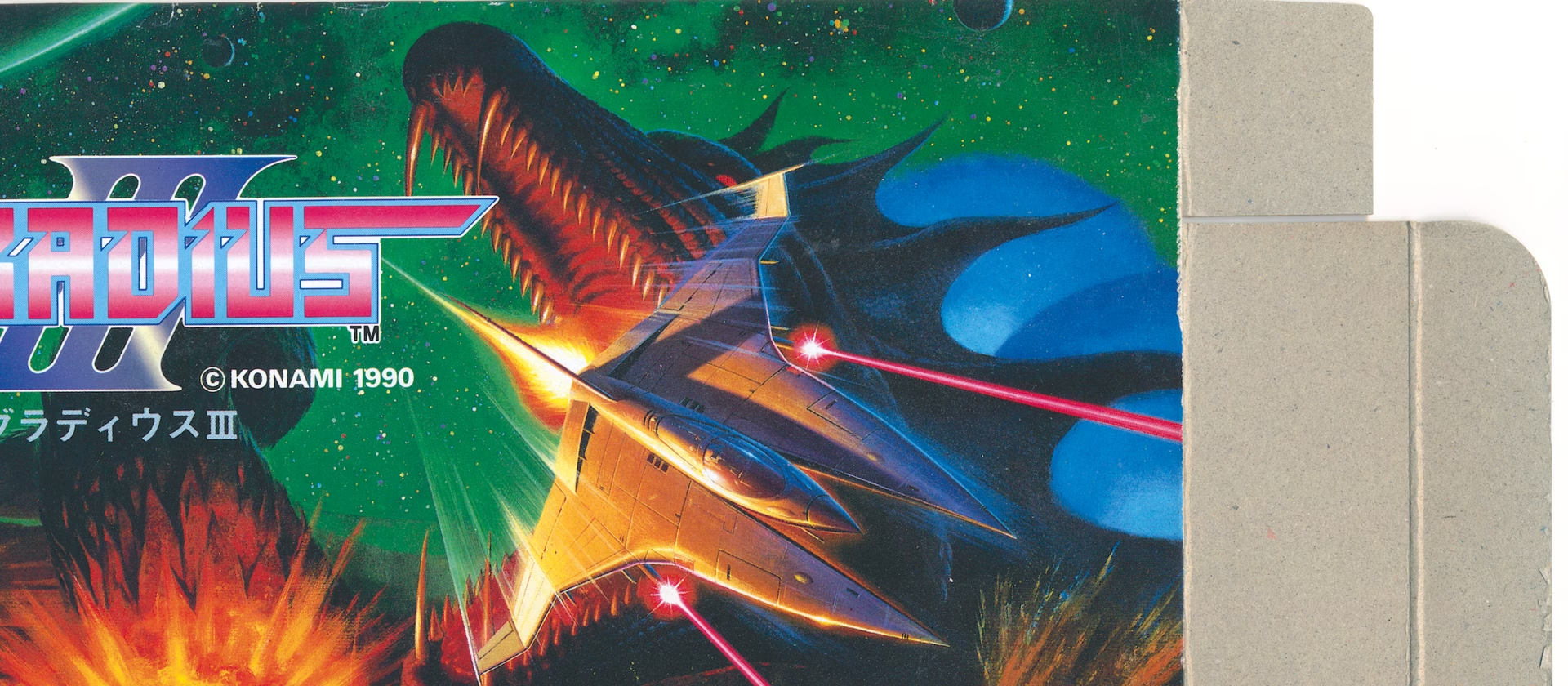
Gradius III · Konami, 1989/1990 · Super Famicom box artwork (SHVC-G3).

The cartridge carried a quiet confession. It shipped in December 1990, eight weeks after the Super Famicom launched, porting an arcade game Hiroyasu Machiguchi’s team had meant to put Gradius down with — a 10-stage maximalist set-piece its own designers could barely clear. Then the arcade door closed for a decade. The next new Gradius in a cabinet would not arrive until 1999. Everything in between happened at home, and most of it began with this cart: the SNES launch shmup that became, for everyone west of Japan, the first Gradius they had ever played.

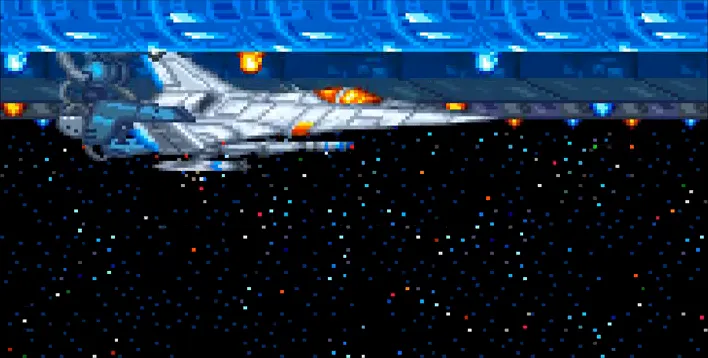
The SNES intro cutscene of Vic Viper flying along the underside of a blue space station, starfield beneath, the ship banking gently toward the right edge of the screen.

The first thing the SNES cart shows is a wide cinematic flyby — a piece of console-era branding the arcade ROM never bothered with, telling players this was Gradius for the living room, not a coin-op port. Gradius III · Konami, 1990 (SFC).

The Japanese subtitle is the giveaway. Densetsu kara Shinwa e — “From Legend to Myth” — is what you call something you mean to end. Konami’s English boxes never carried it. The team thought they were filing the brand. The hardware market would prove them right by silencing the arcade lineage for ten years, and prove them wrong by handing the cartridge to a brand-new audience that had no idea any of this had happened.

The Sequel Designed to End the Series

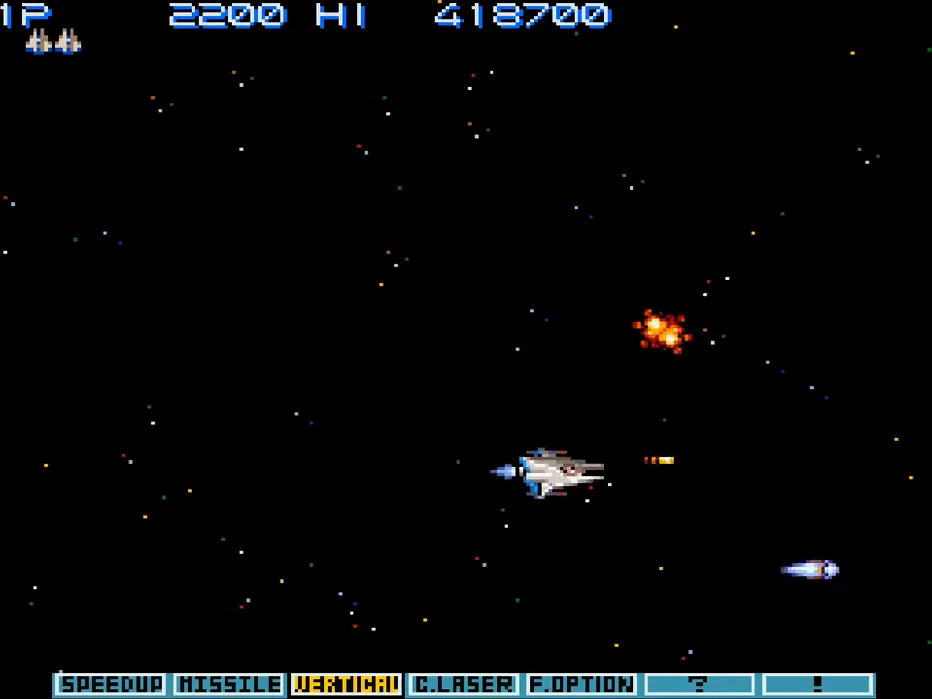
The Edit Mode is the first thing the box screen offers, and it is also the first sign that Gradius III was a designer’s swan song. For the first time in the series the player picks the entire loadout — Speed Up, Missile or Vertical drop, Twin Laser or the chargeable C.Laser, F.Option or R.Option, the empty ? slot, the Mega Crush button — before Vic Viper has fired a shot. Both arcade and SNES versions open with this grid. The previous two games made the player power up through a fixed canon. The third one lets you write your own.

Vic Viper in stage one against a starfield, Edit Mode HUD strip across the bottom showing SPEEDUP / MISSILE / VERTICAL / C.LASER / F.OPTION / ? / ! slots.

The Edit Mode bar — Konami’s first Gradius to expose the whole power-up grammar at once. Below the prose column it looks like a HUD strip; in design terms it’s the moment the series stops being a canon and starts being a sandbox. Gradius III · Konami, 1990 (SFC).

That sandbox was load-bearing for a reason the dossier surfaces only between two interviews. Yoshitaka Itou, the arcade programmer, told Konami’s Portable Guide in 2006 that Gradius III was meant to be the conclusion of the Gradius series. Takemasa Miyoshi, the designer, told the same panel that the location-test response to the difficulty was “pretty critical, so we added [Beginner mode] to appease them” — and that the new mode trimmed the stage count without softening a single enemy pattern. The team was so sure this was the last word that they could not bring themselves to make a kinder version. Maicon BASIC Magazine reported in July 1990 that only two members of the development team had ever cleared a single loop. The “couldn’t beat it” anecdote is everywhere on the internet because the team put it in the press themselves.

The maximalism then becomes legible. Ten stages — the most in the series — opened the cabinet to the deepest weapon menu it had ever offered, gave the deepest menu the meanest enemies it had ever written, and let the result loose on coin-fed players who would have to start over from the title screen the first time the wall of cubes ended their credit. The arcade game flopped. Konami did not announce it; the silence was the announcement. The next arcade Gradius shipped in 1999.

The Bubble Stage Was Five Years Late

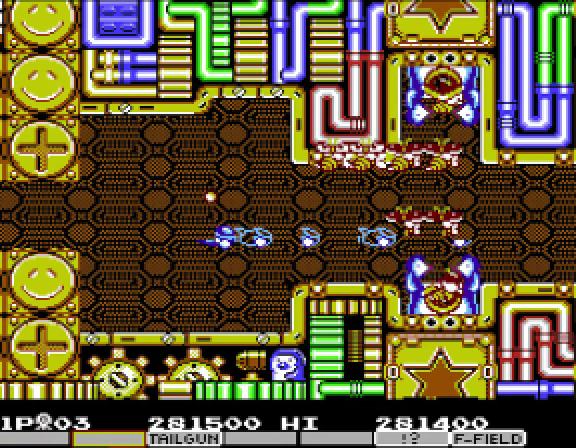
In a 1999 Game Hihyou interview, Machiguchi answered a question about recurring stage ideas with the kind of detail a tired veteran offers. Some of those couldn’t be accomplished due to hardware limitations, but we brought them back for Gradius II and III. The fast scrolling stage and the ice stage in Gradius II, and the bubble stage in Gradius III are examples. The Cell Stage that arrives near the end of the SNES port — pulsating green tissue running floor-to-ceiling, sacs of red pustules clustered into terrain, alien architecture slow enough to feel and fast enough to swallow — is a 1985 idea Konami had wanted to make since Gradius I and only built five years later when the silicon would carry it.

The Cell Stage Machiguchi had wanted since Gradius I. Brought back from the cutting-room when Konami’s new hardware would finally hold a screen this organic, then routed to the SNES port as the closer the home version needed. Gradius III · Konami, 1990 (SFC).

”Some of those couldn’t be accomplished due to hardware limitations, but we brought them back for Gradius II and III. The fast scrolling stage and the ice stage in Gradius II, and the bubble stage in Gradius III are examples.”
— Hiroyasu Machiguchi, director, Game Hihyou, September 1999

The line reframes the whole project. Gradius III is not a sequel reaching for new ideas — it is the directory of every idea the series had not yet been able to ship, dumped into one cabinet by a team that did not think there would be another chance. The Bubble Stage is the cleanest example because the design seam is visible. Nothing else in the game looks like it. The team brought it home before they brought it back home.

The Score That Joined Suikoden’s Future

The composer credit on the cart is a roster the magazines did not really pause to notice. Junichirō Kaneta leads with three Konami staffers underneath whose later work would each define a different franchise. Miki Higashino’s name lands here four years before she would compose the Suikoden main theme; Mutsuhiko Izumi would write Rocket Knight Adventures and the brass-heavy chase music of Castlevania: Bloodlines; Seiichi Fukami and Kōzō Nakamura sat at the same desk for the next decade of Konami’s shmup output. Five composers, one short cartridge, almost no track over two minutes long — and the writing is denser than Gradius II, even when Hardcore Gaming 101 is right that the percussion is thinner.

The texture is the SNES sound chip held to a single idea: that Gradius music is mechanical. The opening theme sits on a stuttering arpeggio and lets the bass walk under it; the Cell Stage cue drops to a sequencer pulse the player counts against the ricocheting enemies; the boss cues stop carrying melody and let an attack-decay synth lead do the work alone. There is no swelling string motif, no faked guitar heroism. Konami’s Kukeiha Club had the tools, demonstrated elsewhere; on Gradius III they used a quarter of them on purpose. The score is a metronome with a thesis: lock the player to the beat, never push, never explain, let the choreography breathe.

The Edit Mode They Finally Trusted

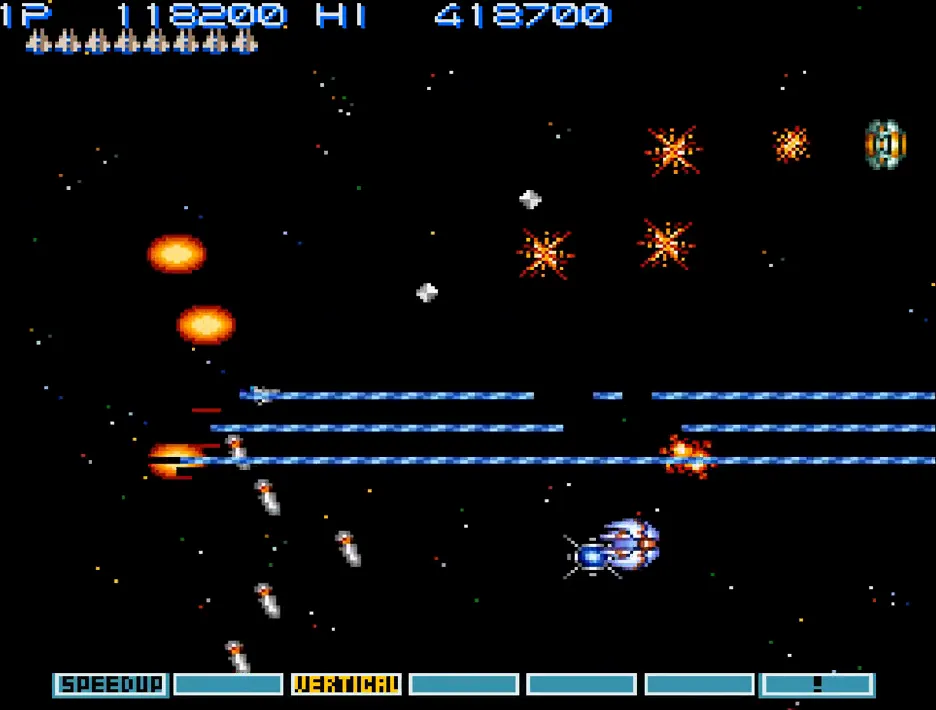
Sit with the SNES port today and the Edit Mode is the design idea that has aged the most cleanly. Pick Twin Laser and the screen fills with rifled parallel beams that strip cluster enemies before they spread; pick C.Laser, hold the button, and Vic Viper carries a chargeable energy lance that punches single bosses where the spread shot wastes ammunition. F.Option spreads four satellite drones in a vertical line for top-and-bottom defence; R.Option (SNES-exclusive) rotates them around the ship for radial pressure. The Mega Crush button — also a SNES addition, sitting in the ! slot — clears the screen once per stage at the cost of every other power-up tier you have accumulated. The bar at the bottom of the HUD stops being a status read and becomes a personal dialect.

Vic Viper firing parallel triple-beam lasers across a starfield against missile-armed enemies, with fireball Options trailing in formation.

A C.Laser sweep with R.Option rotation — the loadout the previous two Gradius games refused to let the player combine, exposed here as a customisation grid. The play-spine of the cart is the Edit Mode menu, not the stage list. Gradius III · Konami, 1990 (SFC).

The PSP Gradius Collection in 2006 would unlock an “Extra Edit” mode for arcade Gradius III that descends directly from the choices made on the SNES cart. The 2025 Gradius Origins compilation hands the same Edit Mode to a modern training mode that finally lets a player tune restart points and loop counts around it. The cartridge’s contribution to the series is not a stage or a boss; it is the moment the loadout became personal. Everything after — Gradius IV, Gaiden, V, the 2006 Portable — uses the grammar this cart printed.

A Slowdown the Future Couldn’t Fix

The slowdown the SNES port is famous for is also load-bearing, and the fix proved it. In May 2019, the romhacker Vitor Vilela released an SA-1 patch that reroutes the workload to the 10.74 MHz enhancement chip and runs the cart at the frame rate Konami’s team never reached. GIGAZINE’s headline at the time read: the degree of difficulty rose to impossible level. The slowdown was, accidentally, the SNES port’s quiet difficulty-management layer — when the Cell Stage threw too much at the player, the console gasped, and the player got a beat of usable time the arcade ROM never gave anyone. The cartridge ran below spec, and that is partly how it survived an audience the arcade ROM was not built for.

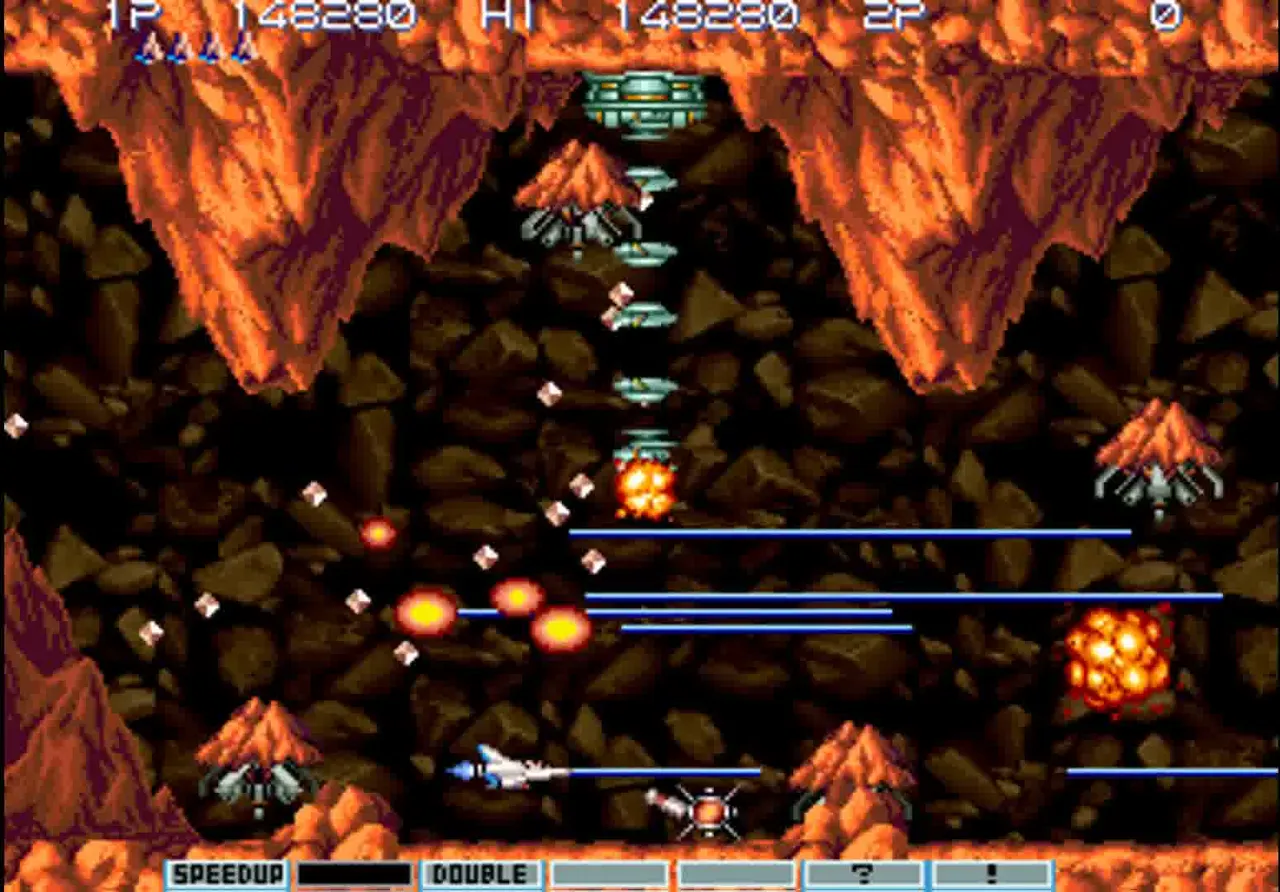
The arcade ROM kept stages the SNES could not.

The arcade Volcanic Planet stage — Vic Viper firing parallel blue lasers through a vertical canyon of orange volcanic rock, multiple turret enemies arranged across the screen, twin missile racks tracking the ship.

The arcade-only Volcanic Planet stage — full-screen vertical rock canyons in saturated orange, parallel blue laser sweep, enemy density the SNES port had no choice but to cut. The arcade ROM kept stages, palettes, and densities the cartridge silicon could not carry. Gradius III · Konami, 1989 (Arcade, GX945).

The North American release dressed the secret as a private joke. Enter the Konami Code on the SNES port with the joypad and Vic Viper self-destructs; enter it with the L and R triggers substituting for Left and Right, and the full power-up still arrives. The cheat that defined the Konami of America era of Gradius and Life Force now punished the same hands that had typed it for years. The English manual renamed Vic Viper M.A.X. The SNES box made Gradius sound like a marketing line for a console launch, not the third chapter of an arcade story the West had not seen. None of those choices were accidents. The version that became Nintendo’s first Gradius was built to be its own object, and the cart’s slowdown — the part Game Developer would later call a poster child for the SNES’ reputedly slow CPU — was the cost of that translation.

What it asks of a modern player is honest: a credit-run is brutal cold, and the unpatched SNES port misrepresents the arcade design to anyone parachuting in for the first time. The Origins collection in 2025 is the cleanest first contact — arcade ROM, SFC cart, the rediscovered AM Show 1989 prototype, save states, training mode. The PSP Collection still works for portables, and the SA-1 patch is the canonical romhack for a flashcart. The original NA SNES cart is the historical object. None of the modern routes erases the cartridge that made this game a household one; they all let you choose, finally, which Gradius III you wanted to meet.

Cartridge Collective 1989 · Arcade · Super Famicom · SNES

Where to play

Why Now

Vic Viper drops into ricocheting cells — Gradius III's Edit Mode lets you carry the loadout the previous two games refused to combine.

Best way to play now Gradius Origins

M2's August 2025 collection ships the arcade ROM, the SFC port, and the rediscovered 1989 AM Show prototype build together — the first time Konami has put the whole Gradius III lineage in one box, with save states, rewind, and a training mode that finally lets the Cube Rush yield.

Time
35–45m per credit-run Stage 1 through the Bubble corridor to feel the maximalism
Cost
£30 Often £18–22 in seasonal sales; bundles seven Gradius / Salamander titles plus the new Salamander III.

Alternatives

  1. 01
    modern

    Gradius Origins (PC / PS5 / Xbox / Switch / Switch 2)

    M2 emulation, save states, rewind, training mode, region toggle. Bundles the AM Show 1989 prototype and Salamander III alongside the cartridge classics.

  2. 02
    emulation

    Gradius Collection (PSP, 2006)

    Six-game UMD with the arcade Gradius III, an unlockable Extra Edit mode, and the cleanest portable route to the whole pre-Origins arcade lineage.

  3. 03
    simulation

    MiSTer SNES core

    Cycle-accurate FPGA SNES simulation for purists running their own legal SFC dump — slowdown intact as Konami shipped it.

  4. 04
    rom hack

    SA-1 patch by Vitor Vilela (v1.5+)

    Reroutes the workload through the SA-1 enhancement chip and erases the slowdown. The 28-year hack that turned the SNES port into a wholly different — and, by GIGAZINE's reckoning, harder — game.

  5. 05
    original

    Super Famicom 「グラディウスIII」 cartridge (SHVC-G3)

    Eight weeks after the Super Famicom launched, this was the system's first showcase shmup. The original Japanese cart is the version everything else descends from.

1989 · Konami

Listen

  • Gradius III SNES OST — Full PlaylistKonami Kukeiha Club · YouTube Junichirō Kaneta leads with Seiichi Fukami, Kōzō Nakamura, Miki Higashino (Suikoden, four years out), and Mutsuhiko Izumi — a Konami composer bench almost too deep for one short cart.

Watch

  • Gradius III (SNES) — Full LongplayVGL / YouTube A clean run on Normal that shows the SNES port's stage routing, Edit Mode loadouts, and the slowdown that defined it for a generation.
  • The A–Z of Konami's 1980s Arcade GamesKim Justice / Retrounlim Gradius III lands at 40:30 in Kim Justice's full-decade Konami sweep — short, but the only citable long-form video that places it inside the studio's arcade arc rather than the SNES one.

Read

  • Gradius — 1996 / 1999 Developer Interviews (Machiguchi)Shmuplations
  • Gradius Portable Guide — 2006 Interview Collection (Itou, Miyoshi)Shmuplations
  • Gradius III — Hardcore Gaming 101Hardcore Gaming 101
  • The History of Gradius: 30 Years of Konami ShootingGame Developer (Gamasutra)
  • 『グラディウス オリジン コレクション』開発インタビューDenfaminicogamer
  • Gradius III — Gradius WikiGradius Wiki (Fandom)
  • 28 Years Later, Hacker Fixes Rampant Slowdown of SNES Gradius IIISlashdot / Vitor Vilela
  • How Can I Play It?: The Gradius SeriesRetronauts

Chapter 02

Parodius Da! ~Shinwa kara Owarai e~

The Konami Parody That Out-Voted Gradius III

Six months after *Gradius III: From Legend to Myth*, Konami released its own send-up — *From Myth to Laughter* — and the parody beat its sibling for Best Shooting and Best Direction at the 1990 Gamest Awards.

Arcade · Super Famicom · PC Engine · Famicom · Game Boy · X680001990Horizontal ShooterKonami

Parodius Da! ~Shinwa kara Owarai e~ · Konami, 1990 · arcade key art.

Two Konami cabinets shipped to Japan in the same six months. In December 1989 the studio released Gradius III under the subtitle Densetsu kara Shinwa eFrom Legend to Myth — a ten-stage maximalist set-piece its programmers told the press they had built as a swan song for the series. The following April, on the same arcade rig, the same studio released Parodius Da! under the subtitle Shinwa kara Owarai e: From Myth to Laughter. The catalogue staged the joke for anyone reading. Konami had spent two games elevating its space-opera mythology toward sacred status, then cued the next rung itself — bring the whole thing down to the level of a Vegas dancer, a cat-faced battleship, and Beethoven’s Ninth Symphony arranged as bullet-hell BGM.

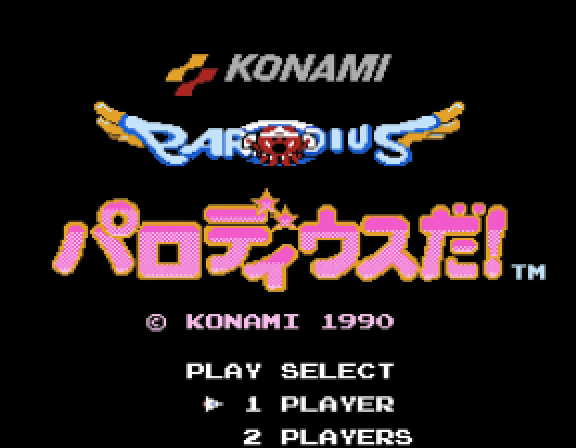
The Parodius Da! title screen — the Roman PARODIUS logo with winged Vic Viper above the pink katakana subtitle パロディウスだ!, © KONAMI 1990 below, and PLAY SELECT 1 PLAYER / 2 PLAYERS at the bottom.

The title screen carries the joke as a piece of corporate signage: the Roman PARODIUS logo answering Gradius’s, the pink katakana subtitle, the 1990 Konami copyright. The studio was selling the parody as a flagship, not a side project. Parodius Da! · Konami, 1990 (Arcade).

The reading audience already knew which game won. The 4th Gamest Grand Prix, compiled from Japanese arcade-goers’ votes across 1990, placed Parodius Da! second overall behind Final Fight, first for Best Shooting, first for Best Direction, fifth for player popularity, and fifth on Konami’s annual income roll. Gradius III held onto Best VGM by a single ranking; Parodius Da! placed second on that ballot too. Two Konami games, one year, head to head on the same readers’ card. The parody outscored its sibling everywhere except music — and even there, the cabaret arrangements of Strauss and Offenbach came within one vote of the straight game’s prog-electronica score. This is the Konami arcade output most contemporary Western retrospectives flatten into “the cute Gradius.” 1990 Japan read it the other way.

A Promotion From the MSX

The franchise had begun two years earlier as a single-platform joke. Parodius on MSX, 1988, was a Konami in-house parody of the studio’s own Gradius aimed at the Japanese home-computer audience that had bought Gradius on cassette and disk first. The premise barely escaped its hardware. Cabinet adaptation was not the plan. Then Gradius III’s December 1989 location-test response told the floor what its difficulty rating implied, the team trimmed a stage for a Beginner mode, and Konami greenlit a parallel cabinet on the same GX-400-family rig that would ship as the studio’s next flagship shooter four months later. A 1988 one-off had been promoted to 1990 marquee. The Japanese press read it that way at the time: Retro Game Raiders’s anniversary review still calls it the franchise’s 大出世 — its great promotion across the bridge of tears in reverse.

The team leader through every arcade Parodius was Tokuda Tsukasa, credited on the cabinet roll as Chichibinta Tsukasa — Konami had decided early that the joke applied to the dev names too. Speaking to Game Hisshou Guide in June 1994, four years after the cabinet shipped, Tokuda put the inheritance plainly: I’ve been the team leader for the Parodius games for quite awhile now, since Parodius Da!. He would carry the franchise through Gokujō Parodius in 1994 and the X68000 and PC-Engine ports in between, but he also told the interviewer that he rated this first arcade entry at eighty out of a hundred, against fifty for the sequel. The studio’s parody programmer thought the first time was the best time. The Gamest readers had agreed.

The Bell Cycle Under the Joke

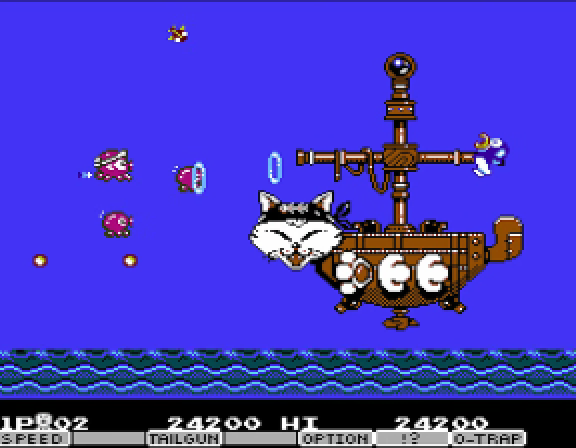
The first boss arrives four minutes into a credit-run. A battleship steams in from the right, masts and smokestacks rigged up like a steampunk pirate brig, and the entire prow is a giant cat’s face — eyes shut in concentration, jaw locked, the kind of expression Konami’s actual R-Type parody might have aimed for. The cat mews when you hit it.

The Parodius Da! stage-one boss — a steampunk pirate battleship with a giant cat-face on the prow, masts and smokestacks rigged above, Vic Viper firing on it from the left as pink octopus enemies stream out.

The opening boss punctures the R-Type and Gradius opening-battleship tradition with a sprite that mews on damage. Beneath the gag is the bell-cycle: eight colours of falling power-up that double Gradius’s scoring grammar into a second live system. Parodius Da! · Konami, 1990 (Arcade).

Underneath the visual gag is a scoring system Konami’s straight shmups did not run. Vic Viper, Octopus, TwinBee, and Pentarou — four selectable craft with identical hitboxes and four distinct loadouts — pick up the Gradius power-bar at the bottom of the screen and add a second one to it: the bell-cycle. Shoot a hanging bell and it begins flashing through colours — yellow, blue, yellow, white, yellow, green, yellow, red, repeating — each value granting a different effect when collected. Yellow bells climb from five hundred to ten thousand points; blue is a screen-bomb (capped at three); white is the megaphone-voice attack that spouts do you believe in God? and I want a girlfriend and the quadratic formula while disabling your weapons; green is jumbo-size and temporary invulnerability; red is a laser barrier. The shmups.wiki rank breakdown calls the system incredibly unforgiving — minimum rank per stage layered on power-up count layered on bell stock layered on frame-rank. A second loop puts single-revenge bullets behind every enemy. The carnival paint is the lure; the punishment economy is Gradius II’s, sharpened by an extra system the canon games never wrote.

Tokuda told Game Hisshou Guide that the Auto option — pre-set power-up routing for newcomers, tucked beside the manual mode — was a deliberate gesture toward the wider audience arcades were trying to attract in 1990, a period where the appeal of STGs was expanding. Two years later Street Fighter II would resolve that audience question for the whole genre by changing what arcades sold. Parodius Da! sits on the lip of the shift. The last moment a horizontal shmup could win Best Shooting at Gamest is also the last moment Konami designed one as a piece of mass-audience outreach.

Beethoven’s Ninth as Arcade BGM

Konami credited the soundtrack to Cameo Matano and Dokuo Umeno, joke pseudonyms for Muraoka Kazuhiko — the studio’s marquee sound man, the composer of Metal Gear on MSX2 and Snatcher on PC-88. Giving Muraoka the parody score was not a junior assignment. The most serious arrangement chair at Konami arrived at the cabinet with the entire Western art-music canon to work from, a Konami-branded 8-bit chip to drive, and instructions to take the joke seriously.

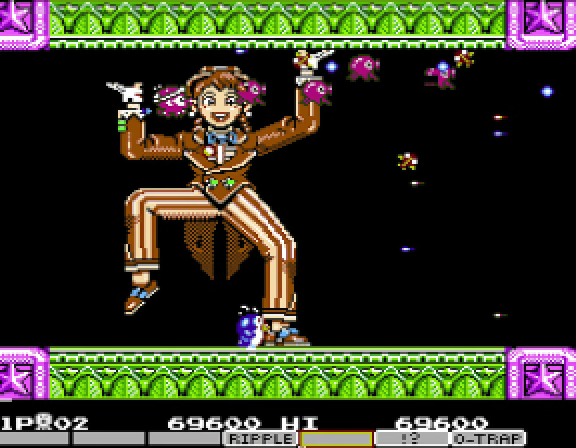
A Vegas-dancer boss character in feathered cabaret costume on the left of the screen, framed by pink and green vaudeville-theatre borders, throwing arrows of bullets across the playfield at Vic Viper on the right.

The boss sequence Offenbach’s Can-Can is scored to — Muraoka arranged the Orpheus in the Underworld cue to land its choruses on the dancer’s attack waves. The Konami sound chip running the joke runs the joke at orchestral scale. Parodius Da! · Konami, 1990 (Arcade).

The selection is documented track by track at VGMPF. Stage one opens on Johann Strauss II’s Under Thunder and Lightning polka. Stage three runs Khachaturian’s Sabre Dance against walking cherry blossoms. Stage four boss music is Offenbach’s Can-Can from Orpheus in the Underworld cued to the cabaret dancer’s attack phrases. The Yoshiwara stage takes Rossini’s William Tell Overture. The cemetery stage medleys Grieg, Beethoven, and Tchaikovsky into a Halloween procession. Crisis 4th Movement — the warp-tunnel cue — is Beethoven’s Ninth, Ode to Joy, scored under bullet patterns the orchestral original never imagined. Hardcore Gaming 101 notes the arcade synth makes the arrangements sound much better than the MSX version; what the website does not say is that this is the moment Konami’s parody scope expands from Gradius-the-game to Western music itself. The joke gets bigger. It also stays joke-uniform: Muraoka’s house mode in 1990 is uptempo and cheerful, and forty minutes of unbroken uptempo is genuinely fatiguing — the soundtrack has the consistency of a temperament rather than the range of a score.

The Famicom Lost the Voices

The Super Famicom port arrived in July 1992, two summers and a console generation after the cabinet. It carried almost all of it across. Hardcore Gaming 101 judges the SFC version looks almost identical, and outside of some slowdown, plays faithfully too — Konami added a bathhouse stage, added an omake bonus mode, kept the bell-cycle and the four-craft roster intact. The major loss was Chichibinta Rika’s hip animation, censored by Nintendo of Japan; Konami compensated by adding her a megaphone phrase, koshi fura sete yo!swing those hips! — that the censor had not anticipated. Mean Machines reviewed it at ninety-three percent. CVG at eighty-eight. The cart became the version Western players met first, and it preserves the cabinet so cleanly that a contemporary Famicom player would not have heard the gap.

The Famicom port of November 1990 is a different shape. It shipped on the smaller console eight months after the arcade, before the SFC even launched, on a chip a generation older than the cabinet. The trade-off is visible. The megaphone is gone — no Konami voice samples on a 1990 Famicom — and the white bell now grants a 1UP instead of the voiced attack.

The Parodius Da! pachinko stage — golden Japanese architecture with brick walls and a yellow 0000-score pachinko machine bottom-left, pink Moai-pachinko-balls flying across the playfield as Vic Viper threads through.

The arcade pachinko stage — one of three Konami’s Famicom port team had to drop wholesale. The cabinet’s mechanical lattice of pachinko-balls-as-bullets routed through gold architecture is the kind of stage 8-bit silicon could not carry. Parodius Da! · Konami, 1990 (Arcade).

Three stages are dropped wholesale: the Japan mountain, the pachinko level, the cloud level. The cemetery is shortened. In their place Konami’s port team built a carnival roller-coaster stage, added two original bosses (a Moai pirate ship, a duck-boat), and routed the bonus zone through the inside of the Moai battleship. None of those were on the arcade cabinet. The Famicom did not carry the parody; it built an answer to it, on the hardware that had hosted MSX Parodius two years before. The console it could not fit onto was the console the franchise had started on.

The Punchline That Beat Konami’s Goodbye

Stage ten begins on a Moai head and ends on the same metallic gold corridor that closes Gradius II. Tokuda had wanted to ship the gag since 1988:

“The final stage, a parody of the final stage of Gradius II, was something I had talked about doing since the original Parodius.”
— Tsukasa Tokuda, Game Hisshou Guide, June 1994

The closer the joke gets, the more the joke knows what it is doing. The yellow plating, the recessed pipes, the curling green coolant lines, the formation pressure of the long enemy approach — all of it carries the Gradius II late-stage shape, with cartoon enemies sprinting through it.

Parodius Da! stage ten — a yellow and gold metallic Gradius II-style corridor with mechanical pipework, recessed gears, and dot patterns; Vic Viper crossing the centre with bullets in mid-flight.

The final stage Tokuda had wanted to ship since the 1988 MSX original. Konami’s mechanical lattice from Gradius II’s closer, reproduced down to the gear ratios under the floor, with parody sprites still doing the work. Parodius Da! · Konami, 1990 (Arcade).

What Konami sanctioned in spring 1990 was not a side-project. It was a flagship-positioning move on a programmer’s three-year creative project — Gradius III’s subtitle had announced an ending, Parodius Da!‘s subtitle announced the next move, and the Gamest readership voted the parody more confidently composed than the canon entry it answered. Tokuda would carry the franchise into Gokujō Parodius in 1994 and then watch arcade economics close the route the parody had been written to broaden. The Auto option that had been an outreach gesture would not survive Street Fighter II’s redefinition of what arcades sold. Muraoka’s Beethoven arrangements would not survive the licensing climate of the 2007 Parodius Portable, which had to substitute Brahms for Khachaturian, and the franchise has shipped nothing since. Konami renewed the Gokujō Parodius Da! trademark in Japan in June 2024 — the first signal anyone has read as movement — and the Arcade Archives slot remains empty. Until something ships, the route to the cabinet runs through a Saturn disc, a Super Famicom cartridge, or a PCB on a JAMMA harness, and the version that beat its own studio’s straight goodbye sits one degree of separation from the arcade audience that put it there.

Cartridge Collective 1990 · Arcade · Super Famicom · PC Engine · Famicom · Game Boy · X68000

Where to play

Why Now

A cat-faced battleship that mews when shot — and a bell-cycle scoring grammar Konami's serious shmups never tried, under the joke.

Best way to play now Gokujō Parodius Deluxe Pack (Saturn / PS1)

Konami's 1994–95 two-game disc bundles arcade-accurate Parodius Da! with its 1994 sequel — easier difficulty options included. The Saturn version released in Europe as Fantastic Journey; the PS1 is Japan-only. Until Konami breaks the franchise's silence, this is the cleanest arcade-spec home route.

Time
30–40m per credit-run Stage 1 through the cat-faced battleship boss
Cost
£40 JP imports £30–60; Saturn EU Fantastic Journey discs £50+ in clean condition.

Alternatives

  1. 01
    original

    Konami Super Famicom port (SHVC-PD)

    Closest single-cart home version. Adds bathhouse stage and omake mode. Nintendo of Japan censored Chichibinta Rika's hip-shake and added the megaphone phrase 'Koshi fura sete yo!' as compensation.

  2. 02
    original

    Konami arcade PCB

    GX-400-family Konami board. YM2151 + K053260 sound. PCBs surface from JAMMA collectors at £150+; the cabinet art alone earns the shelf space if you can house it.

  3. 03
    emulation

    Parodius Portable (PSP, 2007 — JP only)

    Konami's PSP collection. The stage 4 cue swaps Khachaturian's Sabre Dance for Brahms's Hungarian Dance No. 5 — the classical-music joke became a licensing problem two decades later, and the franchise has shipped nothing since.

  4. 04
    simulation

    MiSTer Arcade core

    Cycle-accurate FPGA emulation of the GX-400 board for purists supplying their own legal ROM. The closest to original cabinet response without housing a PCB.

  5. 05
    modern

    Awaiting Arcade Archives release

    Konami renewed the Gokujō Parodius Da! trademark in Japan in June 2024 — the first franchise signal in seventeen years. No release date as of this writing. Recheck the storefronts before settling for an import.

1990 · Konami

Listen

  • Parodius Da! Original Arcade SoundtrackKazuhiko Muraoka — Konami Kukeiha Club / YouTube Muraoka arranged Strauss, Beethoven's Ninth, Tchaikovsky, Offenbach's Can-Can, Khachaturian's Sabre Dance, Rossini's William Tell, Wagner, Mendelssohn, and Grieg — credited on the cabinet roll under the joke pseudonyms 'Cameo Matano' and 'Dokuo Umeno.'

Watch

  • Parodius Da! (Arcade) — Full LongplayWorld of Longplays / YouTube Single-credit run through all ten stages, ending on the Gradius II final-stage send-up. The cat-faced battleship arrives at 4:00; the Vegas-dancer parody sequence at 12:00; stage 10 around 38:30.
  • The A–Z of Konami's 1980s Arcade GamesKim Justice / Retrounlim Parodius lands in Kim Justice's full-decade Konami sweep — useful for placing the parody inside the studio's arcade arc rather than the SFC-port lineage Western retrospectives default to.

Read

  • Gokujō Parodius! Developer Interview (Tokuda) — Game Hisshou Guide, June 1994Shmuplations translation
  • Gokujou Parodius Developer Interview — Gamest Issue 125, 15 Sept 1994It's Fantastic translation
  • Parodius Da! — Hardcore Gaming 101Kurt Kalata / Hardcore Gaming 101
  • Parodius Da! — Shmups Wiki (rank, scoring, bell-cycle mechanics)Shmups Wiki
  • Parodius Da! — Video Game Music Preservation FoundationVGMPF
  • パロディウスだ! 〜神話からお笑いへ〜 — 日本語版 WikipediaJapanese Wikipedia
  • Konami Renews Parodius Trademark After 17 YearsTime Extension
  • Parodius series — Gradius WikiGradius Wiki (Fandom)

Chapter 03

Xexex

The Konami Shooter Konami Couldn't Bring Home

Xexex won the 1992 Gamest crowns for Graphics and VGM, ran on a custom Konami board used only once, and stayed inside Japanese arcade glass for thirty years.

Arcade · Switch · PS4 · PS51991Horizontal ShooterKonami

Xexex · Konami, 1991 · arcade key art.

Xexex won Best Graphics and Best VGM at the 1992 Gamest Awards and placed third overall. It beat Virtua Racing for the graphics crown and Metal Black for the music. It came ninth in Player Popularity. The trade press loved it more than the players did, the trade press was right, and within twelve months Konami had quietly accepted that the game could not be moved off the cabinet that made it. The board was a one-off — Konami’s GX067, custom-built and never used again. No SNES port was attempted. No Mega Drive version. A PlayStation 2 release was started and cancelled. The Princess on the flyer at the top of this article called out into a Japanese arcade for sixteen years before any version reached a home machine, and into the world for thirty years before any version reached one outside Japan. Today the most-decorated Konami arcade shooter of its year is still missing from Konami’s own Gradius Origins compilation.

A Princess and a Custom Board

The team’s stated goal was an accessibility move. “Our goal for Xexex was to change the image people had of Konami STGs as being ‘hardcore,’” Konami planning told Gamest in February 1993. “That’s why we added a cute girl.” Her name in the cabinet is Princess Irene La Tias, of planet E-Square, and she calls out for the Flintlock fighter between every stage in the voice of Sumi Shimamoto — the actress who had voiced Nausicaä in 1984 and Clarisse in The Castle of Cagliostro five years before that. The casting was not a flourish. Konami had cast the most recognisable young-woman voice in mainstream anime to soften a horizontal shooter.

Stage 1 in motion — the Flint detached, tracking the next enemy across the screen on its own. Konami’s answer to the Force pod of R-Type, fused with the tentacle weapon of X Multiply, on a board its own maker would use exactly once. Xexex · Konami, 1991.

The board they wrapped this around was a custom Konami PCB, the GX067, sitting in the family below the Konami GX flagship that would arrive three years later. It carried a 16-megahertz 68000 CPU and a Z80 sound chip driving a YM2151 with PCM samples — mid-tier for late 1991, by Konami’s own standards. What made it remarkable was that Konami never used it again. The cabinet on the workbench in front of the team was theirs alone, the chips were not going to be reused for Sunset Riders or Lethal Enforcers, and the porting question — what comes home, what stays in the cabinet — had been answered before the team finished the cabinet. Nothing about this would come home. The custom board was the bargain that paid for the seven-stage spectacle on screen.

What the Flint Actually Does

The Flint is the mechanism. It is the single most expressive piece of arcade-shooter design Konami shipped in 1991, and it is two competing Irem ideas combined into one organism. R-Type in 1987 had given the genre the Force pod — a detachable forward unit that could be launched and recalled, that absorbed bullets while attached and dealt contact damage while loose. X Multiply in 1989 had given the genre tentacles — flexible, invulnerable, articulated limbs flanking the player ship that lashed at enemies on either side. Konami’s Flint is what happens when those two ideas are placed in the same chassis.

Launched from the Flintlock, the orb homes in on the nearest enemy at slow speed and clamps on, dealing contact damage as long as it stays attached. Charge it up with pickups and it grows tentacles — first one, then two, then a full set of articulated limbs that lash automatically at anything nearby and physically block enemy bullets. Press fire while the Flint is locked to the ship and the tentacles fan out into a charge-shot lattice across the screen. The orb is alive, and it gets more alive the more you feed it. There is nothing else in 1991 doing this. Gradius had the Option satellites, which were obedient duplicates. R-Type had the Force, which was a tool. The Flint is a creature on a leash, and what the leash does shifts as the run progresses.

The Japanese build offers five mutually exclusive primary lasers to fire alongside it. Photon, the standard beam. Ground Laser, which hugs the surface terrain. Spiral, a rotating wide pattern. Homing, splitting into three tracked beams. Shadow, which leaves a damaging trail wherever the ship has flown. Switching between them is its own ongoing decision layer — the Spiral changes how levels read, not just how they play; the Shadow turns the ship’s path into a weapon — and an arcade run is partly the choice of which laser to lock to which board. The Orius build, as we are about to see, threw all four alternates away.

The Spiral Laser engaged on Stage 2’s orb fields — the rotating wide pattern doing crowd control across a screen Konami had no business pushing in 1991. The five-laser ladder is the Japanese build’s strategy layer; the Orius export kept only one of these. Xexex · Konami, 1991.

Two Builds, Two Konamis

The Western export of Xexex — branded Orius in North America, kept under the Xexex name in Europe — is functionally a different game with the same artwork. Single forward weapon plus homing missiles, no five-laser ladder. Energy bar instead of single-hit death. Respawn in place, no checkpoint regression. Rapid fire removed. Five difficulty cycles to clear. Two-player simultaneous co-op, where the Japanese cabinet was solo. Hardcore Gaming 101 is direct: without the rapid-fire option, the Orius bosses become “a total chore.”

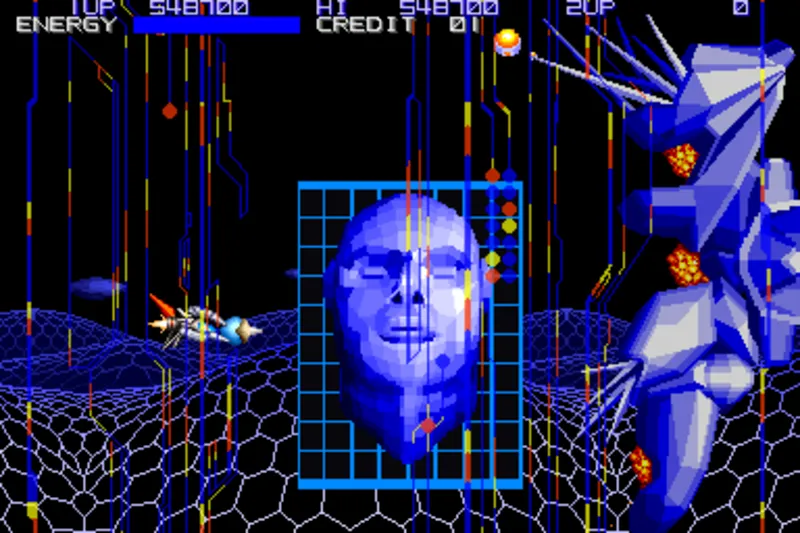
The Stage 5 trompe-l'œil monitor screen in Xexex — a wireframe blue grid environment with a giant rendered face on a cyan grid panel mid-screen, vertical bullet rain falling on a hexagonal floor, and a faceted ice-spike formation in the right of the screen.

Stage 5’s trompe-l’œil monitor — a screen-within-the-screen built out of wireframe geometry and a sampled face. Half of the 1992 Gamest Best Graphics crown is built out of this stage alone. Xexex · Konami, 1991.

That regional split is itself part of the angle. The Japanese cabinet is uncompromising in the 1991 way — single hit, checkpoint regression, five-laser strategy — sitting under a story scaffold that is deliberately soft. The Orius build inverts the proportion: a forgiving health bar under a story scaffold stripped of most of its anime. Konami’s “soften the image” decision did not have one shape. It had two, region-specific, addressed to two different rooms. The reader who comes to Hamster’s 2021 Arcade Archives release with the region menu in front of them is, for the first time on a home console, holding both versions of that decision at once. The recommendation is to start in the Japanese build with save states, and come back to Orius for the two-player co-op. The argument the cabinet was making in 1991 is only legible when both builds are seen against each other.

The Year the Cabinet Won

The 1992 Gamest crown for Best VGM went to the Konami Kukeiha Club team that scored Xexex — Hidenori Maezawa, Motoaki Furukawa, Satoko Miyawaki and Ayako Hashimoto, credited on the cabinet under the era’s standard Konami-Kukeiha alias play (Furukawa as “CAROL QUEEN,” Maezawa as “MICHAEL OLDRIER,” the rest in kind). The score they cut to that board is a sustained piece of late-bubble Japanese arcade composition — bright, lacquered, fast on the bass, leaning into the YM2151’s pitched percussion in the way Gradius II had, but with more PCM in the mix and a willingness to let single tracks carry an entire stage without a transition cue. The opening Breeze sets the floor; The Polygontal Energy on the monitor stage runs grid-pattern arpeggios against the wireframe; Crystal Clear on Stage 1 is the cleanest Kukeiha Club chord work of the year. Furukawa’s hand is the most legible. He had been writing for the Konami arcade catalogue since Gradius in 1985, and Xexex is the loudest thing he ever shipped for the cabinet.

”Our goal for Xexex was to change the image people had of Konami STGs as being ‘hardcore.’ That’s why we added a cute girl.”
— Konami planning team, Gamest #87, 28 February 1993; translated by Shmuplations

The Stage 4 biomechanical interior in motion — green serpents articulating across an organic membrane while the parallax behind them shifts. The X Multiply / Giger inheritance, routed through Konami’s 1991 palette discipline and a board its own maker built for this game alone. Xexex · Konami, 1991.

The graphics award is harder to pull apart in prose because it is half built out of effects the screen had to be doing in motion. Sprite scaling. Multi-plane parallax. Animated palette cycles for the organic stages. Line-scroll on the monitor stage. Pre-rendered tile work behind sprite work, on a board with no transcoding budget at all. The four-year gap before Saturn and PlayStation made an arcade-perfect port unnecessary in commercial terms; the reason Konami did not try a Super Famicom version was the same reason they would have to invent the Axelay Mode 7 vocabulary the following year on the SNES. Xexex is what the arcade workbench could do when the cartridge translation was nobody’s problem.

Thirty Years, Still Outside

For sixteen years after the cabinet shipped, the only home presence Xexex had was a mini-game cameo. A scaled-down version of Stage 2 appears inside Ganbare Goemon 2 on the Super Famicom in 1993 — sub-window, Hardcore Gaming 101 notes, with “tons of slowdown.” That was it. Konami’s planned PlayStation 2 release inside Hamster’s Oretachi Geesen Zoku compilation was cancelled during development. The first proper home port arrived in 2007, on PSP, inside the Japan-only Salamander Portable UMD bundle alongside Salamander, Salamander 2, Gradius II and Life Force. International readers waited another fourteen years.

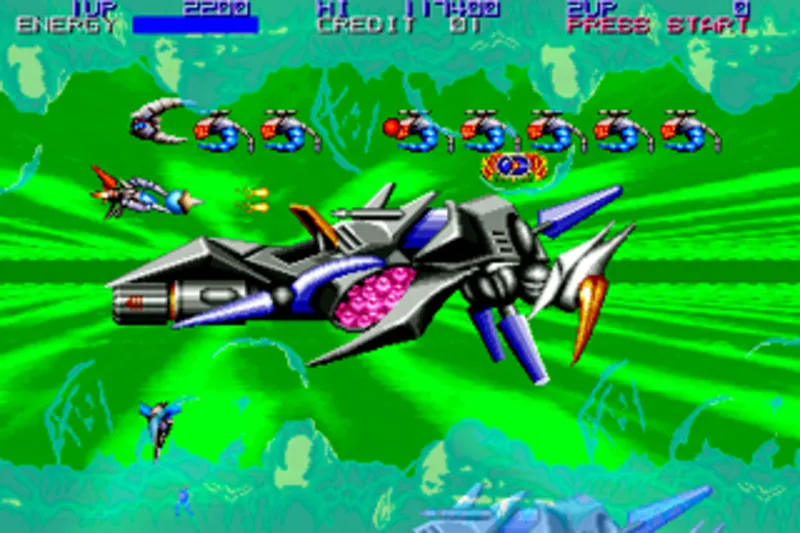
A late-stage gameplay screenshot of Xexex — a massive black-and-purple armoured ship boss with pink organic detailing fills the centre-right of the screen, with a small Vic Viper-style player ship near the bottom-left, ribbon-like fighter shapes above, against a green organic background.

Late-stage biomech architecture — chrome plate over pink organic interior, the X Multiply / Giger inheritance routed through Konami’s 1991 colour discipline. Each stage carries one of these set-pieces; the board does the work. Xexex · Konami, 1991.

Hamster’s Arcade Archives Xexex shipped on Switch and PlayStation 4/5 on 23 December 2021, the first international release of any kind, with the full region toggle the cabinet never offered: Japanese build, European Xexex, US Orius, switchable from a menu. Save states. Online rankings. The standard Arcade Archives feature set. It is the cleanest route on current hardware, at the cost of being a third-party release in a Konami canon — Hamster’s name on the front. Eight months later, in August 2025, Konami’s own Gradius Origins shipped on every current platform with M2’s restoration of Gradius I, II, III, Salamander, Life Force, Salamander 2 and the new Salamander III. Xexex is not in it. The most-decorated Konami arcade shooter of its year — sitting squarely inside the Gradius / Salamander cosmology, sharing engineers, sharing the Vic Viper silhouette, sharing the cabinet vocabulary — is still excluded from the franchise’s canonising compilation.

That omission is real friction for the reader. To play Xexex today you go through Hamster’s Arcade Archives, not through Konami’s own franchise box. The Japanese build’s checkpoint regression and single-hit death are 1991-arcade-strict, and a casual modern player will lean on the save-state option; the Orius build is the gentler entry point but mechanically thinner, missing four of the five lasers and the rapid fire that lets boss fights land. Runtime is forty-five to fifty-five minutes for a one-credit attempt at the Japanese build, longer for a serious Orius five-loop. What you get for the work is the Hardcore Gaming 101 assessment, plain enough to lift: “XEXEX’s graphical intensity prevented straightforward 16-bit console ports without drastically downgrading it. The four-year gap before Saturn/PlayStation availability rendered arcade-perfect porting obsolete from a commercial perspective.” In 1991 the answer to that intensity was to leave the cabinet in Japanese arcades. Today the answer is Hamster’s region menu, six pounds twenty-nine, and the cleanest version of Konami’s most spectacular arcade workbench that the home market has ever held.

Cartridge Collective 1991 · Arcade · Switch · PS4 · PS5

Where to play

Why Now

The Flintlock launches its orb and the tentacles unfurl mid-flight, blocking bullets the orb itself never touches — Konami's answer to R-Type's Force, alive.

Best way to play now Arcade Archives Xexex (Hamster, 2021)

The first international home release of any kind. Hamster's restoration ships the original Konami GX067 ROM with selectable Japanese, European and US (Orius) builds from the region menu, save states, scanline options, and online rankings. Switch and PS4/PS5; the only modern console route.

Time
45–55 min per credit-run Reach Stage 3 — the pink-planet floating islands, where the Flint's tentacles first earn their keep.
Cost
£6.29 Often £4–5 in Switch eShop sales. Same price on PSN.

Alternatives

  1. 01
    modern

    Arcade Archives Xexex (Switch / PS4 / PS5)

    Hamster's 2021 restoration. Region menu carries JP Xexex, EU Xexex, and US Orius — start in the Japanese build with save states, return to Orius for two-player co-op. The only route on current hardware.

  2. 02
    original

    Salamander Portable (PSP, 2007)

    Japan-only UMD bundle of Salamander, Salamander 2, Gradius II, Life Force, and Xexex. The first proper home release Konami ever shipped for the game; Vita-compatible. For collectors — Arcade Archives supersedes it on every practical axis.

  3. 03
    simulation

    MiSTer FPGA — Konami custom arcade core

    FPGA simulation of the GX067 custom board. Cycle-accurate hardware behaviour for purists with a MiSTer kit and a legal ROM. The closest non-cabinet route to the original silicon.

  4. 04
    emulation

    MAME — original arcade ROM

    The 1991 GX067 board through software emulation. Free and accurate; Arcade Archives is the friendlier modern route. Worth noting: Xexex is conspicuously absent from Konami's own 2025 Gradius Origins collection — there is no first-party home release.

1991 · Konami

Listen

  • Xexex Original Soundtrack — Arcade Score (Konami Kukeiha Club)Hidenori Maezawa, Motoaki Furukawa, Satoko Miyawaki, Ayako Hashimoto / Konami Kukeiha Club Won Best VGM at the 1992 Gamest Awards. The original arcade rip is not currently on Spotify; the Konami Kukeiha Club discography there carries arrangements but not the cabinet score. Khinsider hosts the Perfect Selection XEXEX (1992) arrangement album for the score in its full studio form.

Watch

  • Xexex (ゼクセクス) — Arcade Full PlaythroughArcade Longplays / YouTube Single-credit run through the Japanese cabinet's seven stages. The cleanest reference for the Flint mechanism in motion and for the trompe-l'œil monitor stage.
  • Xexex Tutorial With Commentary (Arcade, Japanese Version)Arcade Mastery / YouTube Two-and-a-half-hour route walkthrough of the JP build. The closest thing to a named-creator long-form Xexex video; useful for the five-laser switching strategy the Orius build never had.

Read

  • Xexex — 1993 Developer Interview (Gamest #87)Shmuplations (translated from Gamest, 28 February 1993) The team — Zenji Ishii, KAL, Sato Koken, Hajime Sakai — on why they added Princess Irene to soften the Konami STG image. The primary source for the article's reframing thesis.
  • Konami Shoot-em-ups, Part 4 — Hardcore Gaming 101Hardcore Gaming 101 The long-form English critical read on the Xexex / Orius regional split, the stage inventory, and the home-port absence.
  • Konami Xexex Based Hardware — System 16System 16 Board spec for the GX067 — the custom Konami PCB used for this game and never again.
  • XEXEX — Japanese Konami Wikikonami.fandom.com (Japanese) Preserves the 1992 Gamest Awards placements — 1st Graphics, 1st VGM, 2nd Shooting, 3rd Overall — and the Konami Kukeiha Club credit-alias mapping the cabinet shipped in lieu of staff names.
  • Xexex returns — Arcade Archives review (Video Chums)Video Chums, December 2021 Period coverage of the first international home release. Useful for readers wanting a contemporary opinion on the Hamster restoration.
  • XEXEX Original Soundtrack — VGMdb (KICA-7508)VGMdb Discography record for the 1991 OST and the 1992 Perfect Selection arrangement album. The closest thing to a primary credit list for the four-composer Kukeiha Club team.

Chapter 04

Super Castlevania IV

The Castlevania Where Simon Finally Aims

The 1991 SNES game is remembered as Castlevania's polished apex. What it actually did was hand control back to the player — and nobody named the change at the time.

Super Famicom · SNES1991Action PlatformerKonami

Super Castlevania IV · Konami, 1991 · Tom DuBois cover painting

The Castlevania you remember is a memorisation gauntlet. Simon Belmont walks forward, plants his feet, swings his whip in the only direction available — forward — and gets thrown backwards down a staircase by a Medusa head he could see coming for half a second and could do nothing about. The friction is the point: every screen in the original Castlevania is a puzzle written in muscle memory, and the punishment is calibrated so that learning becomes the play. It is brilliant. It is also brutal, and a great many players bounced off it and never came back.

Super Castlevania IV, on the surface, looks like the polished continuation of that idea. Same hero, same castle, same Bach-quoting music, same descending staircase into Dracula’s chamber. The 1991 trade press treated it that way too. Nintendo Power gave it a column of fours and fours-and-a-halves; GamePro said in its November 1991 review that the game “improves everything.” Both were correct and both were missing what had actually happened. What Konami’s new SNES team had done — quietly enough that nobody at the time put a name to it — was rebuild the central verb. The whip aims in eight directions now. It can be brandished, held out and spun. It can be hung from rings in the ceiling and used to swing Simon over chasms. The screen still kills you, but for the first time in the series, the player gets to answer.

Whip in Eight Directions, Suddenly

The clearest place to feel the change is the staircase. In every previous Castlevania, a staircase is where the game tightens around you: enemies arrive at angles your whip cannot reach, knockback drops you a flight or two, the only correct response is to have memorised which step to stop on and which to keep climbing. In SCIV the staircase is still dangerous, but now you can whip up-and-to-the-right, down-and-to-the-left, straight up, straight down. The medusa-head rooms that defined the NES game — those long horizontal corridors where two snake-haired heads track you in floating sine waves — become rhythm exchanges instead of punishment chambers. Hold the attack button and Simon’s whip becomes a slow propeller blade. Projectiles bounce off it. The screen reads the same; the game underneath it has been rewired.

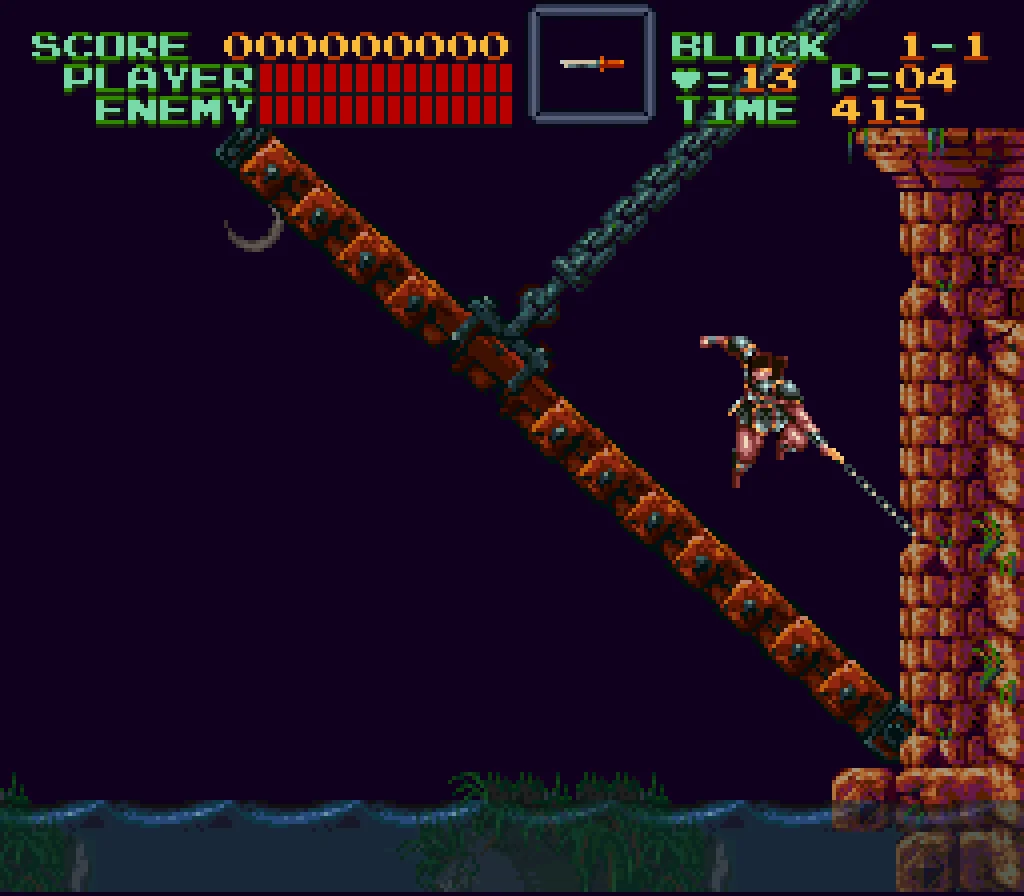
Simon, mid-air with whip raised, swings between flame braziers under a stone archway in an exterior castle stage.

The whip’s new spatial grammar — diagonal arc, hold for a brandished spin. Mechanics the 1986 Famicom design sketched out and could not ship. Super Castlevania IV · Konami, 1991 · Super Famicom.

That eight-way whip is not a SNES novelty. By some accounts it had been on the original 1986 Castlevania design document for the Famicom Disk System and got cut for control and cartridge reasons — director Masahiro Ueno told Retro Gamer’s John Szczepaniak that what he was building was, “to some extent,” a remake of the original, the version the 1986 team would have shipped if the hardware had let them. Five years and a generation of console later, a different programmer (Mitsuru Yaida, credited as “Yaipon”) finally got Simon’s input handling into the shape the series had been reaching for. Ueno’s stated brief was modest: a pure action game in the spirit of the first Castlevania, with the player frustration sanded off. What he and his team actually shipped was the pivot the whole series turns on.

The Designer Who Wasn’t There

This was the first Castlevania of the post-Akamatsu era. Hitoshi Akamatsu had directed the three Famicom games — the one nobody can dislodge from the canon, the strange RPG-adjacent sequel that nobody quite forgives, and the third installment that most fans rate as the high-water mark of the eight-bit era — and then he stopped, somewhere around Bloodlines in 1994, and disappeared from the public record entirely. Szczepaniak tried to interview him for The Untold History of Japanese Game Developers and was politely declined. Super Castlevania IV is the first piece of work where Konami’s series gets to define what Castlevania is in his absence: a new programming team under Ueno, a hold-over audio team from Dracula’s Curse, and the cheerful, unsupervised conviction that the way to honour the original was to redo it correctly.

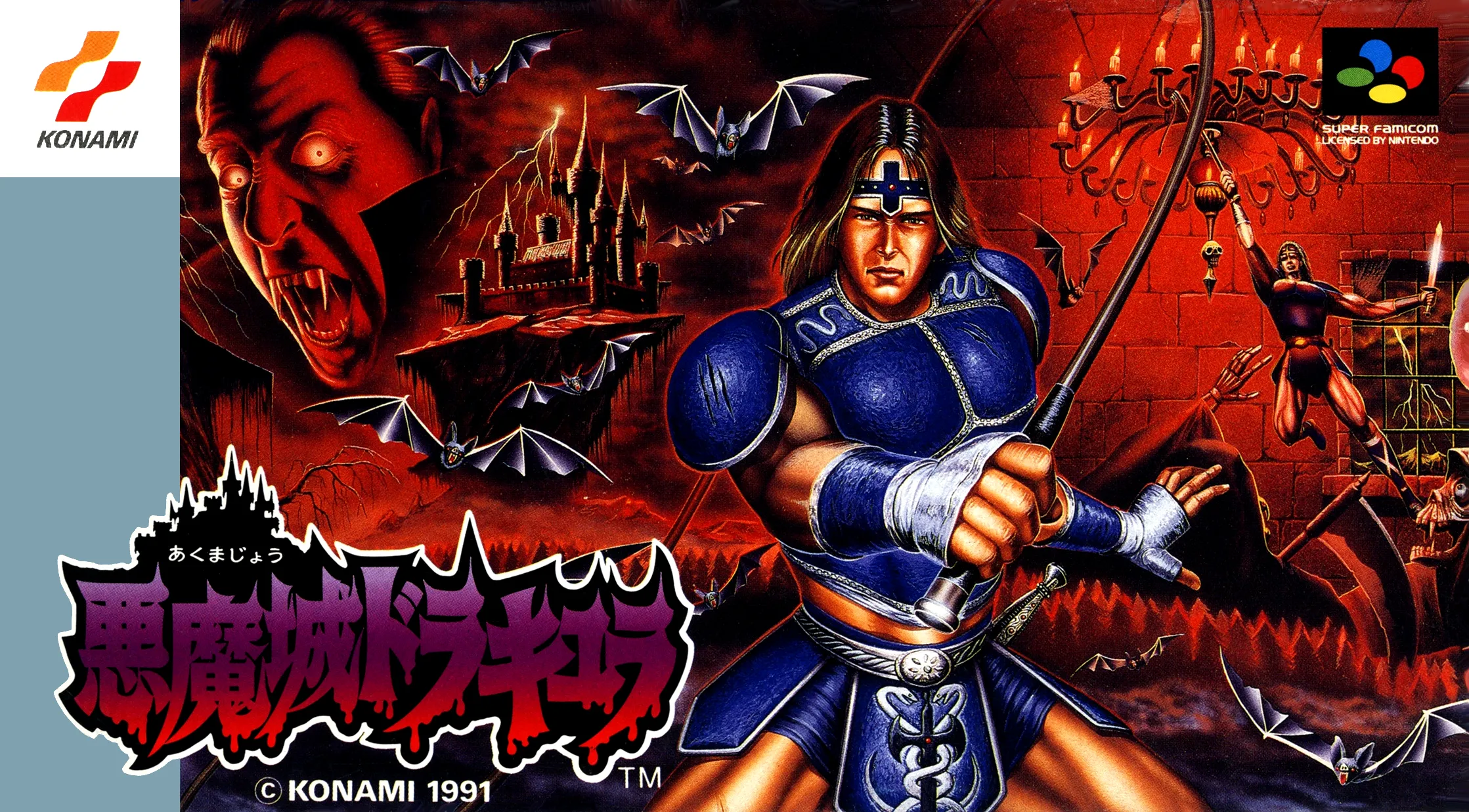
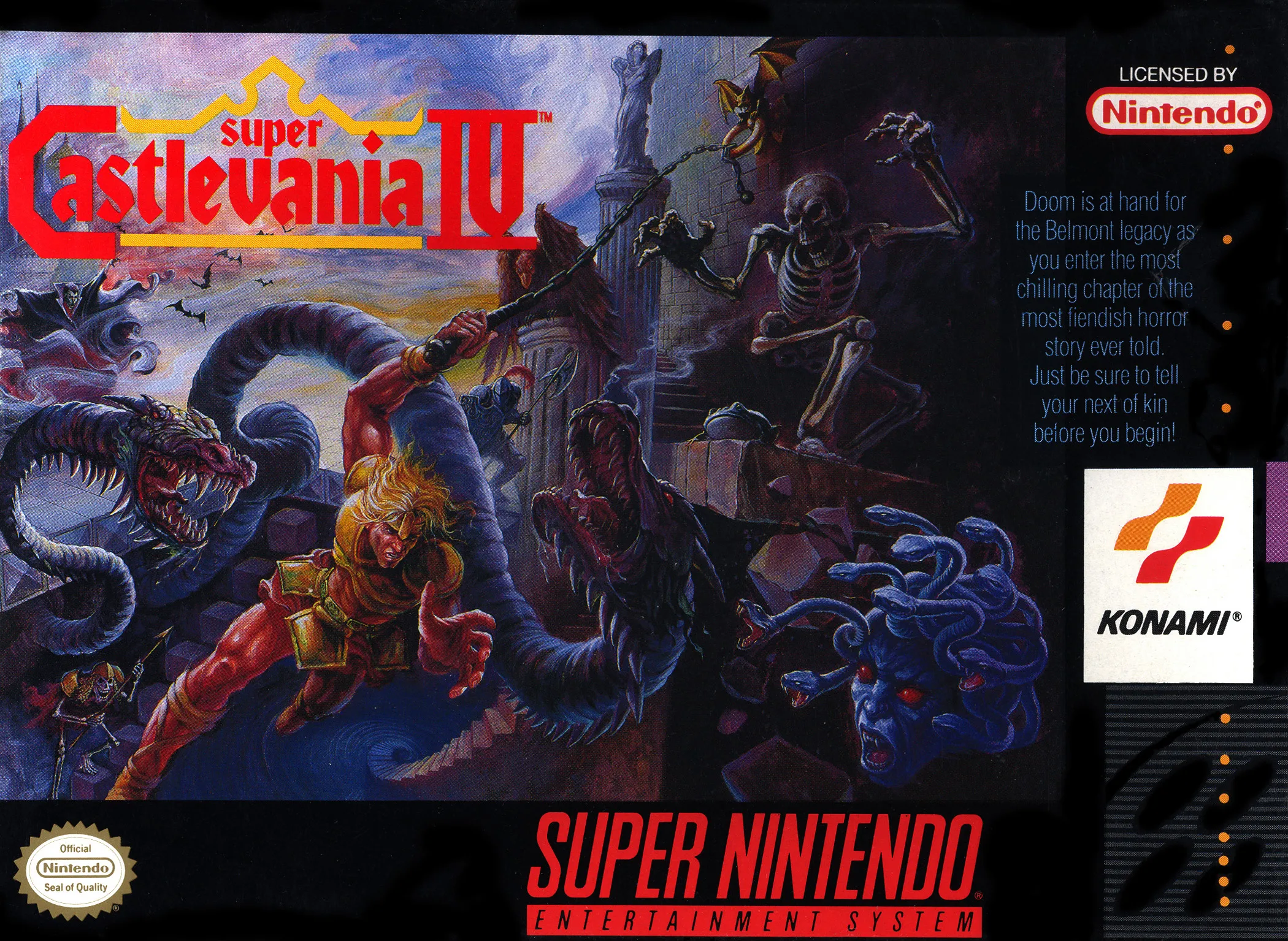
Japanese Super Famicom box: a blue-cloaked Belmont mid-whip-crack against a wall of bats and crimson torchlight, with Dracula's face spectral in the upper-left corner.North American SNES box: Tom DuBois's painted Simon, gold hair flying, fighting snakes, skeletons, gargoyles, and a blue Medusa head across a moonlit ruin.

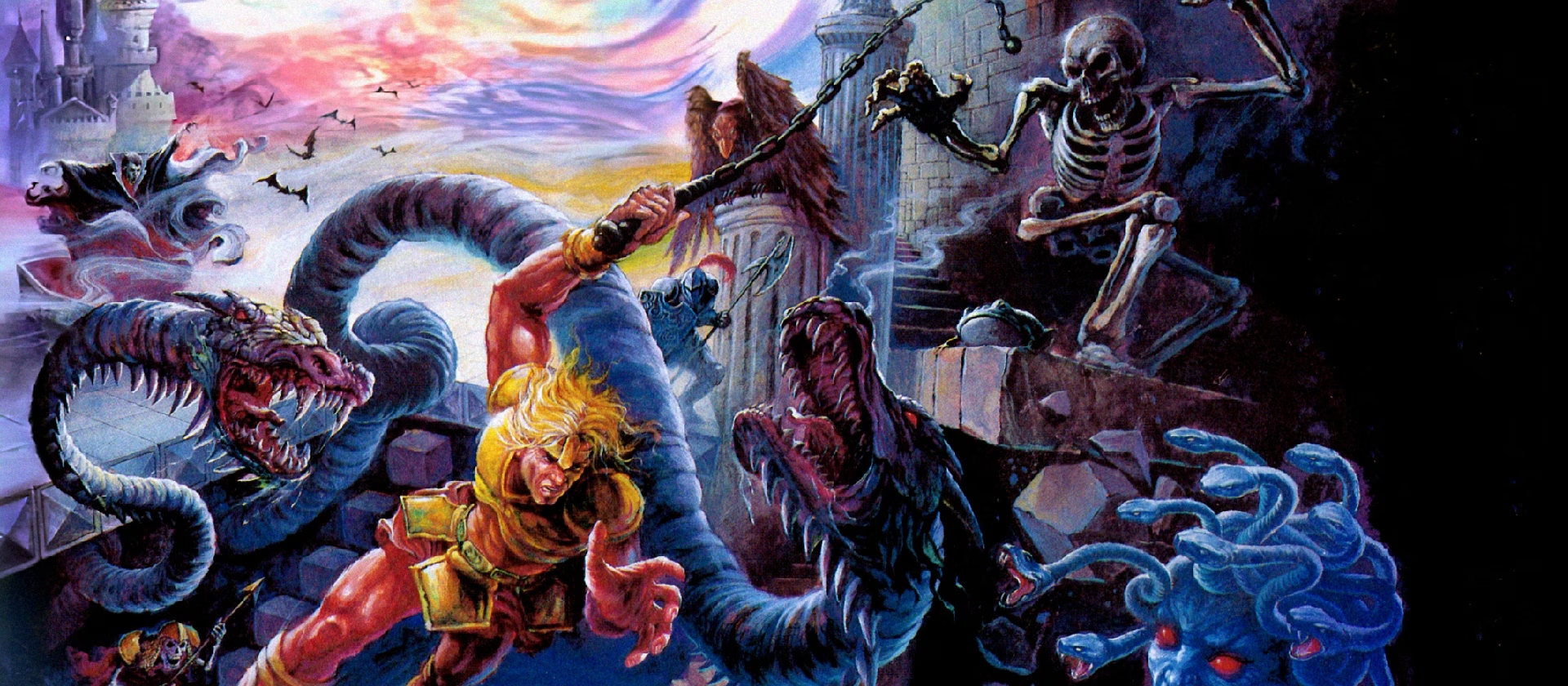
Two readings of the same cartridge: Konami Japan’s blue-cloaked Belmont and Tom DuBois’s painted American Simon. The packaging arrived ten years before the visual identity that Symphony of the Night would later give the series — and the games’ actual castle is closer to neither than to both. Akumajō Dracula (Japan) / Super Castlevania IV (North America) · Konami, 1991.

You can see that conviction in places the box art doesn’t. Konami of America (under Nintendo of America’s pressure) clothed the nude statues, repainted the Stage 8 dungeon’s blood-pools and ceiling-drip as green slime, and stripped the crucifixes out of every coffin and tombstone — even the one on the title screen. The Rosary item stayed; the religious iconography around it did not. The Japanese ROM is the design intent; the international ROM is the design intent with a Vatican filter. The Castlevania Anniversary Collection ships both and lets you toggle, which is most of the reason it remains the only legitimate way to play the game.

Mode 7 Around a Still Verb

The mid-game shows you why the redesigned whip mattered. Stage 4, “A Hidden Path of Stone,” is where Konami’s new team made their public case for what the SNES could do. The level rotates. Not in a racing-game sense, not as an intro flourish — the chamber itself, with Simon inside it, tilts and tips in real time, ceiling becoming floor while gravity gets pinned in place. By 1991 a few SNES games had used Mode 7 sparingly; this was an early use of the mode in service of a narrative idea, where the level animates around the player rather than the player animating around the level.

Simon hanging from a sloped chain bridge while another whip-line extends overhead, mid-room rotation.

The chain bridge in Stage 4, twisting in real time as Simon hangs by his whip. The first place in the series where the room is the thing moving and the player is the still point. Super Castlevania IV · Konami, 1991.

That sequence only works because the eight-way whip exists. The grip — Simon hangs from a ring in the ceiling, the chamber begins to rotate, the whip becomes a static anchor while the geometry swings — is the new verb being asked to hold the new spectacle steady. Take Stage 4 out of Super Castlevania IV and you have a beautiful side-scroller. Leave it in and you have a thesis statement: the level is no longer a fixed surface to traverse; it is an object that can be inspected by an active player. Every Castlevania action game that followed — Rondo of Blood’s elastic stages, Aria of Sorrow’s soul-modulated playthroughs, the Dominus Collection’s recent canonisation of the whole sub-tree — is downstream of this room.

Adachi’s Techno, Briefly Hated

Composers Masanori Adachi and Taro Kudo were a hold-over from the Castlevania III team. What Adachi brought across to the new project was not strictly Castlevania and barely strictly game music. By his own account in a Video Game Music Online interview with Chris Greening, he had spent the back end of the eighties orbiting Voice Project, a Tokyo techno-and-ambient collective. He carried that into the SPC-700:

“At the time of Castlevania, I was working on techno and ambient music together with the people who ran a techno event called Voice Project. I think that turned out to be very influential.” — Masanori Adachi, VGMO

You can hear the influence cleanly in the lower-half-of-the-castle tracks — the cellar themes, the cave music, the long pulse-bass repetitions that sit underneath what most of the genre at this point treats as horror set-dressing. The cathedral pieces are still Bach-quoting; the underground pieces are something else. They are texture, not melody. They are what a club producer scored when handed a haunted-house brief, and they do not sound especially like 1991.

The trade press did not love them. Adachi is unusually frank about that, in the same interview: “Unfortunately, at the time the reception to the soundtrack had been extremely negative.” The vindication came slowly, in scattered pieces — Edge magazine eventually came around, Mondo pressed it to vinyl decades later, the Spotify reissue is presumably how most people now first hear it — and Adachi’s own line on the most-remembered cue is fittingly modest: “As for Simon’s Theme, I had no idea that the track would become so iconic.” The score is what it is partly because nobody told its author that “Castlevania soundtrack” was already a fixed genre. It is the same shape as the game’s design pivot: a 1991 reception that called it correct without ever describing what was actually new.

What the Whip Still Reaches

A modern player who only knows the recent metroidvania-shaped Castlevania will find Super Castlevania IV tighter, more deliberate, and shorter. Five to six hours of main story, ninety minutes to the rotating room, then the late game pulls back toward the NES design vocabulary it spent the rest of the game distancing itself from. Stage A’s pendulum-platform run is genuinely hard, and the multi-form Dracula at the end of Stage B takes the new player verbs and asks them to be applied with no error margin. Simon’s commitment to attack frames is still rooted; knockback on hit is still preserved. The friction the rest of the series sanded off is back in the room for the last forty minutes, and reasonable modern players bounce off it. That is the game being honest about what it is — a Castlevania with the eight-way whip, not a Symphony of the Night with the Belmont sprite.

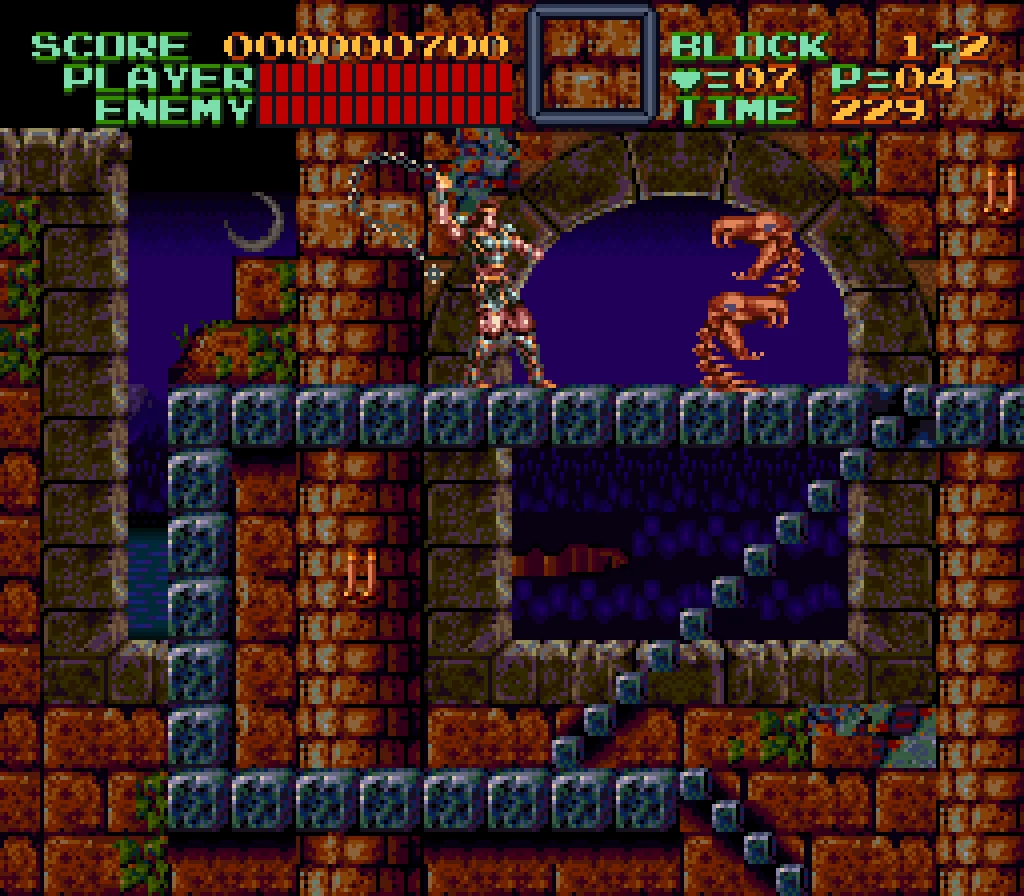
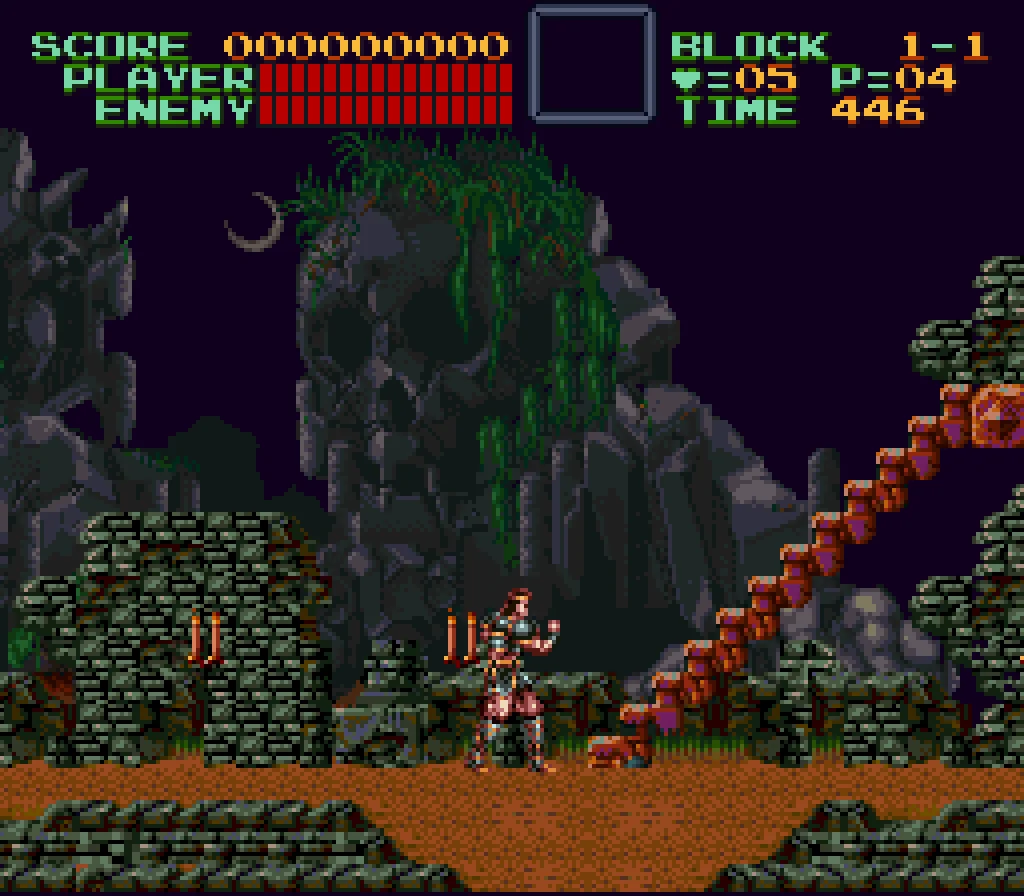
Simon stands on a stone platform in a moonlit, weed-overgrown forest exterior, the castle silhouetted in the distance.

Block 1 exterior — the slow burn before the new vocabulary gets tested. The painted backgrounds run two-and-three planes deep; the score underneath is still ambient pulse. Super Castlevania IV · Konami, 1991.

What it gives you that the obvious peers do not is the moment of overlap — Mega Man still asking memorisation, Symphony of the Night still six years away, this game caught in the middle handing the whip to the player while the level design hasn’t quite admitted what that change implies yet. The friction is the older Castlevania; the answer is the newer one. The cartridge holds both, and the rotating room in the middle is what the series was building toward without knowing.

The Castlevania Anniversary Collection is the route. Toggle the JP ROM the first time through — Stage 8 is a torture chamber, not an acid bath, and the difference is what the team designed. Skip the green slime entirely. The blood was always the point.

Cartridge Collective 1991 · Super Famicom · SNES

Where to play

Why Now

Whip arcs in eight directions, spins to deflect, hangs Simon from rings — the first Castlevania where the player, not the level, decides.

Best way to play now Castlevania Anniversary Collection

The only modern route that ships both the censored US ROM and the uncensored Japanese Akumajō Dracula in the same package — with rewind, save states, and a digital sourcebook on the rest of the FC/SFC trilogy.

Time
5–6h 90 minutes to the rotating room
Cost
£15 frequently £4 in Steam sales

Alternatives

  1. 01
    modern

    Castlevania Anniversary Collection (Steam / PS4 / Xbox / Switch)

    Eight-game compilation with rewind and save states. Includes both the censored US ROM and the uncensored Japanese Akumajō Dracula — the only legitimate way to play the original blood and iconography.

  2. 02
    modern

    Nintendo Switch Online (SNES library)

    Subscription route. US ROM only — no JP toggle, no rewind beyond the NSO baseline. Cheapest entry if you already pay for the service.

  3. 03
    simulation

    MiSTer / Analogue Super Nt

    FPGA SNES on a CRT is how the parallax was meant to land. Both cores run the cartridge dump frame-accurate.

  4. 04
    emulation

    Snes9x or bsnes

    Native-resolution emulation with the JP ROM if you want the red blood and the title-screen crucifix back. bsnes' accuracy core is the cleanest.

1991 · Konami

Listen

  • Super Castlevania IV — Original Sound VersionKonami / Mondo Records reissue Adachi and Kudo's full SPC-700 score. The cellar/cave themes are the moment the soundtrack stops being chiptune horror and starts being ambient techno scored for a haunted house.
  • Super Castlevania IV — SNESmusic.org SPC ripsSNESmusic.org The SPC dumps as the Sony S-SMP chip rendered them — for listeners who want to hear the score exactly as the cartridge produced it, channel-isolated.

Watch

  • Super Castlevania IV (SNES) — Longplay [4K, 60FPS]xRavenXP / YouTube A clean single-player run through every block, upscaled to 4K at the original frame rate. The Stage 4 rotating chamber and the Simon-on-a-pendulum sequence near the end both read clearly here.
  • Masanori Adachi & Hirofumi Taniguchi — VGMO InterviewVideo Game Music Online The composer on his Voice Project techno background, the initial negative reception, and the long road to canonisation. Source for several of this article's pivots.

Read

  • Super Castlevania IV — WikipediaWikipedia Background, release history, and the citation trail back to John Szczepaniak's Retro Gamer interview with director Masahiro Ueno.
  • The Man Behind Super Castlevania IVSuperJump / James Burns The most complete English-language profile of director Masahiro Ueno ("Jun Furano"), built around the Szczepaniak Retro Gamer interview — paraphrased throughout, but the clearest summary of how the eight-way whip and the new team got assembled.
  • Masanori Adachi & Hirofumi Taniguchi — A 25 Year CollaborationVideo Game Music Online Primary developer interview with the SCIV composer. Adachi on the Voice Project techno collective, the initial negative reception of the soundtrack, and Edge's later vindication.
  • Super Castlevania IV — The Cutting Room FloorThe Cutting Room Floor Debug strings, unused content, and a granular catalogue of every JP-to-US iconographic edit — the inventory side of the censorship story.
  • Super Castlevania IV — Japanese vs International comparisonMovie-Censorship.com Side-by-side documentation of the Stage 8 blood recolour, the nude-statue clothing, and the title-screen crucifix removal. The catalogue of what Nintendo of America asked Konami to redraw.
  • 悪魔城ドラキュラ(スーパーファミコン版)— 日本語版Japanese Wikipedia Japanese sources frame this game as an original reworking (原作) of the 1986 Disk System Akumajō Dracula rather than a numbered sequel — a reading English coverage tends to skip.

Chapter 05

Sunset Riders

The Western Konami Priced by the Shot

Great arcade action almost never went West. Konami made the exception: four bounty hunters, eight outlaws, one English aristocrat, and a score system that puts a dollar value on every shot.

Arcade · SNES · Mega Drive1991Run 'n' GunKonami

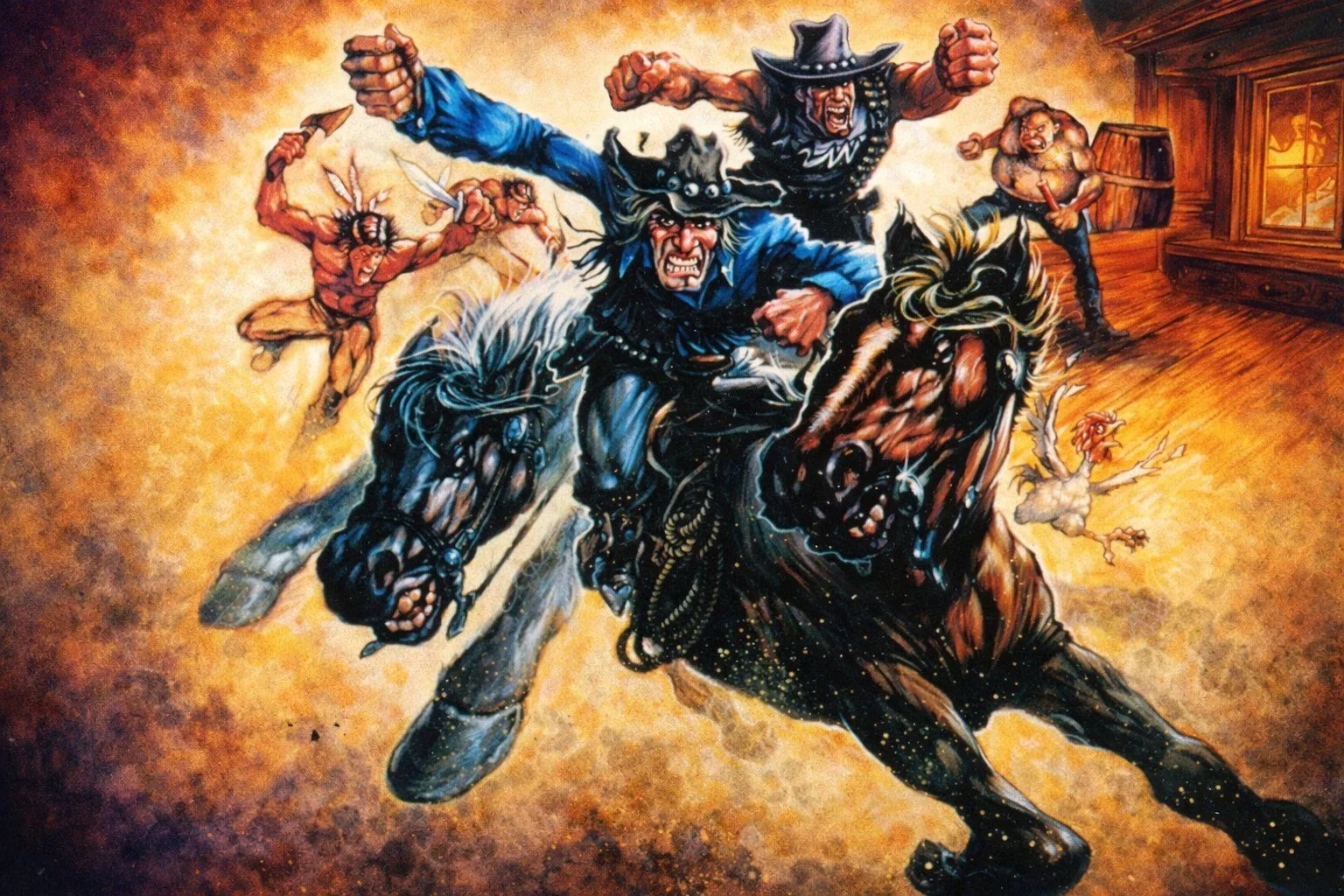
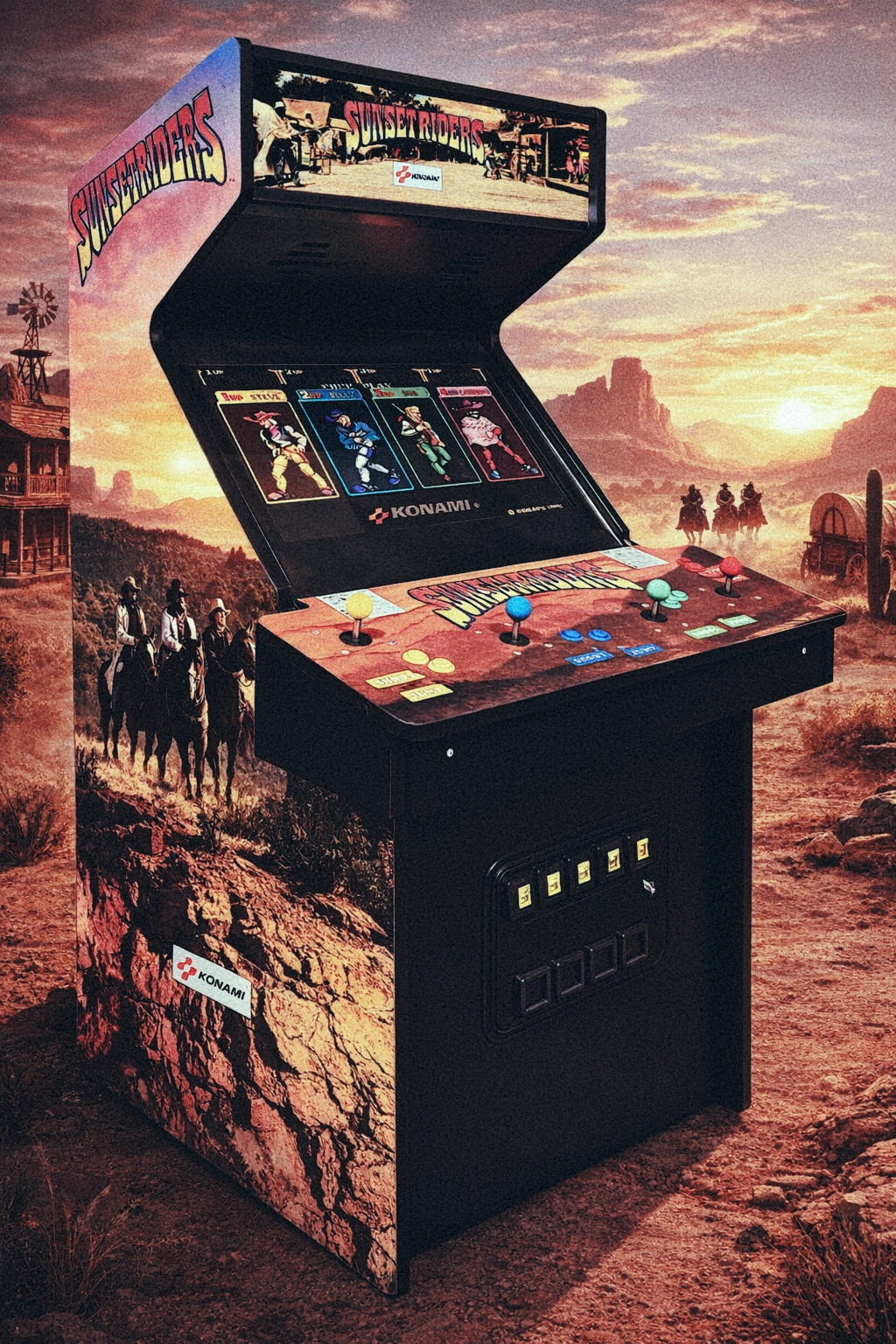
Sunset Riders · Konami, 1991 · Arcade cabinet art

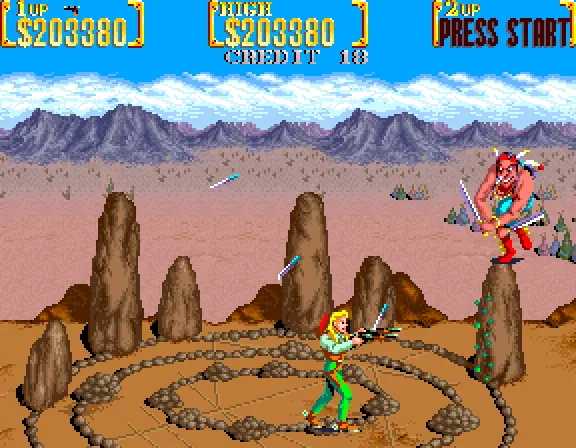
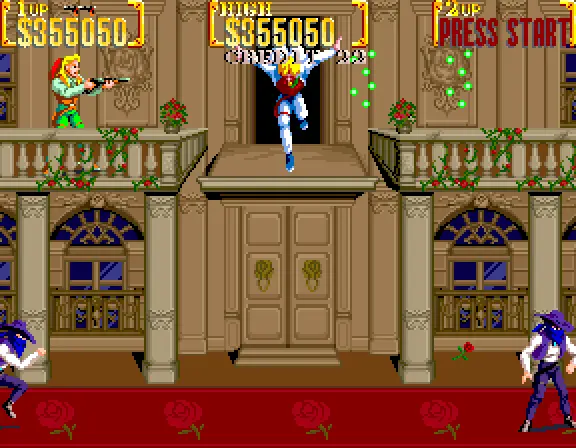
Hideyuki Tsujimoto had already made one of Konami’s sharpest arcade games. Super Contra (1988) was fast, hard, and mechanically exact — tighter than the home version most players know. When Konami tasked him with a new cabinet in 1991, he reached for the same arcade board family that had powered the wildly lucrative four-player Teenage Mutant Ninja Turtles and would soon carry X-Men: a Konami GX-series 68000 board, designed from the ground up for shop-floor co-op. He did not reach for another military theme or another science-fiction premise. He reached for the Western. That choice made Sunset Riders possible, and it made it strange: a Konami run-and-gun shaped by the visual language of the Spaghetti Western, built specifically for the social physics of a crowded arcade floor. Tsujimoto understood that four players on screen simultaneously creates a level of visual noise that would dismantle a traditional shooter. His answer was to design for performance — not survival, but showmanship. You jump onto saloon balconies. You slide under incoming fire. You shoot in eight directions while flying across the screen. The game is fast enough that you look competent even when you are not, and that gap between the player’s skill and their apparent coolness is the first thing you notice.

The second thing you notice is the grin. Four bounty hunters, eight outlaws, one English aristocrat at the top, and a score mechanic built around the cash value of the people you kill. Sunset Riders tells you exactly what it is in the first seconds of every stage: a face, a bounty, and the unambiguous understanding that you are not here to save anything. You are here to get paid.

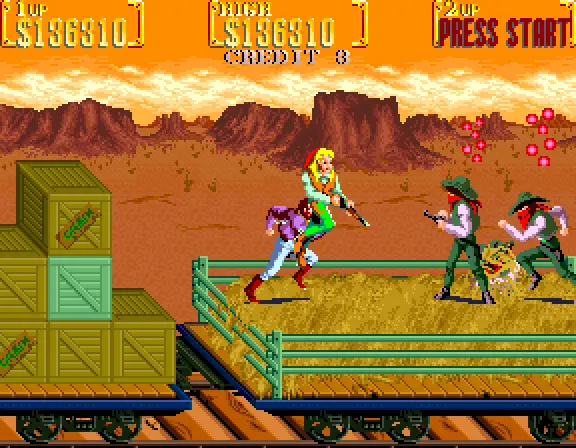
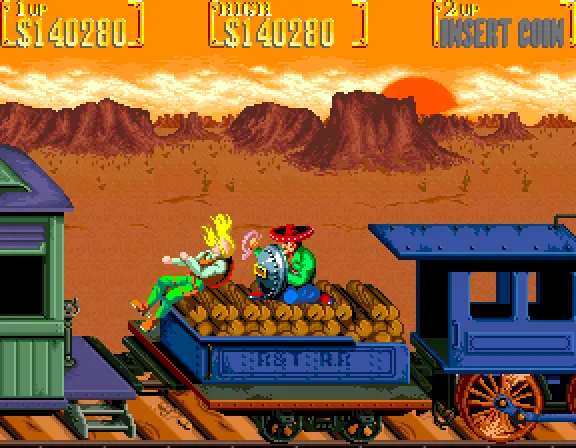
A bounty hunter rides across the roof of a train car while two outlaws close in beneath an orange sunset sky.

By the train stage, the Western premise has become pure arcade grammar: moving footing, horseback enemies, flying bullets, and a sunset doing more work than nostalgia ever could. Native 288×224 MobyGames arcade screenshot, upscaled 2×. Sunset Riders · Konami, 1991 · Arcade.

Four Riders, Four Choices

The four riders are not cosmetic. Steve and Billy carry revolvers — quick fire rate, tight spread, and with the right power-up, twin pistols that turn them into bullet hoses. Bob’s rifle is slower but hits harder and reaches farther. Cormano carries a shotgun: widest spread in the game, awkward at range but catastrophic when the screen starts to crowd. In a genre full of nominal character choice, Sunset Riders makes the differences matter, and the cabinet reinforces them structurally.

The Sunset Riders four-player arcade cabinet, showing the full upright body with game artwork on the side panel and four joystick stations on the control deck.

The four-player upright. Sunset Riders · Konami, 1991 · Arcade.

The arcade machine came in two forms. The two-player version lets you choose your rider. The four-player version assigns one character to each control panel — which means you often play whoever is left. That small constraint changes the entire mood. Cormano’s shotgun is no longer a preference selected from a menu. It is your problem now. So is Bob’s slower rifle. The conversation that forms around that fact becomes part of the game. Somebody gets the shotgun. Somebody complains. Ten minutes later, somebody realises the shotgun is catastrophic at close range, which most of the game is. The argument resolves into understanding, and that arc — from friction to competence — is what separates a great cabinet from a good one.

The four-player version stops feeling like a solo test with extra bodies attached and starts feeling like a social machine. You are not assembling an ideal loadout. You are taking a role and making it work. That gives each run a little friction, a little personality, and the kind of low-stakes conflict between players that fills an arcade with noise — which is exactly what Konami needed it to produce.

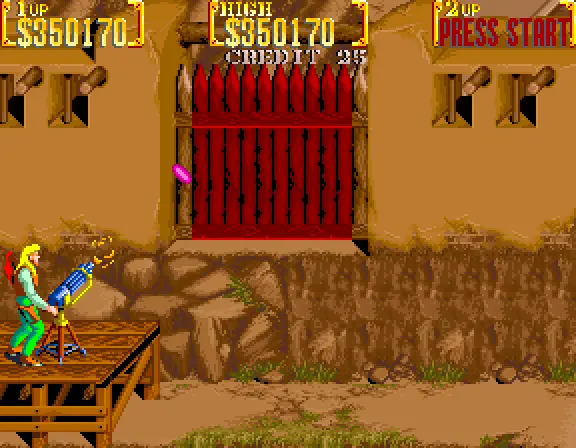
A bounty hunter fires at Paco Loco, who stands behind a gatling gun in front of a red fortress gate.

Paco Loco turns the late game into a firing line: one giant silhouette, one obvious weapon, one place the screen wants your eye to go. Native 288×224 MobyGames arcade screenshot, upscaled 2×. Sunset Riders · Konami, 1991 · Arcade.

Bosses Worth the Bounty

Most of Sunset Riders’ personality lives in its bosses, and each one earns their wanted poster. The bounty rises in clean $10,000 increments stage by stage, then jumps. Simon Greedwell opens proceedings at $10,000 — a man whose name announces his vice before he draws his gun. Hawkeye Hank Hatfield follows for twenty. Dark Horse rides in on his armoured stallion for thirty. The Smith Brothers in the saloon — chandelier chaos, lanterns and dynamite, opposite balconies — for forty. El Greco on a runaway train for fifty. Chief Scalpem in the mountains for sixty. Paco Loco and his gatling gun for seventy. And then a $30,000 leap to Sir Richard Rose — the English villain in a top hat with a metal corset under his waistcoat — at one hundred thousand. The skill spike is encoded as bounty inflation. Each boss enters with a face, a bounty figure, and enough visual identity to make the confrontation feel personal rather than procedural.

The Smith Brothers hang from chains above a saloon stage while two bounty hunters and fallen enemies fill the room below.

The Smith Brothers turn the saloon into a stage set: balcony threats, floor threats, dancers, dynamite, and a boss pair framed like a vaudeville act. Native 288×224 MobyGames arcade screenshot, upscaled 2×. Sunset Riders · Konami, 1991 · Arcade.

That matters more than it first appears. Most action games of this period want you to feel heroic. Sunset Riders wants you to feel mercenary, and the wanted posters are the game’s thesis in miniature — not scene-setting, but a complete statement of purpose. You are the violence the frontier requires, and you have a price for it. None of the bosses overstay their welcome. They are punchlines, silhouettes, reward structures. They break up the run with a new face and a new problem, then get out of the way before the game turns stale.

“Bury me with my money.” — Simon Greedwell, upon defeat, Stage 1

That line is remembered because it is funny, but it lasts because it tells the truth. When you defeat El Greco while playing as Cormano, the dying boss throws his red sombrero into the air and Cormano catches it and wears it for the rest of the game. It is a tiny piece of character animation, almost throwaway. But it tells you a great deal about the team behind it. This is not a stiff game. It is exact, but it leaves room for a flourish.

El Greco rides across train logs with a shield raised while a bounty hunter fires from the opposite car.

El Greco is a moving stage problem as much as a boss: shield, whip, train roof, and enough sunset colour to make the duel read instantly. Native 288×224 MobyGames arcade screenshot, upscaled 2×. Sunset Riders · Konami, 1991 · Arcade.

Two Buttons, Eight Directions

The game’s real quality is how cleanly it reads. Two buttons: shoot and jump. Eight directions of aiming. A slide that takes you under incoming fire. The ability to jump between tiers of platform without breaking your rhythm. Enemy reactions are chunky and immediate. Threats are usually obvious. The screen gets busy but rarely muddy. That sounds simple until you remember how many run-and-guns lose their shape the moment they start trying to impress you.

The native still is crisp enough to show why the cabinet reads: flat bridge, clear enemy silhouettes, bullets on clean diagonals. Motion clip included separately as WebM/MP4. Sunset Riders · Konami, 1991 · Arcade.

Contemporary reviewers responded to that legibility. A SNES Force review gave the home conversion 89%, calling it “easy to pick up, hard to finish” — and that characterisation remains accurate. The controls are immediate enough to feel mastered within one or two stages. The punishment is very real. First runs will include deaths that feel cheap: an attack with a tighter tell than expected, an enemy arriving from just off-screen. But the game’s clarity keeps frustration from curdling into drag. You usually understand what killed you, and a full run is short enough that learning never feels like labour.

The SNES port is the best home version by some distance — four characters, all eight bosses, the full stage flow — though it’s the censored cabinet, not the cabinet as shipped. Nintendo’s 1993 content rules redrew the cancan dancers, cut the courtesans who handed out power-ups, removed the dynamite-tossing cowgirls, replaced the Stage 6 Native American warriors with generic bandits, and renamed Chief Scalpem to Chief Wigwam. The Genesis port is best avoided entirely: two playable characters instead of four, only four bosses, reworked stage flow. One of the joys of Sunset Riders is abundance, and stripping it down to that skeleton leaves you with a game that no longer makes its case.

Chief Scalpem leaps between desert rock spires while two bounty hunters fire upward from the canyon floor.

The Stage 6 boss is also the game’s hardest genre caricature to meet now: mechanically clean, visually confident, and unmistakably built from old Western shorthand. Native 288×224 MobyGames arcade screenshot, upscaled 2×. Sunset Riders · Konami, 1991 · Arcade.

The Mystery of Cormano

The best piece of trivia in the game is also the most revealing about the culture inside Konami’s development team. The Mexican bounty hunter was originally called “Hermano” in the European prototype — simply Spanish for “brother,” a placeholder name that was never intended to survive to release.

In the early 1990s, Konami’s official Italian importer was a company called Elettronica Videogames, headquartered in a small town north of Milan called Cormano. When a Konami delegation visited to demonstrate the European prototype, the company’s chief technician jokingly suggested renaming the character after the town where they worked. The joke survived every subsequent review. The final game kept it.

That story has the quality of a legend that has grown more polished with retelling, and whether or not every detail is precise, it suits Sunset Riders perfectly. This is a polished arcade game, but not an over-managed one. It still feels like the product of a team making each other laugh, keeping the good ideas, and letting odd little accidents harden into canon. A character named after an Italian suburb, carrying a shotgun and wearing a sombrero, who catches a dead man’s hat and keeps it for the rest of the game. You could not have designed something that emblematic on purpose. It had to arrive sideways.

The Sound of the Frontier

Composer Motoaki Furukawa had been a working Konami staff composer since October 1986. By the time he took on Sunset Riders he had already scored Nemesis 2 on the MSX-2, the arcade Gradius II: Gofer no Yabou — the score VGM Online still calls his most iconic — and Super Contra alongside Tsujimoto. Sunset Riders was his Western, and the result is one of the best arcade soundtracks of the period. The town level canters. The train chase pushes forward. The saloon themes lean into showdown tension without losing the pulse underneath. Furukawa used the cabinet’s FM synthesis to approximate Ennio Morricone’s whistle and the heavy, galloping bass that defines the Spaghetti Western — but he never laboured the homage. The score moves because the game does, and that synchrony between sound and momentum is what separates a great arcade soundtrack from background noise.

The Sunset Riders arcade marquee, a wide landscape panel showing a live-action photograph of a Western street scene with cowboys and horses, overlaid with the Sunset Riders logo in red and gold lettering.

The arcade marquee — a live-action Western photograph as backdrop. Sunset Riders · Konami, 1991.

Konami knew it had something worth preserving: the soundtrack received its own Japanese album release in September 1992 on King Records. That kind of investment was unusual for arcade game music at the time, and it clarifies where Sunset Riders sits in Konami’s own estimation. This was not a licensed-property cash-in or a genre exercise. It was a considered piece of work, and the music confirms it — not by sounding expensive, but by sounding exactly right for the game that contains it.

Sir Richard Rose leaps above the balcony of his mansion while a bounty hunter fires at him from the left.

Sir Richard Rose gives the bounty economy its final image: an aristocrat on a mansion balcony, still posing after every outlaw below him has already been priced. Native 288×224 MobyGames arcade screenshot, upscaled 2×. Sunset Riders · Konami, 1991 · Arcade.

The arcade original via Arcade Archives is the one to seek. Simon Greedwell falls from his balcony, coins spilling around him, and says what he says. The game tells you what it is, precisely, and then it asks you to keep paying — not because it has run out of ideas, but because you have not run out of desire. Fast, legible, funny, greedy, and over before it overstays its welcome. Very few arcade games manage all of that at once, and none of them do it with quite this much style.

Cartridge Collective 1991 · Arcade · SNES · Mega Drive

Where to play

Why Now

Konami's four-player Western cabinet — eight wanted posters, one English aristocrat, and a dollar-bounty score system still sharper than most arcade design since.

Best way to play now Arcade Archives Sunset Riders on Switch or PS4

The official route to the authentic four-player arcade original — Hamster's port preserves the cabinet experience with accurate emulation and online leaderboards.

Time
1h
Cost
£7

Alternatives

  1. 01
    modern

    Arcade Archives (Switch / PS4)

    The official route to the authentic four-player arcade original.

  2. 02
    original

    SNES cartridge

    The best home version — two-player, but the clearest console port.

  3. 03
    emulation

    MAME

    The unofficial arcade route when Arcade Archives isn't an option.

  4. 04
    emulation

    RetroArch (bsnes, Snes9x)

    Accurate SNES emulation for the home version.

1991 · Konami

Listen

  • Sunset Riders Original SoundtrackKonami Motoaki Furukawa's galloping, whistle-heavy score — Morricone by FM synthesis, released on King Records in September 1992 as Konami Game Music Collection Vol. 5.
  • Sunset Riders — VGM rip (Arcade)VGMRips Stereo rips from the Konami board — Furukawa's score as the K053260 chip produced it, with the gunshot and 'Yippie!' SFX captured live.

Watch

  • Sunset Riders (1991) Arcade — Full LongplayJohnny Game Over / YouTube A clean single-player run through the four-player arcade original — every boss, every wanted poster, in HD with no commentary.

Read

  • Sunset Riders — Hardcore Gaming 101Hardcore Gaming 101 A thorough overview of all versions, with platform-by-platform comparisons and notes on the European prototype differences.
  • Sunset Riders — Arcade HistoryArcade History
  • Sunset Riders — Nintendo Life retro reviewNintendo Life Covers the arcade-to-SNES conversion quality directly — what survived the port and what was cut. A clean benchmark for the version most players encountered.
  • Sunset Riders — Museum of the GameInternational Arcade Museum The canonical arcade archive entry: GX064 board data, two-player and four-player cabinet variants, operator manuals, and the US/Japan release documentation that most online references leave out.
  • Sunset Riders — Konami (Arcade Flyer Archive)The Arcade Flyer Archive Scans of Konami's 1991 US and Japanese operator flyers. The art language the cabinet marketed itself with — and the reason the four-player version still looks the way it does in memory.
  • Tom duBois — Arcade Attack interviewArcade Attack The Konami cover artist on his run with the company between 1988 and 1994 — Sunset Riders included. Brief, but the only on-the-record account of how the Western art language got fixed.
  • Sunset Riders (videogioco) — Wikipedia (Italian)Wikipedia The Italian-language entry treats the Cormano-naming origin as canonical production anecdote rather than legend — and is the source that pins the importer (Elettronica Videogames) and the town near Milan by name.

Chapter 06

The Simpsons Arcade Game

The Konami Cabinet Without a Cartridge

Third best-selling US arcade of 1991, kept off home consoles for twenty-one years by an Acclaim signature, and the version everyone remembers is the one Konami quietly rebalanced five months later.

Arcade1991Beat-'em-upKonami

The Simpsons · Matt Groening, Konami, 1991 · Promotional artwork

The third best-selling arcade machine in America in 1991 was a Konami cabinet you have probably never owned. The Amusement and Music Operators Association’s Platinum award named it behind only Street Fighter II and the Neo Geo MVS — and of those three, two went home. Street Fighter II arrived on the Super Famicom that summer; the Neo Geo went home in any number of ways. The Simpsons, the third, sat in arcades and Showbiz Pizzas for twenty-one years and then vanished from sale entirely. The mechanism was a single licensing signature, written years before the cabinet shipped.

That absence is the article’s spine. The structural twin against which it has to be read is TMNT IV: Turtles in Time — the Konami brawler that arrived eight months later and inherited the entire cultural afterlife of the era. And what most readers remember as The Simpsons isn’t the game that survives. Konami quietly rebalanced it for Japan five months after the US launch, and that build is the one to play.

Two Months, One Signature

A 1991 Konami operator flyer showing four young Americans crowded around the Simpsons arcade cabinet. A large Bart Simpson figure stands in front, pointing out at the viewer with a speech bubble reading 'HEY, MAN! CHECK US OUT!' The Konami logo and Buffalo Grove, Illinois address are visible bottom-right.

The 1991 US operator flyer — Konami selling the cabinet to bowling alleys and arcades as a piece of social furniture. The Simpsons · Konami, 1991.

Konami started arcade development in February 1990 and ran a location test in the Chicago suburbs that December — three months from the cabinet’s North American debut. The folk-history that puts development at Konami of America’s Chicago office is a misreading of what Chicago actually did. The credit roll is wholly the Japanese arcade division: director Kengo Nakamura, programmer A. Suzuki, composer Norio Hanzawa. The cabinet shipped in the US in March 1991.

Six weeks later, on April 25th, Bart vs. the Space Mutants arrived on the NES. That release date matters because Acclaim Entertainment had signed Fox and Gracie Films for the console rights to The Simpsons in 1989 — eighteen months before the Konami cabinet existed. Konami’s deal covered arcade and home computer only. The Hungarian studio Novotrade did the DOS and Commodore 64 ports under that carve-out. No Mega Drive port, no Super Famicom port, no NES port. Acclaim held the doors, and Acclaim’s idea of a Simpsons home game was the Garry Kitchen platformer that turned Bart into a sprite-jumping mascot. The licensing geometry decided the verdict before Konami started writing code.

“Teenage Mutant Ninja Turtles was already a hit as a comic, as was The Simpsons as a TV show, so we already knew they’d sell if we turned them into video games.” — Masahiro Inoue, Konami (1981–2008), Time Extension

Konami’s other 1991 four-player cabinet, TMNT IV: Turtles in Time, is the clean structural mirror. Same publisher, same year, same arcade-brawler engine family — and Konami also held the TMNT console licence. Turtles in Time arrived on the Super Famicom in summer 1992 with a redesigned campaign mode, a Mode 7 set-piece, and a Mutsuhiko Izumi score the SPC chip rendered in full stereo. The Simpsons got Novotrade’s Commodore 64 port. One cabinet inherited the 16-bit afterlife. The other became a twenty-one-year absence. The difference was one ledger entry in an Acclaim contract.

Four Characters, Two Cabinets

Konami shipped The Simpsons in two cabinet versions: a two-player upright for operators with narrow floor space, and a dedicated four-player upright with one control panel per Simpson. The four-player is the one most readers remember — distinct side art running the family stacked from Maggie down to Homer, four joysticks colour-coded to the characters, the marquee lit yellow over the title’s hand-drawn orange. The two-player let you pick your character. The four-player assigned you whoever was left when you walked up.

Each family member plays differently. Homer punches and kicks with the most damage and the worst reach. Marge clears crowds with a long-handled vacuum that becomes the consensus best moveset within thirty seconds of any new player picking her up. Bart’s skateboard gives mobility — slides, kicks, an aerial that crosses half the screen. Lisa carries a jump-rope that works as a short whip. None of these movesets is balanced for solo play. The game scales by group, the way fighting cabinets and air-hockey tables scale: the mechanical pleasures emerge when there are people standing next to you.

Four unique team-up attacks ship across the four pairings. Homer and Marge interlock ankles and roll across the screen as a human bowling ball. Bart and Lisa link arms and clothesline anyone in their lane. A parent hoisting a child on their shoulders strikes at two heights at once. A parent throwing a child uses the kid as a flying projectile. The team-ups are flavour rather than strategy — wailing on the attack button is more efficient — but they are the cabinet’s most concentrated argument for itself. This is a four-character party game built around a piece of furniture in a bowling alley.

Konami pulled archival voice work from the show’s first season and commissioned new lines on top; Burns and Smithers were voiced by Konami programmers rather than the show’s cast, audible if you listen for it, and the cabinet doesn’t apologise for it. The sprite work and the borrowed-and-supplemented voice track produce a strange double impression: a 1991 brawler that looks and sounds more like the show than any home Simpsons game would for years.

The Cemetery, the Dream, the Roof

Eight stages, each carrying one or two set-pieces strong enough to earn their credits. Stage 1 chases through Downtown Springfield to a wrestler named Professor Werner von Brawn. Stage 3 takes the family to the Springfield Discount Cemetery, where zombies emerge from the dirt and lurch into choreography pointed unmistakably at the Thriller video. The dance reads only as motion — Konami’s animators showing their work, and the prose that describes it cannot do what the sprites are doing.

Dreamland: a single shared hallucination level — flying saxophones, nightmare donuts, Bart-imps, and a giant bowling-ball boss with eyes. The kind of design beat Hardcore Gaming 101 says “so bonkers that players wish they’d done something like that for the whole game.” The Simpsons · Konami, 1991.

Stage 6 is the strangest beat the cabinet attempts. Dreamland is a single shared hallucination — not, as some memories have it, per-character solo vision interludes. The family is unconscious. The floor is a layer of clouds. Flying saxophones, nightmare-sized donuts, and Bart-imps work as enemies; the boss is a giant blue bowling ball with eyes and a mouth, pursuing you across the cloud-floor while a suburban Springfield house sits behind the SIMPSON mailbox. Stage 7 puts the family on the Channel 6 television studio rooftop, where the enemy roster runs through space aliens, robots, ninjas and a kabuki-warrior boss — four arcade-genre callbacks compressed into a single set. Stage 8 is the Nuclear Power Plant, Smithers, then Mr Burns in a mobile battle suit, then the diamond returned and the pacifier handed back.

What the game asks of a modern player and fails to give is real chain timing. Striking attacks lack the rhythm Konami’s own TMNT arcade had in 1989 — moves end with a small dead beat before the next can land — and bosses arrive with on-hit invincibility frames that turn artificial difficulty into a feature. Indie Gamer Chick’s framing is the cleanest articulation: a coin-op designed to grow fat on quarters, the simplistic combat married to frustratingly overwhelming odds. The case for the World ROM is the cabinet and the people around it. The case against it is what happens when you sit down with three other people and discover the boss patterns are designed for a player who hasn’t seen them before.

Hanzawa, in the Cabinet’s Voice

The illuminated cabinet marquee for The Simpsons arcade game. At left, the Konami logo on a white plate. Centre, the show's title hand-drawn in heavy orange letters. At right, the Matt Groening family-in-pink-circle artwork — Homer, Marge, Lisa, Bart, Maggie all visible.

The marquee carries the cabinet’s typographic confidence: Konami’s corporate plate, the show’s title in its hand-drawn lettering, Groening’s signed family portrait. The Simpsons · Konami, 1991.

Norio Hanzawa scored the cabinet before writing any of the Treasure music people now associate with his name. In 1991 he was a Konami staff composer scoring an American licensed cabinet, and what he wrote sits inside the cabinet’s voice rather than performing alongside it. The Springfield town theme canters. The Krustyland cue accelerates. The cemetery procession leans into a minor-key Hammond pulse. The Channel 6 rooftop modulates as the enemy roster shifts from science fiction to ninjas to kabuki, the score doing the work of telling you the genre callback has changed. Hanzawa is using Konami’s K053260 PCM chip and the YM2151’s FM voices the way the Sunset Riders score does — synth-rendered cartoon rather than orchestral pastiche, scaled to the sprite work.

The full-cabinet typographic statement survives in the marquee: Konami logo, hand-drawn show title, Matt Groening’s signed family portrait. That image is the cabinet’s whole pitch in one strip of backlit perspex — an arcade publisher operating at full presentation confidence with a TV licence the rest of the home-games industry was selling to children. Hanzawa’s score is the audible half of the same argument. Nothing about the soundtrack is apologetic. It plays as a 1991 Konami arcade score, with the show’s voice cast layered on top.

Twenty-One Years, Then the Wrong ROM

Konami released a Japanese build of The Simpsons in August 1991, five months after the World ROM. The Japanese cabinet ships smart-bomb pickups across every stage rather than gating them to the final boss, an extendable life bar from food items, fewer boss invincibility frames, lower enemy health on most stages, and a tiered end-of-stage scoring system. Indie Gamer Chick’s split verdict — NO on the World ROM, YES on the Japanese — is the cleanest articulation of what the rebalance does. The same game in the fairer build is a meaningfully better game. The 2012 Backbone Entertainment Xbox 360 and PlayStation 3 port quietly knew this. Complete the World ROM once and the Japanese build unlocks as the second-playthrough reward — a curatorial choice that ratifies the rebalance without saying so out loud.

“Unfortunately, the license on The Simpsons ran out, so if you happen to have this game, consider yourself lucky.” — Hardcore Gaming 101

That Backbone port arrived in late January 2012, timed to the show’s five-hundredth episode, and was quietly delisted from PSN and XBLA in late December 2013. Twenty-two months of legal purchasability in a thirty-five-year lifespan. The Simpsons IP has sat with Disney’s 20th Century Games since the March 2019 Fox acquisition, and Disney licensed Arcade1Up for a 2021 home counter-cade — proof the pathways are open — but no digital re-release of the Konami cabinet has been announced since. The Simpsons is conspicuously absent from Konami’s 2019 Arcade Classics Anniversary Collection. The play-route that survives is MAME running the build Konami shipped to Japan in August 1991.

The play argument isn’t that the World ROM holds up against Turtles in Time. It doesn’t, and saying so is the point. The argument is that Konami shipped the version that does, the West never played it, and the cabinet written out of the Konami canon is also the cabinet whose better build has been quietly waiting in the ROM tree for thirty-five years.

Cartridge Collective 1991 · Arcade

Where to play

Why Now

All four Simpsons on screen regardless of player count — and the Japanese ROM that quietly rebalanced what the West played as a quarter-vacuum.

Best way to play now MAME, ROM set simpsonsj (Japan, 4-Player)

The Japanese rebalance — lower enemy health, smart bombs across every stage, an extendable life bar, fewer boss invincibility frames — is the version the play argument lands on. The 2012 Xbox 360 / PS3 port already knew this, unlocking the JP ROM as a second-playthrough reward before it vanished from sale.

Time
~45m Eight stages, one-credit clear pace — the arcade as the cabinet shipped it
Cost
free No legitimate digital storefront sells the original — the licence has not been re-signed for software since the 2013 delisting

Alternatives

  1. 01
    emulation

    MAME, ROM set simpsonsj (Japan, 4-Player)

    The Japanese rebalance — the version Indie Gamer Chick reverses her verdict on. Also the build the 2012 XBLA port unlocked as a second-playthrough reward.

  2. 02
    emulation

    MAME, ROM set simpsons (US World, 4-Player)

    What your local arcade ran in 1991. Mechanically thinner than simpsonsj — quarter-tuned. Choose this only if the period-faithful build matters more than the better game.

  3. 03
    original

    Arcade1Up The Simpsons 4-Player counter-cade

    Licensed via 20th Century Games — the only legitimate purchase route since 2013. Originally released June 2021, now discontinued; secondary market only, at hardware-investment pricing. Ships the World ROM.

  4. 04
    simulation

    MiSTer FPGA — no core available

    Konami's simpsons.cpp board family is not yet covered by a confirmed MiSTer core. Flagged here so FPGA readers don't go hunting.

1991 · Konami

Listen

  • The Simpsons Arcade Game — Original SoundtrackNorio Hanzawa / Konami Hanzawa's score as the K053260 chip produced it — the Springfield town theme, the Krustyland canter, the cemetery procession, the final-boss synth swell. The cabinet's voice without the cabinet around it.
  • The Simpsons Arcade Game — VGMRipsVGMRips Stereo chip-rip from the Konami board. Hanzawa's arrangement isolated from cabinet ambience and quarter-clinking.

Watch

  • The Simpsons Arcade Game — 4-Player Netplay, 60fpsYouTube Clean four-player run, 60fps. The Dreamland bowling-ball boss arrives around the twenty-three-minute mark; the Channel 6 rooftop cascade — aliens, robots, ninjas, kabuki boss — runs through twenty-six to thirty.
  • The Story of Konami's Classic Arcade Licensed GamesKim Justice / YouTube The cleanest articulation in moving pictures of why The Simpsons never came home in the 16-bit era — Acclaim, Bart vs. the Space Mutants, and the licensing geometry that wrote the cabinet out of the canon. Simpsons section around eighteen to twenty-four minutes.

Read

  • Konami legends reveal the secrets of the arcade hit factoryTime Extension The only direct Konami-side quote tied to this title — Masahiro Inoue on why Konami chose Turtles and The Simpsons as licences. Source of the article's opening epigraph.
  • The Simpsons Arcade Game — Hardcore Gaming 101Hardcore Gaming 101 The definitive English-language retrospective. Documents the World vs Japan ROM differences in detail; sources the central comparison this article makes between the two builds.
  • The Simpsons Arcade Game: How Konami got it right first timeGames Asylum Walks the production timeline — February 1990 dev start, December 1990 Chicago location test, March 1991 North American release. Names the Acclaim licensing situation cleanly.
  • The Simpsons Arcade Game (Indie Gamer Chick)Cathy Vice / Indie Gamer Chick The split verdict at the centre of the play argument: NO on the World ROM, YES on the Japanese. The single sharpest articulation of why the version you played isn't the version that survives.
  • The Simpsons Arcade Game (XBLA) — Destructoid reviewJim Sterling / Destructoid Source of the article's central friction quote — "a game designed around killing the player as cheaply as possible in order for an arcade machine to grow fat on quarters." The case against the World ROM in its sharpest articulation.
  • The Simpsons (1991 video game) — WikipediaWikipedia Source of the citation chain back to the AAMA's 1991 best-seller award (Platinum, third behind Street Fighter II and Neo Geo MVS), the December 2013 PSN delisting date, and the canonical credit roll: director Kengo Nakamura, programmer A. Suzuki, composer Norio Hanzawa.
  • シンプソンズ (ザ・シンプソンズ) ファン日記simpsons333 / Hatena Blog Japanese-language fan archive describing the cabinet as 幻のアーケードゲーム — "the phantom arcade game." The Anglosphere's canonical-childhood-memory is, from Tokyo, a thin-distribution rarity that never had a domestic home presence.

Chapter 07

G.I. Joe

The Cobra Cabinet That Never Left Arcades

Seventh on RePlay's 1992 chart, then thirty years off-limits — Konami didn't own the home rights. A Cabal-style rail shooter with sprite-scaling so good it almost looks like Sega's.

Arcade1992Run 'n' GunKonami

G.I. Joe · Konami, 1992 · Arcade key art

Konami’s G.I. Joe came seventh when RePlay magazine polled American arcade operators on their best-earning cabinets in July 1992. Two months earlier, Computer and Video Games had scored it 346 out of 400 — eighty-six and a half percent — and Electronic Gaming Monthly would file a positive review in October. Then, almost as quickly, the cabinet vanished from the canon. Teenage Mutant Ninja Turtles, The Simpsons, Sunset Riders, X-Men — Konami’s four-player run on the upright JAMMA family — became history; G.I. Joe did not. The reason has nothing to do with the game. Konami held only the arcade rights to the Hasbro license. The NES home rights belonged to Taxan, then to Capcom when Taxan went under, and the SNES era ended without anyone holding the keys to a 16-bit conversion. The cabinet stayed behind glass.

That accident of paperwork made the second mistake possible: the assumption that the game it preserved was the fifth Konami licensed brawler, slotted alongside TMNT IV and Sunset Riders in the same taxonomy. It isn’t. G.I. Joe is something else — a Cabal-style rail shooter pulled forward from the same studio’s 1988 cabinet Devastators, dressed in painted sprite-scaling backgrounds that Konami’s Sega-watching engineers had been quietly mastering for years. The brawler family it sat next to in the arcade is not the family it belongs to mechanically. Reading it as the run-and-gun cousin of Wild Guns, not the run-and-gun cousin of Turtles in Time, changes everything about how it plays.

Seventh, Then Vanished

The G.I. Joe four-player upright cabinet, black with the red-white-and-blue logo marquee, four joystick stations and a side-panel painting of the four playable Joes.

The four-player upright — same JAMMA form-factor Konami built Sunset Riders and TMNT IV into. G.I. Joe · Konami, 1992 · Arcade.

The licensing fluke is the entire reception-gap story. Taxan published a workmanlike NES G.I. Joe in 1991; The Atlantis Factor followed in 1992 under the Capcom imprint after Taxan dissolved. Both were on cartridges. The arcade rights, separately negotiated, sat with Konami. By 1992 the Japanese studio had four years of Western-IP cabinets behind it — Aliens, TMNT, The Simpsons, Bucky O’Hare — and a working arrangement with the Hasbro side: Steve Kaufman, a long-running Sunbow Productions producer, appears in the credit roll’s special thanks. The cabinet shipped through Konami of America in Buffalo Grove, Illinois, in April 1992, supporting one to four simultaneous players on the same upright JAMMA chassis the studio had built Sunset Riders into the previous year.

It was an immediate hit. RePlay’s “Player’s Choice — Top Games Now in Operation” had it seventh in the country; the Computer and Video Games review treated it as a marquee release; Famitsu covered the Japanese launch in issues 180 and 181 across late May and early June. And then the cycle finished. No port came. No Konami collection has ever included it — not the Arcade Classics Anniversary Collection, not Hamster’s Arcade Archives (where Devastators finally arrived as recently as March 2026, but its 1992 sibling did not). The Japanese retro commentator Hyasuhi recently noted, with some weariness, that this fate was structural: “TMNT, X-Men, G.I. Joe, Simpsons, Bucky O’Hare and so on — each was released in Japan and then disappeared almost immediately.” What Konami built, the home market never inherited.

Devastators, Four Years On

The closest relative is not on any Konami home cartridge. It is Devastators, the studio’s 1988 Cabal-format cabinet — a third-person shooter where the player’s character occupies the bottom of the screen and a cursor floats over the field, with enemies arriving behind a perspective horizon. The Cabal pattern was a small genre by 1992. Cabal itself, TAD’s 1988 original. SNK’s NAM-1975 in 1990. Seibu Kaihatsu’s Blood Brothers and the comparatively niche Wild Guns would come later. Inside that niche, G.I. Joe is the most expensively produced thing on the list. Kim Justice, in a 2024 retrospective of Konami’s 1990s arcade run, puts the case directly:

“This is a bit different from the normal side-scrolling formula. Essentially it’s a highly evolved Devastators from a few years ago, where your characters are running into the screen taking down the Cobra troops and blowing up absolutely everything in sight. Of the few games that can be found in this little niche — the likes of Cabal, Blood Brothers and the aforementioned Devastators — this might just be the absolute best of them. The only other one I can think of that could compete is Wild Guns.”
— Kim Justice, The A–Z of Konami’s Arcade Games 1990–1996, 2024

That family identification matters because it pulls the cabinet out of the wrong comparison. Read alongside Sunset Riders, G.I. Joe looks mechanically narrow — no jump, no slide, no melee, no platforms to traverse. Read alongside NAM-1975, the same constraints become genre vocabulary: the player is shooting up the screen, not across it, and the verbset is what the camera angle has to support. The director, credited as Formula Jun in the Konami pseudonymous house style of the period, did not set out to make another TMNT with army jeeps. He set out to make Devastators with a Hasbro budget.

Two Buttons, Both Halves of the Screen

Stage 2’s Cobra installation grows continuously toward the camera as the player runs in — the sprite-scaling that carries the dramatic arc the gun cannot. G.I. Joe · Konami, 1992 · Arcade.

The cabinet runs a Motorola 68000 at sixteen megahertz with Konami’s 054539 PCM sound chip, on the studio’s Xexex-family board — the same chipset that powered the 1991 horizontal shooter currently sitting at the top of this volume’s reading order. The 8-way joystick moves a small reticle anywhere on the screen simultaneously with the character beneath it. One button is unlimited-ammo machine gun; the other launches missiles from a magazine of nine. Three missions, six stages, one loop to a Cobra Commander finale. A skilled player clears it in roughly thirty minutes.

What the camera angle costs in mechanical vocabulary it pays back in spectacle. Hardcore Gaming 101’s retrospective frames the visual identity exactly: “smooth 3D sprite scaling that almost makes it look like something Sega would’ve put out circa Thunder Blade or Galaxy Force II.” The stages do not so much scroll as advance. In Stage 2’s Air Base segment, a Cobra installation appears as a small structure on the horizon, grows continuously through the run, and resolves into a screen-filling fortress by the time the boss arrives. The scaling carries the dramatic arc the gun cannot — the player’s vocabulary is narrow, but the world inflates around the vocabulary until inflation itself becomes the drama. G.I. Joe is rarely thinking about the player; it is thinking about the structure approaching the player.

The friction the cabinet does not solve is feedback. As Cathy Vice noted in her Indie Gamer Chick read of the game, bosses “lack even that Contra-like chiming ping when you score a hit, so really, it just sort of feels like they’re absorbing your bullets until they start to blink and die.” The hit confirmation that Contra taught the player to depend on was never a Konami arcade default; G.I. Joe has it on troops and not on bosses, which means the final ten seconds of every confrontation feel quieter than they should. That is the cabinet’s most-cited failing, and it is real. Most modern players bounce off it briefly, then forget it. Almost nobody bounces off twice.

The Score Released, the Game Didn’t

The music was composed by Tsutomu Ogura, working at Konami since around 1987, and Kenichiro Fukui — both members of the studio’s in-house Kukeiha Club. Fukui would score Konami’s Lethal Enforcers later that year and contribute to Violent Storm in 1993 — the second cabinet in this volume’s reading order whose soundtrack is unmistakably his. The G.I. Joe score is direct, brass-heavy, and built around the cartoon’s “GOT TO GET TOUGH — YO JOE!” refrain, sampled and looped into the title screen. It is, in the strict sense, a licensed-property arcade soundtrack, and most of those go nowhere.

This one did not. On 24 December 1992, Konami’s house label released KONAMI ALL STARS 1993 — Music Station of Dreams, a three-CD year-end compilation catalogue-numbered KICA-9016. Disc three carries five G.I. Joe tracks, credited to “Funiki Fukui” — Kenichiro Fukui’s Kukeiha Club nickname. We Are G.I. JOES. Map Out A Plan Of Operations I. Go To The Airport!. Shooting Small Flies. Dash Toward The Final Battle!. Konami’s internal valuation of the score was such that the label gave it nearly twenty minutes of disc-three space at a moment when its arcade chart-runner was already on the way out of public memory. The compilation is still on VGMdb, Discogs and the Internet Archive. The cabinet that produced it is on none of those.

What Konami Did With the Same Board

The G.I. Joe arcade cabinet marquee — a wide horizontal panel with the chrome G.I. Joe logo over the red, white and blue cartoon-era striping, a navy star in the centre, Konami logo at the left.

The marquee Konami operators bolted onto the same upright chassis as Sunset Riders, TMNT IV, and X-Men — a matched cabinet family, one missing brother. G.I. Joe · Konami, 1992 · Arcade.

This volume of the Konami Anthology already covers the studio’s Xexex — the 1991 horizontal shooter whose chipset G.I. Joe shares. Read them side by side and the cabinet logic becomes legible: same board, two genres, the same studio’s hardware investment doing both jobs. Konami’s run between 1988 and 1992 was a hardware platform in search of as many cabinet pitches as the operator market could absorb — Cabal-style rail, side-scrolling shmup, four-player brawler, four-player run-and-gun, beat-‘em-up — and the platform was equal to all of them. G.I. Joe is not a brawler made in apology for not being TMNT IV. It is a thing Konami’s engineers and Konami’s artists could not have made on hardware they had not already mastered for Xexex.

The route to play it today is, accordingly, narrow. MAME’s gijoe romset runs cleanly enough to read what the cabinet did: two minor sprite-rendering glitches in Cobra’s Weapons Plant and one later stage, gameplay completely unaffected, the painted sprite-scaling backgrounds intact. No MiSTer FPGA core exists for this Konami board family — the GX400 core covers Nemesis-era hardware only, not this generation. No Hamster Arcade Archives release. No Konami collection. Original boards still circulate on the secondary market at around four hundred pounds — the LS74 logic chip around the DTACK signal is a known failure point, per Bryan McPhail’s working repair log; verify board health before buying, and don’t pretend the schematics exist.

What makes a thirty-minute one-credit clear worth the setup today is the specific pleasure the cabinet still gives that Wild Guns and NAM-1975 don’t. Wild Guns has the player’s verbset; NAM-1975 has the harder difficulty curve; G.I. Joe has the largest, most carefully painted scaling stages in the genre, with a four-player co-op layer no other Cabal-family cabinet ever ran. Two friends, an emulator, a Saturday afternoon. The cartoon you remember, the cabinet you didn’t get to play in 1992, the soundtrack Konami’s own label preserved on disc three of an album the game never lent its name to. The catalogue’s missing fifth chair, finally pulled up to the table.

Cartridge Collective 1992 · Arcade

Where to play

Why Now

Roadblock running into a Cobra fortress that grows toward the camera — a sprite-scaling rail shooter Konami couldn't port, still arcade-only thirty years on.

Best way to play now MAME — gijoe romset

No re-release has ever shipped on any platform. MAME is the only honest route, and the game runs cleanly — two minor sprite glitches the gameplay shrugs off.

Time
30m 7m to the first Cobra boss
Cost
free Original Konami PCB ≈ £400 on collector markets — preservation route only.

Alternatives

  1. 01
    emulation

    MAME (gijoe romset)

    The default route. Two known minor sprite issues — a missing floor texture in Cobra's Weapons Plant, an intermittent sprite glitch in the cavern. Neither affects play.

  2. 02
    simulation

    MiSTer FPGA — no core available

    Konami's Xexex-family board has no MiSTer core. The GX400 core covers Nemesis-era hardware only. FPGA is genuinely not an option here.

  3. 03
    original

    Konami arcade PCB

    Boards still circulate at roughly £400. Cabinet-restoration route — verify the board health, the LS74 around the DTACK signal is a known failure point.

1992 · Konami

Listen

  • KONAMI ALL STARS 1993 — Music Station of DreamsKonami Kukeiha Club / King Records The 3-CD Konami year-end label release, KICA-9016, 24 December 1992. Five G.I. Joe tracks on disc three — *We Are G.I. JOES*, *Map Out A Plan Of Operations I*, *Go To The Airport!*, *Shooting Small Flies*, *Dash Toward The Final Battle!* — credited to 'Funiki Fukui', Kenichiro Fukui's Kukeiha Club nickname.
  • G.I. Joe: A Real American Hero — Arcade VGM ripVGMRips Direct rips from the Konami 054539 PCM sound chip — Fukui and Tsutomu Ogura's score as the cabinet produced it, including the title-screen sample of the Sunbow cartoon's 'GOT TO GET TOUGH — YO JOE!' refrain.

Watch

  • G.I. Joe (Arcade) Playthrough — NintendoCompleteNintendoComplete / YouTube A clean single-credit run as Duke through the full three-mission cabinet — Stage 1 chemical plant through to the Cobra Commander throne, no commentary.
  • The A–Z of Konami's Arcade Games from 1990–1996Kim Justice / YouTube Long-form retrospective of Konami's 16-bit arcade run. The G.I. Joe segment (21:22) is the cleanest editorial framing of the Devastators-lineage rail-shooter family — Cabal, Blood Brothers, Wild Guns — that the brawler taxonomy of TMNT IV and Sunset Riders writes over.

Read

  • Konami Run 'n Guns — Hardcore Gaming 101Hardcore Gaming 101 The canonical retrospective treatment. Places G.I. Joe in the Devastators lineage and explains the Taxan/Capcom NES rights split that kept Konami's cabinet off home consoles for thirty years.
  • G.I. Joe (1992 Arcade) — Indie Gamer Chick reviewCathy Vice / Indie Gamer Chick The sharpest modern critical read. Names the boss hit-feedback problem specifically — the missing Contra chime — and the lost-Chris-Latta-on-Cobra-Commander beat. Chick-Approved verdict.
  • Konami G.I. Joe arcade PCB repairBryan McPhail Working preservationist's repair log: the LS74 around the DTACK signal as the typical failure point, the absence of factory schematics, and the manual board-tracing required. The technical floor underneath the rarity figure.
  • G.I.JOE (1992年のビデオゲーム) — Japanese WikipediaWikipedia Confirms the no-port-as-of-2026 status from the Japanese side, mission structure (Chemical Plant → Air Base → Weapons Plant → Jungle → Cavern → Battleship), and the *Konami All-Stars 1993* track listing. The Japanese press covered it at release, then dropped it.
  • KONAMI ALL STARS 1993 — VGMdb (KICA-9016)VGMdb Primary record for Konami's 3-CD year-end label release. The five G.I. Joe tracks on disc three, with composer attribution to 'Funiki Fukui' (Kenichiro Fukui). Konami's house label considered the score worth nearly twenty minutes of compilation space — even as the cabinet itself was already on its way out of public memory.
  • G.I. Joe — Museum of the Game (KLOV)International Arcade Museum The canonical arcade archive entry: cabinet form-factor (upright, JAMMA, 4-player), monitor type, control layout. Confirms the matched-cabinet family with TMNT IV, Sunset Riders and X-Men — same hardware platform, same operator pitch.
  • G.I. Joe (arcade game) — WikipediaWikipedia The most thoroughly footnoted summary. Sources the *RePlay* July 1992 chart position (#7), the *Computer and Video Games* July 1992 score (346/400), and the Famitsu issues 180 and 181 (May–June 1992) that covered the Japanese release.

Part II

The Console Canon

The house style settles onto the SNES — the action and shooting games that made Konami the most consistent third-party studio of the era's first half.

Chapter 08

TMNT IV: Turtles in Time

The Konami Cartridge That Outdid Its Cabinet

The 1991 arcade game was a contract priced in quarters. The 1992 SNES port rebuilt almost every system around replay — checkpoints, a player-triggered throw verb, and Mode 7 used to choreograph a boss.

Super Famicom · SNES1992Beat-'em-upKonami

TMNT IV: Turtles in Time · Konami, 1992 · Tom duBois cover painting

A coin-op is a contract written in seconds. You step up, you put in a quarter, and the cabinet promises you about three minutes of brawling before something kills you and asks for another. Konami’s 1991 four-player Turtles in Time cabinet honoured that contract beautifully — Foot Soldiers thrown briefly toward the camera as a wow beat, bosses that punished proximity to push players toward another insertion, four uprights so the social heat of a Friday night could pay for itself. The 1992 SNES port carried the same sprites, the same stages in broad outline, the same Mutsuhiko Izumi soundtrack. Almost nothing else.

What Konami’s home division did, in roughly fourteen months, was rebuild the central logic of a coin-op into the central logic of a cartridge. The throw animation that flashed past in the arcade became a player-triggered mechanic the final boss exists to test. The autoscroll stage became a Mode 7 pursuit. Insert Coin became Continue From Checkpoint. Turtles in Time is one of the rare home conversions of the 16-bit era where the home version, by almost every measure that matters to a first-time player today, is the better game. Both versions ship together on the Cowabunga Collection now, so the comparison is a sitting, not a historical exercise.

The Quarter Slot the Cabinet Wanted

In 1991, Konami’s arcade division was running the most consistent four-player cabinet line in the industry. Teenage Mutant Ninja Turtles (1989) had proved that a licensed-cartoon brawler on a Motorola 68000 board with four uprights could turn a Friday-night high-school clientele into a recurring revenue stream. Turtles in Time sat in the middle of that run — same producer (Masahiro Inoue), same board family, same year as Sunset Riders and a year before X-Men. Director Gen Suzuki’s cabinet was built for the floor.

That meant specific design choices a home version had no reason to keep. Bosses lead with proximity attacks that interrupt approach — useful when you need the player to fumble a credit, friction-as-feature when there’s a cabinet to lean on. Continue means Insert Coin: you re-spawn where you died, no checkpoint, no campaign arc. The throw-foot-toward-screen animation, the cabinet’s signature wow beat, is scripted into a few specific encounters — Foot Soldiers tossed at the camera at the moments the floor manager wants new players to gather behind the watchers. The whole thing is a contract priced in three-minute increments, and on a Friday night in 1991 it is brilliant.

On the Cowabunga Collection today, that’s about twenty-five minutes of free-credit play before the credits roll. The cabinet has lost its cabinet. What’s left is a tight, generous, beautifully-sprited brawler with no real reason to be replayed — and the Famitsu cross-review staff in early 1993 noticed, handing the SNES port a 26/40 against EGM’s 36/40. The cart is what had to do the work outside the cartoon’s hype field.

Donatello stands with his bo staff outside a chain-link fence at night, two purple Foot Soldiers preparing to attack while a third lies stunned behind him.

Alleycat Blues at the second stage — the cabinet’s social object kept intact even at half player count. The SNES caps at two-player simultaneous; what survives is the cabinet’s brawling rhythm, not its uprights. TMNT IV: Turtles in Time · Konami, 1992.

A Verb Trained on a Foot Soldier

The SNES port keeps the throw-toward-screen animation and rewires what it is. In the arcade, the throw is scripted; in the cart, it is a player input — hold the opposite direction and press Y on a grabbed Foot Soldier, and Donatello or Leonardo or Raphael or Michelangelo hurls them across the foreground, where they hit any enemy in their path. That is a small interaction-design change with structural consequences. It is now a verb the player practises hundreds of times before it matters.

Donatello mid-staff swing in a Technodrome corridor, a Foot Soldier flying off to the left of frame and three more enemies converging from the right.

The throw verb in mid-execution against a Technodrome Foot Soldier. The same animation the arcade used as a scripted spectacle is here a player input — the boss at the end of the stage is the verb’s exam. TMNT IV: Turtles in Time · Konami, 1992.

It matters at the end of Stage 4. “Technodrome: Let’s Kick Shell!” is the SNES-exclusive fourth act — a stage that does not exist in the 1991 cabinet — set inside Shredder’s mobile fortress, where the entire level is built to make the player feel the throw verb as a weapon. The Foot Soldiers in the corridors are designed to be picked up and hurled at the next Foot Soldier; the mid-stage boss pair, Tokka and Rahzar, take grab-and-throw damage cleanly; and then, at the close, Shredder appears in a Battletank parked at the lip of the camera, and the entire boss fight asks the player to throw Foot Soldiers at him.

The Battletank Shredder fight — Mode-7-scaled enemy chassis in the foreground, the playable plane in the middle distance, the throw verb cashed in as the boss’s only weak point. The cabinet’s wow beat promoted from spectacle to gameplay. TMNT IV: Turtles in Time · Konami, 1992.

The fight is unmissable: a foreground enemy the player can only hit with the verb the rest of the game has been practising. Each thrown Foot Soldier cracks one of the three pips of Shredder’s health. The shot is the same one the arcade was using as a wow beat — Foot Soldier flying at the camera, foreground enemy taking the hit — except now it has been promoted from gag to gameplay, from cabinet flourish to the verb the climax exists to test. The boss is the player’s input lesson, cashed in.

That kind of design rhyme — a small repeated mechanic finding its biggest possible payoff in the final encounter — is how cartridge games build replay value. Rice Digital, looking back at the pair of releases years later, put the case more directly than most period reviewers did:

“The SNES version was properly redesigned as a game for the home… continuing resets you back to the beginning of a stage.” — Rice Digital, Turtles in Time for SNES still beats the arcade version

That single sentence is the whole pivot. The continue economy, the boss pacing, the throw verb’s promotion to climax — they all serve the same shift from coin-priced encounter to replayable campaign. It is the move almost no arcade-to-home port of the era bothered to make.

Mode 7 in Service of a Verb

Stage 8, “Neon Night-Riders,” is the other place the redesign shows. In the arcade, it was a horizontally-scrolling autoscroll where the turtles surf the streets of the year 2020. On the SNES it becomes a Mode 7 over-the-shoulder pursuit — the road racing toward the vanishing point, a futuristic Manhattan skyline parallaxed behind, Foot Soldiers and helicopters appearing from the depth of the screen rather than the right edge.

Michelangelo rides a hoverboard down a purple Mode 7 highway with a neon Manhattan skyline ahead and a Foot Soldier on a hoverboard pursuing from behind.

Neon Night-Riders rebuilt as an over-the-shoulder Mode 7 chase. The arcade stage was a brawler with a moving floor; the SNES stage is a chase. Same world, different game. TMNT IV: Turtles in Time · Konami, 1992.

Most 1992 SNES games used Mode 7 as ornament: a rotating title screen, a stage-transition fly-around, a boss pattern that needed perspective scaling for one beat and reset to 2D after. Konami’s team used the mode twice in Turtles in Time, both choreographed for argument rather than spectacle. The Battletank Shredder fight is the obvious one — perspective is the difference between a foreground boss the player can only hit with the throw verb and a flat 2D boss they would walk up to and whip. Neon Night-Riders is the subtler use: the arcade asked the player to keep moving against an autoscroll camera; the SNES version asks them to hold a centre while the world races at them. Different input pattern entirely.

That divergence shows up on the box too. Konami of America commissioned a Tom duBois painted cover — the same illustrator who painted Sunset Riders, Rocket Knight Adventures, the Contra boxes — for a wraparound landscape image of the turtles flung through a time vortex, with the hovercraft and pirate ship and Wild West locomotive and Statue of Liberty’s torch all visible at once in the swirl. The Japanese cover is a tight cartoon group portrait, four turtles in front of a sunset Statue of Liberty, smiling at the camera. Two regions, two readings of the same cartridge, two markets the publisher had already decided wanted different things.

North American SNES box: Tom duBois's painted turtles hurled through a time vortex with pirate ship, hovercraft, train, and torch around them.Japanese Super Famicom box: a tight cartoon group portrait of the four turtles in front of a sunset Statue of Liberty.

Two markets, one cart. Tom duBois’s American time vortex on the left — the spectacle the brand was sold on — and Konami Japan’s cartoon group portrait on the right, scaled to a kid’s bedroom shelf. The cover divergence maps onto the gap between EGM’s 36/40 and Famitsu’s 26/40. TMNT IV: Turtles in Time · Konami, 1992.

Izumi’s Score, Twice

Mutsuhiko Izumi scored both the 1989 Teenage Mutant Ninja Turtles arcade cabinet and the 1991 Turtles in Time arcade — the line’s sonic identity, fast funk-rock with his signature use of orchestral string samples over a syncopated bass, is one person’s signature. The SNES port hands the arrangement off to Kazuhiko Uehara and Harumi Ueko, both later prolific Konami composers, and the tracks that result are not a port of Izumi’s score so much as a translation: the same melodies, retuned for SPC-700 dynamics, looped differently for cartridge-length encounters.

The cabinet’s attract loop plays “Pizza Power,” a song from the 1990 Coming Out of Their Shells live tour album — Konami licensing the franchise’s strangest cross-media artefact for the cabinet floor. The SNES port drops it for a cartoon-style title sequence sung by no one. The cabinet sold itself to a 1991 walk-by; the cart sold itself to a kid’s living room. The cuts in the score map onto the cuts in the design.

What carries across is the funk. The Alleycat Blues theme on SNES is as much Uehara’s track as Izumi’s — the cartridge sound chip is doing things the cabinet’s Konami hardware could not — and the loop works inside a brawler’s much longer per-stage residency. Period reviewers split on whether the move was an upgrade or a thinning. The honest reading is translation: a soundtrack rebuilt for a different room.

What the Cart Could Not Keep

Praise for the redesign should not be praise for an even trade. The cart sheds two players. The cabinet’s social object — four uprights, four kids, the Friday-night choreography of a Foot Soldier going down to a hit none of the players threw — is not in the SNES port and could not be. The hardware caps at two-player simultaneous, and what the cart gains in replay arc, it loses in cabinet heat. The Cowabunga Collection’s 2023 patch put online co-op back into the SNES port thirty-one years late — a partial answer to a real loss, not a denial of it.

There is a real arcade-superiority case on sprite count and frame rate, too. The cabinet’s hardware is doing more on screen at any given moment than the SNES is — more Foot Soldiers spawning, smoother animation under load, sharper sprite work. A first-time player on Cowabunga who plays the arcade first and the cart second will see this clearly, and the right read is that the SNES port traded resolution for redesign. Konami’s home team could not match the cabinet’s spectacle. They built a different kind of object instead.

The cart is also short. Story mode runs about two hours; Time Trial and Versus are pleasant but light; the total package is ten levels and a long replay tail rather than a forty-hour cartridge. The difficulty curve asks for memorisation in the last two stages the way the rest of the game does not. None of this is a deal-breaker for a modern player on save states. None of it is invisible either. The redesign is what made the cart worth replaying. Without honestly naming what the redesign cost, the praise reads as advocacy.

The Cowabunga Collection ships both versions on the same release. The right way to test the case is to play the arcade once on free credits — twenty-five minutes, four turtles, a clinical trial of what the coin slot was actually selling — and then start Story Mode on the SNES side. The difference is the article. The cabinet is a contract; the cart is a campaign.

Cartridge Collective 1992 · Super Famicom · SNES

Where to play

Why Now

The throw verb — Y-button, foot soldier hurled toward the screen — becomes the final boss's whole logic. A coin-op redesigned as a campaign.

Best way to play now TMNT: The Cowabunga Collection

Digital Eclipse's 2022 compilation ships both the arcade Turtles in Time and the SNES TMNT IV on the same release — the only legitimate route to test the cabinet-versus-cartridge case in a single sitting. Online multiplayer for the SNES version was added by a post-launch patch.

Time
Arcade ~25m · SNES ~2h main Clear the arcade once on free credits, then start SNES Story Mode — the difference is the article's argument.
Cost
£35 Frequently 60% off in Konami sales — under £15 in Golden Week and seasonal events.

Alternatives

  1. 01
    modern

    Cowabunga Collection (PS5 / Xbox / Switch / PC)

    Both versions in one compilation, with rewind, save states, and (since the 2023 patch) online co-op for the SNES port — the four-player social object returning thirty-one years late.

  2. 02
    simulation

    MiSTer SNES core / Analogue Super Nt

    FPGA-accurate SNES on a CRT is how the Mode 7 perspective and Foot Soldier throws were meant to land. The arcade board isn't covered by a confirmed MiSTer core; for the cabinet half of the comparison, Cowabunga is the route.

  3. 03
    emulation

    bsnes or Snes9x

    Native-resolution emulation with the JP ROM. Cleanest if you only want the cart and skip the museum material the compilation curates around it.

  4. 04
    modern

    Turtles in Time Re-Shelled (Ubisoft, 2009)

    Delisted June 2011, licence expired. Not a recommended route — listed only as historical context for the arcade game's last commercial outing before Cowabunga.

1992 · Konami

Listen

  • TMNT IV: Turtles in Time — SNES OST (Internet Archive)Internet Archive Uehara and Ueko's SPC arrangement of Mutsuhiko Izumi's cabinet score — the SNES translation, channel-isolated. Alleycat Blues and Sewer Surfin' read most clearly as cartridge-tuned tracks here.

Watch

  • TMNT Turtles in Time — SNES Longplay (4K, 60FPS)YouTube Single-player clear, upscaled to 4K at 60fps. The Battletank Shredder fight at the seventeen-minute mark and the Neon Night-Riders Mode 7 stage near the end of the run are the article's two structural fulcrums.
  • Turtles in Time — Arcade vs SNES Side-by-Side ComparisonYouTube Frame-by-frame visual catalogue of the deltas the cart introduced — replacement bosses, Mode 7 stages, restructured throw verb. The cabinet-versus-cartridge case made in pictures.

Read

  • Turtles in Time for SNES still beats the arcade versionRice Digital The cleanest single articulation of the redesign thesis — "properly redesigned as a game for the home," continues reset to checkpoints rather than insert-coin. Source of this article's central blockquote.
  • TMNT Turtles in Time: All Differences Between the SNES and Arcade VersionGame Rant The catalogue of every SNES-side change: replacement bosses (Slash for Cement Man, Bebop and Rocksteady for Tokka and Rahzar), the Technodrome stage, Mode 7 Neon Night-Riders, Time Trial and Versus modes.
  • Konami and Digital Eclipse on the Cowabunga CollectionNintendo Everything The closest available developer voice on the cartridge half of the pairing — Konami and Digital Eclipse discussing the curation choices that made the 2022 compilation the natural place to test the cabinet-versus-cart case.
  • Side by Side: TMNT Beat-'Em-Ups (Genesis vs. SNES)Sega-16 The adjacent comparison: TMNT IV's Sega-side companion, *Hyperstone Heist*. Reads the SNES design choices in relief by setting them against the Mega Drive's different brawler grammar.
  • Teenage Mutant Ninja Turtles: Turtles in Time — WikipediaWikipedia Background, release dates by region, staff credits (arcade director Gen Suzuki, producer Masahiro Inoue, composer Mutsuhiko Izumi; SNES port arrangement by Kazuhiko Uehara and Harumi Ueko), and the Famitsu / EGM score gap that anchors the reception section.
  • ティーンエージ ミュータント ニンジャ タートルズ タートルズ イン タイム — 日本語版Japanese Wikipedia Famitsu Cross Review issue 211 (Jan 1993) reception — 26/40 from the JP press against EGM's 36/40 from the US. Same cartridge, two markets, two readings.

Chapter 09

Batman Returns

The Konami Brawler Born on the Cartridge

Konami wanted Batman in arcades; Atari took the licence. The SNES tie-in they built instead is the studio's first cartridge-native brawler — moveset deep enough to drill, Burton's noir as art-direction cover.

Super Famicom · SNES1993Beat-'em-upKonami

Batman Returns · Konami / SNES, 1993 · Mode 7 Batmobile chase through Burton's Gotham skyline

Konami’s signature for fifteen years had been the arcade brawler. Crime Fighters in 1989. TMNT the same year. Sunset Riders and The Simpsons alongside X-Men, Vendetta, Bucky O’Hare, and Mystic Warriors — the four-player upright was the studio’s dominant verb, and the cabinet floor was where its house style landed first. So when, sometime in 1989, Konami’s Masaaki Kukino tried to license Tim Burton’s Batman for the arcades, the play looked routine. Then Atari Games walked in with the licence already signed.

Four years later Konami got the sequel as a consolation, but the prize came on a different format. Warner Bros. attached the home-console rights for Batman Returns without any arcade rider, and Konami’s coin-op division had no way in. The licence went to a SNES action team whose director hadn’t been near the cabinet brawler floor — Rush’n Attack, Life Force, Kid Dracula. What Yoichi Yoshimoto’s group did with it was build the studio’s first SNES-native side-scrolling brawler: a deeper moveset than any Konami arcade brawler shipped, four difficulty tiers built for replay, and Burton’s snowed-in Gotham as cover for art-direction risks a Konami-IP project couldn’t have justified. It’s the volume’s outlier, and the one Konami brawler whose closest peers are Final Fight and Streets of Rage 2, not TMNT IV.

Atari Took the Arcade Floor

The pattern Konami had built across the 80s into the early 90s was simple: cabinet first, cart later. TMNT hit arcades in 1989 and reached home consoles as conversions; Sunset Riders was a 1991 cabinet whose SNES port arrived two years afterward. Every brawler in the studio’s published catalogue started on coin-op hardware Konami designed and ended up as a home conversion supervised by a different team. The cabinet was where the studio’s most distinctive design vocabulary lived: the four-player upright, the syncopated boss telegraphs, the wow-beat thrown toward the camera.

In 1989, Konami artist and designer Masaaki Kukino was looking at the post-Batman licence boom and reached the conclusion every Western publisher reached: a Burton-noir beat-em-up in arcades would sell. Three decades later he told Time Extension what happened.

”I was at one point planning to license Tim Burton’s Batman for the Arcades. I couldn’t do it though because other companies got in the way.”
— Masaaki Kukino, ex-Konami artist and designer

The blocking party was Atari Games. Their Batman arcade cabinet shipped in 1990 — also a brawler, also licensed from the 1989 film — and the exclusivity locked Konami’s coin-op division out for the duration of the film’s commercial life. When Batman Returns opened in 1992 and the next round of licensing began, Warner Bros. split the deal: home rights one way, arcade rights another. Konami took the home half and Atari kept the arcade slot. Three carts came out of Konami’s share — SNES, NES, and Game Boy, three different teams, three different games.

The SNES Team Konami Picked

The director Konami handed Batman Returns SNES to was Yoichi Yoshimoto. His credits before 1993 were not arcade-brawler credits. He’d directed Rush’n Attack in 1985 and Life Force the year after, designed Top Gun: The Second Mission and Jackal late in the decade, and most recently planned Akumajō Special: Boku Dracula-kun — the Famicom comedy spin-off in the Castlevania universe, the deliberately wrong-footed one with the cartoon vampire as protagonist. None of those games are brawlers. None of them are arcade ports. The closest thing in the lineup was Monster in My Pocket for the NES, also single-player. Yoshimoto’s design lineage was Konami’s home-console action track, the parallel pipeline running alongside the cabinet brawler unit but rarely touching it.

Batman faces a Thin Clown enemy outside a wooden train station in deep snow, with park benches and a lamppost between them; the HUD shows TEST TUBE x4, BATMAN x4, and the enemy's portrait labelled THIN CLOWN.

First-stage approach. Yoshimoto’s group designed the encounter pacing without a cabinet template to honour — the player has time to read the enemy before engaging, which a Konami coin-op brawler would never give you. Batman Returns · Konami / SNES, 1993.

The team around him was equally non-cabinet. Tae Yabu and Tetsuya Sato shared the design credit; Etsunobu Ebisu, Toshinori Shimono, and Shigeki Morihira programmed. The “producer” credit reads Team Yoshimoto Entertainment — one of the house-alias labels Konami used in this era, the same convention that gave the SNES Turtles in Time a “Yorozuya Juggling Group” credit. What stayed continuous with the arcade brawler line was the sound: Kazuhiko Uehara and Harumi Ueko, both still arranging Mutsuhiko Izumi’s compositions for TMNT IV the same year, joined by Jun Funahashi for the SPC-700 translations of Danny Elfman’s film score.

The asymmetry matters. Most Konami SNES brawlers of the era — TMNT IV, the SNES conversion of Sunset Riders — were home translations of cabinet designs by teams who’d inherited the arcade source. Batman Returns SNES had no cabinet source to inherit. Yoshimoto’s group designed the entire game without reference to a coin-op original, and the design decisions show the absence: more verbs, deeper difficulty curves, a replay structure tuned to a kid’s living room rather than a Friday-night high-school clientele.

A Moveset Built for Drilling

The clearest single signal is the input list. Crime Fighters, Vendetta, Sunset Riders, TMNT IV — Konami’s arcade brawler line gives the player a punch button, a jump button, and sometimes a one-tap special on a third button. Combos exist but the menu is short, because the coin slot needs the player to die in three minutes. Batman Returns SNES doubles it. Batman punches, kicks, chains into a high kick on the third hit, jump-kicks, dive-kicks, grabs and throws forward, throws toward the background, picks up two grabbed enemies and smashes their skulls together in a two-handed crowd-clear, blocks with the shoulder buttons — a verb no Konami arcade brawler of the era carries — twirls his cape to clear circling foes at the cost of his own health, throws infinite batarangs in standard stages, swings on the grappling hook, and detonates one of three test-tube bombs per stage when the boss runs cold.

The point isn’t the menu of moves; the point is the economics. None of those verbs reward a coin-feed. Half of them — the block, the cape, the test tubes — only matter if you’re trying to clear the game without dying, which is the structure of a cartridge play session, not a cabinet quarter. Above NORMAL difficulty the cart asks you to lead with the batarang rather than the fist, which is closer to a Japanese fan strategy guide’s reading of the combat loop than to the western “Final Fight–style brawler” framing the cart’s reception settled on. The game also ships four difficulty tiers — EASY, NORMAL, HARD, MANIA — and prompts you, after a NORMAL clear, to come back and try Hard. A coin-op never says that. A cart designed for replay does.

The Mode 7 Batmobile chase as palate-cleanser between brawler stages — not a centrepiece set-piece, just the bar of rest. The compositional move is what a home-design vocabulary lets you do that the cabinet vocabulary doesn’t. Batman Returns · Konami / SNES, 1993.

Between brawler stages, the cart drops the camera behind a Mode 7 Batmobile and hands the player a chase through Burton’s Gotham skyline, motorcycle thugs scaling out of the depth. Most SNES games of 1993 used Mode 7 as ornament — a rotating title, a stage-transition fly-around, a boss pattern that needed perspective for one beat and reset to 2D after. Yoshimoto’s team uses it as a palate-cleanser: not the centrepiece, not the climactic boss, the bar of rest between two brawler stages.

Burton’s Noir as Editorial Cover

What the film licence let the art team do is make a beat-em-up that looks like a Burton film. TMNT IV is saturated; Sunset Riders is high-contrast hot afternoon; Mystic Warriors runs in tropical jungle palette. Batman Returns is dim — wintry, low-saturation, snow piling on every surface, gothic art deco silhouettes cut against a dark sky, lit by amber streetlamps and the occasional muzzle flash. The film was shot on a colour-graded snow set; Konami’s art team translated that grade to the SNES palette and held the discipline. A Konami-IP brawler couldn’t have justified asking the art team to ship a game this dim. The licence was the cover.

The score is the other half of the cover. Elfman’s main theme runs through the soundtrack as motif rather than direct quote — variations the SPC-700 sound team had to reverse-engineer from the film recording and translate to four-channel SNES audio. The orchestral architecture is intact even when the timbre is square waves. The cabinet sound unit that translated Mutsuhiko Izumi’s funk-rock for Turtles in Time did Danny Elfman in the next cubicle the same year. Both arrangements are excellent and both sound like the team they came from.

Batman stands alone on a snow-dusted rooftop in front of a tall industrial wall, with the Bat-signal projected onto the wall as a pixel-dot matrix, Catwoman's silhouette lying defeated to the right edge of frame.

Bat-signal as pixel-dot matrix, projected on the brickwork after the second Catwoman fight. The sound team’s Elfman variations land cleanest in moments like this — atmosphere doing the work no Konami arcade brawler of the era was permitted to do. Batman Returns · Konami / SNES, 1993.

North American SNES box: a photo collage of Michael Keaton's Batman in the foreground, Penguin and Catwoman around him, Batmobile and burning carnival behind, set as a film tie-in pitched at a Toys R Us clientele.Japanese Super Famicom box: an illustrated comic-book composition with Batman fist raised above a crouching Penguin and Catwoman, drawn in a graphic-novel register that rejects the film stills entirely.

Two regions, one cartridge, two different reads of what kind of object this was. The North American box pitches a Burton film tie-in to American shelves; the Japanese box rejects the photo collage entirely and runs an illustrated cover in the graphic-novel register Japanese readers were used to for American superheroes. Batman Returns · Konami, 1993.

The reach of the licence shows up on the box too. Konami of America commissioned a Burton-photo-collage front — Keaton, the umbrella carriage, the Batmobile, Catwoman on a rope — pitched at a Toys R Us shelf. Konami of Japan commissioned the opposite: an illustrated comic-book composition with Batman’s fist raised and the two villains crouching at his feet, drawn in a graphic-novel register that has nothing to do with the Burton aesthetic and everything to do with how Japanese readers were used to seeing American superheroes.

What the Cart Could Not Carry

The cart’s limits are real and the article that pretends otherwise reads as advocacy. The single-plane platforming stages, where Batman is restricted to left-and-right movement with only the batarang for combat, are the weakest in the game — the sprite is too large for the screen, the jump arc is sluggish, and the encounter waves repeat. Hardcore Gaming 101’s retrospective is honest about it. The enemy roster across the standard brawler stages is also thin: clown variants and knife throwers do most of the work, and the strongman bosses repeat across stages with palette swaps instead of new sprites. The Catwoman fight is run twice across two scenes with different rooftop backdrops; Super Play’s Jonathan Davies, reviewing in 1993, did not like it.

The single-player decision is a cost as well as a choice. A two-player Batman-and-Robin cut of this cart would have been a stronger total object — the moveset is deep enough to accommodate a second character, and Konami’s brawler economy at home depends on the social heat of co-op. Yoshimoto’s team kept it solo by design, and the rationale (Batman alone in Gotham) is defensible. The trade is still a trade. The first-time player should also skip NORMAL. Set the menu to HARD before the first run — the cart is undertuned on its default difficulty in a way that hides what the moveset is actually for.

Two near-identical strongman bosses in clown facepaint and torn grey costumes flank a snowy clearing in a birch forest, with rows of helmeted penguin minions marching toward the camera at the bottom of the frame.

Penguin’s Arctic World, the cartridge’s third-act peak. The reception gap snaps clearest here — Time Extension’s “best beat-em-up ever” reading and CVG’s 1993 67% verdict are both honest readings of the same chained-penguin choreography. Batman Returns · Konami / SNES, 1993.

The third-act atmospheric peak is also where the reception gap snaps clearest. Penguin’s Arctic World — chained penguin troops marching in formation, strongman bosses bracketing a frozen clearing, the Burton zoo set realised as eight-bit menagerie — is one of the most distinctive late-stage runs on the SNES, and the section where the modern Time Extension “best beat-em-up ever” reading and the contemporary CVG 67% verdict diverge most. Both are honest readings. The argument that makes both legible is that this isn’t an arcade Konami brawler trying to fit a cartridge — it’s something the cabinet pipeline never built.

Cartridge Collective 1993 · Super Famicom · SNES

Where to play

Why Now

Pin two clowns, smash their heads together, walk on. Four difficulty tiers above NORMAL; a moveset Konami's arcade brawlers never carried on a cart.

Best way to play now Original SNES or Super Famicom cartridge

No commercial re-release exists — no Virtual Console slot, no Nintendo Switch Online inclusion, no Konami collection. The Super Famicom cart on real hardware is the canonical route and materially cheaper than the NA SNES cart. The SPC700 audio mixing and the Burton-noir palette read clearest on a CRT or a quality scaler; aggressive HD upscalers crush the colour grading the cart was tuned for.

Time
~1.5h main · 3–5h to MANIA Set HARD on first launch — NORMAL is undertuned and hides what the moveset is for.
Cost
£10–20 JP cart · £30–50 US cart Super Famicom cart is materially cheaper than the NA SNES cart; both are undervalued for an in-demand single-player Konami brawler with no re-release route.

Alternatives

  1. 01
    simulation

    Analogue Super Nt / MiSTer SNES core

    FPGA-accurate SNES is how the Burton-noir palette and the SPC700 Elfman arrangements were meant to land. On a CRT or a low-latency scaler, the muted dim palette reads as designed.

  2. 02
    emulation

    bsnes-mercury or Snes9x

    bsnes-mercury for the cleanest SPC700 audio — the Elfman variations lose most of their density on lighter emulators. The JP Super Famicom ROM is the smaller dump and runs identically.

  3. 03
    rom hack

    Pyron / TiagoSC Mega Drive demo (December 2024)

    First-stage tech demo, MD palette and music re-imagined, 320-wide resolution, 60fps, and the co-op slot the original lacked. Not a play vehicle — a curiosity demonstrating what the cart would have been with a two-player slot.

1993 · Konami

Listen

  • Batman Returns — SNES Original Soundtrack (full game rip)YouTube Jun Funahashi, Harumi Ueko, and Kazuhiko Uehara's SPC700 translation of Danny Elfman's score — the same sound team that arranged Mutsuhiko Izumi's funk-rock for TMNT IV the same year, working in a completely different idiom. Listen to Shreck Building and the Penguin's Arctic World tracks for the densest writing.

Watch

  • Batman Returns SNES — Longplay (4K, 60FPS)YouTube Full single-player clear, upscaled to 4K at 60fps. The Mode 7 Batmobile chase sits around the thirty-minute mark; the Penguin's Arctic World final two stages run from roughly thirty-eight minutes to the end. The structural pacing of the cartridge — brawler stage, single-plane interlude, brawler stage, Mode 7 palate-cleanser, brawler stage, boss — is most legible in a single sitting.
  • A Look at the Many Licensed Games of Batman ReturnsKim Justice / YouTube Long-form survey of the ten Batman Returns tie-ins across the 16-bit, 8-bit, handheld, and PC platforms. The Konami SNES segment runs from roughly 1:28 to 8:30; the Mega Drive comparison (Malibu Interactive's much weaker port) sits immediately after and clarifies what Konami's cartridge-native discipline bought.

Read

  • Batman Returns (SNES) — Hardcore Gaming 101Hardcore Gaming 101 The long-form English critical reference: mechanically literate, willing to hedge ("there are better beat-em-ups available, there aren't many when talking about the Super Nintendo"), and the responsible voice the modern "best ever" revisionism needs triangulating against.
  • Ex-Konami Artist Says Developer Wanted To Make A Batman Game For ArcadesTime Extension Source of the Masaaki Kukino quote at the article's spine — the 1989 arcade-licence attempt Atari Games blocked, and the on-record reason the SNES Batman Returns is the game it is rather than an arcade cabinet. Director Yoichi Yoshimoto has given no English- or Japanese-language interview specifically about this cartridge that the research surfaced; the developer record on the Konami SNES side is genuinely sparse.
  • Interview: Konami Legends Reveal The Secrets Of The Arcade Hit FactoryTime Extension The long-form feature containing the Kukino quote alongside Masahiro Inoue (producer on TMNT and Sunset Riders arcade) and Yoshiki Okamoto (Time Pilot, Gyruss; later Capcom's Street Fighter II) on Konami's licensing culture and the studio's appetite for American IPs in the late 80s and early 90s.
  • Batman Returns (NES) — Wikipedia (citing Kuniaki Kinoshita / Super Play 1993)Wikipedia The Wikipedia article quotes a 1993 *Super Play* interview with Konami producer Kuniaki Kinoshita on how licensed games like Batman and TMNT were greenlit at Konami's management level. Adjacent context for the SNES cartridge's own commissioning, sourced from the same period.
  • Best Beat 'Em Ups Of All TimeTime Extension Where the modern "perhaps one of the best movie tie-ins ever" reading lives. Useful as the consensus the article is in conversation with, including the entry's own hedge ("whisper it").
  • Batman Returns (1993 SNES) — Asteroidg retrospectiveAsteroidg The dissenting English-language voice that prefers the NES Batman Returns. Engages the cart's weaknesses directly — single-plane platforming, repetitive enemy roster, undertuned default difficulty — and is the cleanest counter-read to the Time Extension framing.
  • Batman Returns (SNES) — superfamicom.org creditssuperfamicom.org The canonical credit dump for the Konami SNES Batman Returns: director Yoichi Yoshimoto; designers Yoshimoto, Tae Yabu, Tetsuya Sato; programmers Ebisu, Shimono, Morihira; sound by Jun Funahashi, Harumi Ueko, Kazuhiko Uehara — the Konami SNES action team, not the cabinet brawler lineage.
  • バットマンリターンズ攻略 — タコタ仙人のベルトゲー道場ie3.sakura.ne.jp Japanese fan strategy guide that frames the combat loop as batarang-led (バット・ラングで敵を硬直させてから近づいて攻撃 — "stun with the batarang, then close and attack"), closer to how the cart plays at HARD and MANIA than the western "Final Fight–style brawler" framing. The four difficulty tiers and the Bat test tube's role as boss-killer are also documented here.

Chapter 10

Contra III: The Alien Wars

The Konami Cartridge That Forked Treasure

Nobuya Nakazato debuted as director with Contra III; two of its programmers walked out to found Treasure the same year. The cartridge plays like both studios trying to outdo each other inside one sentence.

Super Famicom · SNES1992Run-and-GunKonami

Contra III: The Alien Wars · Konami, 1992 · North American key art.

Two studios begin inside this cartridge, and only one of them is the one on the label. The credited director is Nobuya Nakazato, three years into Konami, making his debut at the wheel of an action game; the design rules he sets here — situation-rush pacing, comic-violence tone, multi-jointed boss spectacle — run through Hard Corps, Rocket Knight Adventures, Shattered Soldier, and 2024’s Operation Galuga. The other studio is Treasure. Two of Contra III’s programmers, Mitsuru Yaida and Hideyuki Suganami, were holding planning sessions in coffee shops while shipping this cart, and walked out of Konami before the year ended. The cartridge is the fork point.

What the period press saw was the showpiece. The Mode 7 overhead stages with their shoulder-button rotation, the rooftop opening with its swarming tank, the giant alien rising out of the floor — all of it called “arcade quality” by reviewers reaching for the highest compliment available. What they were responding to but couldn’t yet name was a first director’s design language being printed onto the franchise. The SNES boast was the salesman’s pitch. The interesting object was always inside.

Something Interesting Every Three Screens

Konami’s own History of Contra — the digital book bundled with the Anniversary Collection — credits Nakazato with a stopwatch design rule on his debut: a new threat every three screens of progress. Stage 1 is the rule made audible. Bill drops onto a rooftop, jogs four steps, a tank crests the horizon firing missiles; a clutch jump becomes a grapple along a hanging chain; a tower mid-boss erupts from the next block; an alien the size of the screen tears itself out of the asphalt. The opening minutes are choreography pretending to be combat.

Bill stands atop a tank firing right, with explosions and ruined buildings in the background.

Four screens into the game, Bill is already on top of a tank firing at something else. The three-screen rule is a stopwatch, not a metaphor. Contra III: The Alien Wars · Konami, 1992.

The rule explains why the difficulty does not feel padded. Contra’s NES progenitor solved length through repetition: long corridors of identical infantry, a difficulty curve maintained by stripping continues. Contra III refuses that solution. Each stage is shorter than the last comparable arcade run-and-gun, and each is denser. There is no traversal between events. The “every three screens” promise becomes a contract the player can feel — pattern memorisation never catches up to surprise, because the next surprise is already setting up behind the current one. Nakazato, asked about Contra difficulty more than a decade later, framed it as a transaction:

“Regular action games can be beaten just by guts and stamina; you can just keep on playing through to the end. That’s normal these days. But with Contra, you have to really think about what you’re doing, and challenge it over and over in order to master your skills. The more that you try, the more reward you get for your efforts.”

Nobuya Nakazato, Game Developer, 2004

The two-weapon toggle is the system that lets the rule breathe. The cart is the first Contra to let the player carry two power-ups at once and switch between them with the shoulder, so a level’s grammar can be answered with a sentence, not a single verb. A flamethrower for the rooftop infantry; a spread shot saved for the screen-filler at the end of the block. The player rotates vocabularies as the camera rotates angles — and the dread of losing the right tool to a stray hit becomes the game’s secondary tension.

The Turtle That Became Seven Force

Inside the same cartridge, Yaida and Suganami were programming bosses that Konami’s middleware had not been built to host. The Stage 4 enemy is the visible proof: a vast turtle called Taka with four independently tracking limbs and a head that swings on its own clock. Each limb runs its own animation routine, anchored to a moving body that itself scrolls relative to the player — a tree of nested objects, each parented to the next, all updating at sixty frames a second on a console without hardware sprites for the job.

Four parallel missiles, a hull whose plates open and close around an exposed core, and a player hanging from one of the missiles to fire back. Multi-jointed boss programming written inside a Konami project — and out the door inside a year. Contra III: The Alien Wars · Konami, 1992.

Within months of the cart shipping, Suganami and Yaida had left Konami and were at a new studio called Treasure, programming a Mega Drive boss called Seven Force — a multi-segment shapeshifter that morphs through seven jointed configurations, each held together by the same nested-object discipline that built Taka. Treasure founder Masato Maegawa, asked later about Gunstar Heroes, put the lineage on the record without flinching:

“Many people see Gunstar Heroes as our defining work, and since the programmers on Contra III and Gunstar Heroes were the same and both games share a lot of similarities, Contra III can be considered one of the origin points of Treasure.”

Masato Maegawa, Time Extension

This is what makes Contra III a stranger object than its reception admits. It is the SNES Contra; it is also the design vocabulary that Treasure would carry across the divide and use to compete with Konami for the rest of the decade. The cartridge births a director and seeds the studio that will become his most consequential rival. The Mode 7 boasting is the only part the magazines knew how to talk about.

Top-down view of a stone-floored corridor with Bill firing upward at a hovering alien orb.

The overhead stages were the salesman’s pitch — Mode 7 rotation and scaling on the cart’s marquee. Time has divided modern players on the controls; the design intent was always to break the player’s posture between stages, not to wow them. Contra III: The Alien Wars · Konami, 1992.

Robots In Place Of Soldiers

The same cart shipped in Europe as Super Probotector: Alien Rebels, with Bill and Lance redrawn as humanoid robots — RD-008 and RC-011 — to clear German content rules. Every human enemy in the game was reanimated as a machine. The robots are a thoughtful piece of art direction, not a slapped-on hack: they move with the same animation budget, sell the same hits, fit the metal-and-rubble palette of the alien-war fiction. A generation of European players’ Contra is a robot Contra, and the version is preserved as a region toggle inside the Anniversary Collection, not buried.

Super Famicom 「魂斗羅スピリッツ」 cover with a soldier and alien skull.Super Probotector: Alien Rebels PAL SNES box art with two armoured robots.

Japan’s 魂斗羅スピリッツ keeps the painted soldier; the PAL Super Probotector repaints him as a machine to clear German content rules. Inside both boxes, the same cartridge — and inside the Anniversary Collection, the Probotector version is preserved as a region toggle rather than buried. Contra III · Konami, 1992.

The defacement, when it came, was American. Time Extension’s reporting on the regional editing of the SNES release makes the bookkeeping plain: Konami of America stripped the cheat-code menu, removed infinite continues, and locked the secret boss off the Normal difficulty. The Japanese 「魂斗羅スピリッツ」 cart is the game Nakazato shipped; the North American SNES cart is the same code with the design’s safety net cut away. If your Contra III was the grey Konami of America cart, you were playing a harder game than the one the team made — and not seeing all of it.

A blue armoured robot stands on a rooftop firing a green energy beam in Super Probotector.
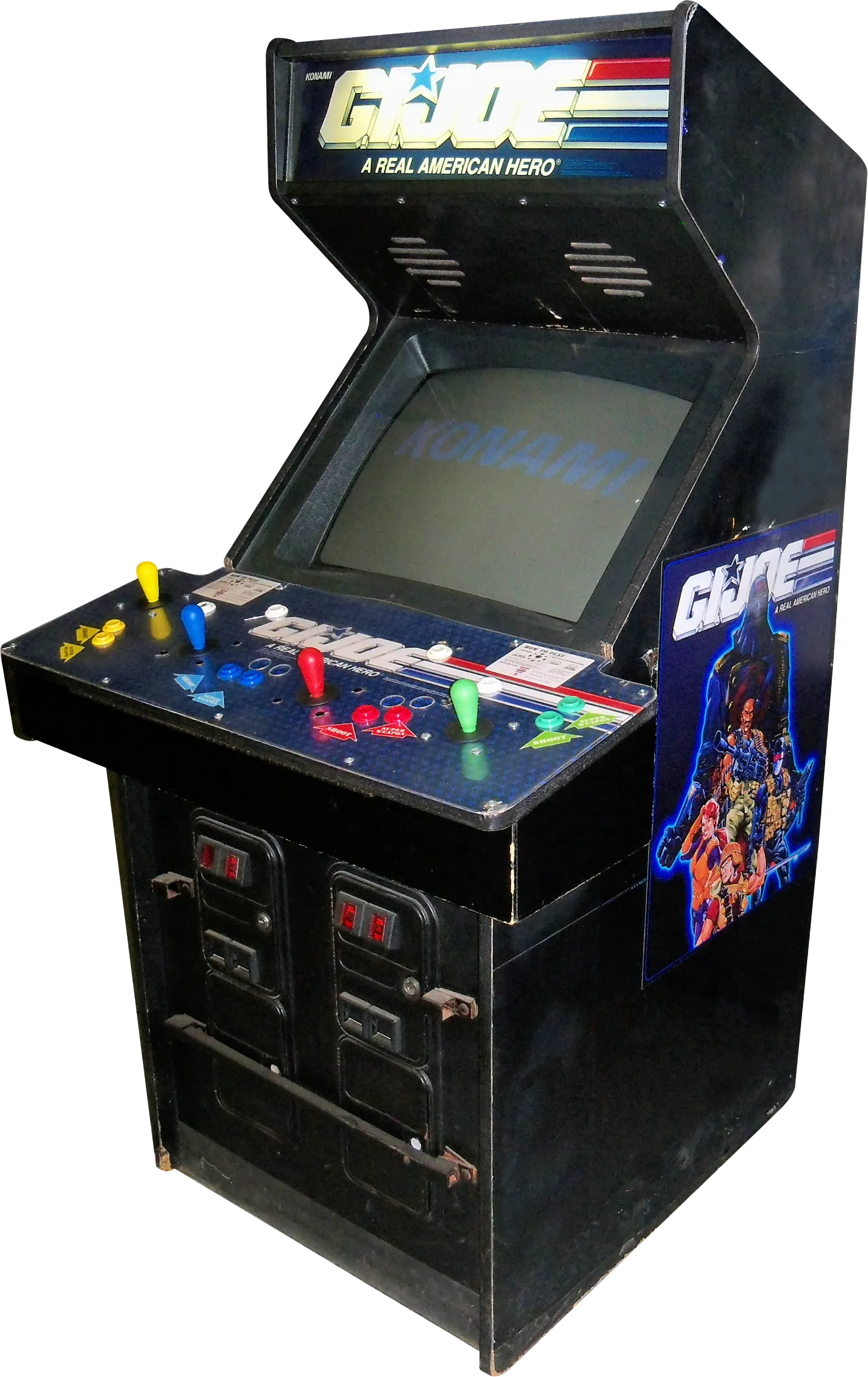
Bill, redrawn as RD-008. The robot is named after Konami’s internal product code for the original NES Contra — the European censorship sleeve carries a Konami in-joke inside it. Super Probotector: Alien Rebels · Konami, 1992 (PAL).

The Score That Stops Being Background

Miki Higashino’s name is on this soundtrack four years before Suikoden. So is Masanori Adachi, who would score Rocket Knight Adventures the next year, and Tappi Iwase, whose later Konami work would include the Policenauts and Metal Gear Solid sound teams. Three composers, one short cartridge, almost no track over two minutes long — and yet the score reads as a single argument about how percussion holds a player to a pulse.

The rooftop theme is the clearest case. It opens with a snare hit on the downbeat and stays there, four-on-the-floor, while the bassline runs underneath at double time. The melody enters late and stays sparse. The result is a track that does not push; it locks. When Stage 1’s three-screen rule starts firing — tank, jump, chain, mid-boss — the percussion is already counting the beat the rule rides on. The music is the choreography in audible form.

What the score refuses to do is the more interesting story. There is no swelling string motif. No power-ballad guitar emulation. No vocal pad faking heroism. Konami’s Kukeiha Club was capable of all three, and proved it elsewhere; on Contra III they treat the genre as machinery and write for it like industrial composers — repetition, locked tempos, bass and drums first. The texture matches the game’s surface: metal, smoke, urgency, no slack.

The boss cues break that rule deliberately. When the screen-fillers arrive, the percussion drops back and a synth lead takes the line, looping a short harmonic figure rather than a melody. The score is telling the player the scale has changed before the boss has finished entering. The rooftop runs on locked tempo; the bosses run on sequence. Recovery becomes possible because the music carries on without underlining failure — when a weapon is lost and a pattern misses, the cue does not punish, it just keeps moving, and the hand follows back into the choreography.

What Operation Galuga Was Reaching For

In an interview ahead of Operation Galuga in 2024, WayForward producer Tomm Hulett and Konami producer Akiyoshi Chosokabe described the remake’s brief as a return to the SNES and Genesis-era games specifically — the cartridge era Nakazato directed. The Flame Weapon, the multi-jointed bosses, the stage pacing where one threat hands off to the next inside a few seconds of screen-time, all trace back. Nakazato himself, five years earlier, pointed at a Contra Spirits moment — Bill hanging from a missile to fire backward — as the motif he kept reaching for across the franchise.

So the cartridge is also a template the publisher is still using three decades later. The 1992 reviewers were not wrong that Contra III looked the part. They were wrong about what made it durable. The Mode 7 stages, the showpiece bit reviewers reached for, are the part time has been hardest on — the rotation feels sluggish to a modern hand; one Twentieth Century Gamer retrospective called the controls “positively abominable” without anyone rushing to argue back. The three-screen pacing, the boss programming, and the two-weapon system feel like they were written yesterday. The friction is the salesman’s pitch the longplay is glad to skip past. The design grammar is the part that runs the franchise.

Contra III is not the longest 16-bit action game, or the deepest, or the most generous. It clears in an hour. It punishes the unprepared, especially on the Konami-of-America cart. But as a piece of playable design it is dense with ideas the rest of the era spent a decade catching up to — and the cartridge contains, in the same plastic shell, both the director those ideas would shape and the studio they would walk out the door to build.

Cartridge Collective 1992 · Super Famicom · SNES

Where to play

Why Now

A fresh threat every three screens: Contra III never lets a modern player settle into pattern, and every minute rewards a different reflex.

Best way to play now Contra Anniversary Collection

M2's emulation restores the Japanese cart's design as Nakazato shipped it — infinite continues, cheat codes, secret boss on Normal — and bundles The History of Contra. Toggle region to JP.

Time
60–90m clear Stage 1 to feel the three-screen pulse
Cost
£15 Frequently around £4 in Steam sales; the full collection includes ten Contra games.

Alternatives

  1. 01
    modern

    Contra Anniversary Collection (Switch / PS4 / Xbox / PC)

    M2 emulation with save states, rewind, region toggle, and Konami's own digital History of Contra book bundled in.

  2. 02
    simulation

    MiSTer SNES core

    Cycle-accurate FPGA simulation for purists running their own legal dump.

  3. 03
    original

    Original Super Famicom cartridge (JP)

    The Japanese 「魂斗羅スピリッツ」 cart preserves infinite continues, cheat codes, and the secret boss on Normal — Konami of America stripped all three from the NA release.

  4. 04
    rom hack

    Probotector (PAL) regional toggle

    Same code, robots in place of humans. Included as a region option inside the Anniversary Collection — historical artefact rather than primary route.

1992 · Konami

Listen

  • Contra III: The Alien Wars — Full SoundtrackKonami Kukeiha Club · YouTube Miki Higashino, Masanori Adachi, and Tappi Iwase score the rooftop run as if the city is the boss; the percussion locks to the three-screen pulse.

Watch

  • Contra III: The Alien Wars — SNES LongplayVGL / YouTube A complete Normal clear, watermark-free; the cleanest source for watching the three-screen rule operate in real time.
  • Tokyo Game Show 2004 — Developer ConversationsBrandon Sheffield / Game Developer Nakazato in his own words on what Contra-style difficulty is for — and the only on-the-record interview where he names the SNES and Genesis Contras as his.

Read

  • Nobuya Nakazato Interview — TGS 2004Brandon Sheffield / Gamasutra · Game Developer
  • Konami Butchered This SNES Classic — So We Fixed ItJohn Szczepaniak / Time Extension
  • The Making of Gunstar HeroesDamien McFerran / Time Extension
  • The Birth of Seven ForceRaster Scroll
  • Contra: Operation Galuga — WayForward and Konami InterviewTomm Hulett & Akiyoshi Chosokabe / PoisonMushroom
  • Contra Spirits — Japanese Wikipediaja.wikipedia
  • Nakazato on Rogue Corps and Contra design DNAGame Watch (Impress)

Chapter 11

Axelay

Konami's SNES Shooter That Weaponised Damage

Axelay looks like Konami showing off the SNES, but its sharper gift is crueler and kinder: damage does not end the run. It rewrites the ship in flight while the music burns underneath.

Super Famicom · SNES1992Scrolling ShooterKonami

Axelay · Konami, 1992 · Hero artwork supplied by Tom

Axelay looks like a brag, and that is the trap. The first stage bends an ocean of clouds under the nose of the ship, fakes height with a vertigo trick the SNES was born to perform, then asks the player to keep shooting while their eyes are still trying to understand the floor. It is easy to mistake that for the whole argument: Konami arrives, shakes the hardware, and proves Nintendo’s machine can host a prestige shooter.

The better reason to play is quieter and meaner. Axelay treats damage as a change in vocabulary. Before each stage you choose three weapons from a growing hangar, one assigned to each button. When a shot connects, the game does not simply pluck a life away and send you back to the start of the sentence. It breaks the weapon currently in use. The ship survives, but the hand that was speaking fluently a second ago now has to find another verb.

That one decision makes a very pretty shooter feel newly legible. A modern player does not need the thrill of discovering parallax, scaling, or pseudo-3D trickery to feel the pressure. The pleasure sits in the moment after a mistake, when the Round Vulcan is gone and the Needle Cracker becomes a desperate second language.

The Brag Is Real

Konami knew exactly how to sell the surface. The North American advertisement practically stands on a table: “For a game with so many brilliant colors, it also looks good in black and white.” The copy beneath it promises a high-speed Super NES ride through “spectrum shattering special 3-D effects,” then keeps naming sights as if the cartridge were a tourism brochure for disaster: fortresses, mobile forts, robot cities, volcanoes, the City of Darkness.

It was not lying. The vertical stages are not flat overhead shooting fields so much as rolling carpets of threat, with the world widening at the top of the screen and pinching toward the ship. Enemies loom out of the apparent distance, bullets thicken as they approach, and the player’s own craft sits at the near edge of a funnel. The horizontal stages switch grammar completely: chunky industrial corridors, ribbed metal, machinery that looks too heavy to be scrolling at all.

This alternation is not a gimmick. It gives Axelay two rhythms without making it feel like two separate games. The vertical stages ask the player to judge perspective, to fire into an image that is constantly swelling toward them. The horizontal stages ask for corridor discipline: height, lane, timing, the small correction that keeps a wingtip out of a wall or bullet stream. Konami built a shooter that changes posture every stage, then bound those postures to the same fragile loadout.

The bosses understand that trick as theatre. They enter like objects too large for the cartridge, then settle into readable patterns: a glowing weak point, a limb that telegraphs its sweep, a cannon that forces the player away from the comfortable centreline. The important thing is not that they look enormous, though they do. It is that they turn the visual boast into a demand on the hand. Scale becomes route planning. Perspective becomes risk.

Damage Changes The Sentence

The setup screen is where Axelay becomes more than spectacle. You do not collect a power-up ladder and hope to keep it. You choose a kit: a forward weapon, a spread, a back-covering shot, a laser, a needle burst, a vulcan that can sweep through a full circle. The stage begins with a thesis about how you intend to survive it.

Then the game edits you.

Axelay's weapon-select screen, showing three weapon rows and a wireframe diagram of the ship.

The argument begins before the stage does. Axelay makes the player choose a grammar, then damages it one weapon at a time. Axelay · Konami, 1992.

Most shooters punish failure by collapsing the player back to poverty. Lose the powered state, lose the speed, lose the tools, then crawl through the same pattern with a weaker ship. Axelay does something more interesting. A hit disables the active weapon, so the penalty is specific. If you were leaning on the weapon that made a section comfortable, comfort disappears. If you were smart enough to rotate through the arsenal before impact, you may lose a secondary plan instead of the whole run.

That difference matters because the game keeps asking for different kinds of sight. A vertical boss may demand sweeping fire across a warped approach. A horizontal corridor may make rear coverage suddenly valuable. A small popcorn enemy may be harmless until the weapon that was meant to erase it has been burnt out by an earlier mistake. Recovery becomes tactical rather than theatrical. The player is not simply weakened; the player’s habits are exposed.

This is why the game has teeth without feeling cruel. Its difficulty is not only memorisation, though memorisation helps. It is a test of whether you understand why each weapon is in the kit. A bad player clings. A better player rotates before panic. A very good player learns to think of damage as a resource risk: which button can I afford to lose here?

Konami’s Ghost Crew

There is no neat Axelay making-of story waiting in the usual places, no warm oral history where a designer explains the weapon system in a paragraph built for citation. What exists is more oblique and maybe more revealing: the trail of people leaving Konami immediately afterward. In a 1993 GameFan interview, Treasure president Masato Maegawa described the new studio’s staff as mostly ex-Konami and named previous work that included Castlevania IV, Contra III, and Axelay for Super Famicom.

”Almost everyone is from Konami.”

Masato Maegawa, GameFan, 1993

That does not make Axelay a Treasure game. It does make it part of the same late-Konami weather system that produced developers who wanted motion, risk, and excess to feel authored rather than merely expensive. Maegawa’s complaint about Konami was not that the company lacked talent; it was that a large publisher could make freedom feel scarce. “You cannot create games freely,” he told GameFan, explaining why he left.

Look back at Axelay through that crack and its contradictions sharpen. This is a lavish first-party-style showcase from a corporate powerhouse, but it behaves like a designer’s object. The weapon breakage is too odd to be a marketing feature. The vertical-stage distortion is too aggressive to be merely tasteful. The six-stage length is arcade-brisk, but the loadout gives each run a private argument. It feels like Konami’s production muscle wrapped around a restless design temperament, one already leaning toward the maximalist action games that would follow elsewhere.

The manual, charmingly blunt, frames the ship as a prototype strapped with eight weapons against the Armada of Annihilation. The ad calls it a “stratafighter.” The fiction is thin, but the language tells you what Konami thought it was selling: arsenal, speed, shock. The interesting part is that the final game makes arsenal fragile. It sells power, then designs around power failing.

Taro Kudo Burns The Sky

Taro Kudo’s score understands the same contradiction. The first stage theme, “Unkai,” does not simply pump the player forward; it glides, opens, and keeps a strange brightness under the battle. The SNES sound chip can become woolly in lesser hands, but Kudo gives Axelay hard edges: metallic bass pulses, lead lines that flash like tracer fire, percussion that suggests machinery tightening under heat.

Axelay flies over a huge red battleship in space.

The horizontal stages exchange cloud-show spectacle for weight: huge machinery, narrow openings, and weapons that suddenly need to cover depth instead of distance. Axelay · Konami, 1992.

The soundtrack also helps the stage alternation feel coherent. “Colony” pushes harder and darker, all forward drive and pressure, while “Silence” lets the game breathe without losing unease. The VGMPF credits list Kudo across most of the soundtrack, with Akira Souji on the ending and Masanori Adachi remixing stage two. That distribution fits what the ear hears: one main temperament, then small changes of emphasis as the game moves from sky to steel to biology to flame.

Music matters in a shooter because the player repeats failure inside it. A weak track becomes wallpaper, or worse, punishment. Axelay gives each stage a pulse sturdy enough to survive practice. When a weapon breaks and the run gets ugly, the music does not underline defeat. It keeps the ship moving, as if adaptation were the expected state of play.

That is the whole game in miniature. The visuals announce confidence; the systems admit vulnerability. The ship is over-armed and under-protected. The player is invited to feel powerful, then forced to discover whether that power was understanding or habit.

Axelay is not the deepest shooter on the SNES, nor the cleanest, nor the one with the most generous route into the present. Its official digital life is stranded on Wii U, and original cartridges now ask collector money for a half-hour game. But as a piece of playable design, it has a rare modern clarity. It gives mistakes shape. It makes recovery expressive. It understands that a shooter becomes more interesting when damage does not merely ask whether you can continue, but who you become when your favourite tool is gone.

Axelay's ending message reads, You have saved the solar system.Axelay's end screen shows a gold medal floating against space.

The ending is almost quaint beside the machinery that precedes it: peace restored, medal awarded, the broken ship’s improvisations folded back into ceremony. Axelay · Konami, 1992.

Cartridge Collective 1992 · Super Famicom · SNES

Where to play

Why Now

Axelay makes damage tactical instead of merely punitive: each hit strips one weapon from your loadout, forcing a modern player to improvise with a ship that keeps changing under pressure.

Best way to play now SNES emulation with an owned copy

No current official storefront route exists; accurate SNES emulation preserves the weapon-switching rhythm without asking readers to pay collector prices.

Time
30–45m clear Two stages to feel the loadout idea bite
Cost
£70+ loose Original cartridges are priced for collectors, not casual discovery.

Alternatives

  1. 01
    simulation

    MiSTer SNES core

    The best hardware-simulation route if you already have the setup and a legal dump.

  2. 02
    original

    Original SNES cartridge

    Authentic and handsome, but the market has turned it into a collector purchase.

  3. 03
    modern

    Wii U Virtual Console

    Once the cleanest official release; kept here as a historical route because the eShop no longer sells it.

1992 · Konami

Listen

  • Axelay — Full SoundtrackTaro Kudo / Konami Kukeiha Club · YouTube Taro Kudo's score keeps the shooter tense without flattening it: cloud-stage shimmer, colony pulse, and boss music that sounds like machinery overheating.

Watch

  • SNES Longplay [017] AxelayWorld of Longplays / YouTube A complete Normal run, useful for seeing how the six-stage alternation changes the ship's grammar.

Read

  • Axelay Instruction BookletKonami / Retrogames.cz
  • An Interview With Treasure — 1993GameFan transcript / MegaDrive.Me
  • Axelay — Nintendo UKNintendo
  • Axelay — VGMPFVideo Game Music Preservation Foundation
  • Axelay — Shmups.com ReviewShmups.com

Chapter 12

Snatcher

Konami's PC-Engine Snatcher Was the Real One

Konami's first CD-ROM project wasn't a Castlevania or a Gradius — it was Hideo Kojima's cyberpunk detective game, finally completing the story the studio had forced him to break in half four years earlier.

PC Engine Super CD-ROM² · Sega CD1992Cyberpunk AdventureKonami

Snatcher CD-ROMantic · Konami, 1992 · PC-Engine Super CD-ROM² key art

The version of Snatcher most English-speaking readers know is the Sega CD release that came out in North America in January 1995 and sold roughly two thousand copies. That release is a port. It is censored, it adds shooting set-pieces Kojima did not write, and he had no hand in it. The version he actually made — completed third act, uncensored script, all-anime voice cast, his name on every reel — came out on the PC-Engine Super CD-ROM² two years earlier and never crossed the Pacific.

That gap is not a translation problem. It is the article. Konami’s most consistent decade — Castlevania IV, Contra III, Axelay, Sunset Riders, the Goemon run — sits in the same seven years that Hideo Kojima was inside the same building turning Snatcher into the studio’s first CD-ROM project. The arcade house style was the visible Konami of 1990 to 1996. Snatcher CD-ROMantic is the other one: a cinematic adventure game on optical media, written by an in-house auteur the company kept in a different room, and finished in the version English players still mostly do not play.

The reason to come back to it now is not preservation, and not Kojima’s later career either. It is that the game itself has aged into legibility. The detective loop is sharper than the genre that has grown up around it. The opening is film. The third act, in the version Kojima signed off on, is short, hard, and final.

The opening credits roll over a slow pan across Neo Kobe under “One Night in Neo Kobe City.” Most PC-Engine CD games used the medium to add Red Book music; Snatcher uses it to assemble a film opening. Snatcher CD-ROMantic · Konami, 1992.

Four Years to Finish a Sentence

The 1988 Snatcher — PC-88 in November, MSX2 in December — was planned as a five-act game. Roughly three hundred hand-painted screens, a presidential-election Snatcher conspiracy, the destruction of Neo-Kobe’s Snatcher headquarters, a Siberian operation, a 3D dungeon under Queen Hospital with branching paths. Konami pulled the rope in halfway through. Acts 1 and 2 shipped; Acts 3 to 5 were cut. The game ends, on the original PC-88 and MSX2, on a cliffhanger the team had no contractual permission to resolve.

Kojima resolved it sideways. SD Snatcher (MSX2, April 1990) is the same world rebuilt as a top-down RPG with super-deformed sprites. It looks like a children’s game. It contains the third-act material Kojima had been forbidden to ship: the conspiracy named, Gillian’s past explained, the Snatcher origin laid out. The Metal Gear 2 team was deployed mid-development when management noticed the RPG was going sideways. The chibi remake was the smuggling route for the ending.

The 1992 PC-Engine release is the round-trip. Act 3, written first for SD Snatcher, is folded back into the original game and given the cinematic treatment the 1988 truncation had denied it. The same story, finally finished, on the platform that became Konami’s first-ever CD-ROM project.

”My projects usually end up having too much content, which gets people angry at me, but this time I could add to my heart’s content without worrying about storage capacity.”

Hideo Kojima, PC Engine Fan #44, July 1992

That CD-ROM choice was strategic and almost happened elsewhere. Kojima told the same magazine the team also pitched the remake for the Sharp X68000 and the Fujitsu FM Towns; the Super CD-ROM² won. They used CD-R writers to author the disc. Nobody on the team had ever used one before. The studio’s first CD-ROM project was a Kojima cyberpunk adventure game, not a Castlevania or a Gradius, and that decision — to put the lab equipment in the hands of the in-house cinephile — is the volume’s hidden inverse on a record.

A Detective Game, Not a Visual Novel

The genre label that follows Snatcher around in English retrospectives is “visual novel.” It is the wrong label. Snatcher is a detective game with a second observation command, and the second observation command is the whole design.

The JUNKER HQ office — Benson Cunningham seated at a console — with Japanese command menu open below: 外へ出る (Exit), 見る (Look), 調べる (Investigate), 聞く (Listen).

The two-tier interface. Look gets a description; Investigate gets the second one. The whole game is which command you reach for. Snatcher CD-ROMantic · Konami, 1992.

Every interactable object in Snatcher answers to two verbs. Look gives you a description. Investigate gives you a different one. In the JUNKER HQ lobby, the recruitment poster is, on first look, a recruitment poster; investigated, it is a sign of personnel shortfall in the Snatcher conflict. The receptionist’s pod is a pod; investigated, it is heat-and-shock-fitted because the receptionist is what the Snatchers would prefer to kill first. Listen is a third verb, surfacing when the room is worth eavesdropping on; Take and Show Photo exist; but the spine of the loop is the two-tier inspection.

This sounds slight on paper and reads as procedural detective work in play. Most adventure games of the era — Sierra, LucasArts, the JP visual-novel canon — gave you one observation command and used it for inventory, hidden objects, or the next hard-coded line of plot. Snatcher gives you two and uses the second one to put a deeper world behind the first. A player who only looks will finish the game and miss most of it. A player who investigates everything will spend an extra hour per act and rebuild Neo Kobe in the margins.

The action breaks come once per act. The Insector set-piece in the abandoned factory is a 3×3 grid shooter; the player aims an outer square, returns to centre, fires before the bug shears them. As light-gun grammar it is thin — geometry, not aiming — and modern reviewers have been right to call it tacked-on. But in the PC-Engine cut it appears once, and that single appearance is the spike the rest of the investigation rhythm needs. The Sega CD added two more grids in Acts 2 and 3; the dilution is part of what makes the PCE master read as a cleaner cut.

The single Insector grid, mid-fire. Aim outer square, return to centre, shoot before it shears you — light-gun grammar in nine compartments. Snatcher CD-ROMantic · Konami, 1992.

An Anime Cast for a Cyberpunk Robot

The studio that posted Castlevania IV and Contra III with sound-chip arrangements did something different here. Motoaki Furukawa led a Konami Kukeiha Club score that gets to use Red Book audio — actual recorded jazz cues — instead of the SCC or the SPC700. The new PCE-only opening, “One Night in Neo Kobe City,” replaces the 1988 PC-88’s “Twilight in Neo Kobe City” with a brushed-snare bossa number that does most of the work of a film score before the player has touched a button.

The voice cast is the other unrepeatable thing about the 1992 version. Yusaku Yara — the dad in Chibi Maruko-chan — plays Gillian Seed. Kikuko Inoue, who voiced Belldandy in Oh My Goddess and Electra in Nadia, is Jamie. Kaneto Shiozawa, Char Aznable in Zeta Gundam, is Random Hajile. Goro Naya — Inspector Zenigata himself — voices the JUNKER director Benson Cunningham. Marukatsu PC Engine called it “an amazing lineup” without exaggerating; nothing comparable was happening in Konami’s arcade output, and certainly nothing comparable was about to happen on the Sega CD.

The abandoned factory exterior — purple sky, blue corrugated walls — with portraits of Gillian Seed and Metal Gear Mk. II inset below.

Metal Gear Mk. II reports in beside Gillian at the abandoned factory. Voiced by Mami Koyama in her Arale-chan timbre — sunny Toriyama tone bolted to a surveillance robot. Snatcher CD-ROMantic · Konami, 1992.

The casting move that gives the texture away is Mami Koyama as Metal Gear Mk. II. Koyama is Arale in Dr. Slump and Bulma’s first voice in Dragon Ball; her register is the sunniest sound in 1980s Toriyama anime. She is given Gillian’s surveillance robot — the noir partner, the Voight-Kampff equipment, the device that scans for Snatchers — and reads the role in the same hyper-cheerful Arale tone. The contrast is deliberate. Kojima later named it. A cyberpunk detective game can hold a cartoon voice strapped to the most paranoid piece of equipment in the room, and the joke makes the rest of the surveillance read sharper, not lighter.

The Mk. II’s screen scrolls biometrics while Koyama’s Arale-bright voice narrates what it finds. Konami’s first CD-ROM project also taught itself UI animation. Snatcher CD-ROMantic · Konami, 1992.

What the Sega CD Smoothed Out

The Sega CD version of Snatcher is a genuinely good port. Jeremy Blaustein’s localisation is the same hand that would translate Metal Gear Solid four years later, and most of what English readers love about the prose — Gillian’s wry deadpan, the snap of the JUNKER patter — survives the trip intact. EGM gave it nine out of ten in January 1995. Mean Machines Sega gave it 85%. The reviewer in Die Hard GameFan called it “moving, dramatic, gore-riddled, MA-17, adult,” which is, as a single line of period reception, about right.

It is also a different cut.

The 1992 PC-Engine Super CD-ROM² jewel-case art for Snatcher CD-ROMantic — Konami logo, red ink-blot type, watercolour cast.The 1994 Sega CD North American box art for Snatcher — Konami and Sega CD logos, painted Gillian Seed firing into a neon Neo Kobe skyline.

Two covers, two arguments. Left: the Konami CD-ROMantic jewel case — cyberpunk-noir as watercolour portrait. Right: the Sega CD US box — Gillian rebuilt as an action hero against a Blade Runner skyline. The cuts inside the case track the covers. Snatcher · Konami, 1992 (JP) / 1994 (NA).

Lisa Nielsen’s exposed breasts, on her death-scene panel, are covered. Katrina Gibson — fourteen years old in the Japanese script — is aged up to eighteen, and her doorway quiz-question is rewritten from her three sizes to her birthmark. The food in Gibson’s stomach changes from whale meat to buffalo. The Neo Kobe “PACHINKO” sign that read “CHINKO” — Japanese schoolyard slang for penis — has the offending letters unlit. A Predator mask in the Joy Division gift-shop becomes a mummy. The single Insector encounter becomes three. None of this was done by Kojima; he was not consulted.

Kojima’s own line on the later 1996 PlayStation and Saturn ports is sharper still. He called those versions, in a 2003 Dorimagá feature, kaizō sareta gisaku — falsified copies — and publicly discouraged players from buying them. The CG opening is glossy, flat, and sometimes goofy, as Sega Lord X put it in a 2026 retrospective. Whatever the PCE version is, it is the only one Kojima will stand behind, and it is the only one with the watercolour cast on the front cover instead of an oil-painted Gillian holding a service revolver.

The friction in the PCE cut is real. Act 3 collapses sharply into non-interactivity. Kojima knew it.

”Act 3 is like a digital comic.”

Hideo Kojima, Snatcher 1992 Developer Interview, Shmuplations translation

He meant it as design, not apology. A modern player coming off Disco Elysium or Pentiment will recognise the shape; a player expecting late-game expansion the way Phoenix Wright expands will hit a wall. The 3×3 shooting is what it is. Some scenes ask the same Look/Investigate cycle three times in succession, and Gillian’s flirting set-pieces have aged badly — particularly the JP version’s Katrina quiz, which the Sega CD did not censor for nothing. None of these are reasons to skip the game. They are reasons to walk in knowing what it is doing.

Why It Still Argues

What Snatcher still gives a modern player is the loop most adventure games abandoned. Disco Elysium has the prose; Pentiment has the period; Return of the Obra Dinn has the deduction. Snatcher, decades earlier, on a fragment of the same lineage, has the discipline to build a city behind every interactable object and then ask the player whether they want to see it. Two verbs, second one optional.

The opening twenty minutes are the second argument. The prologue, the narrated voice-over, the slow pan over Neo Kobe under the Furukawa cue — they land cold on a modern first-timer because they were always already a film opening. Konami’s first CD-ROM project was the studio handing a small budget for tape transport, voice booth, and animation cels to the in-house cinephile and asking what he wanted to do with them. He used them to finish a sentence the company had broken in half.

Cartridge Collective 1992 · PC Engine Super CD-ROM² · Sega CD

Where to play

Why Now

A two-tier detective loop — Look then Investigate — carrying a cinematic opening that lands cold, plus an Act 3 Kojima called a digital comic.

Best way to play now Sega CD via Kega Fusion (Perfect Sync)

The only English route. Jeremy Blaustein's localisation is sharp; toggle Perfect Sync on the emulator so the twin 68000s stay in step. Region-correct BIOS recommended.

Time
12–13h Two hours to feel the detective loop bite
Cost
Free via emulation Original Sega CD disc is £300+ CIB; sealed graded copies sit deep in the thousands.

Alternatives

  1. 01
    simulation

    MiSTer FPGA (Sega CD or PCE Super CD-ROM²)

    Both the Sega CD and PC-Engine Super CD-ROM² cores run on MiSTer with the right BIOS — the hardware-accurate route for either cut.

  2. 02
    emulation

    Kega Fusion (Sega CD)

    The cleanest English route. Enable Perfect Sync; load a US Sega CD BIOS so the twin 68000s stay in step.

  3. 03
    original

    PC-Engine CD-ROMantic (Japanese)

    The artefact. Uncensored, Kojima-supervised, completed. No fan-translation exists; live-OCR tools now make the JP cut readable for non-Japanese readers.

  4. 04
    original

    Sega CD original disc

    Authentic and beautiful — but the market has turned the case into a collector grail, not a play recommendation.

1992 · Konami

Listen

  • Snatcher (PC-Engine) — Opening & IntroductionKonami Kukeiha Club / YouTube Motoaki Furukawa's PCE arrangement opens on 'One Night in Neo Kobe City' — bossa-jazz where the 1988 PC-88 version had chiptune. The opening title cue does most of the article's atmospheric work in under two minutes.

Watch

  • Snatcher CD-ROMantic (PC Engine CD) — Full PlaythroughPC-Engine longplay archive / YouTube The Kojima cut, voice-acted in Japanese throughout. Best way to see the prologue, the JUNKER lobby, and the single Insector set-piece without owning a Super CD-ROM² disc.
  • Snatcher — Kojima's Lost Classic | Sega CD RetrospectiveSega Lord X / YouTube A long-form retrospective on the Sega CD version that's clear-eyed about what the PCE original did better — the cleanest English-language reading of why the 1992 cut is the artefact.

Read

  • Snatcher — 1992 Developer InterviewHideo Kojima / Shmuplations translation
  • PC Engine Fan #44 — Interview with Hideo Kojima on Snatcher CD-ROManticPC Engine Fan, July 1992 / @thearkhound translation
  • Marukatsu PC Engine Vol. 43 — Snatcher CD-ROMantic interviewMarukatsu PC Engine, July 1992 / @thearkhound translation
  • Snatcher — Hardcore Gaming 101Hardcore Gaming 101
  • Snatcher PCE Super CD-ROM² — JunkerHQJunkerHQ (fan archive)
  • The DNA of Hideo Kojima, Video Gaming's Greatest AuteurTime Extension

Chapter 13

Assault Suits Valken

Konami's Mech Drama Reached the West Halved

Masaya built a side-scrolling mech heavy enough to carry an anti-war drama; Konami shipped the mech and left the drama in Japan. The action is still unlike anything else on the SNES.

Super Famicom · SNES · Switch1992Mech ActionNCS Corp. / Masaya

Assault Suits Valken · NCS Corp. / Masaya, 1992

The mech does not run. That is the first thing to understand about Assault Suits Valken, the 1992 Super Famicom cartridge Konami sold the West a year later as Cybernator. Press the d-pad and the suit strides — heel-down, weight forward, the next two frames committed whether you wanted them or not. Shoot a heavy enemy and the world stops for two frames before the round resolves. Get hit and one of your four weapons goes dead until the next stage. Everything is mass, and nothing forgives.
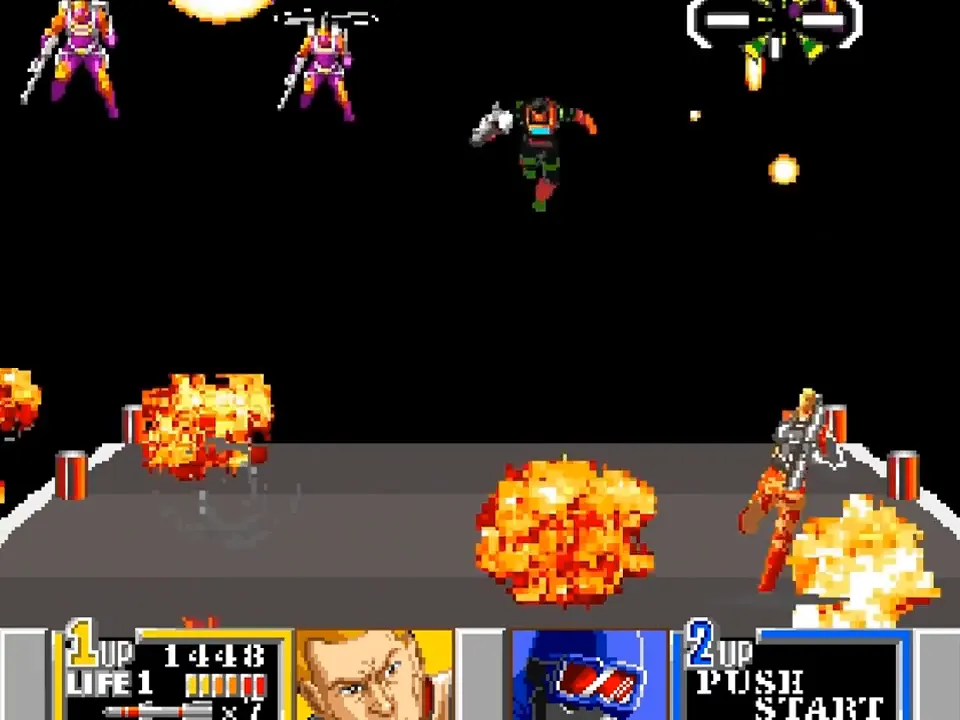
That feel was the work of an artist named Satoshi Nakai, who made most of it by himself, sleeping on cardboard in the NCS office on the cold nights. The producer was Toshiro Tsuchida, who would leave Masaya for Square and build Front Mission. The composer was Masanao Akahori, who treated the SNES sound chip like an anime-OVA studio orchestra. They shipped a cartridge that sold ten thousand copies in Japan, was exported to America with most of its dialogue cut, sat in obscurity for thirty years, and finally landed in English in 2023 — at which point Western players, almost all of whom thought they had been quietly defending it since the nineties, discovered they had been defending half of it.

The 2023 Declassified release, emulated by M2 and packaged by Rainmaker Productions, restores the portraits, an anti-war ending, a moment on the bridge of the enemy capital ship that Nintendo of America’s 1992 content rules would not let through, and a post-credits hook that ties the war to Valken’s Mega Drive predecessor. The cuts were not small. The more surprising thing — once you sit with the uncut original — is that the action game already carried the weight of the story. The stride already mourned. The hit-pause already insisted that violence had cost. Konami’s Cybernator worked because the design did most of the talking, and the talking it did not do is precisely what the restoration adds back.
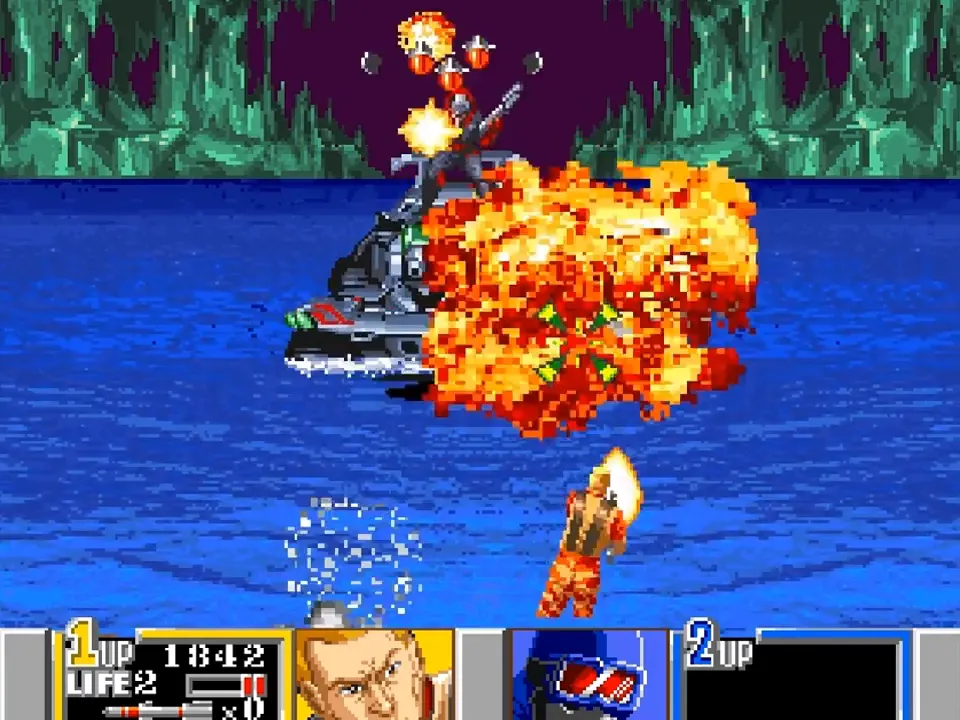
The Mech Strides, Doesn’t Run

The first stage drops a marine named Jake Brain into an orbital colony being raided by a faction called the Axis Empire. The setting is military procedural, not action splash: distant city silhouette, scaffolding, infantry running between cover, a giant siege walker that has to be circled, not out-shot. The mech itself takes up nearly a quarter of the vertical play area. Movement starts with a half-second of acceleration and ends with a half-second of brake. Jumps are committed; the boost thrusters fire in arcs you have to plan into before you leave the floor.
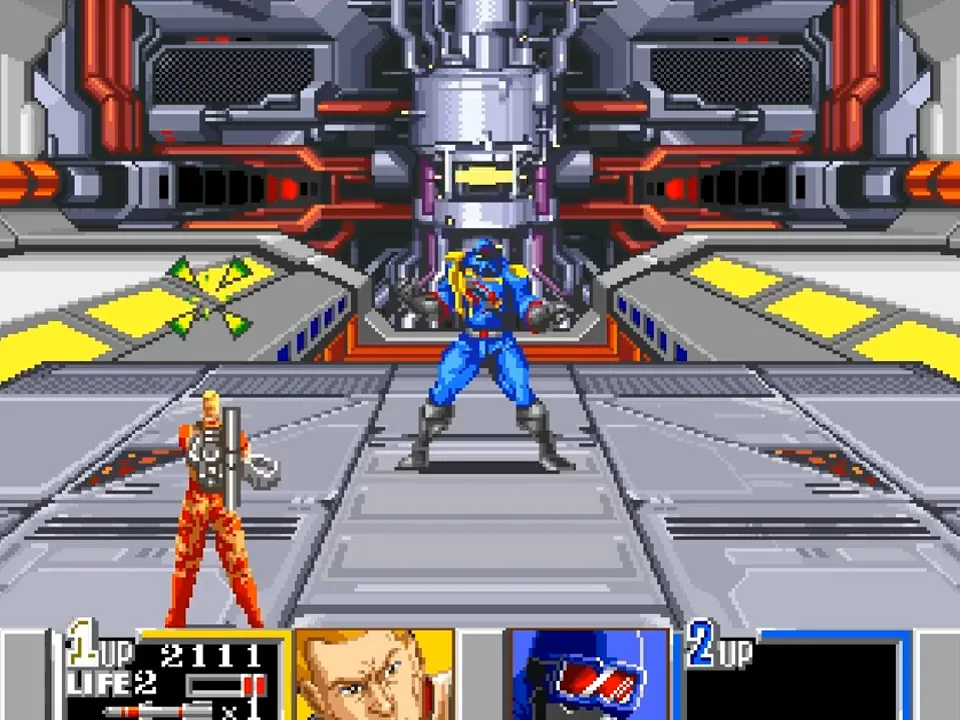
Jake's mech inside an industrial Axis facility, surrounded by enemy infantry and conveyor structures.
The first stage is a procedural — infantry in cover, scaffolding, conveyor lines. Nakai’s destructible-environment demand reads as material physics: the floor can be shot away. Assault Suits Valken · NCS Corp. / Masaya, 1992.

The trick that holds it all together is destructibility. Nakai pushed for it specifically: “It was also my idea to destroy the floor and other objects by shooting them.” You can see it everywhere once you know to look. Crates explode into the geometry, not off it. Conveyor lines deform under fire. A ledge a soldier was sheltering behind degrades while he is still on it. The world reads as material, not as a sequence of triggers, and the consequence is that the mech feels like it is in the level rather than passing over it.

Four weapons rotate on the right shoulder — vulcan, laser, missile, napalm — each charging to an “S”-mode super-shot that transforms how a section reads. The laser overcharge in late levels is the kind of run-defining tool Cuphead’s loadouts try to be. A hit on the suit disables the currently-equipped weapon until the next stage. It is the Axelay recovery system three years earlier, but here the breakage scales to the dramatic register: you can grind out a stage on a single broken loadout, and the prose of the playthrough is that grinding. The texture is grim. It is meant to be.

Stage 2’s asteroid field — the moment the game becomes itself. Vector-style scrolling on a SNES that has no business pulling it off, and the precise difficulty wall every reviewer cites. Assault Suits Valken · NCS Corp. / Masaya, 1992.

The Stage 2 asteroid field is the filter. Every reviewer cites it, every veteran warns you about it, and it is also where the cartridge stops being a curio and starts being itself. Debris streams the screen sideways while the mech’s jets hold position against a planet curving behind. The first run is brutal. The second is illuminating. By the third you understand that the boost thrusters are not for traversal but for breathing space — the asteroid field is the design teaching you how to use them under fire, and after it nothing else feels quite the same.

The Action That Konami Cut

What Cybernator shipped in 1993 was the mech. What it did not ship was the conversation the mech was wrapped inside. The Japanese original interrupts each stage with cabin chatter — Crea on the comms, the captain pushing back, Mitch with the next contact. The portraits are by Satoshi Urushihara, then a rising character artist whose later bishōjo work would make him one of the strange names attached to a sober military drama. The voices are not narration. They are the cost ledger: who saw what, who lost what, who is still talking.

The Japanese Assault Suits Valken box, with a grey humanoid mech standing over kneeling infantry against a desert backdrop, painted in an anime-OVA register.

Masaya’s Japanese cover stages the game as a sober anime-OVA still: a sentinel watching its own troops. Set it beside Konami’s North American “five story tall take-no-prisoners” action figure on the header and the cover gap is the game gap in miniature. Assault Suits Valken · Masaya, 1992.

The export changes are documented frame by frame elsewhere, but the structural ones matter most. The portraits were stripped. Most dialogue went with them. The ending lost a sequence in which the defeated Axis commander, on the bridge of his collapsing capital ship under a banner that evokes the European Union flag, chooses not to be taken alive — a decision the script frames not as villainy but as the war’s final accounting. And a post-credits radio transmission, tying the lieutenant’s war to the Mega Drive prequel Assault Suit Leynos, was clipped. Western players in 1993 finished the run, watched the medal ceremony, and were sent home.

It is tempting to read this as a censorship story and stop. But the more careful reading is that Konami’s localisers, working inside Nintendo of America’s 1992 content rules, were not editing a story they disagreed with — they were excising the register Masaya had written in. Valken asks its player to feel the human cost of the stride and the hit-pause. Cybernator supplies its own register from outside: the box copy promised “a five story tall take-no-prisoners Cybernator” with “hyper-space propulsion and 360° firing range.” Players got there themselves anyway. The design did the work.

Mid-mission cabin chatter restored: Crea's portrait under the subtitle 'Stay out of my way!' as Jake's mech fires into chained explosions on a Stage 1 platform.

The register Cybernator did not ship. Urushihara’s portrait of Crea sits under live gameplay, the cabin chatter Konami stripped now restored to the only place it ever played from. Assault Suits Valken DECLASSIFIED · M2 / Rainmaker Productions, 2023.

Nakai Alone, On Cardboard

The other surprising thing the Declassified extras surface is how small the team was. Nakai handled mech design, backgrounds, “almost all imagery,” and the world bible. Hideo Suzuki — the programmer who had made Assault Suit Leynos on the Mega Drive — wrote the engine. Tsuchida produced. Akahori scored. The rest was contract help and overnight stints in the NCS office.

”On cold nights, we would spread out cardboard, flat on the floor, and stuff newspaper into our clothes. Back in those days, we’d only have between six months and a year to make a game.”

Satoshi Nakai · Time Extension, 2023

That fact reshapes the cartridge on a second look. The reason every screen is dense with shape and material is that one artist was painting them all. The reason the cut content (a branching X-System campaign, a moon-base stage, a harbour stage with a submarine boss) is so cleanly documented in the Declassified guidebook is that it was finished as art before time killed it. The reason the late stages look like a different game — burning sky, rust mountains, capital-ship interiors — is that Nakai kept moving the world’s palette because there was nobody else to argue him out of it.

Mech extends a cable from a low platform across a violet cityscape of cooling towers and chimneys under a grey sky.

Late Valken is a different game’s palette every twenty minutes. One artist setting every key — violet skyline, magenta industrial canyon, the cooling-tower silhouettes of a war economy. Assault Suits Valken · NCS Corp. / Masaya, 1992.

The team’s afterlife is its own footnote. Tsuchida left for Square inside two years and produced Front Mission and five more entries; Suzuki later co-founded Omiya Soft and was reunited with Tsuchida to make Front Mission: Gun Hazard, a side-scrolling action game inside the Front Mission universe. The unified Masaya plan — strategy and action sharing one fiction — was completed three years late inside a different company. Valken failed at retail (Famitsu’s lifetime estimate is just over ten thousand copies) and scattered the people who could have made the sequel.

Akahori’s Score Under Glass

Masanao Akahori’s soundtrack is the part that travelled well even in the truncated export. Cybernator might have lost the dialogue, but it kept the music, and the music does not narrate — it sets a temperature. The Stage 1 colony cue rides a synth-string pad under a brass-and-percussion line that pulses like a procedural — closer to Macross OVA scoring than to a 1992 SNES action game. The atmospheric-entry cue in the third act drops everything to a piano-and-strings figure that sounds like the score forgetting it is in an action game, then remembering, then carrying on.

The mech connects a Punch attack with an enemy walker on a girder platform; the PUNCH weapon indicator burns red as the score holds.

Every clean hit on a heavy enemy freezes the world for two frames. The score keeps moving under it — the only thing in the room that hasn’t paused. Assault Suits Valken · NCS Corp. / Masaya, 1992.

The credits theme is the surprise. It is closer to elegy than to march. Repeated through the Declassified arrange option in fuller live-orchestra textures, it stays a credits theme — but stripped down to the SFC chip it is doing the same work as the cut portrait scenes: marking the cost, releasing the player into mourning before the medal. A soldier looks at the camera. The music does not celebrate. The export played the same notes; only here do they sit under the right ending.

Why the Half-Cut Stayed Loved

It is fair to name what Valken does not give a modern player. Two hours is short. The difficulty is lopsided — the asteroid field punishes a first-time player harder than anything that comes after it, and the Stage 4 capital-ship boss is a documented filter. Cockpit text occasionally runs over the action where it can pull focus. The Declassified package is twenty-five dollars at full price for a runtime Hotline Miami would clear in an afternoon — though the loadout system makes a second run honestly different.

The wider point is that Valken invented a vocabulary the action genre would spend three decades catching up to. Metal Warriors, LucasArts’s 1995 SNES mech, leans heavily on the same controls; Nakai watched it on YouTube and said politely that “the resemblance is even stronger” than he expected. Front Mission took the strategy half. Hardcore Mecha and Furi inherited the commitment-to-the-swing the stride established. None of them carry the hit-pause the way Valken does, because none are saying the same thing about violence with it.

The 2023 restoration is the part that makes the case argue out loud. For thirty years Valken’s defenders, working from the Konami cut, had to gesture at things they could only see in the action — the weight, the cost, the strange seriousness of a SNES cartridge that knew its lieutenant might not come home. The portraits are back. The president on the bridge is back. The post-credits hook is back. None of it is required to enjoy the play. All of it explains, retroactively, what playing it always felt like.

Cartridge Collective 1992 · Super Famicom · SNES · Switch

Where to play

Why Now

Each hit stops the world for two frames; between them the mech strides under its own mass — weight no SNES peer matched.

Best way to play now Assault Suits Valken Declassified on Switch

M2 and Rainmaker's restoration puts the uncut original in English for the first time, with the portraits, the anti-war ending, and the post-credits hook all back in place.

Time
2–3h main Reach the Stage 2 asteroid field — about twenty-five minutes in, the moment the game becomes itself.
Cost
£20 / $24.99 Sale floor seen around $9.99 on the US eShop.

Alternatives

  1. 01
    simulation

    MiSTer SNES core

    Plays the original Super Famicom ROM faithfully on FPGA — pair with a community translation if you want the Japanese cut without the Declassified extras.

  2. 02
    rom hack

    Aeon Genesis fan translation

    The long-standing community route to the uncut original; superseded for most readers by the Declassified release.

  3. 03
    original

    Cybernator (1993 SNES cartridge)

    Historically interesting, but you would be re-watching the redacted version of a film whose director's cut is now in print.

1992 · NCS Corp. / Masaya

Listen

  • Assault Suits Valken — Original SoundtrackMasanao Akahori · NCS Corp. / Apple Music Akahori treats the SNES sound chip like an anime-OVA studio orchestra: synth strings under sustained brass, a credits theme more elegy than march.

Watch

  • Assault Suits Valken / Cybernator — SNES Longplay (English translation, 4K60)Tarosan / World of Longplays · YouTube The cleanest full-run reference; uses a community translation that surfaces the cut dialogue against the Konami export ROM.
  • Review: Assault Suits Valken DECLASSIFIEDRetronauts The sharpest English review of the 2023 restoration — clear-eyed on the difficulty wall, generous about the package.

Read

  • The Making of Cybernator / Assault Suits ValkenTime Extension Long Satoshi Nakai interview — destructible-environment design, the cardboard nights, the X-System branching campaign that didn't ship.
  • Front Mission, Cybernator, and Assault Suit Leynos Are All ConnectedTime Extension How Tsuchida and Suzuki left Masaya for Square and finished the unified mech-action / mech-strategy plan inside Gun Hazard.
  • Cybernator vs Assault Suits Valken — Version Comparisonmovie-censorship.com Frame-by-frame log of what Konami's export cut — portraits, the suicide on the enemy bridge, the post-credits Leynos hook.
  • Assault Suits Valken DECLASSIFIEDRainmaker Productions The publisher's archive page — guidebook reproduction, Urushihara art, Nakai recorded interview, original-and-arranged soundtracks.
  • Cybernator / Assault Suits Valken — game dataSNES Central Regional release chain (Masaya → Konami → Palcom), prototype cart trail, contemporary metadata for the cartridge.
  • [プレイレポ] Assault Suits Valken DECLASSIFIED4Gamer Japanese play-report on the restoration — leads with the archive package rather than the censorship story, the way the original audience remembers it.

Part III

The Far Edge

The outliers and swansongs — CD-era ambition, the auteur lab, and the last great cabinet brawls before the run closed.

Chapter 14

Castlevania: Rondo of Blood

Where Symphony of the Night's Castle Began

Japan-only on PC Engine CD for fourteen years, the apex of classic Castlevania and the game Symphony of the Night was made by — the tightest seventy-five minutes the franchise has ever shipped.

PC Engine Super CD-ROM² · PS41993Action PlatformerKonami

Castlevania: Rondo of Blood · Konami, 1993 · PC Engine Super CD-ROM²

Castlevania: Symphony of the Night opens with the end of a different game. Richter Belmont, climbing a clock tower, walks into Dracula’s throne room and fights him — under a banner reading “Final Stage: Bloodlines” — before the player has earned anything. Most Western players in March 1997 met the moment cold. They didn’t recognise Richter, hadn’t seen Annette being carried off in a stolen carriage four years earlier, didn’t know why Maria materialised from offscreen to make Richter invincible. Symphony won them anyway; the unknowing read as part of the charm. The game it was finishing had been on a Japanese console for four years, and would not be officially released in English for another ten.

Read forward, the gap looks like a translation problem. Read in the other direction — from the game Konami’s director shipped in 1993 — it looks like causation. Symphony of the Night is a sequel to Castlevania: Rondo of Blood, the Japan-only PC Engine CD release the West met in effigy through 1995’s SNES remake before it met it whole. Tōru Hagihara directed both. Koji Igarashi, the assistant director who finished Symphony after Hagihara was promoted away from it, is on record that the series’s actual departure from classic Castlevania happened on the earlier disc, not on the famous one. The Western canon disagrees. The Western canon also had not played the game in question.

The Hit Konami Didn’t Send West

Rondo of Blood shipped on 29 October 1993, on the PC Engine Super CD-ROM² System, on a console with a healthy Japanese market and almost no Western one. Famitsu’s first-week figure was 14,436 copies; PC Engine Fan’s readers’ poll handed it 26.0 out of 30; the January 1994 Micom BASIC Magazine placed it first in its popularity ranking. The audience that could play it loved it. That audience was small.

Richter Belmont stands on a hijacked black carriage drawn by four black horses across moonlit grass; in the upper right, a black-cloaked wraith holds a green pentagram ritual circle, summoning Dracula.

The franchise’s first cinematic action moment: Richter rides the carriage that just took Annette while Shaft summons Dracula in the wings. The CD-format budget that paid for it was also the format that stranded the game in Japan. Castlevania: Rondo of Blood · Konami, 1993.

A SNES port did not follow. Two years later Konami released Akumajō Dracula XX on the Super Famicom — Castlevania: Dracula X in North America, Vampire’s Kiss in PAL territories — and recycled Rondo’s sprites for a different game: different levels, fewer paths, no playable Maria, three endings tied to whether you rescued Annette in time. NEC’s exclusivity contract prevented anything closer to a port. Western buyers met Rondo through that misfit cartridge, then nothing, for twelve years.

The platform constraint was the design opportunity. Character designer Toshiharu Furukawa told the Akumajō Dracula X CD liner notes that previous Castlevania monsters had been restricted by what he called “American morals” — the half-human, half-monster forms he wanted to draw were not exportable to a Konami release that needed to clear Nintendo of America. Rondo being Japan-only, that brief came off. The same liner notes record sound designer Akira Souji recording Dracula’s cape by flapping a blanket in his living room — “an especially pathetic” domestic activity, in his own words. It is the first Castlevania with recorded Foley over chip synthesis, because it is the first Castlevania on a disc.

The Director Behind Both Castles

The line between Rondo and Symphony is not a metaphor. Hagihara directed and programmed Rondo, then directed and produced Symphony four years later, finishing the first half himself and handing the rest to Igarashi after a promotion. Between the two games sat a third Castlevania that the world did not see: a Sega 32X project announced in Game Players in December 1994 and cancelled, by Time Extension’s reconstruction, sometime before October 1995. Three character sprites are all that remain. The team disbanded. Several of them — Hagihara among them — reassembled around what would become Symphony of the Night.
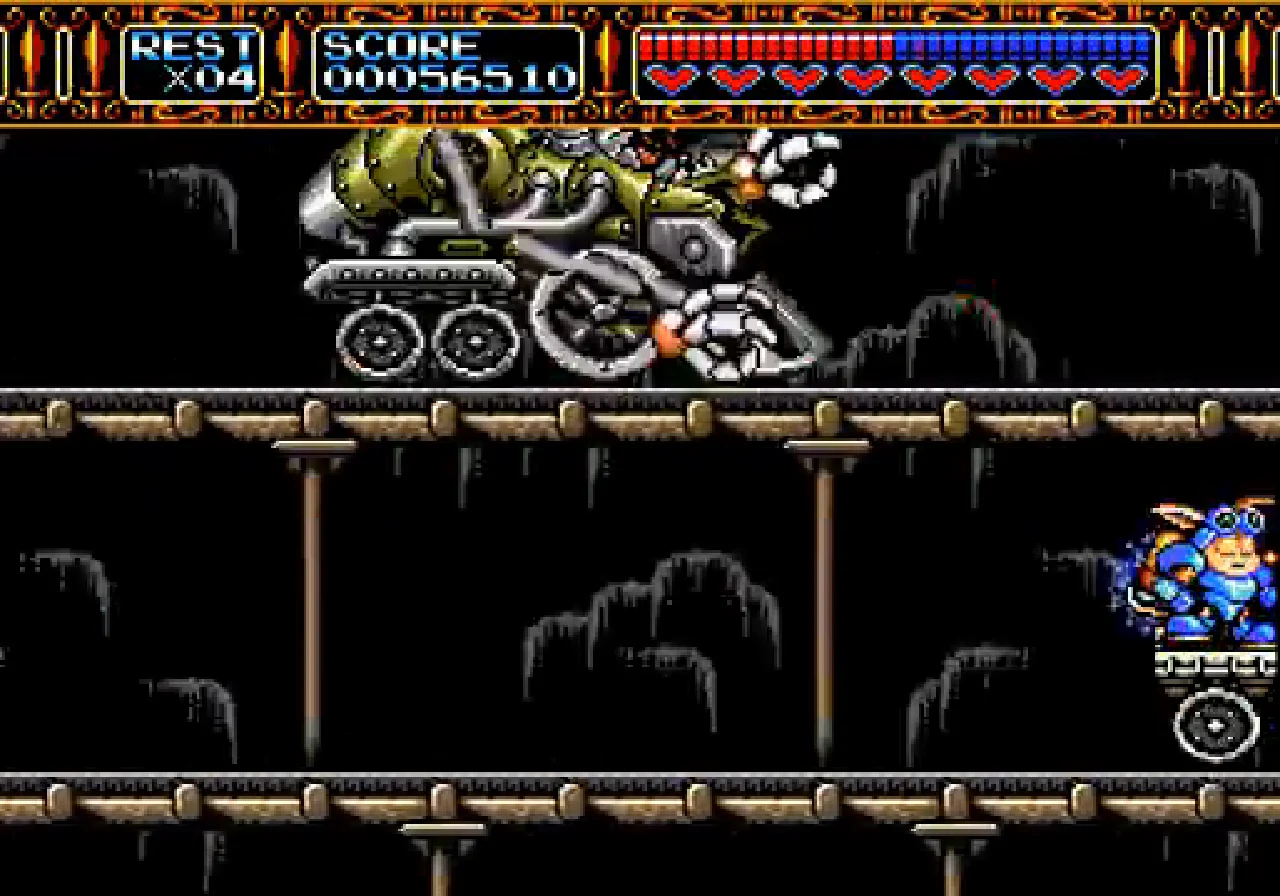
Igarashi has been direct about this for nearly twenty years. In a GDC 2007 conversation with Christian Nutt, he put it plainly:

“Many of the gamers in the U.S., or outside Japan, tend to think that SOTN is one of the Castlevania titles that made a drastic change to the series. But personally speaking, I think Rondo of Blood was the title that actually started branching out from the past Castlevania series.” — Koji Igarashi, GDC 2007

The branching-out he is naming is not the RPG layer that made Symphony famous; it is the structural moves that made Symphony possible. A second playable character, unlocked through play and meaningfully different. Hidden rescuable side characters scattered through the stages. Branching paths discovered inside levels rather than picked from a menu. Anime cutscenes and voice acting placed on top of side-scrolling action. A direct, family-saga plot that pivots away from Simon Belmont’s solo myth. All of those moves are in Rondo. Symphony inherits them and adds the map.

What Rondo’s director also brought from his own production was a working memory of how much the new ambition cost. Hagihara, in the same 1993 liner notes, on the schedule: “Not a single thing went according to schedule… and Maria, that insufferable girl, gave us nothing but bugs!” Maria, the bug-ridden secret character of Rondo’s crunch, returns as the alternate protagonist of Symphony’s Saturn port in 1998 and the PSP remake in 2007. The character who broke the schedule became the franchise’s most-reused experimental moveset. That’s the kind of detail that gets lost when a game’s history starts at the sequel.

Branching Paths Before the Branch

Read on its own terms, without the Symphony lens, the playable thing the cartridge does is take classic Castlevania apart into eight numbered stages plus a brief prologue, then quietly slips four alternate-route stages inside the run: 2′, 3′, 4′, 5′. They are found, not chosen. Stage 2′ rewards a path through a destructible wall in Stage 2; the hardest level in the game sits behind one of these doors. A complete tour requires two or three playthroughs, which the 75-to-90-minute one-credit clear cheerfully accommodates. Scattered through the routes are rescuable maidens — Tera, Iris, Annette, and a violet-eyed twelve-year-old named Maria — who unlock cutscenes, items, and, in Maria’s case, an entirely different way to play the game.

Maria’s mobility — double-jump, slide, animal sub-weapons — translated to a stone bridge under a daylight sky. The verbset and palette that nothing in classic Castlevania ships, four years before Symphony will be praised for inventing them. Castlevania: Rondo of Blood · Konami, 1993.

Maria unlocks after the second stage’s hidden cell. Her moveset is the contradiction the dossier above keeps pointing at. Richter has the rigidity of NES Castlevania — fixed-direction whip, deliberate jump arcs, the same Castlevania-I knockback that can launch him into a pit on a clean hit. Maria has a double jump, a slide, a faster basic attack, and four animal sub-weapons whose effective damage roughly twice Richter’s. The GAME Watch retrospective is honest about what this does to the difficulty curve — her Guardian Knuckle technique, Hiroyuki Endo writes, makes the game “too easy” — and that frankness is the right read. Maria mode is not a parallel character. It is a difficulty toggle wearing a costume, and it’s also a sketch of Symphony’s entire alt-character economy: Saturn-Maria, Richter-Mode, the experimental playthroughs that became the series’s currency.
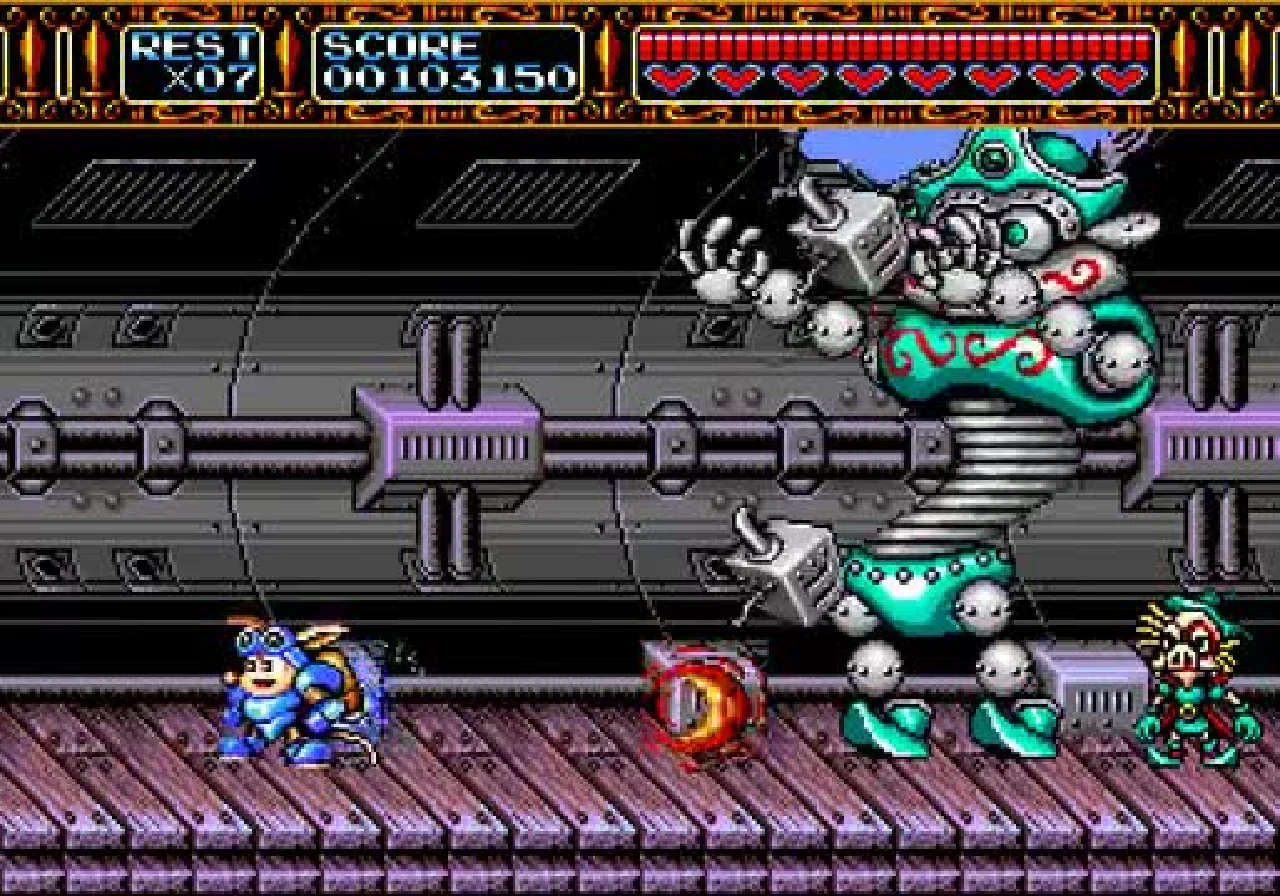
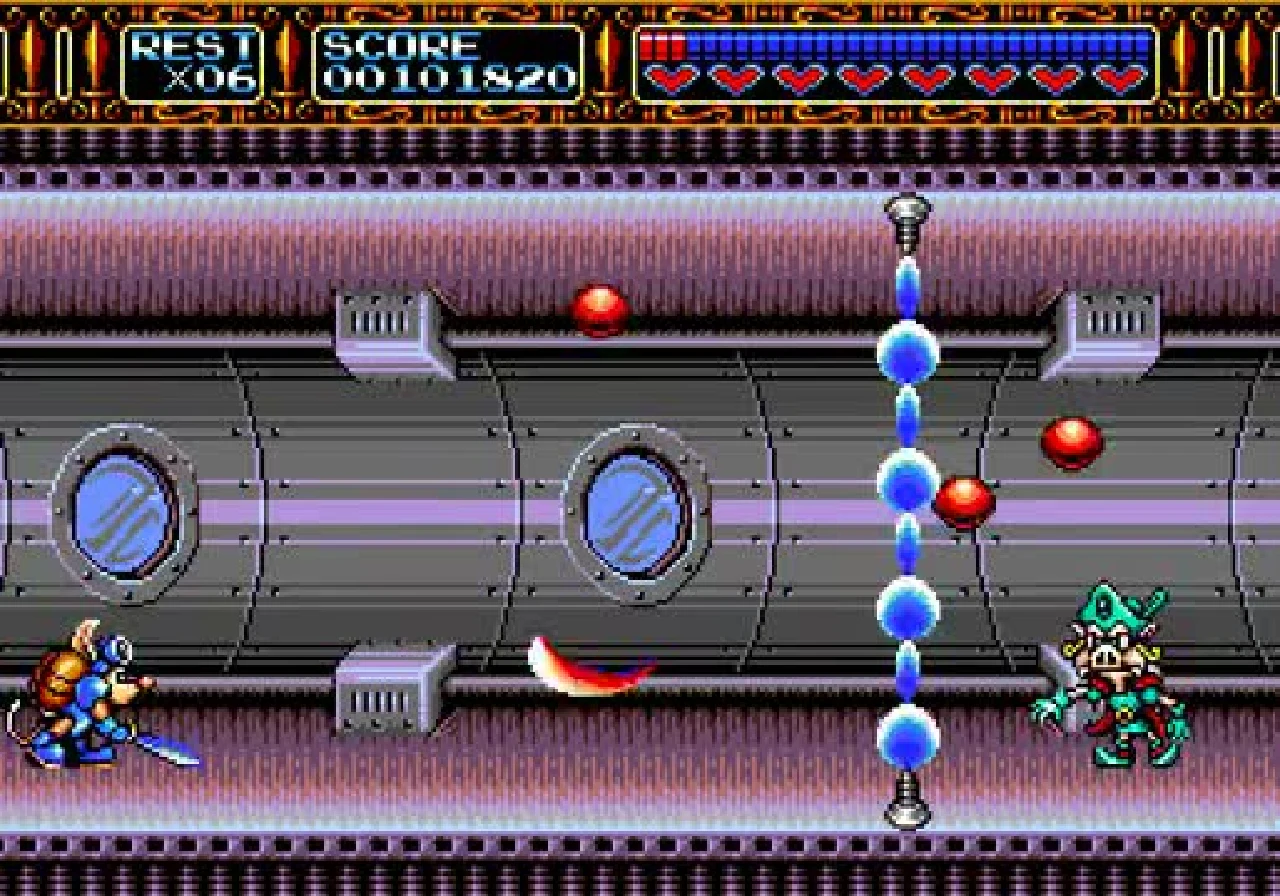
The friction the cartridge keeps is designed, not broken. Richter’s whip doesn’t aim in eight directions the way Simon’s does in Super Castlevania IV; that is sometimes read as a step back, but the level design is composed around the rigidity rather than against it. The choreographed bosses — a behemoth that crashes through the wall to start its fight, a dullahan knight, Death and Shaft on the same stage — are tuned to Richter’s exact attack arcs, and the 2007 PSP remake’s polygonal version of those encounters replaces the in-engine bursts with generic cutscenes precisely because the 1993 originals depended on what the sprite engine could do in the seventeen frames before the boss bar appears. That is the version that’s still on the disc. It is also the version that’s still on the PS4 store.

A Score That Wanted Real Guitars

Motoaki Furukawa, the in-house Konami guitarist and composer, is on record about what the CD-ROM format meant to him: “With Castlevania finally coming to CD-ROM, it could only mean one thing: we can record real guitar now!!!” The exclamation points are in the original liner notes. Six previous Castlevania soundtracks had been chip music. Rondo’s Stage 1 theme, Divine Bloodline — sometimes rendered into English as Bloodlines — is the first time the franchise’s music gets played by an instrumentalist rather than synthesised by the sound chip, and the Stage 1 burning village is built around it. Distorted guitar over orchestral arrangement, the village in flames, Richter walking forward into the brass.

Richter Belmont walks forward through Stage 1's burning village. Two black skeletal trees flank gothic buildings under a red, flame-lit sky; a low fire-line crosses the cobbled foreground.

Stage 1’s burning village under live guitar — the first Castlevania level designed against a CD-Redbook soundtrack rather than around a chip score. The visual register is matched to instrumentation the cartridge format had never funded. Castlevania: Rondo of Blood · Konami, 1993.

The score’s emotional vocabulary changes accordingly. Akira Souji’s recorded effects pull the sound design into a register the chip generation could only suggest. Keizo Nakamura and Tomoko Sano’s arrangements weave franchise themes — Vampire Killer, Bloody Tears, Cross Your Heart — into new compositions written for the disc’s bandwidth rather than the cartridge’s. Endo’s GAME Watch retrospective names the Stage 1 theme specifically among Castlevania’s high-water marks; the audience the article addresses, two decades after release, places Rondo’s score in roughly the same shelf as Symphony’s, which is the highest praise a Castlevania soundtrack receives. It is a 1993 disc, played as a 1993 disc, with the period’s most ambitious production budget for what the genre still treated as background music.

Why Now, on a Console It Wasn’t Built For

The route to play this is narrower than it should be. The original PC Engine Super CD-ROM² disc is a collector item priced past honesty; the Wii Virtual Console import release closed when the Wii Shop Channel did; the 2007 PSP Dracula X Chronicles is physical-only and works on a PSP, a Vita via download, or a PlayStation TV with caveats. The currently-purchasable legitimate route, in 2026, is Castlevania Requiem on the PlayStation Store — a digital package that pairs Rondo with Symphony of the Night for nineteen US dollars, frequently under five in sale, and runs on every PS4 and PS5. My Life in Gaming’s careful technical breakdown identifies the underlying emulation as inherited from the PSP version and catalogues the resulting quirks — a persistent screen-tear in the Burning Town’s first screen, a misaligned scanline overlay, a vertical scroll that goes briefly out of sync on a parallax background — but their summary verdict is also the honest one: the games play correctly, the 4K output on PS4 Pro looks sharper than the original disc ever did on a CRT, and “the soul of these games has continued to shine through.” That is the package the article recommends.

What that package gets you, on a Saturday afternoon in 2026, is not a museum piece. It is a Castlevania short enough to finish in a sitting, hard enough to require a real one, with four hidden levels that reward the second run and a secret playable character that recasts the third. It is the apex of classic Castlevania and the first crack of the post-classic one, played in the same evening. The director told you. The producer told you. The Western canon, slowly, is catching up.

Cartridge Collective 1993 · PC Engine Super CD-ROM² · PS4

Where to play

Why Now

Richter on the burning village's threshold over CD-Redbook Bloodlines — the first Castlevania choreographed for cinema, still the franchise's tightest seventy-five minutes.

Best way to play now Castlevania Requiem on PlayStation Store (PS4 / PS5)

The only legitimately purchasable route to the original 1993 game in English. Pairs Rondo with Symphony of the Night in one package — which is the way the relationship was always meant to read.

Time
75–90m branching paths reward 2–3 runs
Cost
£15.99 frequently under £5 in PS Store sales

Alternatives

  1. 01
    modern

    Castlevania Requiem (PS4 / PS5)

    The default route. Original 1993 game emulated on modern hardware, pairs Rondo with Symphony of the Night. Built on the PSP Dracula X Chronicles emulation layer per close inspection — known quirks (a screen-tear in Burning Town, a misaligned scanline overlay) but the games play correctly and support 4K on PS4 Pro.

  2. 02
    modern

    Castlevania: The Dracula X Chronicles (PSP)

    Physical-only now, but the 2.5D remake plus unlockable original Rondo and Symphony makes for the most context-rich single-disc package. Plays on PSP and PS Vita via digital download; PS TV with caveats.

  3. 03
    simulation

    MiSTer / Analogue Duo (PCE_Fast core)

    The MiSTer pce_fast core and Analogue Duo's native PC Engine support both run the CD image with cycle-accurate timing — closer to the 1993 hardware experience than any emulated re-release.

  4. 04
    emulation

    PC Engine CD with the Cubanraul English patch

    The 2011 community translation patch uses the official 2007 Konami English dub over the PC Engine CD original. The closest approximation of 'what Rondo would have been if it had been localised in 1993.'

1993 · Konami

Listen

  • Akumajō Dracula X: Chi no Rondo — Original SoundtrackKonami Kukeiha Club / Spotify The CD-Redbook score as the cabinet shipped it, with Motoaki Furukawa's live guitar tracks on *Bloodlines* and the underground stages. The first Castlevania music recorded rather than synthesised.
  • Akumajō Dracula X Chronicle — VGMdb (KICA-7723)VGMdb The catalogue entry for the original 1993 Konami release on the King Records imprint, with the full credit roll for Akira Souji, Keizo Nakamura, Tomoko Sano, Mikio Saitou, and Furukawa.

Watch

  • Castlevania: Rondo of Blood (PC Engine CD) Playthrough [4K, English]NintendoComplete / YouTube A clean single-credit Richter run through the original 1993 PC Engine release with the Dracula X Chronicles English voice dub layered in. Upscaled to 4K, no commentary.
  • The Best Way to Play Castlevania: Rondo of Blood & Symphony of the NightMy Life in Gaming / YouTube Thirty-three-minute port-by-port technical comparison from MLiG. The most thoroughly researched survey of every Rondo and Symphony release — the source for several of this article's pivots and the technical floor underneath the Play It block.
  • The Moment Castlevania Became Something Else…TheMentok / YouTube Hour-long retrospective that frames Rondo as the inflection point, not Symphony — and traces the cancelled 32X Castlevania that sat between the two.

Read

  • Castlevania: Rondo of Blood — 1993 Developer InterviewShmuplations / Akumajō Dracula X CD liner notes, 1993 Primary source for almost every production anecdote in this article. Director Tōru Hagihara on Maria's bug count, composer Motoaki Furukawa on finally being allowed to record real guitar, character designer Toshiharu Furukawa on the half-human enemies American morals had previously vetoed.
  • A look back at over a decade of Koji Igarashi interviewsChristian Nutt / Game Developer Compiles the GDC 2007 interview in which Igarashi states — verbatim — that Rondo, not Symphony, was where the series started branching out from classic Castlevania. The load-bearing primary quote at this article's pivot.
  • The Lost 32X Castlevania That Led To Symphony Of The NightDamien McFerran / Time Extension The cancelled Sega 32X Castlevania between Rondo and Symphony — announced December 1994, cancelled by October 1995, team disbanded. Sources the team-continuity claim and clarifies that 'The Bloodletting' was a placeholder title for early Symphony, not the 32X game itself.
  • Konami World — Dracula X: Rondo of BloodHardcore Gaming 101 The English-language retrospective that fixed Rondo's reputation in the West as 'by far the most sought-after of Castlevania games (at least outside Japan)' — its argument and the canon's argument are not the same.
  • 悪魔城ドラキュラX 血の輪廻 — PCエンジン mini 全タイトルレビューHiroyuki Endo / GAME Watch (Impress), 2020 Japanese-language retrospective on the PC Engine mini's inclusion of Rondo. Endo's emphasis is on the soundtrack — Stage 1's *Bloodlines* arrangement specifically — and the CD-format voice-and-anime cutscene leap as a 1993 shock. The angle English coverage skips.
  • Castlevania: Rondo of Blood — Romhacking.net translation patchCubanraul / Romhacking.net The 2011 community English patch using the official 2007 Konami dub over the PC Engine CD original. The eighteen-year gap between Japanese release and a complete English version on original hardware made physical.
  • Castlevania: Rondo of Blood — WikipediaWikipedia The most thoroughly footnoted summary — Famitsu first-week sales (14,436), the *Micom BASIC Magazine* January 1994 popularity ranking, the *PC Engine Fan* readers' poll score (26.0/30), and the citation trail back to primary Japanese sources.

Chapter 15

Mystic Warriors: Wrath of the Ninjas

Konami's Hollywood Ninja Movie in Cabinet Form

Internally codenamed *Sunset Ninja*, the team rented Sho Kosugi tapes as research and decided the American reinvention of the ninja was the point. Thirty years arcade-only — finally home on Arcade Archives.

Arcade1992Run 'n' GunKonami

Mystic Warriors: Wrath of the Ninjas · Konami, 1992 · Arcade key art

The team called it Sunset Ninja. That was the internal name, and it was the entire pitch: the chassis and the staff who had just shipped Konami’s best Western arcade run-and-gun, retooled for the genre’s most over-cultivated stereotype set. Hideyuki Tsujimoto, fresh off Sunset Riders, would direct again. The same Osaka studio, the same Konami GX-series house style, the same four-player cabinet logic. Only this time the cowboys were ninjas. What the team did with that idea is where Mystic Warriors stops being a swap and becomes one of the strangest arguments Konami’s arcade division ever made.

The argument lives in a research session. According to sanpei-btm, a former programmer on the team, a designer was dispatched to a video-rental store to figure out what the project was actually going to be. He came back with Enter the Ninja. He noticed a sequel on the shelf and brought Revenge of the Ninja back too. Sho Kosugi, mid-1980s, American exploitation cinema’s full-throated reinvention of the Japanese ninja. The team watched the tapes. They saw two ninjas on a rooftop tennis court bow, deliver elaborate hand-signs and unload swords, kusarigama, water-escape jutsu and ritual decapitations. They saw an opening dogeza prostration before a duel. They saw a martial-arts vocabulary that had nothing to do with anything Japanese audiences would recognise. The Japanese reaction, distilled by sanpei-btm: アメリカ人のニンジャ観すごいな — the American vision of ninjas is incredible. And the directive that followed was the one nobody expects. They were going to dramatize the misreading, not correct it.

Sunset Ninja

That decision controls everything downstream. The villain is SKULL Enterprise, a sinister Japanese megacorporation dominating the world economically while secretly building a robot ninja army to take it over outright — a satire of bubble-era Japan-megacorp paranoia from 1980s American thrillers, aimed back at Japan as a joke completing itself. The roster reads as exploitation-cinema typology compressed onto a character-select screen. Spyros, the American ninja in red. Keima, the kabuki ninja with face paint and a horned mask. Kojiro, the samurai. Yuri, the kunoichi. And Brad: a cornrowed African-American Buddhist monk in priest-like robes and sunglasses, wielding oversized prayer beads, fighting in an exposed red fundoshi.

The Mystic Warriors four-player upright arcade cabinet, gold side art and four control stations on the deck.

The four-player upright — the cabinet shape Konami had perfected on TMNT and Sunset Riders, now carrying a ninja roster nobody in 1993 had asked for. Mystic Warriors · Konami, 1992 · Arcade.

Brad is where the angle stops being theory. Sanpei-btm attributes the character to the team’s art lead — a former television animator who had worked on Doraemon episodes before joining Konami — and frames the design as the kind of thing only someone with that lineage would propose.

”普通は思いつかないですよ。”
— sanpei-btm, on Brad’s design

You wouldn’t normally even think of it. Quite. The design is shocking in 2026, and was meant to be shocking in 1992 — but the team’s argument is that they were quoting a genre that had already done this. American 80s cinema kept inventing increasingly elaborate ninjas, and Mystic Warriors is the Japanese game that calls the bluff: if you’re going to make ninja films this baroque, here is what your roster looks like rendered as arcade sprites. The five characters are not a marketing exercise. They are the thesis.

What the Video Store Returned

The Konami 2nd Development Division ran the project the way it had run Sunset Riders — Tsujimoto pragmatic and structural, the art lead reaching for whatever the script of the genre would tolerate. Sanpei-btm preserves one production aphorism in Tsujimoto’s Kansai dialect, addressed to a junior programmer agonising over a mid-boss: どうせこいつはすぐに死ぬんやから、そんなもんはどうでもええねん. This guy dies right away anyway, none of that matters. That was the studio culture: ship the cabinet, manage the scope, take the joke seriously enough to draw it well and not seriously enough to mistake it for a manifesto.

What the team built on top of that frame is a tighter run-and-gun than its reputation suggests. The control is two buttons over an eight-way joystick: attack and jump, with the attack auto-switching from shuriken volley at range to melee strike in proximity. That single auto-switch — borrowed from Shinobi — folds the genre’s whole distance-management logic into where you stand, rather than a button you press. Power-ups stack to level two and reset on death, Sunset Riders’ exact risk-economy. A life pool of four hits buys the player room to read a screen before paying for the mistake. Players can swap characters between credits. Two-player and four-player cabinets shipped in parallel, and on the four-player board you take whichever ninja the panel assigns and learn what their spread does — the same drop-in arcade-floor social machine TMNT had templated and Sunset Riders had refined.

English-language coverage has tended to say the five characters are functionally identical; the Japanese strategy guides disagree, and so does the cabinet under your hands. Spyros is the balanced default. Keima fires a wider but slower spread. Kojiro has the strongest vertical reach. Brad’s full-power weapon arcs three streams plus a centre shot — useful for melting bosses parked in one place. Yuri’s melee is the fastest in the game. The differences are statistical rather than systemic — closer to weapon-archetype tuning than Shinobi III’s discrete movesets — but on a four-player floor they are exactly the level of distinction that lets the panel argument from Sunset Riders repeat: somebody complains about being stuck with the wrong character, learns what the spread actually does, and stops complaining.

Auto-Switch and the Mine Cart Wall

The stages do not stay in one register. Stage one closes with a boss who drives a stolen truck straight through its own backdrop, the scenery catching fire behind him. Stage two suspends the run-and-gun grammar entirely for a snowboard chase. Stage seven is a sequence on the rear of a cargo aircraft with ninjas leaping between planes mid-air. The half-game story turn — the kidnapped fifth ninja, dramatically rescued and immediately killed the moment the cell opens — is the genre committing to a beat it usually flinches from.

That set-piece variety is what the game gives now. The genre’s usual problem — a flat horizontal scroll past flat horizontal enemies — gets pushed against from every angle: skiing, mine carts, river logs, plane-hopping, elevator shafts. The friction is real too. Stage six is a forced-scroll mine cart with twin rail-mounted cannons, and it is the difficulty wall the cabinet was designed to filter players against; the Japanese strategy guide eienken and the Western fan retrospectives agree it is the hardest fight in the game. Stage nine’s elevator section is genuinely cheap by modern reading — unintuitive solutions, respawn patterns that punish unfamiliarity. The five characters’ weapon spreads are statistically close, and a modern reader landing on the cabinet expecting Shinobi III-level distinction between them will find a smaller delta than the marketing suggests. The total one-credit run is short — about thirty minutes — which is fair for the cabinet and terse for the couch. None of that breaks the case. It just reminds you which year you’re playing.

Shamisen Over Techno

The music does work above the hardware. Junya Nakano had joined Konami’s Osaka branch in 1991 straight out of vocational school. Mystic Warriors followed his arcade scores for X-Men, with Yuji Takenouchi supervising. The Stage 1 theme is shamisen and percussive shakers over a techno bed, with kabuki vocal samples cutting in over item pickups — 和風テクノ, the Japanese music blogs called it, Japanese-style techno. The composers used pen-names on the credits to reinforce the period-drama affect. The score speaks Japanese back at the player.

Two years later Konami restructured its Osaka personnel and Nakano left for Square. He went on to Threads of Fate, then to Final Fantasy X in 2001, sharing the credit with Uematsu and Hamauzu. The score that played to half-empty 1993 arcade floors was made by a composer one studio move away from helping write the most-listened-to JRPG soundtrack of the decade. The 2024 Arcade Archives port triggered a two-disc Mystic Warriors Game Sound Digital Collection — original plus arrange — thirty years after the cabinet first played to anyone. It is the kind of belated commercial confirmation the music deserved on shipping day.

Thirty Years to Reach the Couch

The reason none of this is common knowledge is timing. Mystic Warriors released in Japan on 21 December 1992 as a limited run and worldwide in February 1993, into the Street Fighter II boom. The four-player drop-in cabinet — the social machine Konami had built across TMNT, X-Men, Sunset Riders — was being overrun on every arcade floor by 1v1 versus-fighter cabinets that took quarters faster and turned the room into a tournament. Game Machine charted the game at number nine on its April 1993 table-arcade league, then it slid. There was no SNES port, no Mega Drive port, no PC port, no 1990s collection. The game existed only in the cabinet, and after the cabinets came out of arcades it existed only in MAME, for thirty years.

The Konami Mystic Warriors US arcade flyer front, the five-ninja roster overlaid on red and gold backdrop.The flyer back, with cabinet specifications, control diagram and four-player co-op messaging.

Konami’s US operator flyer — the one moment the game pitched itself to the West, before silence. Mystic Warriors · Konami, 1992 · Arcade.

That changed on 21 December 2023. Hamster’s Arcade Archives Mystic Warriors shipped on Switch and PS4 for US$7.99 — emulation, online leaderboards, CRT filter, four-player co-op intact. Sanpei-btm learnt of the release after the fact, via YouTube comments, and called the response 晩年の自分への赦し — late-life forgiveness. The Switch version updates for Switch 2. For around six pounds you can run the cabinet as it shipped, and you should, because what Sunset Riders did for the Western and what Shinobi did for the lone-ninja side-scroller, Mystic Warriors does for the four-player drop-in. It is the Konami arcade run-and-gun built on the strangest premise the studio ever fully committed to, finally playable without a coin slot.

The Mystic Warriors arcade marquee — gold-lit logo over the five-ninja silhouette, red-and-black backdrop.

The marquee — gold leaf, five silhouettes, and the title in English and Japanese. The cabinet’s last surviving advertisement to itself. Mystic Warriors · Konami, 1992 · Arcade.

Cartridge Collective 1992 · Arcade

Where to play

Why Now

A truck driven through its own backdrop, dogeza on a rooftop, prayer beads in a swung arc — Konami's tightest run-and-gun, finally reachable from a couch.

Best way to play now Arcade Archives Mystic Warriors on Switch

The first legitimate home release in the game's history — Hamster's emulation, online leaderboards, CRT filter, four-player co-op intact. Supported on Switch 2.

Time
30m 20m to the mine carts
Cost
£6 Hamster Arcade Archives titles rarely discount — this is the floor.

Alternatives

  1. 01
    modern

    Arcade Archives (Switch)

    The recommended route. Switch 2 forward-compatible, handheld plus couch co-op, full cabinet preserved.

  2. 02
    modern

    Arcade Archives (PS4)

    Same release, same price — pick this if Switch isn't to hand.

  3. 03
    emulation

    MAME (ROM: mystwarr)

    The original arcade ROM under MAME. Useful for four-player local hotseat with custom control mapping.

  4. 04
    original

    Konami GX128 PCB

    Boards surface on Arcade-Projects and Yahoo Auctions Japan. Collector route, not editorial-recommended for reading.

1992 · Konami

Listen

  • Mystic Warriors — Full Arcade OSTJunya Nakano / Yuji Takenouchi · Konami The full arcade soundtrack: shamisen and percussive shakers over a techno base, kabuki vocal samples cutting in over item pickups. Nakano's last lap at Konami before the move to Square.
  • Mystic Warriors GAME SOUND DIGITAL COLLECTIONClarice Disc / Konami Two-disc original-plus-arrange release issued in 2024 alongside the Arcade Archives port — Konami's first commercial OST issue in thirty years.

Watch

  • Mystic Warriors (1993) Arcade — Full LongplayBest to be 64K / YouTube A guided commentary playthrough of the full nine-stage arcade game — the snowboard boss, the mine carts, the plane-jumping, the elevator wall.
  • Konami s'amuse de la vision américaine des Ninjas (TAI #3)TAI / YouTube French-language video essay that consolidates the sanpei-btm developer blog series for a Western audience — the Sho Kosugi research session and the SKULL Enterprise satire.

Read

  • ミスティックウォリアーズはこんないきさつで生まれた (Part 1)sanpei-btm / Ameblo A former Konami Osaka arcade programmer on how Mystic Warriors was made. The 'Sunset Ninja' codename, the team continuity from Sunset Riders, the directive to dramatize the American vision of the ninja, the 1993 fighting-game-boom timing. The primary developer voice on this game.
  • ミスティックウォリアーズはこんないきさつで生まれた (Part 7) — the Sho Kosugi viewingsanpei-btm / Ameblo The research session: a designer rents Enter the Ninja and Revenge of the Ninja from a video store, the team watches them, and finds the rooftop tennis-court duels, dogeza prostrations and ritual decapitations they would put back into the game.
  • ミスティックウォリアーズはこんないきさつで生まれた (Part 11) — Character Leader Ysanpei-btm / Ameblo The org-chart entry. Identifies the character leader as a former Doraemon animator and attributes Brad's design — cornrowed Black monk in priest robes, prayer beads, exposed red fundoshi — to him directly.
  • Mystic Warriors — Hardcore Gaming 101Kurt Kalata / Hardcore Gaming 101 The canonical English-language retrospective. Reads the game as Shinobi-derived auto-melee on a Sunset Riders chassis, and attributes its obscurity squarely to Konami's failure to port it.
  • Konami's Arcade Classic 'Mystic Warriors' Finally Arrives On ConsolesJack Yarwood / Time Extension December 2023 launch coverage for the Arcade Archives port — the first legitimate home release in the game's history.
  • 『ミスティックウォリアーズ 怒りの忍者』(1993年・コナミ) 攻略eienken.eek.jp The deep Japanese strategy guide. Stage and boss data, the four-hit life pool, the undocumented i-frames on platform-switch, the genuine character-by-character spread that the English coverage mostly misses.
  • Mystic Warriors — Arcade Archives product pageHamster Hamster's official Switch and PS4 listing — emulation specifics, online leaderboards, CRT filter, four-player co-op support, ¥838.

Chapter 16

Rocket Knight Adventures

Konami Hid Contra Inside a Marsupial Suit

Konami sold Sparkster as a Sonic rival. Nobuya Nakazato, directing between Contra III and Hard Corps, built something stranger: arcade action wearing mascot-platformer armour, too restless for the race it entered.

Mega Drive · Genesis1993Action PlatformerKonami Development Division Six

Rocket Knight Adventures · Konami Development Division Six, 1993

Rocket Knight Adventures looks like the answer Konami thought Sega wanted and plays like the action game Nobuya Nakazato wanted to make anyway. The box sells a smiling animal hero, goggles, blue armour, a sword held like a promise that mascot platforming has found its next star. The cartridge answers with boss patterns, sudden vehicle modes, punishing charge commitment, and stages that keep changing subject before you can settle into a run.

That mismatch is not a footnote. It is the game. Konami had watched Sonic turn speed into a console identity, and Sparkster arrived with enough attitude, thrust, and Saturday-morning silhouette to enter the same conversation. But Nakazato directed it after Contra III: The Alien Wars and before Contra: Hard Corps. Put Rocket Knight Adventures between those two games and the disguise starts to slip. The opossum is real. So is the Contra skeleton underneath him.

Sega Wanted a Mascot

Tom duBois rarely entered a Konami project early. He painted covers, often from material already close to finished, and many of those paintings became the American memory of the company: Contra III, Castlevania IV, Sunset Riders, the blazing commercial grammar of late cartridge Konami. Rocket Knight Adventures was different. DuBois said Konami brought him in early to create Sparkster himself, and he remembered the publisher brief plainly.

”Konami wanted to get a game out there to compete with Sonic the Hedgehog.”
— Tom duBois

A North American magazine advertisement for Rocket Knight Adventures showing Sparkster blasting past a pig emperor under the slogan This One Goes Ballistic.

The North American ad sells Sparkster as velocity and attitude first. Rocket Knight Adventures · Konami, 1993.

The flyer is almost too perfect: “This One Goes Ballistic.” A tiny Sparkster tumbles across the top like a cartoon bullet; the main figure rockets horizontally through a white field, sword forward, jet flame behind him. This is not subtle positioning. Konami understood the shelf. Blue hero. Speed. Animal charisma. Sega hardware. If the market needed a rival mascot, here was one with a blade and a booster.

The trouble is that Sparkster does not move like Sonic. He does not ask you to preserve flow, read slopes, and turn momentum into confidence. His central verb is charged, aimed, and dangerous. Hold the attack button, fill the meter, choose one of eight directions, release, and he detonates across the screen until he hits something. Sometimes that something is a wall and he ricochets perfectly into a new lane. Sometimes it is the wrong corner and the stage punishes your angle. The charge shot feels less like running and more like firing yourself.

The Dash Is a Weapon

That distinction changes the whole game. Rocket Knight Adventures has platforms, but its levels rarely behave like obstacle courses built around elegant traversal. They behave like compact action situations. A burning village gives way to pig soldiers, then a tank, then a waterfall fall, then a short shoot-‘em-up ride on a mechanical dragon. The game does not extend an idea until mastery becomes ease. It throws a new problem into the room and watches whether you can read it before the room changes again.

Sparkster flies across open water on a mechanical dragon while pig-head enemies drift into his path.

The first stage is already changing genre: a mechanical-dragon ride, enemy waves, and projectile positioning before the mascot-platformer premise has settled. Rocket Knight Adventures · Konami, 1993.

Kurt Kalata at Hardcore Gaming 101 called the game a series of “situation rushes”, which catches the structure better than the platformer label does. A substage lasts a few minutes and usually contains one dominant idea: a boss machine, a mine-cart run, a reflective lava chamber, a midair assault. The shortness matters. Rocket Knight Adventures does not want the player suspended in rhythm. It wants alertness, the Contra state of reading a pattern, choosing a position, and committing at the last possible moment.

Sparkster jumps between small platforms above lava while a giant machine head rises from the molten surface.

The lava room turns a technical showcase into a reading test: platforms, reflection, boss machinery, and instant punishment in one screen. Rocket Knight Adventures · Konami, 1993.

Nakazato later described the Contra appeal to Brandon Sheffield as a game where “you have to really think about what you’re doing.” He was talking about another series, but the design philosophy fits Sparkster’s best rooms. A bad rocket dash has weight. You cannot cancel your way out of a wrong angle. The sword projectile is short, useful, and never enough on its own. You survive by understanding where the game wants your body before it tells you directly.

There is friction in that. Some corridors are too narrow for the dash to breathe; the flagship mechanic sometimes argues with the box it has been placed inside. But the tension gives the game its bite. Sparkster is not a frictionless speed toy. He is ammunition with ears.

Every Boss Changes the Room

The bosses make the Contra lineage visible. They are not end punctuation. They are little stage machines: multi-part, theatrical, readable in segments. A pig tank coughs fire and knocks you downriver. Axel Gear turns rivalry into repeated mechanical duels. A haunted contraption erupts from a television. Stage 4 stops the side-scrolling altogether and turns Sparkster into a pilot inside a giant boxing robot, punching another machine across a tiny ring.

Sparkster faces a tall segmented pig machine whose arms and body move independently on an industrial platform.

The boss vocabulary is machinery as theatre: segmented bodies, separate attack reads, and a room built around one oversized contraption. Rocket Knight Adventures · Konami, 1993.

That boxing match is funny because it is so bluntly itself. It has the shamelessness of a studio that trusts a good idea more than a consistent genre label. One minute you are bouncing through corridors; the next, the game has remembered Goemon, carnival toys, and every Konami boss that treated machinery as theatre. The rules are simple enough to learn in seconds, but the tonal swing is the point. Rocket Knight Adventures keeps turning the page before the illustration dries.

Japanese summaries have long repeated that Nakazato described the project as an “animal Contra.” The primary publication behind that wording remains hard to pin down, so the safer evidence is the game itself: the bracketing credits, the stage logic, the insistence that bosses are encounters to study rather than mascots to bop. Stuart Gipp’s Retronauts review reached for “Treasure-esque” to describe the set-piece energy, and that comparison lands because Treasure’s Gunstar Heroes also understood bosses as programmable theatre. Rocket Knight Adventures sits in that conversation more naturally than it sits beside Sonic 2.

Sparkster crosses the curved purple deck of an airship under blue sky and cannon hatches.

Even the traversal stages keep changing the floor under Sparkster: sloped hulls, hatches, sky, and attack angles instead of a clean runway. Rocket Knight Adventures · Konami, 1993.

Yamane Before the Castle

The soundtrack carries the same argument in miniature. The credit list includes Michiru Yamane before Symphony of the Night made her name inseparable from Castlevania, alongside Masanori Adachi and a wider Konami Kukeiha Club team used to making cartridge music punch above the room it occupied. Rocket Knight Adventures does not have one theme that overwhelms the rest of the work. It has a running supply of compact stage identities: bright fanfares, martial snare energy, boss music that snaps the game into attention, and shmup passages that suddenly remember Gradius with a straight face.

This is important because the music does not score cuteness. It scores activity. The first stage theme has the bounce you expect from a heroic animal lead, but the boss cue tightens into arcade pressure. Stage 3’s lava rooms shimmer and threaten. The flagship sequence in Stage 6 drives horizontally, not like a platformer pushing right but like a side-scrolling shooter moving through waves. The score keeps agreeing with the design’s secret: Sparkster may be drawn as a mascot, but the game hears him as a ship, a soldier, a projectile.

The Re-Sparked collection’s music player is more than archive garnish because this score benefits from being heard apart from the chaos. You can hear the handoff between charm and hazard. You can hear a Konami team in the period before the company split its identities into cleaner boxes: Castlevania gloom over here, Contra muscle over there, cute mascot fantasy on the shop front. Rocket Knight Adventures lets those impulses collide inside one cartridge.

Stage Six Gives It Away

Stage 6 is the confession. Sparkster boards the enemy flagship and the game becomes, for several minutes, a horizontal shooter. Pig-head enemy waves enter in formation. Meteors cross the field. Apples stand in for Gradius pick-ups, a joke and an instruction at the same time. The player who came for a mascot platformer is suddenly playing the version of Rocket Knight Adventures the director’s hands seem to know by instinct.

Stage 6 drops the disguise: formation waves, meteor hazards, and apple pick-ups in a full Gradius-shaped run. Rocket Knight Adventures · Konami, 1993.

It is not the only shooter break. The first stage already gives you a brief mechanical-dragon ride, as though the game cannot wait to escape the platform it has chosen. But Stage 6 is longer, clearer, and more revealing. Nothing about it feels like a novelty mode tossed in to vary the pacing. It feels fluent. The enemy waves enter with arcade grammar; the hazards read from the whole screen; the player’s job is positioning, not jumping. Sparkster belongs there because his rocket pack has always made him a ship pretending to have legs.

That is why the old “underrated mascot platformer” line undersells the game. If Rocket Knight Adventures lost the commercial race, part of the reason is that it was running on the wrong track. It did not offer the clean fantasy of speed that made Sonic legible at a glance, nor the gentle escalation of Mario’s toybox. It offered Konami action design in costume: harder to market, easier to remember once your hands understand it.

The modern route finally makes that argument easier to test. Re-Sparked removes the worst barrier around the original: not the difficulty, exactly, but the old regional cruelty and lack of saves that made learning feel more punitive than necessary. The North American cart’s Hard mode gives one life and no continues, a joke only if you already know the punchline. Rewind does not make Rocket Knight Adventures trivial. It lets the player practice the game it actually is. That matters because the pleasure here is not blind execution. It is recognition: seeing the pattern once, failing, then returning with the angle already loaded in your thumb.

That practice reveals a piece of Konami operating at full nervous brightness. A mascot can be a brand asset. Sparkster is more interesting as a misdirection: blue armour, big eyes, sword in hand, rocket on his back, carrying Contra logic through a marketplace that asked for Sonic.

Sparkster flies through space debris near the Pig Star Core during the final escape sequence.

The final escape sends Sparkster through debris and machinery rather than a victory lap, still treating the hero as projectile first. Rocket Knight Adventures · Konami, 1993.

Cartridge Collective 1993 · Mega Drive · Genesis

Where to play

Why Now

Rocket Knight Adventures turns mascot speed into Contra pressure: short stages, ricochet dashes, hard boss reads, and sudden shmup detours that make every few minutes feel newly engineered.

Best way to play now Rocket Knight Adventures: Re-Sparked on Steam

The collection makes the original easy to recommend: rewind, save states, boss rush, museum scans, and the two follow-ups for context without asking you to absorb the Genesis cartridge's regional difficulty trap.

Time
2-3h 30m to the first shmup break and waterfall boss chain
Cost
£24.99 Steam standard price at publication; sales make the collection easier to justify.

Alternatives

  1. 01
    modern

    Re-Sparked on Switch / PlayStation / Xbox

    The same Carbon Engine collection, with rewind and save states turning the original's meaner regions into something you can learn instead of fear.

  2. 02
    original

    Original Mega Drive / Genesis cartridge

    Best for hardware purists, but check the region: the North American difficulty names are harsher than they look.

  3. 03
    simulation

    MiSTer FPGA

    A clean hardware-level route for the Mega Drive original when you want the cartridge feel without aging carts or analogue video fuss.

  4. 04
    emulation

    RetroArch with Genesis Plus GX

    Accurate unofficial emulation, useful for comparing the Japanese and North American difficulty tables side by side.

1993 · Konami Development Division Six

Listen

  • Rocket Knight Adventures: Re-Sparked Official SoundtrackLimited Run Vinyl / VGMdb The official three-LP release gathers the original Konami Kukeiha Club music with the two Sparkster follow-ups.
  • Rocket Knight Adventures soundtrackYouTube The practical listening route when the vinyl is unavailable: stage themes, boss stings, and Yamane-era Konami momentum in one place.

Watch

  • Rocket Knight Adventures (Genesis) — LongplayWorld of Longplays / YouTube A full run through the Mega Drive original, useful for seeing how quickly the game rotates platforming, bosses, and shmup breaks.

Read

  • Rocket Knight Adventures: Re-Sparked reviewRetronauts / Stuart Gipp
  • Rocket Knight AdventuresHardcore Gaming 101 / Kurt Kalata
  • Tokyo Game Show Developer ConversationsGame Developer / Brandon Sheffield
  • Tom duBois cover artist interviewArcade Attack
  • Rocket Knight Adventures 30th anniversary featureFilm Stories / Steven Tucker
  • Rocket Knight AdventuresJapanese Wikipedia

Chapter 17

Ganbare Goemon 2

The Masterpiece Konami Wouldn't Translate

Japan kept Ganbare Goemon 2 for itself. A bunny army invades Edo, a giant robot catches a cold, and Konami's 16-bit confidence goes completely unchecked.

Super Famicom1993PlatformerKonami

Ganbare Goemon 2 player select · Konami, 1993

// import bunnySushiCastlePoster from ”../../assets/images/ganbare-goemon-2-1993-bunny-sushi-castle-poster.jpg”; // deleted

// // import impactCockpitPoster from ”../../assets/images/ganbare-goemon-2-1993-impact-cockpit-poster.jpg”; // deleted // deleted

// // import twinbeeTvPoster from ”../../assets/images/ganbare-goemon-2-1993-twinbee-tv-poster.jpg”; // deleted // deleted

Ganbare Goemon 2: Kiteretsu Shōgun McGuinness opens like a game trying to see how much nonsense it can smuggle past you before you notice that it is, underneath, absurdly well made. The villain is a Western general called McGuinness, complete with an army of anthropomorphic rabbits and a plan to improve feudal Japan by force. One town will sell you a cruise liner as casually as another game might offer a bicycle. Another hides a fully playable slice of an obscure Konami shooter. The climax involves piloting Goemon’s giant robot lookalike in a first-person brawl against a flying saucer while the mech struggles through what appears to be a fairly unpleasant cold. None of this is accidental. None of it is throwaway. The miracle of Goemon 2 is that all this lunacy is under excellent management.

That is what makes the game special. Plenty of old action games are odd. Plenty are energetic. Plenty have one or two ideas you remember years later. Goemon 2 feels different because its strangeness is not a garnish. It is the delivery system for one of the most generous, tightly paced, and cheerfully overstuffed action games on the Super Famicom. It keeps changing masks, costumes, and comic registers, but the hand guiding it never slips. Beneath the rabbits, robots, festivals, and roadside idiocy is a game that knows exactly where it is taking you.

A Package Holiday Through Absolute Nonsense

Part of the pleasure is how easily readable it all is. Goemon 2 is structured as a journey across Japan, with each region broken into towns, diversions, platforming stages, castles, and an Impact sequence at the end. The overworld map gives the whole thing the clarity of a grand day out. You are not being thrown through disconnected levels so much as sent on a very silly national tour. Village follows village, castle follows castle, and the route always feels legible even when the details become gloriously deranged.

That sense of travel matters. It gives the game a holiday mood: not restful, exactly, but festive. You are always arriving somewhere new, and the new place usually has some fresh bit of business to show off. A strange local attraction. A weird shop. A detour that feels half like a joke and half like a reward. The result is a game that rarely feels like it is repeating itself. It keeps the road moving beneath your feet.

What makes that impressive is how little confusion it creates. This is a busy game. A greedy game, in the best sense. It keeps stuffing extra bits into its own pockets. But it never loses sight of the basic rule that variety only feels good if the player can still read the journey. Goemon 2 understands that instinctively. It gives you direction, then fills the road with comic trouble.

Too Japanese? Rubbish

For years, the usual line was that the Goemon games were too specifically Japanese to travel. There is some truth in the premise. This is a series drenched in Edo-period iconography, folklore, broad local caricature, and a comic sensibility that is unmistakably domestic. But the old conclusion never really survives contact with the controller. So much of what makes Goemon 2 delightful is not trapped in text. It is in the pacing, the staging, the visual gags, and the sheer confidence with which the game throws one idea after another across the screen.

You do not need a cultural briefing to understand the joke of a giant mechanical fish turning up as a level, or a sunset road gradually dimming into evening, or a castle that looks as though it was designed by someone with access to too much food and too little restraint. The game gets its point across the old-fashioned way: by making everything immediately funny, legible, and satisfying to play. Its Japanese identity gives it flavour, but the pleasure is mechanical. The comedy is in the timing. The surprise is in the construction.

That is why the game never feels like a curio. It is not something to admire from behind glass while someone explains the context. It is a game that makes itself understood at speed. What once looked like an export problem turns out to be one of its strengths. The setting is specific. The joy is not.

Choose Your Chaos Gremlin

The playable cast helps. Goemon is the balanced option, the one most players will settle into first: quick enough, sturdy enough, and reliably good at whatever the game asks next. Ebisumaru, by contrast, moves like a man who has mistaken lunch for a combat style. He is broader, clumsier-looking, and faintly ridiculous, but the joke hides a proper bruiser. Then there is Sasuke, the clockwork ninja, who is all speed and precision and gives the whole game a sharper edge.

The clever part is that these choices are not just there to pad the back of the box. A run with Sasuke does not feel like the same experience wearing a different hat. The flow changes. The tempo changes. Certain stretches feel cleaner, quicker, more evasive. Ebisumaru turns other moments into a sort of waddling assault. The game bends just enough around each character to make the choice matter without ever making one of them feel like the joke option.

Even the animation gets in on the act. Characters idle with little bits of personality. Enemies do not merely disappear when you hit them; they react, flop, or fly off with a comic flourish. It gives ordinary movement and combat an extra layer of showmanship. Goemon 2 does not just want to play well. It wants to put on a performance while it does it.

This Game Refuses to Sit Down

Then there are the stages. One level gives you a giant snowball to steer down a mountain. Another threads you through laser grids. Another straps you to the back of a mechanical fish. Elsewhere the game changes scale, inverts gravity, or swaps its mood so abruptly the only sensible response is to laugh and keep going.

The key is that it never hangs around too long. Goemon 2 has the instincts of a good variety show: it sends an idea on, lets it do its turn, gets the applause, and ushers it smartly off before anyone starts glancing at the clock. The novelty is rationed. Every stage has a hook, but very few outstay their welcome.

The background art pulls its weight too. Roads darken measurably as evening draws in. Villages fill with lanterns, stall vendors, and dancing silhouettes. Castles become visual punchlines — less fortresses than themed attractions built by eccentrics. The kitsch is staged, not sprayed.

The soundtrack keeps pace. One stretch skips along on bright woodwind and temple bell; another leans into theatrical brass; the final stretch turns unexpectedly heroic as Impact approaches. Each new stop on the map sounds like a new stop. The music gives the travelogue its momentum rather than underlining gags that are already landing on their own.

Meanwhile, a Giant Robot Sneezes

And then, just as the platforming settles into a groove, along comes Impact. A giant Goemon-faced mech barrels across the landscape on its own world map; the view swings into the cockpit and the boss fight plays out in first-person melee, with scaling sprites, shoulder-charges, and ranged sneeze attacks when the robot catches cold. In a lesser game these would be a novelty chapter. Here they are the evening entertainment.

They also arrive at exactly the right moments. Each region closes on a different scale of spectacle, which stops the platforming from ever becoming too comfortable. The Mode 7 scaling and cockpit gags make each battle feel like an event rather than a reskinned boss fight. Even the sneezing works because the game plays the absurdity straight.

That confidence extends to the towns. Shops sell the aforementioned cruise liner. Side attractions contain fully playable slices of other Konami games. Hidden routes reward a second run. Goemon 2 overdelivers as a matter of principle — the game is not parsimonious for a second, and nothing in it feels like filler.

What remains impressive, three decades on, is how effortlessly the game travels. Clarity travels. Momentum travels. Comic surprise travels. Ganbare Goemon 2 is not great because it is strange — strange is easy. It is great because it knows exactly what to do with its strangeness. Every rabbit soldier, every absurd machine, every theatrical castle, every giant-robot interruption serves a game that is carefully shaped, joyfully excessive, and almost aggressively unwilling to become dull. It is one of the most exuberantly controlled action games on the Super Famicom, and it still feels like opening a toy box that keeps producing another toy.

Cartridge Collective 1993 · Super Famicom

Where to play

Why Now

Konami's 16-bit confidence completely unchecked — a bunny invasion, a head-cold giant robot, and wordplay that only survives in the fan English patch.

Best way to play now DDSTranslation English patch + RetroArch

The only accessible English route — apply the fan patch to a Super Famicom ROM dump and run it through RetroArch's bsnes or Snes9x core. The wordplay that makes the game worth playing survives in translation.

Time
4h
Cost
Free via emulation

Alternatives

  1. 01
    rom hack

    DDSTranslation English patch

    The only accessible English route — preserves the wordplay that makes the game worth playing. Apply to a legal Super Famicom ROM dump. No official English release exists.

  2. 02
    emulation

    RetroArch (bsnes, Snes9x)

    Accurate SNES cores for running the patched ROM on any modern machine.

  3. 03
    simulation

    MiSTer FPGA (SNES core)

    Cycle-accurate SNES recreation — handles the patched ROM cleanly for hardware purists.

  4. 04
    original

    Super Famicom cartridge

    If you read Japanese — imports remain affordable and the untranslated original is how Konami shipped it.

1993 · Konami

Listen

  • Ganbare Goemon 2 — Full OSTKonami Kukeiha Club / YouTube The 2017 Sound Tamatebako box never reached streaming, so this YouTube rip of the SPC set is the working archive — fife, shamisen, and synth brass from Konami's in-house band at their sharpest.

Watch

  • Ganbare Goemon 2 — English-Patched Full PlaythroughNintendoComplete / YouTube A full 2h42m run using the DDSTranslation English patch. The clearest way for non-Japanese readers to see why the game's stage-by-stage pacing is so beloved.

Read

  • Ganbare Goemon! Daishuugo — Official SiteKonami
  • Ganbare Goemon 2: Kiteretsu Shōgun Magginesu — Project Goemon Review, Part 2Project Goemon
  • Ganbare Goemon 2 — Game Catalog Wikiゲームカタログ@Wiki ~名作からクソゲーまで~
  • Ganbare Goemon 2 music overviewみんなで決めるゲーム音楽ベスト100まとめwiki
  • Ganbare Goemon 2: Kiteretsu Shōgun Magginesu — Hardcore Gaming 101Hardcore Gaming 101
  • Ganbare Goemon 2 English Translation PatchRomhacking.net
  • Ganbare Goemon 40th Anniversary Collection announcementKonami

Chapter 18

Tiny Toon Adventures: Buster Busts Loose!

Buster Bunny Was Konami's Sparkster Rehearsal

Konami filed it under licensed kids' platformer and the SNES canon nodded along. Under the lime-green box, Konami's flagship pipeline is rehearsing the dash-and-wall-run traversal idea Sparkster will get the credit for two years later.

Super Famicom · SNES1993Action PlatformerKonami

Tiny Toon Adventures: Buster Busts Loose! · Konami, 1993

The licensed cartoon platformer is the safest brief a publisher can hand a team in 1992: take the show, take the characters, take a year, ship something cheerful for the holiday window. The cart Konami shipped under that brief at the end of 1992 spends six stages refusing every part of it.

The Super Famicom Tiny Toon Adventures, packaged for the West as Buster Busts Loose!, has been filed for thirty years as a competent licensed B-tier — a one-line “varied platformer” verdict in the back half of every SNES top-100 list. That filing has nothing to do with the game. Underneath the lime-green box, Konami’s flagship SNES platformer pipeline is rehearsing a dash-and-vertical-wall-run traversal idea two years before Sparkster (1994) takes the same impulse, straps a rocket pack to it, and gets the credit.

Two Tiny Toons, on Purpose

The clearest evidence that Konami knew what it was doing on the SNES is what Konami simultaneously shipped on the Mega Drive. Buster’s Hidden Treasure, on Genesis the same year, is a Sonic-adjacent jump-on-heads platformer with conventional stage counts and conventional level grammar — the safe answer to the brief. The SNES cart is the deliberate other one: six elaborated episodes, a dash gauge, vertical wall-running, an auto-scrolling football stage, an auto-scrolling runaway train, a Star Wars parody finale, and a true ending gated behind one-heart Challenge mode.

Two licensed platformers, same publisher, same year, opposite design solutions. The SNES game is not a port and not a B-team commission; it is a different design conversation Konami chose to have on the Nintendo platform. Capcom had already shipped The Magical Quest Starring Mickey Mouse twenty-eight days earlier, building its identity around a costume-power-up system — fireman, magician, climber. The SNES shelf that month had two cartoon platformers. Capcom chose costumes. Konami chose traversal.

Buster Bunny mid-dash across a stone walkway at ACME Looniversity, dash gauge ticking down in pink and yellow.

The dash gauge is the first thing the HUD teaches you. Not life, not score — momentum, with a meter. Buster Busts Loose! · Konami / SNES, 1993.

The Dash Is the Pivot

Every review of Buster Busts Loose eventually arrives at the dash. The manual’s own developer language is plainer than the breathless retrospectives: “Buster can dash across the screen really quick. He can also run up walls when he is dashing.” That second sentence is the design.

A dash that converts to a vertical wall-run on contact means the level geometry is not a sequence of jump arcs with intervening enemies. It is a momentum problem with recharge stations. Classic-Games.net clocked the design layer best: “Buster’s dash doesn’t last long enough to get you the whole way to the top. You’ll have to run over the dodo buttons set on the wall to refill your power along the way.” The shaft levels are platform geometry standing on its end, and the verb that solves them is the same verb that crosses the horizontal courtyards. Konami built one traversal grammar and pushed it through every plane.

The first room of the game labels the verbs on the wall. The second room asks you to send one of them up a wall. Buster Busts Loose! · Konami / SNES, 1993.

This is what gets undersold by the “good for a licensed game” framing. Capcom’s wall-mounted moves predate it; Sonic’s held-jump-into-roll predates it; nobody owns the dash. What Konami owns here is the combination — a dash gauge, a vertical wall-run as continuation of the horizontal dash, and a cartoon licence wrapped around it tightly enough that the experiment was sold as kids’ merchandise. Two years later the same SNES platformer pipeline ships Sparkster, where the verb is a rocket boost and the design analysis falls into place immediately. The earlier game has been waiting that whole time to be recognised as the rehearsal.

Episode Is the Level Unit

The six stages are framed, in the manual and in the prose between them, as Tiny Toon TV episodes. The framing is not decoration. It changes what a level is allowed to be.

A conventional platformer commits to a level type and varies the obstacles inside it: a forest level, a snow level, a fire level. Buster Busts Loose commits to a level format. Stage 1 is a 2D action-platformer corridor through ACME Looniversity. Stage 2 is an auto-scrolling football play — Buster catches the opening kickoff and runs the ball, dodging linesmen, against a time limit and end-zone goal. Stage 5 is a runaway train. The finale is a princess-rescue Star Wars parody set against Duck Vader and the Milky Way Imperial Army.

Buster Bunny mid-flip-kick on a wallpapered Western saloon staircase, a cowboy hat lying discarded on the lower floor.

The Western saloon: chandeliers, balconies, a cowboy hat on the floor. Each episode commits to set dressing the way a TV production does. Buster Busts Loose! · Konami / SNES, 1993.

The framing isn’t decorative either; RetroXP’s retrospective put it plainly:

“There are some stages where what you’re playing through is clearly a production of some kind put on by these students.”
— RetroXP

The cartoon is not a world to traverse. It is a series of bits the cast performs for you, and each bit gets to choose its own genre. That commitment is what makes the dash matter across formats. The football stage uses the same momentum verb to outpace tacklers that the school corridor uses to climb book stacks. The train sequence makes the dash the only way to stay ahead of the camera. The vocabulary stays constant; the situations rearrange around it. Most licensed-platformer reels of the era were a costume change between identical rooms. This one swaps the room every twenty minutes and trusts your hands.

Buster Bunny clinging to the roof of an ACME Looniversity boxcar on a desert auto-scrolling train sequence.

The runaway train: the dash stops being optional. Stage commits to format, format commits to the verb. Buster Busts Loose! · Konami / SNES, 1993.

Friction belongs in this paragraph, not buried in a Play It addendum. The train is the moment the difficulty turns — The Splintering called it “the most frustrating section of the whole game.” The standing flip-kick attack is fiddly until your thumb stops looking for a Mario stomp. And the cart is short by sixteen-bit standards: a confident first play runs sixty to ninety minutes, a speedrun under twenty-five. Anyone expecting Super Mario World’s seven-evening campaign will finish Buster Busts Loose in one. The cart’s answer to that — the trick that makes the runtime feel correct in retrospect — is that the true ending is locked behind Challenge mode: one heart container, no margin. Beat Normal once and you get a partial credit roll. Beat the harder version and the rest of the cartoon arrives. A 1993 platformer asking you to play it twice to see the end is a Konami arcade-instinct decision dressed in Warner Bros. fur.

The Bonus Wheel Knows What It Is

Between every episode the screen cuts to the Wheel-O’-Game: a roulette pointer, a ring of bonus minigames, and the chance to spin into a Tiny Toon bingo card, a basketball line, or a half-dozen other interstitials. Lose, you move on. Win, you collect lives.

The Wheel-O'-Game Bingo bonus interstitial — a Tiny Toons-themed bingo card pinned beside a chrome arcade machine and Plucky Duck.

Between episodes: a roulette of minigames the prose of the game treats as commercial breaks. Cartoon-as-vaudeville is also cartoon-as-Saturday-morning-schedule. Buster Busts Loose! · Konami / SNES, 1993.

This is where the vaudeville structural reading earns itself. The minigames are not the level. They are commercial breaks between the episodes, with the cast hosting them. A normal platformer would not interrupt itself like this; the interruption is the whole pitch. The structure tells you that Konami’s design team understood the licence as a broadcast, not a world — five minutes of high-friction action, two minutes of comedy interstitial, repeat. It is also why the game ages better than its peer licensed platformers: the wrapper is correct about its source material, so the cart never has to apologise for being short on world.

Buster Bunny mid-jump through the industrial machinery of the Pig Star, scaffolding and turret hardware sketched across a pale-blue sky.

The sci-fi finale: a Pig Star, Duck Vader, and a Milky Way Imperial Army. The cartoon’s literacy reaches as far as the licence allows. Buster Busts Loose! · Konami / SNES, 1993.

The Konami house signature carries into the score. Kazuhiko Uehara and Yukie Morimoto, co-credited on Buster Busts Loose, are the same pair the publisher had on Gradius III, the Ganbare Goemon SNES run, TMNT IV: Turtles in Time, and the soon-to-arrive Sparkster. This is not a licensed-game B-team. The opening theme is a fanfare with the heroic bounce the brief demands; the boss music tightens into the arcade pressure the publisher could not stop writing if it tried; the train stage’s auto-scroll cue commits to motion the way a Castlevania corridor commits to dread. The licensed cartoon platformer is being scored by the people writing Konami’s flagship in-house material, and it sounds like it.

Filed Under Wrong

The contemporary press knew what it had. Computer and Video Games gave the cart a 94 in 1993. Super Play an 89. Official Nintendo Magazine a 93. GameFan cross-reviewed it in the low-to-mid 90s. Nintendo Power ranked it the tenth-best SNES game of 1993. The cart shipped to a confident upper-tier reception.

The reception gap is between then and the long tail. By the time the IGN and Complex top-100 SNES lists hardened in the 2010s, Buster Busts Loose had settled into the back half — “an impressively varied hop-and-bop platformer,” #99 or #92, depending on the list, depending on the year. The verdict that produced those rankings is not the same as the verdict in 1993; it is the verdict you reach by checking which games are currently available and which are not. Buster Busts Loose is not on Nintendo Switch Online. It is not in the Castlevania Anniversary Collection, the Arcade Classics Anniversary Collection, the TMNT Cowabunga Collection, or the Contra Anniversary Collection — Konami has skipped every Tiny Toon cart from its retro programme. There is no PC port. There has never been an HD remaster. The cart’s modern invisibility is what makes it look like a B+ also-ran. It is not one.

What you can do with that knowledge is play the game. The ROM has no enhancement chip — a clean dump runs on any accurate SNES core, FPGA or software, no rights complications and no transcoding to plan around. A first play takes an evening. The Challenge mode that gates the real ending takes a few. And what you are playing, when you settle into the corridors and the football play and the runaway train and the cartoon parody Death Star, is a Konami SNES platformer at full pipeline strength — the same hands that made the rest of the canon, working through a wrapper safe enough to disguise the experiment. The licence was a CV padding line at the time. In retrospect it was the only place Konami was allowed to try this.

Cartridge Collective 1993 · Super Famicom · SNES

Where to play

Why Now

A dash gauge that turns horizontal sprint into vertical climb, six episodes that never repeat a format, and a true ending hidden behind Challenge mode.

Best way to play now Original SNES cartridge

Konami has never re-released this title — no Switch Online slot, no anniversary collection, no PC port. The cart or a clean emulation route is the only way in.

Time
1–2h 30m through ACME Looniversity and the Western town to see the dash and wall-run set the level grammar
Cost
£20–£35 Loose cart market on the NA SNES release; CIB runs roughly twice that. JP Super Famicom carts are often cheaper.

Alternatives

  1. 01
    emulation

    Snes9x / RetroArch

    No enhancement chip; the ROM runs cleanly on any accurate SNES core.

  2. 02
    simulation

    MiSTer FPGA or Analogue Pocket

    Hardware-level routes when the goal is cartridge feel without a thirty-year-old SNES.

  3. 03
    original

    Japanese Super Famicom cart

    Shipped as タイニー・トゥーン アドベンチャーズ — no subtitle. The Japanese release is otherwise identical and often the cheapest route to the silicon.

1993 · Konami

Listen

  • Buster Busts Loose! — full SNES soundtrackYouTube Kazuhiko Uehara and Yukie Morimoto's score in full — the same Kukeiha pair credited on Gradius III, Goemon, TMNT IV, and Sparkster.

Watch

  • Buster Busts Loose! — SNES longplay (no commentary)World of Longplays / YouTube Clean no-commentary run of the NTSC SNES release — useful for seeing how quickly the level grammar rotates between platformer, sports vignette, auto-scroll and shmup parody.
  • Buster Busts Loose! — commented playthroughPursuing Pixels / YouTube A compact commented run, useful for moment-to-moment confirmation of the dash and wall-run as the game's central identity.

Read

  • Retro Review: Tiny Toon Adventures: Buster Busts Loose!The Splintering
  • Retro spotlight: Tiny Toon Adventures: Buster Busts Loose!RetroXP
  • Buster's Hidden Treasure — companion retro reviewThe Splintering The Mega Drive sibling Konami shipped the same year — a Sonic-adjacent platformer that makes the SNES game's structural risks legible by contrast.
  • Kazuhiko Uehara — MSX Magazine interview (English summary)Arkhound / MSX Magazine 2005 The Konami composer who scored Gradius III and Sparkster on his work ethic and the MSX-to-SNES migration.
  • SNESmusic.org composer profile — Kazuhiko UeharaSNESmusic.org
  • The Cutting Room Floor — Buster Busts Loose!TCRF
  • Super Famicom catalogue — タイニー・トゥーン アドベンチャーズsuper-famicom.jp Japanese framing emphasises アメリカらしい — the game's American-themed identity — rather than the Western 'licensed cartoon' read.
  • US SNES manual (archive.org OCR)Internet Archive

Chapter 19

Violent Storm

Konami's Last Brawler, Locked to MAME

Released the year fighting games swallowed the brawler, Konami's last belt-scroller hauled to tenth on the US arcade charts — then sat thirty-three years without a port.

Arcade1993Belt-scrolling BrawlerKonami

Violent Storm · Konami, 1993 · Arcade

In July 1994 Violent Storm was the tenth most-played arcade game in America. RePlay magazine’s operator chart put it there — between Mortal Kombat II on the way down and Samurai Shodown still on the way up, three months after the cabinet had landed in Japan and seven after Europe. Konami’s last belt-scrolling brawler arrived at the exact moment the fighting-game boom was eating the genre alive, made operators’ money anyway, and then went home. It has never been ported. It was not included in the 2019 Arcade Classics Anniversary Collection (that compilation was the shoot-em-ups plus Haunted Castle). Hamster has not put it through Arcade Archives. Thirty-three years after the operator chart, the only legal SKU is the bare ROM the cabinet was built around — which is to say none at all. The most distinctive belt-scroller Konami ever shipped is also the one the company has most thoroughly left behind, and the gap between the operator data and the rerelease drawer is the article in miniature: Violent Storm worked, then nobody filed the paperwork.

Tenth in America, Nowhere After

The chart position is worth holding onto for a second, because it does the work the cult reputation usually skips. Violent Storm was not rescued by retrospect. RePlay had it twenty-first in Japan in November 1993, “selling well” in Europe by January, and tenth in the US that July — operator data, machines on routes, coins in slots. The same year’s arcades were already starting to look very different. Mortal Kombat II shipped that April. Street Fighter II Turbo was nine months old. Samurai Shodown and Virtua Fighter were both eating floor space. The belt-scrolling brawler, the form Konami had effectively co-invented with Crime Fighters and Vendetta and the TMNT cabinets, was visibly running out of oxygen, and the company knew it: Violent Storm was the last one they shipped. After 1993, Konami’s arcade attention swung to rhythm games, light-gun cabinets, and the next generation of board hardware, and the brawler was simply allowed to lapse.

Wade approaches Sledge on a red iron bridge, ocean visible between the girders.

Stage 6, on the red bridge — the iconography of the TMNT arcade cabinet, six years on. Screenshot: Violent Storm · Konami, 1993 · Arcade.

The bridge is the wink. Stage 6 fights you across a red iron bridge against Sledge, a turtle-coded heavy who teleports out of frying-pan stance — Teenage Mutant Ninja Turtles: The Arcade Game, six years older, opened with the heroes scrabbling across that same red span. The set-piece is not subtle. Konami is staging its exit on the bridge that built the cabinet, and the company that designed the wink is also the company that has spent thirty-three years not finding a legal way to put the game back on a screen.

A Diner at the End of the World

The aesthetic doesn’t fit any of the categories the brawler genre had spent six years drawing. Final Fight gave you 1989 Metro City, urban-decay realist. Streets of Rage did neon noir. Vendetta, Konami’s own three years earlier, did Streets-adjacent street-gang grit. Violent Storm is a sealed bubble-city behind chain-link fences, with foregrounds out of an Americana postcard somebody dropped in petrol and lit — counter stools, plate-glass diner fronts, neon Cobalt signs, jukebox brick saloons. The horizon is Mad Max. The street furniture is American Graffiti. The shopping mall in Stage 4 has chandeliers.

Wade leaps over orange clay urns on a wooden walkway, with a derelict skyline and burning city on the horizon behind.

Stage 1 — the sealed city behind, the urn-lined boulevard in front, fires on the horizon. Screenshot: Violent Storm · Konami, 1993 · Arcade.

You can read this as accident — the cheap version, half a dozen pastiche moves a sprite team pulled out of a reference folder. The cabinet doesn’t behave like an accident. The food-stand vendor on Stage 2 is a hippie who hands over a health-restoring lobster. The pigs in the boulevard punt into footballs when you hit them. Stage 5 is a museum stronghold whose centrepiece boss, Mr Julius, is a marble muscle-statue that climbs off its pedestal to pose at you between attacks. Stage 4’s boss, Doyle, wears a jetpack and twin claw-arms that read as a direct Power Loader cribbing from Aliens. By Stage 7 you are fighting Geld in a sky-room flanked by suits of medieval gold armour, and a tiny TwinBee plush is sitting on the floor as a bonus pickup — the Konami sound-room signing its own name in the corner of its own painting. Hardcore Gaming 101 put the verdict best — “probably the brightest, cheeriest nuclear holocaust depicted in media next to Adventure Time” — and the tonal contradiction is the argument. The brawler is dying around Violent Storm; Violent Storm responds with the only post-apocalypse in arcade history that thinks the apocalypse is a venue.

Two Buttons, Three Bodies, One Loop

The cabinet is JAMMA, three-player, eight-way lever, attack and jump. Both buttons together fires a Mega Crash special at the cost of a sliver of HP. The roster is three deep — Wade balanced, Boris a Black powerhouse character who is the only grappler in the cast, Kyle a mash-the-kick speed build — and that thinness is the first friction a modern player names. Streets of Rage 2 had shipped with four nine months earlier. Final Fight had three, but Final Fight was 1989. Indie Gamer Chick, reviewing it in 2023, put the count question in the air cleanly: Three? That’s it? You couldn’t have programmed just one more? The same review made the case for the rest of the design.

”It has a LOT more personality than Final Fight. Then again, chicken pox have more personality than Final Fight.”
— Cathy Vice, Indie Gamer Chick, 2023

Wade lifts a wooden chair to swing at a fleeing enemy in a red-walled saloon, plants and gargoyle lamp framing the room.

The Stage 3 saloon — every chair, table, plant pot, and bar stool is a pickup. Screenshot: Violent Storm · Konami, 1993 · Arcade.

What’s underneath the three-body roster is a moveset deeper than the Final Fight template. Dashing attacks come off a diagonal-plus-button input and cost nothing; a forward-jump cancel pops you out of the dash; grapples chain into ground attacks and knockdown combos; most enemy groups don’t have enough HP to soak more than a single sweep, which means the brawler’s worst pacing failure — the slow chip-away crowd — almost never lands. The screen empties. You walk on. Boris’s piledriver is the cleanest grapple animation in any Konami brawler. A no-continue clear unlocks the Violent Round, a denser-spawn second loop that exists exclusively for the kind of player a 1993 arcade was trying to keep at the cabinet for a second quarter, and which modern emulation lets you actually reach.

The friction beats are real and worth saying out loud. Sprites are among the biggest Konami ever drew, the play-field is 384×224, and a busy screen reads as cramped — designed identity, not a flaw, but the first thing a modern player bounces off. Geld’s final form spits acid puddles that linger on the playfield through the boss timer; the spike is sharp enough that Indie Gamer Chick crossed it off into frustration. Off-screen enemies sometimes refuse to come back to the centre. One-credit clears land at twenty-five minutes, thirty with continues — a normal arcade run that reads as short against a modern player’s idea of a full game.

Fukui Before Square

The thing every retrospective names first is the music, and it is the music that the orphan-status keeps from getting the credit it deserves. The Mystic Warriors board carried two Konami K054539 PCM chips, sixteen ADPCM voices in total, and the Stage 1 BGM uses them to throw a sung vocal hook over the surf-rock — BREAK OUT — BREAK OUT — FIGHTING — followed by a gospel-rap chorus on Stage 3 and synth-pop chorales on the museum-stronghold stages. Vocal sampling in arcade BGM in 1993 was effectively unheard of. The chip allowed it; the score uses it as a structural element, not a stinger.

The Violent Storm cabinet marquee — rust-orange logo with metallic chrome edges over deep navy, Konami badge centred below.

The arcade marquee, oxidised over Konami orange. Violent Storm · Konami, 1993.

Three composers are credited under house handles — Seiichi Fukami as “Prophet Fuka”, Youhei Kishimoto as “Kishimaro”, and Kenichiro Fukui as “Everybody”. Fukui’s Konami arcade run was already over by the time Violent Storm hit cabinets: Lethal Enforcers in 1992, G.I. Joe in 1992, Violent Storm in 1993. In 1995 he transferred to a Square subsidiary called Solid, then up to Square Tokyo, and proceeded to score Einhänder, Front Mission 5, and Project Sylpheed, arrange tracks for Final Fantasy VII: Advent Children, and play keys in Nobuo Uematsu’s prog-metal band The Black Mages until the project ended in 2010. Which is to say: the soundtrack the cult cites most is the bridge between a Konami sound-room writing surf-rock for a brawler and a Square composer arranging prog-metal Final Fantasy. Violent Storm’s score is the credit immediately before the move.

What you get out of running it now, then, is a piece of work with three things very few of its peers had: a tonal argument that runs through every backdrop, a vocal-sampling soundtrack a year ahead of any obvious peer, and a moveset that takes the Final Fight template and adds enough dash-and-cancel grammar to make groups feel like rhythm rather than attrition. What you don’t get is Streets of Rage 2’s roster depth or Final Fight 3’s difficulty curve, and the orphan-status that gives the game its cult oxygen also means the only way through the door is the ROM. Take the trade. The Konami sound-room only signed off the brawler genre once, and it did so by stacking surf rock against a sung chorus on a board that had been built to carry sixteen sample voices because somebody, somewhere in Tokyo in 1992, had thought the next big board ought to be able to sing. It sings. It does so behind a curtain nobody at Konami has so far bothered to draw back.

Cartridge Collective 1993 · Arcade

Where to play

Why Now

A train conductor swings an electric ticket-punch while a sampled choir shouts BREAK OUT — Konami's final brawler, scored by the composer about to leave for Square.

Best way to play now MAME — Konami Mystic Warriors-based hardware

There is no legal route in the current calendar. The honest editorial recommendation is MAME against the original ROM set — the only way to see the game as the cabinet shipped it.

Time
25–30m 3m for Stage 1 — the music makes the case
Cost
Free ROMs circulate widely. No legal SKU exists.

Alternatives

  1. 01
    emulation

    MAME (PC / Mac / Linux)

    The standard route. Mystic Warriors hardware is well-supported in modern MAME builds; the game runs cleanly at native resolution.

  2. 02
    original

    Konami GX168 PCB

    Original Mystic Warriors-board hardware appears on the secondary market — collector territory, not a reader recommendation.

  3. 03
    simulation

    MiSTer FPGA

    No core exists for the Mystic Warriors hardware family — a long-standing community wishlist item. Worth tracking.

  4. 04
    modern

    Hamster Arcade Archives

    Not announced. The most prominent Konami arcade game still without a Hamster release; if a Mystic Warriors-family port ever ships, this is the flagship.

1993 · Konami

Listen

  • Violent Storm — VGMRips (Konami Mystic Warriors hardware)VGMRips Clean rips straight from the K054539 PCM chip — the surf rock, the gospel-rap vocal sample on Stage 3, and the BREAK OUT hook on Stage 1, with the chip envelopes intact. Vocal sampling in arcade BGM in 1993 was effectively unheard of; this is the source format.

Watch

  • Violent Storm (Arcade) Playthrough — NintendoCompleteNintendoComplete / YouTube A clean default-difficulty single-player run as Wade — every boss, every stage, no commentary.
  • Violent Storm — Konami's Answer to Streets of Rage 2!?Top Hat Gaming Man / YouTube The reception-history retrospective most often pointed to in the cult conversation. Useful as a sense of how the orphan-status reads to a 2020s audience.

Read

  • Violent Storm — Hardcore Gaming 101Hardcore Gaming 101 The fullest English retrospective: moveset depth, aesthetic argument, sprite-size notes. The source for the line about the brightest, cheeriest nuclear holocaust in media.
  • Violent Storm (1993) Arcade ReviewCathy Vice / Indie Gamer Chick A modern review that names the friction beats — three-character roster, final-boss acid spike, offscreen lingering — without losing the pacing argument. The Final Fight personality line is hers.
  • Violent Storm — Arcade Database (MAME staff credits)Arcade Database The primary source for the in-game credits roll — Monmo 29 as director, Masahiro Inoue producing, the Fukami / Fukui / Kishimoto sound team. The MAME trivia field also confirms the Stage 4 Aliens Power-Loader homage.
  • Konami Mystic Warriors-based hardwareWikipedia Board genealogy: the 68000 main, Z80 sound, two K054539 PCM chips, and the six 1993 cabinets — Mystic Warriors, Gaiapolis, Martial Champion, Metamorphic Force, Monster Maulers, and Violent Storm — that shared it.
  • Kenichiro Fukui — WikipediaWikipedia The composer arc: Lethal Enforcers, G.I. Joe, Violent Storm at Konami, then Square subsidiary Solid in 1995, then Einhänder, Front Mission 5, Advent Children arrangements, The Black Mages. Violent Storm sits one credit before the Square move.
  • バイオレントストーム — Japanese WikipediaWikipedia (Japan) Carries the verbatim line — コナミ最後のベルトスクロールアクションである — that the genre-endpoint claim rests on, plus the Violent Round second-loop confirmation and the boss roster.

Konami Anthology · Volume I Afterword

Konami's Late 1993 Was Already Three Studios

Volume I caught Konami in the four years its cabinet voice was the brand. The seam to Volume II was already on the studio's desk by late 1993 — three doors, one house style.

Volume Afterword1993 → 1994

Sparkster · Konami, 1994 · Mega Drive cut

The cabinet decade carried four years longer than this Volume covers. What changes after 1993 is not that Konami stopped. It is that the register stopped being the brand. Nineteen articles into a run that reads as one house style — readable, choreographed, top-tier art — the studio that wrote Volume I was already three studios behind the same gold logo. The four years in this Volume are the run when the cabinet was sixteen-bit. The three years that follow are the run after, and the three doors that lead into them were standing open in late 1993 if you knew where to look.

A Mega Drive of Its Own

The Mega Drive was already drawing the studio’s sharpest cartridges. Castlevania: Bloodlines — directed by Toshiki Yamamura with Michiru Yamane’s first horror score reaching into the FM chip — shipped in March 1994 as the post-arcade Castlevania nobody had asked for. Contra: Hard Corps followed that August: four playable characters, branching paths, multiple endings, a difficulty curve the SNES generation had spent two years not building. The Mega Drive cut of Sparkster, released the same year, played stranger and harsher than its SNES twin — different physics, different bosses, a different ending. None of these are late-SNES echoes. They are a different temperament inside the same studio, working out of the same building under a different sound chip and a different brief. Volume II opens on that recognition: that the Mega Drive was where the Konami people who had not signed up for the house style went to work.

A Door That Hadn’t Opened

Snatcher CD-ROMantic had shipped in October 1992 on optical media, with the third act Konami had forced Kojima to cut four years earlier finally restored, an all-anime voice cast, and the director’s name on every reel. By late 1993, Policenauts was already in development against the same disc format, in the same back room, by the same auteur — a cinematic studio standing behind a door the company had not yet opened publicly. The cartridge division could be forgiven for not knowing it was there. The visible Konami of Volume I was Sunset Riders and Axelay and TMNT IV; the Konami behind the door was assembling the next decade in seed form. Metal Gear Solid is five years away. The lab that builds it has the lights on.

The Cabinet Loses the Quarter

The arcade business was changing under the cabinet. Konami’s coin-op division would keep shipping for another three years — Run and Gun in 1993, Crypt Killer in 1995, Salamander 2 in 1996 — but by 1994 the industry’s revenue model was already moving off the cabinet floor. UFO catchers and prize redemption were absorbing the Japanese game centre; the rhythm-game R&D that would surface as Bemani in 1997 was already underway down the corridor. The cabinet still drew. It no longer kept the quarter. Violent Storm charted tenth in America in July 1994 and went home without a port, and the gap between the operator data and the rerelease drawer is the seam in miniature — a sector with just enough commercial oxygen to ship the work and not quite enough to file the paperwork on it afterward.

By late 1993, then, the house style was still the most coherent third-party register in the business — and three different Konamis were already operating behind it. A Mega Drive studio in Kobe drawing the harder, stranger cartridges. An auteur lab on the back corridor scoring the optical disc against the third act Kojima had not been allowed to finish in 1988. A coin-op division running out the cabinet decade on a clock somebody else was setting. Volume II is the three years it took those three studios to surface as separate signatures. Volume I is the last view of the brand as one room.

The cabinet does not slam shut at the end of 1993. It is still onstage, still playing its credits. But the studio is already next door, building the next thing.

Listen

  • Vampire Killer (Konami Version) — Castlevania: BloodlinesKonami / Spotify Michiru Yamane's first horror score, on the FM chip Volume II's opening essay listens to closely. The seam between the cabinet voice and the post-arcade Castlevania, in two minutes.

Watch

  • Castlevania: Bloodlines — Mega Drive longplayWorld of Longplays / Retroplay What Volume II's first cartridge looks like in motion — Yamamura's six-stage 1917 travelogue from a Romanian ruin to Versailles.
  • From Bloodlines to Bloodstained — Michiru Yamane in conversationYouTube Yamane on her Mega Drive debut and the road through Symphony of the Night — the clearest English-language reading of the studio's post-cabinet register.

Read

  • Snatcher — 1992 Developer InterviewHideo Kojima / Shmuplations translation Kojima on the third act Konami forced him to cut in 1988 and restore on CD-ROM in 1992 — the door behind the cabinet, in the auteur's own words.
  • Castlevania: Bloodlines — 1994 BEEP! Megadrive Interviewshmuplations / BEEP! Megadrive, 1994 Toshiki Yamamura on the 'personal interpretation' framing and the Mega Drive's freedom from the SNES house style. The first signal, in 1994 production terms.
  • 『バンパイアキラー』30周年 — Konami's late Mega Drive masterworkFamitsu, March 2024 Thirtieth-anniversary Japanese retrospective on Vampire Killer — frames the cartridge as the start of the post-cabinet register Volume II reads as a structural pivot.

About Cartridge Collective

Cartridge Collective is a long-form editorial archive of older games still worth playing now. Every piece argues — against modern standards rather than period nostalgia — why a curious reader should give the game its hours today.

Further Reading

  • cartridgecollective.co/volumes/konami-anthologyEvery chapter online, with its original links to soundtracks, longplays, and supporting writing.

Cartridge
Collective

Volume 04

Konami Anthology

Compiled from the Cartridge Collective archive — long-form editorial on games still worth playing now. Each piece argues, against modern standards rather than period nostalgia, why a curious reader in 2026 should give the game its hours.

The web archive lives at cartridgecollective.co, where every article in this volume can be read with its original links to soundtracks, longplays, and supporting writing.

June 2026

Typeset for A5 from the source archive.