CARTRIDGE Collective VOLUME 05 A KONAMI READER · VOLUME II Konami Anthology II After the Cabinet, 1994–1996 1994 → 1996 CC · V05

A Konami Reader · Volume II

Konami Anthology II

After the Cabinet, 1994–1996

A Konami Reader · Volume II

Konami Anthology II

After the Cabinet, 1994–1996

1994 → 1996

Cartridge
Collective

Volume 05

Contents

6 Pieces

  1. 01
    Konami's Numbered Sequel Wasn't the Real One Sparkster
  2. 02
    The Castlevania That Left the Castle Castlevania: Bloodlines
  3. 03
    Konami's Cabaret Answer to Street Fighter II Gokujō Parodius
  4. 04
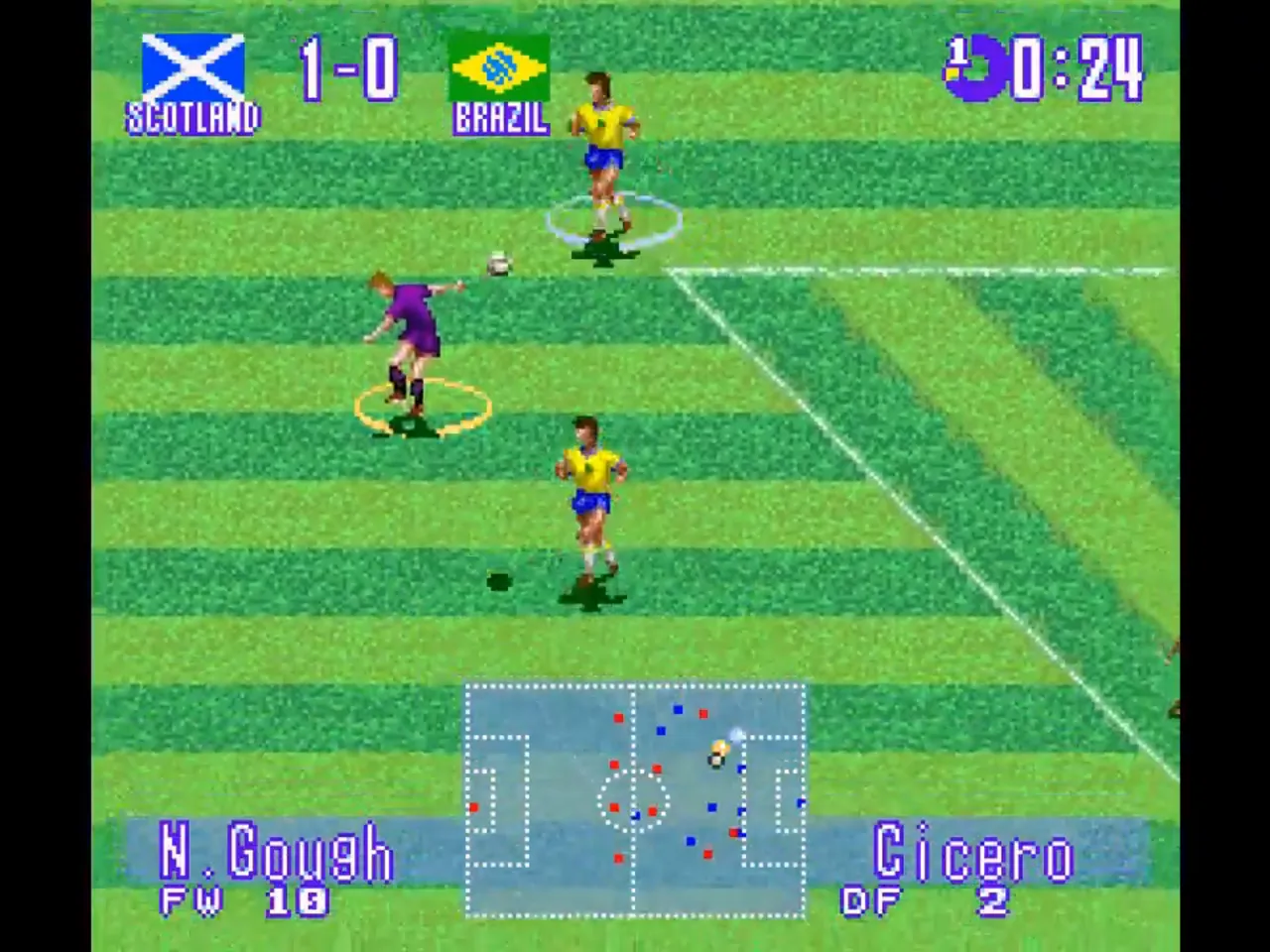
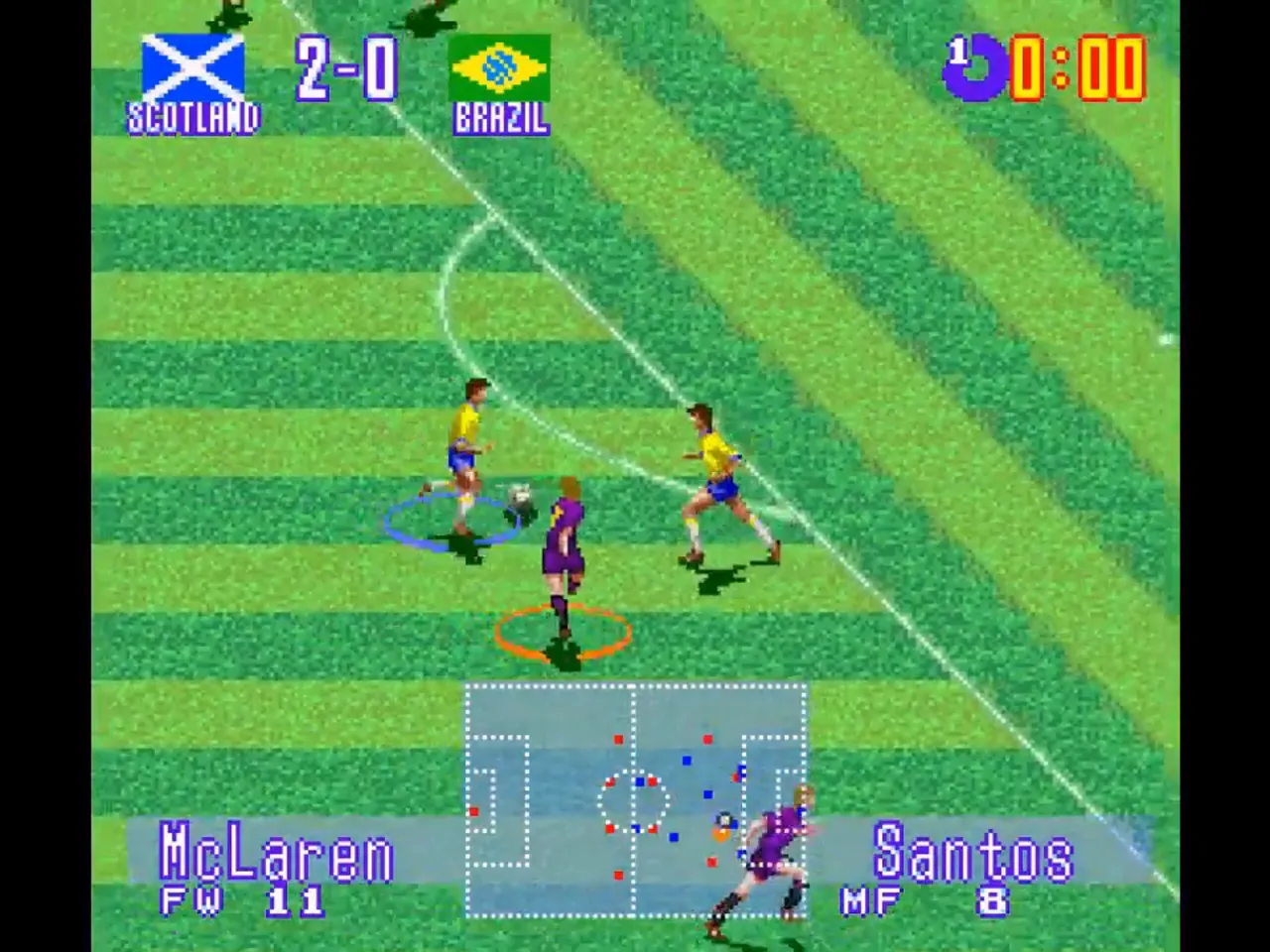
    Konami Osaka's Half of Pro Evolution Soccer International Superstar Soccer Deluxe
  5. 05
    The Salamander That Konami Left in Japan Salamander 2
  6. 06
    The Last Konami Adventure Kojima Wrote Alone Policenauts

Chapter 01

Sparkster

Konami's Numbered Sequel Wasn't the Real One

In eight days of September 1994, Konami shipped two Sparkster sequels by two different teams. The one without a 2 in its name kept the original's charge, sword, and shoot-em-up nerve.

Super NES · Mega Drive / Genesis1994Action PlatformerKonami
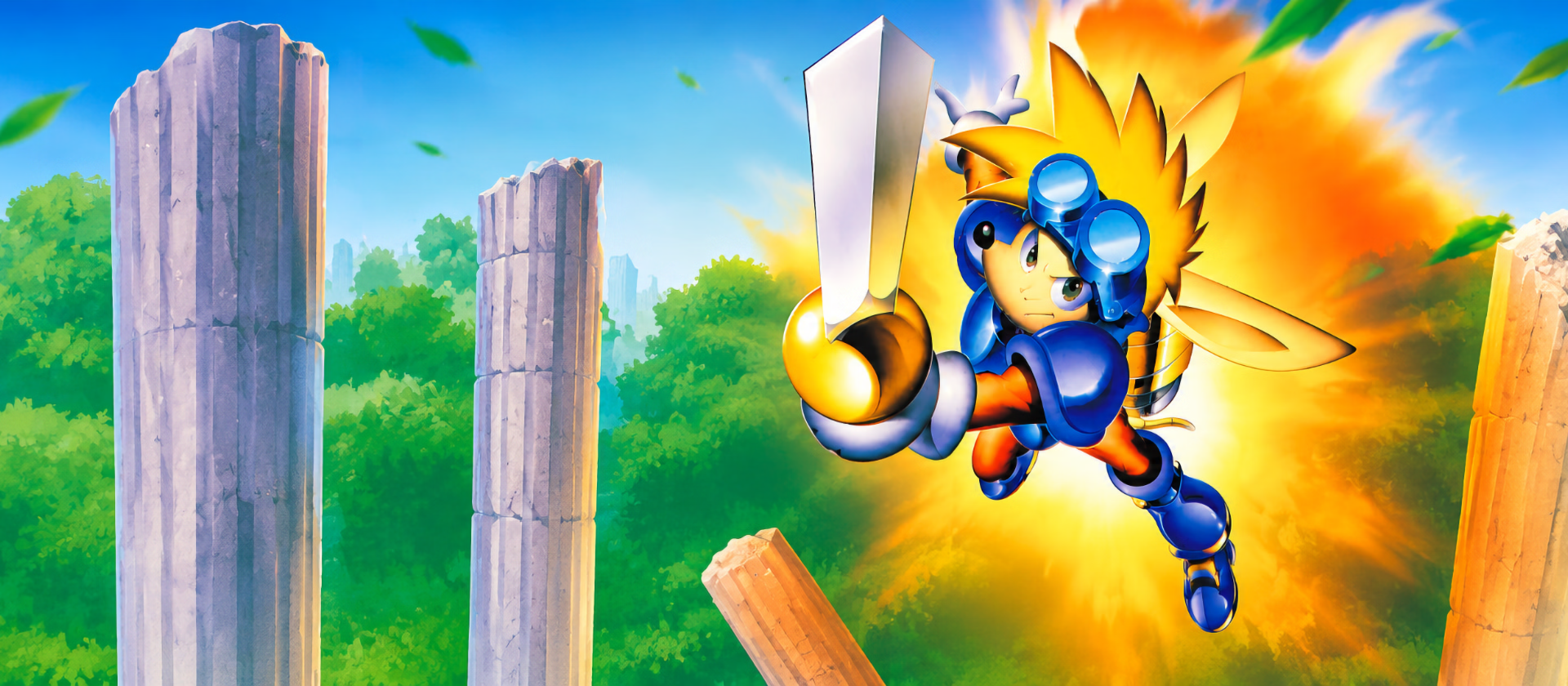
Sparkster · Konami, 1994

Two games called Sparkster shipped in Japan within eight days of each other in September 1994. Different teams. Different directors. Different consoles. The one on the Mega Drive carried a subtitle — Rocket Knight Adventures 2 — and the proper claim to canon. The one on the Super NES carried no number at all and was filed, then and now, as a spin-off. Konami’s numbering held up in Famitsu, where the Mega Drive sequel scored a point higher. It held up in the catalogues. It held up almost everywhere except the cartridges themselves.

Play them now, side by side, and the numbering inverts. The spin-off is the truer sequel. The one with the subtitle is the strange detour. The reason is in the credits: two directors with two completely different inheritances, both handed the same character at the same moment, both asked to make a follow-up to a game whose director had already moved on to Contra: Hard Corps.

Two Sequels, Eight Days Apart

Nobuya Nakazato directed the original Rocket Knight Adventures in 1993 — the Mega Drive cartridge that hid arcade Konami inside a marsupial suit. By 1994 he was elsewhere, building Contra: Hard Corps for the same platform. The Sparkster work fell to two other teams, working in parallel, on opposite sides of the 16-bit divide.

On the Mega Drive, the assignment went to Yasushi Takano, an artist promoted from inside the original Rocket Knight Adventures crew. The result was branded with the original’s subtitle and a numbered “2”, and Konami marketing in Japan treated it as the canonical continuation. On the Super NES, the assignment went to Hideo Ueda, who had directed the X68000 port of Akumajou Dracula in 1993 and, the year before that, Axelay. Konami Japan released his game eight days earlier — 15 September 1994, against 23 September for the Mega Drive — under the bare title Sparkster, with no subtitle, no number, and no editorial weight as a sequel.

It is hard to read this as anything other than Konami declaring its preference up front. The Mega Drive was where Sparkster came from. The Mega Drive was where the line was supposed to continue. The Super NES game was something else — a parallel work, a spin-off, the kind of release a publisher schedules to fill a slot. Then both shipped, and reviewers in Japan agreed: Famitsu’s Cross Review gave the Mega Drive sequel 31/40 and the Super NES game 27/40. The Western press inverted it. Electronic Gaming Monthly called the Super NES game Konami back to form, gave it 8.2/10, and named it Best Sound Effects of 1994; the Mega Drive sequel scored a more cautious 7.2. The territorial split has survived all the way into the bundled re-release thirty years on.

Ueda Came From Axelay

Open the Super NES cartridge and the first thing that registers is the charge meter. Hold the attack button, fill the bar, choose one of eight directions, and Sparkster fires himself across the screen. The pack does not refill automatically; the player commits to the window, lives with the consequences. The sword still throws a short projectile when uncharged. The first set of corridors is built around bouncing that projectile into corners and reading the ricochet. Anyone who finished the original Rocket Knight Adventures recognises the entire vocabulary in the first minute.

Ueda’s only real addition is the rolling dash on the L and R shoulder buttons: a short horizontal burst that costs nothing and recovers fast. It is the rare sequel mobility upgrade that extends the original toolkit rather than replacing it. The charge dash still does the big committed work; the L/R burst handles the small corrections the original asked the player to absorb. The stages then open out to make use of both. Vertical shafts. Long fall lines. Backgrounds that scroll because the camera has somewhere to chase. Kurt Kalata at Hardcore Gaming 101 writes that the SNES game has “more open stages, with larger vertical spaces that allow you to play around with the jetpack much more than its predecessor,” and the design reads as Ueda actually trusting the verb he was given.

The arcade-Konami detour is here too. Where the original Rocket Knight Adventures used a Gradius-shaped horizontal shooter for its Stage 6 reveal, the Super NES game drops a single top-down shooter section into its run. The Konami habit — break the side-scroller, dare the player to handle another genre for a few minutes — survived the platform transfer. The lineage explains the choice better than the credits do. Axelay in 1992 had been Konami’s last vertical scrolling shooter for the Super Famicom, a showpiece for the system’s Mode 7 hardware and the team’s reading of arcade design under cartridge constraint. Ueda came to Sparkster with that grammar still in his hands.

The ostrich-mountain stage is where the SNES game cashes the deposit. Sparkster rides a mechanical bird up a switchbacking peak at full tilt, scrolling past hazards faster than the rest of the game ever does. Playing With Super Power’s review — broadly cooler on the SNES game than the recent consensus — singles this stage out as the one that “maintains the most blistering pace in the game,” and that is the right word for it. Pace. The rest of the cartridge keeps the original’s rhythm of short, varied substages, each handed a different problem. The bird ride is the moment when the team’s restraint about speed pays off.

Takano Came From the Art Room

The Mega Drive sequel begins by retiring its inheritance. The charge meter no longer fills under the player’s control; it refills on its own, fast enough to let the player fly more or less indefinitely. There is no projectile sword — Sparkster’s swing, in Hardcore Gaming 101’s reading, is “pitifully sluggish,” and the original’s reflective-angle puzzle vocabulary disappears with it. The on-foot speed is lower. Enemies are dinosaurs and lizards rather than the pig empire. The shooter detours have become mech-pilot sections. A roulette mechanic, fed by jewels collected through the level, drops either a power-up or a bomb on the player’s head.

Each of these changes is defensible alone. Together they describe a different game. The original Rocket Knight Adventures asked the player to commit to a charge, choose an angle, accept the cost of being wrong. The Mega Drive sequel removes the commitment — the jetpack just refills — and then asks the player to track a small slot machine in the corner of the screen while threats appear at ground level. Stuart Gipp’s Retronauts review names the cost in passing: the roulette “forces players to monitor the HUD instead of focusing on ground-level threats.” The mechanic does not add a layer to the original design. It pulls attention sideways out of it.

The Mega Drive bosses get the worst of it. Where the original had multi-jointed contraptions whose segments could be read and learned, the sequel’s encounters — Retronauts again — are “primarily excruciating; either dull or annoying with no inbetween.” There is nothing wrong with most of the level design; the game is competent, well-drawn, fluently animated by a team that knew the hardware. What is missing is the original’s posture. Rocket Knight Adventures moved like arcade Konami in a marsupial suit. The Mega Drive sequel moves like a careful tribute, made by people who loved the original but did not direct it.

”The Super NES game may be frustrating, but I had way more fun working my way through it than the other one.”
— Kris Randazzo, Stone Age Gamer

Randazzo’s comparison piece runs the two games against each other category by category and gives the Super NES a 4–1 win. The frustration he names is real — the Super NES game’s harder difficulties lean on randomised boss patterns, and the camera on the vertical stages can put threats above the playfield faster than the player can climb to meet them. But the comparison ends where it starts: only the Super NES game still plays like the original.

Yamaoka and Yamane, Before the Names

The music is the place where the two games secretly agree. Both credit Michiru Yamane, three years before Castlevania: Symphony of the Night would make her name a shorthand for a certain kind of gothic-baroque score. Both credit Akira Yamaoka, four years before Silent Hill would do the same for industrial dread. In 1994 both were Konami staff composers writing children’s-action soundtracks. The Mega Drive game adds a separate roster of Konami arcade-and-NES veterans; the Super NES game adds Kazuhiko Uehara, Masahiro Ikariko, Minako Matsuhira. The point is the overlap. Most of the cues are the same. Stone Age Gamer’s comparison calls the tie honestly: “Most of the songs themselves are actually the same! This one all comes to down to instrumentation.”

The instrumentation is where the platforms speak in their own voices. The Mega Drive’s Yamaha FM synthesis sharpens the brass and gives the boss music a metallic snap. The Super NES’s sample-based audio softens the same melodic lines, foregrounds the lower registers, and — in the stages built around vertical motion — opens a low pad under the lead that the Mega Drive arrangement cannot reproduce. Neither is the better score. They are the same music played by two different bands, both of whom would soon become known for something darker.

This is the texture worth holding onto. Both games were made by Konami’s working composer rotation at the moment before its members became famous for their solo voices. Listening to either soundtrack now, you hear Yamane and Yamaoka in their Konami arcade-action register, before the labels stuck. EGM’s Best Sound Effects of 1994 award went to the Super NES game; the deeper musical interest is that the same two composers had spent that year writing the same melodies twice, for two teams who disagreed about almost everything else.

The Bundle Settles It

Until June 2024 you needed three cartridges to make the argument this piece has just made. Rocket Knight Adventures: Re-Sparked — Konami via Limited Run, Carbon Engine emulation, museum mode with concept art and box scans but no developer interviews — bundles the original and both sequels into one purchase. Rewind smooths the difficulty traps of the original North American Mega Drive cart. Save states make the Super NES game’s harder-mode boss randomness something you can practice rather than fear. And the comparison this article has spent fifteen hundred words building becomes a fifteen-minute experiment: load Sparkster (SNES), play the first vertical stage, swap to Sparkster: Rocket Knight Adventures 2, play the same character without the projectile sword and with the roulette spinning in the corner. The body knows the difference before the eye reads the HUD.

The bundle also makes the older verdict reversible. Famitsu in 1994 preferred the numbered sequel; Konami’s catalogue agreed; the Japanese retrospective consensus has continued to treat the Mega Drive game as the canonical line. The Western press in 1994 split the other way, and the past two years of English-language coverage — Gipp at Retronauts, Randazzo at Stone Age Gamer — has settled, by play and not by lineage, on the Super NES game. The bundle lets a reader run the experiment themselves and decide which territory was reading the carts correctly.

The choice does not have to be doctrinal. Both games are competent. The Mega Drive sequel has a more elaborate mechanic, a denser bestiary, a roster of bosses that some players will read as elaborate where this piece has called them excruciating. The Super NES game has the cleaner descendant of the original’s grammar — manual charge, projectile sword, vertical stages, a top-down detour that remembers Gradius — and the better claim to inheritance even though Konami filed it as a spin-off. The cartridges argue themselves. The eight days between them have been long enough.

Cartridge Collective 1994 · Super NES · Mega Drive / Genesis

Where to play

Why Now

Two sequels, eight days, one cartridge that still rewards a Contra reflex: manual charge, projectile sword, vertical stages, a top-down detour that remembers Gradius.

Best way to play now Rocket Knight Adventures: Re-Sparked on Steam

The bundle is the editorial frame: all three Sparkster games next to each other, rewind on, save states armed. Side-by-side play settles the argument better than any review can.

Time
2-3h 20m to the SNES vertical stage and the L/R dash clicking
Cost
£19.99 Steam standard price; sales make the whole collection an easier ask.

Alternatives

  1. 01
    modern

    Re-Sparked on Switch / PlayStation / Xbox

    Same Carbon Engine collection across the current consoles; rewind and museum scans included, no developer interviews bundled in.

  2. 02
    original

    Original Super NES cartridge

    The Japanese cart is cheaper than the North American, and the case for the SNES game is easier to feel on hardware.

  3. 03
    original

    Original Mega Drive cartridge (Sparkster: Rocket Knight Adventures 2)

    The canonical sequel by name — slower on its feet and missing the projectile sword, but worth a side-by-side to feel the divergence.

  4. 04
    simulation

    MiSTer FPGA

    Both originals run on the same hardware-level platform, which is the cleanest way to A/B without emulator drift between the two.

1994 · Konami

Listen

  • Rocket Knight Adventures: Re-Sparked Official SoundtrackLimited Run Vinyl / VGMdb The three-LP set gathers both Sparkster scores alongside the original, the easiest way to hear the Yamane–Yamaoka overlap end to end.
  • Sparkster (Super NES) soundtrackYouTube Practical listen for the SNES score — same composer roster as the Mega Drive game, different arrangement bones.

Watch

  • Sparkster (Super NES) — LongplayYouTube A clean run through Ueda's seven stages, including the ostrich-mountain set piece and the top-down shooter detour.
  • Sparkster: Rocket Knight Adventures 2 (Mega Drive) — LongplayYouTube The canonical sequel beside the original Rocket Knight Adventures, the easiest visual A/B for the two design philosophies.

Read

  • 16-Bit Brawl: Sparkster SNES vs. GenesisStone Age Gamer / Kris Randazzo
  • Rocket Knight Adventures: Re-Sparked reviewRetronauts / Stuart Gipp
  • Sparkster (SNES)Hardcore Gaming 101 / Kurt Kalata
  • Sparkster (Genesis)Hardcore Gaming 101 / Kurt Kalata
  • Sparkster review (SNES)Playing With Super Power
  • Sparkster: Rocket Knight Adventures 2Wikipedia
  • Sparkster SNES prototypeThe Video Game Project
Chapter 02

Castlevania: Bloodlines

The Castlevania That Left the Castle

Konami's 1994 Mega Drive answer to Super Castlevania IV is a 1917 travelogue across Europe — two protagonists, two weapons, and Michiru Yamane's first horror score. Faster and harder than the SNES original.

Mega Drive / Genesis1994Action PlatformerKonami

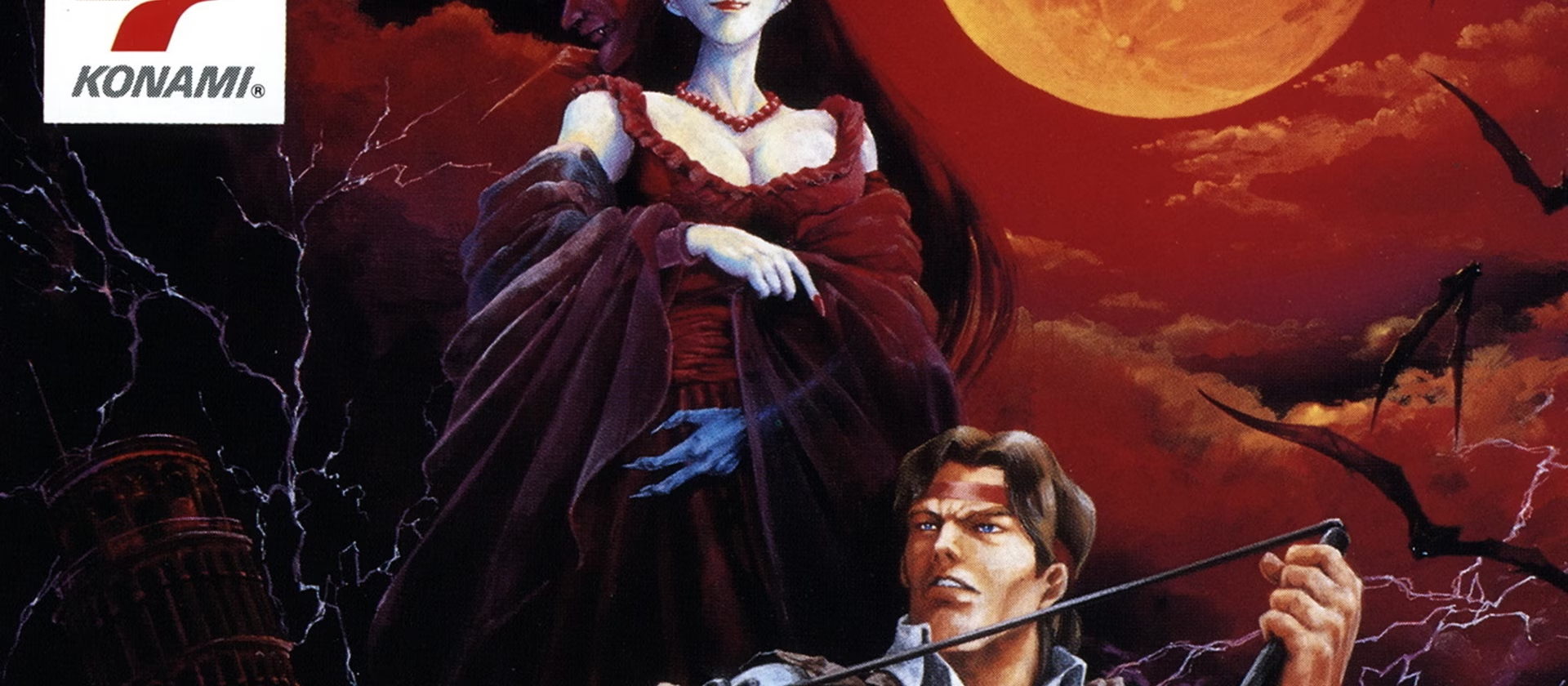
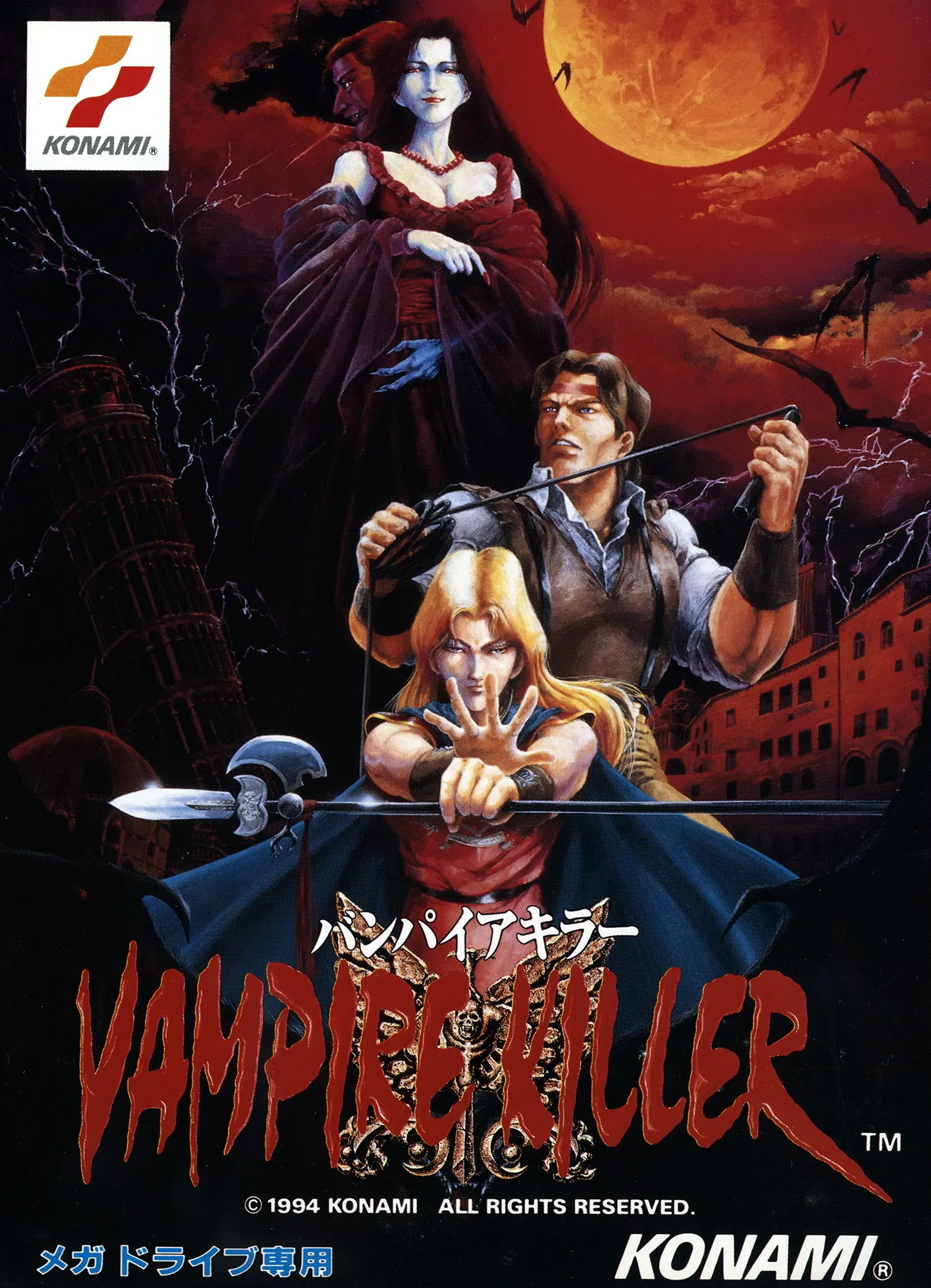
Vampire Killer — Japanese Mega Drive box painting · Konami, 1994

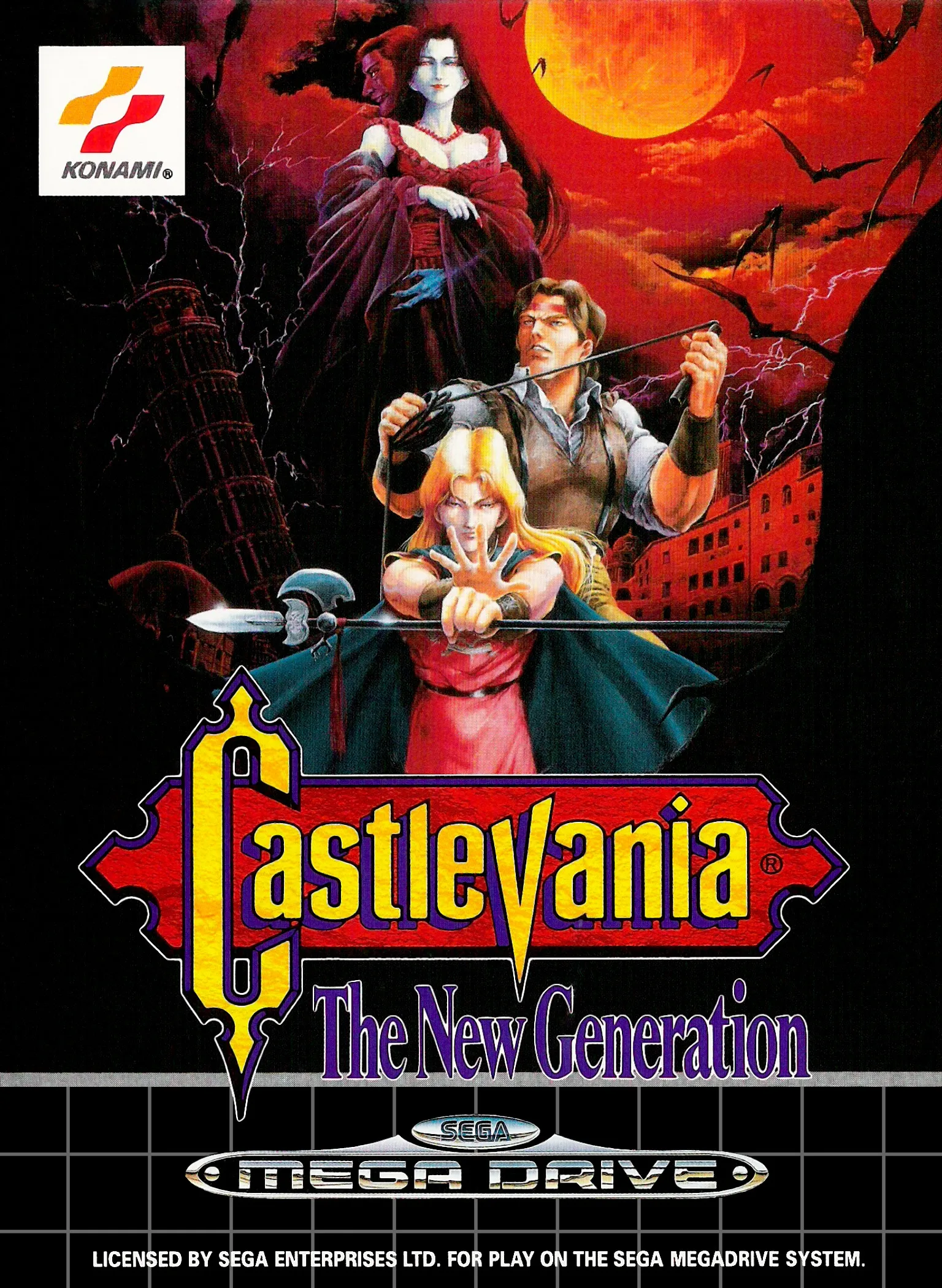
Most people who picked up Castlevania for the Mega Drive in March 1994 picked up the wrong one. The cartridge in the North American case was called Bloodlines and ran at a difficulty the lead designer himself described as the “tabasco” version. The cartridge in the Japanese case was called Vampire Killer — no Dracula, no Akumajō prefix, the twelve-year series brand deliberately stripped from the spine. The cartridge in the European case was called Castlevania: The New Generation because PAL territories had effectively banned the word “blood” from cartridge packaging, and the title screen’s red sea was recoloured blue water to match.

Three cassettes, one design, three different readings. None of them is the Mega Drive Castlevania people mean when they talk about Super Castlevania IV. The Mega Drive Castlevania is its own object: a separately authored, post-castle answer-record built by a different Konami team for a different sound chip, with a script the writer freely admitted was “his personal interpretation” of the saga rather than the canon. And almost nobody heard it. Famitsu’s lifetime sales tally for the Japanese release sits at fewer than ten thousand cartridges — a figure that kept the cart at four-figure secondhand prices until the 2019 reissues forced the gates open.

Three Editions, One Cartridge

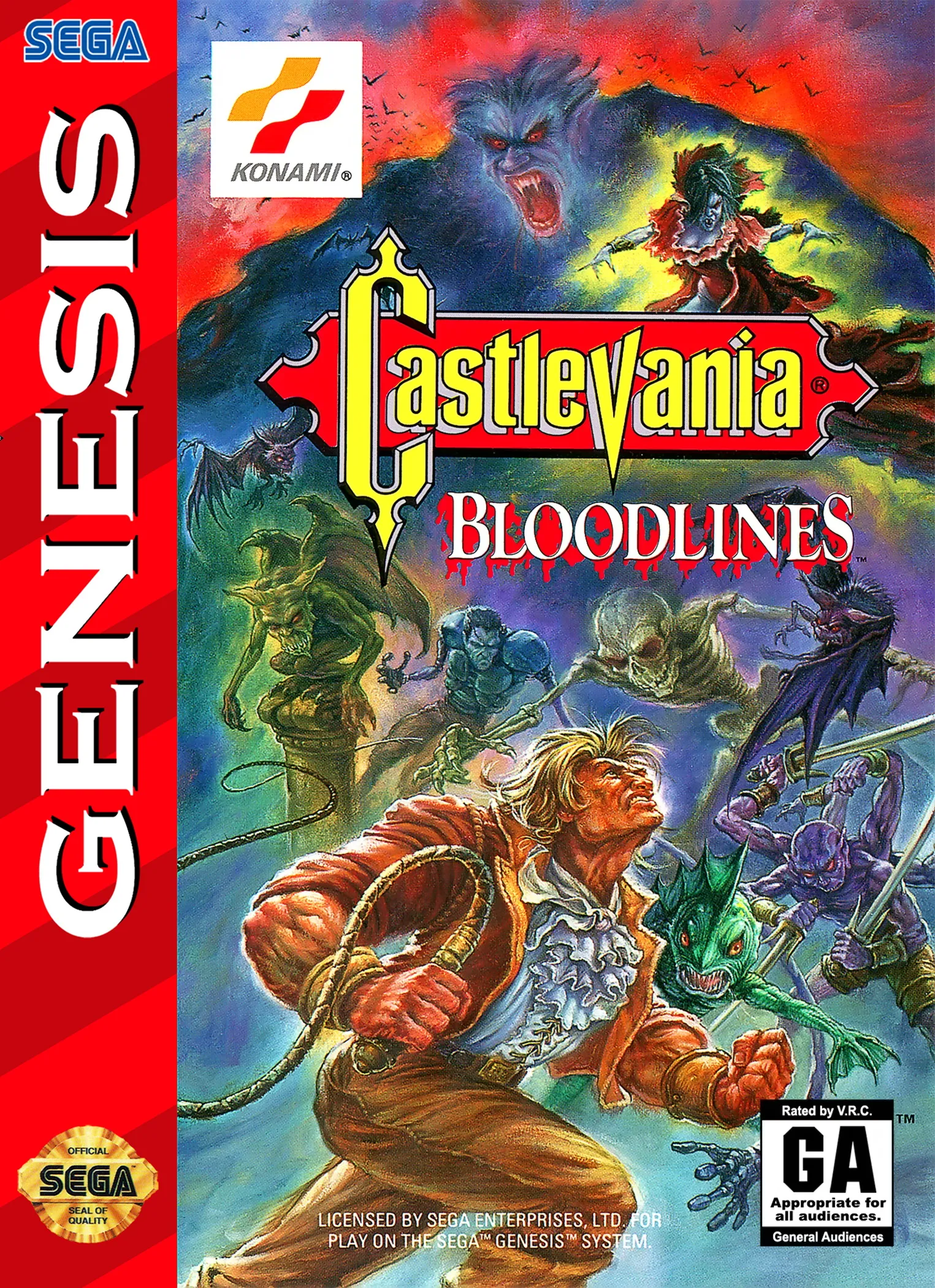
Japanese Mega Drive box for Vampire Killer: Elizabeth Bartley in a red gown above John Morris and Eric Lecarde, the Leaning Tower of Pisa silhouetted to the left.North American Genesis box for Castlevania: Bloodlines, with the John Morris and Eric Lecarde figures rendered against a stained-glass red background and the franchise logo across the top.European Mega Drive box for Castlevania: The New Generation: identical figure painting, the word 'blood' removed from the title, sea-of-blood recoloured to a blue water field.

The same cartridge, three readings of what could be said on a spine. The Japanese edition strips the Castlevania brand entirely; the European edition strips the word “blood.” Vampire Killer / Bloodlines / The New Generation · Konami, 1994.

That regional split is not localisation theatre. Toshiki Yamamura, programmer and scenario writer, told BEEP! Megadrive during development that he wanted to use the title-change to mark a working boundary: “The reason we didn’t use the traditional Akumajō Dracula title is that we wanted to challenge ourselves to present a new style and flavor to the series: speedy and action-packed, while still retaining the strategic aspect of the earlier Castlevania games.” Konami of America put the brand back on the spine because the brand was the franchise; Konami’s European distributor pulled it half-off again because the European trade simply would not allow “blood” on a children’s storefront. Yamamura’s other admission, from the same interview, is the one Mega Drive owners outside Japan didn’t have on the cartridge case: “If you find Vampire Killer too easy for you, be sure to check out the overseas version, Castlevania Bloodlines. It’s like the ‘tabasco’ version of Vampire Killer, in terms of difficulty.” Japanese Normal is broadly the same difficulty curve as overseas Easy. The cleanest shop in 1994 — Europe — was selling the hardest cartridge with the gentlest title.

Yamamura’s Own Dracula Trilogy

The deeper break with the established Castlevania reading is the script. Yamamura was not building a sequel to Super Castlevania IV. He was building, by his own account, the middle act of a separate three-part saga he had been carrying around in his head:

“The scenario is unique to the Megadrive, and is my personal conception of the Dracula series. In my mind there is a trilogy or tri-partite structure to the Dracula saga, and this game takes the place of the second act. I’d like players to see Vampire Killer as my personal interpretation to the canon. I was pretty influenced by Hideyuki Kikuchi’s work.” — Toshiki Yamamura, BEEP! Megadrive, 1994

Kikuchi is the novelist behind Vampire Hunter D, the 1983-onward pulp series that runs the gothic vampire mythology through a far-future hard-boiled chassis. None of the previous Castlevania games had cited him. Bloodlines leans on him in places the player can feel: the cast includes a Texas-blooded American (John Morris, the son of Quincey Morris from Bram Stoker’s novel, who is the man who actually drives the knife into Dracula in the 1897 source material) and a Segovian Spaniard (Eric Lecarde, who wields the Alucard Spear and is a fully novelised character — father of Stella and Loretta from Portrait of Ruin, twelve years later). The setting is 1917: Elizabeth Bartley, Dracula’s niece, has manipulated the assassination of an unnamed Archduke and the resulting World War into a continent-spanning blood-letting designed to resurrect her uncle. Konami had spent twelve years setting Castlevania inside a single building. Yamamura’s edit moved it onto the geopolitical map.

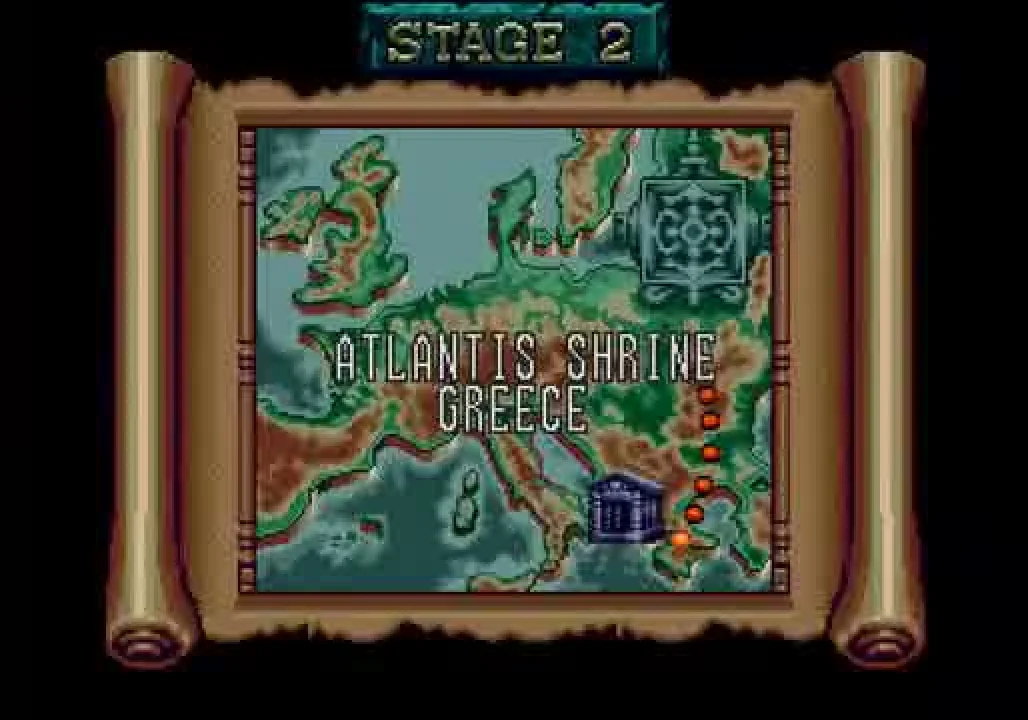
Between-stages interstitial: a yellowed-parchment map of southern Europe, marked 'Atlantis Shrine, Greece,' with a wax-stamp icon and red travel dots tracing the route across the Mediterranean.

The interstitial map between Stages 1 and 2 — the 1917 travelogue made visible. Konami had spent twelve years setting Castlevania inside a single building. Vampire Killer · Konami, 1994 · Mega Drive.

Two Verbs in Six Stages

The travelogue is also a system, not just a setting. The player picks one of two protagonists at the title screen and the cartridge routes around the choice for the rest of the run. John Morris has the family whip — four-directional, knock-out rope-swing, the Belmont-line spatial vocabulary you arrive expecting. Eric Lecarde has the Alucard Spear — eight-direction thrust, longer reach, a vertical pole-vault jump John cannot perform. Stages branch around these moves: walls John can rope-swing past are walls Eric has to pole-vault over; platforms Eric can reach with the spear’s diagonal are platforms John has to whip a candelabra to. Two genuine playthroughs are designed in. Both are needed for the cartridge to disclose itself.

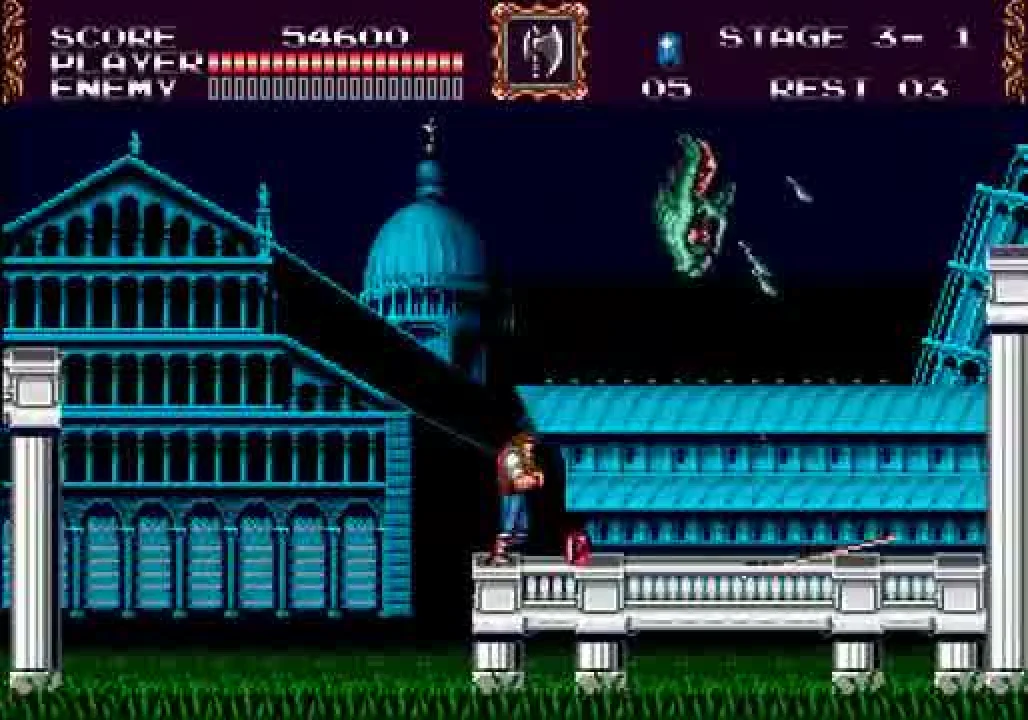
John Morris stands on a stone parapet in the foreground; behind him, the Pisa Cathedral dome and the silhouette of the Leaning Tower of Pisa rise against a blue night sky, lit by a single moon. Stage indicator reads '3 — 1.'

Stage 3-1 — Pisa. The cathedral dome and tower are accurate enough to read against a photograph. Bloodlines doesn’t reuse Dracula’s masonry for European geography; it draws the geography itself. Bloodlines · Konami, 1994 · Mega Drive.

Six stages cover the route. A Romanian ruin to open. The Atlantis Shrine off the coast of Greece. The Leaning Tower of Pisa, which tilts and rotates in real time around the player midway through — Stage 3’s answer to Super Castlevania IV’s rotating Mode 7 chamber, except where the SNES game rotated the room around a stationary player verb, Bloodlines rotates the world while the player keeps walking it. A munitions factory in Germany. The waterworks at Versailles. Castle Proserpina at the end. Each stage is a destination, not a generic dungeon section: the parallax scrolls real architecture, the boss fights cite real myth, the interstitial map traces the route. The friction this puts on a Super Castlevania IV reader is honest: John’s whip cannot spin to deflect projectiles, the knockback on damage remains preserved from the NES line, and Castle Proserpina’s final climb assumes the player has internalised both characters’ verbs to a margin reasonable players bounce off. The cartridge is faster than the SNES original and tighter on its feet — and asks the player to do more.

Yamane’s First Castle, Mostly Unheard

The composer was Michiru Yamane. Bloodlines was her first Castlevania assignment — three years before Symphony of the Night and twenty-five before the Bloodstained Kickstarter that made her name a popular noun. She told Video Game Music Online that she approached the brief by reading sideways into it: “There was some affinity between the image of a vampire-infested world with the traditional classical music that I had been taught from a young age. I tried integrating such things as the classical music element that had already been a part of me with the rock elements previously featured in the series.” The result is a score that quotes Bach against an FM chip — long tonal lines through the cathedral pieces, dynamic bass under the cellars, the series cue “Vampire Killer” itself reframed as a propulsive minor-key march rather than the chiptune anthem the NES game had made it. Yamane later named the Genesis as her favourite system to score — not because she preferred the chip on its merits, but because “for that system I got to do all the work, not just composition, but also synthesising the music into the program. So it’s particularly memorable for me.”

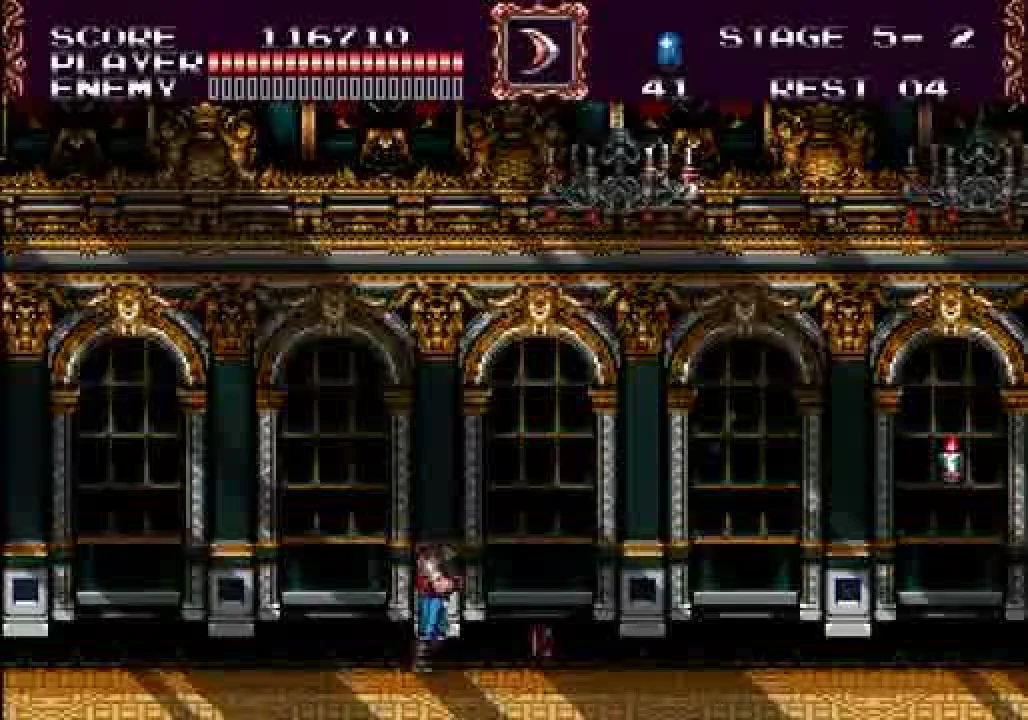
The interior of a gilded baroque hall, columns and arched windows running deep into a vanishing point, candelabras lit, the player visible mid-frame between two enormous pillars. Stage indicator reads '5 — 2.'

Versailles, Stage 5-2 — gilded columns, painted vaulting, candle-lit recess. Yamane’s score sits underneath it as if scored for the building, not the platformer. Bloodlines · Konami, 1994 · Mega Drive.

The trade press in 1994 was divided on the result. Electronic Gaming Monthly gave Ed Semrad’s review a 9 out of 10. Die Hard Game Fan put four editors deep into the nineties. GamePro, less charitably, called it “a satisfactory action cart” that “belongs in the lower reaches of the Castlevania lineage” and signed off with “the Bloodlines run dry.” The split is the reception-gap in miniature: a game the more careful 1994 reviewers heard and the franchise press did not, on a platform that wouldn’t read it back for a quarter-century. The Japanese press buried the score under the rare-cartridge story; the American press buried it under the comparison to a game on a different platform. Yamane’s first Castlevania score — the one she still names when asked about her favourite work for a sound chip — was effectively unheard until the Castlevania Anniversary Collection dropped it on every current console in May 2019, with a fresh interview attached.

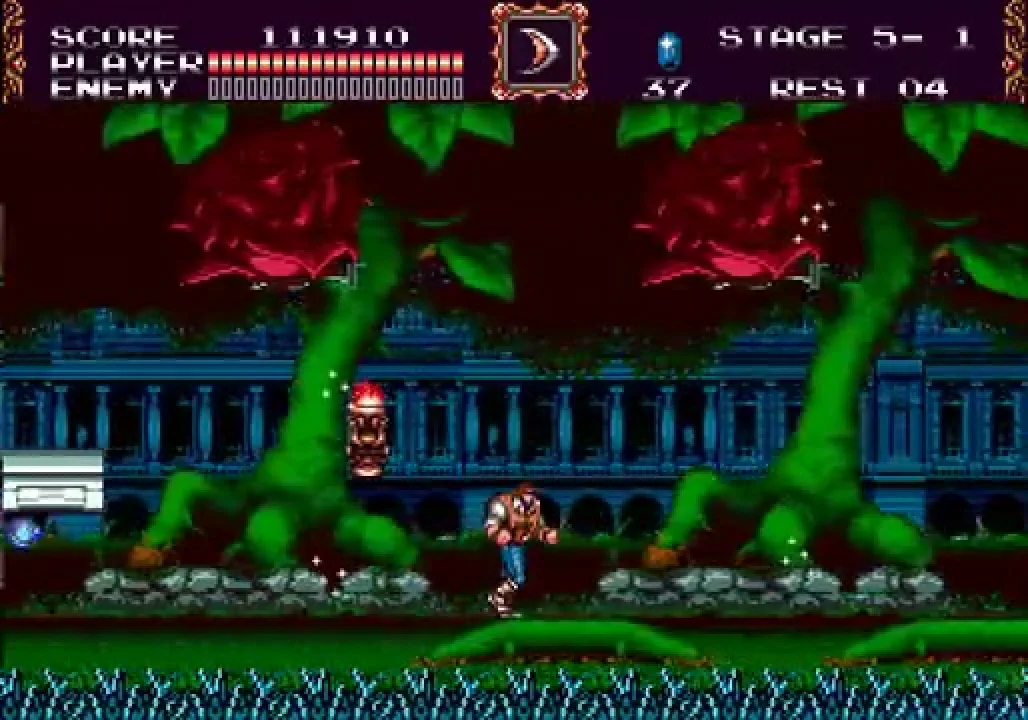
John Morris mid-jump above a coffin-shaped platform. A giant red rose blooms against tree-bark scenery to the left; a Versailles palace facade is faintly visible beyond. Stage indicator reads '5 — 1.'

Stage 5-1 — the rose against the palace. A 1917 Versailles waterworks dressed for horror, scored for cathedral. Bloodlines · Konami, 1994 · Mega Drive.

What the Anniversary Collection gives a present-day player is the cartridge as Konami’s Japan team made it. Toggle to Vampire Killer the first time through — the difficulty is the one the author wrote, and the title’s deliberate distance from the Akumajō Dracula lineage is the framing the rest of the design assumes. Then loop back through as Eric and run the second-character version of the same six stages. Six hours, both halves, the FM chip arranged the way Yamane wrote it. What the cartridge gives that Super Castlevania IV does not is a Castlevania willing to leave the castle and the canon — to be a separately authored interpretation rather than the next number in the series — and a composer doing the work she would later become famous for, three years before anyone was listening for it.

Cartridge Collective 1994 · Mega Drive / Genesis

Where to play

Why Now

A whip in one hand, a spear in the other, six stages from a Romanian ruin to Versailles — Konami's Castlevania left the castle and got faster.

Best way to play now Castlevania Anniversary Collection

The same compilation that holds the uncut Japanese Super Castlevania IV also ships both the Japanese Vampire Killer ROM and the North American Bloodlines, with rewind, save states, and a digital sourcebook that includes a fresh Michiru Yamane interview.

Time
3–4h per character · 7h to see both routes Stage 3 — Pisa is where the cartridge becomes itself
Cost
£15 frequently £4 in Steam sales

Alternatives

  1. 01
    modern

    Castlevania Anniversary Collection (Steam / PS4 / Xbox / Switch)

    Eight-game compilation with rewind and save states. Ships both Japanese Vampire Killer and North American Bloodlines; European New Generation is the only edition not bundled. The digital sourcebook holds a new Michiru Yamane interview.

  2. 02
    modern

    Sega Genesis Mini / Mega Drive Mini

    Hardware-purist route. Japanese unit ships Vampire Killer; North American and European units ship Bloodlines; no in-menu region toggle on either.

  3. 03
    simulation

    MiSTer / Analogue Mega Sg

    FPGA Mega Drive on a CRT is the canonical way to hear the FM chip Yamane was reaching into. Both cores run the cartridge dump frame-accurate.

  4. 04
    emulation

    Kega Fusion or Genesis Plus GX

    Native-resolution emulation with the JP ROM if you want the difficulty Yamamura himself called the gentler one. Genesis Plus GX is the cleanest YM2612 model.

  5. 05
    original

    Original cartridge

    Famously rare. The Japanese Vampire Killer print run sold around 9,000 copies and the cart held a four-figure secondhand price for two decades before the 2019 reissues. Collector territory.

1994 · Konami

Listen

  • Vampire Killer (Konami Version) — singleKonami / Spotify The Bloodlines arrangement of the series anchor cue, on official Spotify — the cleanest way to hear what Yamane built into the Mega Drive FM chip in 1994.
  • Castlevania: Bloodlines — Genesis OST (gamerip)Internet Archive Full FM-chip rip as the YM2612 produced it. The cellar / cathedral pieces are where Yamane's classical-training instinct meets a sound chip nobody had previously asked to play Bach.

Watch

  • Mega Drive Longplay [027] Castlevania: BloodlinesWorld of Longplays / Retroplay Clean single-character run with no commentary. Stage 3's Leaning Tower of Pisa rotation, the Stage 5 rose-and-Versailles sequence, and Castle Proserpina all read clearly from this capture.
  • Castlevania: Bloodlines — Genesis Full Walkthrough [4K60]YouTube Higher-resolution upscale of the same six stages — useful for the Stage 1 Romanian ruins and the Atlantis Shrine intro where the parallax does the work the prose claims it does.
  • From Bloodlines to Bloodstained — Michiru Yamane in conversationYouTube Yamane on her Mega Drive debut and the long road through Symphony of the Night to Bloodstained. The clearest English-language source for how she now reads the Bloodlines score.

Read

  • Castlevania: Bloodlines — 1994 BEEP! Megadrive Interviewshmuplations / BEEP! Megadrive, 1994 The only original-production developer interview ever published for this game. Toshiki Yamamura on the 'personal interpretation' framing, the Hideyuki Kikuchi influence, and the regional-difficulty split — source for every load-bearing quote in this article.
  • Michiru Yamane Interview: The Musical Legacy of CastlevaniaVideo Game Music Online Yamane on the classical-versus-rock decision she made on the Mega Drive job and her route into the series — the foundation interview for her Bloodlines self-account.
  • A Classic Interview with Castlevania Composer Michiru YamaneGame Developer / Brandon Sheffield, 2006 Yamane naming the Genesis as her favourite system to score precisely because she got to programme the sound chip herself — the platform almost nobody heard her on in 1994.
  • 『バンパイアキラー』30周年。メガドライブ後期の『悪魔城ドラキュラ』シリーズ作Famitsu, March 2024 The 30th-anniversary Japanese retrospective. Frames the game as a late-Mega Drive masterwork and surfaces the lifetime sales tally that English coverage usually leaves out.
  • VAMPIRE KILLER — Sega Mega Drive Mini software pageSega Japan Manufacturer page for the 2019 hardware reissue — the moment a ¥50,000 secondhand collectable became playable for the price of a coffee.
  • Castlevania: Bloodlines — WikipediaWikipedia Background and the citation trail back to the Sega Retro magazine index and the regional difficulty mapping documented at the Castlevania community wiki.
  • What Did Critics Think in 1994? — Castlevania BloodlinesDefunct Games GamePro, EGM, Die Hard Game Fan, and the rest of the 1994 trade press in their own period words — the divided contemporary read that the present canonical regard later closed.

Chapter 03

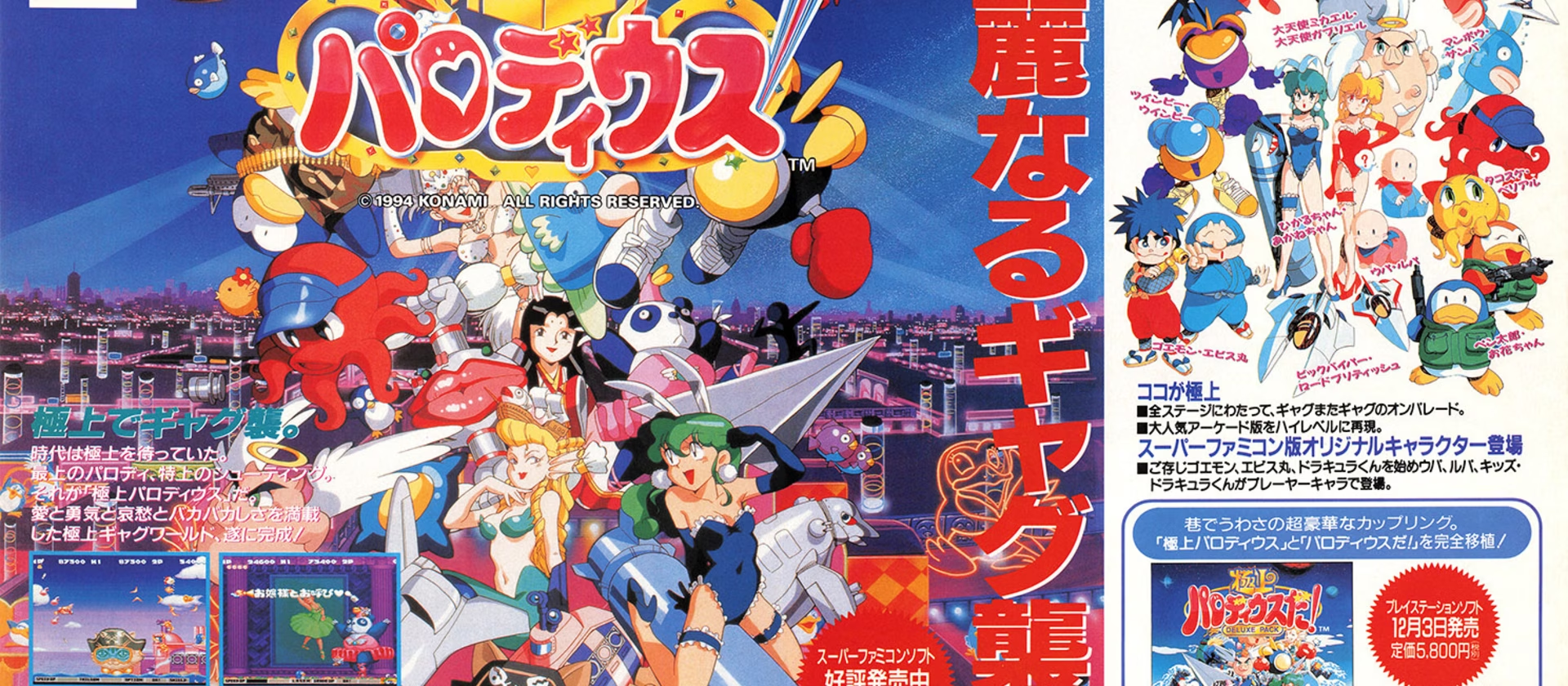
Gokujō Parodius

Konami's Cabaret Answer to Street Fighter II

By 1994 horizontal shooters had been pushed out of arcades by fighting cabinets. Konami's veteran shmup director came back to make one anyway — defiantly, brilliantly, with a disco-penguin chorus.

Arcade · Super Famicom · PSP · Saturn1994Horizontal ShooterKonami

Gokujō Parodius · Konami, 1994

The disco stage opens with a wall of penguins in heavy-metal costume — eight of them, stacked three high in their own little frames, head-banging in unison against a backdrop of neon “ALL NIGHT” signage and a sun the size of the screen. The player ship floats in the middle of an explosion that has not stopped being an explosion since the section began. Somewhere underneath is a Dvořák melody, dressed up as a disco remix. None of this is decoration. This is a 1994 Konami arcade game arguing, in its loudest possible voice, that the horizontal shooter is not finished — that one more credit, one more two-player run, one more set of eight characters with eight different weapon loadouts is still worth setting up the cabinet for. The game’s name is Gokujō Parodius. It is the best Parodius to play today, and the reason it exists at all is that its director walked into an arcade in late 1993 and could not find a hori shmup anywhere.

His name was Tsukasa Tokuda. He had spent the previous two years on the X68000 and PC-Engine ports of Parodius Da!, the 1990 original. When he came back to Konami’s arcade division he was handed what amounted to an internal corporate gift — an anniversary brief, a chance to make a sequel to a game he already loved. He could see what had happened to the floor while he was away. Street Fighter II had been out three years. Samurai Shodown was a year old. Virtua Fighter had just landed. The cabinets that paid the bills were paired-monitor versus boxes, and the genre Konami had spent the eighties owning — Gradius, Salamander, Twinbee, Parodius itself — had been crowded out of operator lineups. So Tokuda did the only thing left to do, which was to make the most defiant horizontal shooter he could.

The Shooter Made Against the Floor

Tokuda’s account of the brief, delivered to a Japanese games mook in 1994 while Gokujō Parodius was new in cabinets, is the most useful single document we have for understanding what the game is. It is not interview boilerplate. It is the director looking around an arcade and naming the problem.

”I noticed there was nothing but vs. fighting games. I personally loved STGs like Gradius, but you could barely find even a single hori STG.”

Tsukasa Tokuda · Game Hisshou Guide, June 1994 (translated by Shmuplations)

The team he built around the brief was small, mixed, and weighted toward people for whom this was a debut or near-debut project. Shuzilow.HA — who had moved into game art via Detana!! TwinBee and Gaiapolis — was the lead character designer, and the recognisable Parodius register (everything has a face, every face is doing a bit) is largely his. The composer was Kazuhiro Senoo, who had joined Konami the previous April; Gokujō Parodius was his first project. The published credits list two more in-house composers, Seiichi Fukami and Satoko Miyawaki, sharing the room. Section 2 chief Masahiro Inoue signed off. Japanese sources — but not, conspicuously, English ones — also credit the gag-manga artist Asari Yoshitoo, whose work on Manga Science and the Wapuro Mahjong strips put Gokujō Parodius inside a humour-comics lineage as much as a shmup-parody one. The piece reads as such if you go looking. The bosses are not parodies of Gradius bosses so much as drawings being asked to do shmup work.

What this team did with the brief is the part that matters. They did not produce a wink at the Gradius line. They produced a game that uses every weapon a shmup has — pattern density, weapon variety, boss-design escalation, second-loop reward stages — to argue that the register of an arcade is the thing worth defending. Cabaret pillars and showgirls and panda ballerinas and disco penguins, yes. But also: bullet waves that demand the same routing instincts as Gradius II, capsule mechs and ringed-bullet battleships, a clock-gear factory that scales in vertical density until the screen runs out of safe space. The argument runs through the design, not above it.

Characters Where Ships Used to Be

The most consequential rule change from Parodius Da! is the roster. Gokujō Parodius ships with eight characters, expanded mid-development from an initial six after the boss team asked for more. They are not skins. The Vic Viper carries the Gradius options-and-shield loadout; TwinBee carries the Twinbee bell-juggling weapons; Pentarou has options that orbit the ship; Hikaru and Akane fire a paired beam between them and have no options at all, their main weapon scaling instead. Each character makes the game a different game. Two players can run simultaneously — the second player picks from clones with the names swapped (Lord British, Hanako, Winbee, Aitsu) — and there is a small, weird interaction in which friendly fire does no damage but, if you rake your partner with enough shots, they will eventually rage and erupt with extra bullets. It is a tiny piece of co-op behavioural design that almost no shmup of the era has, and it changes how two people play together.

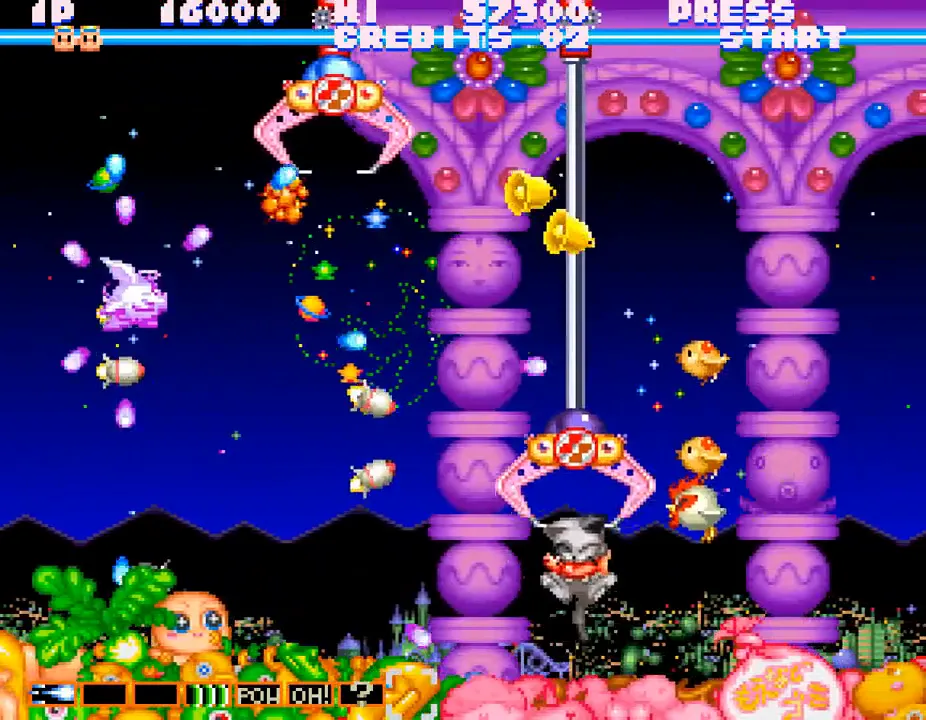
Stage 1 pillars with showgirls below, character ship dodging bullets, painted cabaret architecture in pink and gold.

Cabaret pillars and dancing showgirls under the player ship. Konami’s GX hardware is the loud part of the argument — more parallax, more sprite layers, more confident animation than the bubble-system original could afford. Gokujō Parodius · Konami, 1994.

The hardware doing the talking is the Konami GX board, two generations on from Parodius Da!‘s System 1 platform. The difference is structural, not cosmetic. There are more sprite layers. The parallax behaves like a separate creative voice. The animation budget on character sprites is suddenly enough that Shuzilow.HA’s drawings hold their faces while moving — the showgirls flick their fans, the panda boss pirouettes inside a gilded mirror, the disco penguins headbang in time. The arcade soundboard runs the score wide and clean. None of this would matter if the underlying shooter were thin, and it is not. The Stage 5 sequence of miniaturised previous-Gradius bosses is real homage; the capsule mechs and ringed-bullet ships are real pressure. Gradius II veterans will recognise the routing logic immediately. The difference is that the surface is allowed to make jokes.

Seven stages, not the original’s ten. Tokuda’s design notes describe a deliberate one-loop run — the Special Stage exists for hardcore players who want a harder pass, but the main game refuses the Gradius second-loop demand on principle. It is the right call. The pacing tightens, the encounter design has room to escalate, and a single-credit clear lands at around half an hour — the modern-friendly arcade-run length the genre took twenty more years to admit it needed.

Senoo’s First Score, Played in Pastiche

Senoo’s soundtrack is the part that gives the game its temperature. He worked from a brief that Shuzilow had already established visually — every character a register, every register a recognisable music cue — and treated his job as casting. The mermaid boss enters to Sarasate’s Zigeunerweisen. The early stages run on big-band cuts, with the Stage 1 opening built on Glenn Miller’s “In the Mood.” The closing stretch lands on a disco remix of Dvořák’s New World Symphony. None of this is ironic quotation — the arrangements are played straight, with the Konami soundboard pushing them as confidently as it would push original Kukeiha Club material. The classical pieces sit comfortably; the licensed pop pieces required JASRAC clearance Konami evidently negotiated for the arcade release and could not maintain through every reissue. (The 2007 PSP collection had to substitute six tracks, “In the Mood” among them, when the licensing lapsed — a small archaeological record of how much the original score relied on real, paid music.)

The disco stage’s penguin chorus and the New World Symphony as a four-on-the-floor remix. Motion is the point — the explosion does not stop being an explosion, the penguins do not stop headbanging. The visual argument and the musical argument are the same argument. Gokujō Parodius · Konami, 1994.

The effect on the room is what the score is for. Parodius Da! had used novelty sound. Gokujō Parodius uses real arrangements, paid for and credited, with the confidence of a music staff who knew their hardware. It is the part of the game that travelled best even in the truncated SFC and PSP editions, and it is also the part that explains why the game’s silliness reads now as generous rather than thin. The audio was never the joke. The audio was always the room.

What the Director Got Wrong

There is one strange admission in the 1994 interview. Asked to rate his own work, Tokuda gives Gokujō Parodius fifty out of a hundred — half the eighty he scored Parodius Da!. He had reasons, mostly to do with what he wished he had done with the budget. The judgement is wrong. The game is better than the original by every metric you can name from outside the studio, and the playable evidence is exactly what makes that the case. The hardware is louder. The roster is wider. The pacing is tighter. The music is more confident. The two-player rage mechanic is a small invention nobody else made. The closing image — a treasure chest the cast finally opens to reveal a bomb that politely apologises and detonates the heroes, a cruel anti-climax to a game whose Japanese subtitle is In Search of Past Glory — is the kind of joke a smaller, more nervous design would never risk.

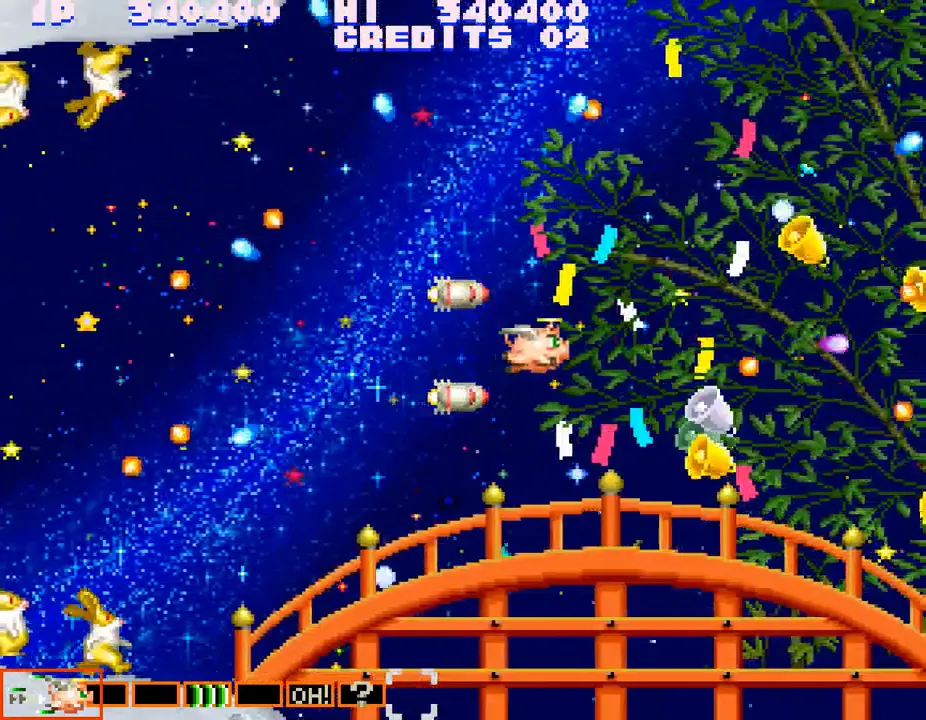
A red Japanese bridge stage with cherry blossoms and falling petals; the player ship navigates bullets through the foliage.

A red bridge and falling blossoms in the moon-stage sequence. The aesthetic range — from Vegas cabaret to Japanese folklore to space-rave disco inside a single half-hour run — is the part Tokuda undersold in his own self-assessment. Gokujō Parodius · Konami, 1994.

It is honest to name what Gokujō Parodius does not give a modern player. The arcade-honest difficulty spikes from Stage 5 onward will eat credits the first three runs, and the Special Stage is, by Tokuda’s own design intent, a wall for hardcore players. The English-language access route is awkward: the cleanest legal-English release is the rare Saturn Fantastic Journey import, the currently-sold Parodius Portable on PSP is a Japanese-only release with six music substitutions baked in, and Konami’s 2019 Arcade Classics Anniversary Collection somehow shipped without it. The Super Famicom port loses two-player simultaneous and gains slowdown; it adds Goemon, Kid Dracula, and Bio Miracle’s Upa as guest characters and is interesting for that reason, but it is not the way to meet the arcade game. The honest answer for most readers today is MAME on a controller, second player on the couch, Parodius Portable if you want a legal route and can read the menus.

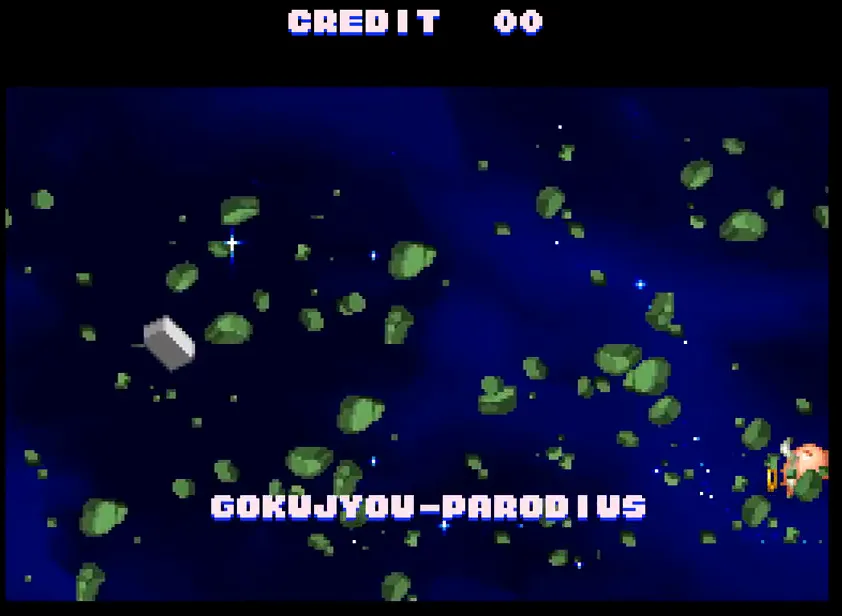
The Special 'Shooting History' bonus stage — green asteroids drifting on a starfield with a GOKUJYOU-PARODIUS title flash.

The bonus ‘Shooting History’ stage — a medley level Tokuda designed as a one-loop reward, looping previous-game music through the action. The ‘past glory’ the subtitle keeps promising lives here, played as celebration rather than mourning. Gokujō Parodius · Konami, 1994.

The wider point, and the reason the rescue argument is not the wrong one, is that Gokujō Parodius gives a present-day player something nothing in the genre’s modern lineage gives: the room-temperature confidence of a developer who has run out of fear. Compare it to Gradius II, its ancestor — Gradius II is precise, punitive, ascetic, the player tested against the design rather than welcomed into it. Compare it to Salamander 2 or Sexy Parodius, its successors — both careful, both inflected by the fighting-game decade either coping with or working around the floor. Gokujō Parodius alone plays as if the genre’s marginalisation is freeing. Tokuda made the shooter he wanted to play, on the hardware he was given, with a team young enough not to know it was supposed to be cautious, and the result is the loudest argument for arcade variety the year produced. The director got the score wrong because he was inside it. Players outside it have thirty years of evidence the other way.

Cartridge Collective 1994 · Arcade · Super Famicom · PSP · Saturn

Where to play

Why Now

Eight characters with asymmetric weapons fan into a 1994 arcade built like a cabaret floor — the loudest, most generous co-op shmup of the era.

Best way to play now Arcade ROM via MAME (RetroArch core or standalone)

The Konami GX board exactly as it was operated — original music, 2P simultaneous, no cuts. Free, accurate, and the only route where every editorial decision the team made arrives intact.

Time
~30 min Reach the disco stage — about twenty minutes in, where the case the game is making becomes hard to ignore.
Cost
Free Saturn Fantastic Journey import runs £30–80; PSP Parodius Portable £25–40 with substituted music.

Alternatives

  1. 01
    original

    Saturn — Gokujō Parodius Deluxe Pack (Europe: Fantastic Journey)

    The only official English-language release — the Saturn Deluxe Pack was rebadged for Europe with translated UI and packaging. Import-collector rare; the cleanest non-MAME route.

  2. 02
    original

    PSP — Parodius Portable (Japan, 2007)

    Still sold on the Japanese PSN. Plays on PSP and Vita. Caveat: six music tracks substituted for licensing — Stage 1's opening cue swaps the In the Mood big-band riff for Turkey in the Straw.

  3. 03
    original

    Super Famicom port (Japan, 1994)

    Adds Goemon, Kid Dracula, and Bio Miracle's Upa as guest characters but loses two-player simultaneous and gains slowdown. Of interest for the guests; not the way to meet the arcade game.

  4. 04
    simulation

    MiSTer Konami GX core

    If you already run a MiSTer, the GX core puts the original arcade board on FPGA — the cleanest hardware-accurate route short of finding a JAMMA cabinet.

1994 · Konami

Listen

  • Gokujō Parodius! — Arcade SoundtrackSeiichi Fukami · Satoko Miyawaki · Kazuhiro Senoo / Konami Senoo's first Konami project, sharing duties with the in-house Konami Kukeiha Club bench. The classical pastiches read straight: Sarasate's Zigeunerweisen for the mermaid, Dvořák's New World as a disco remix for the closing stage.

Watch

  • Gokujou Parodius — Arcade Longplay (1994)Ironclaw / Longplays.org · YouTube Full single-credit arcade run on the Konami GX board — the cleanest reference for the original music and 2P simultaneous before the home ports.
  • Gokujou Parodius (Super Famicom) — LongplayxRavenXP / World of Longplays · YouTube Useful contrast point — the SFC port shows what is lost (2P simul, frame stability) and what is added (Goemon, Kid Dracula, Upa as guest characters).

Read

  • Gokujou Parodius! — 1994 Developer InterviewTsukasa Tokuda et al. / Shmuplations (translated from Game Hisshou Guide, June 1994) The pivot source: the director on the post-Street Fighter II vacuum, the mixed-gender team, why an anniversary brief became a defiance act, and the cruel 'Mr. Past Glory' ending pun.
  • Gokujou Parodius Developer Interview — It's FantasticTsukasa Tokuda / It's Fantastic (translated from Gamest 125, 15 September 1994) Second translation of the same team in a different Japanese mook — covers the Special Stage as a single-loop reward for hardcore players and the character roster's mid-development expansion.
  • Gokujou Parodius — retrospectiveHardcore Gaming 101 The reference English retrospective: GX hardware notes, port-by-port analysis, and the 2007 PSP licensing swaps documented track by track.
  • 極上パロディウス 〜過去の栄光を求めて〜Japanese Wikipedia Confirms the 26 April 1994 arcade release and the gag-manga lineage absent from English coverage — illustrator Asari Yoshitoo contributed alongside Shuzilow.HA.
  • Parodius (1994) — creditsMobyGames Credits ground truth for the small core team — Tokuda, Shuzilow, Senoo — and the in-house Konami Section 2 hierarchy.
  • Parodius Portable music restoration patchRetroGameTalk forum Community track-by-track list of the six music substitutions in the 2007 PSP collection — the most concrete documentation of which arrangements were lost when the licensing ran out.

Chapter 04

International Superstar Soccer Deluxe

Konami Osaka's Half of Pro Evolution Soccer

Two football teams ran inside Konami in 1995. The one in Osaka shipped a SNES game that argued matches should feel like arcade games — sprinted, narrated, sharp. The other studio got Pro Evolution Soccer's name. This was the half that taught it how to play.

Super Nintendo1995FootballKonami (Major A)

International Superstar Soccer Deluxe · Konami (Major A) / Super Nintendo, 1995

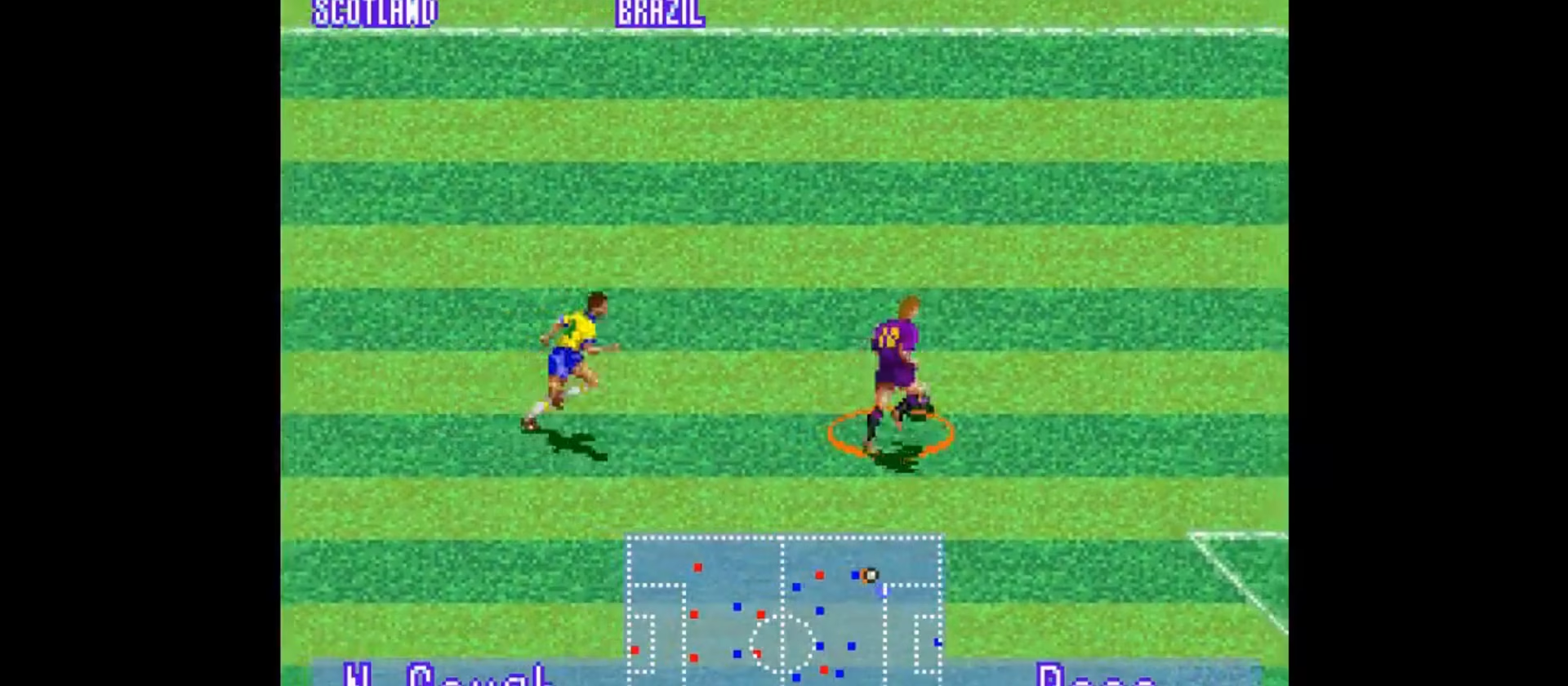
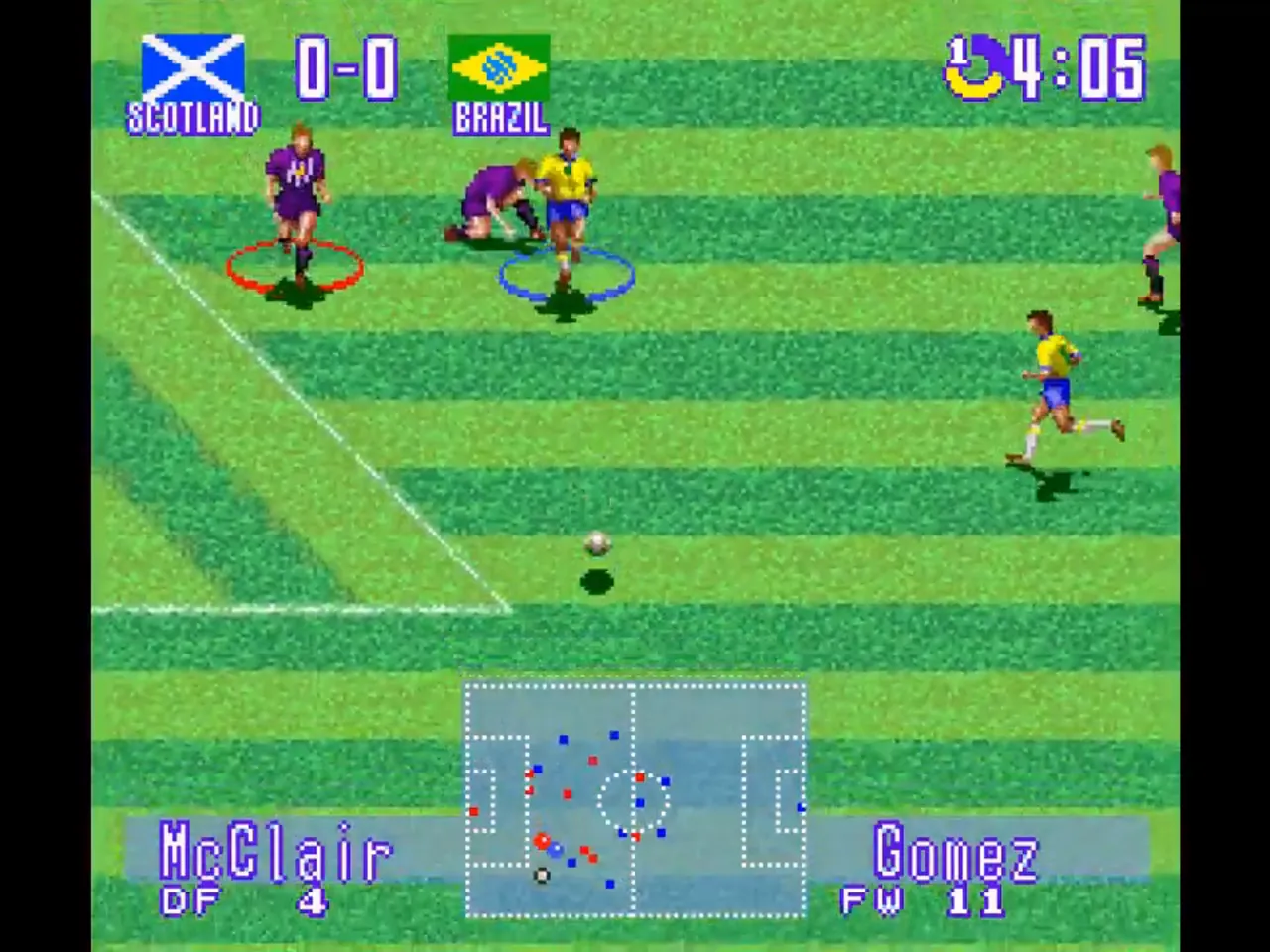
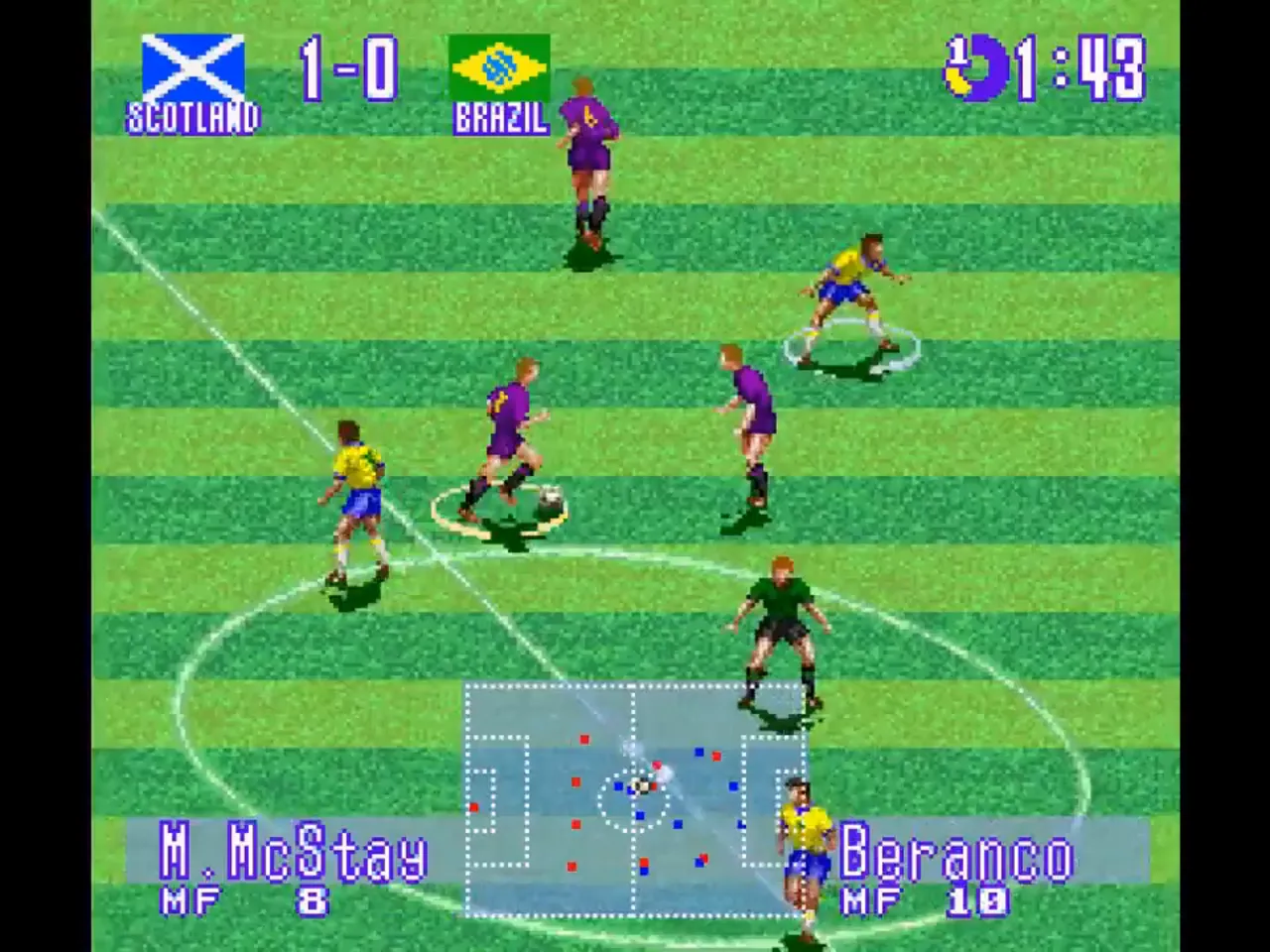
Holding Y burns a small reserve and your forward bursts past his marker — not gradually, not with a one-second wind-up animation, but immediately, with the sharpness of a 1990s arcade game in a hurry to entertain you. A one-touch pass arrives flat and exactly where you sent it. The lob you flicked from midfield is already most of the way to the box, having risen ludicrously high for the sheer fun of doing so, and is now descending in a way the keeper will not handle. He gets a glove to it. The rebound bounces back into the six-yard area, where two strikers are already running. The commentator shouts. Someone scores.

This is International Superstar Soccer Deluxe a minute into its first match. It is also, almost beat for beat, the rhythm of every Pro Evolution Soccer game that came after — sprint, pass, shoot, rebound, narration — minus a generation of presentation gloss and a licensing budget. The strange thing is that none of the people you might credit for Pro Evolution Soccer made it. The team in Tokyo who would, three years later, get their hands on the lineage that became Winning Eleven and then PES were working on a different football game on a different system. ISS Deluxe was built in Osaka, by a separate Konami studio, and it is the half of the eventual PES DNA that almost nobody traces back to its source.

Osaka, not Tokyo

Konami had two football teams running in parallel in 1995. The Tokyo office was on Goal Storm, a brand-new PlayStation entry — the line that the designer Shingo “Seabass” Takatsuka would inherit two years later and eventually steer through International Superstar Soccer Pro, Winning Eleven, and the Pro Evolution Soccer canon. The Osaka office, a separate internal studio known inside the company as Major A and later formalised as Konami Computer Entertainment Osaka, had been on football since 1994’s original International Superstar Soccer and was now shipping its sequel.

“Major A quickly became the ‘go-to’ team for soccer titles within the company.” — Time Extension, on Konami’s Osaka football studio.

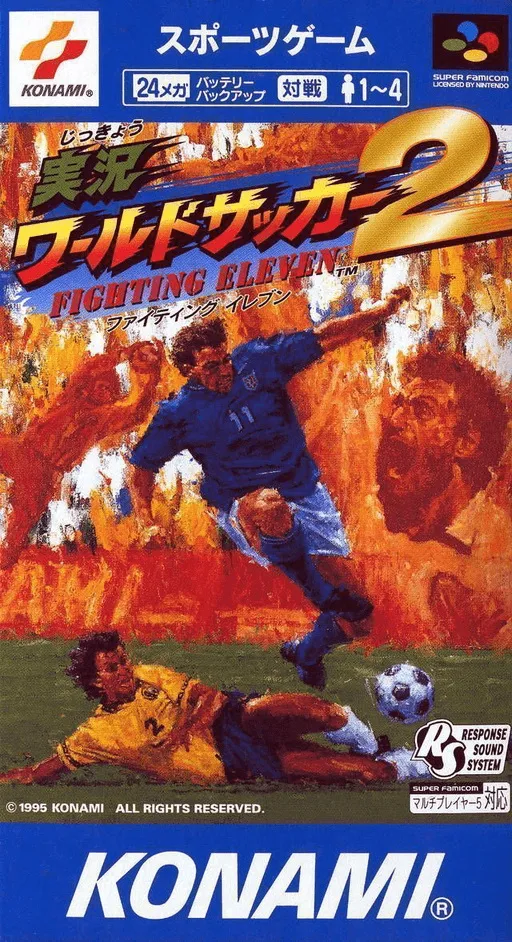
Super Famicom box art for Jikkyō World Soccer 2: Fighting Eleven, the Japanese release of ISS Deluxe — a tall portrait painting of two players in a sliding tackle, the title set in red Japanese script over the Konami logo.

Super Famicom box · Jikkyō World Soccer 2: Fighting Eleven · Konami, 1995. Jikkyō (実況) — live commentary — leads the title.

They were different lines, with different design instincts. Tokyo’s PS1 work pulled toward simulation textures — broadcast cameras, deliberate movement, a softer feel of weight. Osaka pulled the other way. ISS Deluxe runs faster than any contemporary football game in its memory bracket; it treats matches the way Konami’s arcade games treated stages, as ten-to-fifteen-minute units of high-density input. Players sprint with a button. Passes are deterministic. The keeper spills more than he holds. The two lines didn’t merge into a single Winning Eleven pipeline until 1997, when Takatsuka took over and folded both teams’ design vocabulary into one engine. By then, the half of that vocabulary you can still feel inside modern PES — the sharpness, the one-touch passing, the commentary — had already been written. It had been written in Osaka, on a Super Famicom cartridge, in 1995.

Football as arcade game

The argument the game makes with its hands is that football is a sprint. Holding Y burns a stamina pip; the sprint resolves immediately into a forward burst, fast enough to get past a defender if you’ve timed it before he turns. FIFA Soccer 96, EA’s headline contemporary, had no analogue — its players accelerated through animation states. The contrast is the whole design.

Passing is the same: the pass button sends the ball flat and exactly where you sent it, with none of the modern simulation habit of nudging the ball toward the “right” target on the player’s behalf. The lob button, by contrast, is the arcade flourish — a flicked B goes ludicrously high, an exaggeration so committed it loops back into entertainment, before the ball returns to plausible physics on its descent. Iain Mew, in a long retrospective on the original ISS, characterised the keeper as “athletic reflexes but poor ball retention, creating entertaining ‘goalmouth pinball’.” That is precisely the texture: shots are saved into the danger zone, not out of it. Rebounds are a system, not a bug.

There are thirty-six teams on the select screen, none of them licensed, all of them recognisable from the unlicensed-but-suggestive surnames — a striker with a great hairstyle for Colombia, a holding midfielder named Beckenbauer-by-another-syllable for Germany. The team-balance is the sort of broad statistical sketch every football game ships now, but here it actually matters: a fast side plays differently from a technical one, because the sprint and pass primitives are precise enough to feel the difference. Friendlies, leagues, knockout cups, an international tournament — the modes are templates, but each match is paced like a 1990s Konami arcade level, with the same density of decisions per minute as Sunset Riders or Turtles in Time. Two SNES multitaps will get you eight controllers on the same console, eight humans on the same pitch, one ball.

The thing this all adds up to, played today, is that decisions happen at human speed. You see a gap, you sprint into it, the pass goes. There is no animation tax between intent and movement. Modern football games have spent twenty years adding plausibility to that pipeline — momentum, traction, contextual animation — and the side effect is that the moment of decision has gradually been moved from the player’s brain to the controller buffer. ISS Deluxe never made that trade. The cost is that it doesn’t look like football on television. The gift is that it feels like football in your hands.

A commentator who never shuts up

The Japanese title, Jikkyō World Soccer 2: Fighting Eleven, sells the commentary in the first word. Jikkyō (実況) means live play-by-play; Konami had built a recognisable engine for it the year before in Jikkyō Powerful Pro Baseball, and the Osaka football team applied the same template to a different sport. The result, in English, is a voice that calls every shot, every save, every offside, every long ball — chirpy, terse, occasionally inane, and atmospherically essential. The Mega Drive port that followed in 1996 was, by Mundo Retrogaming’s account, “probably the only soccer game on the Genesis that featured true voice-over commentary.” On the SNES, in 1995, it was a small miracle of cartridge engineering.

The compositions underneath, by Hideyuki Eto, Harumi Ueko, Tomoya Tomita and Kazuhiko Uehara, are written for a stadium — synth-brass anthems for menus and team-selects, crowd loops cross-faded under match audio. The Mega Drive port, conducted by the Turrican composer Chris Hülsbeck for the German developer Factor 5 (who handled the conversion entirely), exists as a fascinating parallel score. The notable thing about all of it is that it works in service of an idea: that a football game is an event, with a soundtrack and a narrator and a crowd, not a closed system. Konami Tokyo’s eventual PES line would inherit this conviction wholesale.

What the licence gap built

The reception, in English-language press, was as good as anything Konami released that year. Computer and Video Games gave it 91%, calling it “an essential buy for fans of fast, fun footy” and ranking it as the best soccer game on the system. GamesMaster placed it 34th in their 1996 Top 100 Games of All Time, ahead of most of its release-year peers. Nobody was treating it as the runner-up to FIFA.

The real difference was structural. EA had locked the FIFA Federation licence — real team names, real player names, the brand authority. Konami had to ship with unlicensed-but-recognisable rosters: a striker with curly hair who is obviously Carlos Valderrama, attached to a team that is obviously Colombia, with both standing in for what the licence would have called them. The whole ISS and PES line carried that workaround forward for two decades. The accidental effect is that the game’s energy goes into the model on the pitch — the sprint, the pass, the rebound — and not the model on the broadcast graphic. If you have ever wondered why PES fans, deep into the 2000s, kept loyal to a series that lost the licence war comprehensively, it is partly because Konami had been forced, by the licence gap, to put the design somewhere FIFA wasn’t competing.

The friction worth naming honestly is the camera. ISS Deluxe keeps the view zoomed in close to the play, with a radar minimap as the only way to see what the rest of the pitch is doing. Mew, in his retrospective on the original, called it a habit of “staring at little coloured dots.” Modern players accustomed to broadcast-cam football will notice. It is the one place the game shows its 1995 origin clearly, and there is no defending it as a design choice rather than a hardware constraint — the SNES could not show what a tactical-cam wanted shown. You play through it; you don’t play around it.

What it still gives you

There is no legitimate digital re-release. Konami has not put International Superstar Soccer Deluxe on a storefront, has not included it in any Konami Collector’s Series compilation, and has not added it to the Nintendo Switch Online SNES library at the time of writing. The MiSTer FPGA SNES core is the most-accurate route a paying customer can take; emulation is what the rest of the world will actually do. A Super Famicom cartridge of Jikkyō World Soccer 2 — the Japanese commentary build — costs less than a takeaway dinner on the import market.

The reason to play it now is not preservation. It is that modern football games have built a beautiful, broadcast-accurate, animation-locked decision pipeline that almost nothing immediate can survive, and ISS Deluxe is what football feels like before that pipeline existed. A sprint is a press, not a state machine. A pass is a line, not a probability cone. A save is a rebound. The Konami office in Osaka, working with a licence gap, a stamina reserve, and a commentator, found a tempo that nobody has since improved on. Tokyo got the eventual brand. This is where the football came from.

Cartridge Collective 1995 · Super Nintendo

Where to play

Why Now

Hold sprint, thread a one-touch pass, and the keeper spills a save into a six-yard scramble — football at the tempo modern simulations have animation-locked out of existence.

Best way to play now MiSTer FPGA (SNES core)

No legitimate digital re-release exists — Konami has never relisted this game on a modern storefront. The MiSTer SNES core is the closest cycle-accurate route; an accurate emulator (RetroArch / bsnes) is the practical second.

Time
Match ≈ 10–15m · Cup run ≈ 60–90m One cup, group stage to final.
Cost
Free via emulation Original cartridges remain inexpensive on the import market; the Japanese release is *Jikkyō World Soccer 2: Fighting Eleven*.

Alternatives

  1. 01
    simulation

    MiSTer FPGA — SNES core

    Cycle-accurate SNES recreation. The default route given there is no licensed re-release to recommend.

  2. 02
    emulation

    RetroArch (bsnes, Snes9x)

    Accurate SNES cores. The English-commentary build is the one to seek out — the commentary is part of the design.

  3. 03
    original

    Super Famicom cartridge (Jikkyō World Soccer 2)

    Cheap on the Japanese import market. Commentary in Japanese; menus navigable from screenshots.

1995 · Konami (Major A)

Listen

  • Jikkyō World Soccer 2 — Full SNES OSTHideyuki Eto / Harumi Ueko / Tomoya Tomita / Kazuhiko Uehara The SNES rip — synth-brass anthems and crowd loops by the in-house Konami sound team. The 1996 Mega Drive port handed scoring duties to Chris Hülsbeck, and the contrast is worth a parallel listen.
  • International Superstar Soccer Deluxe — Mega Drive OST (Hülsbeck)Chris Hülsbeck / Internet Archive Hülsbeck's Mega Drive arrangement — the Turrican composer brought to a football game by the Factor 5 conversion team. A different score for what is nominally the same game.

Watch

  • International Superstar Soccer Deluxe — SNES LongplayWorld of Longplays / YouTube A full cup run, English commentary build. The clearest way to see how matches actually pace — the sprint button and the goalmouth pinball are visible inside the first ten minutes.
  • Remember When Japanese Football Games Ruled The World?Time Extension Companion long-read on the Konami / Sega / Namco football boom — the context that puts Major A's Osaka studio next to its peers and explains why this game's commercial slot existed.

Read

  • International Superstar Soccer. Konami step onto the pitch and set up…Iain Mew / Medium
  • Remember When Japanese Football Games Ruled The World?Time Extension
  • Shingo Takatsuka — Pro Evolution Soccer WikiNeoseeker
  • International Superstar Soccer Deluxe (Mega Drive)Mundo Retrogaming
  • International Superstar Soccer Deluxe — MD Soundtrack creditsInternet Archive
  • International Superstar Soccer Deluxe — WikipediaWikipedia

Chapter 05

Salamander 2

The Salamander That Konami Left in Japan

Salamander 2 sat behind Japanese arcade glass for twenty-nine years before Konami sent it West in August 2025. The wait reveals the most legible Salamander cabinet — and its strangest.

Arcade · PS5 · Switch · Xbox · Steam1996Horizontal ShooterKonami

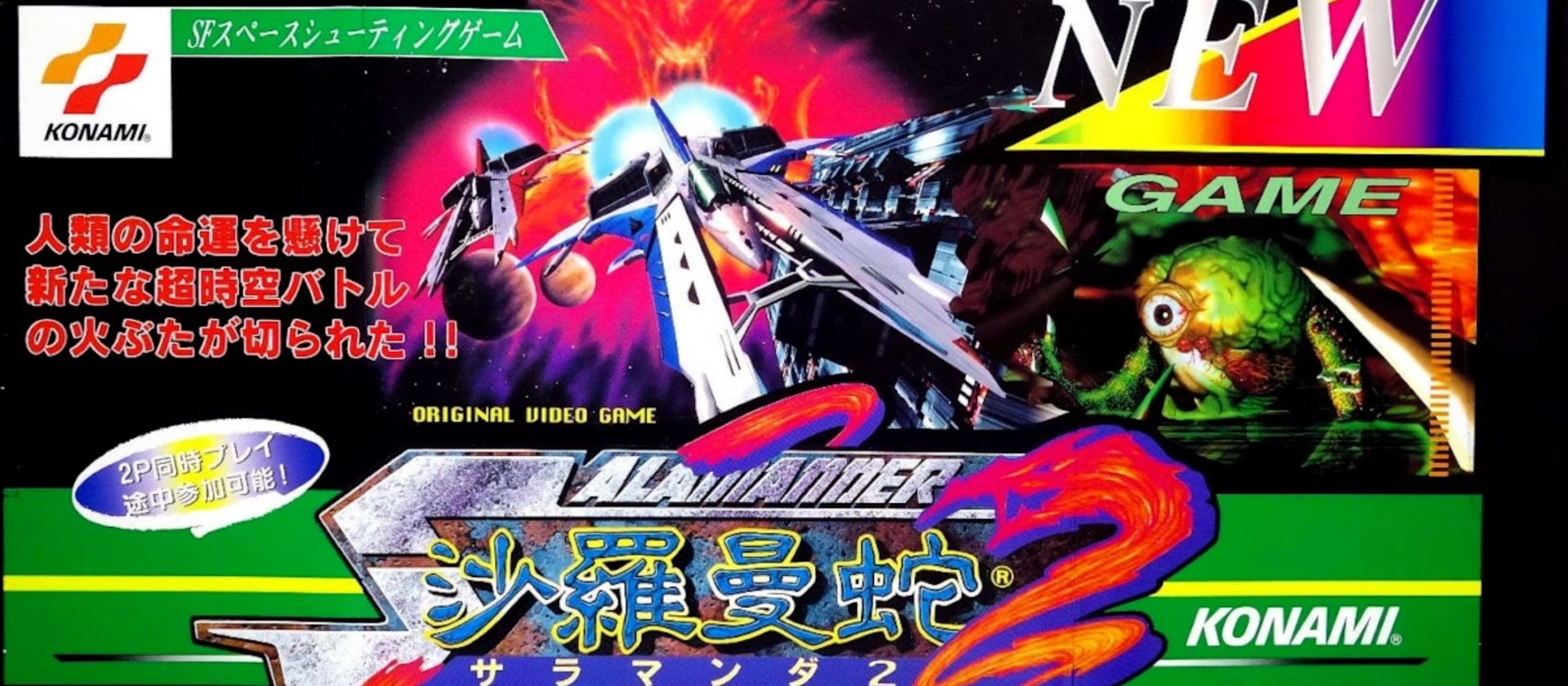
Salamander 2 · Konami, 1996 · Konami GX Type 2 arcade marquee.

It took twenty-nine years to leave Japan. The cabinet went up in January 1996 — a Konami GX board, the same silicon that ran Gokujō Parodius and Sexy Parodius — and the Japanese trade press buried it on arrival. Game Criticism called the colour sense poor and the new Option Shoot mechanic useless. Gamest readers filed it alongside Ultimate Tiger II as a sequel that could not beat its parent. The shooter market was collapsing under them. Konami did not announce the silence; the silence was the announcement. Then the arcade flyer in this article went into a drawer, and Salamander 2 did not appear in any version outside Japan until M2’s Gradius Origins shipped on PlayStation 5, Xbox Series, Nintendo Switch and Steam in August 2025. Played now, with thirty years of distance and a training mode, the game the magazines could not read is hard to mistake.

When the Golem Walks Off

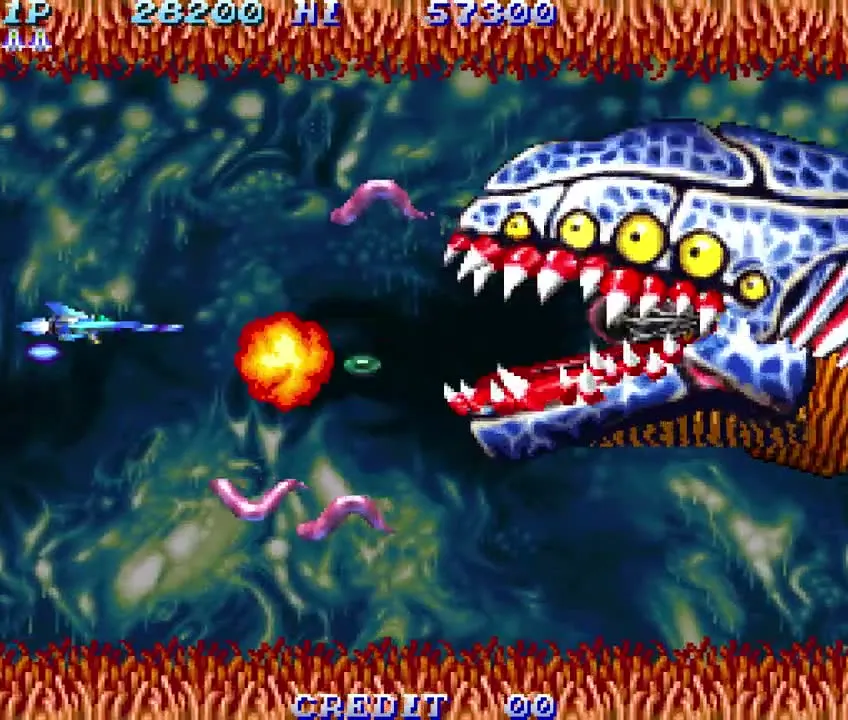
The opening fake-out is the cleanest evidence that nobody on the team had gone on autopilot. Stage 1 — Sublife Space, organic membrane behind a writhing red ground-line — sets up the Brain Golem of the 1986 cabinet exactly as the returning audience would expect. The horned, fleshy boss rises into the screen. Then it shrugs and leaves. What you fight instead is Biter, a six-eyed armoured eel whose mouth fills half the playfield, whose teeth are the cleanest sprite work in the game, and whose appearance is a knowing prank on the franchise’s own iconography.

Vic Viper faces the Biter boss in Stage 1 of Salamander 2 — a giant blue-armoured serpent with rows of red and white teeth and yellow eyes, against a green-and-gold organic background.

The Stage 1 fake-out — the Brain Golem of the 1986 cabinet rises, retreats, and hands the fight to Biter. Konami’s first move in the sequel is a knowing prank on the player’s own expectations. Salamander 2 · Konami, 1996 (Arcade, GX Type 2).

Mariko Tokida did the character art. In the 1997 developer commentary the Salamander Deluxe Pack shipped as bonus files — the only surviving testimony from the team — she said the Golem and the asteroids gave her the worst trouble in the project, that the colour palette had grown to the point of being unmanageable, and that the small enemies were “a battle in 16×16.” That last line is the diagnostic one. The board could push pre-rendered bosses and hand-painted backgrounds in 1996; the small enemies were still being authored at the resolution of the cabinet ten years prior. What the magazines read as a flat look is actually a transition signature: sprite-era Konami and CG-era Konami sharing one frame, the seam visible if you know to look for it.

The Biter figure is where the seam reads most clearly. The eel’s head is pre-rendered, polychrome, antialiased to the edges of its plates. The Vic Viper a quarter-screen to the left is the same chrome sprite from the previous decade. The small worm-grub enemies tumbling out of the dark are 16×16 pixels old. None of these things are wrong with the game; they are what the game is. The 1996 trade press was reviewing a shooter from 1996 against the shooters that would arrive a year later. The team was finishing a series and starting a new aesthetic in the same cabinet.

The Move the Magazines Couldn’t Read

The new mechanic was Option Shoot. Equip Options — the orbs from Gradius — and the dedicated B button no longer just deploys them. It fires them off the ship, in homing-lightning arcs that destroy bosses faster than sustained laser will. The launched Options then shrink and orbit the ship as Option Seeds, recoverable, holdable across deaths. The system reads, at five minutes’ acquaintance, like a complication that does not pay for itself.

”Enemy placement and presentation lack the ingenuity of the predecessor. The overall colour sense is poor. The Option Shoot has no good use.”
Game Criticism magazine review, 1996; preserved via the citation chain at 沙羅曼蛇2, ja.wikipedia.org

That third clause is the one that the modern Option Seeds practice reads back against. Sit with the Gradius Origins training mode for an hour and the boss-DPS economy clarifies: the launched Option is a damage payload that recovers the Seeds while you wait through the next pattern. The two-state cycle is the score curve. DoDonPachi would codify a conditional-DPS economy of its own twenty-two months later, in November 1997, and the next decade of Japanese shmups would normalise the pattern. Konami’s draft of the idea is a year early, named differently, sitting unread in Game Criticism’s third bullet point.

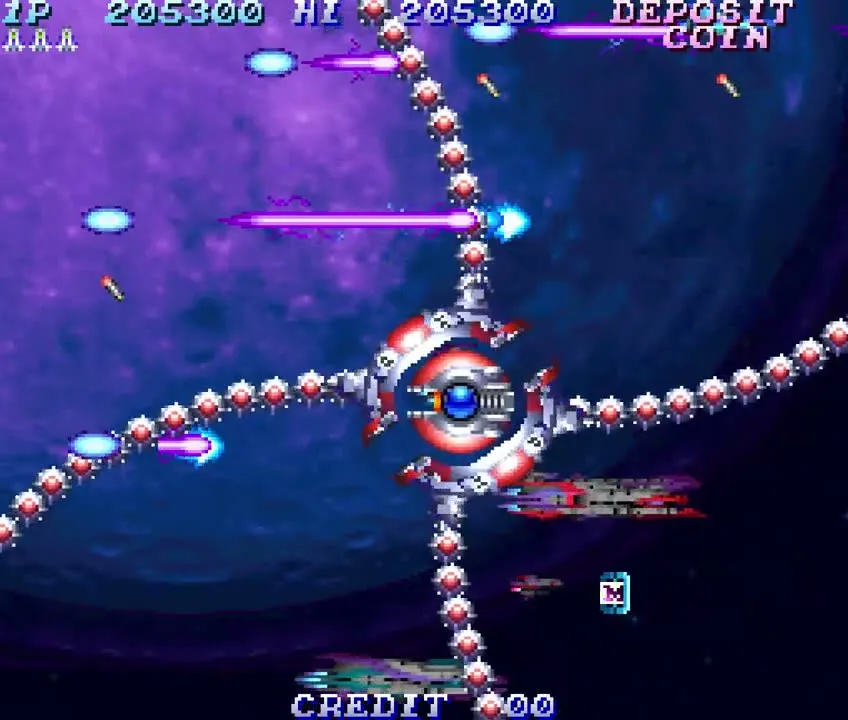
The Stage 5 Plate Core boss — a chrome-and-red ringed assembly with three rotating chains of red orbs whipping across the screen against a purple moon backdrop.

Plate Core, Stage 5 — the chain-arm boss that asks the player to time Option launches against the rotation, not the bullets. The mechanic the 1996 magazines dismissed turns out to be the centre of the scoring system. Salamander 2 · Konami, 1996.

The reception gap is the angle the article was always going to land on, and there is a reason the Game Criticism line is preserved in the Japanese Wikipedia citation chain even now. Salamander 2 released into the worst possible quarter for a Japanese horizontal shooter. Virtua Fighter 2 was a year into its dominance of the cabinets next door. Konami’s own Sexy Parodius would ship from the same board only weeks later and lap Salamander 2 on operator orders. Whatever the team had built, the room had moved.

Maeda’s Last Year of Sirens

The composer credit on the cabinet is Naoki Maeda under his early Ensoniq Maeda alias — named for the synth he was working on — sharing duties with Yuichi Takamine. Two years after Salamander 2 shipped, Yoshihiko Ota at Konami Computer Entertainment Tokyo would recruit Maeda to score the launch track for DanceDanceRevolution. Within five years he would be the sound producer for the franchise through DDR X. The Maeda whose name is still on every Bemani arcade in the world was, in 1996, mixing horizontal-shmup score on this cabinet.

Stage 2 — Prominence Fortress, vertical scrolling, solar-flare aesthetic — carries the track SENSATION, which is the closest the Salamander 2 score comes to naming its composer’s future. The kick pattern is dance-floor years before dance floors. The synth lead is the same family of sounds Maeda would push into BEMANI culture later. The other cues are mechanical in the Gradius way: stuttered arpeggios, walking bass under arpeggios, percussion that exists to mark beat units the player counts against bullet patterns. Less melody than Gradius II, by design — the Hardcore Gaming 101 retrospective is right that the percussion is thinner — and more rhythmic certainty than Gradius III had room for. The score is a metronome with a thesis. The thesis is that the rhythm is the play.

The second loop’s track list is the move that ties the score to the franchise. Cleared once and re-entered, the cabinet remixes Power of Anger, Last Exit, Planet Ratis from the predecessors, in arrangements that read as a goodbye letter. Whether the team knew at the time how much of a goodbye it was is the kind of question the bonus commentary does not answer.

The Bullet Wall Konami Visited Once

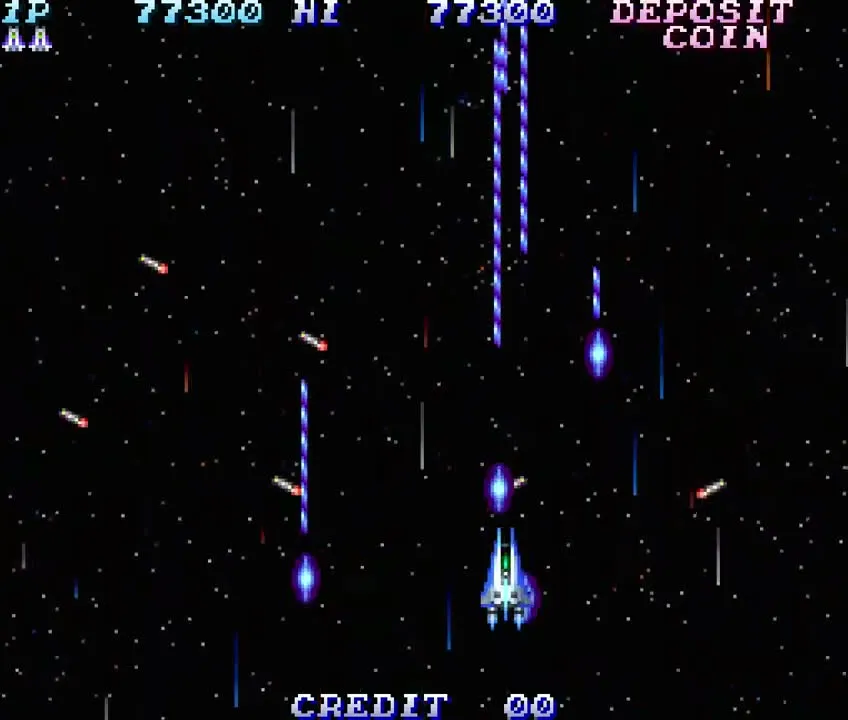
The final stage is the moment Konami briefly walks into a room that Cave was about to own. Stage 6 — Doom, vertical scrolling, deep starfield — closes on a multi-headed Lovecraftian creature, but the fight that gets the player there is a screen-wide bullet wall that the Black Hole retrospective rightly calls “quite novel in ‘96.” The DoDonPachi codification of bullet-hell density would arrive in November 1997, and Mushihimesama and Ikaruga would push the form into the next decade. The Salamander 2 wall is a sketch of the next genre by a team that had no plans to follow it.

Stage 6 of Salamander 2 — Vic Viper in the lower-centre of a black starfield threaded with parallel purple-and-white bullet streams falling from the top of the screen.

Stage 6’s final approach — a screen-wide bullet wall twenty-two months before DoDonPachi made the form an industry. Konami sketches a genre it would never commit to and walks out. Salamander 2 · Konami, 1996.

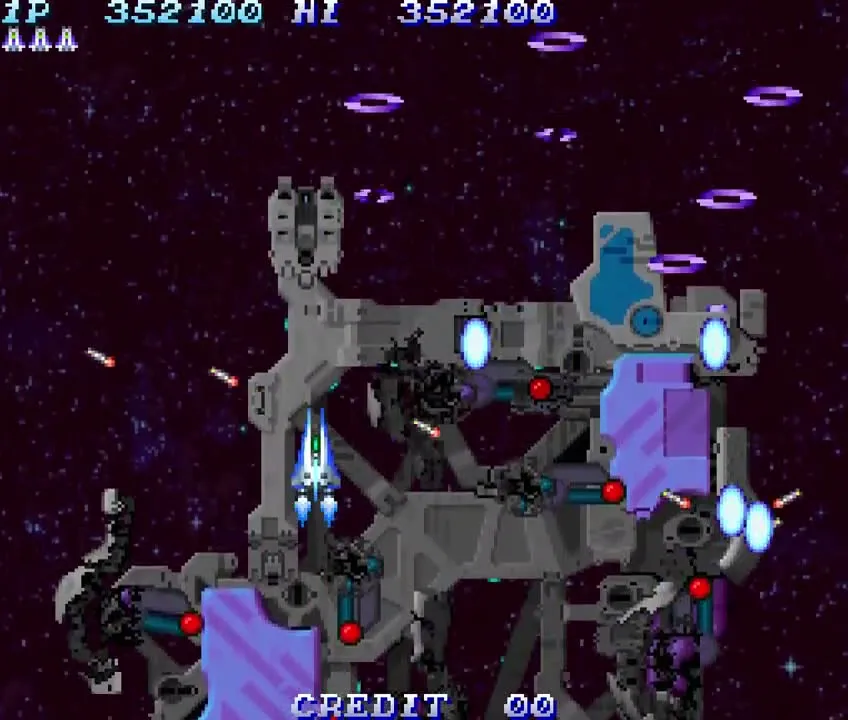
The R-Type homage of Stage 4 sets it up. The Giant Battleship section flies the player along the underside of titanic capital ships, the kind of horizontal capital-ship architecture Irem invented in 1987 and Gradius II had translated to Konami’s vocabulary by 1988. Salamander 2 renders the homage in pre-rendered greys against the deepest starfield on the board. The boss, Tenny Rop — a Tetran callback to Gradius II, the wording itself a franchise signature — closes the stage as cleanly as anything Konami had shipped in the cabinet era.

Stage 4 Giant Battleship section — Vic Viper rising into the cluster of grey enemy capital-ship architecture against a violet starfield.

Stage 4 — the R-Type homage rendered through Konami’s pre-rendered CG, with the Tetran-callback boss Tenny Rop waiting at the top of the screen. The franchise’s whole capital-ship vocabulary in one stage. Salamander 2 · Konami, 1996.

What the cabinet does not offer is the depth its competitors did. Gradius III in 1989 and Gradius Gaiden the year after Salamander 2 both gave the player Edit Mode — a loadout grid before the first shot. Salamander 2 ships you Vic Viper or Super Cobra and a fixed weapon tree. A complete one-credit run is twenty-five to thirty minutes; Edge gave it 6/10 in 1996 and called the runtime short, and it was right. The Biohazard stage’s palette is genuinely flat. Some readings of those flaws are wrong — the colour-sense complaint underrates how much of the look is a deliberate transitional aesthetic — but the brevity, the absent customisation, the no-checkpoint generosity that comes at the cost of Gradius’s strategic stakes are honest costs. The game asks the player to take a short, generous, organically-styled hour. It is not asking for more than that.

Twenty-Nine Years to the Rest of Us

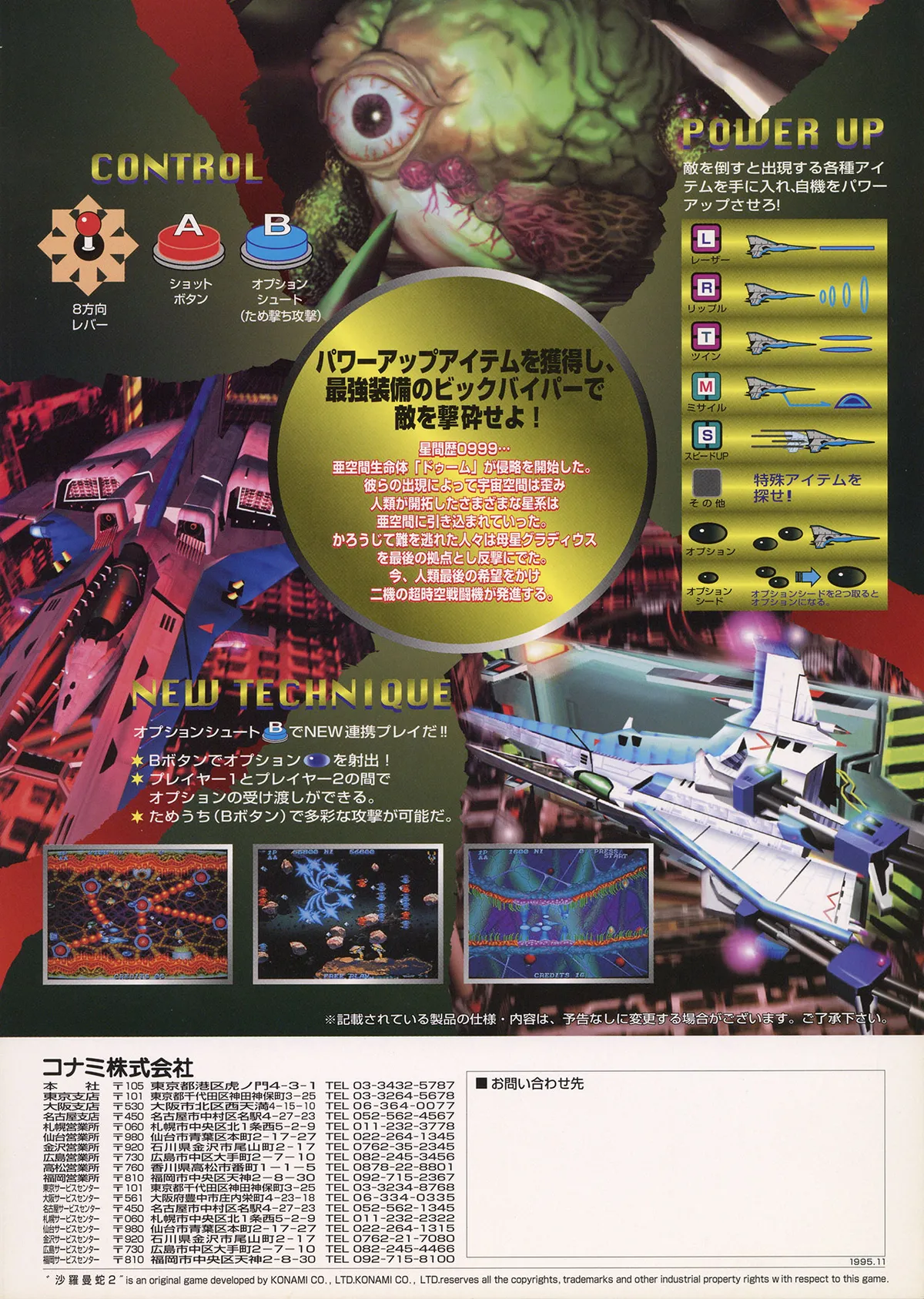
The flyer-back diagram on the wall in the second figure of any operator’s Salamander 2 cabinet is the artefact that Game Criticism should have read more slowly.

The back of the Salamander 2 arcade flyer — controls diagram, power-up grid showing seven weapon icons, and the New Technique panel illustrating the Option Shoot launch mechanic.

The 1996 flyer back, diagramming the mechanic the magazines would call useless within months. Konami’s own marketing department had it figured out — the launched Options leaving behind Seeds, the recovery loop, the boss-fight payload. Salamander 2 · Konami, 1996, Japanese arcade promotional flyer.

The diagram names what the prose did not: a New Technique, illustrated with the Vic Viper launching its Options and the resulting Seeds orbiting at reduced size. Konami’s marketing department had the system figured out before the operators received the boards. The trade press did not, and the cabinets came home in numbers the company never bothered to release. For the next twenty-nine years the only legal way to play the game was a 1997 Saturn / PlayStation compilation that sold inside Japan, a 2007 PSP bundle that sold inside Japan, or a MAME ROM. Salamander 2 became the longest-untranslated game in the Gradius lineage by a margin no contemporary would have predicted in early 1996.

The August 2025 Gradius Origins collection ends the wait. M2 — the preservation studio behind the Sega Ages line, Toaplan Arcade Garage, the Aleste Collection — has restored the arcade ROM with save states, rewind, a training mode that lets the player open the second-loop remixes without grinding to them, online rankings, and a region toggle that switches the cabinet between every regional build that ever existed. The collection bundles six other Gradius and Salamander cabinets and a new entry, Salamander III, the first new Salamander in over a decade. Konami’s own EU launch press release flags Salamander 2 among “regional versions previously unavailable internationally.” It is the corporate version of an apology.

What it gives the modern player is a six-stage, twenty-five-minute, instant-respawn Konami shooter with the kindest continue economy of any 1990s cabinet the studio shipped, the strangest organic art direction in the Gradius canon, a Mariko Tokida boss roster that has aged into precisely what the eye now wants from arcade CG, and a scoring system whose central mechanic Game Criticism misread in print. It is not the most beautiful 1996 arcade output Konami had — Sexy Parodius outranks it on that board — and it is not the most ambitious — Gradius Gaiden would arrive a year later for the home and would offer the customisation the cabinet refused. But it is the most legible Salamander Konami ever shipped, and the one the West has been allowed to read the longest while having no access to it at all.

Cartridge Collective 1996 · Arcade · PS5 · Switch · Xbox · Steam

Where to play

Why Now

Mariko Tokida's serpent-toothed Biter ambushes the Vic Viper in pre-rendered colour — Konami's most accessible Salamander, finally restored worldwide by M2 in 2025.

Best way to play now Gradius Origins (Konami / M2, 2025)

The first international release of Salamander 2 in any form — packed with the original arcade ROM, save states, rewind, training mode, online rankings, and the rest of the Gradius lineage. M2's emulation work is the cleanest route by every practical measure.

Time
25–30 min per credit-run Reach the Biter boss — the Stage 1 fake-out where the Mariko team shows their hand.
Cost
£30 Often £18–22 in seasonal sales. Bundles seven cabinets plus the new Salamander III.

Alternatives

  1. 01
    modern

    Gradius Origins (PC / PS5 / Xbox / Switch)

    M2 emulation with save states, rewind, training mode, region toggle, and online rankings. The single best route — the first one Salamander 2 has ever had outside Japan.

  2. 02
    emulation

    Salamander Deluxe Pack Plus (PS1 / Saturn, 1997)

    Bundles Salamander 2 with the original Salamander and Life Force, plus the 1997 developer-commentary bonus files Shmuplations later translated. Sonically preferable on PS1; the only route that ships the Mariko Tokida interview material.

  3. 03
    original

    Salamander Portable (PSP, 2007)

    Bundle of Salamander, Salamander 2, Gradius II, Life Force, and Xexex on UMD. Vita-compatible. Still the cleanest portable route if Origins on Switch isn't an option.

  4. 04
    simulation

    MiSTer FPGA — Konami GX core

    The Konami GX Type 2 board on FPGA — cycle-accurate hardware simulation for purists with a MiSTer kit and a legal ROM. The closest non-cabinet route to the original silicon.

  5. 05
    emulation

    MAME — original arcade ROM

    The 1996 Konami GX Type 2 board through software emulation. Free and accurate; Gradius Origins supersedes it on every practical axis except cabinet-purist authenticity.

1996 · Konami

Listen

  • Salamander 2 — Arcade SoundtrackNaoki Maeda · Yuichi Takamine / Konami Kukeiha Club Maeda's 1996 work, credited as ‘Ensoniq Maeda' for the synth he was writing on. Two years later he would be recruited to compose the launch track for DanceDanceRevolution. Stage 2's SENSATION is the standout — vermilion synthwave that names its successor before its successor exists.

Watch

  • Salamander 2 (沙羅曼蛇2) — Arcade LongplayArcade Longplays / YouTube Clean MAME single-credit run through all six stages, both loops included. The cleanest reference for the Mariko Tokida art and the Option Shoot economy in practice.
  • Salamander 2 — Arcade · 2 Players, 1 Loop [TAS]TAS / YouTube Tool-assisted speedrun of a 2-player loop. The cleanest reference for the Option Shoot economy at full optimal: launched Options chained through bosses, Seeds recovered between patterns, the scoring system the 1996 trade press could not read.

Read

  • Salamander — 1997 Developer Commentary (Mariko Tokida)Shmuplations (translated from Salamander Deluxe Pack bonus files, 1997) The only surviving developer testimony for Salamander 2. Mariko Tokida on the Golem boss, the asteroid sprites, and the 16×16 small-enemy art she preserved while the bosses moved to pre-rendered CG.
  • Salamander 2 — Hardcore Gaming 101Hardcore Gaming 101
  • Salamander 2 — Shmups WikiShmups Wiki The canonical reference for the Konami GX Type 2 board, the Option Shoot rules, stage routing, and port differences.
  • 沙羅曼蛇2 — Japanese Wikipediaja.wikipedia.org Preserves the citation chain for Gamest magazine's pre-release show-build bug coverage, the Gamest reader column ‘アイランド' grouping with Ultimate Tiger II, and Game Criticism magazine's three-point dismissal.
  • Salamander 2 — When merely good is good enoughGames From The Black Hole
  • Gradius Origins launch — Konami Digital EntertainmentKonami Digital Entertainment B.V., 2025-08-07 Konami's own EU press release, flagging Salamander 2 among ‘regional versions previously unavailable internationally.' The corporate confirmation of the twenty-nine-year hold.
  • Naoki Maeda — RemyWiki biographyRemyWiki Documents the Ensoniq Maeda alias on Salamander 2 and the 1998 recruitment to DDR by KCET's Yoshihiko Ota.

Chapter 06

Policenauts

The Last Konami Adventure Kojima Wrote Alone

Storyboarded in 1990 during a Snatcher break, finished six years later across four ports, untranslated in the West for thirteen years — the last Kojima adventure where every voice take and fade-out is his alone.

PlayStation · Sega Saturn1996Cyberpunk AdventureKonami

Policenauts · Konami, 1996 · PlayStation key art

Policenauts is the last project Hideo Kojima made alone. Every fade-out, every voice take, every musical cue across its twelve hours is a choice he made personally — and three years after the PlayStation version shipped, he said as much himself. Metal Gear Solid, the project that followed it, would be where he stopped trying.

The version most modern readers will play is a fan translation. Konami of America cancelled the official English Saturn release sometime in 1996; in August 2009, a five-person volunteer team led from a forum thread at JunkerHQ.net put out a finished patch for the PlayStation version on the night of Kojima’s forty-sixth birthday. Some of the bugs that patch fixes were bugs Konami left in the master.

The reason to come back to it now is not preservation, and not Kojima’s later career either. It is that the design ideas the fan team brought across — the gun that the story holds back until the player has earned it, the voice direction that nobody at Konami would attempt again at this scale, the phrase-based interface that asks one verb of you at a time and means it — have aged into clarity. Most of what Metal Gear Solid would become was already in this room. Most of what made it work was already on the page.

Six Years to Land One Storyboard

The project predates the question. Kojima storyboarded Policenauts in 1989 and 1990, during gaps in Snatcher development — the PC-88 and MSX2 versions of which were running into the same memory ceilings that would force Konami to truncate that game from five acts to two. The Policenauts storyboards were the consolation project. They sat in a drawer for two years while Kojima carried the Snatcher PC-Engine remake to release, then went into pre-production proper around 1992.

What landed in July 1994 was a PC-9821 release that ran 640×400 across six floppies, painted in sixteen colours. Yoji Shinkawa, three years before he would draw Metal Gear Rex, was on bug-checking duty when he asked to touch up the EMPS — the powered suits the Beyond Coast colony police wear for orbital work. The drawings he supplied are the first Konami mecha he ever signed. Most famous mecha designer in Japanese games, in by the back door of an adventure game.

A photograph held up on a desk: Ed Brown in a yellow jacket and Jonathan Ingram in a red bandana, dialogue box reading 'Ed Brown....'

Jonathan and his old Beyond Coast partner in the on-screen photograph the player keeps returning to. The buddy-cop reference Kojima named openly — Lethal Weapon, Starsky & Hutch — shown rather than spoken. Policenauts · Konami, 1996.

The setting Kojima built around the storyboards is its own quiet provocation. The year is 2040; the place is “Old Los Angeles,” now known to its inhabitants as HOME — the planet a colonist would return to if they had to find something they’d left behind. Twenty-five years earlier, the orbital colony Beyond Coast was completed. Jonathan Ingram, one of the five original Policenauts trained to keep order there, drifted in cryosleep for nearly all of those twenty-five years after an EVA accident, and the game opens with him alive on Earth as a private detective, in late middle age, fielding a request from the wife he last saw when she was twenty.

The colony itself was deliberately drawn as a cylinder — a choice Kojima explained at the time. “A cylinder-type colony doesn’t have much of a reality to it,” he told Mamoru Oshii in a 1996 interview, “but visually for today’s generation it’s what they recognize as a space colony from a glance.” He’d considered a torus, considered a sphere; he picked the shape readable to the eye over the shape that would have been physically right. The whole game runs on that hierarchy.

Aim Outer Square, Wait for the Anger

What you actually do in Policenauts is read paragraphs and choose verbs. Each scene presents a painted cel against which dialogue boxes resolve; the cursor moves over a face or an object; you choose between Look, Investigate, Listen, Ask, Show, Take — the Snatcher verb-set carried forward with a single-screen pointer interface that the 1992 game didn’t have. Most rooms reward the second observation command. The recruitment poster in the JUNKER lobby reads, on first look, as a recruitment poster; investigated, it carries the same conscript-shortfall undertone that Snatcher’s lobby did in 1992. The way you build a city behind every interactable object is by clicking everything twice.

A frame of Policenauts dialogue: Lorraine — purple-shirted, holding folded clothes — stands in front of blue venetian blinds, the dialogue box reading 'Lorraine: It's just the three of us — my husband, my daughter and me.'

The single-pointer interface that replaced Snatcher’s command menus. One face per beat, one verb at a time — phrase-based dialogue tuned for the directorial pace Kojima wanted. Policenauts · Konami, 1996.

The friction is real and worth naming. Twelve to fifteen hours of phrase-based dialogue is slow by modern standards. The plot is OVA melodrama played straight — organ-transplant conspiracy, decades-cold case, late flashback revelations — and whether the reader buys it depends entirely on tolerance for the register. The female-NPC clicking sub-mode, where the player can grab at the chests of any woman on screen and watch a credited animation play, is a piece of authorial indulgence the article won’t dress up; same hand, same micromanagement, same product.

What the game does that almost nothing else in 1996 did is hold the player’s gun back. The shooting interludes are not light-gun grammar of the Lethal Enforcers kind, where you fire at whatever moves; they are scripted gallery sequences keyed to specific story beats, and the system makes you wait. “Gun games like Lethal Enforcers are really fun, but they don’t really evoke much empathy from the player,” Kojima told Shmuplations in 1996. “In Policenauts, take Redwood for example. As Jonathan comes to see him as a villain in the story, his (and the player’s) anger rises, until it reaches a boiling point and, at the time, Jonathan draws his gun.” Diegetic rage, the design says, as a control input.

Old Los Angeles street at night — neon marquee reading 'WHO WILL BE FIRST / DEBRIE DOES EM ALL / STAR ANGEL,' a Speed-King poster on the left, a posed figure under the marquee — with the Policenauts LIFE bar and ammo counter at the bottom of the frame.

The Old LA shooting sequence with the LIFE bar and ammo counter rolled up from below. The trigger is held back behind paragraphs of dialogue: Kojima wanted the rage earned before it was loaded. Policenauts · Konami, 1996.

You aim with an outer square — a soft pointer that hovers off-centre — and return to the middle to fire, then drop back out to keep tracking. The discipline is closer to a duel than a shooting gallery. By the time Jonathan is allowed to draw on Tony Redwood, the colony’s pharmaceutical magnate and the antagonist Kojima specifically named in the Shmuplations quote, you have spent hours processing his unctuous racial-policy speeches and his hands on women you’ve spent the game trying to find. The light-gun grammar is the same it would have been at the start; the meaning is not.

Voice Acted Like a Dubbed American Movie

The voice direction is the keenest authorial fingerprint of the game. Kojima cast for film, not games. “With Policenauts I wanted the actors to act as if they were dubbing an American movie,” he told Oshii, “so I picked out people who had experience with movies.” He recorded the cast in groups: “I wanted to record the dramatic parts with 4 or 5 actors at the same time but such a thing seems to be rarely done in the game industry.”

It wasn’t. Japanese-language games in 1996 typically isolated each actor at a single mic and stitched takes together in post. Kojima had four or five voice professionals in the same room reading off the same paragraph, listening for breath and overlap, breaking each other’s lines. The result, on first hearing in the patched English release, sounds almost overproduced — too acted, too cinematic — because the medium does not normally do this.

”I created Snatcher entirely by myself. I could control the timing of sound effects, where fade-outs occurred, and pretty much everything. But ultimately, after Policenauts I came to the conclusion that controlling everything myself wasn’t necessarily a good thing.”

Hideo Kojima, 1999 developer interview, Shmuplations translation

The score is the same logic in a different register. Masahiro Ikariko (Metal Gear 2: Solid Snake), Motoaki Furukawa (the Snatcher CD-ROMantic arrangement lead), and Tappi Iwase — Konami Kukeiha Club regulars — wrote a soundtrack that doesn’t sound like a 1990s Konami video game and does sound like Michael Kamen scoring an action film. Synth-funk bass under saxophone leads; cues stacked to film-cue lengths rather than looping arcade phrases. The King Records album shipped in February 1995, between the PC-9821 release and the 3DO port — Konami selling the music as standalone product before three of the four console versions even existed.

The cel animation is the third pass at the same idea. Anime International Company, the studio behind Bubblegum Crisis and Tenchi Muyō!, drew the cutscenes for the 3DO and Saturn cuts at twenty-four frames; the PS1 cut runs at fifteen. Not anime aesthetic — anime craft, hired in to draw the way they would have for a direct-to-video film. The game is a director’s catalogue, fanned across film, score, and dub.

What Six Volunteers Restored in Konami’s Absence

The official English release died at Konami of America in 1996, in unrecorded internal votes. Kojima later cited lip-sync timing problems with the phrase-based dialogue. Jeremy Blaustein, who had localised Snatcher for the Sega CD and would localise Metal Gear Solid, told The Snake Soup there were “no internal plans” to do Policenauts while he was at Konami: “There was no English dialog recorded.” The structural reason was Snatcher’s Sega CD release — around two thousand US copies sold in 1995 — and a twelve-hour adventure game in a 3D-action market that looked like a longer bet on a longer-form game. Konami of America said no. The Saturn version that had been announced for North America was unannounced.

Tony Redwood — purple-haired, in a yellow jacket — seated next to Jonathan in his blue bandana inside a craft cockpit. The dialogue box reads 'Redwood: When I was talking about discrimination, that was in reference to the Terrestrials who'.

Redwood mid-monologue, deflecting accountability for a racial-cleansing policy the player has spent acts uncovering. The interface gives you no verb here. The lightgun is the next interaction the game permits — but not yet. Policenauts · Konami, 1996.

A second team picked it up. Marc Laidlaw (the translator, not the Valve writer) had started script work on the JunkerHQ forums around 2002 under Artemio Urbina’s project lead. By summer 2007 the script was complete but the project was stalled — the English text was too long for the binary, and Konami’s text engine used hard-coded pointer addresses that would not accept resized strings. In August 2008, Michael Sawyer — slowbeef, then in the middle of running a screenshot let’s-play of the unpatched Japanese version — joined the team and wrote a “Double Addressing with Text-Chaining Hack” that gave them new text pointers and the room to insert.

slowbeef’s eleven-chapter Tales of ROMhacking on the LP Archive is one of the best first-person fan-translation documents in the medium. Two near-abandonments. A late moment in which the patch worked on every emulator but failed catastrophically on real hardware (“It could never, ever work. Except it did. Why?????” — the diagnosis was instruction-pipeline timing). The release at midnight Japan-standard time on 24 August 2009, sequenced to coincide with Kojima’s forty-sixth birthday. Along the way the team fixed crashes and corrupted text routines that had shipped in the 1996 Konami master. The Saturn-version patch followed in 2016.

What the JunkerHQ team gave the West was not a Kojima curiosity and not a Snatcher footnote. It was the game in working order — at the editorial level Konami had once been capable of, recovered on volunteer time. The Konami of today doesn’t make games like Policenauts any more; the Konami of 1996 cancelled the only path that would have let the West read this one on release. The reason a reader can play it now, in English, on a laptop, is that three people with day jobs decided that wasn’t acceptable.

Kojima drew the door himself in 1999. The fan team made it re-openable in 2009. What’s behind it is the only twelve-hour adventure in the catalogue where one person held every dial, did the thing he’d come to Konami to do, and afterwards put the method down.

Cartridge Collective 1996 · PlayStation · Sega Saturn

Where to play

Why Now

A shooting range that holds your gun back until the villain has earned your rage — the Kojima auteur method calibrated in public, before MGS.

Best way to play now PS1 fan-translation patch via DuckStation

The historical English route. The JunkerHQ patch (Marc Laidlaw, Artemio Urbina, slowbeef — released midnight JST 24 August 2009 on Kojima's 46th birthday) plays cleanly on DuckStation with a JP BIOS. Two-disc swap; some PS1-era animation cuts, but the only English release available for seven years.

Time
12–15h Two hours to feel the dialogue loop settle
Cost
Free via emulation Original Japanese PS1 discs sit around £40–60 CIB; Saturn three-disc set runs higher.

Alternatives

  1. 01
    rom hack

    PS1 patch (JunkerHQ, 2009) on DuckStation

    The canonical English route. Marc Laidlaw's translation, slowbeef's text-pointer hack, Artemio Urbina's project lead — seven years from forum post to release. Bugs the patch fixes were bugs Konami left in the master.

  2. 02
    rom hack

    Saturn patch (JunkerHQ, 2016)

    The more complete cut. Kojima publicly called the Saturn version 'the most charming' and 'truly the final version' — restored scenes the PS1 dropped, 24fps cel animation, hardbound art-book packaging in the original release. Runs on Mednafen with a JP Saturn BIOS.

  3. 03
    simulation

    MiSTer FPGA (PS1 or Saturn cores)

    Both PS1 and Saturn cores run on MiSTer with the right BIOS. The hardware-accurate route for either patched cut — light-gun support on Saturn is still essentially non-replicable, even here.

  4. 04
    original

    Japanese PS1 disc

    The artefact. Two CDs in a jewel case with the Konami INTERACTIVE CINEMA subtitle. Unpatched, Japanese-only — collector value sits below Snatcher's, but no English path exists on original hardware.

1996 · Konami

Listen

  • Policenauts Original Soundtrack — Opening CueKonami Kukeiha Club / YouTube Masahiro Ikariko, Motoaki Furukawa, and Tappi Iwase — the same Konami Kukeiha Club that scored Metal Gear 2, Gradius II, and Snatcher CD-ROMantic. Synth-funk and saxophone, written as Michael Kamen pastiche; the album shipped February 1995, before three of the four ports.

Watch

  • PSX Longplay #95: Policenauts (English Translated)World of Longplays / YouTube The fan-patched PS1 version, played from cold start. The cleanest way to see the prologue, the Old Los Angeles dialogue scenes, the EMPS interludes, and the Beyond Coast shooting sequences without finding a disc.
  • Hideo Kojima's Lethal Weapons | Policenauts RetrospectivePixelmusement / YouTube A clear-eyed reading of the Kojima → MGS lineage with the auteur-direction argument intact. Useful counterweight to retrospectives that treat the game as either a Snatcher footnote or an MGS prologue rather than its own piece of work.

Read

  • Policenauts — 1996 Developer InterviewHideo Kojima / Shmuplations translation
  • Hideo Kojima 1999 Developer InterviewHideo Kojima / Shmuplations translation
  • Hideo Kojima × Mamoru Oshii — Policenauts Kōshiki Guide interviewKojima / Oshii, August 1996 / @thearkhound translation
  • Yoji Shinkawa 2001 Developer InterviewYoji Shinkawa / Shmuplations translation
  • Policenauts — Hardcore Gaming 101Hardcore Gaming 101
  • Tales of ROMhacking — slowbeef's eight-part Policenauts translation historyMichael 'slowbeef' Sawyer / LP Archive
  • Jeremy Blaustein on the cancelled Policenauts localisationJeremy Blaustein / The Snake Soup

Cartridge
Collective

Volume 05

Konami Anthology II

Compiled from the Cartridge Collective archive — long-form editorial on games still worth playing now. Each piece argues, against modern standards rather than period nostalgia, why a curious reader in 2026 should give the game its hours.

The web archive lives at cartridgecollective.co, where every article in this volume can be read with its original links to soundtracks, longplays, and supporting writing.

June 2026

Typeset for A5 from the source archive.